A Covariance-Aware Framework for Spatially Resolved Exoplanet Biosignature Inference with the Solar Gravitational Lens
Pith reviewed 2026-06-30 02:54 UTC · model grok-4.3
The pith
A covariance-aware framework turns Solar Gravitational Lens Einstein-ring data into time-tagged Stokes spectral cubes for spatially resolved exoplanet biosignature inference.
A machine-rendered reading of the paper's core claim, the machinery that carries it, and where it could break.
Core claim
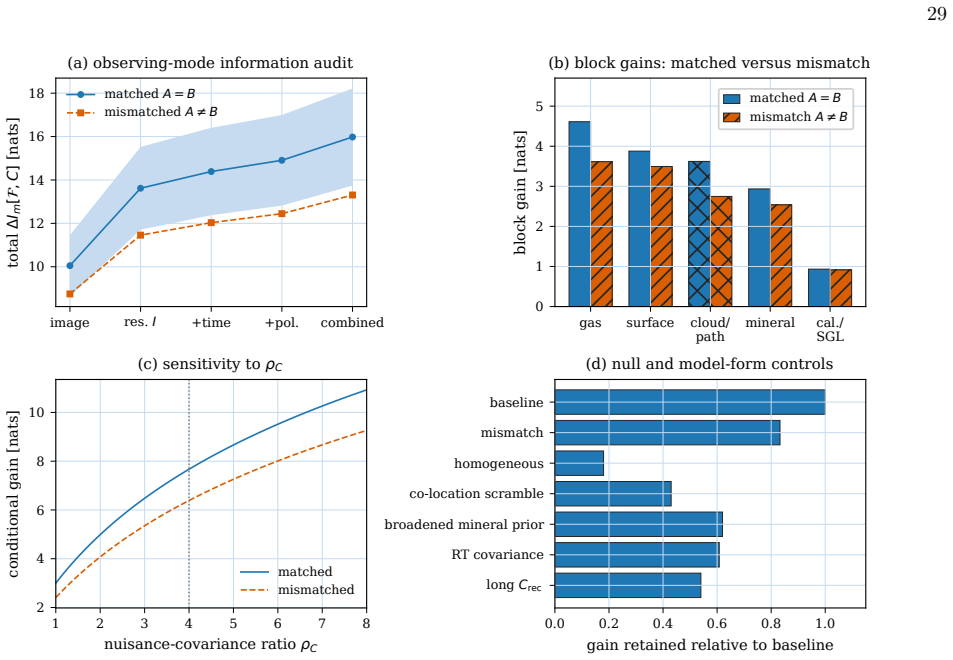
The central claim is that the Solar Gravitational Lens supplies a uniquely powerful path to surface-resolved mapping, regional spectroscopy, thermal-climate diagnostics, and co-location tests. The demonstrated data product is a time-tagged Stokes spectral cube reconstructed from wavelength-dependent Einstein-ring measurements. In the controlled population audit, structural forward-model mismatch reduces combined conditional information gain to 0.83 of the matched-model value while preserving block ordering; a reconstruction-covariance bracket reduces an (8 x 8) regional coadd gain from 7.77 to 3.00.
What carries the argument
The covariance-aware reconstruction that converts wavelength-dependent Einstein-ring measurements into a time-tagged Stokes spectral cube while tracking measured reconstruction covariance after solar-corona and instrumental effects.
If this is right
- Imaging and low-resolution mapping become feasible earlier objectives than full regional spectroscopy.
- Full regional spectroscopy requires simultaneous acquisition, sub-ppm effective coronal calibration, measured reconstruction covariance, and branch-specific radiometric validation.
- Structural forward-model mismatch preserves the ordering gas > surface > cloud/path > mineral > calibration/SGL while lowering combined conditional information gain to 0.83 of the matched-model value.
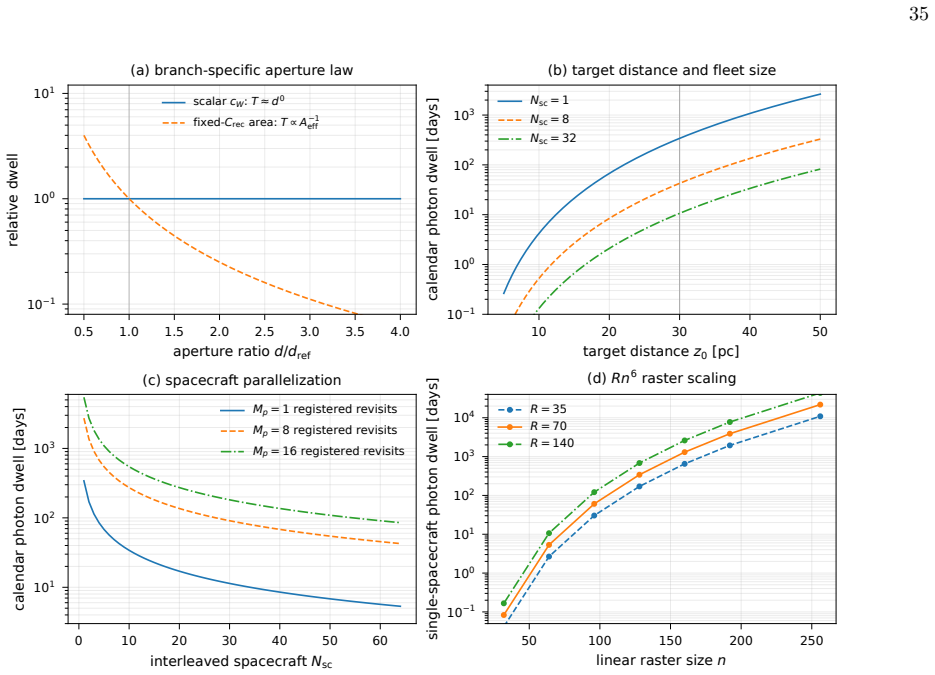
- A reconstruction-covariance bracket imposes a 6.7-fold dwell penalty on an (8 x 8) regional coadd.
Where Pith is reading between the lines
- The framework could be extended to test whether adding thermal-channel data improves co-location of surface features with atmospheric signals.
- If the covariance bracket scales with planet distance, the dwell penalty would increase for targets beyond 30 pc.
- The block-ordering result suggests prioritizing gas and surface channels in early SGL observations even when full spectral coverage is unavailable.
Load-bearing premise
Wavelength-dependent Einstein-ring measurements can be reconstructed into a time-tagged Stokes spectral cube whose measured reconstruction covariance remains usable after solar-corona noise, instrumental backgrounds, and structural forward-model mismatch.
What would settle it
A measured reconstruction-covariance bracket that drives the regional coadd gain below the threshold needed for usable conditional information gain in the 0.45-2.40 um band under the stated dwell times and raster.
Figures




read the original abstract
Assessing possible life on an exoplanet requires spatial, spectral, temporal, and environmental context rather than a threshold detection of one molecule or surface feature. We develop a covariance-aware Solar Gravitational Lens (SGL) framework in which the data product is a time-tagged Stokes spectral cube reconstructed from wavelength-dependent Einstein-ring measurements. The demonstrated calculation is a 0.45-2.40 um Stokes-I reflected-light simulation of an Earth-radius planet at 30 pc, observed from 650 AU with a (128 x 128) raster, 128 simultaneous spectral channels, and $R\simeq70$. A separate 0.40-20 um architecture-level calculation tracks reflected and thermal planet photons, SGL gain, solar-corona noise, instrumental backgrounds, throughput, dwell time, and reconstruction covariance. In the controlled population audit, structural forward-model mismatch preserves the block ordering gas > surface > cloud/path > mineral > calibration/SGL while reducing the combined conditional information gain to 0.83 of the matched-model value. A reconstruction-covariance bracket reduces an (8 x 8) regional coadd gain from 7.77 to 3.00, implying a 6.7-fold dwell penalty. The feasibility results are design scalings, not a mission verdict: imaging and low-resolution mapping are earlier objectives, whereas full regional spectroscopy requires simultaneous acquisition, sub-ppm effective coronal calibration, measured reconstruction covariance, and branch-specific radiometric validation. We show that the SGL offers a uniquely powerful path to surface-resolved mapping, regional spectroscopy, thermal-climate diagnostics, and co-location tests, providing spatial, spectral, temporal, and environmental context that could strengthen assessments of habitability and possible biological activity beyond disk-integrated precursor observations.
Editorial analysis
A structured set of objections, weighed in public.
Referee Report
Summary. The manuscript develops a covariance-aware framework for Solar Gravitational Lens (SGL) observations of exoplanets, with the data product defined as a time-tagged Stokes spectral cube reconstructed from wavelength-dependent Einstein-ring measurements. It presents a 0.45-2.40 μm Stokes-I reflected-light simulation for an Earth-radius planet at 30 pc observed from 650 AU using a 128×128 raster, 128 simultaneous spectral channels at R≈70, plus a separate 0.40-20 μm architecture-level calculation that tracks photons, SGL gain, solar-corona noise, backgrounds, throughput, dwell time, and reconstruction covariance. In the controlled population audit, structural forward-model mismatch preserves the block ordering (gas > surface > cloud/path > mineral > calibration/SGL) while reducing combined conditional information gain to 0.83 of the matched-model value; a reconstruction-covariance bracket reduces an (8×8) regional coadd gain from 7.77 to 3.00 (implying a 6.7-fold dwell penalty). The authors conclude that the SGL offers a uniquely powerful route to surface-resolved mapping, regional spectroscopy, thermal-climate diagnostics, and co-location tests that supply spatial/spectral/temporal/environmental context beyond disk-integrated observations, while emphasizing that the results are design scalings rather than a mission verdict.
Significance. If the reported information-gain reductions and covariance brackets hold under the stated assumptions, the work supplies a quantitative, covariance-aware methodology for assessing whether SGL observations can deliver usable regional spectroscopy and co-location tests. The explicit separation of matched-model versus mismatched-model gains and the translation of the bracket into a dwell-time penalty constitute a concrete advance over purely qualitative discussions of SGL advantages for habitability assessments.
major comments (2)
- [controlled population audit and reconstruction-covariance bracket] Controlled population audit and reconstruction-covariance bracket section: the reduction of the (8×8) regional coadd gain from 7.77 to 3.00 is presented as preserving practical usability for co-location tests, yet the architecture-level calculation already incorporates solar-corona noise and instrumental backgrounds; it is not shown whether the bracket fully propagates the additional variance from real coronal structure or structural forward-model mismatch beyond the controlled audit, which would be required to confirm that the effective gain remains above the threshold needed for the claimed advantage over disk-integrated observations.
- [architecture-level calculation] Architecture-level calculation: the 6.7-fold dwell penalty is derived directly from the bracketed gain of 3.00, but the manuscript does not provide the explicit propagation of the measured reconstruction covariance matrix into the conditional information-gain metric (or the block-ordering preservation), making it impossible to test the sensitivity of the 0.83 combined gain figure to plausible increases in unmodeled variance.
minor comments (2)
- [abstract] Abstract: the symbol R≃70 is introduced without an immediate parenthetical definition of spectral resolving power; this should be stated on first use in the main text as well.
- The manuscript correctly flags that results are design scalings; a short quantitative comparison table contrasting the bracketed SGL gains against equivalent disk-integrated exposure times would strengthen the central claim without altering scope.
Simulated Author's Rebuttal
We thank the referee for their careful reading and constructive comments on our manuscript. We address each of the major comments below.
read point-by-point responses
-
Referee: [controlled population audit and reconstruction-covariance bracket] Controlled population audit and reconstruction-covariance bracket section: the reduction of the (8×8) regional coadd gain from 7.77 to 3.00 is presented as preserving practical usability for co-location tests, yet the architecture-level calculation already incorporates solar-corona noise and instrumental backgrounds; it is not shown whether the bracket fully propagates the additional variance from real coronal structure or structural forward-model mismatch beyond the controlled audit, which would be required to confirm that the effective gain remains above the threshold needed for the claimed advantage over disk-integrated observations.
Authors: We agree that the reconstruction-covariance bracket, while derived from the simulation's measured covariance, does not explicitly propagate additional variance contributions from real coronal structure variability or model mismatches outside the controlled population audit. The architecture-level calculation includes nominal solar-corona noise, but the bracket is an illustrative scaling based on the controlled case. Full propagation would necessitate a more detailed model of coronal fluctuations and their impact on the Einstein-ring measurements, which exceeds the scope of the present design-scaling analysis. In the revised manuscript, we will add a dedicated limitations paragraph clarifying that the reported gain reductions represent conservative estimates under the audit assumptions and that the advantage relative to disk-integrated observations is demonstrated within those bounds. revision: partial
-
Referee: [architecture-level calculation] Architecture-level calculation: the 6.7-fold dwell penalty is derived directly from the bracketed gain of 3.00, but the manuscript does not provide the explicit propagation of the measured reconstruction covariance matrix into the conditional information-gain metric (or the block-ordering preservation), making it impossible to test the sensitivity of the 0.83 combined gain figure to plausible increases in unmodeled variance.
Authors: The 0.83 combined conditional information gain reduction arises from the structural forward-model mismatch in the controlled population audit, while the reconstruction-covariance bracket is applied separately to the regional coadd gain metric. We did not perform an explicit back-propagation of the full covariance matrix through the information-gain calculation to assess sensitivity to increased unmodeled variance. This would require a more integrated framework linking the covariance directly to the population-level metrics. We acknowledge this as a limitation of the current presentation. In revision, we will include a brief methodological note explaining the separation of these calculations and note that the block ordering is preserved in the audit even with mismatch; however, a full sensitivity study is reserved for subsequent work. revision: partial
Circularity Check
No circularity: forward-modeling derivations remain independent of outputs.
full rationale
The paper's core calculations consist of explicit forward modeling of reflected and thermal photons, SGL gain, solar-corona noise, instrumental backgrounds, throughput, dwell time, and reconstruction covariance applied to a simulated Earth-radius planet. Information gains (combined 0.83, regional coadd reduced to 3.00) are obtained from a controlled population audit that incorporates structural forward-model mismatch while preserving block ordering; these quantities are computed from the stated models rather than being redefined or fitted to themselves. No self-citation chains, ansatzes smuggled via prior work, or uniqueness theorems imported from the same authors appear as load-bearing steps in the provided derivation. The framework is therefore self-contained against external benchmarks of photon statistics and covariance propagation.
Axiom & Free-Parameter Ledger
free parameters (5)
- 128 x 128 raster
- 128 simultaneous spectral channels
- R approximately 70
- 650 AU observer distance
- 30 pc target distance
axioms (2)
- domain assumption SGL gain, solar-corona noise, and instrumental background models are sufficiently accurate for the architecture-level calculation
- domain assumption Forward-model mismatch does not alter the block ordering of information gain
Reference graph
Works this paper leans on
-
[1]
S. D. Domagal-Goldman, A. Segura, M. W. Claire, T. D. Robinson, and V. S. Meadows, Astrophys. J.792, 90 (2014)
2014
-
[2]
C. E. Harman, E. W. Schwieterman, J. C. Schottelkotte, and J. F. Kasting, Astrophys. J.812, 137 (2015)
2015
-
[3]
Luger and R
R. Luger and R. Barnes, Astrobiology15, 119 (2015)
2015
-
[4]
V. S. Meadows, C. T. Reinhard, G. N. Arney, M. N. Parenteau, E. W. Schwieterman, S. Domagal-Goldman, A. P. Lincowski, K. R. Stapelfeldt, H. Rauer, S. DasSarma, S. Hegde, N. Narita, R. Deitrick, J. Lustig-Yaeger, T. W. Lyons, N. Siegler, and J. L. Grenfell, Astrobiology18, 630 (2018)
2018
-
[5]
E. W. Schwieterman, N. Y. Kiang, M. N. Parenteau, C. E. Harman, S. DasSarma, T. M. Fisher, G. N. Arney, H. E. Hartnett, C. T. Reinhard, S. L. Olson, V. S. Meadows, C. S. Cockell, S. I. Walker, J. L. Grenfell, S. Hegde, S. Rugheimer, R. Hu, and T. W. Lyons, Astrobiology18, 663 (2018)
2018
-
[6]
Seager, W
S. Seager, W. Bains, and J. J. Petkowski, Astrobiology16, 465 (2016)
2016
-
[7]
Arnold, S
L. Arnold, S. Gillet, O. Lardiere, P. Riaud, and J. Schneider, Astron. Astrophys.392, 231 (2002)
2002
-
[8]
Montanes-Rodriguez, E
P. Montanes-Rodriguez, E. Palle, P. R. Goode, and F. J. Martin-Torres, Astrophys. J.651, 544 (2006)
2006
-
[9]
Tinetti, S
G. Tinetti, S. Rashby, and Y. L. Yung, Astrophys. J. Lett.644, L129 (2006)
2006
-
[10]
Fujii, D
Y. Fujii, D. Angerhausen, R. Deitrick, S. Domagal-Goldman, J. L. Grenfell, Y. Hori, S. R. Kane, E. Pall´ e, H. Rauer, N. Siegler, K. Stapelfeldt, and K. B. Stevenson, Astrobiology18, 739 (2018)
2018
-
[11]
W. B. Sparks, J. H. Hough, L. Kolokolova, T. A. Germer, F. Chen, S. DasSarma, P. DasSarma, F. T. Robb, N. Manset, N. Reid, F. D. Macchetto, and W. Martin, Proc. Natl. Acad. Sci. USA106, 7816 (2009)
2009
-
[12]
Patty, F
L. Patty, F. Snik, F. Ariese, W. J. Buma, I. L. ten Kate, R. J. M. van Spanning, W. B. Sparks, and C. U. Keller, Astrobiology19, 1221 (2019)
2019
-
[13]
D. M. Stam, Astron. Astrophys.482, 989 (2008)
2008
-
[14]
D. C. Catling, J. Krissansen-Totton, N. Y. Kiang, D. Crisp, T. D. Robinson, S. DasSarma, A. J. Rushby, A. Del Genio, W. Bains, and S. Domagal-Goldman, Astrobiology18, 709 (2018)
2018
-
[15]
S. G. Turyshev, Discover Life56, 9 (2026), arXiv:2606.02648
work page internal anchor Pith review Pith/arXiv arXiv 2026
-
[16]
N. B. Cowan and E. Agol, Astrophys. J. Lett.678, L129 (2008)
2008
-
[17]
Fujii and H
Y. Fujii and H. Kawahara, Astrophys. J.755, 101 (2012)
2012
-
[18]
N. B. Cowan and Y. Fujii, Handbook of Exoplanets , 1469 (2018)
2018
-
[19]
National Academies of Sciences, Engineering, and Medicine,Pathways to Discovery in Astronomy and Astrophysics for the 2020s, Tech. Rep. (The National Academies Press, Washington, DC, 2021)
2021
- [20]
-
[21]
J. T. Hansen, M. J. Ireland, S. P. Quanz, F. A. Dannert, A. M. Glauser, J. Kammerer, and L. Collaboration, Astron. & Astrophys.664, A52 (2022)
2022
-
[22]
Einstein, Science84, 506 (1936)
A. Einstein, Science84, 506 (1936)
1936
-
[23]
V. R. Eshleman, Science205, 1133 (1979)
1979
-
[24]
S. G. Turyshev, Phys. Rev. D95, 084041 (2017), arXiv:1703.05783
work page internal anchor Pith review Pith/arXiv arXiv 2017
-
[25]
S. G. Turyshev and V. T. Toth, Phys. Rev. D96, 024008 (2017), arXiv:1704.06824
work page internal anchor Pith review Pith/arXiv arXiv 2017
- [26]
- [27]
- [28]
- [29]
-
[30]
Soummer, L
R. Soummer, L. Pueyo, and J. Larkin, Astrophys. J. Lett.755, L28 (2012)
2012
-
[31]
Pueyo, Astrophys
L. Pueyo, Astrophys. J.824, 117 (2016)
2016
-
[32]
I. A. G. Snellen, R. J. de Kok, J. L. Birkby, B. Brandl, M. Brogi, C. Keller, M. Kenworthy, H. Schwarz, and R. Stuik, Astron. & Astrophys.576, A59 (2015)
2015
-
[33]
J. P. Greco and T. D. Brandt, Astrophys. J.833, 134 (2016)
2016
-
[34]
Brogi and M
M. Brogi and M. R. Line, Astron. J.157, 114 (2019)
2019
-
[35]
Ruffio, B
J.-B. Ruffio, B. Macintosh, J. J. Wang, L. Pueyo, C. Marois, A. Rajan, and D. Savransky, Astron. J.156, 196 (2018)
2018
- [36]
-
[37]
I. E. Gordon, L. S. Rothman, R. J. Hargreaves, R. Hashemi, E. V. Karlovets, F. M. Skinner, E. K. Conway, C. Hill, R. V. Kochanov, Y. Tan, P. Wcislo, A. A. Finenko, K. Nelson, P. F. Bernath, M. Birk, V. Boudon, A. Campargue, K. V. Chance, A. Coustenis, B. J. Drouin, J.-M. Flaud, R. R. Gamache, J. T. Hodges, D. Jacquemart, E. J. Mlawer, A. V. Nikitin, V. I....
2022
-
[38]
A. A. Lacis and V. Oinas, J. Geophys. Res.96, 9027 (1991)
1991
-
[39]
N. Y. Kiang, J. Siefert, Govindjee, and R. E. Blankenship, Astrobiology7, 252 (2007)
2007
-
[40]
Hegde, I
S. Hegde, I. G. Paulino-Lima, R. Kent, L. Kaltenegger, and L. Rothschild, Proceedings of the National Academy of Sciences 112, 3886 (2015)
2015
-
[41]
R. N. Clark, G. A. Swayze, R. Wise, E. Livo, T. Hoefen, R. Kokaly, and S. J. Sutley,USGS digital spectral library splib06a, Data Series 231 (U.S. Geological Survey, 2007)
2007
-
[42]
A. M. Baldridge, S. J. Hook, C. I. Grove, and G. Rivera, Remote Sensing of Environment113, 711 (2009)
2009
-
[43]
Stamnes, S.-C
K. Stamnes, S.-C. Tsay, W. Wiscombe, and K. Jayaweera, Appl. Opt.27, 2502 (1988)
1988
-
[44]
O. B. Toon, C. P. McKay, T. P. Ackerman, and K. Santhanam, J. Geophys. Res.94, 16287 (1989)
1989
-
[45]
M. S. Marley, C. Gelino, D. Stephens, J. I. Lunine, and R. Freedman, Astrophys. J.513, 879 (1999)
1999
-
[46]
Sagan, W
C. Sagan, W. R. Thompson, R. Carlson, D. Gurnett, and C. Hord, Nature365, 715 (1993)
1993
-
[47]
T. D. Robinson, V. S. Meadows, D. Crisp, D. Deming, M. F. A’Hearn, D. Charbonneau, T. A. Livengood, S. Seager, R. K. Barry, T. Hearty, T. Hewagama, C. M. Lisse, L. A. McFadden, and D. D. Wellnitz, Astrobiology11, 393 (2011)
2011
-
[48]
G. L. Villanueva, M. D. Smith, S. Protopapa, S. Faggi, and A. M. Mandell, J. Quant. Spectrosc. Radiat. Transf.217, 86 (2018)
2018
- [49]
- [50]
discussion (0)
Sign in with ORCID, Apple, or X to comment. Anyone can read and Pith papers without signing in.