REVIEW 4 major objections 6 minor 1 cited by
Reinforcement Learning Constrained Beam Search for Parameter Optimization of Paper Drying Under Flexible Constraints
T0 review · 4 major / 6 minor · reviewed 2026-08-10 · deepseek-v4-flash
Pith's one-line read A constrained beam-search decoder lets RL policies honor flexible design constraints at inference time, and on a paper-drying task it outperforms NSGA-II under complex constraints while running 2.58-fold or more faster.
desk verdict The method is a sensible adaptation of constrained beam search to RL, but the headline comparison against NSGA-II is not established by the reported single runs and oracle beam-count selection. read the letter →
The pith
A machine-rendered reading of the paper's core claim, the machinery that carries it, and where it could break.
The reading
What carries the argument
The central object is the RLCBS decoder: a constrained beam search that treats a trained RL policy as a sequence model and the simulation environment as an oracle. At each decoding step it keeps $n_b$ beams, expands each with the policy's action logits, applies logits processors to set forbidden actions' logits to $-\infty$ (negative constraints), and queries beam-constraint objects for actions that advance positive constraints such as 'include at least three DEP modules.' Beams are organized into banks by constraint-fulfillment status, pruned by cumulative log-probability, and only hypotheses that satisfy all constraints are finished; among finished hypotheses the one with the highest true cumulative reward from the simulator is returned. A global state cache reuses simulated prefixes across beams, reducing worst-case simulation steps from $O(T^2 n_b)$ to $O(T n_b)$ in single-threaded execution.
What would settle it
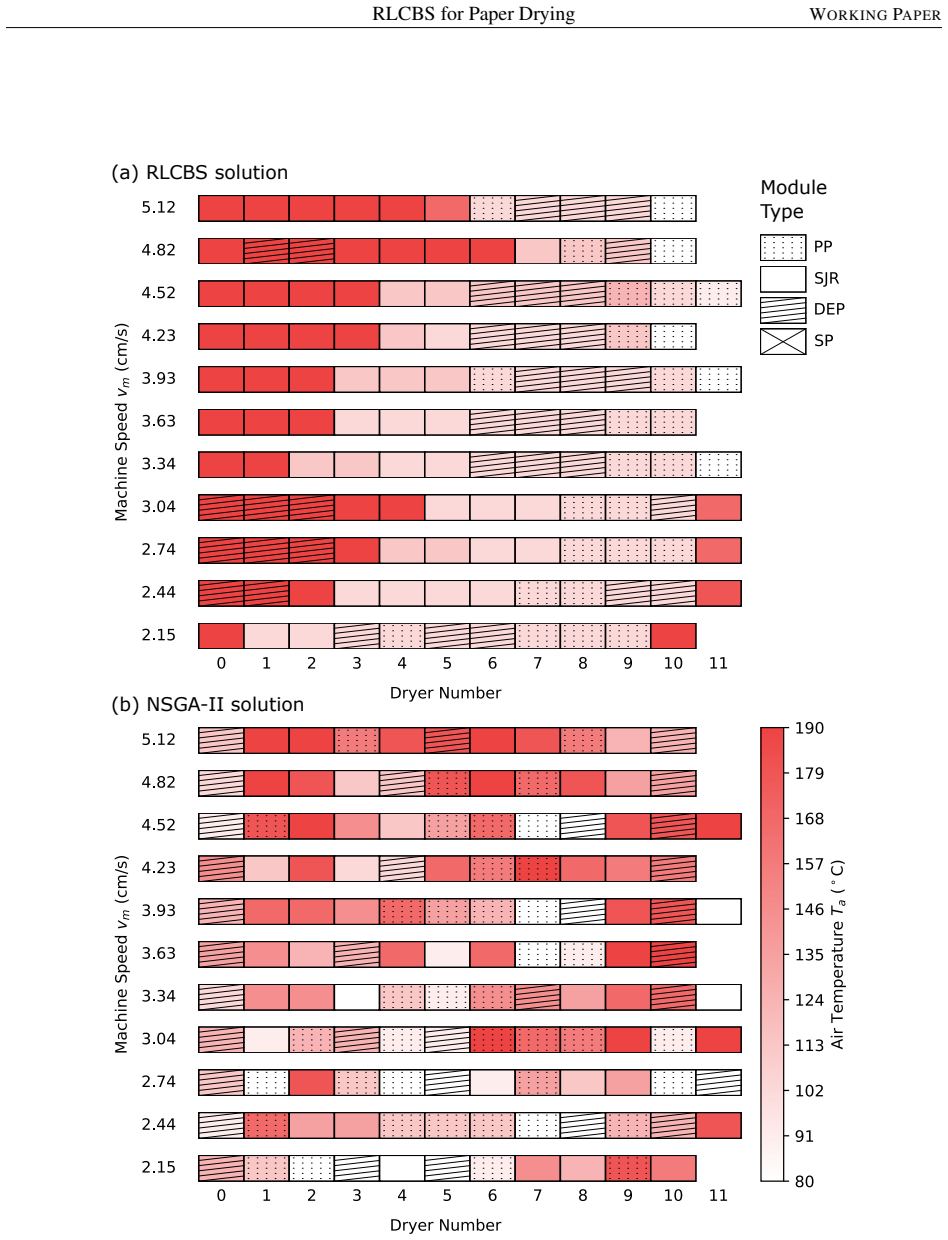
Run the final RLCBS and NSGA-II solutions from Figures 6 and 7 on the physical Smart Dryer at the reported machine speeds and measure final dry-basis moisture content and electrical energy draw; if the measured final DBMC deviates from the simulated 0.2 target by more than the 1.52% spread seen in the single validation point, or if NSGA-II's measured energy consumption is lower than RLCBS's by more than the instruments' uncertainty, the central claim is falsified.
Extended reading notes
Core claim
The paper's central discovery is that constrained beam search---a decoding technique from natural-language generation---can be transplanted onto policy-based RL action generation to satisfy flexible, inference-time design constraints while preserving solution quality. RLCBS maintains $n_b$ candidate action sequences; at each step the RL policy supplies logits for the next action, a logits processor zeroes out actions that violate negative constraints, and beam-constraint objects propose actions that advance positive constraints such as 'at least three DEP modules.' Beams are grouped by constraint-fulfillment status and pruned by cumulative action log-probability, with the simulator acting as an oracle to continue trajectories and to score finished hypotheses by true episodic reward. On the Smart Dryer simulation, with constraints that greedy decoding cannot even honor, RLCBS achieved average energy savings of 6.283 kJ m$^{-2}$ versus 6.221 kJ m$^{-2}$ for NSGA-II and ran in 8.16 minutes on average versus 49.17 minutes; under only the temperature-continuity constraint it traded a 0.979 kJ m$^{-2}$ energy gap for a 49-minute-to-19-minute speed advantage.
Load-bearing premise
The load-bearing premise is that the Smart Dryer physics-based simulator accurately predicts drying outcomes for the optimized module and temperature sequences; all training, decoding, and comparisons happen in simulation, so if the simulator misrepresents the physical dryer the claimed energy savings and the advantage over NSGA-II will not transfer to a real machine.
Editorial extensions
If this is right
- Design constraints that arrive after an RL policy is trained can be enforced at inference time by swapping decoder settings, with no reward redesign or retraining.
- On the Smart Dryer task with all three constraints active, RLCBS both matched or exceeded NSGA-II's energy savings and cut average solution time from 49.17 minutes to 8.16 minutes, a 6.64-fold improvement.
- The beam count $n_b$ gives a user-tunable trade-off: larger beams improve solution quality at higher computational cost, so users can pick a beam budget to fit their time constraints.
- RLCBS remains usable when greedy decoding is infeasible, such as when a positive constraint forces inclusion of actions the policy avoids, which is exactly where reward-penalty and masking approaches break down.
- The method extends to any policy-based RL problem with discrete actions and a deterministic, serializable simulator, not just paper drying.
Reading between the lines
- If the simulator's physics transfer faithfully to the physical dryer, the paper's own estimate of more than 0.1 TJ per day of industrial thermal-energy savings follows from the 0.7% to 1.9% relative energy savings, but this transfer is tested at only one operating point.
- Because RLCBS only needs a sequence-completion oracle, it could in principle be paired with a learned surrogate of the environment when a physics-based simulator is unavailable, at the cost of whatever bias the surrogate introduces.
- The same positive-constraint mechanism could encode quality or safety targets, such as paper properties or maximum temperature, as hard requirements in other RL-based process-control problems; the paper lists this direction as future work but does not demonstrate it.
- The global cache means repeated re-optimization under changing constraints becomes progressively cheaper for a fixed initial condition, making frequent constraint updates more practical than the per-run wall times suggest.
Signed reviews
Editorial analysis
A structured set of objections, weighed in public.
Referee Report
Summary. The paper proposes Reinforcement Learning Constrained Beam Search (RLCBS), an inference-time decoding method that applies constrained beam search to policy-based RL agents with discrete action spaces. RLCBS supports negative constraints via logits masking and positive constraints via beam-constraint objects, and it uses a global cache to reduce repeated simulation work in deterministic environments. The method is applied to a modular Smart Dryer testbed for paper drying, where a PPO agent is trained unconstrained and then decoded with RLCBS under three design constraints. The paper reports results on two scenarios: constraint 3 only, and constraints 1, 2, and 3 together, comparing against NSGA-II. The central claims are that RLCBS outperforms NSGA-II under complex constraints and provides a 2.58-fold or higher speed improvement.
Significance. If the claims were established, RLCBS would be a useful contribution to inference-time constraint handling in RL-based combinatorial optimization: it extends prior RL-guided beam search with positive constraints, supports flexible post-training constraint changes, and includes a well-motivated caching scheme that reduces simulation cost from O(T^2 nb) to O(T nb) (Section 2.2.4). The modular Smart Dryer simulator and the one-point experimental validation are also valuable engineering contributions, and the plan to release code and a Dockerized simulation environment is commendable. However, the headline comparative claims are currently not supported: the speed advantage is computed with a post hoc beam-count selection and warm-cache timing, and the energy advantage over NSGA-II in Table 6 is 0.062 kJ/m2 from single runs with no variance estimates. The significance of the paper therefore depends on fixing the evaluation protocol.
major comments (4)
- [Section 5, Tables 5 and 6] The reported speed advantage is not established. The text states that for each speed level the authors 'retrieve the lowest number of beams required to achieve the best energy savings across all sessions, and report the cumulative run time start from nb = 2 to that beam size.' This is an oracle selection: the best beam count varies across speed levels (nb=2 at vm=0.0482, nb=64 at vm=0.0512, nb=128 at vm=0.0423, nb=256 at vm=0.0274 in Table 6), so a user choosing a beam budget in advance would not know where to stop. Moreover, the cumulative RLCBS time is measured with a warm Redis cache (hit rates 72.61% and 65.06% for Tables 5 and 6), whereas NSGA-II is reported with a 13.95% cache hit rate. A fair comparison requires a fixed ex ante beam budget, cold-cache timing or an explicit accounting of cache warm-up, and repeated runs. The 2.58-fold and 6.64-fold speed claims are therefore not supported as stated.
- [Section 5, Table 6] The energy comparison is statistically fragile. The average advantage of RLCBS over NSGA-II under constraints 1, 2, and 3 is 0.062 kJ/m2 (6.283 vs. 6.221), with no repeated runs, no standard deviations, and no statistical test. A single-run difference of this size is well within plausible run-to-run noise, especially since several individual speed levels show RLCBS losing (e.g., -4.165 vs. -5.756 at vm=0.0363 is a win, but at vm=0.0334 RLCBS is -1.912 vs. 5.584; at vm=0.0304 -3.399 vs. 5.892). The paper should report multiple independent seeds or initial conditions with confidence intervals, and it should state explicitly how variability was handled. Without this, the claim that RLCBS 'outperforms NSGA-II' is not supported, particularly in light of Table 5, where RLCBS loses by an average of 0.979 kJ/m2 under constraint 3.
- [Section 6.2] The 'final timestep refinement' step is not defined in the experimental setup in Section 4.2 and is only introduced in the discussion in Section 6.2. If this refinement was applied to all RLCBS results in Tables 5 and 6, the experimental protocol should state this explicitly; if it was applied only to RLCBS and not to NSGA-II, the comparison is not apples-to-apples. The number of refined hypotheses and the cost of this step (up to 4 x |A| = 176 additional evaluations) should be included in the reported run times or separately itemized.
- [Section 3.3] The experimental validation of the Smart Dryer simulator is performed at one operating point only. The simulator contains a curve-fitted DREDEP correlation (Eq. 14) and several experimentally fitted boundary-condition correlations, so the energy-optimization results may not transfer to the physical system for the optimized module sequences. The paper should either validate the simulator at additional operating conditions (at least a second speed/temperature combination), or explicitly quantify the expected simulation-to-physical discrepancy as an uncertainty on the reported energy savings. The current single-point validation at final DBMC 0.1406 vs. 0.1385 is encouraging but insufficient for an optimization study that changes the operating point substantially.
minor comments (6)
- [Section 2.1.2] There are typographical errors in this section: 'beam serach' should be 'beam search', 'discriptive' should be 'descriptive', and 'grid beam serach' should be 'grid beam search'.
- [Section 4.1, Section 4.3, Eq. (20)] Typos: 'tempearture' in Section 4.1 should be 'temperature', 'nonliear' in Eq. (20) should be 'nonlinear', and 'simulataneously' in Section 4.3 should be 'simultaneously'.
- [Equation (3)] The maximization in Eq. (3) is written as 'arg max_{at in A}' but the quantity being maximized is a full sequence a_{1:T}. The notation should be 'arg max_{a_{1:T}}' with the domain made explicit.
- [Equation (22)] The notation for Constraint 3, '(MTd=2|MTd=3)|Ta,d - Ta,d-1| <= 0', is ambiguous. It should be written with indicator functions, e.g., '1{MTd in {2,3}} * |Ta,d - Ta,d-1| <= 0'.
- [Section 5, Tables 5 and 6] The table captions are inconsistent with the text. Table 5 is described as comparing methods 'under constraint 3' in one sentence but its caption says 'under constraints 1 and 3'; Table 6's caption similarly refers to 'constraints 1 and 3' in the definition of R even though the experiment applies constraints 1, 2, and 3. Please clarify which constraints are active in each table.
- [References] Several references are incomplete: entries such as Yang et al., Ye et al., Anderson et al., and others lack year and/or venue information. The reference list should be brought to journal format before submission.
Circularity Check
Headline comparison is partly forced by per-speed best-beam-count selection; the rest of the derivation chain is self-contained.
-
fitted input called prediction
[Section 5 (Results), beam-count selection paragraph; Table 6 caption; Section 6.3 (Energy Savings) average claim.]
"Among the 8 runs for each machine speed level, we retrieve the lowest number of beams required to achieve the best energy savings across all sessions, and report the cumulative run time start from nb = 2 to that beam size. ... Time reported for RLCBS is cumulative value from nb = 2 to nb for best result."
RLCBS's reported performance is not the output of a fixed inference-time procedure: for each machine speed, the beam count nb is selected after seeing which of the 8 runs (nb = 2 to 256) yields the best energy saving, and the cumulative time is measured only up to that retrospectively known nb. The average R = 6.283 kJ/m2 in Table 6 is therefore a best-of-8 selection statistic, and the average 8.16 min / 6.64x speedup is the time to an oracle-chosen stopping point, not the time a user without hindsight would spend. NSGA-II, by contrast, is evaluated as a single run with a fixed budget.
full rationale
The only circular step is the evaluation-selection one above. The energy metric itself is not circular: R = qSQP - q (Eq. 19 and Table 4) is a common yardstick applied identically to RLCBS and NSGA-II, and qSQP is obtained by an independent SQP optimization, not by fitting RLCBS's outputs. The DREDEP correlation (Eq. 14) is curve-fitted to external experimental drying data [Yang and Yagoobi], not to the solutions being evaluated, so it is an input assumption rather than a predicted result. The method reuses Huggingface's CBS implementation and extends the authors' RLGBS; while 'Chen et al. showed...' and 'RLGBS' appear without a full reference, the premise that beam search can guide RL decoding is independently supported by the external SGBS citation, so the self-reference is not load-bearing. Section 6.4's own limitations (oracle simulation environment required, simplifying assumptions) concern transferability to the physical dryer, not circularity. The central comparative claim, however, is partially forced by choosing the best beam count per speed after seeing results, which makes the reported average energy and speed advantage a selected maximum rather than a forward prediction.
Assumptions & free parameters
free parameters (3)
- Number of beams nb =
2 to 256; best per speed level
- Final refinement hypothesis count =
1 for nb <= 4, 4 for nb > 4
- DREDEP polynomial coefficients =
Sixth-order polynomial (Eq. 14)
assumptions (4)
- domain assumption The physics-based drying model (Eqs. 4-8 with boundary conditions 9-13) accurately simulates the Smart Dryer.
- domain assumption The DREDEP correlation (Eq. 14) remains valid across the operating ranges explored.
- domain assumption RL policy probabilities are a reliable proxy for ranking action sequences during beam pruning.
- domain assumption The SQP baseline (fixed 6 SJR plus 6 PP sequence) is a meaningful reference for energy savings under changing constraints.
Cite this review
Pith. "Pith review of Reinforcement Learning Constrained Beam Search for Parameter Optimization of Paper Drying Under Flexible Constraints." pith.science (2026). https://pith.science/paper/TDEKLBJQ
@misc{pith2026250112542,
  author       = {Pith},
  title        = {Pith review of: Reinforcement Learning Constrained Beam Search for Parameter Optimization of Paper Drying Under Flexible Constraints},
  year         = {2026},
  howpublished = {\url{https://pith.science/paper/TDEKLBJQ}},
  note         = {Machine review of arXiv:2501.12542}
}
read the original abstract
Existing approaches to enforcing design constraints in Reinforcement Learning (RL) applications often rely on training-time penalties in the reward function or training/inference-time invalid action masking, but these methods either cannot be modified after training, or are limited in the types of constraints that can be implemented. To address this limitation, we propose Reinforcement Learning Constrained Beam Search (RLCBS) for inference-time refinement in combinatorial optimization problems. This method respects flexible, inference-time constraints that support exclusion of invalid actions and forced inclusion of desired actions, and employs beam search to maximize sequence probability for more sensible constraint incorporation. RLCBS is extensible to RL-based planning and optimization problems that do not require real-time solution, and we apply the method to optimize process parameters for a novel modular testbed for paper drying. An RL agent is trained to minimize energy consumption across varying machine speed levels by generating optimal dryer module and air supply temperature configurations. Our results demonstrate that RLCBS outperforms NSGA-II under complex design constraints on drying module configurations at inference-time, while providing a 2.58-fold or higher speed improvement.
Figures


Figures from the paper (4 more)


Forward citations
Cited by 1 Pith paper
-
Multi-Modal Fusion of In-Situ Video Data and Process Parameters for Online Forecasting of Cookie Drying Readiness
A ResNet-18 plus GRU video encoder fused with tabular process parameters through a transformer forecasts cookie drying readiness with 15.41 s average MAE under leave-one-group-out evaluation.
Reference graph
Works this paper leans on
-
[1]
Automatic design method of building pipeline layout based on deep reinforcement learning
Chen Yang, Zhe Zheng, and Jia-Rui Lin. Automatic design method of building pipeline layout based on deep reinforcement learning
-
[2]
Grandmaster level in starcraft ii using multi-agent reinforcement learning
Oriol Vinyals, Igor Babuschkin, Wojciech M Czarnecki, Michaël Mathieu, Andrew Dudzik, Junyoung Chung, David H Choi, Richard Powell, Timo Ewalds, Petko Georgiev, et al. Grandmaster level in starcraft ii using multi-agent reinforcement learning. 575 0 (7782): 0 350--354
-
[3]
Mastering complex control in moba games with deep reinforcement learning
Deheng Ye, Zhao Liu, Mingfei Sun, Bei Shi, Peilin Zhao, Hao Wu, Hongsheng Yu, Shaojie Yang, Xipeng Wu, Qingwei Guo, Qiaobo Chen, Yinyuting Yin, Hao Zhang, Tengfei Shi, Liang Wang, Qiang Fu, Wei Yang, and Lanxiao Huang. Mastering complex control in moba games with deep reinforcement learning. 34 0 (04): 0 6672--6679. doi:10.1609/aaai.v34i04.6144. URL https...
-
[4]
A closer look at invalid action masking in policy gradient algorithms
Shengyi Huang and Santiago Ontañón. A closer look at invalid action masking in policy gradient algorithms. In Roman Barták, Fazel Keshtkar, and Michael Franklin, editors, Proceedings of the Thirty-Fifth International Florida Artificial Intelligence Research Society Conference, FLAIRS 2022, Hutchinson Island, Jensen Beach, Florida, USA, May 15-18, 2022 . d...
-
[5]
Guided open vocabulary image captioning with constrained beam search
Peter Anderson, Basura Fernando, Mark Johnson, and Stephen Gould. Guided open vocabulary image captioning with constrained beam search. In Martha Palmer, Rebecca Hwa, and Sebastian Riedel, editors, Proceedings of the 2017 Conference on Empirical Methods in Natural Language Processing, pages 936--945. Association for Computational Linguistics. doi:10.18653...
-
[6]
Lexically constrained decoding for sequence generation using grid beam search
Chris Hokamp and Qun Liu. Lexically constrained decoding for sequence generation using grid beam search. In Regina Barzilay and Min-Yen Kan, editors, Proceedings of the 55th Annual Meeting of the Association for Computational Linguistics (Volume 1: Long Papers), pages 1535--1546. Association for Computational Linguistics. doi:10.18653/v1/P17-1141. URL htt...
-
[7]
fairseq: A fast, extensible toolkit for sequence modeling
Myle Ott, Sergey Edunov, Alexei Baevski, Angela Fan, Sam Gross, Nathan Ng, David Grangier, and Michael Auli. fairseq: A fast, extensible toolkit for sequence modeling. In Waleed Ammar, Annie Louis, and Nasrin Mostafazadeh, editors, Proceedings of the 2019 Conference of the North A merican Chapter of the Association for Computational Linguistics (Demonstra...
-
[8]
Transformers: State-of-the-art natural language processing
Thomas Wolf, Lysandre Debut, Victor Sanh, Julien Chaumond, Clement Delangue, Anthony Moi, Pierric Cistac, Tim Rault, Remi Louf, Morgan Funtowicz, Joe Davison, Sam Shleifer, Patrick von Platen, Clara Ma, Yacine Jernite, Julien Plu, Canwen Xu, Teven Le Scao, Sylvain Gugger, Mariama Drame, Quentin Lhoest, and Alexander Rush. Transformers: State-of-the-art na...
2020
Show all 28 references
-
[9]
Implementing action mask in proximal policy optimization (ppo) algorithm
Cheng-Yen Tang, Chien-Hung Liu, Woei-Kae Chen, and Shingchern D You. Implementing action mask in proximal policy optimization (ppo) algorithm. 6 0 (3): 0 200--203
-
[10]
Stable-baselines3: Reliable reinforcement learning implementations
Antonin Raffin, Ashley Hill, Adam Gleave, Anssi Kanervisto, Maximilian Ernestus, and Noah Dormann. Stable-baselines3: Reliable reinforcement learning implementations. 22 0 (268): 0 1--8. URL https://jmlr.org/papers/v22/20-1364.html
-
[11]
Proximal policy optimization algorithms
John Schulman, Filip Wolski, Prafulla Dhariwal, Alec Radford, and Oleg Klimov. Proximal policy optimization algorithms
-
[12]
Simulation-guided beam search for neural combinatorial optimization
Jinho Choo, Yeong-Dae Kwon, Jihoon Kim, Jeongwoo Jae, André Hottung, Kevin Tierney, and Youngjune Gwon. Simulation-guided beam search for neural combinatorial optimization. In S. Koyejo, S. Mohamed, A. Agarwal, D. Belgrave, K. Cho, and A. Oh, editors, Advances in Neural Inform...
2022
-
[13]
Fast lexically constrained decoding with dynamic beam allocation for neural machine translation
Matt Post and David Vilar. Fast lexically constrained decoding with dynamic beam allocation for neural machine translation. In Marilyn Walker, Heng Ji, and Amanda Stent, editors, Proceedings of the 2018 Conference of the North A merican Chapter of the Association for Computati...
2018 doi
-
[14]
Edward Hu, Huda Khayrallah, Ryan Culkin, Patrick Xia, Tongfei Chen, Matt Post, and Benjamin Van Durme
J. Edward Hu, Huda Khayrallah, Ryan Culkin, Patrick Xia, Tongfei Chen, Matt Post, and Benjamin Van Durme. Improved lexically constrained decoding for translation and monolingual rewriting. In Jill Burstein, Christy Doran, and Thamar Solorio, editors, Proceedings of the 2019 Co...
2019
-
[15]
Seyed-Yagoobi, D
J. Seyed-Yagoobi, D. O. Bell, and M. C. Asensio. Heat and Mass Transfer in a Paper Sheet During Drying . 114 0 (2): 0 538--541, a . ISSN 0022-1481. doi:10.1115/1.2911313
-
[16]
Heating/drying of paper sheet with gas-fired infrared emitters—pilot machine trials
J Seyed-Yagoobi, SJ Sikirica, and KM Counts. Heating/drying of paper sheet with gas-fired infrared emitters—pilot machine trials. 19 0 (3-4): 0 639--651, b . doi:10.1081/DRT-100103940
-
[17]
Seyed-Yagoobi and A
J. Seyed-Yagoobi and A. N. Husain. Experimental and Theoretical Study of Heating/Drying of Moist Paper Sheet With a Gas-Fired Infrared Emitter . 123 0 (4): 0 711--718. ISSN 0022-1481. doi:10.1115/1.1372324. URL https://doi.org/10.1115/1.1372324
-
[18]
Biermann's handbook of pulp and paper
Pratima Bajpai. Biermann's handbook of pulp and paper. Volume 2, paper and board making. Elsevier, 3 edition. ISBN 0-12-814239-1
-
[19]
Openai gym
Greg Brockman, Vicki Cheung, Ludwig Pettersson, Jonas Schneider, John Schulman, Jie Tang, and Wojciech Zaremba. Openai gym
-
[20]
Terry, Ariel Kwiatkowski, John U
Mark Towers, Jordan K. Terry, Ariel Kwiatkowski, John U. Balis, Gianluca de Cola, Tristan Deleu, Manuel Goulão, Andreas Kallinteris, Arjun KG, Markus Krimmel, Rodrigo Perez-Vicente, Andrea Pierré, Sander Schulhoff, Jun Jet Tai, Andrew Tan Jin Shen, and Omar G. Younis. Gymnasiu...
-
[21]
M. C. Asensio and J. Seyed-Yagoobi. Simulation of paper-drying systems with incorporation of an experimental drum/paper thermal contact conductance relationship . 115 0 (4): 0 291--300. ISSN 0195-0738. doi:10.1115/1.2906435
-
[22]
Fundamental and applied studies in modular and system-level novel drying technologies
Munevver Elif Asar Sarikaya. Fundamental and applied studies in modular and system-level novel drying technologies
-
[23]
Enhancement of drying rate of moist porous media with dielectrophoresis mechanism
Mengqiao Yang and Jamal Yagoobi. Enhancement of drying rate of moist porous media with dielectrophoresis mechanism. 40 0 (14): 0 2952--2963. doi:10.1080/07373937.2021.1981922. URL https://doi.org/10.1080/07373937.2021.1981922
2021
-
[24]
Forming handsheets for physical tests of pulp, test method tappi/ansi t 205 sp-24
Technical Association of the Pulp and Paper Industry (TAPPI). Forming handsheets for physical tests of pulp, test method tappi/ansi t 205 sp-24. URL https://imisrise.tappi.org/TAPPI/Products/01/T/0104T205.aspx
-
[25]
Robert B. Wilson. A simplicial algorithm for concave programming. URL https://nrs.harvard.edu/URN-3:HUL.INSTREPOS:37372525
-
[26]
K. Deb, A. Pratap, S. Agarwal, and T. Meyarivan. A fast and elitist multiobjective genetic algorithm: Nsga-ii. 6 0 (2): 0 182--197. doi:10.1109/4235.996017
-
[27]
Pymoo: Multi-objective optimization in python
Julian Blank and Kalyanmoy Deb. Pymoo: Multi-objective optimization in python. 8: 0 89497--89509. doi:10.1109/ACCESS.2020.2990567
2020
-
[28]
Generation and use of thermal energy in the U.S
Colin McMillan, Richard Boardman, Michael McKellar, Piyush Sabharwall, Mark Ruth, and Shannon Bragg-Sitton. Generation and use of thermal energy in the U.S. industrial sector and opportunities to reduce its carbon emissions. doi:10.2172/1335587
Reviewed August 10, 2026 · model on record in the stance chip above.
Discussion (0). Continue with ORCID to comment.