REVIEW 2 major objections 6 minor 64 references
Training-Free Hashing-Based Attention via Binary Principal Components
T0 review · 2 major / 6 minor · reviewed 2026-08-07 · deepseek-v4-flash
Pith's one-line read BinaryPC shows that binary hash codes built from the principal directions of key vectors can retrieve the tokens a long-context LLM actually attends to, matching full-attention accuracy with a 2% token budget while cutting decoding work…
desk verdict Broad, believable empirical results, but the paper's central 'binary PCA' mechanism is not implemented as claimed: Algorithm 1 signs a random projection rather than running the power iteration, which is a load-bearing gap. read the letter →
The pith
A machine-rendered reading of the paper's core claim, the machinery that carries it, and where it could break.
The reading
What carries the argument
The load-bearing mechanism is binary principal component analysis performed greedily as an iterative rank-1 binary decomposition. In each step, the residual signal R is converted into a binary component u = sign(Rv*^T) for a random unit vector v*, the projection v = uR/N is computed in closed form, and the residual is updated as R <- R - uv. This produces a hash matrix H in {-1,+1}^{N x H} and a real projection P, with the property that k ~ hP. Queries are handled asymmetrically: the paper projects the query as qP^T and quantizes it into sign bits and 7-bit magnitudes, so the hash score can be computed with XOR, popcount, and bit-shift instructions. An error-aware safeguard (EAS) computes per-token reconstruction error ||k - hP||^2 and adds the top-m largest-error tokens to the selected set, preventing outliers like passkeys from being missed.
What would settle it
Run a long-context task where several superficially similar tokens compete with the true attention target, compute both the hash-score ranking and the exact inner-product ranking for the same queries, and check whether the top-k sets overlap; the central claim fails if there exists a realistic query-key distribution where the overlap drops below a high threshold and, with EAS disabled, task accuracy falls substantially below full attention. The paper's own EAS ablation, where passkey retrieval drops to 64.00 without the safeguard, indicates the proxy is already fragile for outlier tokens, so a benchmark enriched with many such outliers is a concrete test.
Extended reading notes
Core claim
The paper's central discovery is that binary hash codes can serve as a high-fidelity proxy for query-key inner products if the hash projection is learned from the data geometry rather than chosen randomly or trained. BinaryPC computes a binary principal-component decomposition of the key matrix K, solving min ||K - HP||_F with one bit at a time, so that each key k is approximated by a sum of signed projection components, k ~ hP. For any query q, the hash score (qP^T)h^T then approximates the true inner product qk^T, and the paper shows empirically that ranking by this score and selecting the top 2% of keys preserves accuracy relative to full attention across short-, medium-, and long-context benchmarks, while an error-aware safeguard keeps hard-to-hash tokens from being lost.
Load-bearing premise
The hash-score proxy (qP^T)h^T ~ qk^T preserves the ranking of true attention affinities well enough that top-k retrieval by hash score matches selection by full attention, and the paper offers no theoretical bound on this approximation, only empirical benchmark results.
Editorial extensions
If this is right
- With a 2% token budget, BinaryPC matches or exceeds full-attention accuracy on LongBench, InfiniteBench, LongBench v2, and the RULER and NIAH scalability suites across Llama-3, Llama-3.1, Mistral-7B, Qwen2.5-7B, and Llama-3-70B.
- A 64-bit hash code suffices where MagicPIG needs over 1000 bits of LSH, and BinaryPC matches or beats the training-dependent Spotlight method without any per-model optimization.
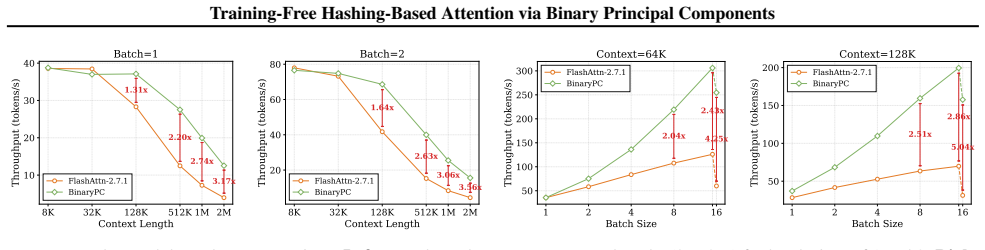
- Using 64-bit codes (one int64 per token per KV head) adds only about 1.56% overhead over the KV cache, and the retrieval stages add roughly 295 microseconds at 512K context while shrinking attention kernel time from 1.814 ms to 163 microseconds.
- The error-aware safeguard is essential: without EAS, passkey retrieval on InfiniteBench collapses to 64.00, but a 2% EAS budget restores it to 99.00; offline calibration (OPC) alone also restores passkey retrieval even at 0% EAS.
- The offline-calibrated variant is robust to domain shift: a projection trained only on literary text performs the same on code and synthetic-reasoning tasks as one trained on a mixed corpus.
Reading between the lines
- The per-token reconstruction error computed by Eq. (8) is a ready-made, quantifiable signal that could be reused beyond retrieval, for example to decide when a token needs to be reprocessed with a fresh hash or routed to full attention.
- The claim that 64-bit codes capture LLM activation structure suggests a testable extension: measuring the rank correlation between hash scores (qP^T)h^T and true attention scores qk^T layer by layer could reveal which layers need more bits and which could use fewer, potentially shrinking memory even further.
- Because OPC transfers across domains with no calibration loss, the binary projection may be capturing a generic structural property of LLM key activations; porting the projection across different model families of the same architecture is a natural experiment the paper does not run.
- The fact that BinaryPC keeps the full KV cache while only skipping attention computation suggests it could be combined with KV-cache compression methods, since the hash codes are already a compact representation of key structure.
Editorial analysis
A structured set of objections, weighed in public.
Referee Report
Summary. BinaryPC is a training-free, hashing-based sparse attention mechanism for long-context LLM decoding. It constructs 64-bit binary hash codes for keys by iteratively binarizing residuals of the key matrix and fitting a real-valued projection matrix P, then scores query-key pairs with the asymmetric hash proxy (qP^T)h^T using quantized, bitwise-friendly arithmetic. A fixed fraction of the retrieval budget is reserved for tokens with large reconstruction error (the EAS safeguard). The paper reports that BinaryPC matches or slightly exceeds full attention on InfiniteBench, LongBench v2, LongBench, RULER, NIAH, and short-context LM-Eval tasks across Llama-3/3.1, Mistral-7B, Qwen2.5-7B, and Llama-3-70B, and reports decoding throughput improvements up to 3.56x over FlashAttention-2.
Significance. If the retrieval mechanism is as effective as the benchmarks suggest, this is a practically valuable contribution: it proposes a training-free, model-agnostic sparse-attention method with compact 64-bit hash codes, validates it across multiple model families and context-length regimes, and provides an optimized CUDA implementation with public code. The main weakness is that the central algorithmic innovation---'binary PCA'---is not what Algorithm 1 actually computes, and the fidelity of the hash proxy is never directly measured. Both issues are fixable with additional experiments and a revised description, so the paper is worth serious consideration after revision.
major comments (2)
- [3.2] Algorithm 1 never performs the power iteration in Eq. (4). At every iteration it samples a fresh isotropic Gaussian v* and sets u = sign(Rv*^T), which corresponds to n = 0 in Eq. (4). For an isotropic Gaussian v*, the coordinates of Rv*^T in the singular basis have equal expected squared magnitude along every singular direction, so the statement that 'the largest singular value ensure(s) Rv*^T will lean towards the principal component with high probability' is not valid without the power step (or an extreme spectral gap, which is not demonstrated for LLM key matrices). Consequently, the method as implemented is a random-hyperplane hash with residual deflation, and the claimed 'binary principal components' and the associated data-awareness advantage over MagicPIG are not supported. Please either implement the power iteration, or amend the description and add an ablation that isolates the contribution of the PCA step (e.g., compare Algorithm 1 with true top-singular-vector signs, one power iteration, and fully independent random hyperplanes).
- [4.3] The central proxy-fidelity claim h_q h_k^T ≈ q k^T is never directly evaluated. The paper reports task accuracy and first-step cosine similarity (Table 10), but not top-k retrieval recall against the oracle TOPK baseline under identical budgets. This matters because the EAS safeguard does much of the work: Table 5 shows that without EAS, BinaryPC's R.PK score collapses from 99.00 to 64.00, while with EAS it recovers to 99.00. That result indicates that the hash codes alone do not reliably retrieve the passkey and that the reported accuracy depends on the error-aware safeguard. Please report (i) retrieval recall of S_hash as a function of hash length and budget on NIAH/RULER, (ii) the fraction of the final retrieved set that comes from S_err during decoding, and (iii) the reconstruction-error distribution that determines membership in S_err. Without these measurements, the claim that 64-bit binary codes provide a high-fidelity proxy for attention affinities is not supported.
minor comments (6)
- [Throughout] There are several typos and inconsistencies: 'incorperated' in Section 1, 'BinV ortex' in the Figure 6 caption, and inconsistent spelling of 'MagicPIG'/'MagicPig' across the text.
- [Algorithm 3] The pseudocode applies XOR to values in {−1,1} without defining the bit mapping; clarify that the implementation maps signs to 0/1 bits before the XOR and population-count operations.
- [Figure 3] The decreasing Frobenius and L2 norms are an expected consequence of subtracting a rank-1 component and do not by themselves establish convergence to a minimizer of Eq. (2); label the plots as residual decay and avoid the term 'converge' unless a formal statement is intended.
- [Tables 1-4] No error bars or confidence intervals are reported; several claimed differences (e.g., 49.66 vs. 49.64 in Table 3) are within likely run-to-run noise. Please add variance information or state that differences below a threshold are not considered significant.
- [Tables 2-4 and 13] The 'Token' column is not consistently defined across tables; indicate in each caption whether '2%' means a fraction of the input length and whether '1K'/'2K' means a fixed token count, and specify the EAS budget used in each row.
- [Section 4.2] The 3.56x and 5.04x throughput numbers are decode-only measurements with 64 generated tokens after warm-up and with positional encoding expanded while 'disregarding output quality'; clarify in the main text that 'end-to-end' refers to the decoding stage and that prefill costs are reported separately in Figure 7.
Circularity Check
No significant circularity in the empirical claims: the projection is fitted to key vectors for reconstruction, not to benchmark labels, and the only self-citation (Spotlight) is a non-load-bearing baseline. The main flagged issue is a mechanism gap — Algorithm 1 computes the Eq. (5) random projection (n=0), not the Eq.
-
other
[Section 3.2, Eqs. (4)-(5) with Algorithm 1; echoed in the Abstract's 'computing binary principal components' claim]
"the principal component of R can be discovered via u= (RR⊤)n Rv∗⊤ (4) for sufficiently large n... We use u=sign(Rv∗⊤) (5) as a sufficiently good binary component to save computation since the largest singular value ensure Rv∗⊤ will lean towards the principal component with high probability. Algorithm 1: sample v∗ ∼N(0,ID); compute u←sign(Rv∗⊤) and v←u⊤R/N; update R←R−u⊤v."
Algorithm 1's u=sign(Rv∗⊤) is Eq. (4) with n=0: each bit is a fresh isotropic-Gaussian projection, belonging to the same data-independent random-hyperplane class as MagicPIG, the paper's key baseline. The asserted justification — 'the largest singular value ensure Rv∗⊤ will lean towards the principal component with high probability' — is an unproved spectral-gap claim: an isotropic Gaussian has equal variance along every singular direction, so the top direction dominates only under an extreme spectral gap never established for LLM keys. Binarization does not justify dropping the power step, because the sign of the true principal component is itself a valid binary code for Eq. (2).
full rationale
The paper's central claims are largely self-contained against external benchmarks, so the honest circularity finding is low. The projection P is fitted to key vectors — online from the current context, or offline from PG19/ProofPile/CodeParrot calibration keys (OPC) — by minimizing the reconstruction objective ∥K−HP∥_F (Eq. 2); it is never fitted to any benchmark label, attention probability, or downstream score that is later reported. Accuracy is measured on held-out external suites (RULER, NIAH, InfiniteBench, LongBench v2, LM-Eval-Harness) and throughput is measured directly against FlashAttention-2 kernels, so no reported 'prediction' reduces to a fitted value. Eq. (3), (qP^T)h^T ≈ qk^T, is a tautological consequence of the fitted reconstruction (k≈hP), but whether that proxy preserves the top-k ranking of true attention affinities is an empirical, not definitional, question; the paper's support for ranking fidelity is benchmark evidence independent of the fitted values. The only self-citation is Spotlight (Li et al., 2025), co-authored by present authors Wenhao Li and Rongrong Ji; it appears only as a comparison baseline and is not load-bearing for any derivation, so it does not raise the score. The EAS safeguard keeps the top-m largest-reconstruction-error tokens by construction, making its recall guarantee definitional, but this is disclosed, budgeted, and ablated (Table 5 shows R.PK falls to 64 at 0% EAS), so it is a transparent design choice rather than hidden circularity. The flagged Section 3.2 gap is the main concern: the 'binary principal components' named in the title and abstract are derived via the power iteration Eq. (4) yet computed with n=0 in Eq. (5) and Algorithm 1, and the 'largest singular value... with high probability' justification is asserted without proof; a fresh isotropic Gaussian direction is the same random-hyperplane class as the data-independent LSH the paper contrasts with, and no ablation isolates the PCA contribution. I weigh this as an unsupported-mechanism and correctness risk, not as an input-output circularity, because it does not force the empirically measured accuracies or throughputs. Hence score 2.
Assumptions & free parameters
free parameters (5)
- hash code length H =
64 bits
- EAS budget ratio =
10% of token budget
- top-k budget =
2% of context or 2048 tokens
- calibration set size =
180 samples (60 each from PG19, ProofPile, CodeParrot)
- projection matrix P =
per-head 128x64 matrix
assumptions (4)
- ad hoc to paper Sign of random projection approximates the largest singular vector
- domain assumption Binary hash score preserves ranking of full-precision attention affinities
- domain assumption LLM key vectors have low-rank structure amenable to binary PCA
- ad hoc to paper Quantization of qP^T into 7-bit magnitudes does not destroy retrieval quality
Cite this review
Pith. "Pith review of Training-Free Hashing-Based Attention via Binary Principal Components." pith.science (2026). https://pith.science/paper/TED42G6I
@misc{pith2026260804405,
  author       = {Pith},
  title        = {Pith review of: Training-Free Hashing-Based Attention via Binary Principal Components},
  year         = {2026},
  howpublished = {\url{https://pith.science/paper/TED42G6I}},
  note         = {Machine review of arXiv:2608.04405}
}
abstract
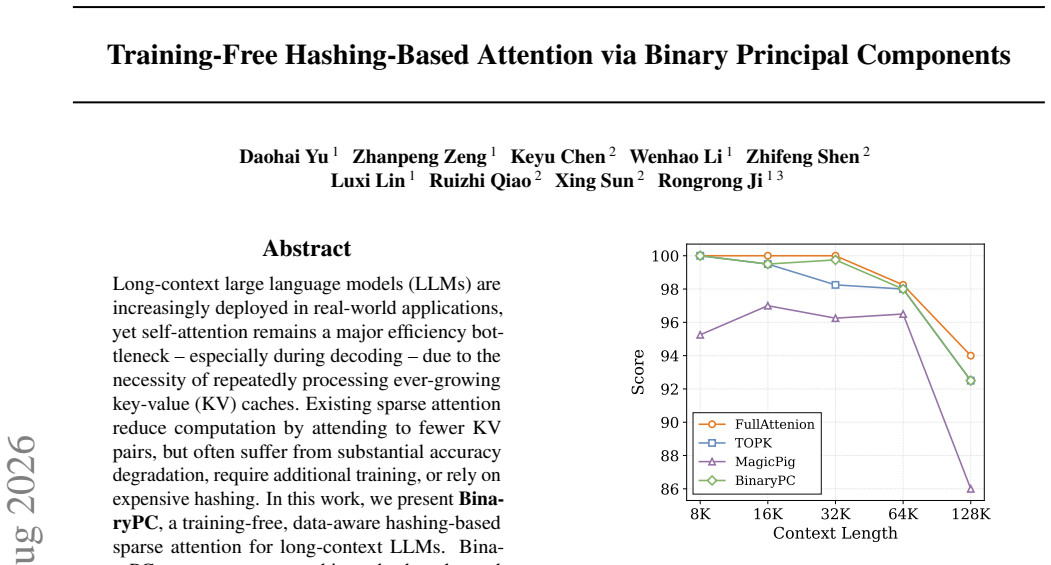
Long-context large language models (LLMs) are increasingly deployed in real-world applications, yet self-attention remains a major efficiency bottleneck -- especially during decoding -- due to the necessity of repeatedly processing ever-growing key-value (KV) caches. Existing sparse attention reduce computation by attending to fewer KV pairs, but often suffer from substantial accuracy degradation, require additional training, or rely on expensive hashing. In this work, we present BinaryPC, a training-free, data-aware hashing-based sparse attention for long-context LLMs. BinaryPC constructs compact binary hash codes and corresponding hash function by computing binary principal components of data. Unlike Locality-Sensitive Hashing (LSH) with data-independent random projections or learned non-linear hashing methods, BinaryPC constructs binary codes that explicitly preserve the structural information of data without requiring gradient-based training. Comprehensive experiments across multiple model families and long-context benchmarks show that BinaryPC preserves accuracy relative to full attention while achieving superior performance among sparse and hashing-based baselines. On modern GPUs, BinaryPC improves end-to-end decoding throughput by 3.56$\times$ over the FlashAttention kernel. Our code is available at https://github.com/yudaohai666/BPC.
Figures


Figures from the paper (7 more)



Reference graph
Works this paper leans on
-
[1]
Proceedings of the 2024 Conference on Empirical Methods in Natural Language Processing , pages=
Leave no document behind: Benchmarking long-context llms with extended multi-doc qa , author=. Proceedings of the 2024 Conference on Empirical Methods in Natural Language Processing , pages=
work page 2024
-
[3]
Claude-3 Model Card , volume=
The claude 3 model family: Opus, sonnet, haiku , author=. Claude-3 Model Card , volume=
-
[5]
Proceedings of machine learning and systems , volume=
Efficiently scaling transformer inference , author=. Proceedings of machine learning and systems , volume=
-
[7]
Model Tells You What to Discard: Adaptive
Suyu Ge and Yunan Zhang and Liyuan Liu and Minjia Zhang and Jiawei Han and Jianfeng Gao , booktitle=. Model Tells You What to Discard: Adaptive
-
[8]
Yuhong Li and Yingbing Huang and Bowen Yang and Bharat Venkitesh and Acyr Locatelli and Hanchen Ye and Tianle Cai and Patrick Lewis and Deming Chen , booktitle=. Snap
-
[9]
Zefan Cai and Yichi Zhang and Bofei Gao and Yuliang Liu and Yucheng Li and Tianyu Liu and Keming Lu and Wayne Xiong and Yue Dong and Junjie Hu and Wen Xiao , booktitle=. Pyramid
-
[10]
Ziran Qin and Yuchen Cao and Mingbao Lin and Wen Hu and Shixuan Fan and Ke Cheng and Weiyao Lin and Jianguo Li , booktitle=
-
[12]
Thirty-seventh Conference on Neural Information Processing Systems , year=
H2O: Heavy-Hitter Oracle for Efficient Generative Inference of Large Language Models , author=. Thirty-seventh Conference on Neural Information Processing Systems , year=
Show all 64 references
-
[14]
The Twelfth International Conference on Learning Representations , year=
Efficient Streaming Language Models with Attention Sinks , author=. The Twelfth International Conference on Learning Representations , year=
-
[15]
Proceedings of Machine Learning and Systems , volume=
Keyformer: Kv cache reduction through key tokens selection for efficient generative inference , author=. Proceedings of Machine Learning and Systems , volume=
-
[16]
Jiaming Tang and Yilong Zhao and Kan Zhu and Guangxuan Xiao and Baris Kasikci and Song Han , booktitle=
-
[17]
Zhuoming Chen and Ranajoy Sadhukhan and Zihao Ye and Yang Zhou and Jianyu Zhang and Niklas Nolte and Yuandong Tian and Matthijs Douze and Leon Bottou and Zhihao Jia and Beidi Chen , booktitle=. Magic
-
[18]
Spotlight Attention: Towards Efficient
Wenhao Li and Yuxin Zhang and Gen Luo and Haiyuan Wan and ZiYang Gong and Fei Chao and Rongrong Ji , booktitle=. Spotlight Attention: Towards Efficient
-
[19]
FlashAttention: Fast and Memory-Efficient Exact Attention with
Tri Dao and Daniel Y Fu and Stefano Ermon and Atri Rudra and Christopher Re , booktitle=. FlashAttention: Fast and Memory-Efficient Exact Attention with
-
[20]
The Twelfth International Conference on Learning Representations , year=
FlashAttention-2: Faster Attention with Better Parallelism and Work Partitioning , author=. The Twelfth International Conference on Learning Representations , year=
-
[21]
International Conference on Learning Representations , year=
Compressive Transformers for Long-Range Sequence Modelling , author=. International Conference on Learning Representations , year=
-
[23]
2023 , eprint=
Mistral 7B , author=. 2023 , eprint=
2023
-
[26]
Proceedings of the 62nd annual meeting of the association for computational linguistics (volume 1: Long papers) , pages=
Longbench: A bilingual, multitask benchmark for long context understanding , author=. Proceedings of the 62nd annual meeting of the association for computational linguistics (volume 1: Long papers) , pages=
-
[27]
Proceedings of the 63rd Annual Meeting of the Association for Computational Linguistics (Volume 1: Long Papers) , pages=
Longbench v2: Towards deeper understanding and reasoning on realistic long-context multitasks , author=. Proceedings of the 63rd Annual Meeting of the Association for Computational Linguistics (Volume 1: Long Papers) , pages=
-
[29]
International Conference on Learning Representations , year=
Measuring Massive Multitask Language Understanding , author=. International Conference on Learning Representations , year=
-
[30]
Transactions of the Association for Computational Linguistics , volume=
Coqa: A conversational question answering challenge , author=. Transactions of the Association for Computational Linguistics , volume=. 2019 , publisher=
2019
-
[31]
Cheng-Ping Hsieh and Simeng Sun and Samuel Kriman and Shantanu Acharya and Dima Rekesh and Fei Jia and Boris Ginsburg , booktitle=
-
[32]
Forty-second International Conference on Machine Learning , year=
HashAttention: Semantic Sparsity for Faster Inference , author=. Forty-second International Conference on Machine Learning , year=
-
[34]
Github repository: hoskison-center/proof-pile
Zhangir Azerbayev, Edward Ayers, Bartosz Piotrowski , year=. Github repository: hoskison-center/proof-pile
-
[35]
Huggingface dataset: namespace-pt/long-llm-data
Peitian Zhang , year=. Huggingface dataset: namespace-pt/long-llm-data
-
[36]
doi:10.5281/zenodo.12608602 , url =
Gao, Leo and Tow, Jonathan and Abbasi, Baber and Biderman, Stella and Black, Sid and DiPofi, Anthony and Foster, Charles and Golding, Laurence and Hsu, Jeffrey and Le Noac'h, Alain and Li, Haonan and McDonell, Kyle and Muennighoff, Niklas and Ociepa, Chris and Phang, Jason and...
-
[37]
Needle In A Haystack - Pressure Testing LLMs
Kamradt, Gregory , year=. Needle In A Haystack - Pressure Testing LLMs
-
[38]
L., Almeida, D., Altenschmidt, J., Altman, S., Anadkat, S., et al
Achiam, J., Adler, S., Agarwal, S., Ahmad, L., Akkaya, I., Aleman, F. L., Almeida, D., Altenschmidt, J., Altman, S., Anadkat, S., et al. Gpt-4 technical report. arXiv preprint arXiv:2303.08774, 2023
2023 arXiv
-
[39]
J., Soloveychik, I., and Kamath, P
Adnan, M., Arunkumar, A., Jain, G., Nair, P. J., Soloveychik, I., and Kamath, P. Keyformer: Kv cache reduction through key tokens selection for efficient generative inference. Proceedings of Machine Learning and Systems, 6: 0 114--127, 2024
2024
-
[40]
The claude 3 model family: Opus, sonnet, haiku
Anthropic, A. The claude 3 model family: Opus, sonnet, haiku. Claude-3 Model Card, 1 0 (1): 0 4, 2024
2024
-
[41]
Longbench: A bilingual, multitask benchmark for long context understanding
Bai, Y., Lv, X., Zhang, J., Lyu, H., Tang, J., Huang, Z., Du, Z., Liu, X., Zeng, A., Hou, L., et al. Longbench: A bilingual, multitask benchmark for long context understanding. In Proceedings of the 62nd annual meeting of the association for computational linguistics (volume 1...
2024
-
[42]
Longbench v2: Towards deeper understanding and reasoning on realistic long-context multitasks
Bai, Y., Tu, S., Zhang, J., Peng, H., Wang, X., Lv, X., Cao, S., Xu, J., Hou, L., Dong, Y., et al. Longbench v2: Towards deeper understanding and reasoning on realistic long-context multitasks. In Proceedings of the 63rd Annual Meeting of the Association for Computational Ling...
2025
-
[43]
Pyramid KV : Dynamic KV cache compression based on pyramidal information funneling
Cai, Z., Zhang, Y., Gao, B., Liu, Y., Li, Y., Liu, T., Lu, K., Xiong, W., Dong, Y., Hu, J., and Xiao, W. Pyramid KV : Dynamic KV cache compression based on pyramidal information funneling. In Second Conference on Language Modeling, 2025
2025
-
[44]
Magic PIG : LSH sampling for efficient LLM generation
Chen, Z., Sadhukhan, R., Ye, Z., Zhou, Y., Zhang, J., Nolte, N., Tian, Y., Douze, M., Bottou, L., Jia, Z., and Chen, B. Magic PIG : LSH sampling for efficient LLM generation. In The Thirteenth International Conference on Learning Representations, 2025
2025
-
[45]
Training verifiers to solve math word problems
Cobbe, K., Kosaraju, V., Bavarian, M., Chen, M., Jun, H., Kaiser, L., Plappert, M., Tworek, J., Hilton, J., Nakano, R., et al. Training verifiers to solve math word problems. arXiv preprint arXiv:2110.14168, 2021
2021 arXiv
-
[46]
Flashattention-2: Faster attention with better parallelism and work partitioning
Dao, T. Flashattention-2: Faster attention with better parallelism and work partitioning. In The Twelfth International Conference on Learning Representations, 2024
2024
-
[47]
Y., Ermon, S., Rudra, A., and Re, C
Dao, T., Fu, D. Y., Ermon, S., Rudra, A., and Re, C. Flashattention: Fast and memory-efficient exact attention with IO -awareness. In Advances in Neural Information Processing Systems, 2022
2022
-
[48]
E., and Stoica, I
Desai, A., Yang, S., Cuadron, A., Zaharia, M., Gonzalez, J. E., and Stoica, I. Hashattention: Semantic sparsity for faster inference. In Forty-second International Conference on Machine Learning, 2025
2025
-
[49]
The language model evaluation harness, 07 2024
Gao, L., Tow, J., Abbasi, B., Biderman, S., Black, S., DiPofi, A., Foster, C., Golding, L., Hsu, J., Le Noac'h, A., Li, H., McDonell, K., Muennighoff, N., Ociepa, C., Phang, J., Reynolds, L., Schoelkopf, H., Skowron, A., Sutawika, L., Tang, E., Thite, A., Wang, B., Wang, K., a...
2024
-
[50]
Model tells you what to discard: Adaptive KV cache compression for LLM s
Ge, S., Zhang, Y., Liu, L., Zhang, M., Han, J., and Gao, J. Model tells you what to discard: Adaptive KV cache compression for LLM s. In The Twelfth International Conference on Learning Representations, 2024
2024
-
[51]
Hata: Trainable and hardware-efficient hash-aware top-k attention for scalable large model inference
Gong, P., Yi, J., Wang, S., Zhang, J., Jin, Z., Zhou, O., Liu, R., Xu, G., Bai, Y., Ye, B., et al. Hata: Trainable and hardware-efficient hash-aware top-k attention for scalable large model inference. arXiv preprint arXiv:2506.02572, 2025
2025 arXiv
-
[52]
The llama 3 herd of models
Grattafiori, A., Dubey, A., Jauhri, A., Pandey, A., Kadian, A., Al-Dahle, A., Letman, A., Mathur, A., Schelten, A., Vaughan, A., et al. The llama 3 herd of models. arXiv preprint arXiv:2407.21783, 2024
2024 arXiv
-
[53]
and Zhai, J
He, J. and Zhai, J. Fastdecode: High-throughput gpu-efficient llm serving using heterogeneous pipelines. arXiv preprint arXiv:2403.11421, 2024
2024 arXiv
-
[54]
Measuring massive multitask language understanding
Hendrycks, D., Burns, C., Basart, S., Zou, A., Mazeika, M., Song, D., and Steinhardt, J. Measuring massive multitask language understanding. In International Conference on Learning Representations, 2021
2021
-
[55]
RULER : What s the real context size of your long-context language models? In First Conference on Language Modeling, 2024
Hsieh, C.-P., Sun, S., Kriman, S., Acharya, S., Rekesh, D., Jia, F., and Ginsburg, B. RULER : What s the real context size of your long-context language models? In First Conference on Language Modeling, 2024
2024
-
[56]
Q., Sablayrolles, A., Mensch, A., Bamford, C., Chaplot, D
Jiang, A. Q., Sablayrolles, A., Mensch, A., Bamford, C., Chaplot, D. S., de las Casas, D., Bressand, F., Lengyel, G., Lample, G., Saulnier, L., Lavaud, L. R., Lachaux, M.-A., Stock, P., Scao, T. L., Lavril, T., Wang, T., Lacroix, T., and Sayed, W. E. Mistral 7b, 2023. URL http...
2023 arXiv
-
[57]
Needle in a haystack - pressure testing llms, 2023
Kamradt, G. Needle in a haystack - pressure testing llms, 2023. URL https://github.com/gkamradt/LLMTest_NeedleInAHaystack
2023
-
[58]
Spotlight attention: Towards efficient LLM generation via non-linear hashing-based KV cache retrieval
Li, W., Zhang, Y., Luo, G., Wan, H., Gong, Z., Chao, F., and Ji, R. Spotlight attention: Towards efficient LLM generation via non-linear hashing-based KV cache retrieval. In The Thirty-ninth Annual Conference on Neural Information Processing Systems, 2025
2025
-
[59]
Snap KV : LLM knows what you are looking for before generation
Li, Y., Huang, Y., Yang, B., Venkitesh, B., Locatelli, A., Ye, H., Cai, T., Lewis, P., and Chen, D. Snap KV : LLM knows what you are looking for before generation. In The Thirty-eighth Annual Conference on Neural Information Processing Systems, 2024
2024
-
[60]
Lin, X., Wang, J., Kondrateva, O., Shi, Y., Li, B., and Zhang, G. L. Compresskv: Semantic retrieval heads know what tokens are not important before generation. arXiv preprint arXiv:2508.02401, 2025
2025 arXiv
-
[61]
Transformers are multi-state rnns
Oren, M., Hassid, M., Yarden, N., Adi, Y., and Schwartz, R. Transformers are multi-state rnns. arXiv preprint arXiv:2401.06104, 2024
2024 arXiv
-
[62]
Efficiently scaling transformer inference
Pope, R., Douglas, S., Chowdhery, A., Devlin, J., Bradbury, J., Heek, J., Xiao, K., Agrawal, S., and Dean, J. Efficiently scaling transformer inference. Proceedings of machine learning and systems, 5: 0 606--624, 2023
2023
-
[63]
CAKE : Cascading and adaptive KV cache eviction with layer preferences
Qin, Z., Cao, Y., Lin, M., Hu, W., Fan, S., Cheng, K., Lin, W., and Li, J. CAKE : Cascading and adaptive KV cache eviction with layer preferences. In The Thirteenth International Conference on Learning Representations, 2025
2025
-
[64]
W., Potapenko, A., Jayakumar, S
Rae, J. W., Potapenko, A., Jayakumar, S. M., Hillier, C., and Lillicrap, T. P. Compressive transformers for long-range sequence modelling. In International Conference on Learning Representations, 2020
2020
-
[65]
Reddy, S., Chen, D., and Manning, C. D. Coqa: A conversational question answering challenge. Transactions of the Association for Computational Linguistics, 7: 0 249--266, 2019
2019
-
[66]
QUEST : Query-aware sparsity for efficient long-context LLM inference
Tang, J., Zhao, Y., Zhu, K., Xiao, G., Kasikci, B., and Han, S. QUEST : Query-aware sparsity for efficient long-context LLM inference. In Forty-first International Conference on Machine Learning, 2024
2024
-
[67]
Leave no document behind: Benchmarking long-context llms with extended multi-doc qa
Wang, M., Chen, L., Cheng, F., Liao, S., Zhang, X., Wu, B., Yu, H., Xu, N., Zhang, L., Luo, R., et al. Leave no document behind: Benchmarking long-context llms with extended multi-doc qa. In Proceedings of the 2024 Conference on Empirical Methods in Natural Language Processing...
2024
-
[68]
Efficient streaming language models with attention sinks
Xiao, G., Tian, Y., Chen, B., Han, S., and Lewis, M. Efficient streaming language models with attention sinks. In The Twelfth International Conference on Learning Representations, 2024
2024
-
[69]
Qwen3 technical report
Yang, A., Li, A., Yang, B., Zhang, B., Hui, B., Zheng, B., Yu, B., Gao, C., Huang, C., Lv, C., et al. Qwen3 technical report. arXiv preprint arXiv:2505.09388, 2025 a
2025 arXiv
-
[70]
Yang, A., Yu, B., Li, C., Liu, D., Huang, F., Huang, H., Jiang, J., Tu, J., Zhang, J., Zhou, J., et al. Qwen2. 5-1m technical report. arXiv preprint arXiv:2501.15383, 2025 b
2025 arXiv
-
[71]
Huggingface dataset: namespace-pt/long-llm-data, 2024
Zhang, P. Huggingface dataset: namespace-pt/long-llm-data, 2024. URL https://huggingface.co/datasets/namespace-Pt/long-llm-data
2024
-
[72]
K., Han, X., Thai, Z
Zhang, X., Chen, Y., Hu, S., Xu, Z., Chen, J., Hao, M. K., Han, X., Thai, Z. L., Wang, S., Liu, Z., et al. bench: Extending long context evaluation beyond 100k tokens. arXiv preprint arXiv:2402.13718, 2024
2024 arXiv
-
[73]
H2o: Heavy-hitter oracle for efficient generative inference of large language models
Zhang, Z., Sheng, Y., Zhou, T., Chen, T., Zheng, L., Cai, R., Song, Z., Tian, Y., Re, C., Barrett, C., Wang, Z., and Chen, B. H2o: Heavy-hitter oracle for efficient generative inference of large language models. In Thirty-seventh Conference on Neural Information Processing Sys...
2023
-
[74]
Zhangir Azerbayev, Edward Ayers, B. P. Github repository: hoskison-center/proof-pile, 2022. URL https://github.com/zhangir-azerbayev/proof-pile
2022
Reviewed August 7, 2026 · model on record in the stance chip above.
Discussion (0). Sign in to comment.