REVIEW 1 major objections 31 references
A recursive vision transformer with adaptive depth and width cuts parameters nearly in half for image semantic communication while raising reconstruction quality.
Reviewed by Pith at T0; open to challenge. T0 means a machine referee read the full paper against a public rubric. the ladder, T0–T4 →
T0 review · grok-4.3
2026-06-29 13:30 UTC pith:TFCST3V5
load-bearing objection The paper applies recursion and dynamic depth/width tuning to a ViT for semantic image comm and reports 48.7% parameter reduction in simulations, but the abstract leaves the overhead of the adaptation logic unaddressed. the 1 major comments →
Recursive Vision Transformer with Dynamic Depth and Width Adjustment for Resource-Efficient Image Semantic Communication
The pith
A machine-rendered reading of the paper's core claim, the machinery that carries it, and where it could break.
Core claim
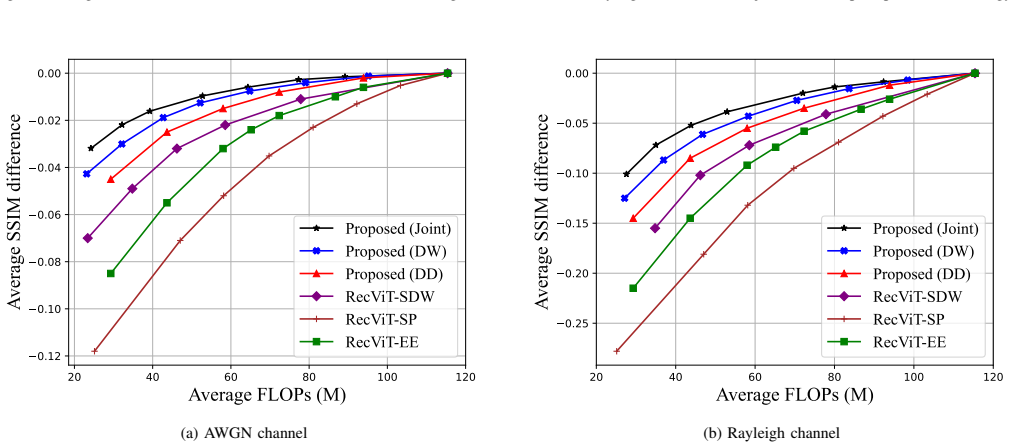
The proposed recursive ViT-based system, combined with the three dynamic adjustment strategies, reduces the parameter count by 48.7% and achieves higher reconstruction quality than existing baselines under comparable computational complexity.
What carries the argument
Recursive structure that iteratively refines semantic features together with dynamic depth adjustment (varying number of recursive modules), dynamic width adjustment (pruning neurons and heads), and joint width-depth optimization.
Load-bearing premise
The simulation results under the tested images and channel conditions will hold in real deployments without extra overhead from the adjustment logic or drops in untested conditions.
What would settle it
Running the system on actual edge hardware with live wireless channels and measuring whether parameter savings and quality gains remain within 5 percent of the reported simulation figures.
If this is right
- The architecture can fit inside the memory budget of typical mobile or IoT devices that current ViT semantic encoders exceed.
- Computation can be scaled on the fly per image or per channel condition without retraining the entire model.
- Joint width-depth control creates a continuous trade-off curve between latency and quality that system designers can tune at runtime.
- Fewer parameters lower the energy cost of transmitting the semantic encoder itself over the network before inference begins.
Where Pith is reading between the lines
- If the dynamic logic itself adds measurable latency on low-power chips, the net gain in end-to-end latency may shrink compared with the static baseline.
- The same recursive-plus-pruning pattern could be applied to other transformer-based semantic tasks such as video or point-cloud transmission without starting from scratch.
- A hardware implementation that exposes the width and depth controls to the MAC layer could close the loop between channel state and model size in real time.
Editorial analysis
A structured set of objections, weighed in public.
Referee Report
Summary. The manuscript proposes a recursive Vision Transformer architecture for image semantic communication, incorporating a recursive structure to iteratively refine semantic features and reduce parameters, along with three dynamic adjustment strategies (dynamic depth based on image content and channel conditions, dynamic width to preserve important neurons/heads, and joint width-depth optimization) to adaptively lower computational complexity. Simulation results are stated to show a 48.7% parameter reduction and higher reconstruction quality than baselines at comparable complexity.
Significance. If the reported simulation outcomes are robustly supported with proper accounting for adaptation overhead and standard baselines, the work could advance resource-efficient semantic communication systems suitable for constrained wireless devices. The combination of recursion with content- and channel-adaptive mechanisms offers a targeted approach to efficiency in ViT-based semantic codecs, though its impact hinges on reproducible experimental validation.
major comments (1)
- [Abstract] Abstract: The central claim of a 48.7% parameter reduction with higher reconstruction quality is presented as a direct simulation outcome, but without any reference to the specific baselines, metrics (e.g., PSNR or SSIM), training details, statistical significance, or ablation isolating the overhead of the dynamic decision mechanisms from the recursive core. This directly affects the load-bearing claim that net savings are achieved under comparable complexity.
Simulated Author's Rebuttal
We thank the referee for the constructive feedback. We address the major comment below and will revise the manuscript accordingly.
read point-by-point responses
-
Referee: [Abstract] Abstract: The central claim of a 48.7% parameter reduction with higher reconstruction quality is presented as a direct simulation outcome, but without any reference to the specific baselines, metrics (e.g., PSNR or SSIM), training details, statistical significance, or ablation isolating the overhead of the dynamic decision mechanisms from the recursive core. This directly affects the load-bearing claim that net savings are achieved under comparable complexity.
Authors: We agree the abstract is too terse on these points. The full manuscript specifies the baselines (non-recursive ViT semantic codecs), metrics (PSNR and SSIM), training details (dataset splits, optimizer, epochs), and Section 4.3 ablations that isolate dynamic overhead from the recursive core; the 48.7% reduction is reported relative to the baseline under matched channel SNR with complexity including decision costs. We will revise the abstract to add brief references to the metrics, the primary baseline, and a note that overhead is accounted for in the reported complexity. revision: yes
Circularity Check
No circularity; architecture and results are independently simulated
full rationale
The paper introduces a recursive ViT structure plus three dynamic adjustment strategies (depth, width, joint) for semantic communication, claiming 48.7% parameter reduction and improved reconstruction via simulation. No equations, fitted parameters, or self-citations are described that would make any 'prediction' or uniqueness claim reduce to its own inputs by construction. The central claims rest on direct empirical comparisons under stated conditions rather than self-referential definitions or imported ansatzes. This is a standard architectural proposal validated externally, warranting score 0.
Axiom & Free-Parameter Ledger
read the original abstract
Image semantic communication is a critical component in next-generation wireless communication systems. However, such systems typically suffer from large memory footprints and high computational complexity, making them difficult to deploy on resource-constrained devices. To address these challenges, we propose a vision transformer (ViT)-enabled image semantic communication system. In this system, a recursive structure is introduced to iteratively refine semantic features and reduce the parameter count. In addition, three dynamic adjustment strategies are designed to adaptively reduce computational complexity: dynamic depth adjustment, dynamic width adjustment, and joint width-depth optimization. Dynamic depth adjustment adaptively determines the number of recursive modules according to image content and channel conditions, while dynamic width adjustment selectively preserves important neurons and attention heads. The joint width-depth optimization further enables flexible computation configurations. Simulation results verify that the proposed recursive ViT-based system, combined with the three dynamic adjustment strategies, reduces the parameter count by 48.7% and achieves higher reconstruction quality than existing baselines under comparable computational complexity.
Figures




Reference graph
Works this paper leans on
-
[1]
SCSC: A novel standards-compatible semantic communication frame- work for image transmission,
X. Han, Y . Wu, Z. Gao, B. Feng, Y . Shi, D. G ¨und¨uz, and W. Zhang, “SCSC: A novel standards-compatible semantic communication frame- work for image transmission,”IEEE Transactions on Communications, vol. 73, no. 8, pp. 5682–5698, Aug. 2025
2025
-
[2]
Enhancement and segmentation of high definition CT images in everything 6G medical IoT environment,
J. Liu, F. Yu, R. Li, X. Lyu, and S. Zheng, “Enhancement and segmentation of high definition CT images in everything 6G medical IoT environment,”IEEE Internet of Things Journal, pp. 1–1, Jun. 2025
2025
-
[3]
Semantic importance- aware image transmission in V2X networks,
A. Cai, L. Wang, Y . Lin, C. Liu, and P. Qian, “Semantic importance- aware image transmission in V2X networks,”IEEE Internet of Things Journal, vol. 12, no. 17, pp. 36 471–36 487, Sep. 2025
2025
-
[4]
Overview of AI and communication for 6G network: Fundamentals, challenges, and future research opportunities,
Q. Cui, X. You, N. Wei, G. Nan, X. Zhang, J. Zhanget al., “Overview of AI and communication for 6G network: Fundamentals, challenges, and future research opportunities,”Science China Information Sciences, vol. 68, no. 7, p. 171301, Apr. 2025
2025
-
[5]
When AI meets sustainable 6G,
X. You, Y . Huang, C. Zhang, J. Wang, H. Yin, and H. Wu, “When AI meets sustainable 6G,”Science China Information Sciences, vol. 68, no. 1, p. 110301, Dec 2024
2024
-
[6]
Advancing 6G: Survey for explainable AI on communications and network slicing,
H. Sun, Y . Liu, A. Al-Tahmeesschi, A. Nag, M. Soleimanpour, B. Can- berk, H. Arslan, and H. Ahmadi, “Advancing 6G: Survey for explainable AI on communications and network slicing,”IEEE Open Journal of the Communications Society, vol. 6, pp. 1372–1412, Jan. 2025
2025
-
[7]
Generative semantic communication for text-to-speech synthesis,
J. Zheng, J. Ren, P. Xu, Z. Yuan, J. Xu, F. Wang, G. Gui, and S. Cui, “Generative semantic communication for text-to-speech synthesis,” in IEEE Globecom Workshops (GC Wkshps), Cape Town, South Africa, Dec. 2024
2024
-
[8]
A survey on semantic communications: technologies, solutions, applications and challenges,
Y . Liu, X. Wang, Z. Ning, M. Zhou, L. Guo, and B. Jedari, “A survey on semantic communications: technologies, solutions, applications and challenges,”Digital Communications and Networks, vol. 10, no. 3, pp. 528–545, Jun. 2024
2024
-
[9]
Attention-based UNet enabled lightweight image semantic communication system over Internet of Things,
G. Ma, H. Tong, N. Yang, and C. Yin, “Attention-based UNet enabled lightweight image semantic communication system over Internet of Things,” inIEEE Wireless Communications and Networking Conference (WCNC), Dubai, United Arab Emirates, Apr. 2024
2024
-
[10]
A novel lightweight joint source- channel coding design in semantic communications,
X. Yu, D. Li, N. Zhang, and X. Shen, “A novel lightweight joint source- channel coding design in semantic communications,”IEEE Internet of Things Journal, vol. 12, no. 11, pp. 18 447–18 450, Jun. 2025
2025
-
[11]
Lightweight semantic communication model driven UA V for intelligent transmission,
Y . Liang, “Lightweight semantic communication model driven UA V for intelligent transmission,” inInternational Symposium on Computer Applications and Information Technology (ISCAIT), Xi’an, China, Mar. 2025
2025
-
[12]
Lightweight task- oriented semantic communication empowered by large-scale AI models,
C. Liu, C. Guo, Y . Yang, M. Chen, and T. Q. S. Quek, “Lightweight task- oriented semantic communication empowered by large-scale AI models,” IEEE Transactions on V ehicular Technology, vol. 74, no. 9, pp. 14 823– 14 827, Sep. 2025
2025
-
[13]
Dynamic neural networks: A survey,
Y . Han, G. Huang, S. Song, L. Yang, H. Wang, and Y . Wang, “Dynamic neural networks: A survey,”IEEE Transactions on Pattern Analysis and Machine Intelligence, vol. 44, no. 11, pp. 7436–7456, Nov. 2022
2022
-
[14]
Learning task-oriented communication for edge inference: An information bottleneck approach,
J. Shao, Y . Mao, and J. Zhang, “Learning task-oriented communication for edge inference: An information bottleneck approach,”IEEE Journal on Selected Areas in Communications, vol. 40, no. 1, pp. 197–211, Jan. 2022
2022
-
[15]
Semantic communications for image recovery and classification via deep joint source and channel coding,
Z. Lyu, G. Zhu, J. Xu, B. Ai, and S. Cui, “Semantic communications for image recovery and classification via deep joint source and channel coding,”IEEE Transactions on Wireless Communications, vol. 23, no. 8, pp. 8388–8404, Aug. 2024. 11
2024
-
[16]
Universal transformers,
M. Dehghani, S. Gouws, O. Vinyals, J. Uszkoreit, and L. Kaiser, “Universal transformers,” inInternational Conference on Learning Representations, New Orleans, Louisiana, USA, May 2019. [Online]. Available: https://openreview.net/forum?id=HyzdRiR9Y7
2019
-
[17]
An image is worth 16x16 words: Transformers for image recognition at scale,
A. Dosovitskiy, L. Beyer, A. Kolesnikov, D. Weissenborn, X. Zhai, T. Unterthiner, M. Dehghani, M. Minderer, G. Heigold, S. Gelly, J. Uszkoreit, and N. Houlsby, “An image is worth 16x16 words: Transformers for image recognition at scale,” inInternational Conference on Learning Representations, Vienna, Austria, Jan. 2021. [Online]. Available: https://openre...
2021
-
[18]
Vision Transformer based semantic communications for next generation wireless networks,
M. A. Mohsin, M. Jazib, Z. Alam, M. F. Khan, M. Saad, and M. A. Jamshed, “Vision Transformer based semantic communications for next generation wireless networks,” inIEEE International Conference on Communications Workshops (ICC Workshops), Montreal, QC, Canada, Jun. 2025
2025
-
[19]
A robust image semantic communication system with multi-scale Vision Transformer,
X. Peng, Z. Qin, X. Tao, J. Lu, and K. B. Letaief, “A robust image semantic communication system with multi-scale Vision Transformer,” IEEE Journal on Selected Areas in Communications, vol. 43, no. 4, pp. 1278–1291, Apr. 2025
2025
-
[20]
Attention is all you need,
A. Vaswani, N. Shazeer, N. Parmar, J. Uszkoreit, L. Jones, A. N. Gomez, L. Kaiser, and I. Polosukhin, “Attention is all you need,” inAdvances in Neural Information Processing Systems, Long Beach, CA, USA, Dec. 2017
2017
-
[21]
Leap: Learnable pruning for Transformer-based models,
Z. Yao, X. Wu, L. Ma, S. Shen, K. Keutzer, M. W. Mahoney, and Y . He, “Leap: Learnable pruning for Transformer-based models,” arXiv:2105.14636, May 2022
-
[22]
To prune, or not to prune: exploring the efficacy of pruning for model compression
M. Zhu and S. Gupta, “To prune, or not to prune: exploring the efficacy of pruning for model compression,”arXiv:1710.01878, Oct. 2017
work page internal anchor Pith review Pith/arXiv arXiv 2017
-
[23]
Big/little deep neural network for ultra low power inference,
E. Park, D. Kim, S. Kim, Y .-D. Kim, G. Kim, S. Yoon, and S. Yoo, “Big/little deep neural network for ultra low power inference,” in International Conference on Hardware/Software Codesign and System Synthesis (CODES+ISSS), Amsterdam, Netherlands, Oct. 2015
2015
-
[24]
Image quality assess- ment: from error visibility to structural similarity,
Z. Wang, A. Bovik, H. Sheikh, and E. Simoncelli, “Image quality assess- ment: from error visibility to structural similarity,”IEEE Transactions on Image Processing, vol. 13, no. 4, pp. 600–612, Apr. 2004
2004
-
[25]
Vision Transformer for adaptive image transmission over MIMO channels,
H. Wu, Y . Shao, C. Bian, K. Mikolajczyk, and D. G ¨und¨uz, “Vision Transformer for adaptive image transmission over MIMO channels,” in ICC-IEEE International Conference on Communications, Rome, Italy, May 2023
2023
-
[26]
Deep joint source- channel coding for wireless image transmission,
E. Bourtsoulatze, D. Burth Kurka, and D. G ¨und¨uz, “Deep joint source- channel coding for wireless image transmission,”IEEE Transactions on Cognitive Communications and Networking, vol. 5, no. 3, pp. 567–579, Sep. 2019
2019
-
[27]
Learning motion blur robust Vision Transformers with dynamic early exit for real-time UA V tracking,
Y . Wu, X. Wang, D. Zeng, H. Ye, X. Xie, Q. Zhao, and S. Li, “Learning motion blur robust Vision Transformers with dynamic early exit for real-time UA V tracking,”CoRR, vol. abs/2407.05383, Jul
-
[28]
Learning motion blur robust Vision Transformers with dynamic early exit for real-time UA V tracking,
[Online]. Available: https://doi.org/10.48550/arXiv.2407.05383
-
[29]
M. Zhu, Y . Tang, and K. Han, “Vision Transformer pruning,” arXiv:2104.08500, Apr. 2021
-
[30]
A flexible bert model enabling width- and depth-dynamic inference,
T. Hu, C. Meinel, and H. Yang, “A flexible bert model enabling width- and depth-dynamic inference,”Computer Speech & Language, vol. 87, p. 101646, Apr. 2024. Zhilong Zhangreceived the B.E. degree in com- munication engineering from the University of Sci- ence and Technology, Beijing, China in 2007, and the M.S. and the Ph.D. degrees in communication and i...
2024
-
[31]
degree with the Laboratory of Wireless Communication Systems and Networks, BUPT
He is currently pursuing the M.S. degree with the Laboratory of Wireless Communication Systems and Networks, BUPT. His main research interests focus on semantic communications. Gongyu Jinreceived the B.E. and M.S. degrees in Communication Engineering from Beijing Uni- versity of Posts and Telecommunications (BUPT), Beijing, China, in 2021 and 2024. Her re...
2021
discussion (0)
Sign in with ORCID, Apple, or X to comment. Anyone can read and Pith papers without signing in.