COMPASS: Grounding Composition-Intent Guidance in Unified Multimodal Models
Pith reviewed 2026-06-30 10:08 UTC · model grok-4.3
The pith
A shared expert token anchors composition intent across perception and generation in one multimodal model.
A machine-rendered reading of the paper's core claim, the machinery that carries it, and where it could break.
Core claim
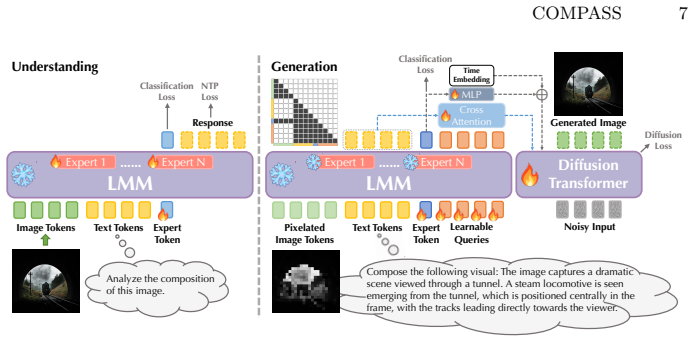
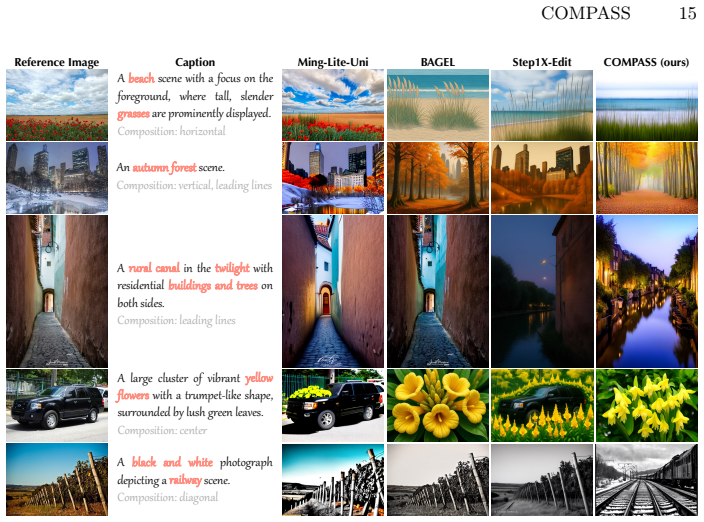
COMPASS is the first unified multimodal framework that grounds composition-intent control in a single system spanning both composition perception and composition-guided generation, with a shared expert token τ_c as the central intent anchor. On the perception side, COMPASS injects composition expertise into an MoE backbone in a minimally invasive manner and distills the inferred intent into τ_c. On the generation side, COMPASS reuses τ_c as a global conditioning signal that steers the denoising trajectory, effectively converting passive composition analysis into explicit layout control. Extensive experiments show that COMPASS substantially improves category-level composition understanding an
What carries the argument
The shared expert token τ_c, which serves as the central intent anchor by receiving distilled composition expertise from perception and then acting as global conditioning for the generation denoising process.
If this is right
- Substantially improves category-level composition understanding.
- Delivers more composition-consistent, prompt-faithful generation than strong baselines.
- Supports systematic instruction-following composition learning and evaluation at scale via the Comp-11 dataset with its 11-class taxonomy.
- Converts passive composition analysis into explicit layout control by reusing the same token across perception and generation.
Where Pith is reading between the lines
- The token reuse mechanism could be tested on other high-level visual intents such as object relations or scene lighting to see whether the same distillation pattern works without new datasets.
- Minimal changes to existing MoE backbones suggest the method might be applied to retrofit current unified multimodal models for better intent grounding.
- Expanding the 11-class taxonomy with finer subcategories could produce tokens that enable more precise layout adjustments during generation.
- Reusing a single distilled token as conditioning may reduce the computational overhead of maintaining separate perception and generation modules in multimodal systems.
Load-bearing premise
That minimally invasive injection of composition expertise into an MoE backbone plus distillation into τ_c will produce a token that can be directly reused as an effective global conditioning signal for denoising without additional training or architectural changes.
What would settle it
An experiment measuring composition consistency metrics on generated images where the model is run once with τ_c conditioning and once without it, showing no statistically significant difference between the two conditions.
Figures
read the original abstract
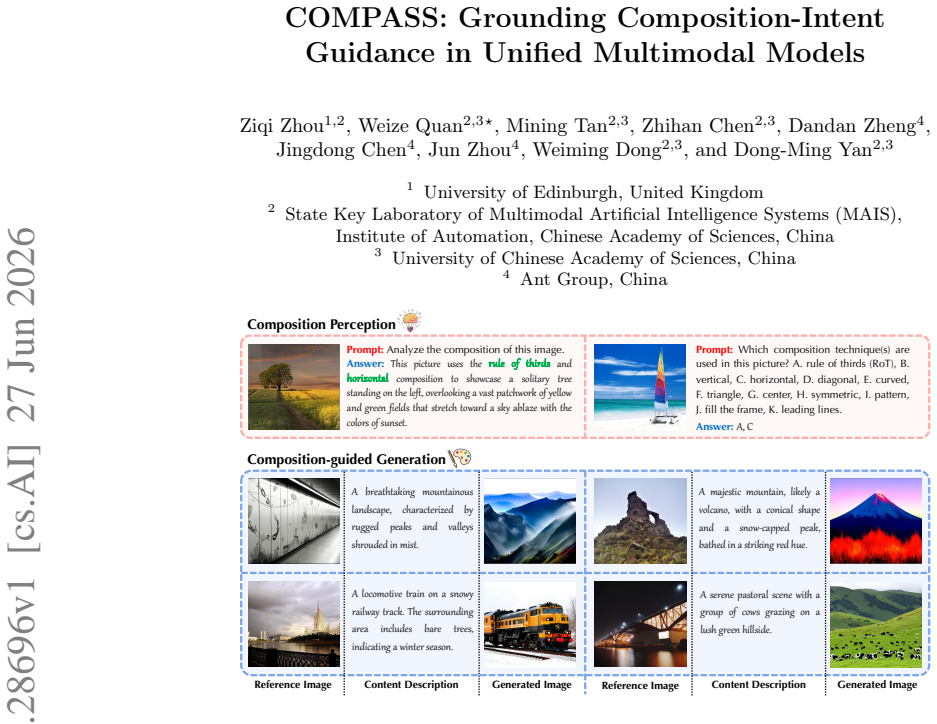
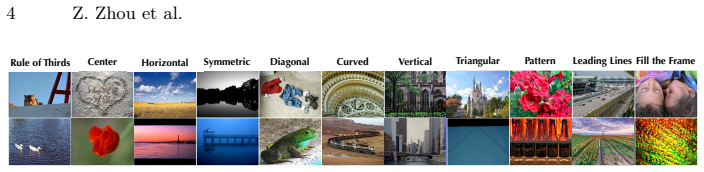
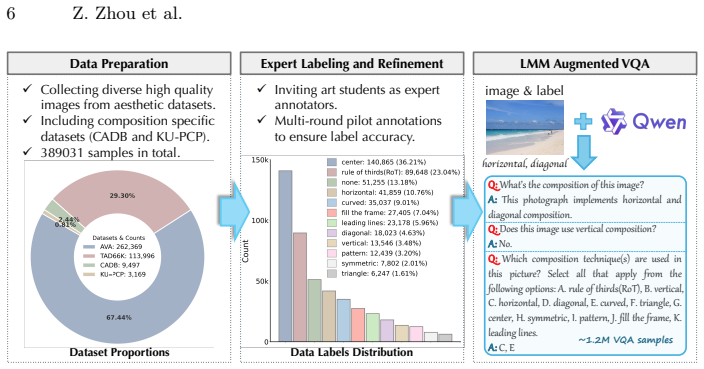
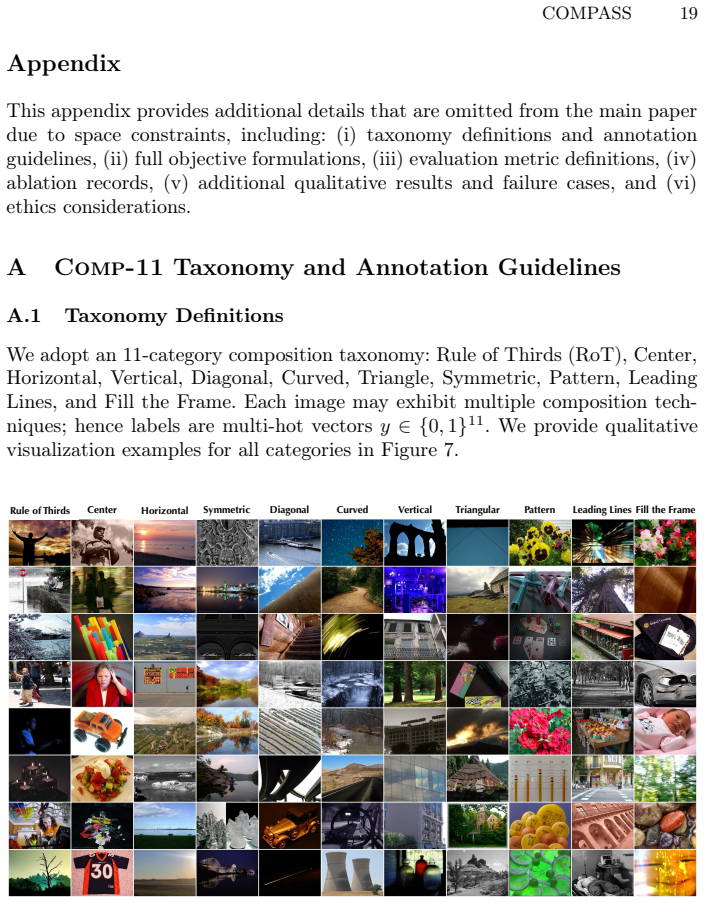
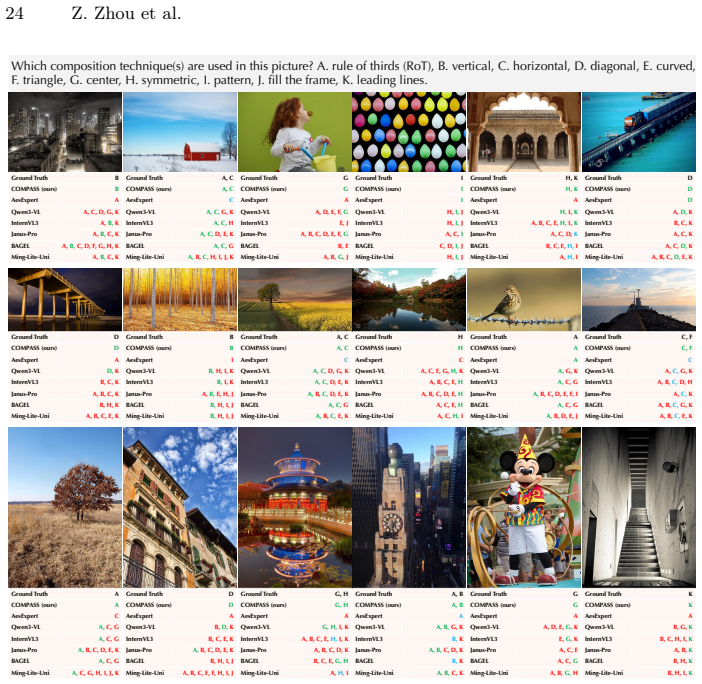
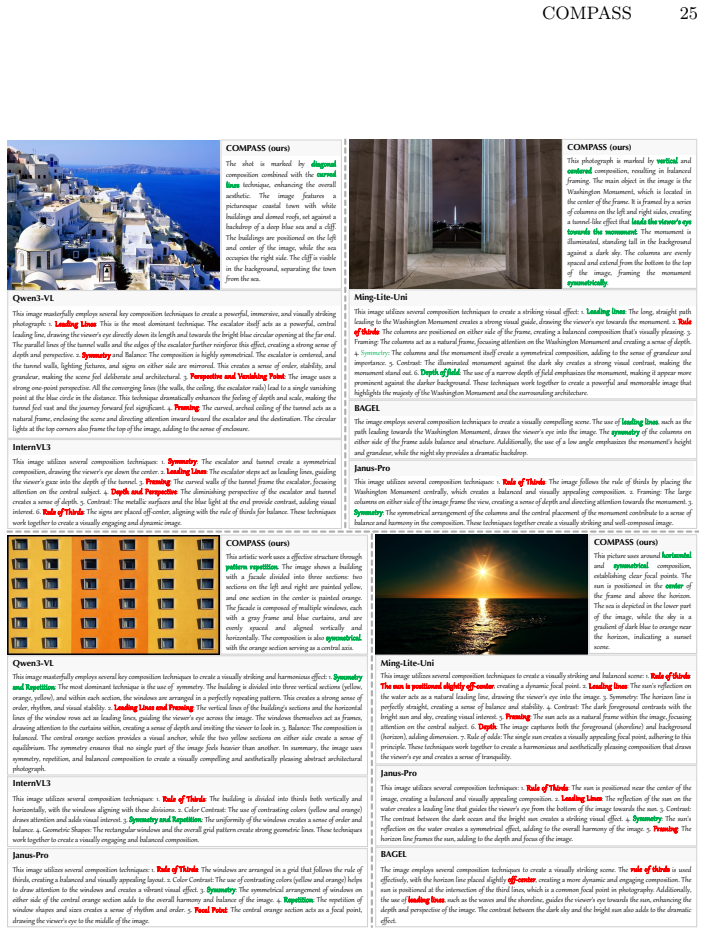
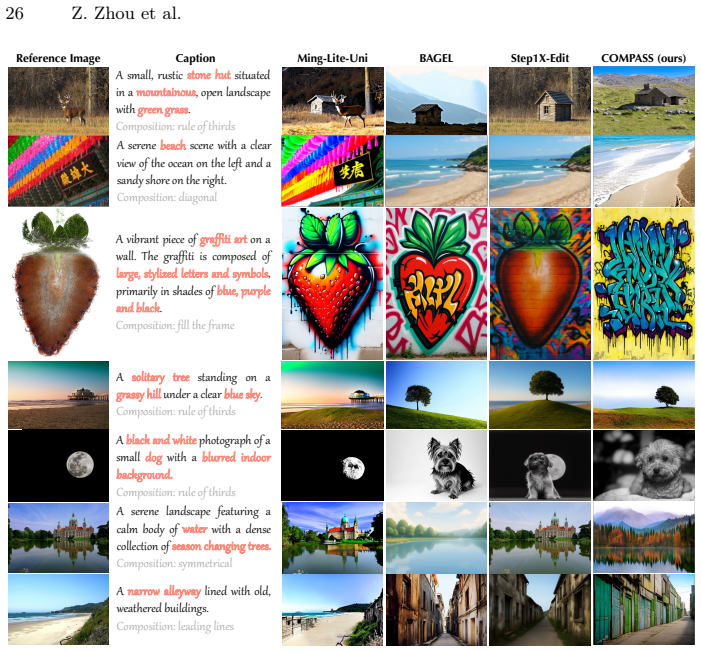
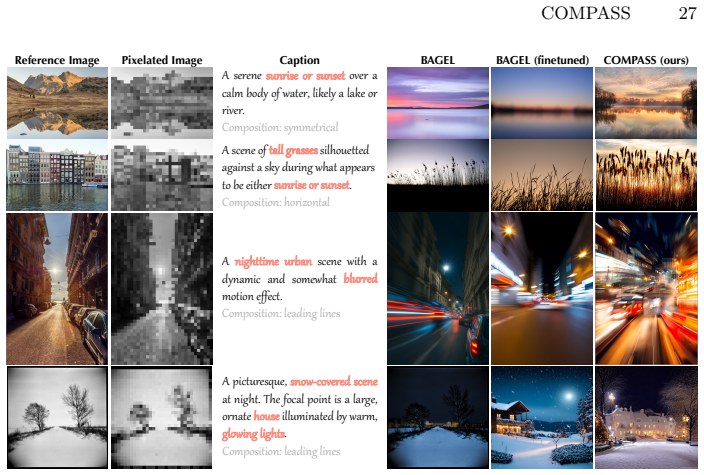
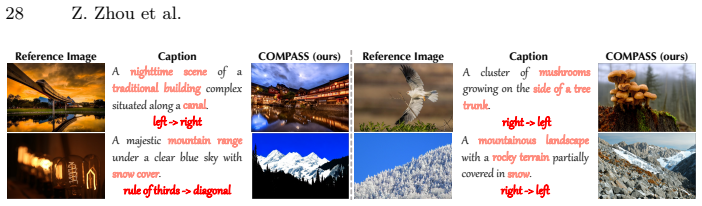
Composition is a high-level visual intent that governs where subjects are placed and how a scene is organized, yet current unified multimodal models remain unreliable at fine-grained composition recognition and struggle to turn such intent into controllable generation. We present COMPASS, the first unified multimodal framework that grounds composition-intent control in a single system spanning both composition perception and composition-guided generation, with a shared expert token $\tau_c$ as the central intent anchor. On the perception side, COMPASS injects composition expertise into an MoE backbone in a minimally invasive manner and distills the inferred intent into $\tau_c$. On the generation side, COMPASS reuses $\tau_c$ as a global conditioning signal that steers the denoising trajectory, effectively converting passive composition analysis into explicit layout control. To support systematic instruction-following composition learning and evaluation at scale, we construct Comp-11, a large-scale dataset with an 11-class taxonomy and reasoning-augmented annotations. Extensive experiments show that COMPASS substantially improves category-level composition understanding and delivers more composition-consistent, prompt-faithful generation than strong baselines.
Editorial analysis
A structured set of objections, weighed in public.
Referee Report
Summary. The paper introduces COMPASS, a unified multimodal framework that grounds composition-intent control via a shared expert token τ_c. On the perception side, composition expertise is injected minimally invasively into an MoE backbone and distilled into τ_c. On the generation side, τ_c is reused directly as a global conditioning signal to steer denoising for layout control. The work also constructs the Comp-11 dataset (11-class taxonomy with reasoning-augmented annotations) and reports experiments showing gains in category-level composition understanding and more composition-consistent, prompt-faithful generation versus baselines.
Significance. If the central mechanism holds, the work offers a potentially efficient route to add explicit composition control to existing unified multimodal models without heavy architectural overhaul, addressing a noted gap in fine-grained spatial intent handling. The Comp-11 dataset could support more systematic evaluation of composition tasks. The shared-token unification across perception and generation is a distinctive framing that, if substantiated, would strengthen claims of minimal invasiveness.
major comments (1)
- [Generation side (abstract and method)] Generation-side description (abstract and corresponding method section): the central claim that τ_c distilled from perception can be directly reused as a global conditioning signal in the denoising trajectory to achieve explicit layout control, without additional training or architectural modifications, is load-bearing for both the 'unified' and 'minimally invasive' framing. Global tokens typically modulate semantics rather than precise spatial arrangements; the manuscript provides no explicit mechanism (e.g., cross-attention modification, spatial encoding, or auxiliary loss) or ablation demonstrating spatial transfer, leaving the weakest assumption unaddressed.
minor comments (1)
- [Abstract] Abstract: the phrase 'extensive experiments' is used without naming the specific metrics, baselines, or dataset splits, which reduces immediate assessability of the reported gains.
Simulated Author's Rebuttal
We thank the referee for the careful reading and for identifying the load-bearing assumption on the generation side. We address the comment directly below.
read point-by-point responses
-
Referee: [Generation side (abstract and method)] Generation-side description (abstract and corresponding method section): the central claim that τ_c distilled from perception can be directly reused as a global conditioning signal in the denoising trajectory to achieve explicit layout control, without additional training or architectural modifications, is load-bearing for both the 'unified' and 'minimally invasive' framing. Global tokens typically modulate semantics rather than precise spatial arrangements; the manuscript provides no explicit mechanism (e.g., cross-attention modification, spatial encoding, or auxiliary loss) or ablation demonstrating spatial transfer, leaving the weakest assumption unaddressed.
Authors: We agree that the current manuscript description leaves the precise integration of τ_c into the denoising process underspecified. While the abstract states that τ_c is reused as a global conditioning signal, the method section does not detail the conditioning operator, any spatial encoding, or cross-attention modifications, nor does it include an ablation isolating spatial transfer. This weakens the claims of unification and minimal invasiveness. In the revised manuscript we will (1) expand the generation-side method to specify the exact conditioning mechanism and (2) add an ablation study that measures layout consistency with and without τ_c, thereby addressing the referee's concern. revision: yes
Circularity Check
No circularity detected; no equations or derivations present
full rationale
The provided abstract and description contain no mathematical derivations, equations, fitted parameters presented as predictions, or self-citations that bear the central claim. The framework is described at a high level (MoE injection, distillation to τ_c, reuse as conditioning) without any chain that reduces a result to its inputs by construction. This matches the default expectation for papers lacking explicit derivation steps, yielding a self-contained presentation with no detectable circularity.
Axiom & Free-Parameter Ledger
Reference graph
Works this paper leans on
-
[1]
In: IEEE/CVF Conference on Computer Vision and Pattern Recognition (CVPR)
Achlioptas,P.,Ovsjanikov,M.,Haydarov,K.,Elhoseiny,M.,Guibas,L.J.:Artemis: Affective language for visual art. In: IEEE/CVF Conference on Computer Vision and Pattern Recognition (CVPR). pp. 11569–11579 (2021)
2021
-
[2]
Bai, S., Cai, Y., Chen, R., Chen, K., Chen, X., Cheng, Z., et al.: Qwen3-vl technical report. arXiv preprint arXiv:2511.21631 (2025)
work page internal anchor Pith review Pith/arXiv arXiv 2025
-
[3]
arXiv preprint arXiv:2512.21675 (2025)
Cao, S., Li, J., Li, X., Pu, Y., Zhu, K., Gao, Y., Luo, S., Xin, Y., Qin, Q., Zhou, Y., Chen, X., Zhang, W., Fu, B., Qiao, Y., Liu, Y.: UniPercept: Towards uni- fied perceptual-level image understanding across aesthetics, quality, structure, and texture. arXiv preprint arXiv:2512.21675 (2025)
-
[4]
In: IEEE/CVF Conference on Computer Vision and Pattern Recognition (CVPR)
Cao, S., Ma, N., Liu, Y., et al.: ArtiMuse: Fine-grained image aesthetics assessment with joint scoring and expert-level understanding. In: IEEE/CVF Conference on Computer Vision and Pattern Recognition (CVPR). pp. 15313–15322 (2026)
2026
-
[5]
Chameleon: Mixed-Modal Early-Fusion Foundation Models
Chameleon Team: Chameleon: Mixed-modal early-fusion foundation models. arXiv preprint arXiv:2405.09818 (2024) 16 Z. Zhou et al
work page internal anchor Pith review Pith/arXiv arXiv 2024
-
[6]
Janus-Pro: Unified Multimodal Understanding and Generation with Data and Model Scaling
Chen, X., Wu, Z., Liu, X., Pan, Z., Liu, W., Xie, Z., Yu, X., Ruan, C.: Janus-Pro: Unified multimodal understanding and generation with data and model scaling. arXiv preprint arXiv:2501.17811 (2025)
work page internal anchor Pith review Pith/arXiv arXiv 2025
-
[7]
In: IEEE Winter Conference on Applications of Computer Vision (WACV) (2017)
Chen, Y.L., Huang, T.W., Chang, K.H., Tsai, Y.C., Chen, H.T., Chen, B.Y.: Quan- titativeanalysisofautomaticimagecroppingalgorithms:adatasetandcomparative study. In: IEEE Winter Conference on Applications of Computer Vision (WACV) (2017)
2017
-
[8]
In: IEEE/CVF Conference on Computer Vision and Pattern Recognition (CVPR)
Chung, J., Hyun, S., Heo, J.P.: Style Injection in Diffusion: A training-free ap- proach for adapting large-scale diffusion models for style transfer. In: IEEE/CVF Conference on Computer Vision and Pattern Recognition (CVPR). pp. 8795–8805 (2024)
2024
-
[9]
Emerging Properties in Unified Multimodal Pretraining
Deng, C., Xie, J., Zhang, D.J., Gu, Y., Mao, W., Bai, Z., Wang, W., Lin, K.Q., Chen, Z., Yang, Z., Shou, M.Z.: Emerging properties in unified multimodal pre- training. arXiv preprint arXiv:2505.14683 (2025)
work page internal anchor Pith review Pith/arXiv arXiv 2025
-
[10]
SEED-X: Multimodal Models with Unified Multi-granularity Comprehension and Generation
Ge, Y., Zhao, S., Zhu, J., Ge, Y., Yi, K., Song, L., Li, C., Ding, X., Shan, Y.: SEED-X: Multimodal models with unified multi-granularity comprehension and generation. arXiv preprint arXiv:2404.14396 (2024)
work page internal anchor Pith review Pith/arXiv arXiv 2024
-
[11]
arXiv preprint arXiv:2505.02471 (2025)
Gong, B., Zou, C., Zheng, D., Yu, H., Chen, J., Sun, J., Zhao, J., Zhou, J., Ji, K., Ru, L., et al.: Ming-Lite-Uni: Advancements in unified architecture for natural multimodal interaction. arXiv preprint arXiv:2505.02471 (2025)
-
[12]
In: International Joint Conference on Artificial Intelligence (IJCAI)
He, S., Zhang, Y., Xie, R., Jiang, D., Ming, A.: Rethinking image aesthetics as- sessment: Models, datasets and benchmarks. In: International Joint Conference on Artificial Intelligence (IJCAI). vol. 6, p. 22 (2022)
2022
-
[13]
In: Proceedings of the 2021 Conference on Empirical Methods in Natural Language Processing
Hessel,J.,Holtzman,A.,Forbes,M.,LeBras,R.,Choi,Y.:CLIPScore:Areference- free evaluation metric for image captioning. In: Proceedings of the 2021 Conference on Empirical Methods in Natural Language Processing. pp. 7514–7528 (2021)
2021
-
[14]
In: International Conference on Neural Information Processing Systems (NIPS)
Heusel, M., Ramsauer, H., Unterthiner, T., Nessler, B., Hochreiter, S.: GANs trained by a two time-scale update rule converge to a local nash equilibrium. In: International Conference on Neural Information Processing Systems (NIPS). vol. 30 (2017)
2017
-
[15]
In: IEEE/CVF Conference on Computer Vision and Pattern Recog- nition (CVPR)
Hong, C., Du, S., Xian, K., Lu, H., Cao, Z., Zhong, W.: Composing photos like a photographer. In: IEEE/CVF Conference on Computer Vision and Pattern Recog- nition (CVPR). pp. 7053–7062 (2021)
2021
-
[16]
In: AAAI Conference on Artificial Intelligence (AAAI)
Hong, J., Yuan, L., Gharbi, M., Fisher, M., Fatahalian, K.: Learning subject-aware cropping by outpainting professional photos. In: AAAI Conference on Artificial Intelligence (AAAI). vol. 38, pp. 2175–2183 (2024)
2024
-
[17]
In: International Conference on Learning Representations (ICLR) (2022)
Hu, E.J., Shen, Y., Wallis, P., Allen-Zhu, Z., Li, Y., Wang, S., Wang, L., Chen, W., et al.: LoRA: Low-rank adaptation of large language models. In: International Conference on Learning Representations (ICLR) (2022)
2022
-
[18]
In: ACM International Conference on Multimedia
Huang, Y., Cao, Z., Li, Q., Zhao, C., Gao, C., Yan, Z., Zuo, Y., Yang, F., Cheng, D., Tan, P., et al.: AesExpert: Towards multi-modality foundation model for image aesthetics perception. In: ACM International Conference on Multimedia. pp. 5925– 5936 (2024)
2024
-
[19]
arXiv preprint arXiv:2401.08276 (2024)
Huang, Y., Yuan, Q., Sheng, X., Yang, Z., Wu, H., Chen, P., Yang, Y., Li, L., Lin, W.: AesBench: An expert benchmark for multimodal large language models on image aesthetics perception. arXiv preprint arXiv:2401.08276 (2024)
-
[20]
Journal of Visual Communication and Image Representation55, 91–105 (2018) COMPASS 17
Lee, J.T., Kim, H.U., Lee, C., Kim, C.S.: Photographic composition classification and dominant geometric element detection for outdoor scenes. Journal of Visual Communication and Image Representation55, 91–105 (2018) COMPASS 17
2018
-
[21]
In: IEEE/CVF Conference on Computer Vision and Pattern Recognition (CVPR)
Li, Y., Liu, H., Wu, Q., Mu, F., Yang, J., Gao, J., Li, C., Lee, Y.J.: GLIGEN: Open- set grounded text-to-image generation. In: IEEE/CVF Conference on Computer Vision and Pattern Recognition (CVPR). pp. 22511–22521 (2023)
2023
-
[22]
Step1X-Edit: A Practical Framework for General Image Editing
Liu, S., Han, Y., Xing, P., Yin, F., Wang, R., Cheng, W., Liao, J., Wang, Y., Fu, H., Han, C., Li, G., Peng, Y., Sun, Q., Wu, J., Cai, Y., Ge, Z., Ming, R., Xia, L., Zeng, X., Zhu, Y., Jiao, B., Zhang, X., Yu, G., Jiang, D.: Step1X-Edit: A practical framework for general image editing. arXiv preprint arXiv:2504.17761 (2025)
work page internal anchor Pith review Pith/arXiv arXiv 2025
-
[23]
arXiv preprint arXiv:2411.07975 (2024)
Ma, Y., Liu, X., Chen, X., Liu, W., Wu, C., Wu, Z., Pan, Z., Xie, Z., Zhang, H., yu, X., Zhao, L., Wang, Y., Liu, J., Ruan, C.: JanusFlow: Harmonizing autore- gression and rectified flow for unified multimodal understanding and generation. arXiv preprint arXiv:2411.07975 (2024)
-
[24]
In: IEE Conference on Computer Vision and Pattern Recog- nition (CVPR)
Murray, N., Marchesotti, L., Perronnin, F.: AVA: A large-scale database for aes- thetic visual analysis. In: IEE Conference on Computer Vision and Pattern Recog- nition (CVPR). pp. 2408–2415 (2012)
2012
-
[25]
In: AAAI Conference on Artificial Intelligence (AAAI)
Su, Y., Cao, Y., Deng, J., Rao, F., Wu, Q.: Spatial-semantic collaborative cropping for user generated content. In: AAAI Conference on Artificial Intelligence (AAAI). pp. 4988 – 4997 (2024)
2024
-
[26]
Team, Q.: Qwen2.5-vl technical report. arXiv preprint arXiv:2502.13923 (2025)
work page internal anchor Pith review Pith/arXiv arXiv 2025
-
[27]
In: IEEE/CVF International Conference on Computer Vision (ICCV)
Tong, S., Fan, D., Zhu, J., Xiong, Y., Chen, X., Sinha, K., Rabbat, M., LeCun, Y., Xie, S., Liu, Z.: MetaMorph: Multimodal understanding and generation via instruction tuning. In: IEEE/CVF International Conference on Computer Vision (ICCV). pp. 17001–17012 (2025)
2025
-
[28]
arXiv preprint arXiv:2404.02733 (2024)
Wang, H., Wang, Q., Bai, X., Qin, Z., Chen, A.: InstantStyle: Free lunch towards style-preserving in text-to-image generation. arXiv preprint arXiv:2404.02733 (2024)
-
[29]
Emu3: Next-Token Prediction is All You Need
Wang, X., Zhang, Z., Wang, W., et al.: Emu3: Next-token prediction is all you need. arXiv preprint arXiv:2409.18869 (2024)
work page internal anchor Pith review Pith/arXiv arXiv 2024
-
[30]
In: IEEE/CVF Conference on Computer Vision and Pattern Recognition (CVPR)
Wu, C., Chen, X., Wu, Z., Ma, Y., Liu, X., Pan, Z., Liu, W., Xie, Z., Yu, X., Ruan, C., Luo, P.: Janus: Decoupling visual encoding for unified multimodal understand- ing and generation. In: IEEE/CVF Conference on Computer Vision and Pattern Recognition (CVPR). pp. 12966–12977 (2025)
2025
-
[31]
In: International Conference on Machine Learning (ICML) (2024)
Wu, S., Fei, H., Qu, L., Ji, W., Chua, T.S.: NExT-GPT: Any-to-any multimodal LLM. In: International Conference on Machine Learning (ICML) (2024)
2024
-
[32]
VILA-U: a Unified Foundation Model Integrating Visual Understanding and Generation
Wu, Y., Zhang, Z., Chen, J., Tang, H., Li, D., Fang, Y., Zhu, L., Xie, E., Yin, H., Yi, L., et al.: VILA-U: a unified foundation model integrating visual understanding and generation. arXiv preprint arXiv:2409.04429 (2024)
work page internal anchor Pith review Pith/arXiv arXiv 2024
-
[33]
In: International Conference on Learning Representations (ICLR) (2025)
Xie, J., Mao, W., Bai, Z., Zhang, D.J., Wang, W., Lin, K.Q., Gu, Y., Chen, Z., Yang, Z., Shou, M.Z.: Show-o: One single transformer to unify multimodal under- standing and generation. In: International Conference on Learning Representations (ICLR) (2025)
2025
-
[34]
In: IEEE/CVF Conference on Computer Vision and Pattern Recognition (CVPR) (2025)
Xu, R., Xi, W., Wang, X., Mao, Y., Cheng, Z.: Stylessp: Sampling start- point enhancement for training-free diffusion-based method for style transfer. In: IEEE/CVF Conference on Computer Vision and Pattern Recognition (CVPR) (2025)
2025
-
[35]
Com- putational Visual Media8(1), 33–62 (2022)
Xu, Y., Wei, H., Lin, M., Deng, Y., Sheng, K., Zhang, M., Tang, F., Dong, W., Huang, F., Xu, C.: Transformers in computational visual media: A survey. Com- putational Visual Media8(1), 33–62 (2022)
2022
-
[36]
Com- putational Visual Media9(1), 87–107 (2023) 18 Z
Yang, G.Y., Zhou, W.Y., Cai, Y., Zhang, S.H., Zhang, F.L.: Focusing on your subject: Deep subject-aware image composition recommendation networks. Com- putational Visual Media9(1), 87–107 (2023) 18 Z. Zhou et al
2023
-
[37]
IP-Adapter: Text Compatible Image Prompt Adapter for Text-to-Image Diffusion Models
Ye, H., Zhang, J., Liu, S., Han, X., Yang, W.: IP-Adapter: Text compati- ble image prompt adapter for text-to-image diffusion models. arXiv preprint arXiv:2308.06721 (2023)
work page internal anchor Pith review Pith/arXiv arXiv 2023
-
[38]
10197–10207 (2026)
You, Z., Wang, K., Zhang, H., Cai, X., Gu, J., Xue, T., Dong, C., Zhang, Z.: PhotoFramer: Multi-modal image composition instruction pp. 10197–10207 (2026)
2026
-
[39]
In: IEEE/CVF International Conference on Computer Vision (ICCV)
Zhang, J., Guo, J., Sun, S., Lou, J.G., Zhang, D.: LayoutDiffusion: Improving graphic layout generation by discrete diffusion probabilistic models. In: IEEE/CVF International Conference on Computer Vision (ICCV). pp. 22490–22499 (2023)
2023
-
[40]
Zhang, L., Niu, Y., Liu, W., et al.: Image composition assessment with saliency- augmented multi-pattern pooling (2021)
2021
-
[41]
In: IEEE/CVF International Conference on Computer Vision (ICCV)
Zhang, L., Rao, A., Agrawala, M.: Adding conditional control to text-to-image diffusion models. In: IEEE/CVF International Conference on Computer Vision (ICCV). pp. 3836–3847 (2023)
2023
-
[42]
In: IEEE/CVF Conference on Computer Vision and Pattern Recognition (CVPR)
Zhao, Z., Lu, P., Hu, Y., Zhang, A., Chen, S., Li, P., Li, X., Liu, X., Wang, L., Guo, W.: Can machines understand composition? dataset and benchmark for photographic image composition embedding and understanding. In: IEEE/CVF Conference on Computer Vision and Pattern Recognition (CVPR). pp. 14411– 14421 (2025)
2025
-
[43]
In: International Conference on Learning Representations (ICLR) (2025)
Zhou, C., Yu, L., Babu, A., Tirumala, K., Yasunaga, M., Shamis, L., Kahn, J., Ma, X., Zettlemoyer, L., Levy, O.: Transfusion: Predict the next token and diffuse images with one multi-modal model. In: International Conference on Learning Representations (ICLR) (2025)
2025
-
[44]
Zhou, Z., Wang, Q., Lin, B., Su, Y., Chen, R., Tao, X., Zheng, A., Yuan, L., Wan, P., Zhang, D.: UNIAA: A unified multi-modal image aesthetic assessment baseline and benchmark. arXiv preprint arXiv:2404.09619 (2024)
-
[45]
InternVL3: Exploring Advanced Training and Test-Time Recipes for Open-Source Multimodal Models
Zhu, J., Tian, H., Gao, Z., Liu, Y., Li, H., Chen, D., Jiang, T., et al.: InternVL3: Ex- ploringadvancedtrainingandtest-timerecipesforopen-sourcemultimodalmodels. arXiv preprint arXiv:2504.10479 (2025) COMPASS 19 Appendix This appendix provides additional details that are omitted from the main paper due to space constraints, including: (i) taxonomy defini...
work page internal anchor Pith review Pith/arXiv arXiv 2025
discussion (0)
Sign in with ORCID, Apple, or X to comment. Anyone can read and Pith papers without signing in.