REVIEW 1 major objections 5 minor 55 references
This paper claims that a superconducting phase difference between two Majorana nanowires around a quantum dot creates quadratic transmission zeros, producing a peak electronic ZT of about 0.75 and a universal Lorenz ratio of 21/5.
Reviewed by Pith at T0; open to challenge. T0 means a machine referee read the full paper against a public rubric. the ladder, T0–T4 →
T0 review · deepseek-v4-flash
2026-08-01 21:41 UTC pith:TGJQU4KC
load-bearing objection Solid self-contained model; universal ZT/WF claims are conditional on exact symmetry and a differential bias protocol, a fragility the paper discloses but doesn't quantify. the 1 major comments →
Phase-controlled quasi-bound states in the continuum and thermoelectric enhancement in Majorana-quantum-dot nanostructures
The pith
A machine-rendered reading of the paper's core claim, the machinery that carries it, and where it could break.
Core claim
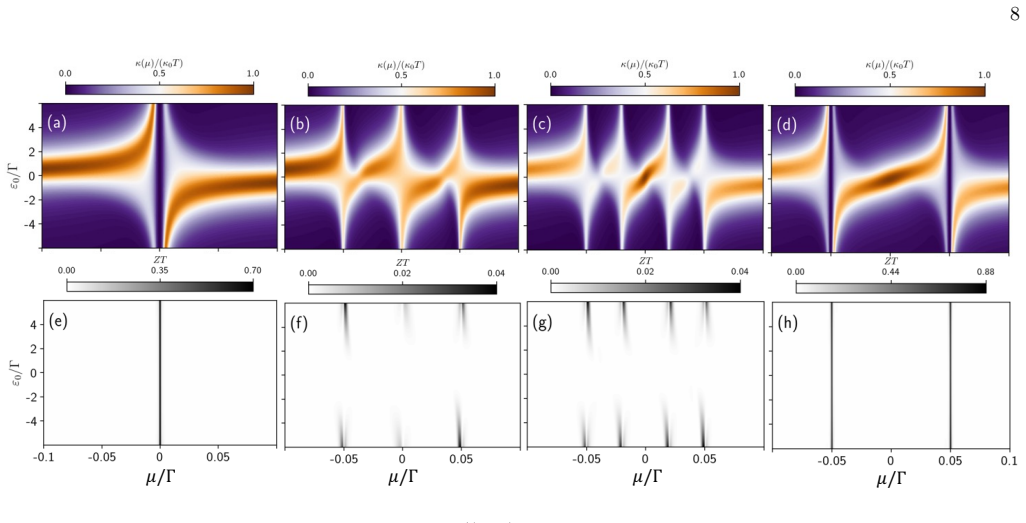
At θ=π/4 the scalar transmission develops a quadratic zero, T(ω)≈C(ω−ω0)^2, located at ω0=0 (long wires) or ω0=±ε_M (symmetric finite wires). The low-temperature Sommerfeld expansion then gives closed forms for S, ZT_el, and L/L0—Eqs. (30)–(32)—that depend only on x=(μ−ω0)/k_B T. These yield |S|_max=π/√3 k_B/e, ZT_el,max=0.75489, and L/L0=21/5 exactly at the zero. Exact integration gives 0.752 (long-wire) and 0.749 (finite-wire). Compared with ZT_el,max≈0.012 from wire-length asymmetry and ≈0.105 from dot detuning, phase tuning is about sixtyfold and sevenfold more effective.
What carries the argument
The load-bearing object is the scalar transmission T(ω)=−Γ Im G^r_ee(ω), obtained from the retarded Nambu Green function of the dot–Majorana system. This reduction is valid only under symmetric lead couplings (Γ_S=Γ_D=Γ/2) and the antisymmetric differential bias protocol of Eq. (15), where unitarity of the Bogoliubov–de Gennes scattering problem equates the electron-transfer plus crossed-Andreev probabilities to a single spectral function. The quadratic transmission zero T(ω)≈C(ω−ω0)^2 generated by the phase difference is what forces the transport moments L_n to scale as L_0∝T^2, L_1=0, L_2∝T^4 at the zero, giving the universal ZT_el=0.75489 and the Wiedemann–Franz violation L/L0=21/5.
Load-bearing premise
The universal numbers rest on the identity T(ω)=−Γ Im G^r_ee(ω), which is exact only for equal lead couplings and the antisymmetric differential bias protocol; if a real device cannot impose that measurement scheme, normal and Andreev channels must be treated separately and the headline ZT≈0.75 and Lorenz ratio 21/5 do not follow directly.
What would settle it
Measure the Lorenz ratio (electronic thermal conductance divided by GT) of the crossbar device at θ=π/4, with symmetric leads and the antisymmetric bias protocol, at low temperature as a function of chemical potential; observation of a peak value approaching 21/5≈4.2 at the transmission zero would confirm the mechanism, while a value far from 4.2 would falsify it.
If this is right
- At θ=π/4 and low temperature, ZT_el should peak at about 0.75 when the chemical potential sits |μ−ω0|=2.5966 k_B T away from the transmission zero, with the Seebeck coefficient reaching ±π/√3 k_B/e.
- At the transmission zero itself the Lorenz ratio is predicted to be exactly 21/5 ≈ 4.2, a clear, quantifiable Wiedemann–Franz violation that persists as a universal low-temperature property.
- Phase tuning is the most effective symmetry-breaking mechanism considered: roughly sixty times the maximum enhancement from unequal Majorana overlaps and about seven times that from dot-level detuning.
- The antiresonance energies (and hence the high-ZT_el ridges) are pinned at μ=0 or μ=±ε_M independent of the dot level ε0, so their positions are stable while amplitudes vary.
- Exact numerical integration of the transport moments corroborates the analytic values (0.752 long-wire, 0.749 finite-wire at k_B T/Γ=8.6173×10^{-5}); the fourth-order Sommerfeld expansion reproduces the curves to a few percent, with error reaching about 6% for the narrowest structures.
Where Pith is reading between the lines
- Because the universal ZT≈0.75 and L/L0=21/5 follow only from the quadratic shape of the antiresonance, the same enhancement should appear in any coherent conductor whose transmission can be tuned to a quadratic zero; the Majorana–dot crossbar is one concrete realization, not a special-case accident.
- The pinning of the antiresonance at μ=0 or μ=±ε_M independent of dot level suggests a thermoelectric route to read out the intra-Majorana hybridization energy ε_M (and thus relative wire length), although the paper does not propose this application.
- An experimental test of the headline numbers requires the symmetric-lead antisymmetric-bias protocol; with asymmetric couplings or one-sided bias the normal and Andreev channels must be treated separately, so the universal values are tied to that specific measurement scheme.
- The quoted figure of merit is electronic only; including phonon heat conduction would lower the total ZT, so the practical enhancement in a real device is an open quantitative question.
Editorial analysis
A structured set of objections, weighed in public.
Referee Report
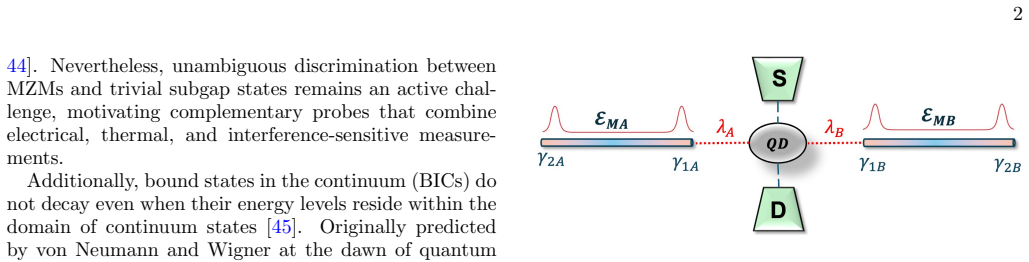
Summary. The paper studies a crossbar-shaped quantum dot coupled to two normal leads and two topological-superconductor nanowires hosting Majorana zero modes. Using a Green-function formalism and the Sommerfeld expansion, it shows that a superconducting phase difference θ=π/4 produces a quadratic transmission zero, leading to universal low-temperature thermoelectric constants ZT_el^max=0.75489 and L/L0=21/5. The mechanism is compared with wire-length asymmetry and quantum-dot level detuning; phase tuning yields the largest enhancement. The analytic closed forms (30)–(32) are verified by exact numerical integration, which gives ZT_el^max=0.752 (long-wire) and 0.749 (finite-wire) for the central parameters.
Significance. The central strength is the parameter-free derivation: the constants C and ω0 cancel from the closed forms (30)–(32), so the results depend only on the quadratic form of the transmission zero, not on microscopic details. The authors provide exact numerical integration checks and explicitly disclose the ~6% Sommerfeld error in narrow finite-detuning cases. The work connects the quantum-thermoelectric bounds of Whitney to a concrete Majorana platform, which is a useful theoretical contribution. The main limitation is the reliance on a symmetric differential measurement protocol and symmetric couplings to realize the exact quadratic zero; this is stated in the text but deserves additional emphasis and a quantitative stability analysis.
major comments (1)
- [III, Eqs. (30)–(32), Fig. 6] The universality claim rests on an exact quadratic transmission zero, which requires λ_A=λ_B, Γ_S=Γ_D, and (for finite wires) symmetric ε_MA=ε_MB. The manuscript does not quantify how small asymmetries in λ or Γ affect ZT_max and the Lorenz ratio. The paper's own Appendix B shows that an asymmetry in ε_M already reduces the maximum response from ~0.75 to ~0.04, indicating the effect is fragile. A quantitative stability analysis (e.g., ZT_max versus Γ_S/Γ_D−1 or λ_A/λ_B−1) or an explicit tolerance statement should be added to support the practical claim of phase-controlled thermoelectric engineering.
minor comments (5)
- [Figures 2–5, 7] Several figure axes and labels contain placeholder '□' symbols instead of 'Γ'. Please fix the rendering.
- [Fig. 7(h) caption] The caption states that exact integration gives ZT_max≃0.83 while the O(T^4) Sommerfeld value is ≃0.88. Please specify the parameter values and explain the color-scale mapping, since the discrepancy is larger than for Fig. 6 and could confuse readers.
- [Abstract and Conclusions] The abstract and conclusions present ZT_el≃0.75 without repeating the caveat that this value applies only under the symmetric differential protocol of Eq. (15) and for symmetric couplings. A brief qualifier in the abstract would avoid misinterpretation.
- [Eqs. (30)–(32)] The phrase 'universal consequences' is correct, but it may be helpful to state explicitly that the constants are universal within the class of transmissions with a quadratic zero, as already implied by the citations to Refs. [54,55].
- [II.B, Eq. (18)] The derivation of the scalar transmission identity is concise. Adding a one-sentence derivation of Eq. (17) from A(ω)=G^r Γ G^{r†} would make the factor-of-two conventions clearer for readers.
Circularity Check
No significant circularity: the universal ZT and Lorenz-ratio values follow from the model's quadratic transmission zero, with C and omega_0 canceling; exact numerical integration independently corroborates the analytic results.
full rationale
The central derivation is self-contained. The scalar transmission T(omega) = -Gamma Im G^r_ee(omega) is obtained from the NEGF spectral identity and is explicitly restricted to the symmetric-lead, antisymmetric-bias protocol of Eq. (15); the paper states that outside this protocol the normal and Andreev channels must be retained, so the assumption is disclosed rather than hidden. The headline constants ZT_max = 0.75489 and L/L0 = 21/5 come from inserting the quadratic zero T(omega) ~ C(omega - omega_0)^2 into the Sommerfeld moments; because C and omega_0 drop out of Eqs. (30)-(32), no parameter is fitted to the reported thermoelectric values. The paper also benchmarks the Sommerfeld result against exact numerical integration, giving ZT_max ~ 0.752 (long-wire) and 0.749 (finite-wire) and Lorenz ratios 4.186/4.145, so the analytic claim is independently supported. Prior Ghost-Fano/BIC work by the same group is cited for the underlying mechanism, but it does not supply the universal constants. The paper's own limitations---phonon heat conduction would reduce the total figure of merit, and the transport reduction requires symmetric leads and a differential bias---are applicability conditions, not circularity. Robustness questions about exact symmetry are physical fragility concerns, not internal circularity.
Axiom & Free-Parameter Ledger
free parameters (6)
- θ (superconducting phase difference) =
π/4
- λ (QD-MZM coupling) =
0.2Γ
- ε_MA, ε_MB (Majorana hybridization energies) =
0 (long-wire); 0.05Γ (finite-wire); 0.055Γ/0.045Γ (length asymmetry)
- Δ0 (wire-length asymmetry) =
0.005Γ
- ε0 (quantum-dot level) =
0 (phase-control result); 8Γ (detuning panels)
- k_B T/Γ (dimensionless temperature) =
8.6173×10^-5
axioms (6)
- domain assumption The device is described by the effective low-energy spinless Hamiltonian H in Eqs. (1)–(8), valid when kBT, Γ, |λ|, |ε0|, and ε_MA/B lie within the induced superconducting gap.
- domain assumption Wide-band leads with energy-independent self-energies Σ^r_α = −iΓ_α.
- domain assumption Symmetric lead couplings Γ_S=Γ_D and antisymmetric source-drain bias/temperature protocol, Eq. (15), so transport reduces to the scalar T(ω)=−Γ Im G^r_ee via Eq. (18).
- standard math The BdG spectral identity A(ω)=G^r(ω)ΓG^a(ω) gives the electron-row relation used to derive Eq. (17).
- ad hoc to paper For θ=π/4 and symmetric parameters, the transmission has a quadratic zero T(ω)=C(ω−ω0)^2 near ω0=0 (long wire) or ω0=±ε_M (finite wire).
- standard math The Sommerfeld expansion through fourth order, Eqs. (27)–(29), and Fermi-function integrals, Eq. (26), accurately give the transport moments.
read the original abstract
We investigate how the interplay between Majorana zero modes (MZMs) and bound states in the continuum (BICs) governs the electronic thermoelectric response of a crossbar-shaped quantum dot (QD) coupled to two topological-superconductor nanowires. Using the Green-function formalism, exact linear-response energy integrals, and their low-temperature Sommerfeld expansion, we analyze the spectral and thermoelectric properties of the system. We show that symmetry breaking converts BICs into quasi-BICs, allowing them to contribute to electrical and thermal transport and thereby generate a finite thermoelectric response. While unequal nanowire lengths, reflected in different intra-Majorana coupling strengths, produce only a modest enhancement of $ZT_{el}$, detuning the QD level increases $ZT_{el}$ by approximately one order of magnitude. Superconducting-phase control produces a much stronger enhancement, reaching $ZT_{el} \simeq 0.75$ through a quadratic transmission zero and a pronounced violation of the Wiedemann-Franz law. The low-temperature values $ZT^{max}_{el} \simeq 0.755$ and $\mathscr{L} /\mathscr{L}_{0} = 21/5$ are universal consequences of this quadratic antiresonance. Our results establish phase-tunable thermoelectric signatures of the Majorana-coupled interference structure and identify superconducting-phase control as an efficient means of engineering the electronic response of topological hybrid nanostructures.
Figures


Reference graph
Works this paper leans on
-
[1]
A. Y. Kitaev, Ann. Phys.303, 2 (2003)
2003
-
[2]
Nayak, S
C. Nayak, S. H. Simon, A. Stern, M. Freedman, and S. D. Sarma, Rev. Mod. Phys.80, 1083 (2008)
2008
-
[3]
J. K. Pachos,Introduction to topological quantum com- putation(Cambridge University Press, 2012)
2012
-
[4]
C. W. J. Beenakker, Annu. Rev. Condens. Matter Phys. 4, 113 (2013)
2013
-
[5]
Laflamme, M
C. Laflamme, M. Baranov, P. Zoller, and C. Kraus, Phys. Rev. A89, 029903 (2014)
2014
-
[6]
S. M. Albrecht, A. P. Higginbotham, M. Madsen, F. Kuemmeth, T. S. Jespersen, J. Nyg ˚ ard, P. Krogstrup, and C. Marcus, Nature531, 206 (2016)
2016
-
[7]
Majorana, Nuovo Cimento14, 171 (1937)
E. Majorana, Nuovo Cimento14, 171 (1937)
1937
-
[8]
Wilczek, Nat
F. Wilczek, Nat. Phys.5, 614 (2009)
2009
-
[9]
Franz, Physics3, 24 (2010)
M. Franz, Physics3, 24 (2010)
2010
-
[10]
C. V. Kraus, M. Dalmonte, M. A. Baranov, A. M. L¨ auchli, and P. Zoller, Phys. Rev. Lett.111, 173004 (2013)
2013
-
[11]
Alicea, Y
J. Alicea, Y. Oreg, G. Refael, F. Von Oppen, and M. Fisher, Nat. Phys.7, 412 (2011)
2011
-
[12]
A. Y. Kitaev, Phys.-usp.44, 131 (2001)
2001
-
[13]
S. B. Bravyi and A. Y. Kitaev, Ann. Phys.298, 210 (2002)
2002
-
[14]
Leijnse and K
M. Leijnse and K. Flensberg, Phys. Rev. Lett.107, 210502 (2011)
2011
-
[15]
Moore, Nat
J. Moore, Nat. Phys.5, 378 (2009)
2009
-
[16]
Wu and J
B. Wu and J. Cao, Phys. Rev. B85, 085415 (2012)
2012
-
[17]
G. W. Semenoff and P. Sodano, arXiv:cond-mat/0601261 (2006)
Pith/arXiv arXiv 2006
-
[18]
Tewari, C
S. Tewari, C. Zhang, S. D. Sarma, C. Nayak, and D.-H. Lee, Phys. Rev. lett.100, 027001 (2008). 9
2008
-
[19]
Mourik, K
V. Mourik, K. Zuo, S. M. Frolov, S. Plissard, E. P. Bakkers, and L. P. Kouwenhoven, Science336, 1003 (2012)
2012
-
[20]
M. Deng, C. Yu, G. Huang, M. Larsson, P. Caroff, and H. Xu, Nano lett.12, 6414 (2012)
2012
-
[21]
A. Das, Y. Ronen, Y. Most, Y. Oreg, M. Heiblum, and H. Shtrikman, Nat. Phys.8, 887 (2012)
2012
-
[22]
E. J. H. Lee, X. Jiang, R. Aguado, G. Katsaros, C. M. Lieber, and S. De Franceschi, Phys. Rev. lett.109, 186802 (2012)
2012
-
[23]
Finck, D
A. Finck, D. Van Harlingen, P. Mohseni, K. Jung, and X. Li, Phys. Rev. Lett.110, 126406 (2013)
2013
-
[24]
Churchill, V
H. Churchill, V. Fatemi, K. Grove-Rasmussen, M. Deng, P. Caroff, H. Xu, and C. M. Marcus, Phys. Rev. B87, 241401 (2013)
2013
-
[25]
Zambrano, J
D. Zambrano, J. P. Ramos-Andrade, and P. Orellana, J. Phys. Condens. Matter30, 375301 (2018)
2018
-
[26]
J. P. Ramos-Andrade, D. Zambrano, and P. A. Orellana, Ann. Phys. (Berlin)531, 1800498 (2019)
2019
-
[27]
Garrido, D
A. Garrido, D. Zambrano, J. Ramos-Andrade, and P. Orellana, The European Physical Journal Plus138, 1 (2023)
2023
-
[28]
L. W. Molenkamp, T. Gravier, H. van Houten, O. J. A. Buijk, M. A. A. Mabesoone, and C. T. Foxon, Phys. Rev. Lett.68, 3765 (1992)
1992
-
[29]
van Houten, L
H. van Houten, L. W. Molenkamp, C. W. J. Beenakker, and C. T. Foxon, Semiconductor Science and Technology 7, B215 (1992)
1992
-
[30]
Fu and C
L. Fu and C. L. Kane, Phys. Rev. Lett.100, 096407 (2008)
2008
-
[31]
A. G. Bauer, B. Scharf, L. W. Molenkamp, E. M. Han- kiewicz, and B. Sothmann, Phys. Rev. B104, L201410 (2021)
2021
-
[32]
J. P. Ramos-Andrade, O. ´Avalos-Ovando, P. A. Orellana, and S. E. Ulloa, Phys. Rev. B94, 155436 (2016)
2016
-
[33]
A. P. Garrido, D. Zambrano, J. Ramos-Andrade, and P. Orellana, The European Physical Journal Plus140, 897 (2025)
2025
-
[34]
P. E. Dolgirev, M. S. Kalenkov, and A. D. Zaikin, physica status solidi (RRL)–Rapid Research Letters13, 1800252 (2019)
2019
-
[35]
C.-Y. Hou, K. Shtengel, and G. Refael, Phys. Rev. B 88, 075304 (2013)
2013
-
[36]
E. Sela, Y. Oreg, S. Plugge, N. Hartman, S. L¨ uscher, and J. Folk, Phys. Rev. Lett.123, 147702 (2019)
2019
-
[37]
Giuliano, A
D. Giuliano, A. Nava, R. Egger, P. Sodano, and F. Buc- cheri, Phys. Rev. B105, 035419 (2022)
2022
-
[38]
Buccheri, A
F. Buccheri, A. Nava, R. Egger, P. Sodano, and D. Giu- liano, Phys. Rev. B105, L081403 (2022)
2022
-
[39]
Benjamin and R
C. Benjamin and R. Das, Europhysics Letters146, 16006 (2024)
2024
-
[40]
D. I. Pikulin, B. van Heck, T. Karzig, E. A. Mar- tinez, B. Nijholt, T. Laeven, G. W. Winkler, J. D. Watson, S. Heedt, M. Temurhan,et al., arXiv preprint arXiv:2103.12217 (2021)
Pith/arXiv arXiv 2021
-
[41]
Mizushima, Y
T. Mizushima, Y. Tanaka, and J. Cayao, Phys. Rev. B 112, 174504 (2025)
2025
-
[42]
Aghaee, A
M. Aghaee, A. Akkala, Z. Alam, R. Ali, A. Al- caraz Ramirez, M. Andrzejczuk, A. E. Antipov, P. Aseev, M. Astafev, B. Bauer,et al., Physical Review B107, 245423 (2023)
2023
-
[43]
D. Aasen, M. Aghaee, Z. Alam, M. Andrzejczuk, A. An- tipov, M. Astafev, L. Avilovas, A. Barzegar, B. Bauer, J. Becker,et al., arXiv preprint arXiv:2502.12252 (2025)
Pith/arXiv arXiv 2025
-
[44]
M. Aghaee, Z. Alam, M. Andrzejczuk, A. Antipov, T. Asimakidis, M. Astafev, L. Avilovas, A. Aziz- imanesh, A. Barzegar, B. Bauer,et al., arXiv preprint arXiv:2606.03884 (2026)
Pith/arXiv arXiv 2026
-
[45]
C. W. Hsu, B. Zhen, A. D. Stone, J. D. Joannopoulos, and M. Soljaˇ ci´ c, Nat. Rev. Mater.1, 1 (2016)
2016
-
[46]
von Neumann and E
J. von Neumann and E. P. Wigner, Z. Phys.30, 465 (1929)
1929
-
[47]
J. P. Ramos and P. A. Orellana, Phys. B: Condens. Mat- ter455, 66 (2014)
2014
-
[48]
B. Grez, J. Ramos-Andrade, V. Juriˇ ci´ c, and P. Orellana, Phys. Rev. A106, 013719 (2022)
2022
-
[49]
M. A. Sierra, M. Saiz-Bret ´ ın, F. Dom ´ ınguez-Adame, and D. S´ anchez, Phys. Rev. B93, 235452 (2016)
2016
-
[50]
R. S. Cortes-Santamaria, J. A. Landazabal-Rodr ´ ıguez, J. Silva-Valencia, E. Ramos, M. S. Figueira, and R. F. Pe˜ naloza., SciPost Phys. Core7, 058 (2024)
2024
-
[51]
D. A. Ruiz-Tijerina, E. Vernek, L. G. G. V. Dias da Silva, and J. C. Egues, Phys. Rev. B91, 115435 (2015)
2015
-
[52]
Datta,Electronic transport in mesoscopic systems (Cambridge university press, 1997)
S. Datta,Electronic transport in mesoscopic systems (Cambridge university press, 1997)
1997
-
[53]
M. L. Ladr´ on de Guevara, F. Claro, and P. A. Orellana, Phys. Rev. B67, 195335 (2003)
2003
-
[54]
R. S. Whitney, Physical Review Letters112, 130601 (2014)
2014
-
[55]
R. S. Whitney, Physical Review B91, 115425 (2015)
2015
discussion (0)
Sign in with ORCID, Apple, or X to comment. Anyone can read and Pith papers without signing in.