REVIEW 1 major objections 5 minor 58 references
Beyond the Coulson-Fischer point: Characterizing single excitation CI and TDDFT for excited states in single bond dissociations
T0 review · 1 major / 5 minor · reviewed 2026-08-14 · deepseek-v4-flash
Pith's one-line read This paper establishes that singles-only excited-state methods (CIS, TDHF, TDDFT) produce qualitatively wrong lowest-triplet surfaces for single-bond dissociation once the ground state spin-polarizes beyond the Coulson–Fischer point…
desk verdict A careful, mostly convincing mechanistic account of why single-excitation response methods break down past the Coulson-Fischer point; just don't let the abstract's local-functional claim outrun the collinear-kernel caveat. read the letter →
The pith
A machine-rendered reading of the paper's core claim, the machinery that carries it, and where it could break.
The reading
What carries the argument
The central machinery is the two-orbital, two-electron minimal-basis H$_2$ model parametrized by the orbital-mixing angle $\theta$, with the restricted orbitals recovered at $\theta = 0$ and fully spin-polarized atomic orbitals at $\theta = \pi/4$. In this model every relevant Slater determinant can be written explicitly, so the paper can show exactly which singles survive spin polarization and which character the omitted double excitation carries. The carrying identity is the spin-flip block relation $A = -B$ derived in Appendix A, which follows from the UHF stationarity condition (Eq. A12, from the standard orbital-stability equation of Ref 37); it forces the TDHF spin-flip excitation eigenvalue to zero beyond the Coulson–Fischer point. The same toy model supplies the mechanism for every larger molecule studied: spin polarization moves the T$_1$ character into a double excitation, and the kink-and-rise shape of the computed surfaces follows from singles-only response to that reference.
What would settle it
Compute the full singles-plus-doubles (CISD or CC2) T$_1$ surface for a stretched single bond using the same unrestricted reference: if the kink and the rise to the charge-transfer limit persist despite inclusion of double excitations, the paper's diagnosis would be refuted; if the surface becomes smooth and reaches the neutral-fragment limit, the diagnosis is confirmed. A second check is to compare spin-flip TDHF excitation energies for a stretched bond whose unrestricted solution is artificially forced to violate the UHF stability condition, where the claimed zero mode should become nonzero.
Extended reading notes
Core claim
The central claim is that beyond the Coulson–Fischer point, where the optimized UHF/UKS ground state develops unequal $\alpha$ and $\beta$ orbitals, the lowest triplet excitation as computed by singles-only response theories is not a continuation of the physical T$_1$ state. In the minimal-basis H$_2$ model the authors show analytically that the $M_S=0$ single excitations from the spin-polarized determinant are charge-transfer singlets, so the covalent triplet character that was present before the Coulson–Fischer point now resides in the double excitation, which CIS/TDHF/TDDFT omit. The $M_S=\pm1$ spin-flip block does retain the triplet, and for CIS it reaches the correct neutral-fragment limit in H$_2$, but TDHF spin-flip solutions collapse onto the ground state (zero excitation energy) because the $A$ and $B$ matrices of the spin-flip block satisfy $A = -B$ once the ground state obeys the UHF stability condition; for local functionals the spin-flip TDDFT excitation reduces to an orbital-energy difference and reproduces the $M_S=0$ artifact. The paper concludes that only restricted CIS gives a reasonable T$_1$ surface, at the price of a badly compromised restricted ground state.
Load-bearing premise
The proof that spin-flip TDHF triplets have exactly zero excitation energy rests on the optimized unrestricted ground state satisfying the UHF orbital-stability equation precisely; for molecules beyond H$_2$ this is transferred by numerical observation rather than proven.
Editorial extensions
If this is right
- Beyond the Coulson–Fischer point, the $M_S=0$ lowest triplet computed by CIS/TDHF/TDDFT should not be trusted for photodissociation dynamics; its apparent local minimum is an artifact of missing double excitations.
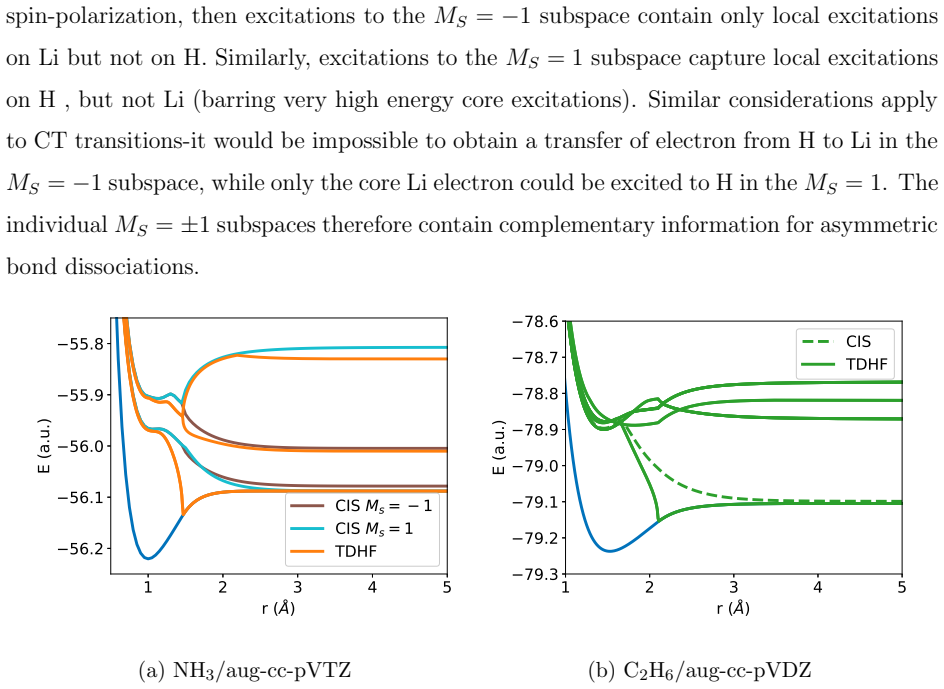
- The $M_S=\pm1$ spin-flip TDHF triplet surface is degenerate with the ground state beyond the Coulson–Fischer point, so any TDHF-based interpretation of triplet photochemistry in stretched bonds is invalid there.
- For local functionals, the spin-flip TDDFT/TDA triplet surfaces replicate the unphysical $M_S=0$ shape, because the local xc kernel contributes nothing to the spin-flip block and only orbital energy differences remain.
- Restricted CIS, despite a badly contaminated ground state, gives qualitatively reasonable T$_1$ surfaces for single bond dissociations and may be safer than unrestricted response for these states.
- CIS spin-flip T$_1$ states from unrestricted references are non-degenerate beyond the Coulson–Fischer point for most bonds, incurring a fragment degeneracy error $\Delta_{\alpha\beta}$ that vanishes only for hydrogen-like fragments.
Reading between the lines
- The same mechanism should affect any response method that truncates excitations at singles, including CIS(D), CC2, and algebraic diagrammatic construction at lowest order, when the reference is spin-polarized; the paper hints at this but does not test it.
- The zero excitation energy of spin-flip TDHF beyond the Coulson–Fischer point may be reinterpreted as a Goldstone-like zero mode of the broken spin-rotation symmetry; a testable consequence is that a functional approximant with non-collinear spin response would restore a nonzero spin-flip gap.
- The degeneracy error $\Delta_{\alpha\beta}$ suggests a simple diagnostic: for a stretched radical-pair system, compare CIS spin-flip excitation energies from the two subspaces; a large splitting flags unreliable T$_1$ surfaces and could be used as a black-box warning in production calculations.
- For practical photochemistry, spin-restricted references combined with methods that include at least doubles (or non-orthogonal CI) may be a more robust route than unrestricted TDDFT for bond-breaking regions; the paper's holomorphic HF remark points in that direction.
Signed reviews
Editorial analysis
A structured set of objections, weighed in public.
Referee Report
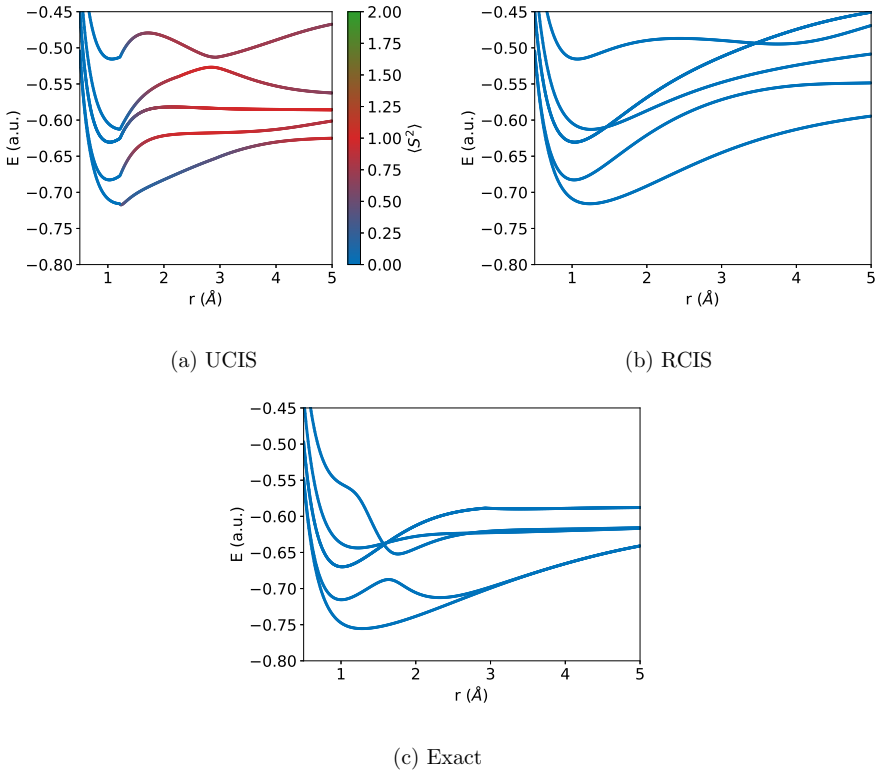
Summary. This manuscript investigates how the spin polarization of the unrestricted ground-state determinant beyond the Coulson-Fischer (CF) point affects excited-state potential energy surfaces computed with configuration interaction singles (CIS), time-dependent Hartree-Fock (TDHF), and linear-response TDDFT/TDA. The authors use minimal-basis H2 as an exactly solvable two-orbital, two-electron model and supplement it with numerical calculations on H2, NH3, C2H6, and LiH in extended basis sets. They show that beyond the CF point the M_S=0 lowest triplet T1 state becomes a double excitation relative to the spin-polarized reference, so that singles-only response methods produce kinked surfaces that connect to incorrect dissociation limits. They further demonstrate that M_S=±1 CIS T1 states provide better dissociation limits but suffer from a broken degeneracy and a fragment-dependent spin-flip error (Delta_alpha_beta), while M_S=±1 TDHF T1 states merge with the ground state, giving zero excitation energy beyond the CF point. For TDDFT/TDA, the authors argue that with collinear exchange-correlation kernels the local f_xc contribution to the spin-flip block vanishes, causing the M_S=±1 T1 surfaces to resemble the unphysical M_S=0 surface. The paper traces these failures to the absence of double excitations and to the structure of the spin-flip response blocks.
Significance. This is a valuable and timely systematic characterization of failures in the most widely used excited-state methods, and the findings, if correct, should guide practitioners in choosing between spin-restricted and spin-unrestricted references for photochemical studies. The analytical Appendix A is a genuine strength: it provides a clean, parameter-free derivation using the standard UHF orbital-stability condition and is benchmarked against FCI for H2. The spin-rotation Goldstone-mode argument gives a general physical reason for the zero TDHF spin-flip excitation energies, so the transfer of the conclusion to polyatomic molecules is not purely numerical. The paper also introduces a quantifiable CIS degeneracy error (Delta_alpha_beta) that is likely to be useful beyond the specific examples studied. The main caveat is that the TDDFT/TDA result for local functionals is established only in the collinear-kernel approximation, a qualification that is present in Section III but missing from the abstract and conclusion.
major comments (1)
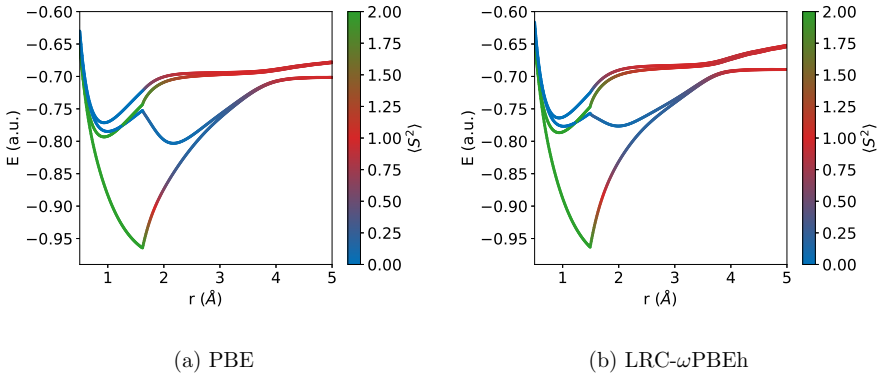
- [Abstract and Conclusion (cf. Sec. III)] The abstract and the concluding section state that 'local exchange-correlation functionals' cause the M_S=±1 T1 TDDFT/TDA surfaces to resemble the unphysical M_S=0 surface. Section III, however, explicitly restricts the argument to collinear exchange-correlation kernels, where the local f_xc contribution to the spin-flip block vanishes by spin symmetry. For a noncollinear spin-density-functional kernel the transverse f_xc is generally nonzero, so a properly constructed local functional invariant under global spin rotations should restore the Goldstone mode and hence the S0/T1 degeneracy beyond the CF point. The abstract and conclusion should therefore be qualified to say 'local functionals within the collinear-kernel approximation' (or 'collinear local kernels'), with a sentence noting the expected difference for noncollinear spin-flip TDDFT implementations.
minor comments (5)
- [Sec. IV, text around Fig. 3] The sentence 'TDHF further worsens the CIS reuslts' contains a typo; it should read 'results'.
- [Sec. VII, Conclusion] The phrase 'via a a rapidly increasing concave segment' contains a duplicated article; it should read 'via a rapidly increasing concave segment'.
- [Figs. 4 and 5 captions] The captions note that 'small state crossing induced discontinuities might be present on the top surface'; the manuscript would be clearer if the ⟨S²⟩ labeling of TDHF states (taken from the corresponding CIS states) were described as a diagnostic rather than a rigorous assignment, especially where crossings are possible.
- [Table II] The table reports asymptotic T1 energies relative to ROHF and UHF fragments, but the Computational Details state that all internal coordinates other than the stretched bond are frozen; the table caption should state explicitly that the fragment energies are for the unrelaxed geometries used in the scans.
- [Sec. III, paragraph after Eq. (16)] The statement that local exchange-correlation contributions render TDA identical to full TDDFT within the spin-flip block is correct for collinear kernels, but it would benefit from the same qualifier used elsewhere in the paper, to avoid confusion with noncollinear spin-flip implementations.
Circularity Check
No significant circularity: the central claims rest on self-contained analytic derivations and FCI-benchmarked numerics, with self-citations only in background and motivation.
full rationale
The paper's central derivation chain is self-contained. The minimal-basis H2 analysis parameterizes the UHF determinant using the standard Szabo-Ostlund two-orbital ansatz, and the Appendix A proof that spin-flip TDHF T1 excitation energies vanish beyond the Coulson-Fischer point uses the textbook UHF stationarity condition (Eq. 3.374 of Ref. 37) plus the RPA equations; no fitted parameter or author-supplied uniqueness theorem is invoked. The transfer to polyatomic systems is supported by the GHF Goldstone-mode argument (an externally cited stability result) and by direct numerical observation on NH3 and C2H6, and the M_S=0 double-excitation conclusion follows by algebra from the singles-only CI space and is checked against FCI. Self-citations (e.g., Refs. 18, 19, 22, 23, 28, 38, 56) appear only in background remarks, method motivation, and interpretive asides; none is load-bearing for the main conclusions. The only notable caveat is that the TDDFT M_S=±1 result is derived for collinear exchange-correlation kernels, and the abstract/conclusion state it without that qualifier; this is a correctness/scope limitation, not an input-output circularity.
Assumptions & free parameters
assumptions (4)
- domain assumption Linear response TDDFT/TDHF/CIS equations (Eqs. 1-5) describe physical excitations
- standard math UHF orbital stability condition (Eq. 3.374 in Ref 37) holds for the optimized spin-polarized determinant at all r > r_CF
- domain assumption Collinear adiabatic XC kernel has zero contribution to the spin-flip block
- standard math GHF stability: spin-density direction is arbitrary, yielding zero-curvature orbital rotations
Cite this review
Pith. "Pith review of Beyond the Coulson-Fischer point: Characterizing single excitation CI and TDDFT for excited states in single bond dissociations." pith.science (2026). https://pith.science/paper/TK4CF6JC
@misc{pith2026190807081,
  author       = {Pith},
  title        = {Pith review of: Beyond the Coulson-Fischer point: Characterizing single excitation CI and TDDFT for excited states in single bond dissociations},
  year         = {2026},
  howpublished = {\url{https://pith.science/paper/TK4CF6JC}},
  note         = {Machine review of arXiv:1908.07081}
}
abstract
Linear response time dependent density functional theory (TDDFT), which builds upon configuration interaction singles (CIS) and TD-Hartree-Fock (TDHF), is the most widely used class of excited state quantum chemistry methods and is often employed to study photochemical processes. This paper studies the behavior of the resulting excited state potential energy surfaces beyond the Coulson-Fisher (CF) point in single bond dissociations, when the optimal reference determinant is spin-polarized. Many excited states exhibit sharp kinks at the CF point, and connect to different dissociation limits via a zone of unphysical concave curvature. In particular, the unrestricted M$_S=0$ lowest triplet T$_1$ state changes character, and does not dissociate into ground state fragments. The unrestricted $M_S=\pm 1$ T$_1$ CIS states better approximate the physical dissociation limit, but their degeneracy is broken beyond the CF point for most single bond dissociations. On the other hand, the $M_S=\pm 1$ T$_1$ TDHF states reach the asymptote too soon, by merging with the ground state from the CF point onwards. Use of local exchange-correlation functionals causes $M_S=\pm 1$ T$_1$ TDDFT states to resemble their unphysical $M_S= 0$ counterpart. The 2 orbital, 2-electron model system of minimal basis H$_2$ is analytically treated to understand the origin of these issues, revealing that the lack of double excitations is at the root of these remarkable observations. The behavior of excited state surfaces is also numerically examined for species like H$_2$, NH$_3$, C$_2$H$_6$ and LiH in extended basis sets.
Figures


Figures from the paper (9 more)





Reference graph
Works this paper leans on
-
[1]
author author E. Runge \ and\ author E. K. U. \ Gross ,\ @noop journal journal Phys. Rev. Lett. \ volume 52 ,\ pages 997 ( year 1984 ) NoStop
work page 1984
-
[2]
author author M. E. \ Casida ,\ in\ @noop booktitle Recent Advances In Density Functional Methods: (Part I) \ ( publisher World Scientific ,\ year 1995 )\ pp.\ pages 155--192 NoStop
work page 1995
-
[3]
author author M. A. \ Marques \ and\ author E. K. \ Gross ,\ @noop journal journal Annu. Rev. Phys. Chem. \ volume 55 ,\ pages 427 ( year 2004 ) NoStop
work page 2004
-
[4]
Dreuw \ and\ author M
author author A. Dreuw \ and\ author M. Head-Gordon ,\ @noop journal journal Chem. Rev. \ volume 105 ,\ pages 4009 ( year 2005 ) NoStop
2005
-
[5]
author author C. M. \ Isborn , author N. Luehr , author I. S. \ Ufimtsev , \ and\ author T. J. \ Mart \' nez ,\ @noop journal journal Journal of chemical theory and computation \ volume 7 ,\ pages 1814 ( year 2011 ) NoStop
work page 2011
-
[6]
author author J. F. \ Stanton \ and\ author R. J. \ Bartlett ,\ @noop journal journal The Journal of chemical physics \ volume 98 ,\ pages 7029 ( year 1993 ) NoStop
work page 1993
-
[7]
author author A. I. \ Krylov ,\ @noop journal journal Annu. Rev. Phys. Chem. \ volume 59 ,\ pages 433 ( year 2008 ) NoStop
work page 2008
-
[8]
author author B. O. \ Roos , author P. R. \ Taylor , author P. E. \ Si , et al. ,\ @noop journal journal Chemical Physics \ volume 48 ,\ pages 157 ( year 1980 ) NoStop
work page 1980
Show all 58 references
-
[9]
Andersson , author P
author author K. Andersson , author P. A. \ Malmqvist , author B. O. \ Roos , author A. J. \ Sadlej , \ and\ author K. Wolinski ,\ @noop journal journal Journal of Physical Chemistry \ volume 94 ,\ pages 5483 ( year 1990 ) NoStop
1990
-
[10]
Andersson , author P.-
author author K. Andersson , author P.- . \ Malmqvist , \ and\ author B. O. \ Roos ,\ @noop journal journal The Journal of chemical physics \ volume 96 ,\ pages 1218 ( year 1992 ) NoStop
1992
-
[11]
author author J. B. \ Foresman , author M. Head-Gordon , author J. A. \ Pople , \ and\ author M. J. \ Frisch ,\ @noop journal journal The Journal of Physical Chemistry \ volume 96 ,\ pages 135 ( year 1992 ) NoStop
1992
-
[12]
author author P. A. \ Dirac ,\ in\ @noop booktitle Mathematical Proceedings of the Cambridge Philosophical Society ,\ Vol. volume 26 \ ( organization Cambridge University Press ,\ year 1930 )\ pp.\ pages 376--385 NoStop
1930
-
[13]
Hohenberg \ and\ author W
author author P. Hohenberg \ and\ author W. Kohn ,\ @noop journal journal Phys. Rev. \ volume 136 ,\ pages B864 ( year 1964 ) NoStop
1964
-
[14]
author author N. T. \ Maitra , author F. Zhang , author R. J. \ Cave , \ and\ author K. Burke ,\ @noop journal journal The Journal of chemical physics \ volume 120 ,\ pages 5932 ( year 2004 ) NoStop
2004
-
[15]
author author B. G. \ Levine , author C. Ko , author J. Quenneville , \ and\ author T. J. \ Mart \'I nez ,\ @noop journal journal Molecular Physics \ volume 104 ,\ pages 1039 ( year 2006 ) NoStop
2006
-
[16]
Mardirossian \ and\ author M
author author N. Mardirossian \ and\ author M. Head-Gordon ,\ @noop journal journal Mol. Phys. \ volume 115 ,\ pages 2315 ( year 2017 ) NoStop
2017
-
[17]
Goerigk , author A
author author L. Goerigk , author A. Hansen , author C. Bauer , author S. Ehrlich , author A. Najibi , \ and\ author S. Grimme ,\ @noop journal journal Phys. Chem. Chem. Phys. \ volume 19 ,\ pages 32184 ( year 2017 ) NoStop
2017
-
[18]
Hait \ and\ author M
author author D. Hait \ and\ author M. Head-Gordon ,\ @noop journal journal J. Chem. Theory Comput. \ volume 14 ,\ pages 1969 ( year 2018 a ) NoStop
1969
-
[19]
Hait \ and\ author M
author author D. Hait \ and\ author M. Head-Gordon ,\ @noop journal journal Phys. Chem. Chem. Phys. \ volume 20 ,\ pages 19800 ( year 2018 b ) NoStop
2018
-
[20]
author author J. P. \ Perdew , author R. G. \ Parr , author M. Levy , \ and\ author J. L. \ Balduz Jr ,\ @noop journal journal Phys. Rev. Lett. \ volume 49 ,\ pages 1691 ( year 1982 ) NoStop
1982
-
[21]
Mori-S \'a nchez , author A
author author P. Mori-S \'a nchez , author A. J. \ Cohen , \ and\ author W. Yang ,\ @noop journal journal J. Chem. Phys. \ volume 125 ,\ pages 201102 ( year 2006 ) NoStop
2006
-
[22]
Hait \ and\ author M
author author D. Hait \ and\ author M. Head-Gordon ,\ @noop journal journal J. Phys. Chem. Lett. \ ( year 2018 c ) NoStop
2018
-
[23]
Dreuw , author J
author author A. Dreuw , author J. L. \ Weisman , \ and\ author M. Head-Gordon ,\ @noop journal journal J. Chem. Phys. \ volume 119 ,\ pages 2943 ( year 2003 ) NoStop
2003
-
[24]
Iikura , author T
author author H. Iikura , author T. Tsuneda , author T. Yanai , \ and\ author K. Hirao ,\ @noop journal journal The Journal of Chemical Physics \ volume 115 ,\ pages 3540 ( year 2001 ) NoStop
2001
-
[25]
Tawada , author T
author author Y. Tawada , author T. Tsuneda , author S. Yanagisawa , author T. Yanai , \ and\ author K. Hirao ,\ @noop journal journal The Journal of chemical physics \ volume 120 ,\ pages 8425 ( year 2004 ) NoStop
2004
-
[26]
author author M. J. \ Peach , author P. Benfield , author T. Helgaker , \ and\ author D. J. \ Tozer ,\ @noop journal journal The Journal of chemical physics \ volume 128 ,\ pages 044118 ( year 2008 ) NoStop
2008
-
[27]
Sun , author C
author author H. Sun , author C. Zhong , \ and\ author J.-L. \ Bredas ,\ @noop journal journal Journal of chemical theory and computation \ volume 11 ,\ pages 3851 ( year 2015 ) NoStop
2015
-
[28]
Hait , author T
author author D. Hait , author T. Zhu , author D. P. \ McMahon , \ and\ author T. Van Voorhis ,\ @noop journal journal J. Chem. Theory Comput. \ volume 12 ,\ pages 3353 ( year 2016 ) NoStop
2016
-
[29]
Subotnik ,\ @noop journal journal The Journal of chemical physics \ volume 135 ,\ pages 071104 ( year 2011 ) NoStop
author author J. Subotnik ,\ @noop journal journal The Journal of chemical physics \ volume 135 ,\ pages 071104 ( year 2011 ) NoStop
2011
-
[30]
Kohn \ and\ author L
author author W. Kohn \ and\ author L. J. \ Sham ,\ @noop journal journal Phys. Rev. \ volume 140 ,\ pages A1133 ( year 1965 ) NoStop
1965
-
[31]
Thouless ,\ @noop journal journal Nuclear Physics \ volume 21 ,\ pages 225 ( year 1960 ) NoStop
author author D. Thouless ,\ @noop journal journal Nuclear Physics \ volume 21 ,\ pages 225 ( year 1960 ) NoStop
1960
-
[32]
Seeger \ and\ author J
author author R. Seeger \ and\ author J. A. \ Pople ,\ @noop journal journal The Journal of Chemical Physics \ volume 66 ,\ pages 3045 ( year 1977 ) NoStop
1977
-
[33]
Bauernschmitt \ and\ author R
author author R. Bauernschmitt \ and\ author R. Ahlrichs ,\ @noop journal journal The Journal of chemical physics \ volume 104 ,\ pages 9047 ( year 1996 a ) NoStop
1996
-
[34]
Bauernschmitt \ and\ author R
author author R. Bauernschmitt \ and\ author R. Ahlrichs ,\ @noop journal journal Chemical Physics Letters \ volume 256 ,\ pages 454 ( year 1996 b ) NoStop
1996
-
[35]
author author C. A. \ Coulson \ and\ author I. Fischer ,\ @noop journal journal Philos. Mag. \ volume 40 ,\ pages 386 ( year 1949 ) NoStop
1949
-
[36]
C \' z ek \ and\ author J
author author J. C \' z ek \ and\ author J. Paldus ,\ @noop journal journal The Journal of Chemical Physics \ volume 47 ,\ pages 3976 ( year 1967 ) NoStop
1967
-
[37]
Szabo \ and\ author N
author author A. Szabo \ and\ author N. S. \ Ostlund ,\ @noop title Modern Quantum Chemistry: Introduction to Advanced Electronic Structure Theory \ ( publisher Dover Publications, Inc. ,\ address Mineola, New York ,\ year 1996 )\ pp.\ pages 286--296 NoStop
1996
-
[38]
Hait , author A
author author D. Hait , author A. Rettig , \ and\ author M. Head-Gordon ,\ 10.1063/1.5080122 journal journal The Journal of Chemical Physics \ volume 150 ,\ pages 094115 ( year 2019 ) ,\ http://arxiv.org/abs/https://doi.org/10.1063/1.5080122 https://doi.org/10.1063/1.5080122 NoStop
2019 doi
-
[39]
Giesbertz \ and\ author E
author author K. Giesbertz \ and\ author E. Baerends ,\ @noop journal journal Chemical Physics Letters \ volume 461 ,\ pages 338 ( year 2008 ) NoStop
2008
-
[40]
author author A. T. \ Gilbert , author N. A. \ Besley , \ and\ author P. M. \ Gill ,\ @noop journal journal The Journal of Physical Chemistry A \ volume 112 ,\ pages 13164 ( year 2008 ) NoStop
2008
-
[41]
author author A. J. \ Thom \ and\ author M. Head-Gordon ,\ @noop journal journal The Journal of chemical physics \ volume 131 ,\ pages 124113 ( year 2009 ) NoStop
2009
-
[42]
author author E. J. \ Sundstrom \ and\ author M. Head-Gordon ,\ @noop journal journal The Journal of chemical physics \ volume 140 ,\ pages 114103 ( year 2014 ) NoStop
2014
-
[43]
Wu , author C.-L
author author Q. Wu , author C.-L. \ Cheng , \ and\ author T. Van Voorhis ,\ @noop journal journal The Journal of chemical physics \ volume 127 ,\ pages 164119 ( year 2007 ) NoStop
2007
-
[44]
Kaduk , author T
author author B. Kaduk , author T. Kowalczyk , \ and\ author T. Van Voorhis ,\ @noop journal journal Chemical reviews \ volume 112 ,\ pages 321 ( year 2011 ) NoStop
2011
-
[45]
Myneni \ and\ author M
author author H. Myneni \ and\ author M. E. \ Casida ,\ https://doi.org/10.1016/j.cpc.2016.12.011 journal journal Computer Physics Communications \ volume 213 ,\ pages 72 ( year 2017 ) NoStop
2016 doi
-
[46]
Head-Gordon , author R
author author M. Head-Gordon , author R. J. \ Rico , author M. Oumi , \ and\ author T. J. \ Lee ,\ @noop journal journal Chemical Physics Letters \ volume 219 ,\ pages 21 ( year 1994 ) NoStop
1994
-
[47]
Christiansen , author H
author author O. Christiansen , author H. Koch , \ and\ author P. J rgensen ,\ @noop journal journal Chemical Physics Letters \ volume 243 ,\ pages 409 ( year 1995 ) NoStop
1995
-
[48]
Seidl , author A
author author A. Seidl , author A. G \"o rling , author P. Vogl , author J. Majewski , \ and\ author M. Levy ,\ @noop journal journal Physical Review B \ volume 53 ,\ pages 3764 ( year 1996 ) NoStop
1996
-
[49]
Hirata \ and\ author M
author author S. Hirata \ and\ author M. Head-Gordon ,\ @noop journal journal Chemical Physics Letters \ volume 314 ,\ pages 291 ( year 1999 ) NoStop
1999
-
[50]
Cordova , author L
author author F. Cordova , author L. J. \ Doriol , author A. Ipatov , author M. E. \ Casida , author C. Filippi , \ and\ author A. Vela ,\ @noop journal journal The Journal of chemical physics \ volume 127 ,\ pages 164111 ( year 2007 ) NoStop
2007
-
[51]
author author J. P. \ Perdew , author K. Burke , \ and\ author M. Ernzerhof ,\ @noop journal journal Phys. Rev. Lett. \ volume 77 ,\ pages 3865 ( year 1996 ) NoStop
1996
-
[52]
Adamo \ and\ author V
author author C. Adamo \ and\ author V. Barone ,\ @noop journal journal J. Chem. Phys. \ volume 110 ,\ pages 6158 ( year 1999 ) NoStop
1999
-
[53]
author author M. A. \ Rohrdanz , author K. M. \ Martins , \ and\ author J. M. \ Herbert ,\ @noop journal journal J. Chem. Phys. \ volume 130 ,\ pages 054112 ( year 2009 ) NoStop
2009
-
[54]
author author W. J. \ Hehre , author R. F. \ Stewart , \ and\ author J. A. \ Pople ,\ @noop journal journal The Journal of Chemical Physics \ volume 51 ,\ pages 2657 ( year 1969 ) NoStop
1969
-
[55]
Cui , author I
author author Y. Cui , author I. W. \ Bulik , author C. A. \ Jim \'e nez-Hoyos , author T. M. \ Henderson , \ and\ author G. E. \ Scuseria ,\ @noop journal journal The Journal of chemical physics \ volume 139 ,\ pages 154107 ( year 2013 ) NoStop
2013
-
[56]
Hait \ and\ author M
author author D. Hait \ and\ author M. Head-Gordon ,\ @noop journal journal J. Chem. Phys. \ volume 148 ,\ pages 171102 ( year 2018 d ) NoStop
2018
-
[57]
author author H. G. \ Burton \ and\ author A. J. \ Thom ,\ @noop journal journal Journal of chemical theory and computation \ volume 12 ,\ pages 167 ( year 2015 ) NoStop
2015
-
[58]
Shao , author Z
author author Y. Shao , author Z. Gan , author E. Epifanovsky , author A. T. B. \ Gilbert , author M. Wormit , author J. Kussmann , author A. W. \ Lange , author A. Behn , author J. Deng , author X. Feng , author D. Ghosh , author M. Goldey , author P. R. \ Horn , author L. D....
2015
Reviewed August 14, 2026 · model on record in the stance chip above.
Discussion (0). Continue with ORCID to comment.