REVIEW 2 major objections 2 minor 40 references
Penalty-free quantum optimization applied to lattice protein folding
T0 review · 2 major / 2 minor · reviewed 2026-06-28 · grok-4.3
Pith's one-line read A quantum algorithm solves lattice protein folding without penalty terms by using independent sets of a conflict graph.
desk verdict Penalty-free QAOA for lattice protein folding works on small cases via independent-set mapping but the N=14 claims rest on an unproven heuristic search. read the letter →
The pith
A machine-rendered reading of the paper's core claim, the machinery that carries it, and where it could break.
The reading
What carries the argument
The QAOA mixer for the maximum independent set problem applied to the conflict graph of lattice configurations, which enforces validity without penalties.
What would settle it
Finding a known low-energy valid fold for a length-14 protein that the algorithm fails to discover would falsify the claim that the method reliably identifies global minima.
Extended reading notes
Core claim
By constructing a conflict graph whose independent sets correspond exactly to valid lattice protein configurations, and employing a QAOA mixer designed for the maximum independent set problem, the folding problem can be solved with an objective consisting solely of the protein energy and a linear bias term. This approach is validated on proteins of length 4 and 6 via direct simulation and extended to length 14 using an iterative local-search heuristic on local subgraphs.
Load-bearing premise
The conflict graph must be constructed so that its independent sets include every valid chain configuration, including those with low energy, without any omissions.
Editorial extensions
If this is right
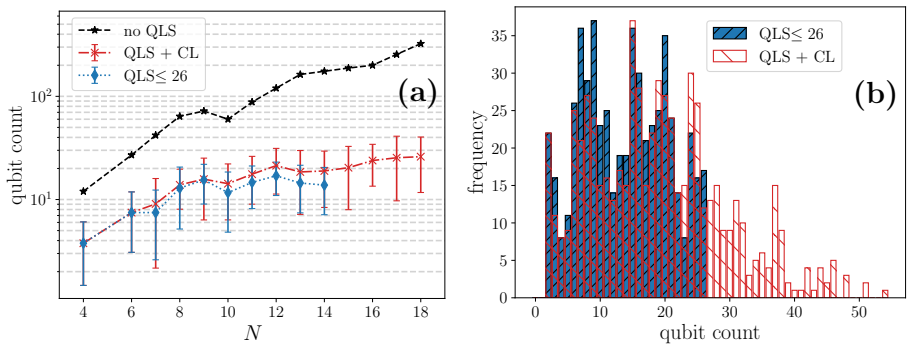
- Proteins up to length 14 can be folded using this method with local subgraphs of at most 26 qubits.
- The objective function avoids quadratic penalties, consisting only of energy plus linear bias.
- Direct classical simulation succeeds for N=4 and N=6.
- The method identifies minimum-energy structures for the tested lattice proteins.
Reading between the lines
- Similar penalty-free mappings could simplify quantum optimization for other discrete problems with configuration constraints.
- The local-search heuristic on subgraphs may generalize to larger systems if subgraph size can be controlled.
- This reduces the complexity of the cost function, potentially improving performance on near-term quantum devices.
Editorial analysis
A structured set of objections, weighed in public.
Referee Report
Summary. The paper claims that a QAOA variant for the maximum independent set problem on a conflict graph allows penalty-free optimization of lattice protein folding, with the objective consisting only of the protein energy plus a linear bias. Classical simulations validate the approach for N=4 and N=6; a heuristic iterative local-search scheme on local subgraphs (≤26 qubits) is then used to report successful folding for proteins up to N=14.
Significance. If the heuristic reliably locates global minima, the work provides a concrete demonstration that validity constraints can be enforced via the mixer and search space restriction rather than quadratic penalties, which is a useful technical contribution for constrained quantum optimization. The small-N circuit simulations supply direct evidence for the mapping; the N=14 results, however, rest on an unproven assumption about the local-search procedure.
major comments (2)
- [heuristic iterative local-search scheme paragraph] The section introducing the heuristic iterative local-search scheme (the paragraph beginning 'To explore larger systems...'): the manuscript reports that this procedure 'successfully fold[s] lattice proteins with lengths up to N=14', yet provides no exhaustive verification, known-optima comparison, or convergence argument showing that the scheme reaches the global minimum-energy valid configuration rather than a higher-energy local minimum. This assumption is load-bearing for the central claim that the method solves the problem for N=14.
- [conflict graph construction paragraph] The description of conflict-graph construction (the paragraph on restricting the search space to independent sets): while the text states that independent sets 'exactly correspond to all valid chain configurations', no explicit check or enumeration is supplied confirming that every low-energy valid fold is retained and that no valid configurations are inadvertently excluded by the conflict edges. This is required to ensure the reported energies are comparable to the true ground states.
minor comments (2)
- [abstract and results] The abstract and results section would benefit from explicit reporting of circuit depths, approximation ratios achieved, and direct baseline comparisons (e.g., against classical solvers or penalty-based QAOA) for the N=4 and N=6 cases.
- [objective function definition] Notation for the linear bias term and the precise form of the objective function should be introduced with an equation number for clarity when first presented.
Simulated Author's Rebuttal
We thank the referee for their careful reading and valuable comments on our manuscript. We address each major comment below and indicate the revisions we will make.
read point-by-point responses
-
Referee: The section introducing the heuristic iterative local-search scheme (the paragraph beginning 'To explore larger systems...'): the manuscript reports that this procedure 'successfully fold[s] lattice proteins with lengths up to N=14', yet provides no exhaustive verification, known-optima comparison, or convergence argument showing that the scheme reaches the global minimum-energy valid configuration rather than a higher-energy local minimum. This assumption is load-bearing for the central claim that the method solves the problem for N=14.
Authors: We agree that the iterative local-search procedure is a heuristic and that exhaustive verification of global optimality is infeasible for N=14 due to the size of the configuration space. The manuscript presents the lowest energies obtained by this procedure on local subgraphs and notes their competitiveness with classical results where available. We will revise the relevant sections to explicitly describe the method as heuristic, clarify that global optimality is not guaranteed, and add a discussion of its limitations along with any available comparisons to known ground-state energies for the proteins studied. This addresses the load-bearing nature of the assumption while preserving the demonstration that the penalty-free QAOA mapping can be applied at these sizes via the heuristic. revision: partial
-
Referee: The description of conflict-graph construction (the paragraph on restricting the search space to independent sets): while the text states that independent sets 'exactly correspond to all valid chain configurations', no explicit check or enumeration is supplied confirming that every low-energy valid fold is retained and that no valid configurations are inadvertently excluded by the conflict edges. This is required to ensure the reported energies are comparable to the true ground states.
Authors: The conflict graph is constructed by placing an edge between any two nodes whose simultaneous selection would violate chain connectivity or self-avoidance; therefore, by definition, every independent set encodes a valid lattice configuration and no valid configuration is excluded. For the N=4 and N=6 cases we have performed full enumeration within the QAOA simulations, confirming that all valid folds are retained. We will add an explicit paragraph (or small worked example) detailing this construction and the resulting bijection to make the correspondence rigorous and transparent. revision: yes
Circularity Check
No significant circularity; derivation is self-contained
full rationale
The paper maps lattice protein folding to a maximum independent set problem on a conflict graph, applies a standard QAOA mixer for that problem, and uses an objective consisting only of the protein energy plus a linear bias term. Validation for N=4 and N=6 is performed via direct classical simulation of the circuits. The extension to N=14 relies on an explicitly introduced heuristic iterative local-search procedure on subgraphs; this is presented as a practical exploration tool rather than a derived claim that reduces to fitted parameters or prior self-citations. No equations or steps in the provided text equate a prediction to its own inputs by construction, and no load-bearing uniqueness theorems or ansatzes are imported via self-citation. The central construction therefore remains independent of the target results.
Assumptions & free parameters
assumptions (1)
- standard math The standard QAOA framework and mixer for the maximum independent set problem can be directly applied to the protein folding objective after graph mapping.
Cite this review
Pith. "Pith review of Penalty-free quantum optimization applied to lattice protein folding." pith.science (2026). https://pith.science/paper/TPY6J3PQ
@misc{pith2026260602104,
  author       = {Pith},
  title        = {Pith review of: Penalty-free quantum optimization applied to lattice protein folding},
  year         = {2026},
  howpublished = {\url{https://pith.science/paper/TPY6J3PQ}},
  note         = {Machine review of arXiv:2606.02104}
}
abstract
Identifying minimum-energy structures of lattice proteins is a challenging discrete optimization problem. Quantum approaches such as analog quantum annealing and the gate-based quantum approximate optimization algorithm (QAOA) can address this problem after mapping it to a binary representation, which typically involves introducing penalty terms to enforce valid chain configurations. However, in this and many related problems, the use of quadratic penalty terms can be avoided by restricting the search space to independent sets in a conflict graph and using a QAOA mixer designed for the maximum independent set problem. In this work, we implement and explore this QAOA variant for lattice protein folding. Here, the objective function consists solely of the protein energy together with a simple linear bias term, without quadratic penalties. We validate this approach through classical simulations of the quantum circuits for lattice proteins of lengths $N=4$ and $N=6$. To explore larger systems, we further introduce a heuristic iterative local-search scheme, with which we successfully fold lattice proteins with lengths up to $N=14$ using local subgraphs with at most 26 qubits.
Figures
Figures from the paper (7 more)
Reference graph
Works this paper leans on
-
[1]
We first randomly select a root node, (i 0, n0)
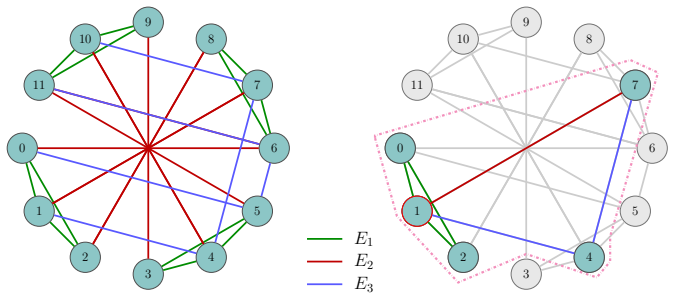
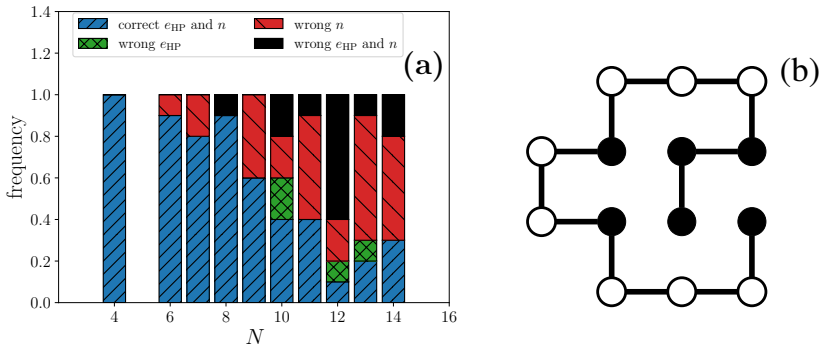
Selection ofC loc. We first randomly select a root node, (i 0, n0). We then add every one of its neighbors that can be included without extending the search to states that are unfeasible due to conflicts with surrounding nodes (see above). We restrict our- selves to first neighbors to keep the quantum circuit computationally manageable. An illustration of...
-
[2]
The pinning status is updated based on the out- come of the preceding local search
Pinning/unpinning of amino acids. The pinning status is updated based on the out- come of the preceding local search. Any amino acidifor whichb i,n changed from 0 to 1 for somenbecomes pinned with probabilityp p. Any amino acid that was already pinned is unpinned with probabilityp u. In the computations presented below, these parameters are set top p = 0....
-
[3]
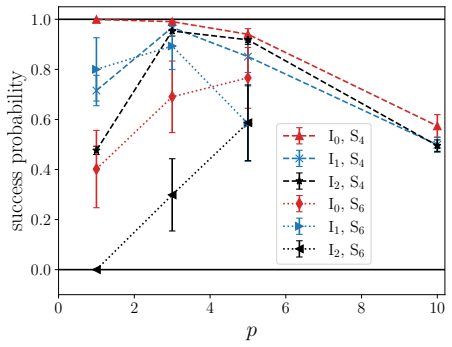
QAOA MIS-based minimization ofE MIS over unpinned amino acids inC loc. The initial state|ψ 0⟩(Eq. 2.6) is chosen to be a product of single-qubit states,|ψ i,n⟩. We set |ψi,n⟩=|0⟩ifb i,n = 0. Ifb i,n = 1, we set|ψ i,n⟩= 2 −1/2 (|0⟩+|1⟩) rather than |ψi,n⟩=|1⟩, to facilitate escape from local minima. When testing this scheme for QAOA MIS-based iterative loc...
-
[4]
Kadowaki and H
T. Kadowaki and H. Nishimori, Phys. Rev. E58, 5355 (1998)
1998
-
[5]
A Quantum Approximate Optimization Algorithm
E. Farhi, J. Goldstone, and S. Gutmann, arXiv:1411.4028 (2014), 10.48550/arXiv.1411.4028
work page Pith review arXiv doi:10.48550/arxiv.1411.4028 2014
-
[6]
Hadfield, Z
S. Hadfield, Z. Wang, B. O’Gorman, E. G. Rieffel, D. Venturelli, and R. Biswas, Algorithms 12, 34 (2019)
2019
-
[7]
Hen and F
I. Hen and F. M. Spedalieri, Phys. Rev. Appl.5, 034007 (2016)
2016
-
[8]
Z. Wang, N. C. Rubin, J. M. Dominy, and E. G. Rieffel, Phys. Rev. A101, 012320 (2020)
2020
Show all 40 references
-
[9]
Perdomo-Ortiz, N
A. Perdomo-Ortiz, N. Dickson, M. Drew-Brook, G. Rose, and A. Aspuru-Guzik, Sci. Rep.2, 248 (2012)
2012
-
[10]
Irb¨ ack, L
A. Irb¨ ack, L. Knuthson, S. Mohanty, and C. Peterson, Phys. Rev. Res.4, 043013 (2022)
2022
- [11]
-
[12]
Boulebnane, X
S. Boulebnane, X. Lucas, A. Meyder, S. Adaszewski, and A. Montanaro, npj Quantum Inf. 9, 70 (2023)
2023
-
[13]
Robert, P
A. Robert, P. K. Barkoutsos, S. Woerner, and I. Tavernelli, npj Quantum Inf.7, 38 (2021)
2021
-
[14]
J. V. Pamidimukkala, S. Bopardikar, A. Dakshinamoorthy, A. Kannan, K. Dasgupta, and S. Senapati, J. Chem. Theory Comput.20, 10223 (2024)
2024
-
[15]
Irb¨ ack, L
A. Irb¨ ack, L. Knuthson, and S. Mohanty, Phys. Rev. E112, 045302 (2025)
2025
-
[16]
V. K. Mulligan, H. Melo, H. I. Merritt, S. Slocum, B. D. Weitzner, A. M. Watkins, P. D. Renfrew, C. Pleasure, P. S. Arora, and R. Bonneau, bioRxiv:752485 (2020), 10.1101/752485
2020 doi
-
[17]
Irb¨ ack, L
A. Irb¨ ack, L. Knuthson, S. Mohanty, and C. Peterson, Phys. Rev. Res.6, 013162 (2024)
2024
-
[18]
Panizza, P
V. Panizza, P. Hauke, C. Micheletti, and P. Faccioli, PRX Life2, 043012 (2024)
2024
- [19]
-
[20]
Tomesh, Z
T. Tomesh, Z. H. Saleem, and M. Suchara, Quantum6, 781 (2022)
2022
-
[21]
Z. H. Saleem, T. Tomesh, B. Tariq, and M. Suchara, SN Comput. Sci.4, 183 (2023)
2023
-
[22]
K. F. Lau and K. A. Dill, Macromolecules22, 3986 (1989)
1989
-
[23]
K. Yue, K. M. Fiebig, P. D. Thomas, H. S. Chan, E. I. Shakhnovich, and K. A. Dill, Proc. Natl. Acad. Sci. USA92, 325 (1995)
1995
-
[24]
H. Linn, I. Brundin, L. Garc´ ıa-´Alvarez, and G. Johansson, Phys. Rev. Res.6, 033112 (2024). 23
2024
-
[25]
McGeoch, P
C. McGeoch, P. Farr´ e, and W. Bernoudy,D-Wave Hybrid Solver Service + Advantage: tech- nology update, Tech. Rep. (D-Wave Systems Inc., 2020)
2020
-
[26]
Irb¨ ack and C
A. Irb¨ ack and C. Troein, J. Biol. Phys.28, 1 (2002)
2002
-
[27]
Holzgr¨ afe, A
C. Holzgr¨ afe, A. Irb¨ ack, and C. Troein, J. Chem. Phys.135, 195101 (2011)
2011
-
[28]
Crescenzi, D
P. Crescenzi, D. Goldman, C. Papadimitriou, A. Piccolboni, and M. Yannakakis, J. Comput. Biol.5, 423 (1998)
1998
-
[29]
Bucher, J
D. Bucher, J. Stein, S. Feld, and C. Linnhoff-Popien, Phys. Rev. A112, 062605 (2025)
2025
-
[30]
B¨ artschi and S
A. B¨ artschi and S. Eidenbenz, inFundamentals of Computation Theory, edited by L. A. G¸ asieniec, J. Jansson, and C. Levcopoulos (Springer, Cham, 2019) pp. 126–139
2019
-
[31]
Zhou, S.-T
L. Zhou, S.-T. Wang, S. Choi, H. Pichler, and M. D. Lukin, Phys. Rev. X10, 021067 (2020)
2020
- [32]
-
[33]
Virtanen, R
P. Virtanen, R. Gommers, T. E. Oliphant, M. Haberland, T. Reddy, D. Cournapeau, E. Burovski, P. Peterson, W. Weckesser, J. Bright, S. J. van der Walt, M. Brett, J. Wil- son, K. J. Millman, N. Mayorov, A. R. J. Nelson, E. Jones, R. Kern, E. Larson, C. J. Carey, ˙I. Polat, Y. Fe...
2020
-
[34]
Boppana and M
R. Boppana and M. Halld´ orsson, BIT32, 180 (1992)
1992
-
[35]
A. J. da Silva and D. K. Park, Phys. Rev. A106, 042602 (2022)
2022
-
[36]
Zindorf and S
B. Zindorf and S. Bose, Phys. Rev. Appl.24, 044030 (2025)
2025
-
[37]
J. J. Hopfield and D. W. Tank, Biol. Cybern.52, 141 (1985)
1985
-
[38]
Lucas, Front
A. Lucas, Front. Phys.2, 1 (2014)
2014
- [39]
-
[40]
Vikst˚ al, M
P. Vikst˚ al, M. Gr¨ onkvist, M. Svensson, M. Andersson, G. Johansson, and G. Ferrini, Phys. Rev. Appl.14, 034009 (2020). 24
2020
Reviewed June 28, 2026 · model on record in the stance chip above.
Discussion (0). Continue with ORCID to comment.