REVIEW 3 major objections 4 minor 63 references
AquaGen generates all-atom, explicit-solvent molecular configurations from the Boltzmann distribution that match MD free-energy accuracy at a fraction of the cost.
Reviewed by Pith at T0; open to challenge. T0 means a machine referee read the full paper against a public rubric. the ladder, T0–T4 →
T0 review · grok-4.5
2026-07-12 01:57 UTC pith:TQINM6X4
load-bearing objection First credible all-atom explicit-solvent Boltzmann generator at ~10³ atoms that actually feeds MBAR for AHFE; the ~1 kcal/mol headline is real but partly flattered by cancellation and teacher-force-field matching. the 3 major comments →
AquaGen: Scaling generative models to molecular dynamics precision on thousands of atoms
The pith
A machine-rendered reading of the paper's core claim, the machinery that carries it, and where it could break.
Core claim
AquaGen is the first generative model to sample Boltzmann-distributed all-atom configurations that include explicit solvent and periodic boundaries for systems of thousands of atoms, with geometric and energetic fidelity high enough that MBAR free-energy estimates from force-field energies on those samples match molecular-dynamics absolute hydration free energies to about 1.22 kcal/mol mean (0.93 median) error on held-out compounds, at 4–10× lower GPU cost.
What carries the argument
λ-conditional flow matching: a graph neural network learns a velocity field that transports a Gaussian prior over atomic coordinates and a cubic simulation cell into alchemical Boltzmann configurations conditioned on the order parameter λ that gradually annihilates solute–solvent interactions; uncorrelated samples at each λ are scored with the same force field used in MD and pooled by the multistate Bennett acceptance ratio (MBAR) estimator to obtain free-energy differences.
Load-bearing premise
Samples at neighboring alchemical windows must have energy overlaps faithful enough that free-energy increments from MBAR are trustworthy, not merely that opposite-signed errors along the electrostatic and van der Waals legs cancel to a small final number.
What would settle it
On held-out compounds, compare cumulative absolute error (sum of absolute adjacent-λ free-energy increments) and box-length bias of AquaGen ensembles against long MD; if CAE stays large while AHFE absolute error looks small, or if short MD refinement from generated starts fails to approach MD free energies within the reported compute budgets, the claim that the generative ensembles are Boltzmann-faithful for free-energy work fails.
If this is right
- Absolute hydration free energy can be estimated 4–10× faster than GPU MD with comparable accuracy, and still faster when short MD refinement starts from generated frames.
- Scaling model size and the number of generated samples predictably improves free-energy accuracy (train- and test-time compute).
- Bootstrapped confidence intervals over generated samples give well-calibrated uncertainty without deep ensembles.
- The same high-resolution ensemble approach is positioned to extend to lipophilicity, membrane permeability, and absolute binding free energy.
- Gray-box predictions remain refinable and inspectable via force-field energies, unlike pure black-box regressors.
Where Pith is reading between the lines
- If adjacent-λ energy overlaps remain faithful at protein–ligand scale, the same pipeline could cut wall-clock cost of absolute binding free energy campaigns without abandoning force-field grounding.
- Opposite-signed errors on the electrostatic versus van der Waals legs imply that better λ conditioning may improve reliability more than further model scaling alone.
- Explicit-solvent generative ensembles may become a practical intermediate between structure predictors and full MD for any property that is an ensemble average of potential energies.
Editorial analysis
A structured set of objections, weighed in public.
Referee Report
Summary. AquaGen is presented as the first all-atom, explicit-solvent, PBC-aware generative model (flow matching on a GNN) that samples approximately Boltzmann-distributed configurations of solvated drug-like molecules (~10^3 atoms) conditioned on an alchemical parameter λ. Samples are used with force-field energy evaluations and MBAR to estimate absolute hydration free energies (AHFE) on held-out compounds, claiming ~1.22 kcal/mol mean / 0.93 kcal/mol median absolute error versus GPU MD at 4–10× lower cost, with further gains from model scaling, more samples, short MD refinement, calibrated bootstrap uncertainties, and gray-box interpretability relative to black-box regressors.
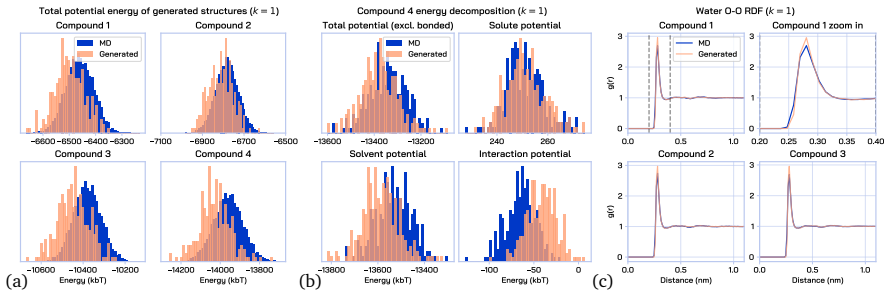
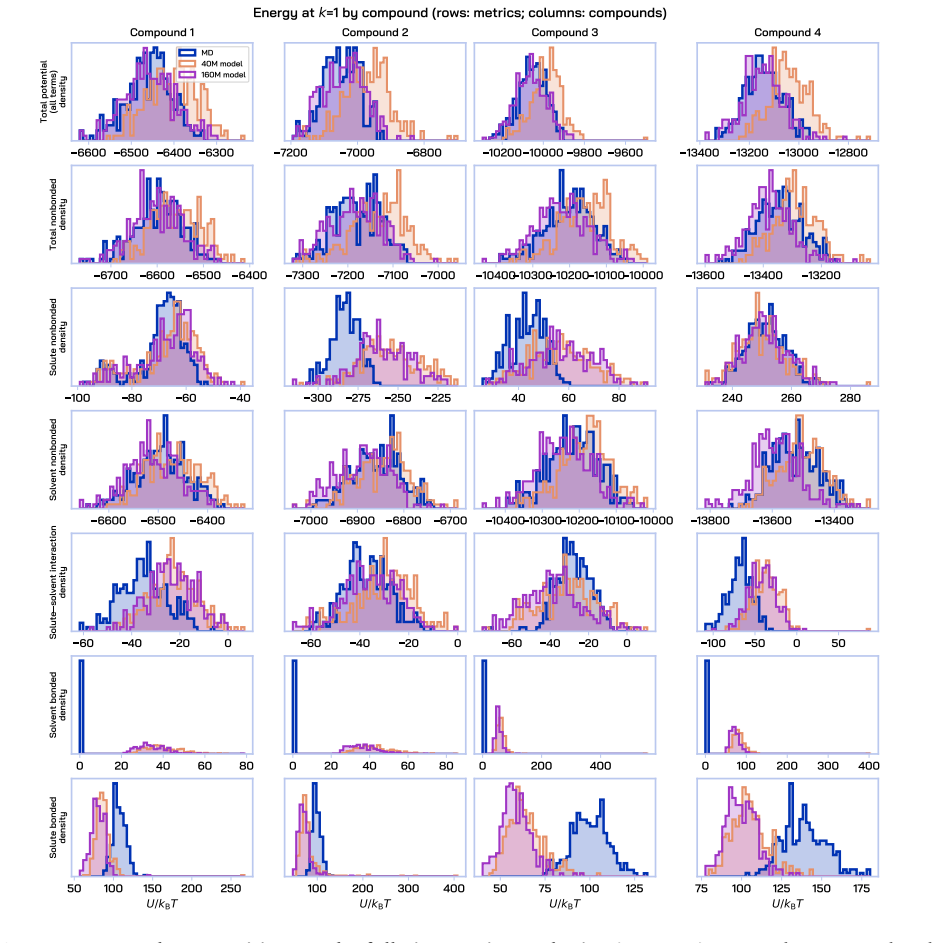
Significance. If the energetic fidelity and free-energy accuracy hold under broader scrutiny, this is a substantial advance: it closes a resolution gap relative to prior biomolecular generative models (Table 3) and shows that high-resolution ensemble generation can serve as a practical, refinable surrogate for alchemical MD free-energy workflows. The multi-layered evidence (energy histograms/decompositions, RDFs, tICA, H-bond trends, train/test-time scaling in Fig. 1c, uncertainty calibration, CAE ablations, and black-box baselines) and explicit gray-box advantages (refinability, inspectable samples) are genuine strengths that would matter for industrial free-energy tasks and for scaling toward ABFE or related properties.
major comments (3)
- [§4.4–4.5, Fig. 4c, Table 2] §4.4–4.5, Fig. 4c and Table 2: The headline AHFE AE (~1.22/0.93 kcal/mol) is a telescoping sum of free-energy increments and can be substantially smaller than the cumulative absolute error (CAE) because of systematic opposite-signed errors (negative on the electrostatic leg k=1–5, positive on the VDW leg k=6–20). Several ablations improve AE while worsening CAE, and the authors themselves attribute this to imperfect λ-conditioning that learns an “averaged” distribution. For the central claim that generated ensembles are faithful enough for trustworthy MBAR free energies (not merely that the endpoint difference happens to match after cancellation), the paper needs either (i) stronger evidence that adjacent-state energy overlaps and per-leg increments are accurate, or (ii) primary reporting of CAE (or equivalent) alongside AE, with clearer caveats on when cancellation is acceptable.
- [§4.1, Table 1] §4.1, Table 1 and FreeSolv/CombiSolv columns: Without MD refinement the model’s mean AE on public experimental sets is ~3–4 kcal/mol (worse than the internal MD-matched numbers), while short refinement brings it below 1 kcal/mol. The abstract and main claims emphasize “comparable accuracy to standard GPU-based MD” and 4–10× speedup largely on the internal MD-vs-MD comparison under the same force field. The manuscript should more carefully separate surrogate fidelity to the teacher MD ensemble from transfer to experiment, and quantify how much of the claimed speedup remains after the refinement step that is needed for competitive experimental accuracy.
- [§4.3, §4.5] §4.3 and §4.5 (Gaussian prior / box-size results): There is a consistent ~0.1 Å overestimation of simulation box length attributed to the N(0,2) coordinate prior and cell prior. Because free energies and densities depend on volume, and because the cell is generated jointly, this systematic bias is load-bearing for the claim of energetically accurate Boltzmann samples; the paper should either correct it (e.g., better prior or post-hoc volume reweighting) or demonstrate that residual volume error does not materially affect the reported AHFE increments and energy distributions.
minor comments (4)
- [Fig. 1c, §4.1] Fig. 1c and related text: Clarify wall-clock vs GPU-time accounting when claiming 4–10× speedups, especially under parallel sampling across λ versus HREX communication overhead.
- [§3.2, §A.1, §C.3] §3.2 / §A.1: The water-compression scheme (O retained, H reconstructed via projection) is central to scaling; a short quantitative ablation of its effect on solvent bonded/nonbonded energies (beyond the qualitative note in §C.3) would help readers assess the approximation.
- [§3.2, §C.1] Notation: τ is used for flow-matching time and t for physical time, but some figure captions and §C.1 still mix t/τ; unify for clarity.
- [Table 3, §5] Table 3 and related-work claims of “first”: The comparison is useful; a one-sentence qualification that “first at all-atom explicit-solvent Boltzmann sampling suitable for direct FF+MBAR” would avoid over-reading relative to concurrent trajectory or ensemble models.
Circularity Check
No load-bearing circular derivation; AHFE is obtained by standard MBAR on force-field energies of samples from a generative model trained to match MD configurations, not by fitting free energies or defining the target in terms of itself.
full rationale
AquaGen is trained via flow matching to transport a Gaussian prior to MD-sampled configurations conditioned on alchemical λ (Eqs. 7–10, §3.2–3.3), using >1B frames from OpenFF/TIP3P HREX trajectories. AHFE is then computed exactly as in classical alchemical MD: evaluate U(λk) with the same force field on the generated frames and apply the unbiased MBAR estimator (Eqs. 4–6, §2.2, §3.1). The model is never trained on free-energy labels; black-box regressors that are trained on AHFE are shown as separate baselines (Table 1). Evaluation against held-out MD AHFE (and recomputed FreeSolv/CombiSolv under the identical protocol) therefore measures fidelity of the learned ensemble, which is the intended surrogate objective rather than a tautology. Error cancellation along the alchemical path (Fig. 4c, CAE vs AE, §4.4–4.5) is an acknowledged accuracy limitation, not a definitional reduction. No uniqueness theorems, self-citation chains, or ansatzes are load-bearing; the free-energy estimator itself is the external, standard MBAR of Shirts & Chodera. Mild surrogate-to-teacher character is inherent to any Boltzmann generative model and does not meet the enumerated circularity patterns.
Axiom & Free-Parameter Ledger
free parameters (5)
- Gaussian coordinate prior variance σ² =
2
- Cell prior mean/variance (μ_c, σ_c²) =
μ_c=7.84, σ_c²=0.05
- Exponential integration schedule α =
α=4
- Alchemical λ schedules (20 windows) =
20 λ values; elec first 5, vdW remaining 15
- Model capacity (40M / 80M / 160M) and GNN design knobs =
main results 160M; ablations 40M
axioms (6)
- domain assumption NPT MD with the chosen thermostat/barostat ergodically samples the isothermal-isobaric Boltzmann distribution p_NPT (Eq. 2).
- domain assumption MBAR on reduced energies from overlapping alchemical states yields an unbiased minimum-variance free-energy estimate (Shirts & Chodera).
- domain assumption OpenFF 2.1.1 + TIP3P + stated soft-core/annihilation path define the target physics for AHFE.
- ad hoc to paper Linear conditional flow-matching path with velocity target x1−x0 is an adequate transport for joint (coordinates, cell) generation.
- ad hoc to paper Water molecules may be compressed to a single message-passing node with reconstructed H latents without destroying Boltzmann-relevant energetics.
- domain assumption Vacuum ΔG from classical MD can be combined with generative solvated ΔG via the thermodynamic cycle (Eq. 4).
invented entities (2)
-
AquaGen (λ-conditional all-atom explicit-solvent flow model)
independent evidence
-
Cumulative Absolute Error (CAE) metric for alchemical pathways
no independent evidence
read the original abstract
We present AquaGen, the first all-atom, explicit solvent, periodic-boundary-condition-aware generative model that produces molecular configurations from the Boltzmann distribution at a fraction of the cost of molecular dynamics (MD). This is in contrast with existing generative models that remove degrees of freedom by operating on coarse-grained, vacuum, or implicit solvent systems. Operating at this resolution allows for post-processing through force field energy evaluations and MD simulations, and enables the prediction of relevant properties in a gray-box manner (as ensemble averages of potential energy evaluations over generated samples). We demonstrate the utility of this paradigm on absolute hydration free energy (AHFE), producing estimates 4-10x faster and with comparable accuracy to standard GPU-based MD. By generating uncorrelated samples from alchemical Boltzmann distributions, we create more accurate, interpretable, and refinable ensemble predictions with calibrated uncertainty estimates, unlike regression methods which are entirely black-box predictors. Our approach also yields predictable benefits from increasing train- and test-time compute, realized by scaling model size and generating more samples, respectively. We believe that this approach demonstrates the utility of high-resolution ensemble generation for free energy estimation, with future potential to replace MD in tasks such as the prediction of lipophilicity, membrane permeability, or absolute binding free energy (ABFE) -- whose grounding and interpretability may be critical for the development of new drugs and materials.
Figures




Reference graph
Works this paper leans on
-
[1]
arXiv preprint arXiv:2401.04246 , year=
Scalable normalizing flows enable boltzmann generators for macromolecules , author=. arXiv preprint arXiv:2401.04246 , year=
-
[2]
Advances in Neural Information Processing Systems , volume=
Generative modeling of molecular dynamics trajectories , author=. Advances in Neural Information Processing Systems , volume=
-
[3]
Highly accurate protein structure prediction with
Jumper, John and Evans, Richard and Pritzel, Alexander and Green, Tim and Figurnov, Michael and Ronneberger, Olaf and Tunyasuvunakool, Kathryn and Bates, Russ and. Highly accurate protein structure prediction with. nature , volume=. 2021 , publisher=
2021
-
[4]
Accurate structure prediction of biomolecular interactions with
Abramson, Josh and Adler, Jonas and Dunger, Jack and Evans, Richard and Green, Tim and Pritzel, Alexander and Ronneberger, Olaf and Willmore, Lindsay and Ballard, Andrew J and Bambrick, Joshua and others , journal=. Accurate structure prediction of biomolecular interactions with. 2024 , publisher=
2024
-
[5]
Nature Machine Intelligence , volume=
Predicting equilibrium distributions for molecular systems with deep learning , author=. Nature Machine Intelligence , volume=. 2024 , publisher=
2024
-
[6]
Neumann, Mark and Gin, James and Rhodes, Benjamin and Bennett, Steven and Li, Zhiyi and Choubisa, Hitarth and Hussey, Arthur and Godwin, Jonathan , journal=. Orb:
-
[7]
Boltzmann generators:
No. Boltzmann generators:. Science , volume=. 2019 , publisher=
2019
-
[8]
The Journal of Chemical Physics , volume=
Targeted free energy perturbation with machine learning , author=. The Journal of Chemical Physics , volume=. 2020 , publisher=
2020
-
[9]
International Conference on Learning Representations , year=
Flow Matching for Generative Modeling , author=. International Conference on Learning Representations , year=
-
[10]
Advances in Neural Information Processing Systems , year=
Equivariant Flow Matching , author=. Advances in Neural Information Processing Systems , year=
-
[11]
St. Equi. International Conference on Machine Learning , pages=. 2022 , organization=
2022
-
[12]
Advances in Neural Information Processing Systems , volume=
Hassan, Majdi and Shenoy, Nikhil and Lee, Jungyoon and St. Advances in Neural Information Processing Systems , volume=
-
[13]
Boltz-2:
Passaro, Saro and Corso, Gabriele and Wohlwend, Jeremy and Reveiz, Mateo and Thaler, Stephan and Somnath, Vignesh Ram and Getz, Noah and Portnoi, Tally and Roy, Julien and Stark, Hannes and others , journal=. Boltz-2:
-
[14]
Science , volume=
Scalable emulation of protein equilibrium ensembles with generative deep learning , author=. Science , volume=. 2025 , publisher=
2025
-
[15]
The Journal of Chemical Physics , volume=
Statistically optimal analysis of samples from multiple equilibrium states , author=. The Journal of Chemical Physics , volume=. 2008 , publisher=
2008
-
[16]
Journal of chemical information and modeling , volume=
Extended-connectivity fingerprints , author=. Journal of chemical information and modeling , volume=. 2010 , publisher=
2010
-
[17]
Neural thermodynamic integration:
Mate, Balint and Fleuret, Francois and Bereau, Tristan , journal=. Neural thermodynamic integration:. 2024 , publisher=
2024
-
[18]
The Journal of Chemical Physics , volume=
Solvation free energies from neural thermodynamic integration , author=. The Journal of Chemical Physics , volume=. 2025 , publisher=
2025
-
[19]
arXiv preprint arXiv:2504.11516 , year=
He, Jiajun and Du, Yuanqi and Vargas, Francisco and Wang, Yuanqing and Gomes, Carla P and Hern. arXiv preprint arXiv:2504.11516 , year=
-
[20]
Thaler, Stephan and Wu, Zhiyi and Glass, William G and Bradshaw, Richard T and Bartlett, Gail and Tossou, Prudencio and Wood, Geoffrey PF , journal=. Boltz-. 2026 , publisher=
2026
-
[21]
How well does
Tan, Chunhu and Yang, Lijiang and Luo, Ray , journal=. How well does. 2006 , publisher=
2006
-
[22]
arXiv preprint arXiv:2603.17633 , year=
Atomic Trajectory Modeling with State Space Models for Biomolecular Dynamics , author=. arXiv preprint arXiv:2603.17633 , year=
-
[23]
Jing, Bowen and Berger, Bonnie and Jaakkola, Tommi , journal=. Alpha
-
[24]
All-atom diffusion transformers:
Joshi, Chaitanya K and Fu, Xiang and Liao, Yi-Lun and Gharakhanyan, Vahe and Miller, Benjamin Kurt and Sriram, Anuroop and Ulissi, Zachary W , journal=. All-atom diffusion transformers:
-
[25]
Advances in Neural Information Processing Systems , volume=
Guiding a diffusion model with a bad version of itself , author=. Advances in Neural Information Processing Systems , volume=
-
[26]
arXiv preprint arXiv:2207.12598 , year=
Classifier-free diffusion guidance , author=. arXiv preprint arXiv:2207.12598 , year=
-
[27]
Adjoint matching:
Domingo-Enrich, Carles and Drozdzal, Michal and Karrer, Brian and Chen, Ricky TQ , journal=. Adjoint matching:
-
[28]
arXiv preprint arXiv:2501.06848 , year=
A general framework for inference-time scaling and steering of diffusion models , author=. arXiv preprint arXiv:2501.06848 , year=
-
[29]
High-temperature equation of state by a perturbation method
Zwanzig, Robert W , journal=. High-temperature equation of state by a perturbation method. 1954 , publisher=
1954
-
[30]
Efficient estimation of free energy differences from
Bennett, Charles H , journal=. Efficient estimation of free energy differences from. 1976 , publisher=
1976
-
[31]
Nonphysical sampling distributions in
Torrie, Glenn M and Valleau, John P , journal=. Nonphysical sampling distributions in. 1977 , publisher=
1977
-
[32]
Exchange
Hukushima, Koji and Nemoto, Koji , journal=. Exchange. 1996 , publisher=
1996
-
[33]
Understanding Molecular Simulation:
Frenkel, Daan and Smit, Berend , year=. Understanding Molecular Simulation:
-
[34]
Science , volume=
How fast-folding proteins fold , author=. Science , volume=. 2011 , publisher=
2011
-
[35]
Communications of the ACM , volume=
Anton, a special-purpose machine for molecular dynamics simulation , author=. Communications of the ACM , volume=. 2008 , publisher=
2008
-
[36]
Journal of the American Chemical Society , volume=
Accurate and reliable prediction of relative ligand binding potency in prospective drug discovery by way of a modern free-energy calculation protocol and force field , author=. Journal of the American Chemical Society , volume=. 2015 , publisher=
2015
-
[37]
Science , volume=
Atomic-level characterization of the structural dynamics of proteins , author=. Science , volume=. 2010 , publisher=
2010
-
[38]
Alchemical free energy calculations:
Shirts, Michael R and Mobley, David L and Chodera, John D , journal=. Alchemical free energy calculations:. 2007 , publisher=
2007
-
[39]
Chithrananda, Seyone and Grand, Gabriel and Ramsundar, Bharath , journal=. Chem
-
[40]
Ahmad, Walid and Simon, Elana and Chithrananda, Seyone and Grand, Gabriel and Ramsundar, Bharath , journal=. Chem
-
[41]
Chemprop:
Heid, Esther and Greenman, Kevin P and Chung, Yunsie and Li, Shih-Cheng and Graff, David E and Vermeire, Florence H and Wu, Haoyang and Green, William H and McGill, Charles J , journal=. Chemprop:. 2023 , publisher=
2023
-
[42]
Approaches for calculating solvation free energies and enthalpies demonstrated with an update of the
Duarte Ramos Matos, Guilherme and Kyu, Daisy Y and Loeffler, Hannes H and Chodera, John D and Shirts, Michael R and Mobley, David L , journal=. Approaches for calculating solvation free energies and enthalpies demonstrated with an update of the. 2017 , publisher=
2017
-
[43]
Mobley, David L and Guthrie, J Peter , journal=. Free. 2014 , publisher=
2014
-
[44]
Chemical Engineering Journal , volume=
Transfer learning for solvation free energies: From quantum chemistry to experiments , author=. Chemical Engineering Journal , volume=. 2021 , publisher=
2021
-
[45]
Kapu. Mar. International Conference on Learning Representations (ICLR) , year=
-
[46]
2007 , publisher=
Free energy calculations , author=. 2007 , publisher=
2007
-
[47]
Rhodes, Benjamin and Vandenhaute, Sander and. Orb-v3:. arXiv preprint arXiv:2504.06231 , year=
-
[48]
Advances in neural information processing systems , volume=
Uncertainty quantification and deep ensembles , author=. Advances in neural information processing systems , volume=
-
[49]
Calculation of protein-ligand binding affinities , author=. Annu. Rev. Biophys. Biomol. Struct. , volume=. 2007 , publisher=
2007
-
[50]
Briefings in bioinformatics , volume=
Prediction of protein-ligand binding affinity via deep learning models , author=. Briefings in bioinformatics , volume=. 2024 , publisher=
2024
-
[51]
Relative binding free energy calculations in drug discovery:
Cournia, Zoe and Allen, Bryce and Sherman, Woody , journal=. Relative binding free energy calculations in drug discovery:. 2017 , publisher=
2017
-
[52]
ACS Medicinal Chemistry Letters , volume=
Recent advances in alchemical binding free energy calculations for drug discovery , author=. ACS Medicinal Chemistry Letters , volume=. 2023 , publisher=
2023
-
[53]
Advances in neural information processing systems , volume=
Understanding and improving layer normalization , author=. Advances in neural information processing systems , volume=
-
[54]
Mathematical correlations for describing solute transfer into functionalized alkane solvents containing hydroxyl, ether, ester or ketone solvents
Grubbs, Laura M and Saifullah, Mariam and De La Rosa, Nohelli E and Ye, Shulin and Achi, Sai S and Acree, Jr, William E and Abraham, Michael H. Mathematical correlations for describing solute transfer into functionalized alkane solvents containing hydroxyl, ether, ester or ketone solvents. Fluid Phase Equilib
-
[55]
Minnesota Solvation Database ( MNSOL ) version 2012
Marenich, Aleksandr V and Kelly, Casey P and Thompson, Jason D and Hawkins, Gregory D and Chambers, Candy C and Giesen, David J and Winget, Paul and Cramer, Christopher J and Truhlar, Donald G. Minnesota Solvation Database ( MNSOL ) version 2012
2012
-
[56]
Estimation of solvation quantities from experimental thermodynamic data: Development of the comprehensive CompSol databank for pure and mixed solutes
Moine, Edouard and Privat, Romain and Sirjean, Baptiste and Jaubert, Jean-No \"e l. Estimation of solvation quantities from experimental thermodynamic data: Development of the comprehensive CompSol databank for pure and mixed solutes. J. Phys. Chem. Ref. Data
-
[57]
Large-scale assessment of binding free energy calculations in active drug discovery projects
Schindler, Christina E M and Baumann, Hannah and Blum, Andreas and B \"o se, Dietrich and Buchstaller, Hans-Peter and Burgdorf, Lars and Cappel, Daniel and Chekler, Eugene and Czodrowski, Paul and Dorsch, Dieter and Eguida, Merveille K I and Follows, Bruce and Fuch , Thomas and Gr \"a dler, Ulrich and Gunera, Jakub and Johnson, Theresa and Jorand Lebrun, ...
-
[58]
Accuracy comparison of several common implicit solvent models and their implementations in the context of protein-ligand binding
Katkova, E V and Onufriev, A V and Aguilar, B and Sulimov, V B. Accuracy comparison of several common implicit solvent models and their implementations in the context of protein-ligand binding. J. Mol. Graph. Model
-
[59]
Are AMBER force fields and implicit solvation models additive? A folding study with a balanced peptide test set
Robinson, Melina K and Monroe, Jacob I and Shell, M Scott. Are AMBER force fields and implicit solvation models additive? A folding study with a balanced peptide test set. J. Chem. Theory Comput
-
[60]
A modified TIP3P water potential for simulation with Ewald summation
Price, Daniel J and Brooks, 3rd, Charles L. A modified TIP3P water potential for simulation with Ewald summation. J. Chem. Phys
-
[61]
The Journal of chemical physics , volume=
Statistical mechanics of fluid mixtures , author=. The Journal of chemical physics , volume=. 1935 , publisher=
1935
-
[62]
2022 , howpublished =
Absolute Solvation Protocol , author =. 2022 , howpublished =
2022
-
[63]
The Open Free Energy library
Alibay, Irfan and Gowers, Richard J and Swenson, David W H and Henry, Michael M and Ries, Benjamin and Baumann, Hannah M and Eastwood, James R B and Mitchell, Ashley and Dotson, David and Horton, Joshua T and Thompson, Matthew and Travitz, Alyssa. The Open Free Energy library
discussion (0)
Sign in with ORCID, Apple, or X to comment. Anyone can read and Pith papers without signing in.