REVIEW 2 major objections 7 minor 14 references
Gravitational Atoms and Black Hole Binaries
T0 review · 2 major / 7 minor · reviewed 2026-08-11 · deepseek-v4-flash
Pith's one-line read The thesis claims that boson clouds formed by black hole superradiance alter binary inspirals so strongly that ionization, not gravitational radiation, can set the merger timescale, and that orbital resonances imprint preferred…
desk verdict A careful, honest PhD thesis that compiles the author's own published results; the physics is solid, but the quantitative claims rest on free-parameter clouds and the document adds no new result beyond those papers. read the letter →
The pith
A machine-rendered reading of the paper's core claim, the machinery that carries it, and where it could break.
The reading
What carries the argument
The machinery is the gravitational-atom description: an ultralight scalar field around a Kerr black hole obeys a Schrödinger equation whose bound states are hydrogenic orbitals labeled by principal, angular, and azimuthal quantum numbers, with gravitational fine-structure constant $\alpha=\mu M$. The binary companion enters as a multipole-expanded Newtonian potential whose matrix elements between bound and continuum states obey angular selection rules and are expanded in Fourier components oscillating at orbital overtones. Ionization is computed with Fermi's Golden Rule, supplemented by a chirp-aware derivation that integrates out the continuum, to obtain the ionization rate, power $P_{\rm ion}$, and torque $\tau_{\rm ion}$. Resonances are treated as Landau-Zener transitions with adiabaticity parameter $Z=\eta^2/(|g|\gamma)$, and the backreaction on the orbit is encoded in a parameter $B$ that determines whether a resonance floats or sinks the inspiral.
What would settle it
Observe a massive black hole binary with LISA over a long inspiral and find that its frequency evolution matches the vacuum general-relativistic chirp within measurement error, for a system whose inferred parameters ($M\approx 10^4\,M_\odot$, spin near the superradiance threshold, $\alpha\approx 0.2$, companion mass ratio $q\approx 10^{-3}$) would give $P_{\rm ion}>P_{\rm gw}$ for a $|211\rangle$ cloud with $M_c/M\approx 0.01$; the absence of the predicted accelerated merger and of the ionization threshold discontinuities in the chirp would falsify the central claim for that boson mass.
Extended reading notes
Core claim
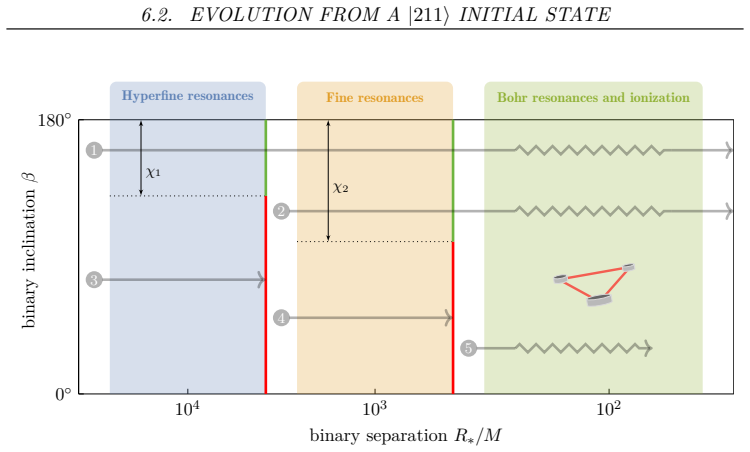
The paper's central claim is that the dynamical interaction between a black hole binary and a superradiant boson cloud is not a small perturbation but often the dominant driver of the inspiral. Ionization, the analogue of the photoelectric effect in which the binary's time-varying gravitational potential kicks bound bosons into unbound states, removes energy from the orbit at a rate that can exceed the gravitational-wave luminosity for a wide range of separations, so the binary merges substantially sooner than in vacuum. In addition, the discrete hydrogen-like spectrum of the cloud makes resonant transitions sharp: Landau-Zener crossings occur at specific orbital frequencies, and their backreaction can create floating orbits where the inspiral is temporarily stalled while eccentricity and inclination are pushed toward fixed points. Together these effects create two kinds of signatures: direct ones in the waveform from ionization power and resonance dephasing, and indirect ones in the preferred residual eccentricities and inclinations that survive even if the cloud is destroyed before the observation.
Load-bearing premise
The quantitative predictions assume a pure, non-relativistic, self-interaction-free boson cloud whose mass $M_c$ is an independent parameter, set to the fiducial $M_c/M=0.01$; if scalar self-interactions trigger a bosenova that destroys the cloud before the inspiral, or if astrophysical clouds are far less massive, the large ionization power and resonance strengths that drive the claimed signatures will be reduced or absent.
Editorial extensions
If this is right
- Ionization removes orbital energy faster than gravitational radiation over much of the inspiral, so binaries with clouds merge earlier than vacuum binaries with the same initial parameters.
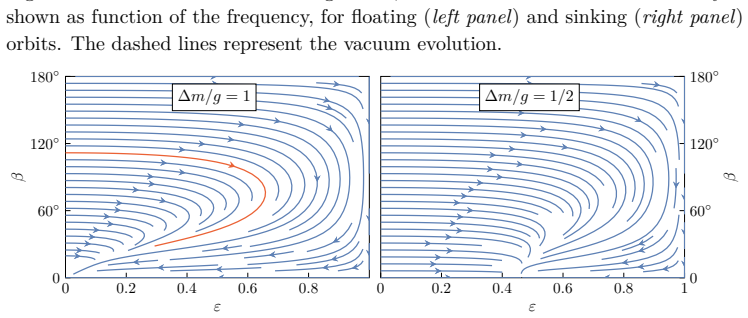
- Resonances act as filters on orbital elements, pushing eccentricity and inclination toward specific fixed points whose values are set by the cloud state and the resonance overtone number $g$.
- The cloud enhances the dynamical-capture cross section by up to factors of tens to hundreds, raising the predicted merger rate for mass ratios around $q\sim 10^{-3}$ in dense environments.
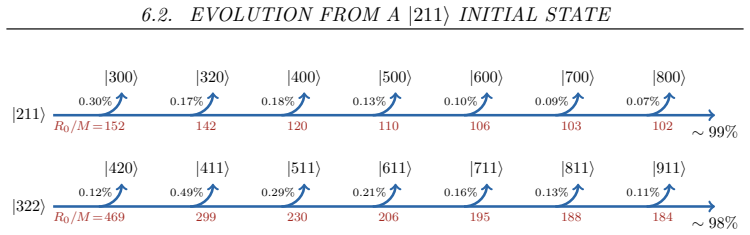
- Ionization depletes the cloud by an amount comparable to the companion's mass, so smaller clouds experience larger fractional mass loss during the inspiral.
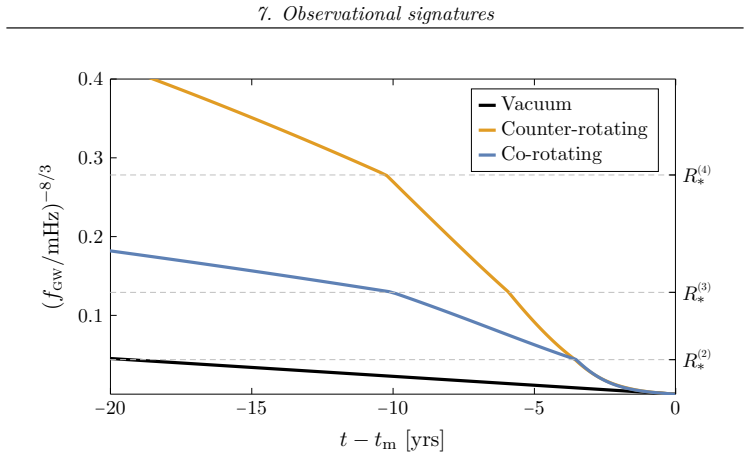
- The predicted signatures, ionization threshold steps, chirp dephasing, and fixed points in eccentricity and inclination, fall in the sensitivity bands of LISA, DECIGO, Einstein Telescope, and TianQin.
Reading between the lines
- A key implicit consequence is that measuring a vacuum-like waveform in a candidate LISA event would not rule out ultralight bosons; it would only push the cloud mass below the value needed to dominate the inspiral, so searches should scan over $M_c/M$.
- Because the ionization rate depends on the quantum numbers of the populated superradiant state, waveform fits could in principle identify which state the cloud occupied, effectively measuring the boson mass and the black hole's initial spin.
- The framework naturally extends to distinguishing boson-cloud environments from other environmental effects such as dark-matter spikes or accretion disks, since ionization produces characteristic threshold steps in the chirp that other mechanisms do not.
- A testable extension is to compute full waveform templates including the transient oscillations near ionization thresholds; their timescale $\gamma^{-1/2}$ would give a direct measurement of the effective chirp rate induced by the cloud.
Editorial analysis
A structured set of objections, weighed in public.
Referee Report
Summary. This PhD thesis studies the dynamics of an ultralight boson cloud ('gravitational atom') around a spinning black hole when a companion black hole inspirals through it. After reviewing the required background (Kerr black holes, gravitational waves, ultralight scalars, superradiance), the thesis develops a perturbative framework for the binary-cloud interaction and uses it to treat four effects: cloud-mediated dynamical capture, bound-state resonances, ionization into the continuum, and accretion onto the companion. The presentation is extended to eccentric and inclined orbits, and the backreaction of resonances on the binary is modeled through coupled Landau-Zener-type equations, leading to floating and sinking orbits and to preferred final values of eccentricity and inclination. The central quantitative claim, stated in the abstract and developed in Chapters 3-4, is that ionization power can exceed gravitational-wave luminosity during a substantial part of the inspiral, so that the cloud significantly modifies the merger time and leaves distinctive imprints in the binary parameters.
Significance. If its central claims hold, the work is significant: it provides a coherent, self-contained treatment of gravitational-atom binaries and identifies observable signatures that could be searched for with LISA, DECIGO, Einstein Telescope, and similar observatories. The main strengths are the analytic derivations from hydrogenic wavefunctions, Fermi's Golden Rule, Landau-Zener theory, and matched asymptotic expansions; the explicit scaling formulas in Sec. 4.2, which allow results to be extrapolated away from the fiducial parameters; and the transparent statement of assumptions at each step. The thesis is also honest in acknowledging its main limitations, in particular the treatment of the cloud mass as an independent parameter and the neglect of scalar self-interactions. Those limitations, however, are load-bearing for the observability claims, and the manuscript does not yet provide the model-space boundary needed to make the signatures falsifiable predictions for concrete ultralight-scalar models.
major comments (2)
- [Secs. 2.3, 2.5, 3.4, 4.3] The abstract claims that ionization and resonances leave distinctive observational signatures, but the quantitative support for this claim assumes a cloud that survives intact with Mc/M treated as a free parameter. Section 2.3 states that self-interactions are 'ignored altogether', and Section 2.5 states that Mc is treated as an independent parameter rather than linked to the black-hole parameters, with only a passing remark that self-interactions can limit the cloud mass. For the ALP/QCD-axion models motivating the work, the quartic coupling in Eq. (2.3.4) is generically nonzero; strong self-interactions can trigger a bosenova that depletes the cloud and can also shift the bound-state spectrum entering the resonance conditions. The manuscript never computes the maximum stable Mc/M as a function of the decay constant f_a, nor does it map the region of scalar-model parameter space in which the fiducial cloud (Mc/M = 0.01, alpha = 0.2, used e.g. in Fig. 4.2) actually survives. Because P_ion/P_GW and the resonance strengths scale with the cloud mass and its survival, this is not a peripheral caveat: without this boundary, the signatures are conditional on an unquantified model assumption, and for a given ALP model the predicted effect can be absent simply because the cloud is gone. I ask the authors to either compute the bosenova-safe region for the parameter space considered, or to explicitly reframe the abstract and Chapter 7 claims as predictions conditional on a stated range of f_a and self-coupling.
- [Sec. 5.1, Eqs. (5.1.2)-(5.1.3)] A central stated goal of the thesis is to extend the treatment of resonances and ionization to orbits with generic eccentricity and inclination. However, after deriving the separate eccentric and inclined expansions, Section 5.1 states: 'We do not explicitly compute η(g) in the general case'. Since the resonance strength Z, the Landau-Zener dynamics, and the resonance-breaking conditions studied in Sections 5.2-5.5 all depend quantitatively on η(g), the general simultaneous eccentric-and-inclined case is not actually evaluated. This missing step should be supplied, at least for a representative set of (epsilon, beta) values, or the scope of the 'generic orbit' claim should be explicitly restricted to the separately treated cases.
minor comments (7)
- [Sec. 1] There is a typo in the introduction: 'photoeletric' should be 'photoelectric'.
- [Sec. 2.1] In the discussion of Kerr black holes, 'astropyhsically' should be 'astrophysically'.
- [Sec. 2.2.3] The word 'anormous' in the gravitational-wave detector overview should be 'enormous'.
- [Sec. 4.6.3] The sentence 'ionization acts on inlined orbits' should read 'ionization acts on inclined orbits'.
- [Fig. 4.8] The vertical axes of the ionization rate, power, and torque plots are labeled in arbitrary units; please provide the normalization factors in the caption or text so that the curves can be compared quantitatively with Figs. 3.5 and 4.5.
- [Sec. 4.1] The claim that the dynamical-friction power Pdf reproduces Pion up to a universal O(1) factor depends on the choices rho = Mc|psi|^2, v = orbital velocity, and bmax = R*; the sensitivity of this comparison to the Coulomb cutoff bmax should be quantified.
- [Abstract, Secs. 4.3 and 7] The statement that the predictions 'can be tested' with current and future interferometers is not yet tied to a detector-level calculation: I did not find signal-to-noise or waveform-mismatch estimates that show the predicted dephasing or parameter shifts are measurable. A quantitative detectability statement, even for one benchmark, would considerably strengthen the observational claims.
Circularity Check
No significant circularity: the central predictions are derived from first-order perturbation theory, energy/momentum balance, and the hydrogenic spectrum; no fitted target quantity is renamed as a prediction.
full rationale
The thesis's central quantitative claims—ionization power Pion, the ionization rate, the Pion/Pgw ratio, resonance thresholds, and the preferred inclinations/eccentricities—are computed, not fitted. Section 3.4 obtains Pion via Fermi's Golden Rule (Eq. 3.4.5) from bound-to-continuum matrix elements of the Newtonian perturbation (Eq. 3.1.1), with the hydrogenic bound and continuum wavefunctions given in Sec. 2.5 and App. A. Section 4.4 re-derives the same result from a chirping-frequency Schrödinger equation (Eqs. 4.4.28–4.4.29), confirming the stationary-frequency result. The resonance backreaction equations (5.2.8)–(5.2.10) follow from conservation of energy and angular momentum coupled to the Landau–Zener system; no parameter is adjusted to match the claimed signatures. The thesis repeatedly cites the author's own prior papers [1–5], but those papers' derivations are reproduced in the thesis itself (Chapters 3–7), so the citations are not load-bearing in the sense of importing an unverified uniqueness theorem. The acknowledged modeling choices—treating Mc as an independent parameter (Sec. 2.5) and ignoring self-interactions (Sec. 2.3)—are assumptions that bound the validity of the predictions, not a circular reduction of the predictions to their own inputs. The skeptic concern that a bosenova could destroy the cloud is a physical robustness/assumption risk, not a circularity of the derivation chain.
Assumptions & free parameters
free parameters (4)
- cloud mass fraction Mc/M =
0.01 (fiducial; varied 0.001-0.1)
- gravitational fine structure constant alpha =
0.2 (fiducial; also 0.1 in Fig. 3.3)
- mass ratio q =
1e-3 (fiducial)
- dynamical friction Coulomb cutoff bmax =
R* (orbital separation)
assumptions (6)
- domain assumption Rotational superradiance of a light scalar around a Kerr black hole creates a long-lived bound boson cloud with the stated growth rates.
- domain assumption The scalar self-interactions are negligible, so the cloud is described by the linear Klein-Gordon and Schrodinger equation.
- domain assumption The companion is a test mass with q << 1 and the cloud's backreaction on the spacetime is O(Mc/M) and neglected.
- standard math The nonrelativistic hydrogenic approximation (alpha << 1) with bound and continuum states of the Schrodinger-Coulomb problem is accurate at the order used.
- standard math Fermi's Golden Rule and the Markov (Weisskopf-Wigner) approximation correctly capture bound-to-continuum ionization rates.
- standard math The Landau-Zener formula governs bound-bound resonances, with an extended numerical threshold for backreaction.
Cite this review
Pith. "Pith review of Gravitational Atoms and Black Hole Binaries." pith.science (2026). https://pith.science/paper/TR3TXRAU
@misc{pith2026241212526,
  author       = {Pith},
  title        = {Pith review of: Gravitational Atoms and Black Hole Binaries},
  year         = {2026},
  howpublished = {\url{https://pith.science/paper/TR3TXRAU}},
  note         = {Machine review of arXiv:2412.12526}
}
read the original abstract
Several models of physics beyond the Standard Model predict the existence of new ultralight bosons. This thesis investigates a way to discover such particles through observations of gravitational waves from binary black holes. This is possible through black hole superradiance, which spontaneously creates a "boson cloud" around a rapidly spinning black hole. The system is also known as a gravitational atom, due to its similarities with the hydrogen atom. The thesis focuses on a scenario where a gravitational atom is orbited by a binary companion. The goal is to characterize the dynamics of the system and identify the signatures left by the boson cloud on the gravitational waves emitted by the binary. The predictions can be tested with current and future interferometers, such as LISA, LIGO, DECIGO, Einstein Telescope and TianQin. First, I demonstrate that the cloud catalyzes the binary formation by increasing the dynamical capture cross section. I then introduce and study the ionization of the cloud, wherein the perturbation from the binary unbinds the bosons, analogous to the photoelectric effect in atomic physics. After that, I examine the accretion of the cloud on the companion black hole. To achieve realistic and complete results, I proceed to extend the treatment of ionization, as well as of the orbital resonances discussed in earlier works, to orbits with generic inclination and eccentricity. This allows to study the entire history of the system, from formation to merger. The most distinctive observational signatures of the cloud are found to be the orbital energy lost through ionization and the preference for specific inclinations and eccentricities induced by the orbital resonances.
Figures


Figures from the paper (39 more)










Reference graph
Works this paper leans on
-
[189]
Y. Levin, “Starbursts near supermassive black holes: young stars in the Galactic Center, and gravitational waves in LISA band,” Mon. Not. Roy. Astron. Soc. 374 (2007) 515–524, arXiv:astro-ph/0603583
arXiv 2007
-
[190]
Extreme mass-ratio inspirals into black holes surrounded by scalar clouds,
R. Brito and S. Shah, “Extreme mass-ratio inspirals into black holes surrounded by scalar clouds,” Phys. Rev. D 108 no. 8, (2023) 084019, arXiv:2307.16093 [gr-qc]
arXiv 2023
-
[191]
Axion Weak Leaks: extreme mass-ratio inspirals in ultra-light dark matter,
F. Duque, C. F. B. Macedo, R. Vicente, and V. Cardoso, “Axion Weak Leaks: extreme mass-ratio inspirals in ultra-light dark matter,” arXiv:2312.06767 [gr-qc]
-
[192]
Formation Rate of Extreme Mass Ratio Inspirals in Active Galactic Nuclei,
Z. Pan and H. Yang, “Formation Rate of Extreme Mass Ratio Inspirals in Active Galactic Nuclei,” Phys. Rev. D 103 no. 10, (2021) 103018, arXiv:2101.09146 [astro-ph.HE]
arXiv 2021
-
[193]
Wet extreme mass ratio inspirals may be more common for spaceborne gravitational wave detection,
Z. Pan, Z. Lyu, and H. Yang, “Wet extreme mass ratio inspirals may be more common for spaceborne gravitational wave detection,” Phys. Rev. D 104 no. 6, (2021) 063007, arXiv:2104.01208 [astro-ph.HE]
arXiv 2021
-
[194]
Signatures of ultralight bosons in the orbital eccentricity of binary black holes,
M. Bo vskovi´ c, M. Koschnitzke, and R. A. Porto, “Signatures of ultralight bosons in the orbital eccentricity of binary black holes,” arXiv:2403.02415 [gr-qc]
-
[195]
Gravitational Collider Physics via Pulsar-Black Hole Binaries,
Q. Ding, X. Tong, and Y. Wang, “Gravitational Collider Physics via Pulsar-Black Hole Binaries,” Astrophys. J. 908 no. 1, (2021) 78, arXiv:2009.11106 [astro-ph.HE]
arXiv 2021
-
[196]
X. Tong, Y. Wang, and H.-Y. Zhu, “Gravitational Collider Physics via Pulsar–Black Hole Binaries II: Fine and Hyperfine Structures Are Favored,” Astrophys. J. 924 no. 2, (2022) 99, arXiv:2106.13484 [astro-ph.HE]
arXiv 2022
Show all 14 references
-
[197]
Searching for ultra-light bosons and constraining black hole spin distributions with stellar tidal disruption events,
P. Du, D. Egana-Ugrinovic, R. Essig, G. Fragione, and R. Perna, “Searching for ultra-light bosons and constraining black hole spin distributions with stellar tidal disruption events,” Nature Commun. 13 no. 1, (2022) 4626, arXiv:2202.01215 [hep-ph]
2022 arXiv
-
[198]
Modulating binary dynamics via the termination of black hole superradiance,
K. Fan, X. Tong, Y. Wang, and H.-Y. Zhu, “Modulating binary dynamics via the termination of black hole superradiance,” Phys. Rev. D 109 no. 2, (2024) 024059, arXiv:2311.17013 [gr-qc]
2024 arXiv
-
[199]
Signatures of ultralight bosons in compact binary inspiral and outspiral,
Y. Cao and Y. Tang, “Signatures of ultralight bosons in compact binary inspiral and outspiral,” Phys. Rev. D 108 no. 12, (2023) 123017, arXiv:2307.05181 [gr-qc]
2023 arXiv
-
[200]
Relativistic Perturbation Theory for Black-Hole Boson Clouds,
E. Cannizzaro, L. Sberna, S. R. Green, and S. Hollands, “Relativistic Perturbation Theory for Black-Hole Boson Clouds,” Phys. Rev. Lett. 132 no. 5, (2024) 051401, arXiv:2309.10021 [gr-qc]
2024 arXiv
-
[201]
Fast extreme-mass-ratio-inspiral waveforms: New tools for millihertz gravitational-wave data analysis,
M. L. Katz, A. J. K. Chua, L. Speri, N. Warburton, and S. A. Hughes, “Fast extreme-mass-ratio-inspiral waveforms: New tools for millihertz gravitational-wave data analysis,” Phys. Rev. D 104 no. 6, (2021) 064047, arXiv:2104.04582 [gr-qc]
2021 arXiv
-
[202]
Black Hole Hair from Scalar Dark Matter,
L. Hui, D. Kabat, X. Li, L. Santoni, and S. S. C. Wong, “Black Hole Hair from Scalar Dark Matter,” JCAP 06 (2019) 038, arXiv:1904.12803 [gr-qc] . 176
2019 arXiv
Reviewed August 11, 2026 · model on record in the stance chip above.
Discussion (0). Continue with ORCID to comment.