EmbodiTTA: Resource-Efficient Test-Time Adaptation for Embodied Visual Systems
Pith reviewed 2026-05-22 16:30 UTC · model grok-4.3
The pith
OD-TTA adapts models on edge devices only when domain shifts are detected, cutting energy use while matching full adaptation accuracy.
A machine-rendered reading of the paper's core claim, the machinery that carries it, and where it could break.
Core claim
OD-TTA is an on-demand TTA framework that activates adaptation only upon detecting a significant domain shift, using a lightweight detection mechanism, a source domain selection module, and a decoupled Batch Normalization update scheme to achieve accurate adaptation with reduced memory and energy overhead on edge devices.
What carries the argument
The lightweight domain shift detection mechanism that decides when to trigger adaptation, combined with source selection and decoupled BN updates.
If this is right
- Adaptation becomes feasible on devices with limited memory and battery by avoiding unnecessary updates.
- Accuracy remains high or improves because adaptation is targeted rather than constant.
- Small batch sizes work for adaptation thanks to the decoupled BN scheme.
- Overall computation overhead drops substantially compared to continual TTA.
Where Pith is reading between the lines
- Similar on-demand strategies might benefit other continual learning tasks beyond visual adaptation.
- Integrating this with hardware-specific optimizations could further reduce costs in embodied AI.
- The detection mechanism implies that many domain changes are minor and do not warrant full adaptation.
Load-bearing premise
The domain shift detector correctly identifies when adaptation is needed without missing critical shifts or activating too frequently on insignificant variations.
What would settle it
A test scenario where the system fails to detect a genuine domain shift, resulting in degraded model performance compared to continuous adaptation.
Figures




read the original abstract
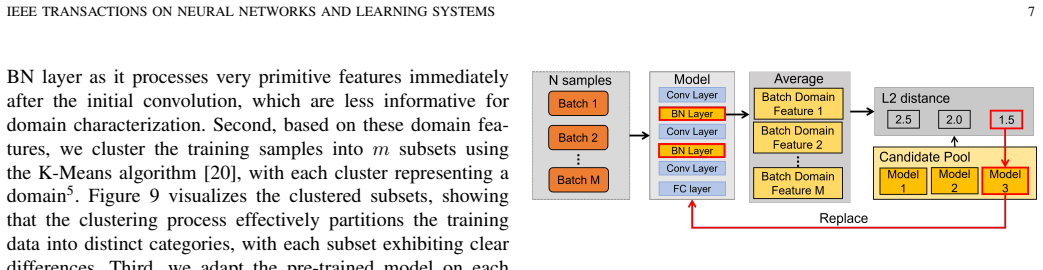
Continual Test-time adaptation (CTTA) continuously adapts the deployed model on every incoming batch of data. While achieving optimal accuracy, existing CTTA approaches present poor real-world applicability on resource-constrained edge devices, due to the substantial memory overhead and energy consumption. In this work, we first introduce a novel paradigm -- on-demand TTA -- which triggers adaptation only when a significant domain shift is detected. Then, we present OD-TTA, an on-demand TTA framework for accurate and efficient adaptation on edge devices. OD-TTA comprises three innovative techniques: 1) a lightweight domain shift detection mechanism to activate TTA only when it is needed, drastically reducing the overall computation overhead, 2) a source domain selection module that chooses an appropriate source model for adaptation, ensuring high and robust accuracy, 3) a decoupled Batch Normalization (BN) update scheme to enable memory-efficient adaptation with small batch sizes. Extensive experiments show that OD-TTA achieves comparable and even better performance while reducing the energy and computation overhead remarkably, making TTA a practical reality.
Editorial analysis
A structured set of objections, weighed in public.
Referee Report
Summary. The paper introduces a new 'on-demand TTA' paradigm for continual test-time adaptation in embodied visual systems on resource-constrained devices. OD-TTA triggers adaptation only upon detecting significant domain shifts via a lightweight detector, selects an appropriate source model, and employs a decoupled batch normalization update to support memory-efficient adaptation with small batches. The authors claim that extensive experiments demonstrate comparable or superior accuracy to standard CTTA methods while achieving substantial reductions in energy and computational overhead.
Significance. If the efficiency gains hold without accuracy degradation, this work could meaningfully advance practical deployment of adaptive models on edge hardware for robotics and embodied AI, addressing key barriers of memory and power consumption that currently limit continual TTA.
major comments (2)
- [Section 3.1] Section 3.1 (Domain Shift Detection): The central efficiency claim rests on the lightweight domain shift detector triggering adaptation only for significant shifts. No precision, recall, threshold sensitivity analysis, or ablation on missed shifts (e.g., gradual lighting or viewpoint changes in navigation) is reported, leaving the 'on-demand' premise unverified and risking silent accuracy loss in deployment.
- [Section 4] Section 4 (Experiments): The abstract asserts 'comparable and even better performance' with 'remarkably' reduced overhead, yet the manuscript provides no concrete accuracy metrics, energy/computation numbers, baseline comparisons, or statistical significance tests. This absence prevents evaluation of whether the claimed gains are load-bearing or merely incremental.
minor comments (2)
- [Section 3.1] The notation and exact formulation of the domain shift detection threshold and scoring function should be stated explicitly with an equation for reproducibility.
- [Section 4] Figure captions and axis labels in the experimental results could more clearly distinguish energy vs. accuracy trade-offs across methods.
Simulated Author's Rebuttal
We thank the referee for the constructive feedback on our manuscript. We address the major comments point by point below, outlining how we will strengthen the presentation and analysis in the revised version.
read point-by-point responses
-
Referee: [Section 3.1] Section 3.1 (Domain Shift Detection): The central efficiency claim rests on the lightweight domain shift detector triggering adaptation only for significant shifts. No precision, recall, threshold sensitivity analysis, or ablation on missed shifts (e.g., gradual lighting or viewpoint changes in navigation) is reported, leaving the 'on-demand' premise unverified and risking silent accuracy loss in deployment.
Authors: We agree that a dedicated evaluation of the domain shift detector would provide stronger support for the on-demand TTA premise. In the revised manuscript, we will add precision and recall metrics for the detector across different shift magnitudes, include threshold sensitivity analysis, and provide ablations examining performance under gradual domain shifts such as lighting variations or viewpoint changes typical in navigation scenarios. These additions will help confirm that the detector reliably triggers adaptation without introducing silent accuracy degradation. revision: yes
-
Referee: [Section 4] Section 4 (Experiments): The abstract asserts 'comparable and even better performance' with 'remarkably' reduced overhead, yet the manuscript provides no concrete accuracy metrics, energy/computation numbers, baseline comparisons, or statistical significance tests. This absence prevents evaluation of whether the claimed gains are load-bearing or merely incremental.
Authors: The experimental results, including accuracy metrics, energy and computation overhead numbers, and comparisons against standard CTTA baselines, are presented in Section 4 along with the associated tables and figures. To improve clarity and address the concern directly, we will revise Section 4 to more explicitly tabulate and highlight these concrete values, ensure all baseline comparisons are clearly labeled, and add statistical significance tests (such as mean and standard deviation over multiple runs or p-values) to demonstrate that the observed efficiency gains and accuracy levels are robust rather than incremental. revision: partial
Circularity Check
No significant circularity; empirical techniques and experiments stand independently
full rationale
The paper introduces an on-demand TTA paradigm and three concrete modules (lightweight shift detection, source selection, decoupled BN) whose value is demonstrated through empirical results on accuracy and resource use. No equations, fitted parameters renamed as predictions, or self-citation chains are load-bearing for the central claims. The derivation chain consists of proposed algorithmic choices validated externally by experiments rather than reducing to inputs by construction.
Axiom & Free-Parameter Ledger
Lean theorems connected to this paper
-
IndisputableMonolith/Cost/FunctionalEquation.leanwashburn_uniqueness_aczel unclear?
unclearRelation between the paper passage and the cited Recognition theorem.
lightweight domain shift detection mechanism using exponential moving average (EMA) entropy to detect the domain shift
-
IndisputableMonolith/Foundation/AlphaCoordinateFixation.leanalpha_pin_under_high_calibration unclear?
unclearRelation between the paper passage and the cited Recognition theorem.
decoupled BN update strategy... BN statistics... updated... with larger batch sizes... BN parameters with smaller batch sizes
What do these tags mean?
- matches
- The paper's claim is directly supported by a theorem in the formal canon.
- supports
- The theorem supports part of the paper's argument, but the paper may add assumptions or extra steps.
- extends
- The paper goes beyond the formal theorem; the theorem is a base layer rather than the whole result.
- uses
- The paper appears to rely on the theorem as machinery.
- contradicts
- The paper's claim conflicts with a theorem or certificate in the canon.
- unclear
- Pith found a possible connection, but the passage is too broad, indirect, or ambiguous to say the theorem truly supports the claim.
Forward citations
Cited by 1 Pith paper
-
What changes after deployment? A survey on On-device Learning in TinyML
A survey of on-device learning in TinyML organized by distribution change regimes, highlighting influences on applications, hardware, and solutions plus a gap between benchmarks and deployments.
discussion (0)
Sign in with ORCID, Apple, or X to comment. Anyone can read and Pith papers without signing in.