REVIEW 4 major objections 6 minor 23 references
Language-Structured Relational Q-Learning for Threat-Aware Control in Safety-Critical Driving
T0 review · 4 major / 6 minor · reviewed 2026-08-15 · deepseek-v4-flash
Pith's one-line read Language-structured training gives a driving policy threat awareness, but not the ability to choose the right maneuver.
desk verdict The recognition-control gap is a genuinely useful diagnostic, but the language-attribution claim is confounded and needs a programmatic control before it is taken at face value. read the letter →
The pith
A machine-rendered reading of the paper's core claim, the machinery that carries it, and where it could break.
The reading
What carries the argument
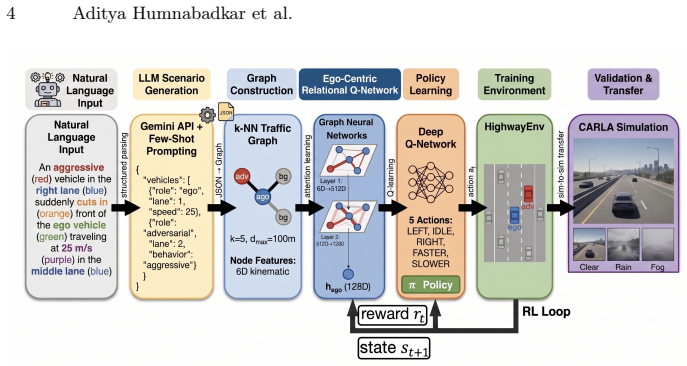
The load-bearing object is the Ego-Centric Relational Q-Network (ERQ-Net), a graph-attention value network. At each timestep the scene becomes a k-nearest-neighbour traffic graph (k=5, 100m radius) whose nodes are vehicles described by kinematic features; two multi-head graph-attention layers aggregate neighbours into an ego-node embedding, and a two-layer MLP maps that embedding to Q-values for five maneuvers: LEFT, IDLE, RIGHT, FASTER, SLOWER. The graph encoder and Q-head are trained jointly by the temporal-difference objective, so attention is shaped by its utility for action selection rather than by a separate representation loss. Natural-language descriptions are parsed by a schema-constrained language model into actor configurations and interaction programs, and those descriptions and semantic roles are withheld from the policy, which must infer threat relevance from observable kinematics alone. The second key object is the recognition–control gap measure, the difference between the success of a union of policies and the best single policy, which quantifies solvable headroom that no single policy exploits.
What would settle it
Measure the criticality score of the random-control training distribution under the same non-reactive reference ego used for the language-structured set—the collision rate when the ego drives at constant velocity with no avoidance. If the random-control criticality is substantially below the 0.75 reported for the language-structured set, the six-point success gain and 2.1x attention gain could reflect scenario difficulty rather than language-induced structure, and the counterfactual does not isolate semantics.
Extended reading notes
Core claim
On the paper's own terms, the central discovery is that a relational Q-network trained on language-structured safety-critical scenarios learns to attend to the adversarial vehicle, raising its threat-attention ratio from 1.2x to 2.1x and improving success by up to six points over a matched random control, but the policy then plateaus at roughly the success of the best constant action, 'SLOWER' at 57%, and does not exploit the 76% headroom available to a union of twelve simple policies. The authors formalize this as a recognition–control gap of 18 percentage points, show that reward reweighting and dense margin shaping actually reduce success, and find that increasing the decision frequency from 1Hz to 10Hz narrows the gap to 7 points. The same policy also transfers zero-shot from a highway driving simulator to a second urban simulator through a shared graph-state interface with about 73% average success, which the paper interprets as geometric portability of the state interface rather than visual robustness.
Load-bearing premise
The random-control training set is treated as a valid counterfactual: it matches the marginal ranges of vehicle count, position, lane, and speed but omits the coherent adversarial interaction, so the six-point success gain and 2.1x attention gain are attributed to language-induced structure rather than to the presence of structured adversarial content.
Editorial extensions
If this is right
- If the recognition–control gap is real, then reporting mean success over random controls can hide the fact that a learned policy is no better than a constant action; benchmarks should include constant-action baselines and policy-union headroom.
- Raising the decision frequency from 1Hz to 10Hz cuts the gap from 18 to 7 points, so temporal resolution within the critical interaction window is a concrete lever for turning threat recognition into action.
- Language-structured training alone is enough to shape attention toward relevant actors, which suggests language can act as a curriculum signal even when it is never seen at execution time.
- Reward reweighting and margin shaping do not prevent policy collapse, implying the failure is not a simple reward-shaping issue and that objective-level diversity preservation is needed.
Reading between the lines
- A cleaner counterfactual would train on the same coherent interaction programs with randomized or shuffled language labels; if performance and attention match the language-structured condition, the gains come from structured adversarial content, not from natural-language semantics.
- The same recognition–control gap may appear in other language-generated training domains, such as robotic manipulation or game playing, where the policy must infer intent from observed behavior; decision-frequency and policy-union diagnostics are cheap to port.
- The 7-point residual gap at 10Hz suggests that beyond temporal resolution, the discrete low-level action space (five maneuvers) or lack of memory may limit scenario-adaptive control; continuous or hierarchical actions are a testable next step.
- If language-conditioned generation is to serve safety validation, the practical takeaway is to treat the generated scenes as a probe for attention and failure modes, not as a direct recipe for a deployable controller.
Signed reviews
Editorial analysis
A structured set of objections, weighed in public.
Referee Report
Summary. The paper proposes Language-Structured Relational Q-Learning, instantiated through an Ego-Centric Relational Q-Network (ERQ-Net), to study whether training on language-structured traffic scenarios produces threat-aware and adaptive control policies. Natural-language descriptions are parsed into schema-valid configurations and executable interaction programs (cut-in, sudden braking, overtaking, tailgating), but the policy observes only kinematic graph features, not language or semantic roles. The authors compare ERQ-Net trained on language-structured scenarios (D_lang) against a random-control distribution (D_rand), report a six-point success improvement and an increase in adversary-focused attention, and then show that trained policies remain comparable to the best constant action while a portfolio of simple policies solves 76% of scenarios. They formalize this as a recognition-control gap and investigate reward shaping, decision frequency, encoder ablations, scenario quality, and state-interface transfer to CARLA.
Significance. If the central attribution were established, the paper would make a useful contribution to language-conditioned scenario generation and to evaluating whether representation-level threat awareness translates into control. The manuscript is unusually honest: it reports the policy-collapse result as a first-class finding, includes constant-action and policy-portfolio baselines, and provides a decision-frequency ablation that gives a concrete, testable mechanism for the recognition-control gap. The CARLA transfer study also draws a careful and appropriate distinction between state-interface transfer and perception-level sim-to-real transfer. However, the positive claim that language structure, rather than the presence of coherent adversarial interaction programs, drives the observed gains is underdetermined by the current experimental design. The recognition-control-gap analysis is more robust than the headline success improvement and should be framed as the main contribution.
major comments (4)
- [Section 3.1 and Tables 2-3] The random-control distribution D_rand is not a valid counterfactual for isolating language-induced structure. D_lang and D_rand differ by two factors at once: scenarios are instantiated from LLM-parsed language descriptions, and they contain a coherent adversarial interaction program, whereas D_rand samples vehicle count, position, lane, and speed independently and omits the structured interaction. The reported 55-58% versus 49-52% success gain and the 2.1x versus 1.2x attention ratio could therefore be produced by any training distribution that contains structured adversarial events, regardless of language. Since Section 4.1 states that the parser is replaceable by any model that emits schema-valid JSON, the causal content may reside in the interaction program rather than in the language. A third training condition using the same interaction programs and parameter ranges generated programmatically (no LLM) is needed to attribute the gains to language structure; without it, the paper's central positive claim is underdetermined.
- [Eq. (4) and Table 3] The threat-attention ratio Athreat is computed from the model's own final-layer attention coefficients, and the paper interprets the increase from 1.2x to 2.1x as evidence of 'emergent threat awareness.' This interpretation is partially circular: attention is jointly optimized for Q-value estimation, so preferential weighting of the adversarial actor can be a byproduct of value computation rather than evidence of a semantically meaningful threat representation. The claim needs external validation, for example by comparing attention to ground-truth relevance masks derived from the interaction program, or by an intervention showing that high attention to the adversarial node is causally necessary for the observed success (e.g., clamping or ablating that attention). As written, the awareness claim is not independently supported.
- [Section 5.1 and Tables 2-3] The headline six-point improvement is reported as ranges over three seeds without confidence intervals or significance tests. Although the reported min-max ranges do not overlap, three seeds is a small sample, and the same 500-scenario test set is evaluated across seeds, so a paired test or a bootstrap over scenarios should accompany the central comparison. This matters because the paper's main positive claim rests on this difference; the current presentation does not distinguish a stable effect from seed noise.
- [Table 6] The recognition-control gap at each decision frequency is computed as the shortfall from the 76% portfolio union reported in Table 2, which was obtained at 1 Hz. If the simple policies in the portfolio also benefit from higher decision frequency, the 76% ceiling is not constant across frequencies, so the reported shrinkage of the gap from 18 to 8 points may overstate the improvement attributable to decision frequency. The portfolio union should be recomputed at 2, 5, and 10 Hz before concluding that temporal resolution closes the gap.
minor comments (6)
- [Section 3.3, Eq. (8)] The margin-shaping term r_margin(dfront) is not defined precisely; its functional form should be stated for reproducibility.
- [Table 2] The 'Best constant action (SLOWER)' row reports a single value (57%) while neighboring rows report ranges over seeds; please report the seed range for this baseline as well.
- [Section 4.1] The manuscript names the Gemini API but does not give the model version, temperature, or other decoding parameters; these details are needed for reproducibility of the parser results.
- [Figure 4 caption] The figure caption mentions night settings, but the table reports only clear, heavy rain, and dense fog; please clarify whether a night condition was actually evaluated.
- [Eq. (5)] The indicator function is rendered as a boxed symbol in the text; use \mathbb{1} consistently to avoid confusion.
- [Table 3 caption] Please state explicitly that the reported success values are min-max ranges over three seeds, not confidence intervals, so that readers do not overinterpret the six-point gap.
Circularity Check
No circular derivation found: the central claims rest on empirical comparisons and measured diagnostics, not on fitted inputs or self-citation chains.
full rationale
I walked the paper's derivation chain and found no step in which a claimed prediction reduces by construction to its own inputs. The central comparison is empirical: the same ERQ-Net architecture is trained on D_lang and D_rand and evaluated on a fixed 500-scenario test set, with success and A_threat reported as measured outcomes. Equation 4 defines A_threat as the ratio of the model's own final-layer attention weights, which is an operational metric for adversary-focused attention; the abstract's phrase 'emergent threat awareness' is an interpretive label, not a quantity obtained by fitting the same data from which it is later 'predicted'. The TD objective in Eq. 15 does not contain A_threat, and A_threat is not used as a training reward or target, so the attention result is not forced by the optimization objective. The recognition-control gap in Eqs. 5-6 is a diagnostic computed from a policy union; although the union is definitionally at least as good as any single policy, the paper presents it as a measurement of headroom, not as a derived theoretical prediction. The only self-citation, reference [15] by one of the present authors, appears in a context sentence about the cost of physical testing and is not load-bearing. The main threat to the central language-structured claim is a confound, not circularity: D_rand omits the coherent adversarial interaction, so the D_lang-versus-D_rand difference does not isolate 'language' from 'structured adversarial content'. The paper's own admission that the parser is replaceable by any schema-valid JSON emitter reinforces this confound, but this is a validity and experimental-design concern, properly scored under correctness risk, not circularity. No equation reduces to another equation, no fitted parameter is renamed as a prediction, and no load-bearing conclusion depends on a self-citation chain.
Assumptions & free parameters
free parameters (3)
- Scenario quality weights (w_R, w_C, w_F) =
0.4, 0.4, 0.2 (hand-chosen)
- Reward coefficients (omega_col, omega_lc) =
1.0, 0.1 (hand-chosen)
- Target velocity v_target =
30 m/s
assumptions (3)
- domain assumption The simulator's kinematic node features (position, velocity, heading) are sufficient to identify threat relevance.
- domain assumption Graph-attention coefficients are a valid measure of actual threat awareness.
- standard math Standard DQN convergence assumptions hold in the HighwayEnv simulator over 1,000 episodes.
Cite this review
Pith. "Pith review of Language-Structured Relational Q-Learning for Threat-Aware Control in Safety-Critical Driving." pith.science (2026). https://pith.science/paper/TSFDCY6V
@misc{pith2026260811498,
  author       = {Pith},
  title        = {Pith review of: Language-Structured Relational Q-Learning for Threat-Aware Control in Safety-Critical Driving},
  year         = {2026},
  howpublished = {\url{https://pith.science/paper/TSFDCY6V}},
  note         = {Machine review of arXiv:2608.11498}
}
read the original abstract
Natural-language-based scenario generation offers an intuitive means of describing rare and complex driving interactions, yet it is still uncertain whether training with language-structured data leads to truly adaptive control policies. We propose Language-Structured Relational Q-Learning, instantiated through an Ego-Centric Relational Q-Network (ERQ-Net), which jointly learns inter-vehicle relevance and action values from dynamic traffic graphs. Language descriptions define surrounding-vehicle behaviours during training, while prompts and semantic actor roles are hidden from the policy. ERQ-Net must therefore infer threat relevance solely from observable kinematics and interactions. Across 2,500 safety-critical scenarios, language-structured training improves test success from 49-52% to 55-58% and increases adversary-focused attention from 1.2x to 2.1x, demonstrating emergent threat awareness. However, this representational gain does not consistently translate into adaptive control: trained policies perform similarly to the best constant action, while a portfolio of simple policies solves 76% of scenarios. We formalise this discrepancy as a recognition-control gap and show that reward reweighting and margin shaping do not eliminate the resulting policy collapse. Evaluations of realism, criticality, semantic accuracy, and transfer of state-interface representations to CARLA further highlight both the strengths and the constraints of language-structured relational policy learning in safety-critical driving scenarios.
Figures


Figures from the paper (1 more)

Reference graph
Works this paper leans on
-
[1]
Cai, X., Bai, X., Cui, Z., Xie, D., Fu, D., Yu, H., Ren, Y.: Text2scenario: Text- driven scenario generation for autonomous driving test. Automotive Innovation pp. 1–26 (2026)
work page 2026
-
[2]
com / carla - simulator / scenario_runner(2019)
CARLA Team: Scenario runner.https : / / github . com / carla - simulator / scenario_runner(2019)
work page 2019
-
[3]
In: 2020 IEEE/RSJ International Conference on Intelligent Robots and Systems (IROS)
Ding, W., Chen, B., Xu, M., Zhao, D.: Learning to collide: An adaptive safety- critical scenarios generating method. In: 2020 IEEE/RSJ International Conference on Intelligent Robots and Systems (IROS). pp. 2243–2250. IEEE (2020)
work page 2020
- [4]
- [5]
- [6]
-
[7]
Kalra, N., Paddock, S.M.: Driving to safety: How many miles of driving would it take to demonstrate autonomous vehicle reliability? Transportation Research Part A: Policy and Practice94, 182–193 (2016)
work page 2016
-
[8]
Leurent, E.: An environment for autonomous driving decision-making.https:// github.com/eleurent/highway-env(2018)
work page 2018
Show all 23 references
-
[9]
Nature518(7540), 529–533 (2015)
Mnih, V., Kavukcuoglu, K., Silver, D., Rusu, A.A., Veness, J., Bellemare, M.G., Graves, A., Riedmiller, M., Fidjeland, A.K., Ostrovski, G., et al.: Human-level control through deep reinforcement learning. Nature518(7540), 529–533 (2015)
2015
-
[10]
In: 2024 IEEE 27th International Conference on Intelligent Transportation Systems (ITSC)
Ransiek, J., Plaum, J., Langner, J., Sax, E.: Goose: Goal-conditioned reinforcement learning for safety-critical scenario generation. In: 2024 IEEE 27th International Conference on Intelligent Transportation Systems (ITSC). pp. 2651–2658. IEEE (2024)
2024
-
[11]
In: CVPR
Rempe, D., Philion, J., Guibas, L.J., Fidler, S., Litany, O.: Generating useful accident-prone driving scenarios via a learned traffic prior. In: CVPR. pp. 17305– 17315 (2022)
2022
-
[12]
In: Conference on Robot Learning
Rowe, L., Girgis, R., Gosselin, A., Carrez, B., Golemo, F., Heide, F., Paull, L., Pal, C.: Ctrl-sim: Reactive and controllable driving agents with offline reinforcement learning. In: Conference on Robot Learning. pp. 3600–3621. PMLR (2025)
2025
-
[13]
In: CVPR
Suo, S., Regalado, S., Casas, S., Urtasun, R.: TrafficSim: Learning to simulate realistic multi-agent behaviors. In: CVPR. pp. 10400–10409 (2021)
2021
-
[14]
In: CoRL
Tan, S., Ivanovic, B., Weng, X., Pavone, M., Kraehenbuehl, P.: Language condi- tioned traffic generation. In: CoRL. pp. 2714–2752 (2023)
2023
-
[15]
IET Intelligent Transport Systems 14(10), 1228–1239 (2020)
Thomas, E., McCrudden, C., Wharton, Z., Behera, A.: Perception of autonomous vehicles by the modern society: A survey. IET Intelligent Transport Systems 14(10), 1228–1239 (2020)
2020
-
[16]
arXiv preprint arXiv:2404.08570 (2024)
Tian, H., Reddy, K., Feng, Y., Quddus, M., Demiris, Y., Angeloudis, P.: Enhancing autonomous vehicle training with language model integration and critical scenario generation. arXiv preprint arXiv:2404.08570 (2024)
2024 arXiv
-
[17]
Veličković, P., Cucurull, G., Casanova, A., Romero, A., Liò, P., Bengio, Y.: Graph attention networks (2017), arXiv preprint arXiv:1710.10903
2017 arXiv
-
[18]
Wang, J., Pun, A., Tu, J., Manivasagam, S., Sadat, A., Casas, S., Ren, M., Urtasun, R.:AdvSim:Generatingsafety-criticalscenariosforself-drivingvehicles.In:CVPR. pp. 9909–9918 (2021) 16 Aditya Humnabadkar et al
2021
-
[19]
In: NeurIPS
Xu, C., Ding, W., Lyu, W., Liu, Z., Wang, S., He, Y., Hu, H., Zhao, D., Li, B.: SafeBench: A benchmarking platform for safety evaluation of autonomous vehicles. In: NeurIPS. pp. 25667–25682 (2022)
2022
-
[20]
In: CVPR (2024)
Zhang, J., Xu, C., Li, B.: ChatScene: Knowledge-enabled safety-critical scenario generation for autonomous vehicles. In: CVPR (2024)
2024
-
[21]
In: CoRL
Zhang, L., Peng, Z., Li, Q., Zhou, B.: CAT: Closed-loop adversarial training for safe end-to-end driving. In: CoRL. pp. 2357–2372 (2023)
2023
-
[22]
In: CoRL (2023)
Zhong, Z., Rempe, D., Chen, Y., Ivanovic, B., Cao, Y., Xu, D., Pavone, M., Ray, B.: Language-guided traffic simulation via scene-level diffusion. In: CoRL (2023)
2023
-
[23]
In: CVPR
Zhou, Z., Ye, L., Wang, J., Wu, K., Lu, K.: HiVT: Hierarchical vector transformer for multi-agent motion prediction. In: CVPR. pp. 8823–8833 (2022)
2022
Reviewed August 15, 2026 · model on record in the stance chip above.
Discussion (0). Continue with ORCID to comment.