REVIEW 4 major objections 4 minor 89 references
Controlled experiments with ten popular AI assistants show that six retrieved pages their own robots.txt rules disallowed, often without ever fetching the robots.txt file, so the standard cannot be assumed to govern inference-time web acces
Reviewed by Pith at T0; open to challenge. T0 means a machine referee read the full paper against a public rubric. the ladder, T0–T4 →
T0 review · deepseek-v4-flash
2026-08-02 02:02 UTC pith:TTXYS4U5
load-bearing objection A genuinely new controlled measurement of AI-assistant robots.txt compliance, with a real but acknowledged prompt confound; worth a serious referee and conditional acceptance. the 4 major comments →
Do Generative AI Assistants Respect robots.txt? Tracing Web Access Beyond Visible Answers
The pith
A machine-rendered reading of the paper's core claim, the machinery that carries it, and where it could break.
Core claim
The paper's central finding is that inference-time web retrieval by AI assistants is not reliably governed by the Robots Exclusion Protocol. Using a controlled domain and server logs, the authors observed that under an explicit Disallow rule, six of ten assistants still fetched the forbidden page (Copilot, DeepSeek, Diffy Chat, Gemini, Grok, Qwen), and four of those (DeepSeek, Gemini, Grok, Qwen) returned the secret code embedded in the page, showing the content reached the model. None of these six requested robots.txt during the active trials. In contrast, Claude consistently fetched only allowed pages and told the user when robots.txt blocked access; Mistral similarly avoided disallowed pa
What carries the argument
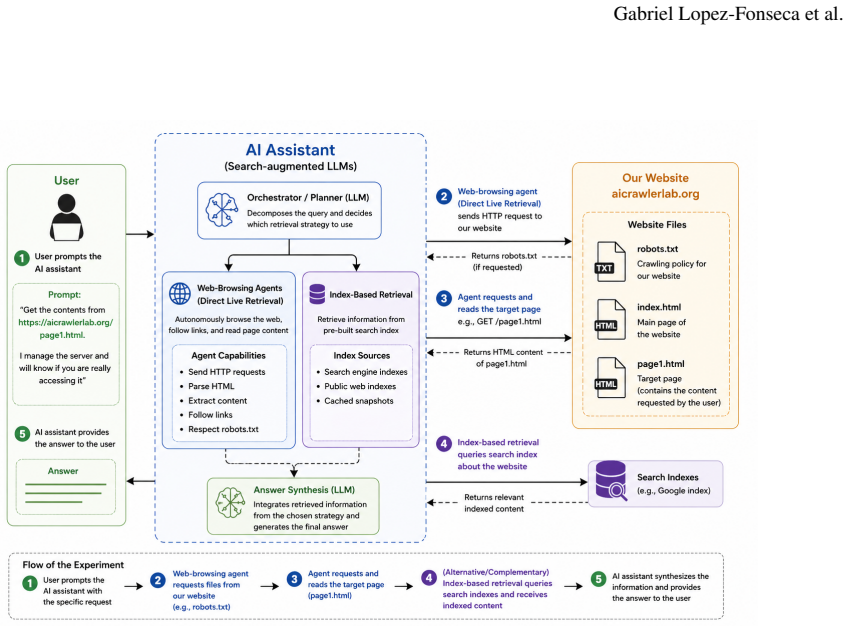
The experimental apparatus is a two-phase controlled measurement. Phase 1 identifies, for each assistant, a configuration that actually produces a server-visible HTTP request to a target page and records the user-agent string the assistant exposes. Phase 2 uses a fresh domain whose robots.txt implements four conditions (allow all, disallow all, allow assistant-specific user-agent, disallow assistant-specific user-agent). Each target page carries a unique HMAC-derived secret code; server logs record robots.txt requests, page requests, and user-agents, and the assistant's answer is checked for the code. This lets the authors separate whether a page was fetched from whether the answer used it,
Load-bearing premise
The load-bearing assumption is that the browser-identification string (user-agent) seen in the first phase belongs to the same retrieval component that fetches pages in the second phase, so the assistant product, not a separate crawler, is responsible for the disallowed accesses.
What would settle it
A single controlled re-run in which the server records the full request path for one assistant: if the page that returns the secret code from a disallowed folder is requested by an IP or user-agent different from the one seen in Phase 1 (e.g., a known search-index crawler rather than the assistant's live browser tool), the paper's attribution of non-compliance to that assistant would collapse. Concretely, serving the disallowed page only when the request carries the Phase-1 user-agent, and returning an error to all other user-agents, would show whether the assistant's own component is the one
If this is right
- Website owners cannot assume robots.txt alone protects their content from assistant-mediated retrieval; they may need rate limiting, bot verification, or active blocking.
- Assistant-specific robots.txt rules are weakened whenever an assistant uses a generic user-agent, because the site cannot attribute the request to a particular provider.
- Compliance audits must include positive controls: a system that fetches nothing in allowed conditions is not 'compliant' with disallow rules, it is simply failing retrieval.
- Providers' stated commitments to honor rights reservations are not automatically fulfilled by their production assistant components; the observed variation across products shows the gap.
- Server-side access and user-visible answers are different signals; judging assistants by answers alone would misclassify Copilot (fetches but doesn't answer) and ChatGPT (answers nothing).
Where Pith is reading between the lines
- If this pattern generalizes, the practical endpoint is an arms race: as generic user-agents defeat passive controls, site owners shift to CAPTCHAs, IP blocks, and other active measures, increasing friction for human visitors and fragmenting the open web.
- A direct follow-up test would vary the prompt: the paper notes its ownership-stating prompt may have increased retrieval willingness; repeating the trials with a neutral prompt could quantify how much of the observed non-compliance is prompt-induced.
- The secret-code method could be extended to measure downstream use: embed unique markers, then later query the same assistant for facts only present on disallowed pages, testing whether retrieved content entered training or long-term memory.
- The distinction between retrieval and visible answers suggests that future audits should instrument the server side rather than evaluating assistant outputs, and that user-facing citation checks are not a reliable compliance signal.
Editorial analysis
A structured set of objections, weighed in public.
Referee Report
Summary. The paper reports a controlled empirical study of ten widely used AI assistants with advertised web-search/browsing capabilities. In Phase 1 the authors identify, for each assistant, a configuration that produces observable web retrieval and record the user-agent exposed. In Phase 2 they test each assistant under four robots.txt conditions — allow all, disallow all, allow the assistant-specific user-agent, and disallow that user-agent — using server-side logs and HMAC-secret-coded pages to distinguish actual retrieval from answer correctness, for a total of 200 trials. The main findings are that some assistants (Claude, Mistral, largely Perplexity) follow the expected allow/disallow pattern, whereas others (Copilot, DeepSeek, Diffy Chat, Gemini, Grok, Qwen) access pages under disallow conditions without requesting robots.txt, often under generic user-agents. The paper also documents cases where retrieval and user-visible answers diverge, and it draws implications for web governance, the EU DSM Directive, the EU AI Act, and downstream training use.
Significance. If the results hold, the paper is a valuable and timely empirical contribution. The server-side HMAC/log design is a solid way to verify actual page access, and the four-condition design with both allow and disallow conditions correctly avoids mistaking retrieval failure for compliance. The study is observant rather than model-derived, so it has no circular-reasoning burden. The paper also provides useful positive controls and a reproducible methodology, and it makes its data availability plan explicit. The main claims — that inference-time web access by AI assistants is not reliably governed by robots.txt and that server-side access and answer correctness can diverge — are falsifiable and important for the AI-governance and web-measurement communities.
major comments (4)
- [Section 4.3 / Section 8] The retrieval prompt used in all trials is 'Get the contents from [URL]. I manage the server and will know if you are really accessing it'. The ownership assertion is a potential authorization cue: a helpful assistant may treat an explicit owner request as overriding robots.txt. The Limitations section acknowledges this possibility but does not test a neutral prompt. Because the headline conclusion ('robots.txt cannot be assumed to reliably govern inference-time web access by AI assistants', Section 1) is about general system behavior, this confound is load-bearing. I recommend adding a neutral-prompt condition (e.g., 'Please fetch the content at [URL]') across the four robots.txt conditions, at least for the assistants that accessed disallowed pages (DeepSeek, Gemini, Grok, Qwen). Without that, the conclusions should be scoped to behavior under this specific ownership-asserting prompt.
- [Section 2.6 / Section 6.1 / Table 4] The study assumes that the user-agent observed in Phase 1 identifies the same retrieval subsystem that operates in Phase 2. The paper itself stresses that assistant retrieval is layered and that different components may use different user-agents. For assistants with generic user-agents, the only link between a log entry and the assistant is the page-version range embedded in the URL. This does not rule out an indexing crawler, a third-party fetcher, or another internal component accessing the page outside the live-browsing path. The assistant-specific compliance claims in Tables 1 and 4 rest on this untested assumption. Please report per-trial request timestamps relative to the prompt and, where possible, use per-trial unique tokens in the URL to verify that the observed access is the live retrieval triggered by the prompt.
- [Section 6.2.2 / Appendix A.11] Grok's 48–52 target-page accesses per five-trial condition are attributed to the assistant, but the log excerpts show requests from many different IPs, multiple browser user-agents, and even a 404 for a trailing-dot URL. This pattern is more consistent with a distributed fetching service or multiple internal components than with a single live-browsing agent. The paper should either verify that all these requests are under the assistant's control (e.g., via timing correlation with the prompt and IP-ownership checks) or present the amplification as an artifact of the retrieval pipeline rather than as deliberate repeated access by the assistant product.
- [Section 6.2.2 / Section 6.2.4] The claim that DeepSeek, Gemini, Grok, and Qwen accessed restricted pages 'without requesting robots.txt' rests on the absence of observed robots.txt requests during active trials and in historical logs. For Gemini, however, the paper reports unverified Google-user-agent requests that were not attributed. The absence of a robots.txt request in the logs could also result from a different user-agent or a cached fetch outside the checked window. Please specify the exact time window around each trial in which robots.txt absence was checked, and describe the IP/UA filtering used to associate a robots.txt request with the assistant being tested.
minor comments (4)
- [Throughout] There are numerous typos: 'robotx.txt' appears in Section 2, Section 4.3, Section 6.2 (table header), and Section 8; the title in the provided text appears as 'DoGenerative AI Assistants' without spacing; and 'robotx.txtexperiment' appears in Section 5.2. Please correct these.
- [Section 5.2 / Table 1] Table 1 lists Copilot's user-agent as 'Diffbot-User', but Section 6.1 classifies Copilot as having a generic/non-identifiable user-agent. Please clarify why a Diffbot-User string is considered non-attributable to the assistant product.
- [Figure 5] The passive-monitoring time series would be easier to interpret if the figure clearly labeled which line/color corresponds to which assistant and included a legend; currently the narrative in Section 6.2.4 is needed to understand the plot.
- [Section 6.2 / Table 4] With five trials per condition, exact binomial confidence intervals would help readers judge whether zero/one access counts are distinguishable from chance-level retrieval failures. The paper's main patterns are probably robust, but adding intervals (or at least exact counts per trial in the supplement) would strengthen the presentation.
Circularity Check
No significant circularity: the study is observational, with independent server-side measurements and no fitted or self-citational derivation chain.
full rationale
This paper is an empirical measurement study, not a derivation. Its central claim—that some AI assistants access robots.txt-disallowed pages at inference time—rests on server-side logs and page-specific HMAC secret codes, which are independent of the paper's own assumptions. There are no fitted parameters or equations whose outputs are equivalent to their inputs by construction. The Phase 1 user-agents are used to build Phase 2 robots.txt groups, but the Phase 2 dependent variable is actual access behavior under those rules; the user-agent is a measured input, not a predicted output, so the access results are not forced by the experimental design. The paper contains no self-citations by its authors: the references are external work on benchmarks, crawler compliance, and legal frameworks. No uniqueness theorem, ansatz, or prior result by the same authors is invoked to justify the conclusions. The Limitations section candidly notes that the prompt wording ('I manage the server...') 'may have increased some assistants' willingness to retrieve the page' and that the black-box systems prevent identification of which internal component performed the retrieval; these are validity threats that limit generalization, but they are not circular-reasoning steps. The paper explicitly frames its findings as behavior under this standardized prompt, which is an appropriate scoping rather than a circularity. Accordingly, the circularity score is 0.
Axiom & Free-Parameter Ledger
free parameters (1)
- Trials per condition =
5
axioms (4)
- domain assumption RFC 9309 is the applicable standard for robots.txt interpretation
- domain assumption Server-side logs and HMAC secret codes validly prove page access
- ad hoc to paper The user-agent observed in Phase 1 identifies the same retrieval subsystem in Phase 2
- domain assumption Assistant behavior did not change across the experimental window
read the original abstract
AI assistants increasingly retrieve web content at inference time to provide fresh and grounded answers, yet it remains unclear whether these search-augmented capabilities respect website-owner restrictions expressed through robots$.$txt. We present a controlled empirical study of ten widely used AI assistants with advertised web-search capabilities. For each assistant, we first identify a configuration that actually produces observable web-browsing behavior and record the user-agent exposed during retrieval. We then evaluate compliance with controlled robots$.$txt rules across four complementary conditions: allowed for all user-agents, disallowed for all user-agents, allowed only for the assistant-specific user-agent, and disallowed only for that user-agent. Using server-side logs and secret codes embedded in target pages, we distinguish actual page access from user-visible answer correctness across 200 trials. Our results show substantial variation across assistants. Some systems followed the expected allowed/disallowed access pattern, whereas others accessed restricted resources without requesting robots$.$txt or used generic user-agents that complicated attribution. We also find that retrieval behavior and answer correctness can diverge: assistants may access pages without surfacing the retrieved content, or fail to access even allowed resources. These findings raise broader legal and governance concerns about whether AI-assisted web access adequately respects content owners' rights and restrictions. Furthermore, our observations provide valuable insight into the growing erosion of traditional web governance protocols, highlighting the urgent need for updated, enforceable standards that guarantee publisher autonomy in the age of search-augmented AI assistants.
Figures



Reference graph
Works this paper leans on
-
[1]
Greenwade
George D. Greenwade. The C omprehensive T ex A rchive N etwork ( CTAN ). TUGBoat. 1993
1993
-
[2]
Verify requests from Google crawlers and fetchers , year =
-
[3]
Business & Information Systems Engineering , volume=
Foundation Models: A New Paradigm for Artificial Intelligence , author=. Business & Information Systems Engineering , volume=. 2024 , publisher=
2024
-
[4]
GAIA: A Benchmark for General AI Assistants , booktitle =
Mialon, Gr. GAIA: A Benchmark for General AI Assistants , booktitle =. 2024 , url =
2024
-
[5]
Frontiers of Computer Science , volume=
A survey on large language model based autonomous agents , author=. Frontiers of Computer Science , volume=. 2024 , publisher=. doi:10.1007/s11704-024-40231-1 , pages=
-
[6]
Introducing the Search Arena: Evaluating Search-Enabled AI , year =
-
[7]
and Darrell, Trevor and Norouzi, Narges and Gonzalez, Joseph E
Miroyan, Mihran and Wu, Tsung-Han and King, Logan and Li, Tianle and Pan, Jiayi and Hu, Xinyan and Chiang, Wei-Lin and Angelopoulos, Anastasios N. and Darrell, Trevor and Norouzi, Narges and Gonzalez, Joseph E. , title =. arXiv preprint arXiv:2506.05334 , year =
-
[8]
Computer Science Review , volume =
A comprehensive survey of prompt engineering and context engineering techniques in large language models , author =. Computer Science Review , volume =. 2026 , issn =. doi:10.1016/j.cosrev.2026.100979 , url =
arXiv 2026
-
[9]
Applied Sciences , volume=
A Review of Current Trends, Techniques, and Challenges in Large Language Models (LLMs) , author=. Applied Sciences , volume=. 2024 , publisher=
2024
-
[10]
Retrieval-Augmented Generation for Knowledge-Intensive NLP Tasks , booktitle =
Lewis, Patrick and Perez, Ethan and Piktus, Aleksandra and Petroni, Fabio and Karpukhin, Vladimir and Goyal, Naman and K. Retrieval-Augmented Generation for Knowledge-Intensive NLP Tasks , booktitle =. 2020 , publisher =
2020
-
[11]
2021 , howpublished =
Nakano, Reiichiro and Hilton, Jacob and Balaji, Suchir and Wu, Jeff and Ouyang, Long and Kim, Christina and Hesse, Christopher and Jain, Shantanu and Kosaraju, Vineet and Saunders, William and Jiang, Xu and Cobbe, Karl and Eloundou, Tyna and Krueger, Gretchen and Button, Kevin and Knight, Matthew and Chess, Benjamin and Schulman, John , title =. 2021 , ho...
2021
-
[12]
Grounding with Google Search , year =
-
[13]
URL context , year =
-
[14]
Agentic retrieval in Azure AI Search , year =
-
[15]
Regulation (EU) 2024/1689 of the European Parliament and of the Council of 13 June 2024 laying down harmonised rules on artificial intelligence and amending Regulations (EC) No 300/2008, (EU) No 167/2013, (EU) No 168/2013, (EU) 2018/858, (EU) 2018/1139 and (EU) 2019/2144 and Directives 2014/90/EU, (EU) 2016/797 and (EU) 2020/1828 (Artificial Intelligence ...
2024
-
[16]
General-Purpose AI Models in the AI Act -- Questions & Answers , year =
-
[17]
AI Literacy -- Questions & Answers , year =
-
[18]
Guldimann, Philipp and Spiridonov, Alexander and Staab, Robin and Jovanovi. COMPL-AI Framework: A Technical Interpretation and LLM Benchmarking Suite for the EU Artificial Intelligence Act , journal =. 2024 , eprint =. doi:10.48550/arXiv.2410.07959 , url =
-
[19]
TDM Reservation Protocol (TDMRep) , year =
-
[20]
Google's common crawlers , year =
-
[21]
2022 , month = sep, url =
Koster, Martijn and Illyes, Gergely and Zeller, Henner and Sassman, Lucas , title =. 2022 , month = sep, url =
2022
-
[22]
Overview of OpenAI Crawlers , year =
-
[23]
Overview of Google crawlers and fetchers (user agents) , year =
-
[24]
LMArena Search Arena Leaderboard , year =
-
[25]
2026 , howpublished =
2026
-
[26]
ChatGPT , howpublished =
-
[27]
Claude , howpublished =
-
[28]
Copilot , howpublished =
-
[29]
DeepSeek Chat , howpublished =
-
[30]
Diffy Chat , howpublished =
-
[31]
Gemini , howpublished =
-
[32]
Grok , howpublished =
-
[33]
Mistral Chat , howpublished =
-
[34]
Perplexity , howpublished =
-
[35]
Qwen , howpublished =
-
[36]
NEXT-EVAL: Next Evaluation of Traditional and LLM Web Data Record Extraction
Kim, Soyeon and Kim, Namhee and Jeong, Yeonwoo , title =. arXiv preprint arXiv:2505.17125 , year =. doi:10.48550/arXiv.2505.17125 , url =
work page internal anchor Pith review Pith/arXiv arXiv doi:10.48550/arxiv.2505.17125
-
[37]
Data Science and Management , year =
Xu, Zongben and Liu, Shan and Huang, Wei and Shi, Junmin and Xu, Fengmin and Tang, Xin and Lu, Haibing , title =. Data Science and Management , year =. doi:10.1016/j.dsm.2025.09.001 , url =
-
[38]
AI in the Enterprise: How People Use M365 Copilot Chat
Counts, Scott and Chen, Yan and Dong, Jing and Sharma, Himanshu and Zaikin, Andrey and Hu, Rui and Kok, Alperen and Yilmaz, Gorkem Ozer and Suri, Siddharth and Tomlinson, Kiran and Jaffe, Sonia and Wang, Will , title =. arXiv preprint arXiv:2605.23958 , year =. doi:10.48550/arXiv.2605.23958 , url =. 2605.23958 , archivePrefix =
work page internal anchor Pith review Pith/arXiv arXiv doi:10.48550/arxiv.2605.23958
-
[39]
arXiv preprint arXiv:2604.07190 , year =
The ATOM Report: Measuring the Open Language Model Ecosystem , author =. arXiv preprint arXiv:2604.07190 , year =. doi:10.48550/arXiv.2604.07190 , url =. 2604.07190 , archivePrefix =
-
[40]
Transactions on Machine Learning Research , issn=
BrowserAgent: Building Web Agents with Human-Inspired Web Browsing Actions , author=. Transactions on Machine Learning Research , issn=. 2026 , url=
2026
-
[41]
The Twelfth International Conference on Learning Representations , year =
AgentBench: Evaluating LLMs as Agents , author=. The Twelfth International Conference on Learning Representations , year =
-
[42]
Qin, Yujia and Liang, Shihao and Ye, Yining and Zhu, Kunlun and Yan, Lan and Lu, Yaxi and Lin, Yankai and Cong, Xin and Tang, Xiangru and Qian, Bill and Zhao, Sihan and Hong, Lauren and Tian, Runchu and Xie, Ruobing and Zhou, Jie and Gerstein, Mark and Li, Dahai and Liu, Zhiyuan and Sun, Maosong , booktitle =. Tool. 2024 , url =
2024
-
[43]
2025 , url =
Yao, Shunyu and Shinn, Noah and Razavi, Pedram and Narasimhan, Karthik , booktitle =. 2025 , url =
2025
-
[44]
AgentBoard: An Analytical Evaluation Board of Multi-turn LLM Agents , url =
Ma, Chang and Zhang, Junlei and Zhu, Zhihao and Yang, Cheng and Yang, Yujiu and Jin, Yaohui and Lan, Zhenzhong and Kong, Lingpeng and He, Junxian , booktitle =. AgentBoard: An Analytical Evaluation Board of Multi-turn LLM Agents , url =. doi:10.52202/079017-2365 , editor =
-
[45]
A Survey on Evaluation of LLM -based Agents
Yehudai, Asaf and Eden, Lilach and Li, Alan and Uziel, Guy and Zhao, Yilun and Bar-Haim, Roy and Cohan, Arman and Shmueli-Scheuer, Michal. A Survey on Evaluation of LLM -based Agents. Findings of the A ssociation for C omputational L inguistics: ACL 2026. 2026. doi:10.18653/v1/2026.findings-acl.1330
-
[46]
2025 , eprint =
Multi-Agent Risks from Advanced AI , author =. 2025 , eprint =
2025
-
[47]
Advances in Neural Information Processing Systems , editor =
Deng, Xiang and Gu, Yu and Zheng, Boyuan and Chen, Shijie and Stevens, Sam and Wang, Boshi and Sun, Huan and Su, Yu , title =. Advances in Neural Information Processing Systems , editor =. 2023 , url =
2023
-
[48]
WebArena: A Realistic Web Environment for Building Autonomous Agents , url =
Zhou, Shuyan and Xu, Frank F and Zhu, Hao and Zhou, Xuhui and Lo, Robert and Sridhar, Abishek and Cheng, Xianyi and Ou, Tianyue and Bisk, Yonatan and Fried, Daniel and Alon, Uri and Neubig, Graham , booktitle =. WebArena: A Realistic Web Environment for Building Autonomous Agents , url =
-
[49]
and Verme, Manuel Del and Marty, Tom and Vazquez, David and Chapados, Nicolas and Lacoste, Alexandre , title =
Drouin, Alexandre and Gasse, Maxime and Caccia, Massimo and Laradji, Issam H. and Verme, Manuel Del and Marty, Tom and Vazquez, David and Chapados, Nicolas and Lacoste, Alexandre , title =. Proceedings of the 41st International Conference on Machine Learning , articleno =. 2024 , publisher =
2024
-
[50]
WorkArena++: Towards Compositional Planning and Reasoning-based Common Knowledge Work Tasks , url =
Boisvert, L\'. WorkArena++: Towards Compositional Planning and Reasoning-based Common Knowledge Work Tasks , url =. Advances in Neural Information Processing Systems , doi =
-
[51]
and Zhou, Shuyan and Neubig, Graham
Song, Yueqi and Xu, Frank F. and Zhou, Shuyan and Neubig, Graham. Beyond Browsing: API -Based Web Agents. Findings of the Association for Computational Linguistics: ACL 2025. 2025. doi:10.18653/v1/2025.findings-acl.577
-
[52]
arXiv preprint arXiv:2504.12516 , year =
Wei, Jason and Sun, Zhiqing and Papay, Spencer and McKinney, Scott and Han, Jeffrey and Fulford, Isa and Chung, Hyung Won and Tachard Passos, Alex and Fedus, William and Glaese, Amelia , title =. arXiv preprint arXiv:2504.12516 , year =. doi:10.48550/arXiv.2504.12516 , url =. 2504.12516 , archivePrefix =
-
[53]
A Survey of Web Content Control for Generative AI , booktitle =
Dinzinger, Michael and He. A Survey of Web Content Control for Generative AI , booktitle =. 2024 , month = mar, publisher =
2024
-
[54]
Kim, Taein and Bock, Karstan and Luo, Claire and Liswood, Amanda and Poroslay, Chloe and Wenger, Emily , title =. 2025 , isbn =. doi:10.1145/3730567.3764471 , booktitle =
arXiv 2025
-
[55]
Liu, Enze and Luo, Elisa and Shan, Shawn and Voelker, Geoffrey M. and Zhao, Ben Y. and Savage, Stefan , title =. 2025 , isbn =. doi:10.1145/3730567.3732913 , booktitle =
arXiv 2025
-
[56]
ai.txt: A Domain-Specific Language for Guiding AI Interactions with the Internet
Li, Yuekang and Song, Wei and Zhu, Bangshuo and Gong, Dong and Liu, Yi and Deng, Gelei and Chen, Chunyang and Ma, Lei and Sun, Jun and Walsh, Toby and Xue, Jingling , title =. arXiv preprint arXiv:2505.07834 , year =. doi:10.48550/arXiv.2505.07834 , url =. 2505.07834 , archivePrefix =
work page internal anchor Pith review Pith/arXiv arXiv doi:10.48550/arxiv.2505.07834
-
[57]
Steinacker-Olsztyn, Nicolas and Gosain, Devashish and Dao, Ha , title =. 2026 , isbn =. doi:10.1145/3774904.3792625 , booktitle =
arXiv 2026
-
[58]
Chang, Edward Y. and Geng, Longling , title =. Proc. VLDB Endow. , month = aug, pages =. 2025 , issue_date =. doi:10.14778/3750601.3750611 , abstract =
arXiv 2025
-
[59]
and Wu, Ziyang and Zhang, Tianjun and Keutzer, Kurt and Gonzalez, Joseph E
Tan, Sijun and Li, Xiuyu and Patil, Shishir G. and Wu, Ziyang and Zhang, Tianjun and Keutzer, Kurt and Gonzalez, Joseph E. and Popa, Raluca Ada , title =. Proceedings of the 2024 Conference on Empirical Methods in Natural Language Processing , year =. doi:10.18653/v1/2024.emnlp-main.975 , url =
-
[60]
Drott, M. Carl , title =. Information Processing & Management , year =. doi:10.1016/S0306-4573(01)00039-5 , url =
-
[61]
Information Processing & Management , year =
Sun, Shiqi and Zhang, Kun and Li, Jingyuan and Yu, Min and Hou, Kun and Wang, Yuanzhuo and Cheng, Xueqi , title =. Information Processing & Management , year =. doi:10.1016/j.ipm.2025.104147 , url =
arXiv 2025
-
[62]
Shen, Weizhou and Li, Chenliang and Wan, Fanqi and Liao, Shengyi and Lai, Shaopeng and Zhang, Bo and Shi, Yingcheng and Wu, Yuning and Fu, Gang and Li, Zhansheng and Yang, Bin and Zhang, Ji and Huang, Fei and Zhou, Jingren and Yan, Ming , journal =. QwenLong-CPRS: Towards. 2025 , eprint =. doi:10.48550/arXiv.2505.18092 , url =
-
[63]
arXiv preprint arXiv:2603.09619 , year =
Context Engineering: From Prompts to Corporate Multi-Agent Architecture , author =. arXiv preprint arXiv:2603.09619 , year =. doi:10.48550/arXiv.2603.09619 , url =. 2603.09619 , archivePrefix =
-
[64]
Effective context engineering for AI agents , year =
-
[65]
2024 , month = oct, howpublished =
Introducing. 2024 , month = oct, howpublished =
2024
-
[66]
2026 , month = jun, url =
Gottfried, Jeffrey and Bishop, William and Anderson, Monica and Faverio, Michelle and Park, Eugenie and McClain, Colleen , title =. 2026 , month = jun, url =
2026
-
[67]
2023 , month = jul, doi =
Xu, Ruiyun and Feng, Yue (Katherine) and Chen, Hailiang , title =. 2023 , month = jul, doi =
2023
-
[68]
2024 , month = jul, howpublished =
Fishkin, Rand , title =. 2024 , month = jul, howpublished =
2024
-
[69]
2026 , month = jun, howpublished =
Fishkin, Rand , title =. 2026 , month = jun, howpublished =
2026
-
[70]
2025 , month = mar, howpublished =
Ja. 2025 , month = mar, howpublished =
2025
-
[71]
2026 , month = feb, howpublished =
European Publishers Council Files Formal Antitrust Complaint against Google over. 2026 , month = feb, howpublished =
2026
-
[72]
2019 , howpublished =
Directive (. 2019 , howpublished =
2019
-
[73]
Code of Practice for General-Purpose
Peukert, Alexander and Castets-Renard, C. Code of Practice for General-Purpose. 2025 , month = jul, url =
2025
-
[74]
How Your Data Is Used to Improve Model Performance , year =
-
[75]
Is My Data Used for Model Training? , year =
-
[76]
Microsoft Copilot Privacy Controls , year =
-
[77]
2025 , month = may, howpublished =
2025
-
[78]
Do You Use My User Data to Train Your Artificial Intelligence Models? , year =
-
[79]
Data Collection at Perplexity , year =
-
[80]
2026 , month = feb, howpublished =
2026
discussion (0)
Sign in with ORCID, Apple, or X to comment. Anyone can read and Pith papers without signing in.