REVIEW 3 major objections 5 minor 27 references
It's Not That Simple. An Analysis of Simple Test-Time Scaling
T0 review · 3 major / 5 minor · reviewed 2026-08-06 · deepseek-v4-flash
Pith's one-line read This paper claims that simple test-time scaling's curve is mostly a truncation artifact, that distilled long-CoT fine-tuning is not the driver, and that 'Wait'-based scaling up is inconsistent and inefficient.
desk verdict Useful decomposition of s1's scaling, but the multi-model evidence is confounded by a system-prompt change, so the central claim only fully holds for s1 itself. read the letter →
The pith
A machine-rendered reading of the paper's core claim, the machinery that carries it, and where it could break.
The reading
What carries the argument
The operative mechanism is the maximum-length cap imposed by budget forcing: generation is truncated at a preset token budget and the model is forced to answer prematurely. This cap functions as an upper bound on accuracy, so each reduction makes a new set of length-demanding problems fail, producing the observed scaling curve. Redundancy in long chains of thought--multiple solution paths, verbose re-derivations--explains why distilled long-CoT models tolerate truncation longer; a correct answer may need only about one-third of the original tokens. Scaling up via 'Wait' is the mirrored intervention, but it lacks a stopping oracle and therefore does not provide reliable control over performance.
What would settle it
A matched-length control would settle this: on the same AIME 2024 questions, compare hard-truncated generation at a budget L against natural generation that happens to finish within L without any stop instruction; if the natural condition keeps accuracy high while the truncated condition collapses, the cap alone is not the cause.
Extended reading notes
Core claim
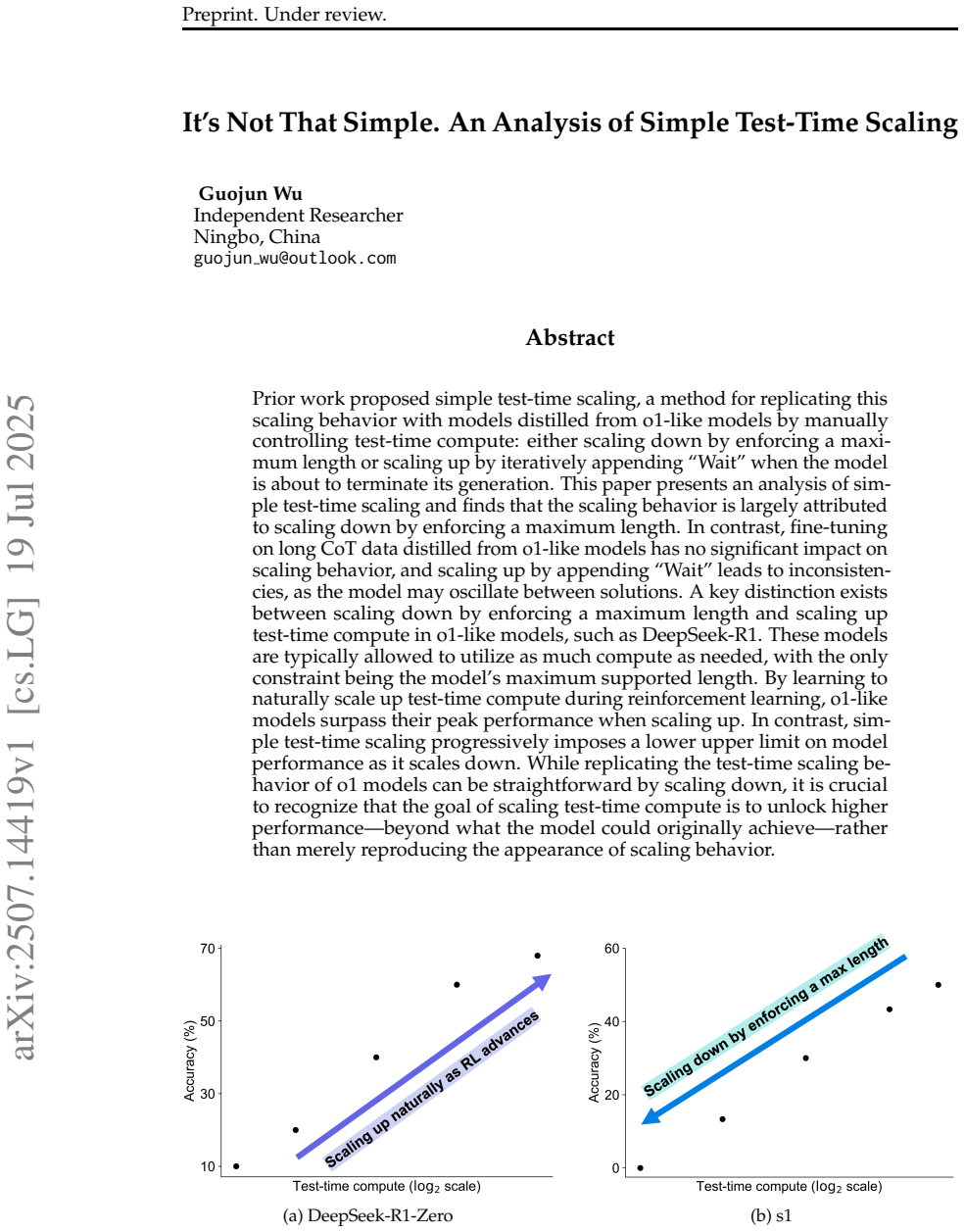
In the paper's own terms, simple test-time scaling's apparent scaling behavior is primarily caused by scaling down: enforcing a maximum output length makes models provide premature answers, and as the maximum length is reduced, problems that require longer reasoning fail first. Models never fine-tuned on distilled long chain-of-thought data show the same accuracy-versus-maximum-length curves, so distillation is not the driver. The scaling-up half--appending 'Wait' whenever the model tries to stop--produces inconsistent results because answers oscillate between correct and incorrect, and the underlying responses are often repeated verbatim rather than genuinely revised. The paper concludes that the purpose of test-time scaling is to exceed the model's initial peak by using more compute, which is what RL-trained o1-like models do naturally, whereas simple test-time scaling only imposes a progressively tighter upper bound on performance.
Load-bearing premise
The comparison assumes the modified system prompt that tells models to answer directly affects accuracy only by shortening output length; if the wording itself changes answer quality, the scaling-down curves do not isolate the effect of the maximum-length cap.
Editorial extensions
If this is right
- Any model, distilled or not, will show a test-time scaling curve on AIME 2024 if its maximum output length is progressively lowered; the curve is a property of the cap, not of the training data.
- Each reduction of the maximum length selects a new set of problems that fail, namely those needing longer reasoning, so scaling down is equivalent to shrinking a performance ceiling.
- Long-CoT models resist truncation better because their outputs contain redundant reasoning, meaning a correct answer can survive even after most of the chain of thought is cut away.
- 'Wait'-based scaling up should not be treated as a reliable way to improve accuracy, since per-problem answers can flip back and forth and no oracle tells when to stop appending.
Reading between the lines
- A testable extension: any length-controlling intervention, such as early stopping, a 'be brief' prompt, or sampling with a token budget, should reproduce downward scaling curves on reasoning benchmarks, offering a cheap non-distillation control experiment.
- The redundancy account suggests a measurable prediction: a model's tolerance to truncation should correlate with the fraction of tokens it spends after its first correct derivation, which could be estimated by parsing the chain of thought for each problem.
- For neighboring work on reinforcement-learned reasoners, this implies that accuracy-versus-compute curves should be reported together with the direction of the intervention (natural longer reasoning versus imposed cap) and with answer-stability statistics; otherwise similar-looking curves can mean opposite things.
Editorial analysis
A structured set of objections, weighed in public.
Referee Report
Summary. This paper re-examines the 'simple test-time scaling' recipe underlying the s1 model (Muennighoff et al., 2025) and decomposes it into three ingredients: fine-tuning on distilled long chain-of-thought (CoT) data, scaling down by enforcing a maximum output length, and scaling up by repeatedly appending 'Wait'. Using the AIME 2024 benchmark (30 problems) and a set of five models, the authors report that (i) all tested models show a monotonic accuracy decrease as maximum length is reduced, regardless of whether they were fine-tuned on distilled CoT data; (ii) appending 'Wait' yields inconsistent performance, with models oscillating between correct and incorrect answers; and (iii) the scaling behavior is therefore 'largely attributed to scaling down by enforcing a maximum length', not to distillation or to genuine test-time compute scaling. The paper argues that this differs fundamentally from o1-like models where scaling up emerges naturally through reinforcement learning.
Significance. The paper addresses a timely and important question: whether the apparent test-time scaling of s1 arises from a meaningful mechanism or from a truncation artifact. The manuscript is valuable for its conceptual disaggregation of the three ingredients and for its careful manual analysis of the 'Wait' trajectories. The authors are transparent about experimental limitations, including the exclusion of one model and the addition of a post-hoc truncation point. The claim that scaling down alone reproduces the scaling curve, if confirmed with an unconfounded protocol, is a significant contribution that would redirect attention from 'simple test-time scaling' to the nature of compute-constrained decoding. However, the empirical evidence currently is narrow (one 30-problem benchmark, no confidence intervals) and contains a central confound in the cross-model scaling-down experiment.
major comments (3)
- [3.1 Setup] The modified system prompt 'Give the answer directly without any explanation or reasoning' is not a neutral way to enforce a maximum length. It directly instructs the model to suppress reasoning and to provide a guess, which can depress accuracy independently of how many outputs are truncated. Since the highest length for each model is chosen so that fewer than 10% of outputs exceed it, the rightmost point of each scaling-down curve in Figure 3 should approximate accuracy under the modified prompt, not under the original prompt. The paper does not report accuracy under the original system prompt at the same maximum lengths. As a result, the observed monotonic decreases for DeepSeek-V3, Qwen2.5-32B, and Qwen2.5-72B may combine prompt identity with truncation, and the conclusion in Section 4 that the behavior is 'largely attributed to scaling down by enforcing a maximum length' is not yet isolated for these models. Please add a control in which the original system prompt is used and outputs are hard-truncated at the same token budgets, or otherwise demonstrate that the prompt alone does not reduce accuracy at the longest budget. The s1 curve, which uses the original public outputs, is not affected by this confound, but the cross-model evidence for the 'no impact of distilled CoT' claim is.
- [3, first paragraph] The paper classifies DeepSeek-V3 as having been 'fine-tuned on long CoT data distilled from reasoning models,' alongside s1 and r1-distill-Qwen-32B. This is surprising and appears inconsistent with public information about DeepSeek-V3, which is a general-purpose dense MoE model. If this classification is incorrect, then the scaling-down comparison in Section 3.1 effectively has only one distilled long-CoT model (s1) that follows the instruction, because r1-distill-Qwen-32B is excluded. The ablation of 'distilled vs. not' then rests on the comparison of s1 with its base model Qwen2.5-32B-Instruct, which is also the model most exposed to the prompt confound described above. Please clarify the provenance of DeepSeek-V3's fine-tuning and, if the statement is an error, correct the categorization and restate the conclusions that depend on it.
- [3.1 Results and Figure 3] The AIME 2024 benchmark contains only 30 problems, and the scaling-down curves are reported without confidence intervals, repeated sampling, or raw per-problem counts. With 30 problems, a 10% accuracy change corresponds to three problems, so the 'clear test-time scaling behavior' asserted in the text is not statistically substantiated on a per-model basis. In addition, the post-hoc addition of the 800-token setting for Qwen2.5-72B-Instruct (reported in the Setup) can bias the curve toward monotonicity. Please provide per-length accuracies with bootstrap confidence intervals or exact binomial intervals, raw counts, and a sensitivity analysis excluding the added 800-token point.
minor comments (5)
- [Figure 3(a)] The x-axis labels (512, 1024, 2048, 4096) do not match the text in Section 3.1, which lists s1 maximum lengths of 500, 1k, 2k, 4k, 8k; please reconcile the values.
- [3.2.2 and Table 1 caption] '1-distill-Qwen-32B' should read 'r1-distill-Qwen-32B'.
- [3.2.3 heading] The heading 'Inefficency' should be 'Inefficiency'.
- [3.2.2 and 3.2.3 Setup] Each section excludes one DeepSeek-V3 run for producing 'nonsensical output'; please report the failure mode and clarify whether the exclusion was preselected, since excluding runs by outcome can bias the repetition-rate estimates.
- [3.1 Results] The term 'short-CoT models' is used to classify Qwen2.5-32B-Instruct and Qwen2.5-72B-Instruct, but no quantitative threshold for output length is given; please define the criterion or replace it with descriptive terms.
Circularity Check
No significant circularity: the analysis is an external empirical benchmark comparison, with no fitted quantity reused as a prediction.
full rationale
The paper's derivation chain is empirical rather than definitional or fitted. The central claim—that simple test-time scaling behavior is largely attributed to scaling down by enforcing a maximum length—is supported by directly measured accuracy under varying maximum-length limits on an external benchmark (AIME 2024). No parameter is fitted to a subset of the data and then presented as a prediction of the same or a closely related quantity. The s1 results use publicly available generation outputs, and the non-s1 models are evaluated via API; these are external observations, not outputs of the paper's own model. The conclusion that fine-tuning on distilled long CoT data has no significant impact is drawn from a comparison across models, and while the modified system prompt in Section 3.1 ('Give the answer directly without any explanation or reasoning') introduces a potential confound, a confound is a validity threat, not circularity: the paper does not define scaling behavior in terms of the prompt or derive the result from an identity. There are no self-citations by the present author, no imported uniqueness theorem, and no ansatz smuggled in via citation. The argument is self-contained against external benchmarks, so the appropriate circularity score is 0.
Assumptions & free parameters
free parameters (2)
- Maximum-length grid values =
s1: 500/1k/2k/4k/8k; DeepSeek-V3: 512/1024/2048/4096; Qwen2.5-72B: 256/512/800/1024; Qwen2.5-32B: 256/512/1024
- Wait-count horizon =
7 for s1, 2 for other models in the main experiment; 2 in repetition tables
assumptions (4)
- domain assumption AIME 2024 accuracy (30 problems) is a sufficiently sensitive measure of reasoning performance.
- ad hoc to paper The early-answer system prompt affects accuracy only by limiting output length.
- domain assumption DeepSeek-R1-Zero's natural scaling behavior is as characterized in DeepSeek-AI (2025).
- domain assumption s1's publicly available generation outputs are correct and representative.
Cite this review
Pith. "Pith review of It's Not That Simple. An Analysis of Simple Test-Time Scaling." pith.science (2026). https://pith.science/paper/TVKKOQUO
@misc{pith2026250714419,
  author       = {Pith},
  title        = {Pith review of: It's Not That Simple. An Analysis of Simple Test-Time Scaling},
  year         = {2026},
  howpublished = {\url{https://pith.science/paper/TVKKOQUO}},
  note         = {Machine review of arXiv:2507.14419}
}
read the original abstract
Prior work proposed simple test-time scaling, a method for replicating this scaling behavior with models distilled from o1-like models by manually controlling test-time compute: either scaling down by enforcing a maximum length or scaling up by iteratively appending "Wait" when the model is about to terminate its generation. This paper presents an analysis of simple test-time scaling and finds that the scaling behavior is largely attributed to scaling down by enforcing a maximum length. In contrast, fine-tuning on long CoT data distilled from o1-like models has no significant impact on scaling behavior, and scaling up by appending "Wait" leads to inconsistencies, as the model may oscillate between solutions. A key distinction exists between scaling down by enforcing a maximum length and scaling up test-time compute in o1-like models, such as DeepSeek-R1\@. These models are typically allowed to utilize as much compute as needed, with the only constraint being the model's maximum supported length. By learning to naturally scale up test-time compute during reinforcement learning, o1-like models surpass their peak performance when scaling up. In contrast, simple test-time scaling progressively imposes a lower upper limit on model performance as it scales down. While replicating the test-time scaling behavior of o1 models can be straightforward by scaling down, it is crucial to recognize that the goal of scaling test-time compute is to unlock higher performance -- beyond what the model could originally achieve -- rather than merely reproducing the appearance of scaling behavior.
Figures


Figures from the paper (2 more)


Reference graph
Works this paper leans on
-
[5]
URL https://arxiv.org/abs/2310.09044. DeepSeek-AI. Deepseek-r1: Incentivizing reasoning capability in llms via reinforcement learning,
-
[6]
Xidong Feng, Ziyu Wan, Muning Wen, Stephen Marcus McAleer, Ying Wen, Weinan Zhang, and Jun Wang
URL https://arxiv.org/abs/2501.12948. Xidong Feng, Ziyu Wan, Muning Wen, Stephen Marcus McAleer, Ying Wen, Weinan Zhang, and Jun Wang. Alphazero-like tree-search can guide large language model decoding and training,
-
[7]
Kanishk Gandhi, Denise Lee, Gabriel Grand, Muxin Liu, Winson Cheng, Archit Sharma, and Noah D
URL https://arxiv.org/abs/2309.17179. Kanishk Gandhi, Denise Lee, Gabriel Grand, Muxin Liu, Winson Cheng, Archit Sharma, and Noah D. Goodman. Stream of search (sos): Learning to search in language,
-
[8]
URL https://arxiv.org/abs/2404.03683. Google. Gemini 2.0 flash thinking mode (gemini-2.0flash-thinking-exp-1219). December
-
[9]
URL https://cloud.google.com/vertex-ai/generative-ai/docs/thinking-mode . Accessed: 2025-03-26. Dan Hendrycks, Collin Burns, Saurav Kadavath, Akul Arora, Steven Basart, Eric Tang, Dawn Song, and Jacob Steinhardt. Measuring mathematical problem solving with the math dataset,
work page 2025
-
[11]
URL https://arxiv.org/abs/2303.06135. Carlos E Jimenez, John Yang, Alexander Wettig, Shunyu Yao, Kexin Pei, Ofir Press, and Karthik R Narasimhan. SWE-bench: Can language models resolve real-world github issues? In The Twelfth International Conference on Learning Representations ,
-
[12]
URL https: //arxiv.org/abs/2501.12599. Jiacheng Liu, Andrew Cohen, Ramakanth Pasunuru, Yejin Choi, Hannaneh Hajishirzi, and Asli Celikyilmaz. Don’t throw away your value model! generating more preferable text with value-guided monte-carlo tree search decoding,
-
[13]
Michael Luo, Sijun Tan, Justin Wong, Xiaoxiang Shi, William Y
URL https://arxiv.org/ab s/2309.15028. Michael Luo, Sijun Tan, Justin Wong, Xiaoxiang Shi, William Y. Tang, Manan Roongta, Colin Cai, Jeffrey Luo, Tianjun Zhang, Li Erran Li, Raluca Ada Popa, and Ion Stoica. Deepscaler: Surpassing o1-preview with a 1.5b model by scaling rl. https://pretty-radio-b75.not ion.site/DeepScaleR-Surpassing-O1-Preview-with-a-1-5B...
Show all 27 references
-
[14]
URL https://arxiv.org/abs/2501.19393. Maxwell Nye, Anders Johan Andreassen, Guy Gur-Ari, Henryk Michalewski, Jacob Austin, David Bieber, David Dohan, Aitor Lewkowycz, Maarten Bosma, David Luan, Charles Sut- ton, and Augustus Odena. Show your work: Scratchpads for intermediate ...
-
[15]
URL https://arxiv.org/abs/2112.00114. OpenAI. Learning to reason with llms. September
-
[16]
Accessed: 2025-03-26
URL https://openai.com/index/l earning-to-reason-with-llms/ . Accessed: 2025-03-26. Charlie Snell, Jaehoon Lee, Kelvin Xu, and Aviral Kumar. Scaling llm test-time compute optimally can be more effective than scaling model parameters,
2025
-
[17]
Kaya Stechly, Matthew Marquez, and Subbarao Kambhampati
URL https: //arxiv.org/abs/2408.03314. Kaya Stechly, Matthew Marquez, and Subbarao Kambhampati. Gpt-4 doesn’t know it’s wrong: An analysis of iterative prompting for reasoning problems,
-
[18]
Kaya Stechly, Karthik Valmeekam, and Subbarao Kambhampati
URL https: //arxiv.org/abs/2310.12397. Kaya Stechly, Karthik Valmeekam, and Subbarao Kambhampati. On the self-verification limitations of large language models on reasoning and planning tasks. arXiv preprint arXiv:2402.08115,
-
[19]
Xuezhi Wang, Jason Wei, Dale Schuurmans, Quoc Le, Ed Chi, Sharan Narang, Aakanksha Chowdhery, and Denny Zhou
URL https://arxiv.org/abs/2302.13971. Xuezhi Wang, Jason Wei, Dale Schuurmans, Quoc Le, Ed Chi, Sharan Narang, Aakanksha Chowdhery, and Denny Zhou. Self-consistency improves chain of thought reasoning in language models,
-
[20]
Yue Wang, Qiuzhi Liu, Jiahao Xu, Tian Liang, Xingyu Chen, Zhiwei He, Linfeng Song, Dian Yu, Juntao Li, Zhuosheng Zhang, Rui Wang, Zhaopeng Tu, Haitao Mi, and Dong Yu
URL https://arxiv.org/abs/2203.11171. Yue Wang, Qiuzhi Liu, Jiahao Xu, Tian Liang, Xingyu Chen, Zhiwei He, Linfeng Song, Dian Yu, Juntao Li, Zhuosheng Zhang, Rui Wang, Zhaopeng Tu, Haitao Mi, and Dong Yu. Thoughts are all over the place: On the underthinking of o1-like llms,
-
[21]
Jason Wei, Xuezhi Wang, Dale Schuurmans, Maarten Bosma, Brian Ichter, Fei Xia, Ed Chi, Quoc Le, and Denny Zhou
URL https://arxiv.org/abs/2501.18585. Jason Wei, Xuezhi Wang, Dale Schuurmans, Maarten Bosma, Brian Ichter, Fei Xia, Ed Chi, Quoc Le, and Denny Zhou. Chain-of-thought prompting elicits reasoning in large lan- guage models,
-
[22]
Yangzhen Wu, Zhiqing Sun, Shanda Li, Sean Welleck, and Yiming Yang
URL https://arxiv.org/abs/2201.11903. Yangzhen Wu, Zhiqing Sun, Shanda Li, Sean Welleck, and Yiming Yang. Inference scaling laws: An empirical analysis of compute-optimal inference for problem-solving with language models,
-
[23]
Yuxi Xie, Kenji Kawaguchi, Yiran Zhao, Xu Zhao, Min-Yen Kan, Junxian He, and Qizhe Xie
URL https://arxiv.org/abs/2408.00724. Yuxi Xie, Kenji Kawaguchi, Yiran Zhao, Xu Zhao, Min-Yen Kan, Junxian He, and Qizhe Xie. Self-evaluation guided beam search for reasoning,
-
[24]
Yixin Ye, Zhen Huang, Yang Xiao, Ethan Chern, Shijie Xia, and Pengfei Liu
URL https: //arxiv.org/abs/2408.08152. Yixin Ye, Zhen Huang, Yang Xiao, Ethan Chern, Shijie Xia, and Pengfei Liu. Limo: Less is more for reasoning,
-
[25]
Edward Yeo, Yuxuan Tong, Morry Niu, Graham Neubig, and Xiang Yue
URL https://arxiv.org/abs/2502.03387. Edward Yeo, Yuxuan Tong, Morry Niu, Graham Neubig, and Xiang Yue. Demystifying long chain-of-thought reasoning in llms,
-
[26]
Weihao Zeng, Yuzhen Huang, Wei Liu, Keqing He, Qian Liu, Zejun Ma, and Junxian He
URL https://arxiv.org/abs/2502.03373. Weihao Zeng, Yuzhen Huang, Wei Liu, Keqing He, Qian Liu, Zejun Ma, and Junxian He. 7b model and 8k examples: Emerging reasoning with reinforcement learning is both effective and efficient. https://hkust-nlp.notion.site/simplerl-reason,
-
[27]
URL https://arxiv.org/abs/2303.05510. 12
-
[2020]
Xingyu Chen, Jiahao Xu, Tian Liang, Zhiwei He, Jianhui Pang, Dian Yu, Linfeng Song, Qiuzhi Liu, Mengfei Zhou, Zhuosheng Zhang, Rui Wang, Zhaopeng Tu, Haitao Mi, and Dong Yu
URL https://proceedings.neurips.cc/paper files/paper/2020/ file/1457c0d6bfcb4967418bfb8ac142f64a-Paper.pdf. Xingyu Chen, Jiahao Xu, Tian Liang, Zhiwei He, Jianhui Pang, Dian Yu, Linfeng Song, Qiuzhi Liu, Mengfei Zhou, Zhuosheng Zhang, Rui Wang, Zhaopeng Tu, Haitao Mi, and Dong...
2020
-
[2021]
URL https://arxiv.org/abs/2103.03874. Robert Irvine, Douglas Boubert, Vyas Raina, Adian Liusie, Ziyi Zhu, Vineet Mudupalli, Aliaksei Korshuk, Zongyi Liu, Fritz Cremer, Valentin Assassi, Christie-Carol Beauchamp, Xiaoding Lu, Thomas Rialan, and William Beauchamp. Rewarding chat...
-
[2023]
Bradley Brown, Jordan Juravsky, Ryan Ehrlich, Ronald Clark, Quoc V
URL https://arxiv.org/abs/2309.16609. Bradley Brown, Jordan Juravsky, Ryan Ehrlich, Ronald Clark, Quoc V . Le, Christopher R´e, and Azalia Mirhoseini. Large language monkeys: Scaling inference compute with repeated sampling,
-
[2024]
URL https://arxiv.org/abs/2407.21787. Tom Brown, Benjamin Mann, Nick Ryder, Melanie Subbiah, Jared D Kaplan, Prafulla Dhariwal, Arvind Neelakantan, Pranav Shyam, Girish Sastry, Amanda Askell, Sandhini Agarwal, Ariel Herbert-Voss, Gretchen Krueger, Tom Henighan, Rewon Child, Ad...
1901 arXiv
-
[2025]
Sehyun Choi, Tianqing Fang, Zhaowei Wang, and Yangqiu Song
URL https://arxiv.org/abs/2412.21187. Sehyun Choi, Tianqing Fang, Zhaowei Wang, and Yangqiu Song. Kcts: Knowledge- constrained tree search decoding with token-level hallucination detection,
Reviewed August 6, 2026 · model on record in the stance chip above.
Discussion (0). Sign in to comment.