REVIEW 4 major objections 6 minor 59 references
MPG learns a reward as two parts — a multi-task expert recognizer plus a proximity guide — and teaches a new task from a few demonstrations with an 81.2% average success rate.
Reviewed by Pith at T0; open to challenge. T0 means a machine referee read the full paper against a public rubric. the ladder, T0–T4 →
T0 review · deepseek-v4-flash
2026-08-01 17:03 UTC pith:TWQVOG44
load-bearing objection Useful new FM-IRL setting and a sensible reward decomposition, but the proximity term may be inert and the headline margin lacks statistical backing. the 4 major comments →
Generalize and Guide: Decomposing Rewards for Few-Shot Inverse Reinforcement Learning
The pith
A machine-rendered reading of the paper's core claim, the machinery that carries it, and where it could break.
Core claim
The central claim is that the reward for a novel task can be decomposed into two complementary signals: a multi-task discriminator d_φ(τ, (s,a)) that says whether a state-action pair looks expert for the task described by a demonstration, and a proximity function p_θ(s) that measures, in temporal steps, how far a state is from the expert distribution. The two are trained on different data — the discriminator on all task demonstrations plus online policy samples, the proximity function on target-task demonstrations and policy transitions under a triangle-inequality constraint that anchors expert states at zero. The final reward is d(s,a) plus λ times the one-step decrease in proximity, so the
What carries the argument
The load-bearing object is the two-term reward R̃(s_t, a_t, s_{t+1}) = d_φ(s_t, a_t) + λ[p_θ(s_t) − p_θ(s_{t+1})]. The first term is a demonstration-conditioned binary discriminator that transfers shared structure from multi-task demonstrations. The second term is a learned proximity function, trained by maximizing p_θ on policy states subject to the local consistency constraint p_θ(s_t) ≤ p_θ(s_{t+1}) + ζ, with expert states anchored at zero; this constraint is what makes p_θ behave like a distance-to-expert estimate rather than an arbitrary score. The proximity term is the mechanism that supplies corrective guidance in regions the discriminator cannot judge.
Load-bearing premise
The guidance term works only if p_θ honestly tracks how many steps a state is from the expert distribution; if the learned proximity function is flat or noisy outside the demonstrated region, the supposedly corrective part of the reward stops providing useful signal.
What would settle it
Take a single task, freeze the expert set, and chart p_θ over states at known temporal distances from the expert distribution (1, 3, 10 steps). If p_θ does not decrease as true distance grows, or if it collapses to its minimum value a few steps away from the expert, the proximity assumption is violated; then a policy trained with only the p_θ(s_t) − p_θ(s_{t+1}) term should fail to recover from states far from the demonstrations.
If this is right
- If the decomposition is right, an agent can acquire a new task from a handful of demonstrations plus access to related-task demonstrations and its own environment interaction — no multi-task environments or reward engineering needed.
- Because the proximity term is a dense, smooth signal in non-expert regions, methods that currently use sparse or purely adversarial rewards should see stabler learning in long-horizon tasks.
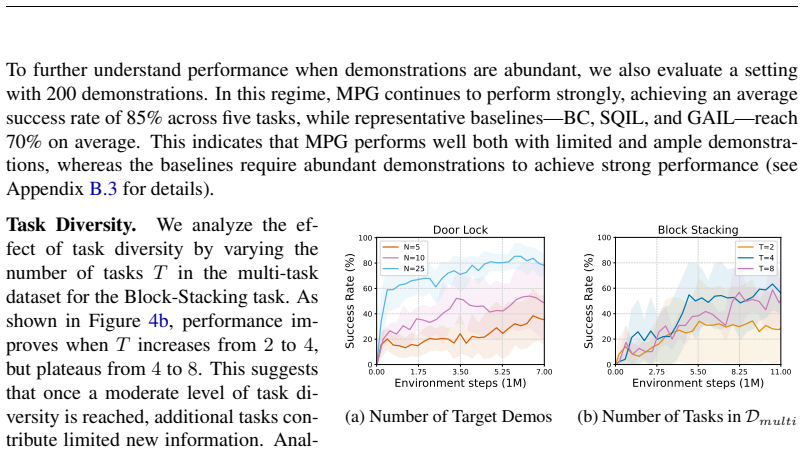
- The approach degrades gracefully with more data: with 200 target demonstrations it stays competitive with behavior cloning, suggesting the reward remains valid beyond the few-shot regime.
- Task diversity in the multi-task set helps up to a point; beyond roughly four related tasks, additional demonstrations contribute little, implying a modest multi-task dataset suffices.
Where Pith is reading between the lines
- The proximity component is portable: nothing in its objective requires multi-task data, so it could be grafted onto any IRL or imitation algorithm that has online experience, not just the specific discriminator used here.
- Because policy states get re-labeled as expert when the discriminator is confident, the proximity function will inherit the discriminator's blind spots; an interesting stress test is to see whether the guidance term misleads the agent on states the discriminator confidently misclassifies.
- The online-trained reward is not reusable for a fresh policy, as the authors note; a natural extension is to distill the learned two-part reward into a frozen reward model that could be applied offline.
- The FM-IRL setting itself, with multi-task demonstrations but no multi-task environments, may be a more realistic match for real robot data than meta-learning's environment-heavy paradigm, and could serve as a testing ground for incorporating foundation-model priors.
Editorial analysis
A structured set of objections, weighed in public.
Referee Report
Summary. The paper introduces FM-IRL, a few-shot IRL setting where the target task has only a handful of demonstrations but the agent has access to a large multi-task demonstration corpus and online interaction with the target environment. To solve it, the authors propose MPG, which learns a reward decomposes into a demonstration-conditioned multi-task discriminator d(s,a) and a proximity function p(s) that is intended to measure temporal distance to expert states. The policy is optimized with the reward d(s,a)+λ[p(s_t)-p(s_{t+1})]. Experiments on Maze2D, Block Stacking, and seven FactorWorld manipulation tasks report mean success rates of 81.2% on average and a 24.7 percentage point improvement over the strongest per-task baseline.
Significance. The FM-IRL problem setting is practically motivated and appears new: it relaxes the multi-task environment access assumption of meta-IRL while still leveraging related demonstrations and online target-environment interaction. The reward decomposition idea—a generalizable discriminator plus a distance-to-expert proximity reward—is a reasonable design that could be useful beyond this specific setting. The paper includes a fairly extensive benchmark suite, multiple ablations of the reward components, hyperparameter sensitivity analyses, and a promised code release, all of which strengthen the empirical contribution. If the proximity mechanism is genuinely active, the results would be a solid step toward few-shot IRL with multi-task demonstrations. However, as detailed in the major comments, the current manuscript does not yet establish that the proximity function is non-degenerate or that the claimed gains are robustly attributable to the proposed mechanism.
major comments (4)
- [§4.2, Eq. (3)] The proximity function objective is susceptible to a degenerate solution: pθ≈1 on all non-expert states and pθ≈0 on expert states satisfies the triangle inequality for transitions that stay within non-expert states, and the α=100 soft penalty is only incurred on rare transitions entering the expert set. In that case p(s_t)−p(s_{t+1}) is zero almost everywhere and the 'guidance' term in Eq. (4) is inert. The paper provides no diagnostic to rule this out—no statistics on the fraction of transitions with nonzero Δp, no measure of how p varies with true distance, and no theoretical mechanism preventing flatness. The ablations (e.g., Fig. 5a, Fig. 10) show that Ours beats Discriminator Only, but this only shows that the proximity term has some effect; it could be a sparse boundary signal rather than the dense corrective guidance claimed. The authors should add an analysis of the learned p (e.
- [§5.1, Table 2] The headline claim 'outperforming the strongest per-task baseline by an average of 24.7 percentage points' is computed by picking the best baseline separately for each task, which is an oracle comparison. More importantly, many individual task differences are not statistically significant given the reported 95% CIs: e.g., Door Lock (57.6±31.8 vs 52.0±16.7), Door Unlock (78.6±22.0 vs 61.4±20.1), Plate Slide Back (63.9±23.7 vs 35.5±21.4), and Lever Pull (93.2±3.0 vs 52.2±45.1, overlapping). On Maze2D, MPG (94.1±3.6) is actually below the best baseline GoalPro (96.0±2.8). The paper should report a single fixed baseline comparison (e.g., the strongest overall baseline), perform paired significance tests across the five seeds, and state how many of the nine task differences survive the test. As written, 'eight of nine' and the 24.7 pp average overstate the robustness.
- [§4.2, §D.7] The expert boundary for p is not fixed: policy states with d(s,a)>c_thresh are re-labeled as expert and inserted into the expert buffer. This creates a circular dependency—the policy can influence which states are treated as expert, and those states then have p=0, making the policy appear closer to the expert distribution. While the target demonstrations provide an independent anchor, the re-labeling can artificially inflate the proximity improvement term, because a state the policy visits and the discriminator accepts becomes an 'expert' state, so transitions into it yield a large positive Δp. The paper should analyze the sensitivity of results to c_thresh in the main experiments and, ideally, compare with a fixed-expert variant (only Dtarget) to quantify the contribution of re-labeling. Appendix B.5 already shows that c_thresh required tuning (0.4/0.6) for the GAIL+Proximity analysis,
- [§5.3, Appendix B.5] The standalone evaluation of the proximity reward is weaker than the main text suggests. Appendix B.5 states that for FactorWorld tasks, '200 target demonstrations were required for GAIL + Proximity to yield consistent improvements,' and that c_thresh had to be tuned for Lever Pull and Door Lock. This means the proximity function alone, as proposed, does not consistently help in the few-shot regime in which the main experiments operate. The main text (Section 5.3) reports only 'in 3 out of 5 tasks, this improves GAIL's performance,' which is conditional and not statistically strong. The authors should either provide a standalone proximity analysis in the few-shot setting with fixed c_thresh, or temper the claim that the proximity function provides reliable corrective guidance in low-data conditions.
minor comments (6)
- [Abstract/§5.1] The phrase 'outperforming the strongest per-task baseline by an average of 24.7 percentage points' should be clarified: this is an oracle baseline per task, and MPG is not the best on Maze2D. A reader may misinterpret the average as a consistent improvement on every task.
- [Figure 1] The figure contains 'ICML 2025' watermark and editorial notes such as 'Teaser Figure Revised + Ziyi's Feedback'; these should be removed for a journal submission.
- [§3] Typo: 'unkown' should be 'unknown'.
- [Eq. (1)] The notation d(τ_i, s_i, a_i) to d(τ_i, s_j, a_j) to d(τ, s, a) is overloaded; the argument ordering and indexing should be made consistent, and the target-task shorthand should be introduced explicitly.
- [Appendix D.9] The hyperparameter table lists c_thresh=0.9 for Maze2D and Block Stacking but 0.8 for FactorWorld; the text in D.9 says 'a fixed value of c_thresh in the range of 0.8-0.9 is generally sufficient'. This is fine, but the Appendix B.5 tuning to 0.4/0.6 should be reconciled, perhaps by explicitly stating that the standalone analysis used a different protocol from the main MPG experiments.
- [Appendix E] The limitation that the reward function 'cannot be reused to train a new policy from scratch' is an important caveat for the method's practical applicability; consider mentioning it in the main text or conclusion.
Circularity Check
No significant circularity: MPG's reward components are trained on external demonstrations and evaluated on held-out task variations; the co-training loop is a soundness concern, not a definitional reduction.
full rationale
MPG's derivation chain is empirical rather than definitional. The discriminator d_phi is trained with Eq. 1 on target and multi-task demonstrations plus adversarial policy negatives; the proximity function p_theta is trained with Eq. 3 using target demonstrations as an expert anchor, policy transitions under a triangle-inequality constraint, and multi-task demonstrations as non-expert data in pretraining; the full reward in Eq. 4 combines these. Success is then measured on held-out task configurations (Table 2), so the reported 81.2% average success and 24.7 percentage-point improvement are not a restatement of any fitted parameter or training loss. The only feedback loop is the re-labeling rule in Sec. 4.2 and Appendix D.7, where policy states with d(s_t,a_t)>c_thresh are added to the expert buffer for training p_theta. That is a pseudo-labeling heuristic; because D_target provides an independent anchor and the final evaluation is external task success, this does not make the central claim true by construction. The skeptic's concern that p_theta could collapse to a constant, making the proximity term inert, is a soundness/robustness issue rather than circularity: even if it occurred, the paper would report a weaker or different method, not derive its result from its assumptions. There are no self-citations, no imported uniqueness theorems, and no known result renamed as a prediction. Thus the appropriate finding is no significant circularity.
Axiom & Free-Parameter Ledger
free parameters (5)
- lambda (proximity reward weight) =
100
- zeta (timestep cost) =
0.001
- alpha (temporal consistency multiplier) =
100
- beta (expert boundary multiplier) =
5
- cthresh (discriminator re-labeling threshold) =
0.8–0.9
axioms (4)
- domain assumption Demonstrations are generated by an optimal expert policy for their task (standard IRL assumption)
- domain assumption Multi-task demonstrations share enough structure with the target task that a multi-task discriminator transfers
- domain assumption The proximity function's triangle inequality constraint (Eq. 2) models temporal distance to the expert distribution
- ad hoc to paper Relabeling policy states with d>cthresh as expert states for proximity is valid
read the original abstract
Inverse reinforcement learning (IRL) provides a powerful framework for learning from demonstrations. However, real-world tasks often exhibit substantial natural variations (e.g., picking up mugs with varying shapes), making it impractical to collect demonstrations that fully specify a new task under every possible scenario. In practice, while demonstrations for the target task are limited, it is often easier to obtain datasets of heterogeneous but related behaviors. This motivates the problem of few-shot IRL with multi-task demonstrations (FM-IRL), where an agent must learn a new task with substantial variations from only a limited number of target-task demonstrations, together with sufficient demonstrations of related tasks and online agent experience. To do so, we must both recover the expert distribution of the new task and provide guidance when the agent deviates from it. We introduce Multitask discriminator Proximity-Guided IRL (MPG), which learns two complementary reward components: (1) a generalizable discriminator that transfers shared structure across related tasks to identify expert behavior in a new task, and (2) a proximity function that measures how far a state deviates from expert behavior and provides corrective guidance during exploration. We demonstrate the effectiveness of our method on multiple challenging navigation and manipulation tasks under significant variations (e.g., object configurations, table layouts, and initial robot poses), achieving an average success rate of 81.2%, outperforming the strongest per-task baseline by an average of 24.7 percentage points.
Figures




Reference graph
Works this paper leans on
-
[1]
1990 , doi =
McGeer, Tad , title =. 1990 , doi =. http://ijr.sagepub.com/content/9/2/62.full.pdf+html , journal =
1990
-
[2]
Journal of Basic Engineering , volume=
A new approach to linear filtering and prediction problems , author=. Journal of Basic Engineering , volume=. 1960 , publisher=
1960
-
[3]
Scaling Learning Algorithms Towards
Bengio, Yoshua and LeCun, Yann , booktitle =. Scaling Learning Algorithms Towards
-
[4]
and Osindero, Simon and Teh, Yee Whye , journal =
Hinton, Geoffrey E. and Osindero, Simon and Teh, Yee Whye , journal =. A Fast Learning Algorithm for Deep Belief Nets , volume =
-
[5]
2016 , publisher=
Deep learning , author=. 2016 , publisher=
2016
-
[6]
2018 , publisher=
Reinforcement Learning: An Introduction (2nd edition) , author=. 2018 , publisher=
2018
-
[7]
and Russell, Stuart J
Ng, Andrew Y. and Russell, Stuart J. , title =. Proceedings of the Seventeenth International Conference on Machine Learning , pages =. 2000 , isbn =
2000
-
[8]
International Conference on Machine Learning , year=
Soft actor-critic: Off-policy maximum entropy deep reinforcement learning with a stochastic actor , author=. International Conference on Machine Learning , year=
-
[9]
2017 , eprint=
Proximal Policy Optimization Algorithms , author=. 2017 , eprint=
2017
-
[10]
2016 , eprint=
Concrete Problems in AI Safety , author=. 2016 , eprint=
2016
-
[11]
Advances in Neural Information Processing Systems , editor=
Unpacking Reward Shaping: Understanding the Benefits of Reward Engineering on Sample Complexity , author=. Advances in Neural Information Processing Systems , editor=. 2022 , url=
2022
-
[12]
International Conference on Learning Representations , year=
Reinforcement Learning with Sparse Rewards using Guidance from Offline Demonstration , author=. International Conference on Learning Representations , year=
-
[13]
Proceedings of the IEEE/CVF conference on computer vision and pattern recognition , pages=
Alfred: A benchmark for interpreting grounded instructions for everyday tasks , author=. Proceedings of the IEEE/CVF conference on computer vision and pattern recognition , pages=
-
[14]
arXiv preprint arXiv:2004.07219 , year=
D4rl: Datasets for deep data-driven reinforcement learning , author=. arXiv preprint arXiv:2004.07219 , year=
Pith/arXiv arXiv 2004
-
[15]
2024 IEEE International Conference on Robotics and Automation (ICRA) , pages=
Decomposing the generalization gap in imitation learning for visual robotic manipulation , author=. 2024 IEEE International Conference on Robotics and Automation (ICRA) , pages=. 2024 , organization=
2024
-
[16]
Conference on robot learning , pages=
Meta-world: A benchmark and evaluation for multi-task and meta reinforcement learning , author=. Conference on robot learning , pages=. 2020 , organization=
2020
-
[17]
2020 , url =
Youngwoon Lee , title =. 2020 , url =
2020
-
[18]
Conference on robot learning , pagesfu2018airl=
Accelerating reinforcement learning with learned skill priors , author=. Conference on robot learning , pagesfu2018airl=. 2021 , organization=
2021
-
[19]
Proceedings of the 38th International Conference on Machine Learning , pages =
Demonstration-Conditioned Reinforcement Learning for Few-Shot Imitation , author =. Proceedings of the 38th International Conference on Machine Learning , pages =. 2021 , editor =
2021
-
[20]
Neural Information Processing Systems , year=
Generative Adversarial Imitation Learning , author=. Neural Information Processing Systems , year=
-
[21]
Dragan and Sergey Levine , booktitle=
Siddharth Reddy and Anca D. Dragan and Sergey Levine , booktitle=. 2020 , url=
2020
-
[22]
2021 , url=
Divyansh Garg and Shuvam Chakraborty and Chris Cundy and Jiaming Song and Stefano Ermon , booktitle=. 2021 , url=
2021
-
[23]
Deep RL Workshop NeurIPS 2021 , year=
Hierarchical Few-Shot Imitation with Skill Transition Models , author=. Deep RL Workshop NeurIPS 2021 , year=
2021
-
[24]
Proceedings of the 39th International Conference on Machine Learning , pages =
Robust Imitation Learning against Variations in Environment Dynamics , author =. Proceedings of the 39th International Conference on Machine Learning , pages =. 2022 , editor =
2022
-
[25]
Proceedings of the 40th International Conference on Machine Learning , year =
Jiayu Chen and Dipesh Tamboli and Tian Lan and Vaneet Aggarwal , title =. Proceedings of the 40th International Conference on Machine Learning , year =
-
[26]
International conference on machine learning , pages=
Learning a prior over intent via meta-inverse reinforcement learning , author=. International conference on machine learning , pages=. 2019 , organization=
2019
-
[27]
Advances in neural information processing systems , volume=
Meta-inverse reinforcement learning with probabilistic context variables , author=. Advances in neural information processing systems , volume=
-
[28]
Advances in Neural Information Processing Systems , volume=
Smile: Scalable meta inverse reinforcement learning through context-conditional policies , author=. Advances in Neural Information Processing Systems , volume=
-
[29]
International conference on machine learning , pages=
Model-agnostic meta-learning for fast adaptation of deep networks , author=. International conference on machine learning , pages=. 2017 , organization=
2017
-
[30]
The Twelfth International Conference on Learning Representations , year=
Meta inverse constrained reinforcement learning: Convergence guarantee and generalization analysis , author=. The Twelfth International Conference on Learning Representations , year=
-
[31]
Proceedings of the 39th International Conference on Machine Learning , year =
Xu, Haoran and Zhan, Xianyuan and Yin, Honglei and Qin, Huiling , title =. Proceedings of the 39th International Conference on Machine Learning , year =
-
[32]
The Eleventh International Conference on Learning Representations , year=
Optimal Transport for Offline Imitation Learning , author=. The Eleventh International Conference on Learning Representations , year=
-
[33]
Advances in Neural Information Processing Systems , editor=
Mitigating Covariate Shift in Imitation Learning via Offline Data With Partial Coverage , author=. Advances in Neural Information Processing Systems , editor=. 2021 , url=
2021
-
[34]
, author=
Maximum entropy inverse reinforcement learning. , author=. Aaai , volume=. 2008 , organization=
2008
-
[35]
International Conference on Learning Representations , year=
Learning Robust Rewards with Adverserial Inverse Reinforcement Learning , author=. International Conference on Learning Representations , year=
-
[36]
Learning generalizable robotic reward functions from" in-the-wild" human videos , author=. arXiv preprint arXiv:2103.16817 , year=
-
[37]
2nd Conference on Robot Learning , year=
Few-Shot Goal Inference for Visuomotor Learning and Planning , author=. 2nd Conference on Robot Learning , year=
-
[38]
2018 , eprint=
Multi-task Maximum Entropy Inverse Reinforcement Learning , author=. 2018 , eprint=
2018
-
[39]
Proceedings of the 38th International Conference on Machine Learning , year =
Filos, Angelos and Lyle, Clare and Gal, Yarin and Levine, Sergey and Jaques, Natasha and Farquhar, Gregory , title =. Proceedings of the 38th International Conference on Machine Learning , year =
-
[40]
Conference on robot learning , pages=
One-shot visual imitation learning via meta-learning , author=. Conference on robot learning , pages=. 2017 , organization=
2017
-
[41]
Advances in neural information processing systems , volume=
One-shot imitation learning , author=. Advances in neural information processing systems , volume=
-
[42]
arXiv preprint arXiv:1802.01557 , year=
One-shot imitation from observing humans via domain-adaptive meta-learning , author=. arXiv preprint arXiv:1802.01557 , year=
-
[43]
Advances in neural information processing systems , volume=
Generalizable imitation learning from observation via inferring goal proximity , author=. Advances in neural information processing systems , volume=
-
[44]
Forty-first International Conference on Machine Learning , year=
Expert Proximity as Surrogate Rewards for Single Demonstration Imitation Learning , author=. Forty-first International Conference on Machine Learning , year=
-
[45]
6th Annual Conference on Robot Learning , year=
Watch and Match: Supercharging Imitation with Regularized Optimal Transport , author=. 6th Annual Conference on Robot Learning , year=
-
[46]
International Conference on Learning Representations , year=
Primal Wasserstein Imitation Learning , author=. International Conference on Learning Representations , year=
-
[47]
Sumedh Anand Sontakke and Jesse Zhang and S. Robo. Thirty-seventh Conference on Neural Information Processing Systems , year=
-
[48]
Advances in Neural Information Processing Systems , volume=
Ceil: Generalized contextual imitation learning , author=. Advances in Neural Information Processing Systems , volume=
-
[49]
Advances in Neural Information Processing Systems , volume=
Learn what matters: cross-domain imitation learning with task-relevant embeddings , author=. Advances in Neural Information Processing Systems , volume=
-
[50]
Advances in Neural Information Processing Systems , volume=
Imitation learning from imperfection: Theoretical justifications and algorithms , author=. Advances in Neural Information Processing Systems , volume=
-
[51]
International Conference on Learning Representations , year=
Behavioral cloning from noisy demonstrations , author=. International Conference on Learning Representations , year=
-
[52]
Advances in neural information processing systems , volume=
Multi-modal imitation learning from unstructured demonstrations using generative adversarial nets , author=. Advances in neural information processing systems , volume=
-
[53]
CoRR , volume =
Maxime Chevalier-Boisvert and Bolun Dai and Mark Towers and Rodrigo de Lazcano and Lucas Willems and Salem Lahlou and Suman Pal and Pablo Samuel Castro and Jordan Terry , title =. CoRR , volume =
-
[54]
ICML , year =
Tongzhou Wang and Antonion Torralba and Phillip Isola and Amy Zhang , title =. ICML , year =
-
[55]
ArXiv , year=
Representation Learning with Contrastive Predictive Coding , author=. ArXiv , year=
-
[56]
Proceedings of the 37th International Conference on Machine Learning , articleno =
Wang, Tongzhou and Isola, Phillip , title =. Proceedings of the 37th International Conference on Machine Learning , articleno =. 2020 , publisher =
2020
-
[57]
Proceedings of the 37th International Conference on Machine Learning , articleno =
Chen, Ting and Kornblith, Simon and Norouzi, Mohammad and Hinton, Geoffrey , title =. Proceedings of the 37th International Conference on Machine Learning , articleno =. 2020 , publisher =
2020
-
[58]
arXiv preprint arXiv:1707.06347 , year=
Proximal policy optimization algorithms , author=. arXiv preprint arXiv:1707.06347 , year=
-
[59]
Conference on Robot Learning (CoRL) , year=
What Matters in Learning from Offline Human Demonstrations for Robot Manipulation , author=. Conference on Robot Learning (CoRL) , year=
discussion (0)
Sign in with ORCID, Apple, or X to comment. Anyone can read and Pith papers without signing in.