Learning Inhomogeneous Heisenberg Hamiltonians in Nanographene Spin Chains
Pith reviewed 2026-06-30 02:32 UTC · model grok-4.3
The pith
Machine learning reconstructs spatially modulated exchange interactions in nanographene spin chains directly from inelastic STS maps.
A machine-rendered reading of the paper's core claim, the machinery that carries it, and where it could break.
Core claim
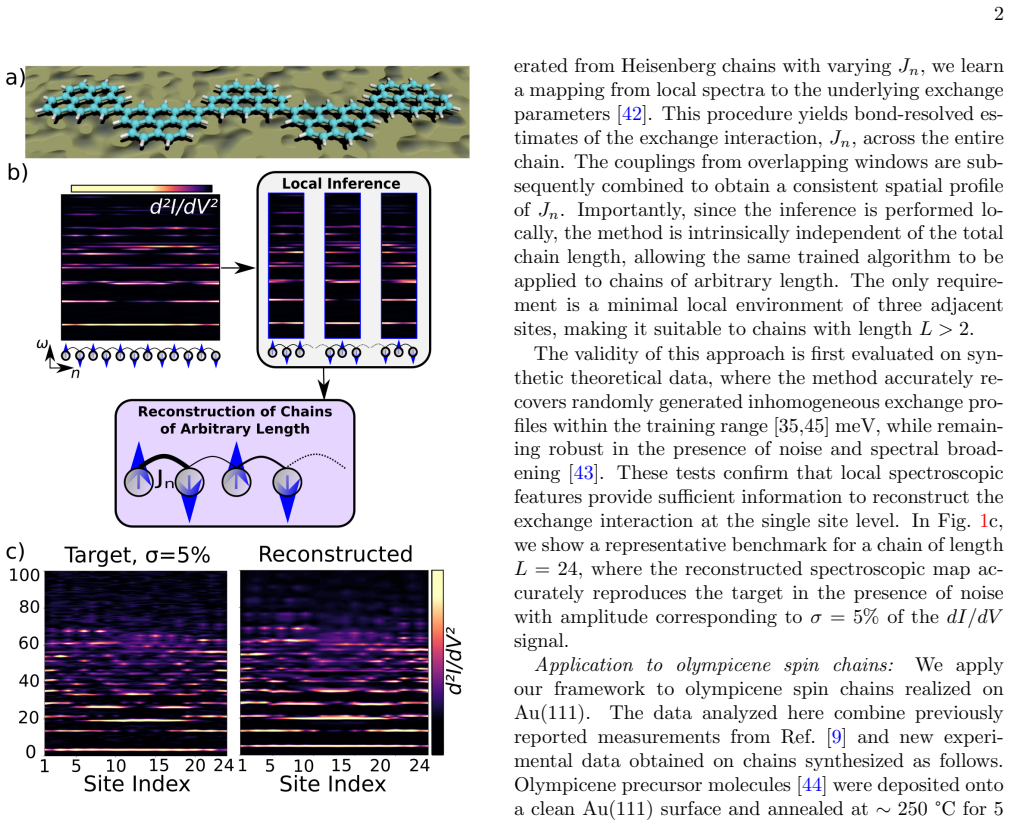
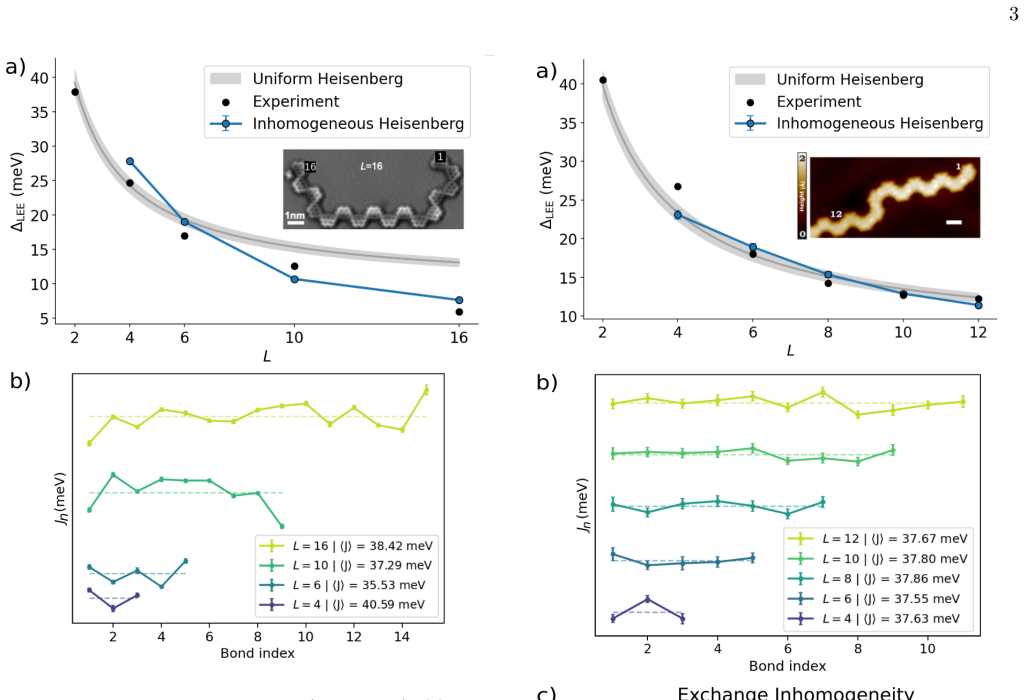
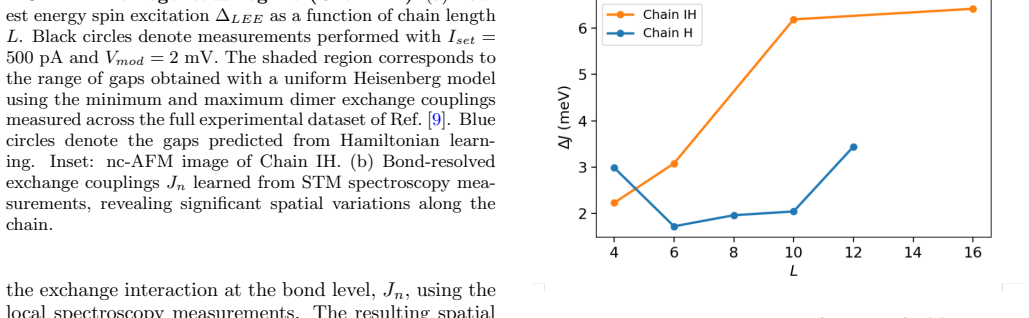
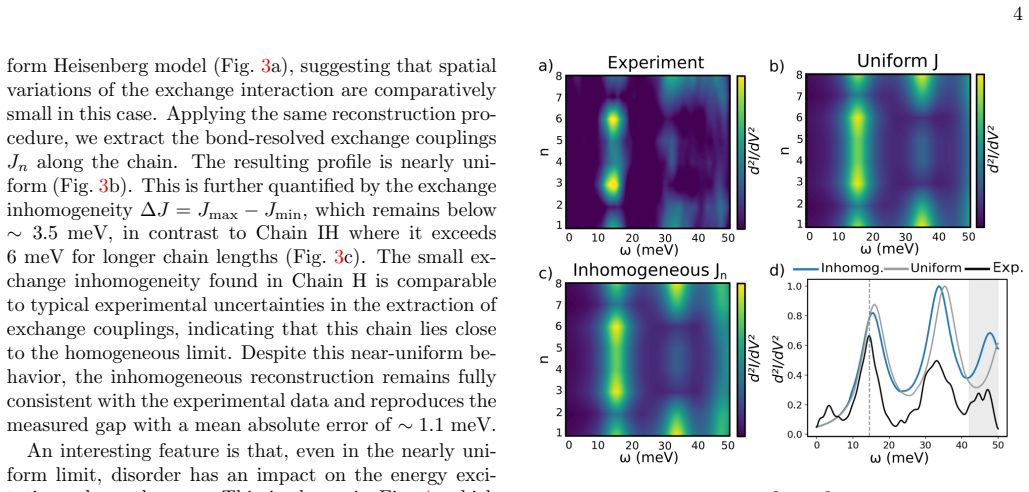
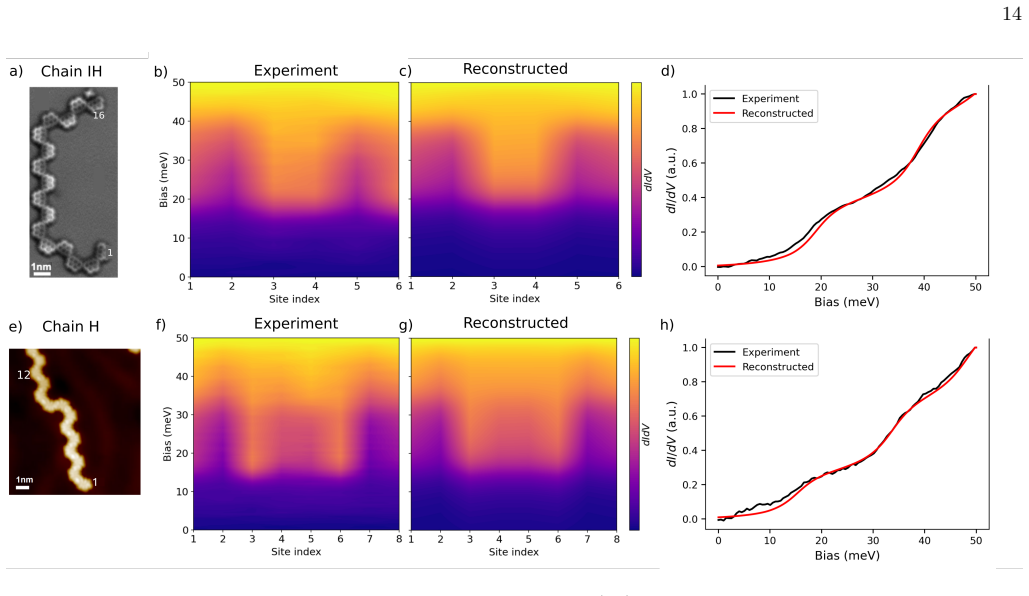
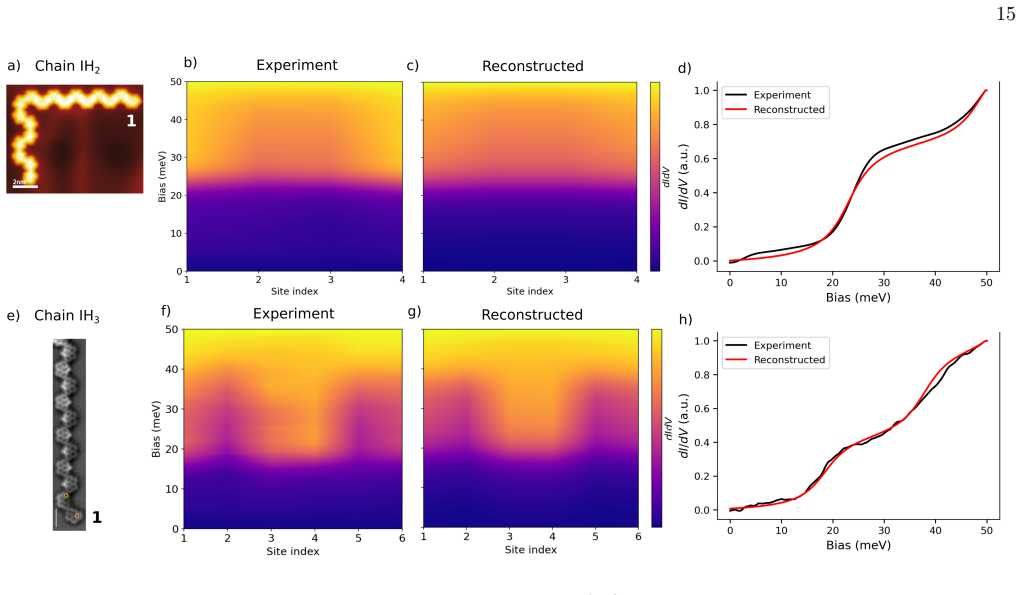
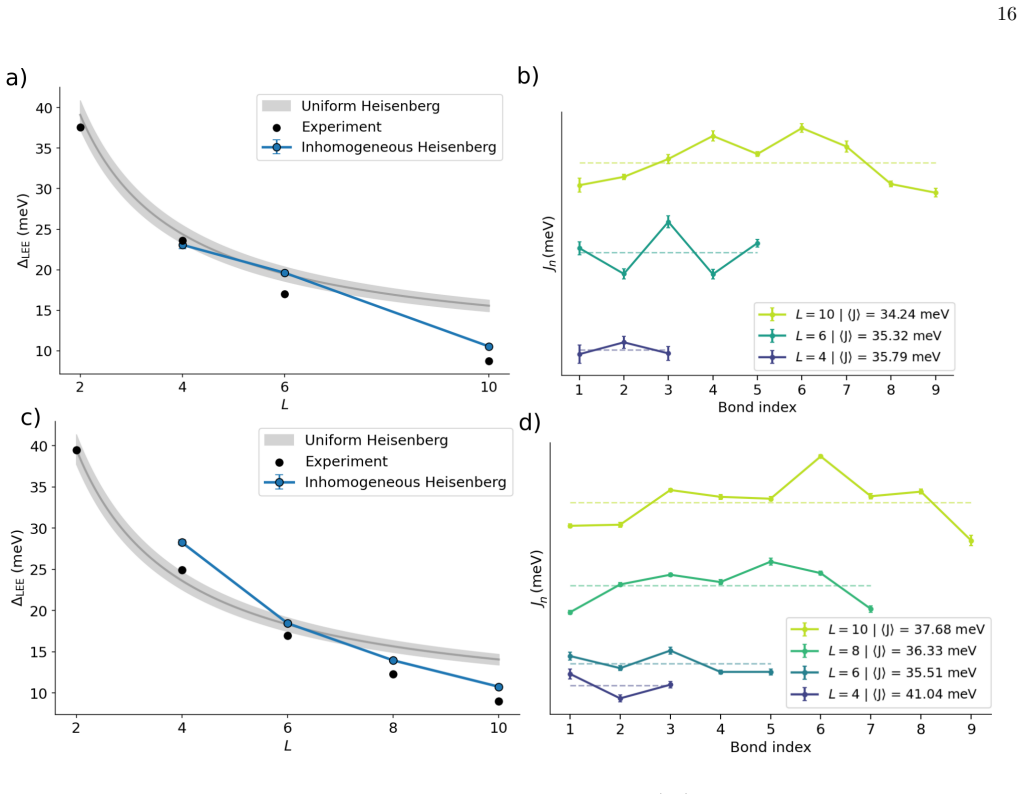
We leverage a local, length-independent machine learning methodology to reconstruct spatially modulated exchange interactions directly from inelastic scanning tunneling spectroscopy maps. We demonstrate this approach with nanographene spin chains, identifying both near-uniform and inhomogeneous regimes across the synthesized magnets. The reconstructed models quantitatively reproduce the experimental spectra and recover the correct scaling of the excitation gap with system size. Our results establish a general strategy to bridge local spectroscopic measurements with effective many-body Hamiltonians.
What carries the argument
A local, length-independent machine learning methodology that takes inelastic STS maps as input and outputs spatially modulated exchange couplings in an effective Heisenberg Hamiltonian.
If this is right
- The method distinguishes near-uniform from inhomogeneous exchange regimes in synthesized nanographene magnets.
- Reconstructed Hamiltonians match experimental inelastic spectra at a quantitative level.
- The models recover the correct dependence of the excitation gap on chain length.
- The workflow provides a general route from local spectroscopic data to effective many-body spin Hamiltonians.
Where Pith is reading between the lines
- The same reconstruction pipeline could be tested on other low-dimensional spin systems such as molecular chains or trapped-ion arrays where local coupling variations are suspected.
- If additional interaction terms like anisotropy or longer-range couplings prove necessary, the method could be extended by enlarging the parameter space while keeping the local fitting structure.
- Quantitative agreement on gap scaling suggests the approach may help predict behavior in devices or larger assemblies built from the same nanographene building blocks.
Load-bearing premise
The measured inelastic STS maps arise from an effective Heisenberg spin Hamiltonian whose only spatial variation occurs in the exchange couplings, with no major contributions from other terms or from the measurement process.
What would settle it
Apply the reconstructed Hamiltonians to chains longer than those used in training and check whether the predicted excitation gap continues to follow the observed scaling; mismatch in gap values or spectra would falsify the reconstruction.
Figures



read the original abstract
Inferring microscopic Hamiltonians from experimental data is a central challenge in quantum materials and quantum simulation. In low-dimensional spin systems, exchange interactions are often assumed to be spatially uniform, despite structural and environmental inhomogeneities that can locally modify the coupling. Here, we leverage a local, length-independent machine learning methodology to reconstruct spatially modulated exchange interactions directly from inelastic scanning tunneling spectroscopy maps. We demonstrate this approach with nanographene spin chains, identifying both near-uniform and inhomogeneous regimes across the synthesized magnets. The reconstructed models quantitatively reproduce the experimental spectra and recover the correct scaling of the excitation gap with system size. Our results establish a general strategy to bridge local spectroscopic measurements with effective many-body Hamiltonians.
Editorial analysis
A structured set of objections, weighed in public.
Referee Report
Summary. The manuscript presents a local, length-independent machine learning methodology to reconstruct spatially modulated exchange interactions J(r) directly from inelastic scanning tunneling spectroscopy (STS) maps in nanographene spin chains. It applies the approach to both near-uniform and inhomogeneous regimes, claiming that the resulting Heisenberg models quantitatively reproduce the experimental spectra and recover the correct scaling of the excitation gap with system size.
Significance. If the central claims hold after detailed validation, the work would provide a general strategy for inferring effective many-body Hamiltonians from local spectroscopic data in systems with structural or environmental inhomogeneities. This is significant for quantum materials research, as it moves beyond the common assumption of uniform couplings and enables direct comparison between measured spectra and reconstructed models.
major comments (3)
- [Methods] Methods section: no description is provided of the machine learning training procedure, choice of validation sets, error bars on the reconstructed J(r), or controls for overfitting. This information is load-bearing for the claim that the models are inferred from the STS maps rather than being artifacts of the fitting process.
- [Results] Results section (spectra comparison): the assertion of quantitative reproduction of experimental spectra lacks reported metrics (e.g., RMS deviation, overlap integrals, or per-peak error) or explicit comparison tables/figures that would allow assessment of agreement quality across the claimed uniform and inhomogeneous cases.
- [Finite-size scaling] Finite-size scaling analysis: while the correct gap scaling with system length is claimed, the manuscript does not specify how the gap is extracted from the reconstructed Hamiltonian (e.g., exact diagonalization details or finite-size extrapolation procedure) or provide the raw gap values versus length for both experiment and model.
minor comments (2)
- [Abstract] The abstract states that the methodology is 'length-independent' but does not clarify whether this property was verified by training on chains of varying lengths and testing on unseen lengths.
- [Model definition] Notation for the spatially varying exchange J(r) should be defined explicitly in the main text, including how the local ML model parametrizes the spatial modulation.
Simulated Author's Rebuttal
We thank the referee for the detailed and constructive report. The comments highlight important areas where additional methodological transparency and quantitative validation will strengthen the manuscript. We address each major comment below and will incorporate the requested information in a revised version.
read point-by-point responses
-
Referee: [Methods] Methods section: no description is provided of the machine learning training procedure, choice of validation sets, error bars on the reconstructed J(r), or controls for overfitting. This information is load-bearing for the claim that the models are inferred from the STS maps rather than being artifacts of the fitting process.
Authors: We agree that the current Methods section does not provide sufficient detail on these aspects. In the revised manuscript we will add a dedicated subsection describing the machine-learning training procedure (including network architecture, loss function, optimizer, and hyperparameters), the construction and use of validation sets, the method used to obtain error bars on the reconstructed J(r), and the regularization and cross-validation steps employed to control overfitting. These additions will directly support the claim that the inferred Hamiltonians are data-driven rather than fitting artifacts. revision: yes
-
Referee: [Results] Results section (spectra comparison): the assertion of quantitative reproduction of experimental spectra lacks reported metrics (e.g., RMS deviation, overlap integrals, or per-peak error) or explicit comparison tables/figures that would allow assessment of agreement quality across the claimed uniform and inhomogeneous cases.
Authors: We acknowledge that quantitative metrics and explicit comparison tables are absent. In the revision we will report RMS deviations between experimental and simulated spectra, peak-position errors, and (where appropriate) spectral overlap integrals. We will also add a supplementary table and/or figure that tabulates these metrics separately for the near-uniform and inhomogeneous chains, allowing direct assessment of agreement quality. revision: yes
-
Referee: [Finite-size scaling] Finite-size scaling analysis: while the correct gap scaling with system length is claimed, the manuscript does not specify how the gap is extracted from the reconstructed Hamiltonian (e.g., exact diagonalization details or finite-size extrapolation procedure) or provide the raw gap values versus length for both experiment and model.
Authors: We will expand the finite-size scaling section to specify the exact-diagonalization procedure (including Hilbert-space truncation and convergence criteria) used to obtain the excitation gap from each reconstructed Hamiltonian. We will also include the raw gap values versus chain length for both the experimental STS data and the model predictions, presented in a table or supplementary figure, together with the extrapolation procedure employed to confirm the scaling. revision: yes
Circularity Check
No significant circularity identified
full rationale
The abstract describes an ML-based reconstruction of spatially varying J(r) from inelastic STS maps, followed by verification that the resulting models reproduce the input spectra and recover gap scaling with length. No equations, self-citations, or derivation steps are supplied that reduce any claimed result to its inputs by construction. Reproduction of spectra is the expected outcome of a fitting procedure and does not render the reconstruction methodology circular; the central claim remains an independent inverse-problem technique validated against external experimental benchmarks.
Axiom & Free-Parameter Ledger
Reference graph
Works this paper leans on
-
[1]
D. G. de Oteyza and T. Frederiksen, Carbon-based nanostructures as a versatile platform for tunableπ- magnetism, Journal of Physics: Condensed Matter34, 443001 (2022)
2022
-
[2]
Zhang, B
Y. Zhang, B. Fu, N. Li, J. Lu, and J. Cai, Advancements inπ-magnetism and precision engineering of carbon- based nanostructures, Chemistry – A European Journal 30, e202402765 (2024)
2024
-
[3]
Mishra, G
S. Mishra, G. Catarina, F. Wu, R. Ortiz, D. Jacob, K. Eimre, J. Ma, C. A. Pignedoli, X. Feng, P. Ruffieux, J. Fern´ andez-Rossier, and R. Fasel, Observation of frac- tional edge excitations in nanographene spin chains, Na- ture598, 287 (2021)
2021
-
[4]
Chenxiao, G
Z. Chenxiao, G. Catarina, J.-J. Zhang, J. Henriques, L. Yang, J. Ma, X. Feng, O. Gr¨ oning, P. Ruffieux, J. Fern´ andez, and R. Fasel, Tunable topological phases in nanographene-based spin-1/2 alternating-exchange heisenberg chains, Nature Nanotechnology19, 1789 (2024)
2024
-
[5]
X. Su, Z. Ding, Y. Hong, N. Ke, K. Yan, C. Li, Y.-F. Jiang, and P. Yu, Fabrication of spin-1/2 heisenberg an- tiferromagnetic chains via combined on-surface synthesis and reduction for spinon detection, Nature Synthesis4, 694 (2025)
2025
-
[6]
K. Sun, N. Cao, O. J. Silveira, A. O. Fumega, F. Hanin- dita, S. Ito, J. L. Lado, P. Liljeroth, A. S. Foster, and S. Kawai, On-surface synthesis of heisenberg spin-1/2 an- tiferromagnetic molecular chains, Science Advances11, eads1641 (2025)
2025
-
[7]
X. Fu, L. Huang, K. Liu, J. C. G. Henriques, Y. Gao, X. Han, H. Chen, Y. Wang, C.-A. Palma, Z. Cheng, X. Lin, S. Du, J. Ma, J. Fern´ andez-Rossier, X. Feng, and H.-J. Gao, Building spin-1/2 antiferromagnetic heisen- berg chains with diaza-nanographenes, Nature Synthesis 4, 684 (2025)
2025
-
[8]
Yuan, X.-Y
Z. Yuan, X.-Y. Zhang, Y. Jiang, X. Qian, Y. Wang, Y. Liu, L. Liu, X. Liu, D. Guan, Y. Li, H. Zheng, C. Liu, J. Jia, M. Qin, P.-N. Liu, D.-Y. Li, and S. Wang, Fractional spinon quasiparticles in open-shell triangulene spin-1/2 chains, Journal of the American Chemical Soci- ety147, 5004 (2025)
2025
-
[9]
C. Zhao, L. Yang, J. C. G. Henriques, M. Ferri-Cort´ es, G. Catarina, C. A. Pignedoli, J. Ma, X. Feng, P. Ruffieux, J. Fern´ andez-Rossier, and R. Fasel, Spin excitations in nanographene-based antiferromagnetic spin-1/2 heisen- berg chains, Nature Materials24, 722 (2025)
2025
-
[10]
Vegliante, S
A. Vegliante, S. Fern´ andez, R. Ortiz, M. Vilas-Varela, T. Y. Baum, N. Friedrich, F. Romero-Lara, A. Aguirre, K. Vaxevani, D. Wang, C. Garcia Fernandez, H. S. J. van der Zant, T. Frederiksen, D. Pe˜ na, and J. I. Pascual, Tuning the spin interaction in nonplanar organic dirad- icals through mechanical manipulation, ACS Nano18, 26514 (2024)
2024
-
[11]
Catarina, E
G. Catarina, E. Turco, N. Krane, M. Bommert, A. Ortega-Guerrero, O. Gr¨ oning, P. Ruffieux, R. Fasel, and C. A. Pignedoli, Conformational tuning of magnetic interactions in coupled nanographenes, Nano Letters24, 12536 (2024)
2024
-
[12]
Krane, E
N. Krane, E. Turco, A. Bernhardt, D. Jacob, G. Gan- dus, D. Passerone, M. Luisier, M. Jur´ ıˇ cek, R. Fasel, J. Fern´ andez-Rossier, and P. Ruffieux, Exchange inter- actions and intermolecular hybridization in a spin-1/2 nanographene dimer, Nano Letters23, 9353 (2023)
2023
-
[13]
C. Zhao, Q. Huang, L. c. v. Valenta, K. Eimre, L. Yang, A. V. Yakutovich, W. Xu, J. Ma, X. Feng, M. Jur´ ıˇ cek, R. Fasel, P. Ruffieux, and C. A. Pignedoli, Tailoring mag- netism of graphene nanoflakes via tip-controlled dehydro- genation, Phys. Rev. Lett.132, 046201 (2024)
2024
-
[14]
Carleo and M
G. Carleo and M. Troyer, Solving the quantum many- body problem with artificial neural networks, Science 355, 602–606 (2017)
2017
-
[15]
E. P. L. van Nieuwenburg, Y.-H. Liu, and S. D. Huber, Learning phase transitions by confusion, Nature Physics 13, 435–439 (2017)
2017
-
[16]
Carrasquilla and R
J. Carrasquilla and R. G. Melko, Machine learning phases of matter, Nature Physics13, 431–434 (2017)
2017
-
[17]
Durrer, B
R. Durrer, B. Kratochwil, J. Koski, A. Landig, C. Re- ichl, W. Wegscheider, T. Ihn, and E. Greplova, Au- tomated tuning of double quantum dots into specific charge states using neural networks, Phys. Rev. Appl. 13, 054019 (2020)
2020
-
[19]
I.-J. Chen, M. Aapro, A. Kipnis, A. Ilin, P. Liljeroth, and A. S. Foster, Precise atom manipulation through deep reinforcement learning, Nature Communications 13, 10.1038/s41467-022-35149-w (2022)
-
[20]
N. Wu, M. Aapro, J. S. Jestil¨ a, R. Drost, M. M. Garc´ ıa, T. Torres, F. Xiang, N. Cao, Z. He, G. Bottari, P. Lil- jeroth, and A. S. Foster, Precise large-scale chemical transformations on surfaces: Deep learning meets scan- ning probe microscopy with interpretability, Journal of the American Chemical Society147, 1240–1250 (2024)
2024
-
[22]
Lupi and J
G. Lupi and J. L. Lado, Hamiltonian-learning quantum magnets with nonlocal impurity tomography, Phys. Rev. Appl.23, 054077 (2025)
2025
-
[23]
Karjalainen, Z
N. Karjalainen, Z. Lippo, G. Chen, R. Koch, A. O. Fumega, and J. L. Lado, Hamiltonian inference from dy- namical excitations in confined quantum magnets, Phys. Rev. Appl.20, 024054 (2023)
2023
-
[24]
N. Karjalainen, G. Lupi, R. Koch, A. O. Fumega, and J. L. Lado, Hamiltonian learning quantum magnets with 6 dynamical impurity tomography, arXiv:2510.18613
-
[25]
Cross-Platform Autonomous Control of Minimal Kitaev Chains
D. van Driel, R. Koch, V. P. M. Sietses, S. L. D. ten Haaf, C.-X. Liu, F. Zatelli, B. Roovers, A. Bor- din, N. van Loo, G. Wang, J. C. Wolff, G. P. Mazur, T. Dvir, I. Kulesh, Q. Wang, A. M. Bozkurt, S. Gaz- ibegovic, G. Badawy, E. P. A. M. Bakkers, M. Wimmer, S. Goswami, J. L. Lado, L. P. Kouwenhoven, and E. Gre- plova, Cross-platform autonomous control o...
work page internal anchor Pith review Pith/arXiv arXiv
- [26]
-
[27]
V. Hernandes, J. Rogers, R. Koch, T. Spriggs, B. Und- seth, A. Chatterjee, L. M. K. Vandersypen, and E. Gre- plova, Reconstructing quantum dot charge stability dia- grams with diffusion models, arXiv:2603.26432
-
[28]
Hamiltonian learning for spin-spiral moir\'e magnets from electronic magnetotransport
F. Nigmatulin, G. Lupi, J. L. Lado, and Z. Sun, Hamil- tonian learning for spin-spiral moir´ e magnets from elec- tronic magnetotransport (2026), arXiv:2604.02959 [cond- mat.mes-hall]
work page internal anchor Pith review Pith/arXiv arXiv 2026
-
[29]
J. Wang, S. Paesani, R. Santagati, S. Knauer, A. A. Gen- tile, N. Wiebe, M. Petruzzella, J. L. O’Brien, J. G. Rarity, A. Laing, and M. G. Thompson, Experimental quantum hamiltonian learning, Nature Physics13, 551 (2017)
2017
-
[30]
Koch and J
R. Koch and J. L. Lado, Designing quantum many-body matter with conditional generative adversarial networks, Phys. Rev. Res.4, 033223 (2022)
2022
-
[31]
R. Koch, D. van Driel, A. Bordin, J. L. Lado, and E. Gre- plova, Adversarial hamiltonian learning of quantum dots in a minimal kitaev chain, Phys. Rev. Appl.20, 044081 (2023)
2023
-
[32]
Valenti, G
A. Valenti, G. Jin, J. L´ eonard, S. D. Huber, and E. Gre- plova, Scalable hamiltonian learning for large-scale out- of-equilibrium quantum dynamics, Phys. Rev. A105, 023302 (2022)
2022
-
[33]
L. Che, C. Wei, Y. Huang, D. Zhao, S. Xue, X. Nie, J. Li, D. Lu, and T. Xin, Learning quantum hamiltonians from single-qubit measurements, Phys. Rev. Res.3, 023246 (2021)
2021
-
[34]
Simard, A
O. Simard, A. Dawid, J. Tindall, M. Ferrero, A. M. Sen- gupta, and A. Georges, Learning interactions between Rydberg atoms, PRX Quantum6, 030324 (2025)
2025
-
[35]
Bairey, I
E. Bairey, I. Arad, and N. H. Lindner, Learning a local Hamiltonian from local measurements, Phys. Rev. Lett. 122, 020504 (2019)
2019
-
[36]
Gebhart, R
V. Gebhart, R. Santagati, A. A. Gentile, E. M. Gauger, D. Craig, N. Ares, L. Banchi, F. Marquardt, L. Pezz` e, and C. Bonato, Learning quantum systems, Nat. Rev. Phys.5, 141 (2023)
2023
-
[37]
J. A. Sobral, S. Obernauer, S. Turkel, A. N. Pasupathy, and M. S. Scheurer, Machine learning the microscopic form of nematic order in twisted double-bilayer graphene, Nature Communications14, 10.1038/s41467-023-40684- 1 (2023)
-
[38]
R. Koch, R. Drost, P. Liljeroth, and J. L. Lado, Hamil- tonian learning of triplon excitations in an artificial nanoscale molecular quantum magnet, Nano Letters25, 13435 (2025)
2025
-
[39]
Heinrich, J
A. Heinrich, J. Gupta, C. Lutz, and D. Eigler, Single- atom spin-flip spectroscopy, Science (New York, N.Y.) 306, 466 (2004)
2004
-
[40]
C. F. Hirjibehedin, C. P. Lutz, and A. J. Heinrich, Spin coupling in engineered atomic structures, Science312, 1021 (2006)
2006
-
[41]
Ternes, Spin excitations and correlations in scan- ning tunneling spectroscopy, New Journal of Physics17, 063016 (2015)
M. Ternes, Spin excitations and correlations in scan- ning tunneling spectroscopy, New Journal of Physics17, 063016 (2015)
2015
-
[42]
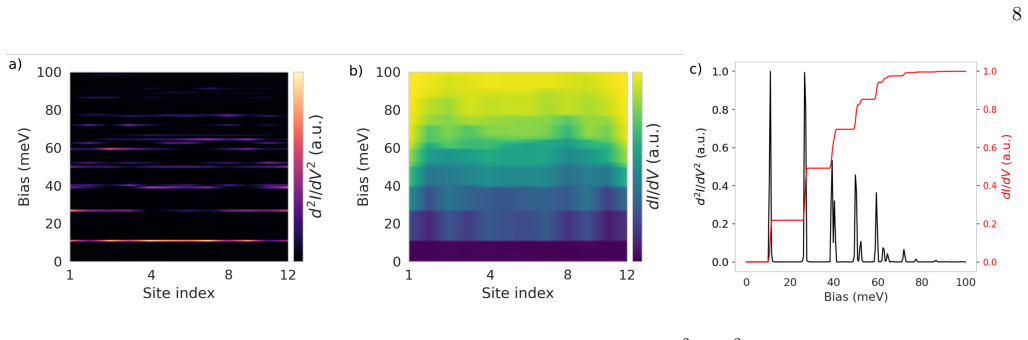
The details of dataset generation and preprocessing are provided in the Supplemental Information (SI)
-
[43]
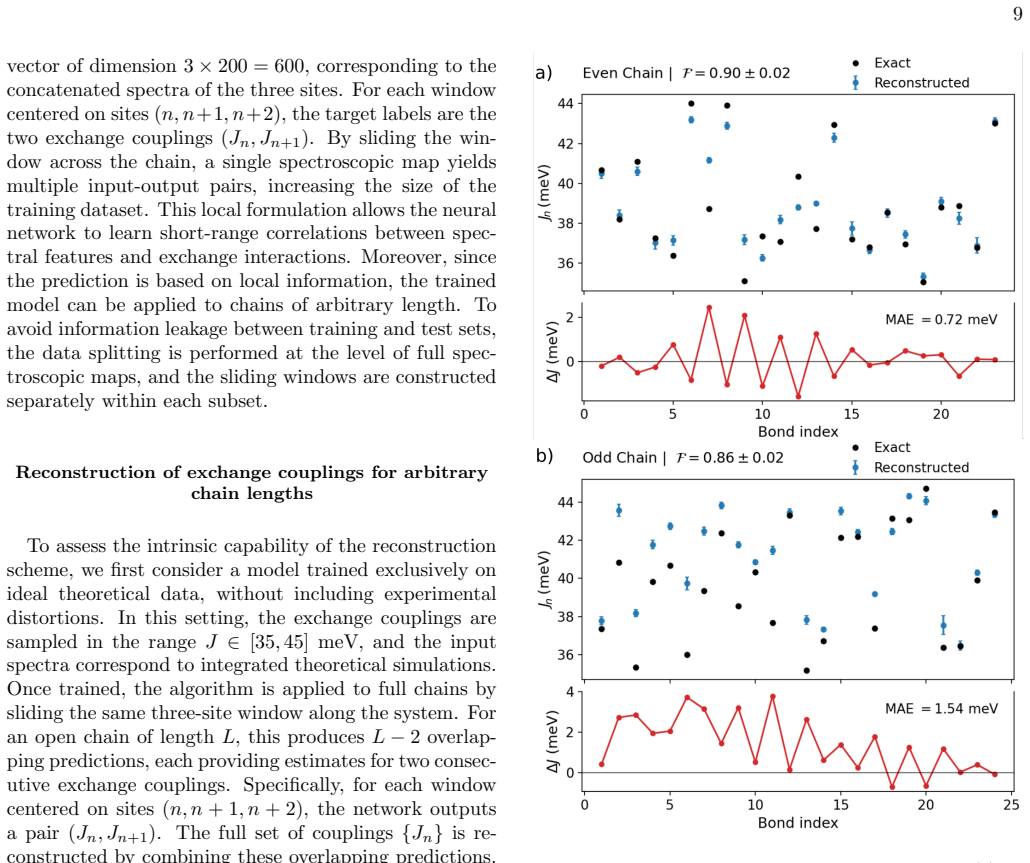
Systematic benchmarks of the trained algorithm in the SI
-
[44]
Further details on the synthesis are provided in the SI
-
[45]
Further experimental details are provided in the SI
-
[46]
See Supplementary Information for a detailed compari- son, including reconstructed maps and quantitative error analysis
-
[47]
Lupi, Code repository for ”learning inhomo- geneous heisenberg hamiltonians in nanographene spin chains”,https://github.com/GretaLupi/ Inhomogeneous-Heisenberg-HL(2026)
G. Lupi, Code repository for ”learning inhomo- geneous heisenberg hamiltonians in nanographene spin chains”,https://github.com/GretaLupi/ Inhomogeneous-Heisenberg-HL(2026)
2026
-
[48]
Holzner, A
A. Holzner, A. Weichselbaum, I. P. McCulloch, U. Schollw¨ ock, and J. von Delft, Chebyshev matrix prod- uct state approach for spectral functions, Phys. Rev. B 83, 195115 (2011)
2011
-
[49]
J. L. Lado and O. Zilberberg, Topological spin excita- tions in harper-heisenberg spin chains, Phys. Rev. Res. 1, 033009 (2019)
2019
-
[50]
Fishman, S
M. Fishman, S. R. White, and E. M. Stoudenmire, The ITensor Software Library for Tensor Network Calcula- tions, SciPost Phys. Codebases , 4 (2022)
2022
-
[51]
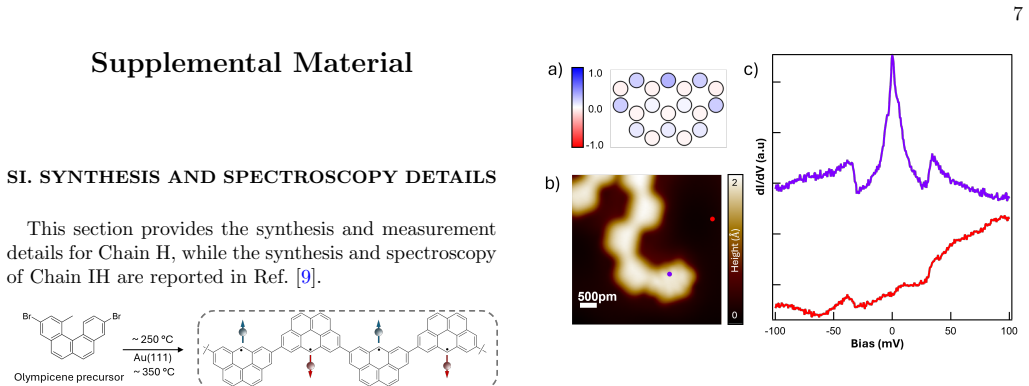
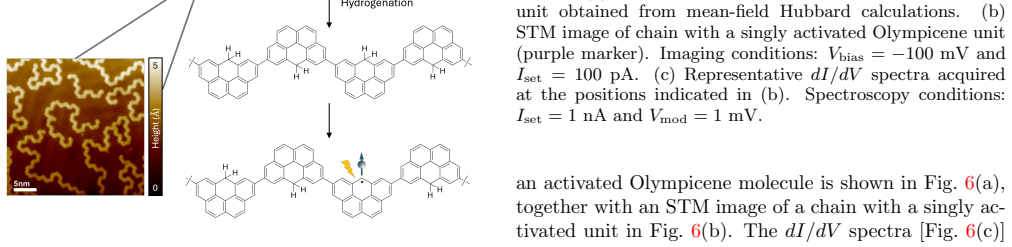
J. L. Lado, https://github.com/joselado/dmrgpy (2025). 7 Supplemental Material SI. SYNTHESIS AND SPECTROSCOPY DETAILS This section provides the synthesis and measurement details for Chain H, while the synthesis and spectroscopy of Chain IH are reported in Ref. [9]. FIG. 5. On-surface synthesis route used to fabricate the Olympicene-based Heisenberg chains...
2025
discussion (0)
Sign in with ORCID, Apple, or X to comment. Anyone can read and Pith papers without signing in.