Hamiltonian learning for spin-spiral moir\'e magnets from electronic magnetotransport
Pith reviewed 2026-05-13 18:26 UTC · model grok-4.3
The pith
Machine learning extracts the q vector of spin-spiral magnets directly from lateral conductance measurements under varying magnetic field and bias.
A machine-rendered reading of the paper's core claim, the machinery that carries it, and where it could break.
Core claim
The conductance pattern in lateral transport reveals a complex dependence on the spin-spiral q vector; a supervised machine-learning algorithm trained on magnetic-field and bias sweeps can therefore extract the q vector of arbitrary spin spirals, remaining robust against impurities and noise in the conductance data.
What carries the argument
Supervised machine-learning model trained on the joint dependence of conductance on magnetic field and bias voltage.
If this is right
- Noncollinear magnetic states in 2D materials can be characterized using standard electronic transport setups instead of specialized magnetic probes.
- The same conductance dataset can be reused to train models for different classes of spin spirals without new sample fabrication.
- Device-scale mapping of magnetic texture becomes feasible by combining local transport measurements with the trained algorithm.
Where Pith is reading between the lines
- The method could be extended to time-resolved measurements to track dynamic changes in the spiral structure during device operation.
- Combining the transport-trained model with a small number of direct imaging points might reduce the required training data volume for new material systems.
- The approach suggests that other noncollinear orders, such as skyrmion lattices, might also leave identifiable fingerprints in magnetotransport that a similar algorithm could learn.
Load-bearing premise
The conductance measured under field and bias sweeps encodes enough unique information to identify the q vector of any spin spiral, even with impurities present.
What would settle it
Measure conductance on a device whose spin-spiral q vector has been independently confirmed by neutron scattering or scanning probe microscopy, then check whether the trained model returns the correct q vector.
Figures


read the original abstract
Two-dimensional noncollinear magnetic states, such as spin-spiral magnets, offer an excellent platform for investigating fundamental phenomena, with potential for advancing stray-field-free spintronics. However, detection and characterization of noncollinear magnetic states in two-dimensional systems remain challenging, motivating the development of alternative probing methods. Here, we present a methodology for extracting the spin-spiral $\mathbf{q}$ vector from lateral electronic transport measurements. Our approach leverages the magnetic field and bias dependence of the conductance to train a supervised machine learning algorithm, which enables us to extract the $\mathbf{q}$ vectors of arbitrary spin-spiral magnets. We demonstrate that this methodology is robust to the presence of impurities in the system and noise in the conductance data. Our findings show that the conductance pattern reveals a complex dependence on the $\mathbf{q}$ vector of the spin spiral, providing a new strategy to learn magnetic structures directly from transport experiments.
Editorial analysis
A structured set of objections, weighed in public.
Referee Report
Summary. The manuscript proposes a supervised machine-learning methodology to extract the spin-spiral wavevector q from the magnetic-field and bias dependence of lateral conductance in two-dimensional moiré magnets. Simulated transport data are used to train the algorithm, which is then asserted to recover q for arbitrary spin spirals while remaining robust to impurities and additive noise in the conductance.
Significance. If the central mapping from (G,B,V) surfaces to q proves unique and stable, the work would supply a practical, non-invasive route to characterize noncollinear magnetism in 2D systems where direct probes are difficult. This could accelerate experimental screening of spin-spiral candidates for stray-field-free spintronics, complementing existing transport-based studies of moiré magnetism.
major comments (2)
- [§3] §3 (Methods): the training-set construction for q-space is not specified (grid density, range of |q|, sampling strategy). Without this information the claim that the learned map generalizes to arbitrary continuous q vectors cannot be assessed, especially once impurity averaging and noise are introduced.
- [§4] §4 (Results): no quantitative metrics (test-set MSE, error bars, accuracy versus noise amplitude or impurity density) are reported. The robustness statements therefore rest on qualitative assertions rather than falsifiable benchmarks.
minor comments (1)
- [Abstract and §2] Notation for the q vector is introduced inconsistently between the abstract and the main text; a single, clearly defined symbol should be used throughout.
Simulated Author's Rebuttal
We thank the referee for the constructive comments and positive assessment of the potential significance of our work. We address each major comment below and have revised the manuscript accordingly.
read point-by-point responses
-
Referee: [§3] §3 (Methods): the training-set construction for q-space is not specified (grid density, range of |q|, sampling strategy). Without this information the claim that the learned map generalizes to arbitrary continuous q vectors cannot be assessed, especially once impurity averaging and noise are introduced.
Authors: We agree that the original manuscript did not provide sufficient detail on the training-set construction. In the revised version we have expanded Section 3 with a new subsection that specifies: (i) a uniform Cartesian grid with spacing Δq = 0.02 (in units of the moiré reciprocal-lattice vector), (ii) the range |q| ∈ [0, 0.5] (covering the physically relevant portion of the Brillouin zone for spin spirals), and (iii) a deterministic dense sampling strategy that generates 2500 distinct q vectors per training epoch, augmented by random rotations to ensure isotropy. We have also added explicit statements confirming that the same grid is used for the impurity-averaged and noisy data sets, thereby allowing direct assessment of generalization to continuous q. revision: yes
-
Referee: [§4] §4 (Results): no quantitative metrics (test-set MSE, error bars, accuracy versus noise amplitude or impurity density) are reported. The robustness statements therefore rest on qualitative assertions rather than falsifiable benchmarks.
Authors: We acknowledge that the original results section relied on qualitative statements. The revised manuscript now includes quantitative benchmarks in Section 4 and a new supplementary figure: test-set MSE = 0.004 ± 0.001 (10-fold cross-validation), mean absolute error on |q| of 0.008 (in reciprocal-lattice units), and explicit curves showing that the error remains below 5 % for additive noise amplitudes up to 18 % and for impurity densities up to 4 %. These metrics are reported both for the clean case and under the impurity/noise conditions used in the robustness tests, making the claims falsifiable. revision: yes
Circularity Check
No circularity: supervised ML extraction from simulated transport data is self-contained
full rationale
The methodology trains a supervised learner on conductance(G, B, V) surfaces generated from known q vectors, then applies the trained model to new data. This is a standard forward-simulation + inverse-learning pipeline with no analytic derivation that reduces to its own fitted parameters, no self-citation load-bearing the central claim, and no renaming of known results. The mapping is learned rather than assumed or defined circularly; robustness claims are empirical on held-out simulations and noise. No load-bearing step collapses to an input by construction.
Axiom & Free-Parameter Ledger
axioms (1)
- domain assumption The magnetic-field and bias dependence of conductance in spin-spiral magnets encodes sufficient information to allow supervised ML to recover the q vector for arbitrary spirals.
Lean theorems connected to this paper
-
Foundation.RealityFromDistinctionreality_from_one_distinction unclear?
unclearRelation between the paper passage and the cited Recognition theorem.
We generated a conductance dataset with 10000 samples... q1 and q2 components spanning from 0 to 1/2... fidelities reach F|q| = 0.9998 and Fθ = 0.9943.
What do these tags mean?
- matches
- The paper's claim is directly supported by a theorem in the formal canon.
- supports
- The theorem supports part of the paper's argument, but the paper may add assumptions or extra steps.
- extends
- The paper goes beyond the formal theorem; the theorem is a base layer rather than the whole result.
- uses
- The paper appears to rely on the theorem as machinery.
- contradicts
- The paper's claim conflicts with a theorem or certificate in the canon.
- unclear
- Pith found a possible connection, but the passage is too broad, indirect, or ambiguous to say the theorem truly supports the claim.
Reference graph
Works this paper leans on
-
[1]
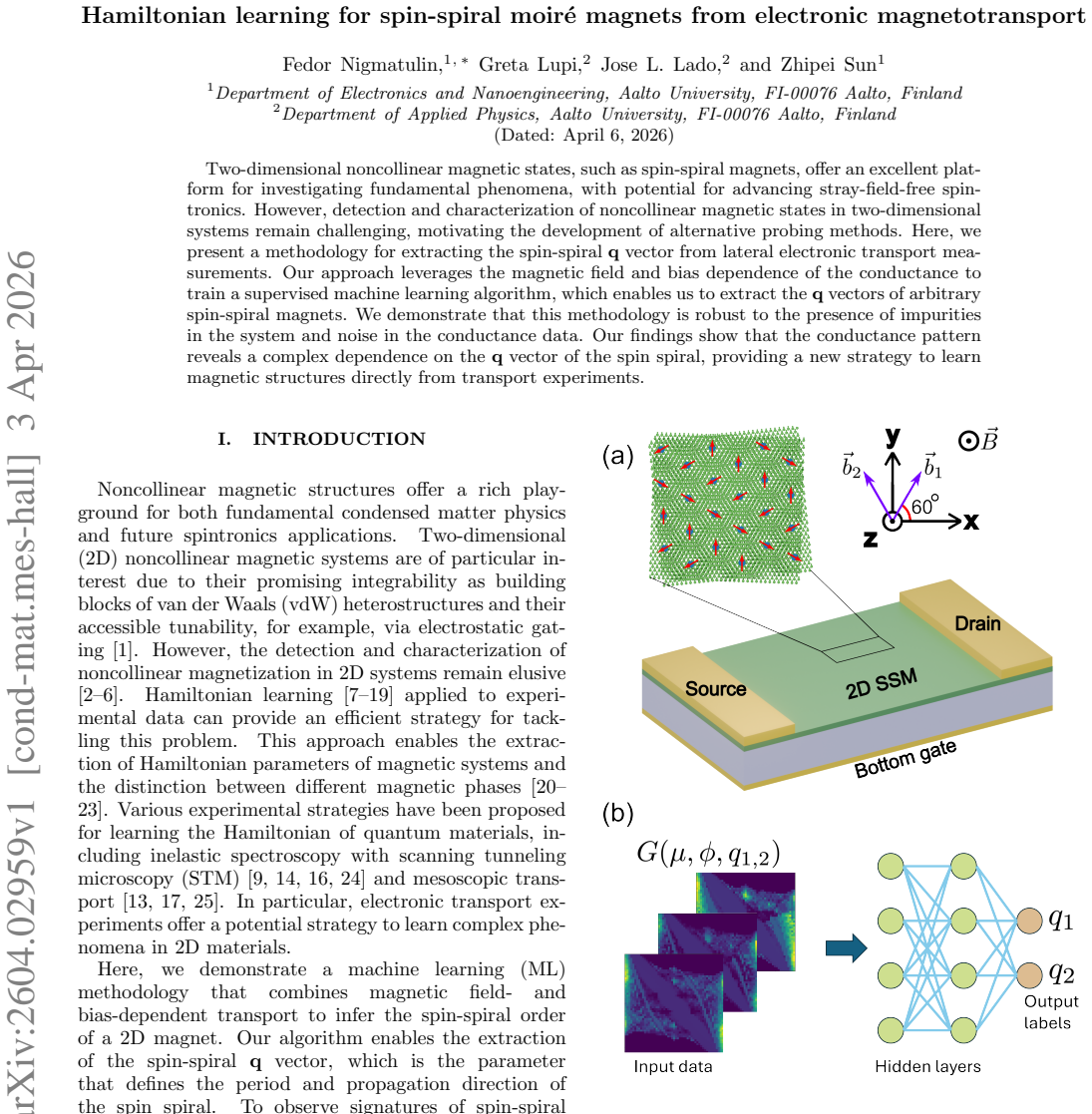
as a function of electron doping and magnetic flux. We leverage the impact of the spin spiral on the Hofstadter pattern, focusing on an effective triangular superlattice of a twisted vdW structure, showing that ∗ fedor.nigmatulin@aalto.fi FIG. 1. (a) Schematic of an electrical gated device to probe noncollinear magnetic order in a twisted vdW structure (s...
work page internal anchor Pith review Pith/arXiv arXiv 2026
-
[2]
K. F. Mak, J. Shan, and D. C. Ralph, Probing and con- trolling magnetic states in 2D layered magnetic materials, Nat. Rev. Phys.1, 646 (2019)
work page 2019
-
[3]
Q. Song, S. Stavri´ c, P. Barone, A. Droghetti, D. S. An- tonenko, J. W. F. Venderbos, C. A. Occhialini, B. Ilyas, E. Erge¸ cen, N. Gedik, S.-W. Cheong, R. M. Fernandes, S. Picozzi, and R. Comin, Electrical switching of a p-wave magnet, Nature642, 64–70 (2025)
work page 2025
-
[4]
Y. Wang, X. Zhao, L. Yao, H. Liu, P. Cheng, Y. Zhang, B. Feng, F. Ma, J. Zhao, J. Sun, K. Wu, and L. Chen, Orientation-selective spin-polarized edge states in mono- layer NiI2, Nat. Commun.15, 10916 (2024)
work page 2024
-
[5]
M.-P. Miao, N. Liu, W.-H. Zhang, J.-W. Zhou, D.-B. Wang, C. Wang, W. Ji, and Y.-S. Fu, Spin-resolved imag- ing of atomic-scale helimagnetism in mono- and bilayer NiI2, Proc. Natl. Acad. Sci. U.S.A.122, e2422868122 (2025)
work page 2025
-
[6]
F. Nigmatulin, J. L. Lado, and Z. Sun, Electrical probe of spin-spiral order in quantum spin Hall/spin-spiral mag- net van der Waals heterostructures, Phys. Rev. B112, 024430 (2025)
work page 2025
- [7]
-
[8]
J. Wang, S. Paesani, R. Santagati, S. Knauer, A. A. Gen- tile, N. Wiebe, M. Petruzzella, J. L. O’Brien, J. G. Rarity, A. Laing, and M. G. Thompson, Experimental quantum Hamiltonian learning, Nat. Phys.13, 551 (2017)
work page 2017
-
[9]
A. Valenti, G. Jin, J. L´ eonard, S. D. Huber, and E. Gre- plova, Scalable Hamiltonian learning for large-scale out- of-equilibrium quantum dynamics, Phys. Rev. A105, 023302 (2022)
work page 2022
-
[10]
R. Koch, R. Drost, P. Liljeroth, and J. L. Lado, Hamil- tonian learning of triplon excitations in an artificial nanoscale molecular quantum magnet, Nano Lett.25, 13435 (2025)
work page 2025
- [11]
-
[12]
V. Gebhart, R. Santagati, A. A. Gentile, E. M. Gauger, D. Craig, N. Ares, L. Banchi, F. Marquardt, L. Pezz` e, and C. Bonato, Learning quantum systems, Nat. Rev. Phys.5, 141 (2023)
work page 2023
-
[13]
G. Lupi and J. L. Lado, Hamiltonian-learning quantum magnets with nonlocal impurity tomography, Phys. Rev. Appl.23, 054077 (2025)
work page 2025
-
[14]
D. van Driel, R. Koch, V. P. M. Sietses, S. L. D. ten Haaf, C.-X. Liu, F. Zatelli, B. Roovers, A. Bor- din, N. van Loo, G. Wang, J. C. Wolff, G. P. Mazur, T. Dvir, I. Kulesh, Q. Wang, A. M. Bozkurt, S. Gaz- ibegovic, G. Badawy, E. P. A. M. Bakkers, M. Wimmer, S. Goswami, J. L. Lado, L. P. Kouwenhoven, and E. Gre- plova, Cross-platform autonomous control o...
-
[15]
N. Karjalainen, Z. Lippo, G. Chen, R. Koch, A. O. Fumega, and J. L. Lado, Hamiltonian inference from dy- namical excitations in confined quantum magnets, Phys. Rev. Appl.20, 024054 (2023)
work page 2023
-
[16]
N. Karjalainen, G. Lupi, R. Koch, A. O. Fumega, and J. L. Lado, Hamiltonian learning quantum magnets with dynamical impurity tomography, arXiv:2510.18613
-
[17]
R. Koch and J. L. Lado, Designing quantum many-body matter with conditional generative adversarial networks, Phys. Rev. Res.4, 033223 (2022)
work page 2022
-
[18]
R. Koch, D. van Driel, A. Bordin, J. L. Lado, and E. Gre- plova, Adversarial Hamiltonian learning of quantum dots in a minimal Kitaev chain, Phys. Rev. Appl.20, 044081 (2023)
work page 2023
-
[19]
L. Che, C. Wei, Y. Huang, D. Zhao, S. Xue, X. Nie, J. Li, D. Lu, and T. Xin, Learning quantum Hamiltonians from single-qubit measurements, Phys. Rev. Res.3, 023246 (2021)
work page 2021
- [20]
-
[21]
D. Wang, S. Wei, A. Yuan, F. Tian, K. Cao, Q. Zhao, Y. Zhang, C. Zhou, X. Song, D. Xue, and S. Yang, Ma- chine learning magnetic parameters from spin configura- tions, Adv. Sci.7, 2000566 (2020)
work page 2020
-
[22]
J. Salcedo-Gallo, C. Galindo-Gonz´ alez, and E. Restrepo- Parra, Deep learning approach for image classification of magnetic phases in chiral magnets, J. Magn. Magn. Mater.501, 166482 (2020)
work page 2020
-
[23]
I. A. Iakovlev, O. M. Sotnikov, and V. V. Mazurenko, Supervised learning approach for recognizing magnetic skyrmion phases, Phys. Rev. B98, 174411 (2018)
work page 2018
-
[24]
D. Feng, Z. Guan, X. Wu, Y. Wu, and C. Song, Classifi- cation of skyrmionic textures and extraction of Hamilto- nian parameters via machine learning, Phys. Rev. Appl. 21, 034009 (2024)
work page 2024
- [25]
-
[26]
V. Hernandes, J. Rogers, R. Koch, T. Spriggs, B. Und- seth, A. Chatterjee, L. M. K. Vandersypen, and E. Gre- plova, Reconstructing quantum dot charge stability dia- grams with diffusion models, arXiv:2603.26432
-
[27]
D. R. Hofstadter, Energy levels and wave functions of Bloch electrons in rational and irrational magnetic fields, Phys. Rev. B14, 2239 (1976)
work page 1976
-
[28]
F. Wu, T. Lovorn, E. Tutuc, and A. H. MacDonald, Hub- bard model physics in transition metal dichalcogenide moir´ e bands, Phys. Rev. Lett.121, 026402 (2018)
work page 2018
-
[29]
E. C. Regan, D. Wang, C. Jin, M. I. Bakti Utama, B. Gao, X. Wei, S. Zhao, W. Zhao, Z. Zhang, K. Yu- migeta, M. Blei, J. D. Carlstr¨ om, K. Watanabe, T. Taniguchi, S. Tongay, M. Crommie, A. Zettl, and F. Wang, Mott and generalized Wigner crystal states in WSe2/WS2 moir´ e superlattices, Nature579, 359 (2020)
work page 2020
-
[30]
B. A. Foutty, A. P. Reddy, C. R. Kometter, K. Watanabe, T. Taniguchi, T. Devakul, and B. E. Feldman, Magnetic Hofstadter cascade in a twisted semiconductor homobi- layer, Nat. Phys.21, 1942 (2025)
work page 1942
-
[31]
C. R. Kometter, J. Yu, T. Devakul, A. P. Reddy, Y. Zhang, B. A. Foutty, K. Watanabe, T. Taniguchi, L. Fu, and B. E. Feldman, Hofstadter states and re- entrant charge order in a semiconductor moir´ e lattice, Nat. Phys.19, 1861 (2023)
work page 2023
-
[32]
C. Zhao, M. Wu, Z. Ma, M. Liang, M. Lu, J.-H. Gao, and X. C. Xie, Hofstadter spectrum in a semiconductor moir´ e lattice, Phys. Rev. B111, L201302 (2025)
work page 2025
-
[33]
B. A. Foutty, C. R. Kometter, T. Devakul, A. P. Reddy, K. Watanabe, T. Taniguchi, L. Fu, and B. E. Feld- man, Mapping twist-tuned multiband topology in bilayer WSe2, Science384, 343 (2024)
work page 2024
-
[34]
B. Hunt, J. D. Sanchez-Yamagishi, A. F. Young, M. Yankowitz, B. J. LeRoy, K. Watanabe, T. Taniguchi, P. Moon, M. Koshino, P. Jarillo-Herrero, and R. C. Ashoori, Massive Dirac fermions and Hofstadter butter- fly in a van der Waals heterostructure, Science340, 1427 (2013)
work page 2013
-
[35]
C. R. Dean, L. Wang, P. Maher, C. Forsythe, F. Ghahari, Y. Gao, J. Katoch, M. Ishigami, P. Moon, M. Koshino, T. Taniguchi, K. Watanabe, K. L. Shepard, J. Hone, and P. Kim, Hofstadter’s butterfly and the fractal quantum Hall effect in moir´ e superlattices, Nature497, 598 (2013)
work page 2013
-
[36]
L. A. Ponomarenko, R. V. Gorbachev, G. L. Yu, D. C. Elias, R. Jalil, A. A. Patel, A. Mishchenko, A. S. Mayorov, C. R. Woods, J. R. Wallbank, M. Mucha- Kruczy´ nski, B. A. Piot, M. Potemski, I. V. Grigorieva, K. S. Novoselov, F. Guinea, V. I. Fal’ko, and A. K. Geim, Cloning of Dirac fermions in graphene superlattices, Na- ture497, 594 (2013)
work page 2013
-
[37]
K. F. Mak and J. Shan, Semiconductor moir´ e materials, Nat. Nanotechnol.17, 686 (2022)
work page 2022
-
[38]
F. He, Y. Zhou, Z. Ye, S.-H. Cho, J. Jeong, X. Meng, and Y. Wang, Moir´ e patterns in 2D materials: A review, ACS Nano15, 5944 (2021). 7
work page 2021
-
[39]
C. N. Lau, M. W. Bockrath, K. F. Mak, and F. Zhang, Reproducibility in the fabrication and physics of moir´ e materials, Nature602, 41 (2022)
work page 2022
-
[40]
H.-W. Guo, Z. Hu, Z.-B. Liu, and J.-G. Tian, Stacking of 2D materials, Adv. Funct. Mater.31, 2007810 (2021)
work page 2021
-
[41]
S. Xu, Z. Wu, H. Lu, Y. Han, G. Long, X. Chen, T. Han, W. Ye, Y. Wu, J. Lin, J. Shen, Y. Cai, Y. He, F. Zhang, R. Lortz, C. Cheng, and N. Wang, Universal low-temperature Ohmic contacts for quantum transport in transition metal dichalcogenides, 2D Mater.3, 021007 (2016)
work page 2016
- [42]
-
[43]
H. Bruus and K. Flensberg,Many-body quantum theory in condensed matter physics: An introduction(Oxford University Press, Oxford, 2004)
work page 2004
-
[44]
PYQULA Library,https://github.com/joselado/ pyqula
-
[45]
K. v. Klitzing, G. Dorda, and M. Pepper, New method for high-accuracy determination of the fine-structure con- stant based on quantized Hall resistance, Phys. Rev. Lett. 45, 494 (1980)
work page 1980
-
[46]
B. I. Halperin, Quantized Hall conductance, current- carrying edge states, and the existence of extended states in a two-dimensional disordered potential, Phys. Rev. B 25, 2185 (1982)
work page 1982
-
[47]
M. Khosravian, R. Koch, and J. L. Lado, Hamiltonian learning with real-space impurity tomography in topolog- ical moir´ e superconductors, J. Phys.: Mater.7, 015012 (2024)
work page 2024
-
[48]
Y. Tang, L. Li, T. Li, Y. Xu, S. Liu, K. Barmak, K. Watanabe, T. Taniguchi, A. H. MacDonald, J. Shan, and K. F. Mak, Simulation of Hubbard model physics in WSe2/WS2 moir´ e superlattices, Nature579, 353 (2020)
work page 2020
-
[49]
A. J. Campbell, M. Brotons-Gisbert, H. Baek, V. Vi- tale, T. Taniguchi, K. Watanabe, J. Lischner, and B. D. Gerardot, Exciton-polarons in the presence of strongly correlated electronic states in a MoSe 2/WSe2 moir´ e su- perlattice, npj 2D Mater. Appl.6, 79 (2022)
work page 2022
-
[50]
E. C. Regan, Z. Lu, D. Wang, Y. Zhang, T. Devakul, J. H. Nie, Z. Zhang, W. Zhao, K. Watanabe, T. Taniguchi, S. Tongay, M. Crommie, A. Zettl, and F. Wang, Spin transport of a doped Mott insulator in moir´ e heterostruc- tures, Nat. Commun.15, 10252 (2024)
work page 2024
- [51]
-
[52]
J. S. Lee, A. Richardella, R. D. Fraleigh, C.-x. Liu, W. Zhao, and N. Samarth, Engineering the breaking of time-reversal symmetry in gate-tunable hybrid ferromag- net/topological insulator heterostructures, npj Quantum Mater.3, 51 (2018)
work page 2018
-
[53]
M. K¨ onig, S. Wiedmann, C. Brune, A. Roth, H. Buh- mann, L. W. Molenkamp, X.-L. Qi, and S.-C. Zhang, Quantum spin Hall insulator state in HgTe quantum wells, Science318, 766 (2007)
work page 2007
-
[54]
A. Mukhopadhyay, S. Kanungo, and H. Rahaman, The effect of the stacking arrangement on the device behav- ior of bilayer MoS 2 FETs, J. Comput. Electron.20, 161 (2021)
work page 2021
-
[55]
H. Schmidt, J. C. Rode, D. Smirnov, and R. J. Haug, Superlattice structures in twisted bilayers of folded graphene, Nat. Commun.5, 5742 (2014)
work page 2014
-
[56]
Weak localization and universal conductance fluctuations in large area twisted bilayer graphene
S. Talkington, D. Mallick, A.-H. Chen, B. F. Mead, S.-J. Yang, C.-J. Kim, S. Adam, L. Wu, M. Brahlek, and E. J. Mele, Weak localization and universal conduc- tance fluctuations in large area twisted bilayer graphene, arXiv:2511.07334
work page internal anchor Pith review Pith/arXiv arXiv
-
[57]
P. A. Guerrero, V.-H. Nguyen, J. M. Romeral, A. W. Cummings, J.-H. Garcia, J.-C. Charlier, and S. Roche, Disorder-induced delocalization in magic-angle twisted bilayer graphene, Phys. Rev. Lett.134, 126301 (2025)
work page 2025
discussion (0)
Sign in with ORCID, Apple, or X to comment. Anyone can read and Pith papers without signing in.