REVIEW 3 major objections 6 minor 21 references
EditCLEVR shows that compositional out-of-distribution failures in object-centric representations persist even when object masks are ground-truth, and that locality or stability alone overstates semantic faithfulness.
Reviewed by Pith at T0; open to challenge. T0 means a machine referee read the full paper against a public rubric. the ladder, T0–T4 →
T0 review · deepseek-v4-flash
2026-08-01 18:20 UTC pith:U4CN7USG
load-bearing objection A genuinely useful benchmark with a clean metric ladder, but the headline OOD-core collapse needs a condition-B probe before it can be read as a statement about representations rather than probe generalization. the 3 major comments →
EditCLEVR: A Paired-Scene Intervention Benchmark for Compositional Faithfulness of Object-Centric Representations
The pith
A machine-rendered reading of the paper's core claim, the machinery that carries it, and where it could break.
Core claim
The paper's central claim is that compositional out-of-distribution degradation in object-centric semantic faithfulness persists even when the object-discovery problem is removed. Using EditCLEVR's paired before/after scenes, strict SGIA on the CoGenT-OOD-core slice collapses for every tested frozen backbone when given ground-truth instance masks—for example, from 0.82 to 0.14 for one ViT family and from 0.86 to 0.12 for another—while target-factor accuracy can remain high. A second claim is that probe-free diagnostics (change locality and no-edit stability) do not predict semantic faithfulness: the model with the lowest no-edit drift (0.070) has poor SGIA (ID 0.112, OOD-core 0.009), and a s
What carries the argument
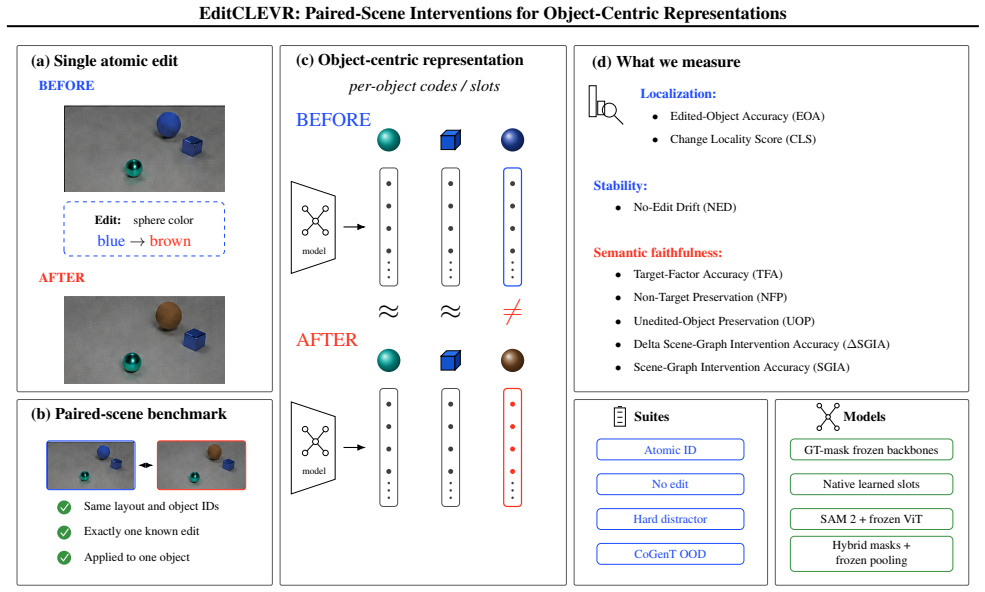
The paired-scene design: before/after renders with identical layout, object indices, and all but one attribute fixed (or a no-edit re-render for drift), which makes intervention faithfulness directly checkable. The central metric is Scene-Graph Intervention Accuracy (SGIA), which conjoins after-frame scene-graph exactness (all decoded after attributes on trusted objects correct) with the single-site change condition (the only predicted attribute change is the intended edit at the edited object-factor position). Its companion Delta-SGIA drops the exactness requirement and isolates the single-site pattern. The benchmark's ground-truth edit metadata is what lets these conditions be scored.
Load-bearing premise
The generator guarantee that each before/after pair shares the same scene layout and object indices, that edit suites differ in exactly one attribute of one object, and that no-edit re-renders are semantically identical—if this guarantee fails, every localization and single-site-change score measures renderer artifacts.
What would settle it
Re-verify a random sample of the 20,000 paired scenes—e.g., with an independent renderer or script—to confirm that only the intended attribute changed and object identities are preserved, then recompute SGIA on the verified pairs. If the OOD-core collapse persists, the benchmark claim stands; if scores recover, the generator guarantee was the weak point.
If this is right
- If SGIA becomes a standard readout, models that look strong on segmentation or single-image factor prediction will need to be re-checked for whether they actually localize a semantic edit to the right object and factor.
- The OOD-core collapse under perfect masks indicates a semantic attribution failure independent of object discovery, so progress on discovery alone will not close this gap.
- The decomposition into TFA, NFP, UOP, Delta-SGIA, and SGIA gives a diagnostic path to identify whether failures come from decoding noise, leakage to non-target factors/objects, or global after-scene incorrectness.
- The paired intervention design is extensible to other synthetic factors, to relational edits, and, with reliable annotations, to natural scenes, providing a template for evaluating compositional faithfulness beyond CLEVR.
Where Pith is reading between the lines
- Inference: Because OOD-core SGIA is computed with linear probes trained only on training-split attributes, the collapse could partly reflect probe extrapolation to unseen color values rather than a binding failure in the representation itself. The paper's MLP probe replication shows only partial recovery, suggesting the limitation is not purely readout—but a probe-free or generative readout would
- Inference: The no-edit drift (NED) measurement uses a different renderer seed, so it likely captures renderer-induced appearance noise in addition to any true object-code drift; separating these would require controls that vary lighting or camera slightly while keeping semantics fixed.
- Inference: The OOD-core slice is small (327 pairs), and although the SGIA drop is large and consistent across backbones, the exact ranking of models on this slice is likely noisy; a larger CoGenT-derived sample would sharpen the comparison.
- Inference: A natural next test would be to benchmark VLM-based, generative, or factor-structured models on EditCLEVR; the paper notes it does not cover these, but the paired-intervention protocol makes such comparisons straightforward.
Editorial analysis
A structured set of objections, weighed in public.
Referee Report
Summary. The paper introduces EditCLEVR, a paired-scene benchmark for object-centric representations. Each example pairs a before/after CLEVR-style render with the same scene layout and object indices, and either exactly one known attribute edit on one known object or a no-edit re-render. The protocol defines probe-free diagnostics (EOA, CLS, NED) and probe-decoded semantic metrics (TFA, NFP, UOP, Delta-SGIA, SGIA) across in-distribution, hard-distractor, and CoGenT-style OOD suites, including a derived OOD-core slice. Baselines include ground-truth-mask frozen ViT backbones, Slot Attention, DINOSAUR, SAM 2 + frozen features, and a mask-feature hybrid. The main findings are that CoGenT-OOD-core strict SGIA degrades even with ground-truth masks, mask source explains part but not all of native-model performance, and locality/stability can overstate semantic faithfulness.
Significance. If the results hold, EditCLEVR provides a useful, reusable intervention benchmark that separates code-space localization from probe-decoded semantic fidelity, with a clear metric hierarchy. The paper ships code and data, reports an MLP probe replication, and includes several controlled ablations (GT masks, soft-mixture aggregation, per-factor breakdowns). The central empirical claim—that OOD degradation persists under ground-truth masks—is important for the object-centric learning community, but it depends critically on probes trained only in condition A. The probe-distribution-shift concern is real and needs an explicit control before the headline conclusion is accepted.
major comments (3)
- [§3–4, Table 1, Appendix C] The headline claim that CoGenT-OOD-core SGIA degrades under ground-truth masks rests on attribute probes trained only on condition A. Under CoGenT, cube/cylinder color palettes swap, and a linear (or MLP) probe trained on condition A can learn shape–color correlations, systematically misclassifying colors on cubes/cylinders in condition B. The unfiltered CoGenT-OOD column in Table 2 shows similar degradation, so the OOD-core filter is not the cause, but the probe distribution shift is. The Appendix C MLP replication is also trained on condition A, so it does not address this. Provide SGIA/Delta-SGIA with probes trained on a condition-B (or balanced A+B) training split, and report per-factor confusion matrices. Without this control, the central claim is confounded by probe generalization failure.
- [§2, 'Pairs and ground truth'] All metrics in §3 are scored against the generator guarantee: each pair shares layout and object indices, edits change exactly one attribute of one object, and no-edit re-renders change only the renderer seed. No independent verification pass over the 20,000 pairs is reported. If the renderer silently alters any other property, shifts an object identity, or introduces seed-dependent geometric variation, every localization, stability, and single-site-change metric would measure artifacts. Please provide an automated verification protocol (e.g., compare scene JSONs, confirm object-index correspondence via masks, check pixel diffs confined to the edited object, and verify no-edit re-renders preserve semantics and geometry) and report pass/failure rates.
- [§4, Table 5] Native semantic metrics are conditioned on a MatchBO≥0.5 gate for the edited object, but the low-confidence exclusion rate is reported only for ATOMIC ID. If the exclusion rate differs on COGENT OOD or OOD-core, native-row comparisons in Table 1 (e.g., mask-source effects) are conditional on different subsets across conditions. Report MatchBO and low-confidence rates for each suite, especially the CoGenT-OOD and OOD-core slices, so the native-row conclusions can be interpreted properly.
minor comments (6)
- [Table 1 caption] The caption states 'CIs are 95% bootstrap intervals' but no intervals are shown in any table. Add error bars or a supplementary table with CIs, or explicitly state that intervals are omitted for readability.
- [Appendix F, Table 6] The pooled factors/object-count table mixes ATOMIC ID, HARD DISTRACTOR, and full COGENT OOD suites. The main text should point to this limitation in the caption, as the pooled values are descriptive and should not be read as a single suite.
- [Figure 2] The arrow for 'OOD-Core filter' is visually ambiguous. Clarify in the caption that the filter removes sphere cases because spheres keep the full palette in both CoGenT conditions, leaving only cube/cylinder color and shape edits.
- [§2, no-edit suite] Please state explicitly whether the no-edit suite has the same object-count distribution and visibility constraints as the other suites, so NED is comparable across rows.
- [Notation] In the EOA equation, using a bare '1' for the indicator can be confused with the number one. Use the indicator notation \mathbb{1}[...] or explicitly define EOA as the mean of an indicator variable.
- [Throughout] The paper alternates between 'CoGenT' and 'COGENT' in table/caption text (e.g., Table 1 vs Table 2). Standardize the spelling to 'CoGenT' for internal consistency.
Circularity Check
No significant circularity: EditCLEVR is an empirical benchmark and metric protocol, not a derivation chain whose conclusions are built into its definitions.
full rationale
The paper's central content is a paired-scene benchmark with defined metrics. SGIA, Delta-SGIA, EOA, CLS and NED are explicit arithmetic/logical compositions of observable quantities (L2 distances and probe predictions) in Section 3; no headline result is defined in terms of itself. The supervised attribute probes are trained on the train split and evaluated on held-out suites, which is a standard readout procedure rather than a fitted parameter renamed as a prediction: high OOD-core SGIA is logically possible if the representation supports a transferable decoder, so the observed collapse is an empirical finding, not a tautology. The CoGenT-OOD-core slice is a post-hoc subset defined by edit factor and object shape, but the same directional SGIA drop appears on the unfiltered CoGenT-OOD rows in Table 2 (e.g., DINO ViT-S/8 SGIA 0.142), so the central claim does not reduce to the filter. The paper explicitly acknowledges the probe-conditioned nature of semantic metrics in Section 3 and reports an MLP replication in Appendix C as a probe-sensitivity check. No load-bearing self-citation or imported uniqueness theorem appears. The possible probe distribution-shift confound under CoGenT condition B is a validity/correctness concern about the readout, not a circularity in the derivation chain.
Axiom & Free-Parameter Ledger
free parameters (3)
- Per-factor linear probe classifiers (color, material, size, shape) =
Trained on 10k train pairs; per-factor accuracy not reported in main text
- MatchBO matching gate threshold =
0.5 (one-to-one best-overlap coverage)
- CoGenT-OOD-core slice filter =
n=327 of 2,000 CoGenT-OOD pairs
axioms (4)
- domain assumption The CLEVR-derived generator produces before/after pairs with the same scene layout, same object indices, and exactly one attribute change on exactly one object (or a true semantic no-op in the no-edit suite).
- domain assumption Frozen backbone/self-supervised features contain decodable object-attribute information accessible to the probes.
- domain assumption Probe-decoded semantics is a valid operational proxy for semantic faithfulness.
- standard math Standard supervised-learning machinery: L2-normalized vectors, logistic regression probes, one-to-one best-overlap object assignment.
invented entities (2)
-
EditCLEVR paired-scene benchmark dataset
independent evidence
-
SGIA and Delta-SGIA metrics
independent evidence
read the original abstract
Object-centric learning aims to represent scenes as objects whose properties can be reused in new combinations. Existing evaluations usually score segmentation, single-image factor prediction, or downstream accuracy, but these tests do not directly ask whether a per-object representation behaves correctly under a controlled semantic edit. We introduce EditCLEVR, a paired-scene intervention benchmark in which each example contains a before/after pair of CLEVR-style renders with the same object indices and scene layout, and either exactly one known attribute change on one known object or a no-edit re-render for drift measurement. The protocol includes probe-free diagnostics for representation-change localization and stability, together with probe-decoded semantic faithfulness metrics that test whether the predicted scene change matches the intended intervention across in-distribution and compositional out-of-distribution (OOD) suites, allowing code-space movement and decoded object-attribute correctness to be evaluated separately. We introduce the semantic metric Scene-Graph Intervention Accuracy (SGIA), which requires the full after-scene prediction to be correct and the only predicted before-to-after semantic change to be the intended object-factor edit. We also establish Delta-SGIA as a companion diagnostic that checks the single-site change pattern without requiring the full after-scene graph to be correct. Baseline evaluations on ground-truth-mask backbones, learned-slot models, SAM 2 + frozen-ViT models, and one mask-feature hybrid indicate that CoGenT-OOD-core degradation can persist under ground-truth instance masks, that mask source accounts for part but not all of native performance, and that locality or stability alone can overstate semantic faithfulness. Code is available at https://github.com/torux-bughunter/EditCLEVR.
Figures

Reference graph
Works this paper leans on
-
[1]
Higgins, Irina and Matthey, Lo. beta-. Proceedings of the 5th International Conference on Learning Representations , year =
-
[2]
and Girshick, Ross , booktitle =
Johnson, Justin and Hariharan, Bharath and van der Maaten, Laurens and Fei-Fei, Li and Lawrence Zitnick, C. and Girshick, Ross , booktitle =. 2017 , doi =
2017
-
[3]
Behavioral and Brain Sciences , volume =
Building Machines That Learn and Think Like People , author =. Behavioral and Brain Sciences , volume =. 2017 , doi =
2017
-
[4]
Proceedings of the 6th International Conference on Learning Representations , year =
A Framework for the Quantitative Evaluation of Disentangled Representations , author =. Proceedings of the 6th International Conference on Learning Representations , year =
-
[5]
Advances in Neural Information Processing Systems , volume =
Object-Centric Learning with Slot Attention , author =. Advances in Neural Information Processing Systems , volume =. 2020 , url =
2020
-
[6]
arXiv preprint arXiv:2012.05208 , year =
On the Binding Problem in Artificial Neural Networks , author =. arXiv preprint arXiv:2012.05208 , year =
Pith/arXiv arXiv 2012
-
[7]
Multi-Object Datasets , author =. 2020 , publisher =. doi:10.5281/zenodo.4895643 , url =
-
[8]
2022 , url =
Greff, Klaus and others , booktitle =. 2022 , url =
2022
-
[9]
Proceedings of the IEEE/CVF International Conference on Computer Vision , pages =
Emerging Properties in Self-Supervised Vision Transformers , author =. Proceedings of the IEEE/CVF International Conference on Computer Vision , pages =. 2021 , url =
2021
-
[10]
Proceedings of the 39th International Conference on Machine Learning , series =
Generalization and Robustness Implications in Object-Centric Learning , author =. Proceedings of the 39th International Conference on Machine Learning , series =. 2022 , url =
2022
-
[11]
Advances in Neural Information Processing Systems , volume =
Lost in Latent Space: Examining Failures of Disentangled Models at Combinatorial Generalisation , author =. Advances in Neural Information Processing Systems , volume =. 2022 , url =
2022
-
[12]
Proceedings of the 11th International Conference on Learning Representations , year =
Bridging the Gap to Real-World Object-Centric Learning , author =. Proceedings of the 11th International Conference on Learning Representations , year =
-
[13]
Transactions on Machine Learning Research , year =
Oquab, Maxime and Darcet, Timoth. Transactions on Machine Learning Research , year =
-
[14]
Proceedings of the IEEE/CVF International Conference on Computer Vision , pages =
Segment Anything , author =. Proceedings of the IEEE/CVF International Conference on Computer Vision , pages =. 2023 , url =
2023
-
[15]
Advances in Neural Information Processing Systems , volume =
Zero-Shot Object-Centric Representation Learning , author =. Advances in Neural Information Processing Systems , volume =. 2024 , url =
2024
-
[16]
Proceedings of the 13th International Conference on Learning Representations , year =
Ravi, Nikhila and Gabeur, Valentin and Hu, Yuan-Ting and Hu, Ronghang and Ryali, Chaitanya and Ma, Tengyu and Khedr, Haitham and R. Proceedings of the 13th International Conference on Learning Representations , year =
-
[17]
2025 , url =
Tschannen, Michael and Gritsenko, Alexey and Wang, Xiao and Naeem, Muhammad Ferjad and Alabdulmohsin, Ibrahim and Parthasarathy, Nikhil and Evans, Talfan and Beyer, Lucas and Xia, Ye and Mustafa, Basil and others , journal =. 2025 , url =
2025
-
[18]
Proceedings of the 36th International Conference on Machine Learning , series =
Challenging Common Assumptions in the Unsupervised Learning of Disentangled Representations , author =. Proceedings of the 36th International Conference on Machine Learning , series =. 2019 , url =
2019
-
[19]
2024 , doi =
Moon, Ye-Bin and Nam, Hyeon-Woo and Choi, Wonseok and Oh, Tae-Hyun , booktitle =. 2024 , doi =
2024
-
[20]
Proceedings of the 2019 Conference on Empirical Methods in Natural Language Processing and the 9th International Joint Conference on Natural Language Processing , pages =
Designing and Interpreting Probes with Control Tasks , author =. Proceedings of the 2019 Conference on Empirical Methods in Natural Language Processing and the 9th International Joint Conference on Natural Language Processing , pages =. 2019 , url =
2019
-
[21]
arXiv preprint arXiv:2503.15141 , year =
Object-Centric Pretraining via Target Encoder Bootstrapping , author =. arXiv preprint arXiv:2503.15141 , year =
discussion (0)
Sign in with ORCID, Apple, or X to comment. Anyone can read and Pith papers without signing in.