REVIEW 4 major objections 5 minor 1 cited by
Under the Shadow of Babel: How Language Shapes Reasoning in LLMs
T0 review · 4 major / 5 minor · reviewed 2026-08-06 · deepseek-v4-flash
Pith's one-line read Large language models internalize language-specific causal habits — attending to sentence-initial causes in Chinese — and the habit degrades reasoning when Chinese input presents effects first.
desk verdict New dataset and attention-analysis lens, but the headline claim about internalized causal priors rests on an unmeasured corpus-frequency assumption and thin statistics. read the letter →
The pith
A machine-rendered reading of the paper's core claim, the machinery that carries it, and where it could break.
The reading
What carries the argument
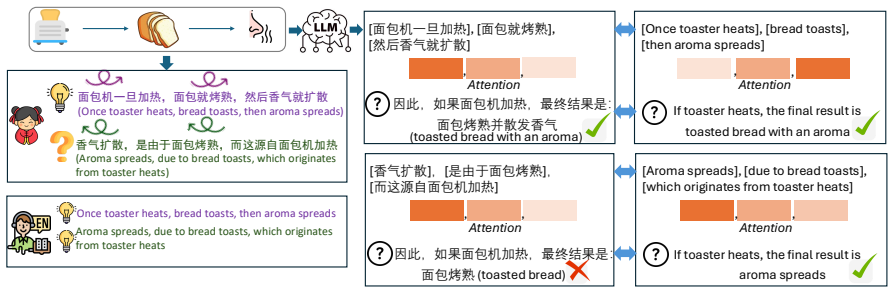
Two instruments carry the argument. BICAUSE is a dataset of 400 semantically and syntactically aligned three-step causal chains in Chinese and English, each in forward and reversed order with a QA inference question, decomposed into 13 syntactic components and 3 causal components ([cause], [intermediate effect], [final effect]). The Relative Component Attention Ratio (RCAR) measures the attention each component receives from later tokens, normalized per token so comparisons across languages are fair; SVCCA (Singular Vector Canonical Correlation Analysis) scores the similarity of the 24-layer attention trajectories across the four input variants, and layerwise cosine similarity of hidden vectors at the final causal token tracks whether successful reasoning shares a representation. The forward/reversed contrast is what makes the internalized prior visible: identical semantics, identical model, different word order, and the attention pattern moves exactly as a typological habit would predict.
What would settle it
Count effect-first causal constructions (with connectives such as '是由于...而这源自') in the pretraining corpora of the tested models and compare the rates with their English counterparts; if reversed Chinese forms occur at comparable or higher frequency than English 'X happened, because Y' forms and the 76.5% versus 88.5% gap persists, the internalized-rarity explanation fails. As a second check, have native Chinese readers rate the naturalness of the reversed BICAUSE sentences: ratings at the level of translationese would indicate the stimuli, not a learned prior, drive the drop.
Extended reading notes
Core claim
The paper's central claim is that LLMs do not merely process surface syntax: they internalize language-specific habitual patterns of causal expression as stable attention-allocation strategies, and those habits shape downstream reasoning. Because Chinese prefers forward causal order and topic-initial structure, the model learns a 'sentence-initial component is the cause' prior and locks attention onto the first event; applied to a grammatically valid but atypical reversed chain, the prior misfires, the model anchors on the final effect, and accuracy falls to 76.5%. Because English routinely uses effect-first constructions such as 'X happened, because Y', the same model keeps attention flexible and accuracy high (88.5%) under both orders. The paper further argues that the destination of reasoning is language-agnostic: correctly reasoned samples from all four conditions converge on nearly identical hidden representations, so the divergence is in the habitual path, not in the shared understanding reached at the end.
Load-bearing premise
The central premise is that effect-first causal sentences are genuinely rare in the Chinese text the models were trained on; if they are actually common, or if the authors' reversed Chinese sentences read as unnatural templates rather than native usage, the accuracy gap would reflect the test items rather than an internalized cause-first habit.
Editorial extensions
If this is right
- Chinese reversed causal chains will keep underperforming English reversed chains across model families and sizes, because the cause-first habit is a property of the pretraining distribution, not of one architecture.
- Answer accuracy on a causal question is predictable from attention placement: the SVCCA similarity between a structure and the canonical forward form tracks accuracy, from 0.73 with roughly 91% down to 0.46 with 76.5%.
- Multilingual benchmarks that test only canonical word order will overstate cross-lingual reasoning ability; atypical constructions expose the language-specific ceiling.
- Because successful reasoning converges on a shared abstraction, cross-lingual semantic alignment is attainable in representation space even while surface processing remains language-specific.
Reading between the lines
- The same measurement could be run on language pairs with other typological contrasts — head-final languages, for example — to predict which constructions will degrade and which will transfer easily.
- A causal test of the attention-as-mechanism reading: redirect attention toward the true cause in reversed Chinese chains by activation patching and check whether accuracy recovers to the English level; if attention is only a correlate, the intervention should do nothing.
- The rarity premise is directly checkable: corpus statistics on effect-first causal constructions in native Chinese, plus native-speaker naturalness ratings for the reversed BICAUSE sentences, would confirm or refute the claim that the drop comes from an underrepresented pattern rather than from awkward stimuli.
- If the habit is learned from corpus statistics, fine-tuning on reversed Chinese causal chains should shrink the 76.5% versus 88.5% gap — a cheap intervention test with practical value for aligning multilingual models.
Editorial analysis
A structured set of objections, weighed in public.
Referee Report
Summary. The paper introduces BICAUSE, a bilingual Chinese-English causal reasoning dataset with semantically aligned forward and reversed causal chains across eight domains. Using the RCAR attention metric (Eq. 1-2), SVCCA, and hidden-state cosine similarities on Qwen1.5-1.8B-Chat plus several larger models, it reports three findings: LLMs allocate attention in typologically aligned ways (more subject/connective focus in Chinese, more verb/result focus in English); they internalize a cause-first ordering preference for Chinese that degrades accuracy on reversed Chinese chains (Table 2: Qwen1.5-1.8B 76.8% Chinese vs 88.5% English); and successful reasoning is accompanied by cross-language convergence of hidden representations. The authors interpret these results as evidence that LLMs internalize language-specific causal reasoning biases, echoing linguistic relativity.
Significance. If the claims hold, the paper provides a new kind of evidence for linguistic relativity in LLMs and a reusable dataset and analytical framework for cross-lingual interpretability. The dataset is publicly released, the RCAR metric is explicitly defined, and the main attention analyses are replicated across several model families and sizes, which are concrete strengths. The central limitation is that the behavioral asymmetry is attributed to an unmeasured corpus-frequency asymmetry, so the current evidence does not yet uniquely support the linguistic-relativity reading. The representation-convergence claim is also weakened by selection on correct predictions. These issues are addressable, however, and the paper's overall direction is sound.
major comments (4)
- [Section 5.2, Figure 1, Table 2] The claim that reversed causal chains are 'rare in native usage and likely underrepresented in the training corpus' is the load-bearing premise for explaining the Chinese reversed-chain accuracy drop as an internalized cause-first prior. The manuscript provides no corpus counts, n-gram frequencies, independent citations, or human naturalness ratings for the reversed Chinese template such as '香气扩散,是由于面包烤熟,而这源自面包机加热'. Without such measurements, the 12-point accuracy gap in Table 2 could be a stimulus-construction artifact, e.g., if the Chinese reversed template is a formal or literary calque of the English 'due to ... which originates from'. I request a concrete test: report corpus frequencies of the forward and reversed construction types in large Chinese and English corpora, and/or collect native-speaker naturalness ratings, and show that model accuracy tracks this measured asymmetry.
- [Section 4.2-4.3, Figures 2-3, Tables 1-2] The central quantitative comparisons, including RCAR differences up to 1.585 in Figure 3 and the Chinese reversed accuracy drop, are presented without confidence intervals, bootstrap estimates, or significance tests, despite the dataset containing only 400 samples (50 per domain). For instance, Table 2 reports Qwen1.5-1.8B at 88.5% (English) versus 76.8% (Chinese) on reversed chains, but no uncertainty is attached and the domain-level values show high variance (Qwen1.5-1.8B Chinese ranges from 64% to 86% across domains). Please report per-condition confidence intervals and pairwise tests across models before claiming a systematic Chinese-specific degradation.
- [Section 6, Figure 5] The claim that successful reasoning converges to shared, language-agnostic representations is based on cosine similarity computed only over pairs where both predictions are correct. This selection on the dependent variable can inflate similarity, because correct cases may be systematically easier or less noisy, so the convergence could reflect task difficulty rather than language-agnostic abstraction. Please report the same analysis on all samples or on matched correct/incorrect subsets, and compare against a shuffled-token baseline, to show that the convergence is not an artifact of filtering.
- [Section 4.3] The typological interpretation of attention divergence is plausible but confounded with surface word order and the connective inventory. For example, 'once' appears sentence-initially in both languages in the forward template, while Chinese and English connectives have different positional and co-occurrence distributions. A stronger test would include English stimuli with Chinese-like preposed connectives or Chinese stimuli with English-like postverbal connectives, to separate typological bias from template-specific surface effects.
minor comments (5)
- [Section 5.2 and Table 2] The text reports the Chinese reversed-chain accuracy as 76.5%, but Table 2 lists 76.8%; please reconcile the numbers.
- [Section 3 and Appendix A] Table 2 is labeled 'paraphrased data,' while Section 3 consistently calls these examples 'reversed causal chains'; please unify the terminology and clarify whether the 400-sample total refers to forward chains, reversed chains, or chain semantics shared across both forms.
- [Figure 4 caption] The caption contains a typo, 'LLayerwise,' and the figure label in Section 5.1 also says 'lanuages'; please correct these.
- [References] Several reference entries are malformed or inconsistent, including 'Steven Piantadosi' as the author of 'Meaning without reference in large language models' (should be Piantadosi and Hill), the formatting of the Feng-Fu citation, and 'V oita' in the Voita et al. entry; please check the bibliography.
- [Figure 3] The bars appear sorted by magnitude, but the sorting criterion is not stated; please describe the ordering and add error bars or a significance annotation.
Circularity Check
No significant circularity: the empirical measurements (RCAR, SVCCA, accuracy) are made on an externally constructed dataset, and the typological explanation is an external hypothesis, not an input to the derivation.
full rationale
No significant circularity is present. The paper's empirical chain—constructing the BICAUSE dataset, computing RCAR attention ratios (Eq. 1-2), SVCCA similarities, and QA accuracy—is performed on an externally constructed dataset, and no parameter is fitted to the target conclusion. The observation that Chinese reversed causal chains receive different attention and lower accuracy (76.5% vs. 88.5% English reversed) is a direct measurement, not an identity derived from the RCAR definition, and no equation in the paper reduces to its own inputs. The typological interpretation in Sections 4.3 and 5.2 (Chinese topic-prominence, cause-first preference, rarity of reversed Chinese forms) is an external linguistic hypothesis used to explain the measurements, not a premise used to construct them; thus there is no Eq. X = Eq. Y reduction. The main weakness is the unsupported empirical claim in Section 5.2 that reversed causal forms 'are rare in native usage and likely underrepresented in the training corpus,' which is asserted without corpus frequency counts or native-speaker naturalness ratings. If false, the Chinese accuracy drop could be a stimulus artifact rather than evidence of an internalized typological prior, but this is an empirical-validity and correctness concern, not circularity. The paper cites prior work (e.g., Schut et al. 2025, Lindsey et al. 2025) only as convergent support for representation alignment findings, and no load-bearing argument reduces to a self-citation chain.
Assumptions & free parameters
assumptions (4)
- domain assumption Chinese reversed causal chains are rare in native usage and underrepresented in pretraining corpora
- domain assumption Two-level normalization makes component-level attention ratios comparable across Chinese and English despite different tokenizers and segmentation granularity
- domain assumption The hidden state at the final causal-chain token captures the integrated causal representation
- standard math SVCCA and cosine similarity are valid measures of structural and representational alignment
Cite this review
Pith. "Pith review of Under the Shadow of Babel: How Language Shapes Reasoning in LLMs." pith.science (2026). https://pith.science/paper/U4GR4NN2
@misc{pith2026250616151,
  author       = {Pith},
  title        = {Pith review of: Under the Shadow of Babel: How Language Shapes Reasoning in LLMs},
  year         = {2026},
  howpublished = {\url{https://pith.science/paper/U4GR4NN2}},
  note         = {Machine review of arXiv:2506.16151}
}
read the original abstract
Language is not only a tool for communication but also a medium for human cognition and reasoning. If, as linguistic relativity suggests, the structure of language shapes cognitive patterns, then large language models (LLMs) trained on human language may also internalize the habitual logical structures embedded in different languages. To examine this hypothesis, we introduce BICAUSE, a structured bilingual dataset for causal reasoning, which includes semantically aligned Chinese and English samples in both forward and reversed causal forms. Our study reveals three key findings: (1) LLMs exhibit typologically aligned attention patterns, focusing more on causes and sentence-initial connectives in Chinese, while showing a more balanced distribution in English. (2) Models internalize language-specific preferences for causal word order and often rigidly apply them to atypical inputs, leading to degraded performance, especially in Chinese. (3) When causal reasoning succeeds, model representations converge toward semantically aligned abstractions across languages, indicating a shared understanding beyond surface form. Overall, these results suggest that LLMs not only mimic surface linguistic forms but also internalize the reasoning biases shaped by language. Rooted in cognitive linguistic theory, this phenomenon is for the first time empirically verified through structural analysis of model internals.
Figures


Figures from the paper (7 more)


Forward citations
Cited by 1 Pith paper
-
Inside the Unfair Judge: A Mechanistic Interpretability Account of LLM-as-Judge Bias
LLM-as-judge scoring biases concentrate in low-dimensional, type-specific activation subspaces that support bidirectional causal steering and cross-domain failure prediction.
Reference graph
Works this paper leans on
- [1]
-
[7]
Dissecting recall of factual associa- tions in auto-regressive language models. InProceed- ings of the 2023 Conference on Empirical Methods in Natural Language Processing, pages 12216–12235. M.A.K. Halliday and Christian Matthiessen. 2004.An Introduction to Functional Grammar. Johann Gottfried Herder and Jean-Jacques Rousseau. 1986.On the Origin of Langua...
work page 2023
-
[8]
A survey on large language models with multilingualism: Recent advances and new frontiers.Preprint, arXiv:2405.10936. Wilhelm Humboldt, editor
-
[9]
https://transformer-circuits.pub/2025/ attribution-graphs/biology.html
On the biology of a large language model. https://transformer-circuits.pub/2025/ attribution-graphs/biology.html. John A. Lucy. 1992.Language Diversity and Thought: A Reformulation of the Linguistic Relativity Hypothe- sis. Cambridge University Press. Kevin Meng, David Bau, Alex Andonian, and Yonatan Belinkov
work page 2025
-
[10]
Decomposed prompting: Unveiling multilin- gual linguistic structure knowledge in english-centric large language models.Preprint, arXiv:2402.18397. Aneta Pavlenko
-
[11]
Do multilingual llms think in english?Preprint, arXiv:2502.15603. John Schwieter
-
[13]
SeaE- val for multilingual foundation models: From cross- lingual alignment to cultural reasoning. InProceed- ings of the 2024 Conference of the North American Chapter of the Association for Computational Lin- guistics: Human Language Technologies (V olume 1: Long Papers), pages 370–390, Mexico City, Mexico. Association for Computational Linguistics. Chri...
work page 2024
-
[14]
Do llamas work in English? on the latent language of multilingual transformers. InProceedings of the 62nd Annual Meeting of the Association for Computational Linguistics (V olume 1: Long Papers), pages 15366–15394, Bangkok, Thai- land. Association for Computational Linguistics. Benjamin Lee Whorf. 1956.Language, Thought, and Reality: Selected Writings of ...
work page 1956
Show all 15 references
-
[15]
InFindings of the Association for Computational Linguistics: ACL 2024, pages 9191– 9200, Bangkok, Thailand
AutoCAP: Towards auto- matic cross-lingual alignment planning for zero-shot chain-of-thought. InFindings of the Association for Computational Linguistics: ACL 2024, pages 9191– 9200, Bangkok, Thailand. Association for Computa- tional Linguistics. A Accuracy Results on BICAUSE ...
2024
-
[2019]
InProceedings of the 2019 ACL Workshop BlackboxNLP: Analyzing and Interpreting Neural Networks for NLP, page
What does bert look at? an analysis of bert’s attention. InProceedings of the 2019 ACL Workshop BlackboxNLP: Analyzing and Interpreting Neural Networks for NLP, page
2019
-
[2020]
InProceedings of the 2020 Conference on Empirical Methods in Natural Language Processing (EMNLP), pages 8718–8735, Online
Experience grounds language. InProceedings of the 2020 Conference on Empirical Methods in Natural Language Processing (EMNLP), pages 8718–8735, Online. Association for Computational Linguistics. Lera Boroditsky
2020
-
[2022]
InNeurIPS 2022 Workshop on Neuro Causal and Symbolic AI (nCSI)
Meaning without reference in large language models. InNeurIPS 2022 Workshop on Neuro Causal and Symbolic AI (nCSI). Qwen Team
2022
-
[2023]
Qwen technical report.arXiv preprint arXiv:2309.16609. Yonatan Bisk, Ari Holtzman, Jesse Thomason, Jacob Andreas, Yoshua Bengio, Joyce Chai, Mirella Lap- ata, Angeliki Lazaridou, Jonathan May, Aleksandr Nisnevich, Nicolas Pinto, and Joseph Turian
-
[2024]
Association for Computational Lin- guistics
Do mul- tilingual language models think better in English? InProceedings of the 2024 Conference of the North American Chapter of the Association for Computa- tional Linguistics: Human Language Technologies (V olume 2: Short Papers), pages 550–564, Mexico City, Mexico. Associat...
2024
-
[2025]
Large language models share representations of latent grammatical concepts across typologically diverse languages. InProceed- ings of the 2025 Conference of the Nations of the Americas Chapter of the Association for Computa- tional Linguistics: Human Language Technologies (V o...
2025
Reviewed August 6, 2026 · model on record in the stance chip above.
Discussion (0). Sign in to comment.