Native-Opacity Sensitivity of a Fixed Delta Cephei MESA-RSP Pulsation Model
Pith reviewed 2026-07-03 04:48 UTC · model grok-4.3
The pith
Different high-temperature opacity tables shift the computed period and amplitude growth in a fixed delta Cephei MESA-RSP model.
A machine-rendered reading of the paper's core claim, the machinery that carries it, and where it could break.
Core claim
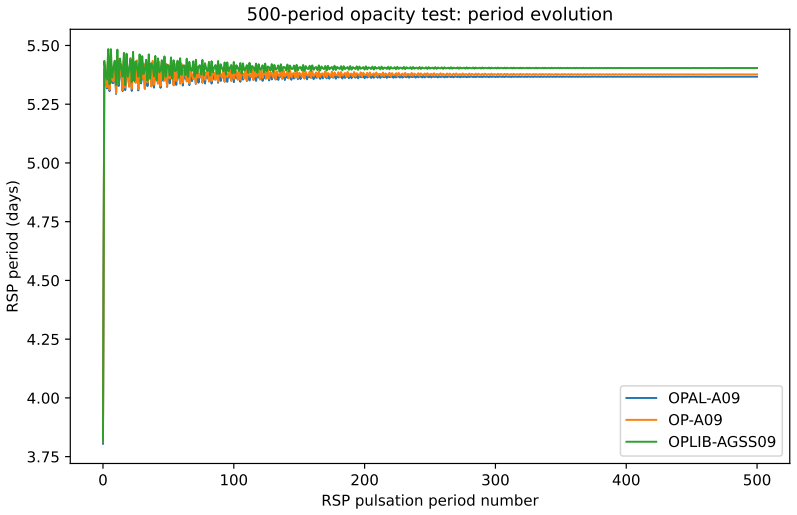
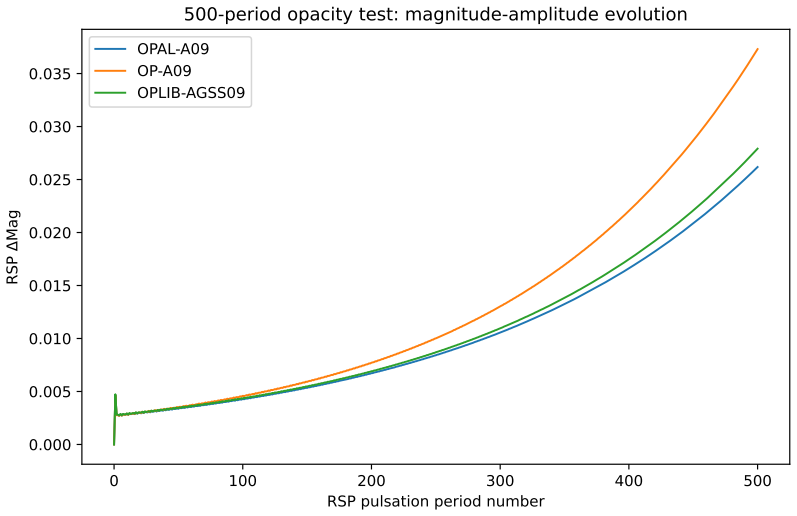
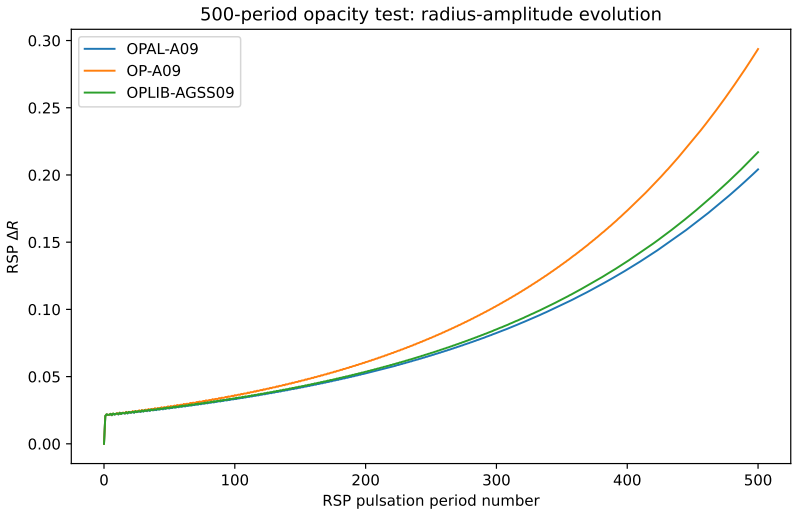
In a fixed 5-solar-mass delta Cephei model with Teff = 6050 K, L = 2360 solar luminosities, X = 0.73, Z = 0.007 and RSP_alfam = 0.425, switching the high-temperature opacity source among OPAL-A09, OP-A09 and OPLIB-AGSS09 while holding all other inputs constant changes the 500-cycle period, the fractional amplitude growth in magnitude and radius, and the per-period kinetic-energy growth rate. OPAL-A09 returns the period closest to the observed value (5.366986 d versus 5.366531 d). OP-A09 produces the largest growth increments (42–44 percent above OPAL-A09). OPLIB-AGSS09 yields a longer period with intermediate growth. The tested opacity choices therefore affect period matching and nonlinear a
What carries the argument
High-temperature opacity table (OPAL-A09, OP-A09, OPLIB-AGSS09) inside the fixed MESA-RSP radial-pulsation integration, which sets the thermal response and driving of the stellar envelope.
If this is right
- OPAL-A09 produces a period only 39 seconds longer than observed while the other two tables produce larger offsets.
- Amplitude-growth increments reach 42.5 percent in magnitude and 43.9 percent in radius when OP-A09 is substituted for OPAL-A09.
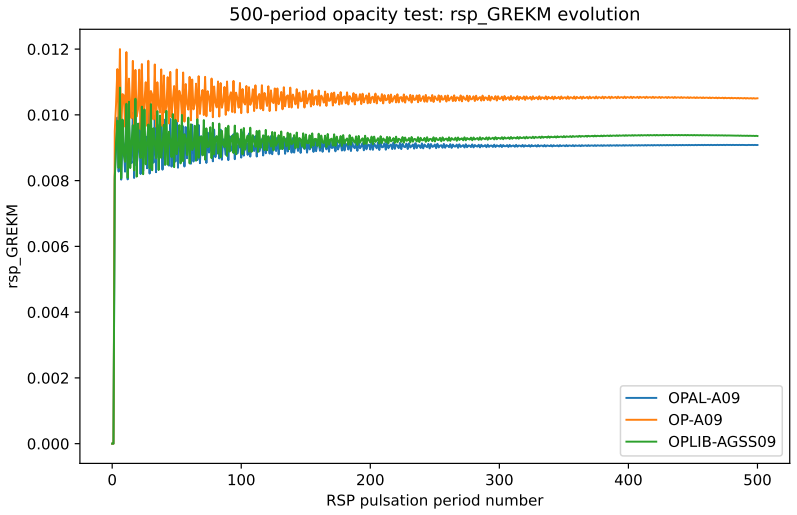
- The MESA diagnostic rsp_GREKM follows the same ordering as the amplitude changes across the three tables.
- The amplitude discrepancy with observations persists under all three opacity choices.
Where Pith is reading between the lines
- Releasing the fixed value of RSP_alfam while varying opacity could reveal whether the two inputs interact to enlarge or shrink the reported differences.
- A parallel test that varies the low-temperature opacity tables instead would indicate whether those tables produce comparable period and growth shifts in the same model.
- Opacity choice therefore contributes to but does not dominate the amplitude problem, suggesting that other microphysical or numerical ingredients must be examined next.
Load-bearing premise
Holding every other RSP parameter and the low-temperature opacities fixed isolates the high-temperature opacity effect without hidden interactions or incomplete relaxation after 500 cycles.
What would settle it
Re-running the three integrations to 500 cycles with the identical restart procedure and then comparing the final computed photometric or radial-velocity amplitudes directly against the star's observed light curve would show whether any table narrows the amplitude gap.
Figures
read the original abstract
Radiative opacity is one of the central microphysical inputs controlling the thermal response of Cepheid envelopes and the driving or damping of radial pulsations. We present a controlled opacity-sensitivity experiment for a fixed delta Cephei nonlinear radial pulsation model computed with the MESA Radial Stellar Pulsation module. The stellar and pulsation parameters are held fixed at M = 5.0 solar masses , Teff = 6050 K, L = 2360 solar luminosities , X = 0.73, Z = 0.007, and RSP_alfam = 0.425, while the high-temperature opacity source is varied among native MESA opacity configurations: OPAL-A09, OP-A09, and OPLIB-AGSS09. The low-temperature opacity prefix, C/O-dependent opacity prefix, and all other RSP parameters are kept fixed so that the comparison isolates the effect of the adopted high-temperature opacity table. Verification integrations were performed at 20, 100, and 300 pulsation cycles, followed by photo-restarted continuations to 500 cycles. At 500 cycles, OPAL-A09 gives the closest period agreement, PRSP = 5.366986 d, only about 39 s longer than Pobs = 5.366531 d. OP-A09 gives the largest amplitude-growth diagnostics, with Delta Mag = 0.037307 and Delta R = 0.293677, corresponding to increases of 42.5% and 43.9% relative to OPAL-A09. OPLIB-AGSS09 gives a systematically longer period, P_RSP = 5.403926 d, with more modest amplitude-growth changes. The same ordering is reflected in the MESA history-column diagnostic rsp_GREKM, defined by the MESA defaults as the fractional growth of kinetic energy per pulsation period. These results show that native opacity choice measurably affects period matching, pulsation growth diagnostics, and nonlinear amplitude growth in this fixed {\delta} Cephei model. However, the tested opacity choices do not by themselves resolve the known observed-amplitude discrepancy.
Editorial analysis
A structured set of objections, weighed in public.
Referee Report
Summary. The manuscript reports results from a fixed-parameter MESA-RSP simulation of a δ Cephei star, varying only the high-temperature opacity table among OPAL-A09, OP-A09, and OPLIB-AGSS09 while holding M=5 M_sun, T_eff=6050 K, L=2360 L_sun, X=0.73, Z=0.007, and RSP_alfam=0.425 fixed. After integrations verified at 20, 100, and 300 cycles and continued to 500 cycles, it finds that OPAL-A09 yields the period closest to observation (P_RSP = 5.366986 d vs P_obs = 5.366531 d), OP-A09 produces the largest amplitude growth (ΔMag = 0.037307, ΔR = 0.293677, increases of 42.5% and 43.9% over OPAL-A09), and OPLIB-AGSS09 gives a longer period (5.403926 d). The ordering is consistent with the rsp_GREKM diagnostic. The authors conclude that opacity choice affects these quantities but does not resolve the amplitude discrepancy.
Significance. If robust, these results demonstrate that the choice of native high-temperature opacity table in MESA has a measurable impact on period matching and nonlinear pulsation amplitude in this δ Cephei model. This is significant for the field of stellar pulsation modeling, as it provides quantitative evidence for the sensitivity to microphysical inputs and suggests that opacity variations alone are insufficient to explain the observed vs. modeled amplitude discrepancy. The controlled setup with fixed parameters and multi-cycle verification supports reproducibility of the numerical experiment.
major comments (1)
- [Integration and verification procedure (as described)] The claim that the differences in PRSP, ΔMag, ΔR, and rsp_GREKM at 500 cycles are attributable solely to the opacity choice assumes sufficient relaxation without residual transients or opacity-dependent coupling to the fixed RSP_alfam. Although verifications at 20, 100, and 300 cycles are mentioned, no time series of growth diagnostics or explicit limit-cycle convergence metrics are described, leaving open the possibility that the reported ordering and percentage increases (42.5%/43.9%) are affected by incomplete relaxation.
minor comments (2)
- A summary table compiling PRSP, ΔMag, ΔR, and rsp_GREKM for all three opacity choices at 500 cycles would improve readability and facilitate direct comparison of the reported values.
- The definition and exact computation of the rsp_GREKM diagnostic (referred to MESA defaults) would benefit from a brief inline equation or citation to the relevant MESA documentation section for clarity.
Simulated Author's Rebuttal
We thank the referee for their careful review and constructive comment on the integration and verification aspects of our MESA-RSP opacity-sensitivity experiment. We respond to the major comment below.
read point-by-point responses
-
Referee: The claim that the differences in PRSP, ΔMag, ΔR, and rsp_GREKM at 500 cycles are attributable solely to the opacity choice assumes sufficient relaxation without residual transients or opacity-dependent coupling to the fixed RSP_alfam. Although verifications at 20, 100, and 300 cycles are mentioned, no time series of growth diagnostics or explicit limit-cycle convergence metrics are described, leaving open the possibility that the reported ordering and percentage increases (42.5%/43.9%) are affected by incomplete relaxation.
Authors: The verifications at 20, 100, and 300 cycles were performed specifically to confirm consistency of the opacity-induced ordering before the photo-restarted continuation to 500 cycles. The same relative ordering of periods, rsp_GREKM, and amplitude growth was observed at each checkpoint, which supports that the reported differences at 500 cycles are driven by the opacity tables rather than transients or coupling to the fixed RSP_alfam. Nevertheless, the manuscript does not present explicit time series of the growth diagnostics. We agree that including such metrics would strengthen the demonstration of limit-cycle convergence and will add a figure or table showing the evolution of rsp_GREKM and amplitude diagnostics across the verified cycles in the revised manuscript. revision: yes
Circularity Check
Direct numerical experiment; no derivation or fitting performed
full rationale
The paper reports outputs from MESA-RSP integrations with fixed parameters (M=5 Msun, Teff=6050 K, L=2360 Lsun, X=0.73, Z=0.007, RSP_alfam=0.425) while varying only the high-T opacity table (OPAL-A09, OP-A09, OPLIB-AGSS09). All reported quantities (PRSP, Delta Mag, Delta R, rsp_GREKM) are direct simulation results at 500 cycles after verification at earlier cycle counts. No equations, ansatze, fitted parameters, predictions, or self-citations are invoked as load-bearing steps in any derivation chain. The analysis is therefore self-contained against external benchmarks and receives the default non-circularity finding.
Axiom & Free-Parameter Ledger
free parameters (1)
- RSP_alfam
axioms (1)
- domain assumption MESA Radial Stellar Pulsation module produces physically meaningful results when parameters are held fixed and only the high-temperature opacity table is changed.
Reference graph
Works this paper leans on
-
[1]
N. R. Simon. A plea for reexamining heavy element opacities in stars.The Astrophysical Journal Letters, 260:L87–L90, 1982. doi: 10.1086/183911. URLhttps://ui.adsabs.harvard. edu/abs/1982ApJ...260L..87S/abstract
-
[2]
C. A. Iglesias and F. J. Rogers. Opacity tables for cepheid variables.The Astrophysical Journal Letters, 371:L73–L76, 1991. doi: 10.1086/186004. URLhttps://ui.adsabs.harvard.edu/ abs/1991ApJ...371L..73I/abstract
-
[3]
C. A. Iglesias and F. J. Rogers. Updated OPAL opacities.The Astrophysical Journal, 464: 943–953, 1996. doi: 10.1086/177381. URLhttps://ui.adsabs.harvard.edu/abs/1996ApJ. ..464..943I/abstract
-
[4]
N. R. Badnell, M. A. Bautista, K. Butler, F. Delahaye, C. Mendoza, P. Palmeri, C. J. Zeippen, and M. J. Seaton. Updated opacities from the Opacity Project.Monthly Notices of the Royal Astronomical Society, 360:458–464, 2005. doi: 10.1111/j.1365-2966.2005.08991.x. URL https://ui.adsabs.harvard.edu/abs/2005MNRAS.360..458B/abstract
- [5]
-
[6]
J. Colgan, D. P. Kilcrease, N. H. Magee, M. E. Sherrill, J. Abdallah, P. Hakel, C. J. Fontes, J. A. Guzik, and K. A. Mussack. A new generation of Los Alamos opacity tables.The 13 Astrophysical Journal, 817:116, 2016. doi: 10.3847/0004-637X/817/2/116. URLhttps://ui. adsabs.harvard.edu/abs/2016ApJ...817..116C/abstract
-
[7]
E. Farag, C. J. Fontes, F. X. Timmes, E. P. Bellinger, J. A. Guzik, E. B. Bauer, S. R. Wood, K. Mussack, P. Hakel, J. Colgan, D. P. Kilcrease, M. E. Sherrill, T. C. Raecke, and M. T. Chidester. An expanded set of Los Alamos OPLIB tables in MESA: Type-1 Rosseland-mean opacities and solar models.The Astrophysical Journal, 968:56, 2024. doi: 10.3847/1538-435...
-
[8]
P. Moskalik, J. R. Buchler, and A. Marom. Toward a solution of the beat cepheid mass discrepancy.The Astrophysical Journal, 385:685–693, 1992. doi: 10.1086/170973. URL https://ui.adsabs.harvard.edu/abs/1992ApJ...385..685M/abstract
-
[9]
S. M. Kanbur, N. R. Simon, and J. R. Buchler. Comparative pulsation calculations with OP and OPAL opacities.The Astrophysical Journal, 420:880–885, 1994. doi: 10.1086/173614. URL https://ui.adsabs.harvard.edu/abs/1994ApJ...420..880K/abstract
-
[10]
J. P. Cox.Theory of Stellar Pulsation. Princeton University Press, Princeton, NJ, 1980. URL https://www.jstor.org/stable/j.ctt1m32337
1980
-
[11]
MESA r24.08.1 default history columns list
MESA Team. MESA r24.08.1 default history columns list. Online, 2024. URL https://raw.githubusercontent.com/MESAHub/mesa/release/r24.08.1/star/ defaults/history_columns.list. File: extttstar/defaults/history_columns.list
2024
-
[12]
and Schwab, Josiah and Gautschy, A
B. Paxton, R. Smolec, J. Schwab, A. Gautschy, L. Bildsten, M. Cantiello, A. Dotter, R. Farmer, J. A. Goldberg, A. S. Jermyn, S. M. Kanbur, P. Marchant, A. Thoul, R. H. D. Townsend, W. M. Wolf, M. Zhang, and F. X. Timmes. Modules for experiments in stellar astrophysics (MESA): Pulsating variable stars, rotation, convective boundaries, and energy conservati...
-
[13]
A Reproducible AAVSO Johnson-V Fourier Template for the Prototype Cepheid Delta Cephei
Z. Elahi and W. Gull. A reproducible AAVSO Johnson-V Fourier template for the prototype cepheid Delta Cephei.arXiv e-prints, art. arXiv:2606.29543, 2026. doi: 10.48550/arXiv.2606. 29543. URLhttps://arxiv.org/abs/2606.29543
work page internal anchor Pith review Pith/arXiv arXiv doi:10.48550/arxiv.2606 2026
-
[14]
Z. Elahi and W. Gull. Semi-empirical pulsation reconstruction of Delta Cephei with photometry, radial velocities, and temperature constraints.arXiv e-prints, art. arXiv:2606.29561, 2026. doi: 10.48550/arXiv.2606.29561. URLhttps://arxiv.org/abs/2606.29561
work page internal anchor Pith review Pith/arXiv arXiv doi:10.48550/arxiv.2606.29561 2026
-
[15]
B. Paxton, L. Bildsten, A. Dotter, F. Herwig, P. Lesaffre, and F. Timmes. Modules for experiments in stellar astrophysics (MESA).The Astrophysical Journal Supplement Series, 192:3, 2011. doi: 10.1088/0067-0049/192/1/3. URLhttps://ui.adsabs.harvard.edu/abs/ 2011ApJS..192....3P/abstract. 14
-
[16]
B. Paxton, M. Cantiello, P. Arras, L. Bildsten, E. F. Brown, A. Dotter, C. Mankovich, M. H. Montgomery, D. Stello, F. X. Timmes, and R. Townsend. Modules for experiments in stellar astrophysics (MESA): Planets, oscillations, rotation, and massive stars.The Astrophysical Journal Supplement Series, 208:4, 2013. doi: 10.1088/0067-0049/208/1/4. URL https: //u...
work page internal anchor Pith review doi:10.1088/0067-0049/208/1/4 2013
-
[17]
and Bildsten, Lars and Cantiello, Matteo and Dessart, Luc and Farmer, R
B. Paxton, P. Marchant, J. Schwab, E. B. Bauer, L. Bildsten, M. Cantiello, L. Dessart, R. Farmer, H. Hu, N. Langer, R. H. D. Townsend, D. M. Townsley, and F. X. Timmes. Modules for experiments in stellar astrophysics (MESA): Binaries, pulsations, and explosions.The Astrophysical Journal Supplement Series, 220:15, 2015. doi: 10.1088/0067-0049/220/1/15. URL...
work page internal anchor Pith review doi:10.1088/0067-0049/220/1/15 2015
-
[18]
and Bildsten, Lars and Blinnikov, Sergei and Duffell, Paul and Farmer, R
B. Paxton, J. Schwab, E. B. Bauer, L. Bildsten, S. Blinnikov, P. Duffell, R. Farmer, J. A. Goldberg, P. Marchant, E. Sorokina, A. Thoul, R. H. D. Townsend, and F. X. Timmes. Modules for experiments in stellar astrophysics (MESA): Convective boundaries, element diffusion, and massive-star explosions.The Astrophysical Journal Supplement Series, 234:34, 2018...
work page internal anchor Pith review doi:10.3847/1538-4365/aaa5a8 2018
-
[19]
MESA r24.08.1 documentation: Opacity controls and kap module reference
MESA Team. MESA r24.08.1 documentation: Opacity controls and kap module reference. Online, 2024. URLhttps://docs.mesastar.org/en/24.08.1/kap/overview.html. 15
2024
discussion (0)
Sign in with ORCID, Apple, or X to comment. Anyone can read and Pith papers without signing in.