pith. sign in

arxiv: 2504.13259 · v2 · pith:U5RRKSRGnew · submitted 2025-04-17 · ✦ hep-ph · cond-mat.mes-hall

The β-decay spectrum of Tritiated graphene: combining nuclear quantum mechanics with Density Functional Theory

Pith reviewed 2026-05-22 18:47 UTC · model grok-4.3

classification ✦ hep-ph cond-mat.mes-hall
keywords tritium beta decaygraphenedensity functional theorynuclear quantum mechanicsneutrino experimentsdecay spectrumcondensed matter effectshosting material
0
0 comments X

The pith

The graphene substrate modifies the tritium beta-decay spectrum by folding lattice interaction potentials into the nuclear decay rate.

A machine-rendered reading of the paper's core claim, the machinery that carries it, and where it could break.

The paper combines Density Functional Theory calculations of interaction potentials between tritium, helium, and the graphene lattice with nuclear quantum mechanics to recompute the beta-decay rate. This produces a modified shape for the event rate that includes condensed-matter degrees of freedom under different loadings and geometries. A reader would care because tritium beta decay is the basis for precision neutrino-mass experiments, and any unaccounted substrate effect could shift the inferred neutrino mass or the experiment's sensitivity reach. The work also demonstrates a calculational bridge between high-energy nuclear decays and low-energy material properties.

Core claim

We combine Density Functional Theory to evaluate the interaction potentials between tritium, helium and the graphene lattice with calculations of the decay rate in order to study the consequences that the presence of the substrate has on the β-decay spectrum of Tritium. We determine the shape of the event rate, accounting for the effects of condensed matter degrees of freedom. In the context of future neutrino experiments, our results provide important information aimed at the optimization of hosting material, as well as the determination of the physics reach. Our work outlines a novel theoretical and computational scheme to address a question at the boundary between high and low energy.

What carries the argument

DFT-derived interaction potentials between tritium/helium and the graphene lattice, inserted into nuclear quantum mechanics calculations of the beta-decay rate.

If this is right

  • The shape of the observed event rate in tritium beta decay must include contributions from the graphene lattice degrees of freedom.
  • Hosting-material choice in neutrino experiments becomes an active design variable rather than a passive container.
  • The physics reach of a tritium-based neutrino-mass search can be reassessed once substrate effects are quantified.
  • A calculational pathway now exists for treating other condensed-matter hosts at the interface of nuclear and low-energy physics.

Where Pith is reading between the lines

These are editorial extensions of the paper, not claims the author makes directly.

  • The same DFT-plus-nuclear-quantum approach could be applied to tritium decay inside other two-dimensional materials to rank their suitability as hosts.
  • If graphene is adopted in a next-generation experiment, the modified spectrum would need to be folded into the analysis pipeline before claiming a neutrino-mass limit.
  • Temperature-dependent lattice vibrations or different tritium loadings could be added as extensions to refine the predicted spectrum shift.
  • Direct comparison of measured spectra from free tritium versus tritiated graphene samples would provide an immediate experimental test.

Load-bearing premise

The interaction potentials obtained from DFT are accurate enough to be inserted directly into the nuclear decay-rate formula without large many-body or relativistic corrections.

What would settle it

A high-precision measurement of the beta-decay electron spectrum from tritium embedded in graphene that matches the free-atom spectrum to within the claimed substrate correction would falsify the predicted modification.

Figures

Figures reproduced from arXiv: 2504.13259 by Andrea Casale, Angelo Esposito, Guido Menichetti, Valentina Tozzini.

Figure 1
Figure 1. Figure 1: FIG. 1. Scheme of the theoretical framework and calculations perfo [PITH_FULL_IMAGE:figures/full_fig_p002_1.png] view at source ↗
Figure 2
Figure 2. Figure 2: FIG. 2. Model system and calculation setup. The structures inc [PITH_FULL_IMAGE:figures/full_fig_p004_2.png] view at source ↗
Figure 3
Figure 3. Figure 3: FIG. 3. Sample orthogonal and parallel potentials. [PITH_FULL_IMAGE:figures/full_fig_p006_3.png] view at source ↗
Figure 4
Figure 4. Figure 4: FIG. 4. Orthogonal Helium potential in sudden and semi [PITH_FULL_IMAGE:figures/full_fig_p008_4.png] view at source ↗
Figure 5
Figure 5. Figure 5: FIG. 5. Electron [PITH_FULL_IMAGE:figures/full_fig_p010_5.png] view at source ↗
Figure 6
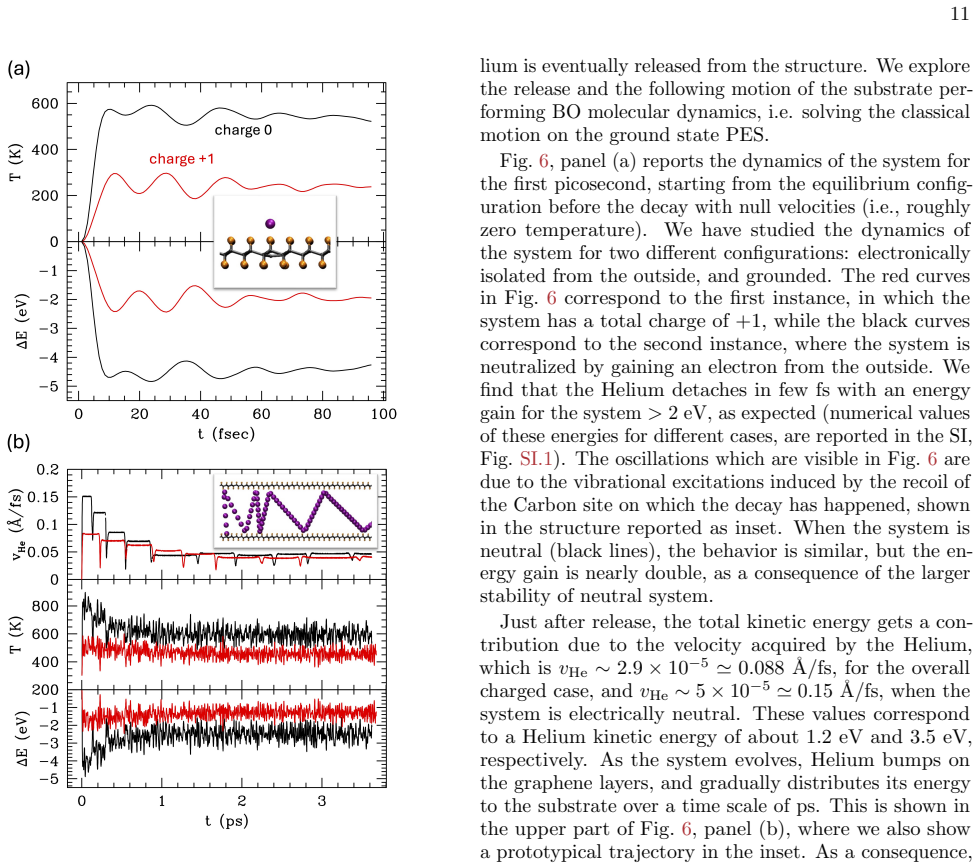
Figure 6. Figure 6: , panel (a) reports the dynamics of the system for the first picosecond, starting from the equilibrium config￾uration before the decay with null velocities (i.e., roughly zero temperature). We have studied the dynamics of the system for two different configurations: electronically isolated from the outside, and grounded. The red curves in [PITH_FULL_IMAGE:figures/full_fig_p011_6.png] view at source ↗
read the original abstract

We present the results of a multi-methodological study aimed at investigating the interaction between graphene and Tritium during its $\beta$-decay to Helium, under different levels of loading and geometrical configurations. We combine Density Functional Theory (DFT), to evaluate the interaction potentials, with calculations of the decay rate, in order to study the consequences that the presence of the substrate has on the $\beta$-decay spectrum of Tritium. We determine the shape of the event rate, accounting for the effects of (part of) the corresponding condensed matter degrees of freedom. In the context of future neutrino experiments, our results provide important information aimed at the optimization of hosting material, as well as the determination of the physics reach. Furthermore, our work outlines a novel theoretical and computational scheme to address a question at the boundary between high and low energy physics. This requires non-conventional declinations of DFT combined with full quantum treatments of the nuclear configuration involved in the decay process.

Editorial analysis

A structured set of objections, weighed in public.

Desk editor's note, referee report, simulated authors' rebuttal, and a circularity audit. Tearing a paper down is the easy half of reading it; the pith above is the substance, this is the friction.

Referee Report

2 major / 2 minor

Summary. The paper presents a multi-methodological study that combines Density Functional Theory (DFT) calculations of interaction potentials between tritium, helium, and graphene (under varying loadings and geometries) with nuclear quantum-mechanical treatments of the decay process. The central claim is that these condensed-matter degrees of freedom modify the tritium β-decay spectrum shape and endpoint, providing guidance for material optimization in future neutrino-mass experiments.

Significance. If the central results hold, the work supplies a concrete computational bridge between nuclear β-decay and substrate effects that is directly relevant to tritium-based neutrino-mass searches. The explicit combination of first-principles electronic-structure potentials with a full quantum treatment of the nuclear configuration is a methodological strength that could be reused for other light-nucleus decays in condensed-matter hosts.

major comments (2)
  1. [Decay-rate calculation section] The manuscript must demonstrate that the decay-rate calculation employs the sudden approximation with explicit overlap integrals between the initial (tritium + graphene) and final (helium + graphene) many-body electronic states. Beta decay occurs on ~10^{-21} s timescales; if only static DFT potentials are inserted into a time-independent nuclear Schrödinger equation without these overlaps or time-dependent DFT validation, the reported spectrum shape and endpoint shift rest on an uncontrolled approximation (see skeptic note and abstract description of the decay-rate step).
  2. [DFT potential evaluation] The accuracy of the DFT-derived T–He–graphene potentials for the final-state distribution must be quantified. The paper should report convergence tests with respect to functional, basis set, and supercell size, together with an estimate of missing many-body or relativistic corrections, because these directly propagate into the claimed substrate-induced modification of the spectrum.
minor comments (2)
  1. [Abstract and introduction] The abstract states that the study accounts for “(part of) the corresponding condensed matter degrees of freedom”; the manuscript should clarify which degrees of freedom are omitted and why they are expected to be sub-dominant.
  2. [Methods] Notation for the nuclear wave functions and the interaction potentials should be made uniform between the DFT and nuclear-QM sections to avoid ambiguity when the potentials are transferred.

Simulated Author's Rebuttal

2 responses · 0 unresolved

We thank the referee for their careful reading of our manuscript and for the constructive comments. We appreciate the positive evaluation of the work's significance and methodological approach. We address each of the major comments below.

read point-by-point responses
  1. Referee: [Decay-rate calculation section] The manuscript must demonstrate that the decay-rate calculation employs the sudden approximation with explicit overlap integrals between the initial (tritium + graphene) and final (helium + graphene) many-body electronic states. Beta decay occurs on ~10^{-21} s timescales; if only static DFT potentials are inserted into a time-independent nuclear Schrödinger equation without these overlaps or time-dependent DFT validation, the reported spectrum shape and endpoint shift rest on an uncontrolled approximation (see skeptic note and abstract description of the decay-rate step).

    Authors: We thank the referee for pointing out the need for clarity on this aspect. Our calculation of the decay rate does employ the sudden approximation, justified by the short timescale of the beta decay process (~10^{-21} s) compared to nuclear motion. The DFT interaction potentials are used to solve the nuclear Schrödinger equation for the initial tritium-graphene and final helium-graphene systems. The spectrum is then obtained from the overlap integrals of the corresponding nuclear wave functions. This captures the effect of the substrate on the nuclear configuration. We will revise the relevant section to explicitly describe this procedure and the underlying assumptions of the sudden approximation. A full explicit calculation of many-body electronic overlap integrals is not performed; instead, the effective potentials from DFT encode the electronic contributions. We believe this is a controlled approximation for the purposes of this study, though we acknowledge the referee's concern and will discuss its limitations. revision: partial

  2. Referee: [DFT potential evaluation] The accuracy of the DFT-derived T–He–graphene potentials for the final-state distribution must be quantified. The paper should report convergence tests with respect to functional, basis set, and supercell size, together with an estimate of missing many-body or relativistic corrections, because these directly propagate into the claimed substrate-induced modification of the spectrum.

    Authors: We agree that quantifying the accuracy of the DFT potentials is crucial. In the revised manuscript, we will add a subsection detailing convergence tests with respect to supercell size and the number of k-points. We will also discuss the choice of functional (PBE) and provide an estimate of the effects of missing van der Waals corrections and relativistic effects on the potentials and resulting spectrum shifts. These will be presented as systematic uncertainties in the final results. revision: yes

Circularity Check

0 steps flagged

No significant circularity; DFT potentials and nuclear decay rate are independent computational steps

full rationale

The paper computes interaction potentials via standard DFT electronic-structure methods and feeds the resulting potentials into a separate nuclear quantum-mechanical treatment of the decay rate. No equations reduce the final spectrum to a fit of the same data, no self-citation supplies a uniqueness theorem that forces the result, and no ansatz is smuggled in. The derivation chain therefore adds independent content at each stage and remains self-contained against external benchmarks.

Axiom & Free-Parameter Ledger

0 free parameters · 2 axioms · 0 invented entities

The central claim rests on the transferability of standard DFT functionals to the tritium-graphene system and on the validity of separating electronic and nuclear degrees of freedom in the decay process. No new particles or forces are introduced.

axioms (2)
  • domain assumption Standard DFT exchange-correlation functionals provide accurate interaction potentials between tritium, helium, and graphene carbon atoms.
    Invoked when the paper states it uses DFT to evaluate the interaction potentials.
  • domain assumption The nuclear decay can be treated quantum-mechanically on top of the DFT-derived potentials without significant back-reaction from the electronic system during the decay.
    Required by the hybrid scheme described in the abstract.

pith-pipeline@v0.9.0 · 5707 in / 1416 out tokens · 55007 ms · 2026-05-22T18:47:07.158391+00:00 · methodology

discussion (0)

Sign in with ORCID, Apple, or X to comment. Anyone can read and Pith papers without signing in.

Lean theorems connected to this paper

Citations machine-checked in the Pith Canon. Every link opens the source theorem in the public Lean library.

What do these tags mean?
matches
The paper's claim is directly supported by a theorem in the formal canon.
supports
The theorem supports part of the paper's argument, but the paper may add assumptions or extra steps.
extends
The paper goes beyond the formal theorem; the theorem is a base layer rather than the whole result.
uses
The paper appears to rely on the theorem as machinery.
contradicts
The paper's claim conflicts with a theorem or certificate in the canon.
unclear
Pith found a possible connection, but the passage is too broad, indirect, or ambiguous to say the theorem truly supports the claim.

Reference graph

Works this paper leans on

68 extracted references · 68 canonical work pages · 7 internal anchors

  1. [1]

    Evidence for oscillation of atmospheric neutrinos

    Y. Fukuda et al. (Super-Kamiokande), “Evidence for os- cillation of atmospheric neutrinos,” Phys. Rev. Lett. 81, 1562–1567 (1998) , arXiv:hep-ex/9807003

  2. [2]

    Measurement of the rate of nu_e + d --> p + p + e^- interactions produced by 8B solar neutrinos at the Sudbury Neutrino Observatory

    Q. R. Ahmad et al. (SNO), “Measurement of the rate of νe + d → p + p + e− interactions produced by 8B solar neutrinos at the Sudbury Neutrino Observatory,” Phys. Rev. Lett. 87, 071301 (2001) , arXiv:nucl-ex/0106015

  3. [3]

    Direct Evidence for Neutrino Flavor Transformation from Neutral-Current Interactions in the Sudbury Neutrino Observatory

    Q. R. Ahmad et al. (SNO), “Direct evidence for neutrino flavor transformation from neutral current interactions in the Sudbury Neutrino Observatory,” Phys. Rev. Lett. 89, 011301 (2002) , arXiv:nucl-ex/0204008

  4. [4]

    2020 Global reassessment of the neutrino oscillation picture

    P. F. de Salas, D. V. Forero, S. Gariazzo, P. Mart ´ ınez- Mirav´ e, O. Mena, C. A. Ternes, M. T´ ortola, and J. W. F. Valle, “2020 global reassessment of the neutrino oscillation 14 picture,” JHEP 02, 071 (2021) , arXiv:2006.11237 [hep- ph]

  5. [5]

    Esteban, M

    Ivan Esteban, M. C. Gonzalez-Garcia, Michele Maltoni, Thomas Schwetz, and Albert Zhou, “The fate of hints: updated global analysis of three-flavor neutrino oscilla- tions,” JHEP 09, 178 (2020) , arXiv:2007.14792 [hep-ph]

  6. [6]

    Unfinished fabric of the three neu- trino paradigm,

    Francesco Capozzi, Eleonora Di Valentino, Eligio Lisi, Antonio Marrone, Alessandro Melchiorri, and An- tonio Palazzo, “Unfinished fabric of the three neu- trino paradigm,” Phys. Rev. D 104, 083031 (2021) , arXiv:2107.00532 [hep-ph]

  7. [7]

    Limit on anti-electron-neutrino mass from observation of the beta decay of molecular tritium,

    R. G. H. Robertson, T. J. Bowles, G. J. Stephenson, D. L. Wark, John F. Wilkerson, and D. A. Knapp, “Limit on anti-electron-neutrino mass from observation of the beta decay of molecular tritium,” Phys. Rev. Lett. 67, 957–960 (1991)

  8. [8]

    New upper bound on the electron anti-neutrino mass,

    H. Kawakami et al. , “New upper bound on the electron anti-neutrino mass,” Phys. Lett. B 256, 105–111 (1991)

  9. [9]

    Measure- ment of the electron-neutrino mass from tritium beta decay,

    E. Holzschuh, M. Fritschi, and W. Kuendig, “Measure- ment of the electron-neutrino mass from tritium beta decay,” Phys. Lett. B 287, 381–388 (1992)

  10. [10]

    Anomalous Structure in the Beta Decay of Gaseous Molecular Tri- tium,

    Wolfgang Stoeffl and Daniel J. Decman, “Anomalous Structure in the Beta Decay of Gaseous Molecular Tri- tium,” Phys. Rev. Lett. 75, 3237–3240 (1995)

  11. [11]

    Improved Upper Limit on the Neutrino Mass from a Direct Kinematic Method by KATRIN,

    M. Aker et al. (KATRIN), “Improved Upper Limit on the Neutrino Mass from a Direct Kinematic Method by KATRIN,” Phys. Rev. Lett. 123, 221802 (2019) , arXiv:1909.06048 [hep-ex]

  12. [12]

    Direct neutrino-mass mea- surement with sub-electronvolt sensitivity,

    M. Aker et al. (KATRIN), “Direct neutrino-mass mea- surement with sub-electronvolt sensitivity,” Nature Phys. 18, 160–166 (2022) , arXiv:2105.08533 [hep-ex]

  13. [13]

    Aker et al

    M. Aker et al. , “Direct neutrino-mass measurement based on 259 days of KATRIN data,” Science 388, 180–185 (2025), arXiv:2406.13516 [nucl-ex]

  14. [14]

    A Design for an Electromagnetic Filter for Precision Energy Measurements at the Tritium Endpoint

    M. G. Betti et al. , “A design for an electromagnetic filter for precision energy measurements at the tritium end- point,” Prog. Part. Nucl. Phys. 106, 120–131 (2019) , arXiv:1810.06703 [astro-ph.IM]

  15. [15]

    Neutrino physics with the PTOLEMY project: active neutrino proper- ties and the light sterile case,

    M. G. Betti et al. (PTOLEMY), “Neutrino physics with the PTOLEMY project: active neutrino proper- ties and the light sterile case,” JCAP 07, 047 (2019) , arXiv:1902.05508 [astro-ph.CO]

  16. [16]

    Implementation and optimization of the PTOLEMY transverse drift electromagnetic filter,

    A. Apponi et al. , “Implementation and optimization of the PTOLEMY transverse drift electromagnetic filter,” JINST 17, P05021 (2022) , arXiv:2108.10388 [physics.ins- det]

  17. [17]

    Heisenberg’s uncertainty principle in the PTOLEMY project: A theory update,

    A. Apponi et al. (PTOLEMY), “Heisenberg’s uncertainty principle in the PTOLEMY project: A theory update,” Phys. Rev. D 106, 053002 (2022) , arXiv:2203.11228 [hep- ph]

  18. [18]

    A Demonstration of Slowed Electron E × B Drift for PTOLEMY,

    M. Farino et al. (PTOLEMY), “A Demonstration of Slowed Electron E × B Drift for PTOLEMY,” JINST 20, P08025 (2025) , arXiv:2503.10025 [physics.ins-det]

  19. [19]

    The Project 8 Neutrino Mass Experiment,

    A. Ashtari Esfahani et al. (Project 8), “The Project 8 Neutrino Mass Experiment,” in Snowmass 2021 (2022) arXiv:2203.07349 [nucl-ex]

  20. [20]

    Tritium Beta Spectrum Measurement and Neutrino Mass Limit from Cyclotron Radiation Emission Spectroscopy,

    A. Ashtari Esfahani et al. (Project 8), “Tritium Beta Spectrum Measurement and Neutrino Mass Limit from Cyclotron Radiation Emission Spectroscopy,” Phys. Rev. Lett. 131, 102502 (2023) , arXiv:2212.05048 [nucl-ex]

  21. [21]

    Universal Neutrino Degeneracy,

    Steven Weinberg, “Universal Neutrino Degeneracy,” Phys. Rev. 128, 1457–1473 (1962)

  22. [22]

    Probing Low Energy Neutrino Backgrounds with Neutrino Capture on Beta Decaying Nuclei

    Alfredo G. Cocco, Gianpiero Mangano, and Marcello Messina, “Probing low energy neutrino backgrounds with neutrino capture on beta decaying nuclei,” JCAP 06, 015 (2007), arXiv:hep-ph/0703075

  23. [23]

    Hydrogen storage in rippled graphene: perspec- tives from multi-scale simulations,

    Vito Dario Camiola, Riccardo Farchioni, Tommaso Cav- allucci, Antonio Rossi, Vittorio Pellegrini, and Valentina Tozzini, “Hydrogen storage in rippled graphene: perspec- tives from multi-scale simulations,” Frontiers in materials 2, 3 (2015)

  24. [24]

    Gap open- ing in double-sided highly hydrogenated free-standing graphene,

    M G Betti, E Placidi, C Izzo, E Blundo, A Polimeni, M Sbroscia amd J A P Dudin, K Hu, Y Ito, D Prezzi, M Bonacci, E Molinari, and Carlo Mariani, “Gap open- ing in double-sided highly hydrogenated free-standing graphene,” Nano Lett. 22, 2971–2977 (2022)

  25. [25]

    Transmission through graphene of electrons in the 30–900 ev range,

    Alice Apponi, Domenica Convertino, Neeraj Mishra, Camilla Coletti, Mauro Iodice, Franco Frasconi, Federico Pilo, Narcis Silviu Blaj, Daniele Paoloni, Ilaria Rago, et al. , “Transmission through graphene of electrons in the 30–900 ev range,” Carbon 216, 118502 (2024)

  26. [26]

    Navigating the pitfalls of relic neutrino detection,

    Yevheniia Cheipesh, Vadim Cheianov, and Alexey Bo- yarsky, “Navigating the pitfalls of relic neutrino detection,” Phys. Rev. D 104, 116004 (2021) , arXiv:2101.10069 [hep- ph]

  27. [27]

    Quantum in- duced broadening: A challenge for cosmic neutrino back- ground discovery,

    Shmuel Nussinov and Zohar Nussinov, “Quantum in- duced broadening: A challenge for cosmic neutrino back- ground discovery,” Phys. Rev. D 105, 043502 (2022) , arXiv:2108.03695 [hep-ph]

  28. [28]

    Importance of the X-ray edge singularity for the detection of relic neutrinos in the PTOLEMY project,

    Zhiyang Tan and Vadim Cheianov, “Importance of the X-ray edge singularity for the detection of relic neutrinos in the PTOLEMY project,” SciPost Phys. 17, 022 (2024) , arXiv:2202.07406 [physics.ins-det]

  29. [29]

    Relativistic corrections to polarized-tritium β decay,

    Gianluca Cavoto, Angelo Esposito, Guglielmo Papiri, and Antonio Davide Polosa, “Relativistic corrections to polarized-tritium β decay,” Phys. Rev. C 107, 064603 (2023), arXiv:2211.13247 [hep-ph]

  30. [30]

    Quantized nuclear recoil in the search for sterile neutrinos in tritium beta decay with ptolemy,

    Wonyong Chung, Mark Farino, Andi Tan, Christopher G. Tully, and Shiran Zhang, “Quantized nuclear recoil in the search for sterile neutrinos in tritium beta decay with ptolemy,” Universe 11 (2025), 10.3390/universe11090297

  31. [31]

    Computer modeling across energy scales: Tritiated graphene for neutrinos investigation,

    G Menichetti, A Casale, A Esposito, and V Tozzini, “Computer modeling across energy scales: Tritiated graphene for neutrinos investigation,” Nuovo Cimento 48 C (2025), 10.1393/ncc/i2025-25211-2

  32. [32]

    Multi- methodological analysis of hydrogen desorption from graphene,

    Francesco Delfino, Carles Ros, Sidney M Palardonio, Nina M Carretero, Sebasti´ an Murcia-L´ opez, Juan Ram´ on Morante, Jordi Martorell, Zacharias G Fthenakis, Mauro Francesco Sgroi, Valentina Tozzini, et al. , “Multi- methodological analysis of hydrogen desorption from graphene,” Carbon 227, 119211 (2024)

  33. [33]

    Engineering 3d graphene-based materials: State of the art and perspectives,

    L Bellucci and V Tozzini, “Engineering 3d graphene-based materials: State of the art and perspectives,” Molecules 25, 339 (2020)

  34. [34]

    Nano-scale corrugations in graphene: A density functional theory study of structure, electronic properties and hydrogena- tion,

    Antonio Rossi, Simone Piccinin, Vittorio Pellegrini, Ste- fano de Gironcoli, and Valentina Tozzini, “Nano-scale corrugations in graphene: A density functional theory study of structure, electronic properties and hydrogena- tion,” J. Phys. Chem. C 119, 7900–7910 (2015)

  35. [35]

    Unraveling localized states in quasi free standing monolayer graphene by means of density func- tional theory,

    T Cavallucci, Y Murata, M Takamura, H Hibino, S Heun, and V Tozzini, “Unraveling localized states in quasi free standing monolayer graphene by means of density func- tional theory,” Carbon 130, 466–474 (2019)

  36. [36]

    Self-consistent equa- tions including exchange and correlation effects,

    Walter Kohn and Lu Jeu Sham, “Self-consistent equa- tions including exchange and correlation effects,” Physical review 140, A1133 (1965)

  37. [37]

    Phonons and related crystal properties from 15 density-functional perturbation theory,

    S Baroni, S de Gironcoli, A Dal Corso, and P Gi- annozzi, “Phonons and related crystal properties from 15 density-functional perturbation theory,” Rev Mod Phys 73, 515–562 (2001)

  38. [38]

    Sudden approximation in pho- toemission and beyond,

    Lars Hedin and JD Lee, “Sudden approximation in pho- toemission and beyond,” Journal of electron spectroscopy and related phenomena 124, 289–315 (2002)

  39. [39]

    Exact relativistic tritium beta-decay endpoint spectrum in a hadron model

    Fedor Simkovic, Rastislav Dvornicky, and Amand Faessler, “Exact relativistic tritium beta-decay endpoint spectrum in a hadron model,” Phys. Rev. C 77, 055502 (2008), arXiv:0712.3926 [hep-ph]

  40. [40]

    Generalized gradient approximation made simple,

    John P. Perdew, Kieron Burke, and Matthias Ernzerhof, “Generalized gradient approximation made simple,” Phys. Rev. Lett. 77, 3865–3868 (1996)

  41. [41]

    Reproducibility in density functional theory calculations of solids,

    Kurt Lejaeghere, Gustav Bihlmayer, Torbj¨ orn Bj¨ orkman, Peter Blaha, Stefan Bl¨ ugel, Volker Blum, Damien Caliste, Ivano E Castelli, Stewart J Clark, Andrea Dal Corso, et al., “Reproducibility in density functional theory calculations of solids,” Science 351, aad3000 (2016)

  42. [42]

    Semiempirical gga-type density func- tional constructed with a long-range dispersion correc- tion,

    Stefan Grimme, “Semiempirical gga-type density func- tional constructed with a long-range dispersion correc- tion,” Journal of Computational Chemistry 27, 1787–1799 (2006)

  43. [43]

    Special points for brillouin-zone integrations,

    Hendrik J. Monkhorst and James D. Pack, “Special points for brillouin-zone integrations,” Phys. Rev. B 13, 5188– 5192 (1976)

  44. [44]

    Weinberg, Lectures on Quantum Mechanics (Cam- bridge University Press, 2013)

    S. Weinberg, Lectures on Quantum Mechanics (Cam- bridge University Press, 2013)

  45. [45]

    Born and K

    M. Born and K. Huang, Dynamical Theory of Crystal Lattices, International series of monographs on physics (Clarendon Press, 1988)

  46. [46]

    Highly hydro- genated monolayer graphene with wide band gap opening,

    Alice Apponi, Orlando Castellano, Daniele Paoloni, Domenica Convertino, Neeraj Mishra, Camilla Coletti, Carlo Mariani, and Alessandro Ruocco, “Highly hydro- genated monolayer graphene with wide band gap opening,” (2025), arXiv:2504.10238 [cond-mat.mtrl-sci]

  47. [47]

    Feliciano Giustino, Materials modelling using density func- tional theory: properties and predictions (Oxford Univer- sity Press, 2014)

  48. [48]

    Intrinsic structural and electronic properties of the buffer layer on silicon carbide unraveled by density functional theory,

    T Cavallucci and V Tozzini, “Intrinsic structural and electronic properties of the buffer layer on silicon carbide unraveled by density functional theory,” Sci. Rep. 8, 13097 (2018)

  49. [49]

    The influence of graphene curvature on hydrogen adsorption: Towards hydrogen storage devices,

    Sarah Goler, Camilla Coletti, Valentina Tozzini, Vincenzo Piazza, Torge Mashoff, Fabio Beltram, Vittorio Pellegrini, and Stefan Heun, “The influence of graphene curvature on hydrogen adsorption: Towards hydrogen storage devices,” J Phys Chem C 117, 11506–11513 (2013)

  50. [50]

    Advanced capabilities for materials modelling with quantum espresso,

    Paolo Giannozzi, Oliviero Andreussi, Thomas Brumme, Oana Bunau, M Buongiorno Nardelli, Matteo Calandra, Roberto Car, Carlo Cavazzoni, Davide Ceresoli, Matteo Cococcioni, et al. , “Advanced capabilities for materials modelling with quantum espresso,” Journal of physics: Condensed matter 29, 465901 (2017)

  51. [51]

    Xcrysden—a new program for displaying crystalline structures and electron densities,

    Anton Kokalj, “Xcrysden—a new program for displaying crystalline structures and electron densities,” Journal of Molecular Graphics and Modelling 17, 176–179 (1999)

  52. [52]

    Vmd - vi- sual molecular dynamics,

    W. Humphrey, A. Dalke, and K. Schulten, “Vmd - vi- sual molecular dynamics,” J. Molec. Graphics 14, 33–38 (1996)

  53. [53]

    Electron correlation driven non- adiabatic relaxation in molecules excited by an ultrashort extreme ultraviolet pulse,

    A Marciniak, V Despr´ e, Vincent Loriot, G Karras, M Herv´ e, L Quintard, F Catoire, C Joblin, Eric Con- stant, AI Kuleff, et al. , “Electron correlation driven non- adiabatic relaxation in molecules excited by an ultrashort extreme ultraviolet pulse,” Nature communications 10, 337 (2019)

  54. [54]

    Identifying vibra- tions that control non-adiabatic relaxation of polaritons in strongly coupled molecule–cavity systems,

    Ruth H Tichauer, Dmitry Morozov, Ilia Sokolovskii, J Jussi Toppari, and Gerrit Groenhof, “Identifying vibra- tions that control non-adiabatic relaxation of polaritons in strongly coupled molecule–cavity systems,” J. Phys. Chem. Lett. 13, 6259–6267 (2022)

  55. [55]

    Jun John Sakurai and Jim Napolitano, Modern Quan- tum Mechanics , Quantum physics, quantum information and quantum computation (Cambridge University Press, 2020)

  56. [56]

    Effect of final-state interactions in allowed beta decays. 2. Reliability of the beta-decay spectrum for T-2,

    Alejandro Saenz and Piotr Froelich, “Effect of final-state interactions in allowed beta decays. 2. Reliability of the beta-decay spectrum for T-2,” Phys. Rev. C 56, 2162– 2184 (1997)

  57. [57]

    Stability of highly hydrogenated monolayer graphene in ultra-high vacuum and in air,

    Alice Apponi, Orlando Castellano, Daniele Paoloni, Domenica Convertino, Neeraj Mishra, Camilla Co- letti, Andrea Casale, Luca Cecchini, Alfredo G. Cocco, Benedetta Corcione, Nicola D’Ambrosio, Angelo Espos- ito, Marcello Messina, Francesco Pandolfi, Francesca Pofi, Ilaria Rago, Nicola Rossi, Sammar Tayyab, Ravi Prakash Yadav, Federico Virzi, Carlo Mariani, ...

  58. [58]

    The- oretical analysis of spectral lineshapes from molecular dynamics,

    A Cupo, D Tristant, K Rego, and V Meunier, “The- oretical analysis of spectral lineshapes from molecular dynamics,” npj Comput Mat 5 (2019)

  59. [59]

    706 (Springer, 2006)

    Miguel AL Marques, Carsten A Ullrich, Fernando Nogueira, Angel Rubio, Kieron Burke, and Eberhard KU Gross, Time-dependent density functional theory , Vol. 706 (Springer, 2006)

  60. [60]

    Ab initio ehrenfest dynamics,

    X. Li, J. C. Tully, H. B. Schlegel, and M. J. Frisch, “Ab initio ehrenfest dynamics,” J. Chem. Phys. 123 (2005)

  61. [61]

    The quan- tum dynamics of interfacial hydrogen: Path integral max- imum entropy calculation of adsorbate vibrational line shapes for the h/ni (111) system,

    Dongsup Kim, JD Doll, and JE Gubernatis, “The quan- tum dynamics of interfacial hydrogen: Path integral max- imum entropy calculation of adsorbate vibrational line shapes for the h/ni (111) system,” J. Chem. Phys. 106, 1641–1645 (1997)

  62. [62]

    Time- dependent self-consistent harmonic approximation: An- harmonic nuclear quantum dynamics and time correlation functions,

    Lorenzo Monacelli and Francesco Mauri, “Time- dependent self-consistent harmonic approximation: An- harmonic nuclear quantum dynamics and time correlation functions,” Phys Rev B 103, 104305 (2021)

  63. [63]

    Beta decay of molec- ular tritium,

    Y. T. Lin et al. (TRIMS), “Beta decay of molec- ular tritium,” Phys. Rev. Lett. 124, 222502 (2020) , arXiv:2001.11671 [nucl-ex]

  64. [64]

    In silico design, building and gas adsorption of nano-porous graphene scaffolds,

    L Bellucci, F Delfino, and V Tozzini, “In silico design, building and gas adsorption of nano-porous graphene scaffolds,” Nanotechnology 32 (2021)

  65. [65]

    Evaluating the performance of reaxff potentials for sp2 carbon systems (graphene, carbon nanotubes, fullerenes) and a new reaxff potential,

    ZG Fthenakis, ID Petsalakis, V Tozzini, and NN Lath- iotakis, “Evaluating the performance of reaxff potentials for sp2 carbon systems (graphene, carbon nanotubes, fullerenes) and a new reaxff potential,” Front Chem 10 (2022)

  66. [66]

    A ma- chine learning empirical potential for c-o-h interactions,

    L Bellucci, V Tozzini, G Fisicaro, and S Piccinin, “A ma- chine learning empirical potential for c-o-h interactions,” in preparation. The β -decay spectrum of Tritiated graphene: combining nuclear quantum mechanics with Density Functional Theory Andrea Casale, 1, ∗ Angelo Esposito, 2, 3, † Guido Menichetti, 4, 5, ‡ and Valentina Tozzini 6, 7, § 1Departmen...

  67. [67]

    Baroni, S

    S. Baroni, S. de Gironcoli, A. D. Corso, and P. Giannozzi, Rev Mod Phys 73, 515 (2001)

  68. [68]

    Cube Toolz, https://github.com/funkymunkycool/ Cube-Toolz