Curvature-induced smectic-C order of tangentially anchored hard spherocylinders on a sphere with a rigidly locked director field
Pith reviewed 2026-06-25 22:33 UTC · model grok-4.3
The pith
Curvature on a sphere induces smectic-C order in hard rods whose axes are rigidly locked to a tangential director field.
A machine-rendered reading of the paper's core claim, the machinery that carries it, and where it could break.
Core claim
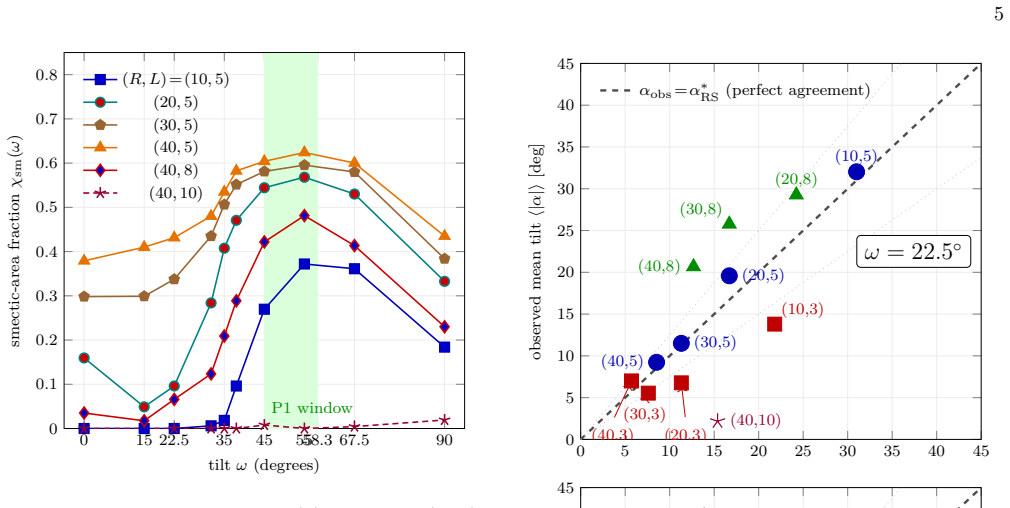
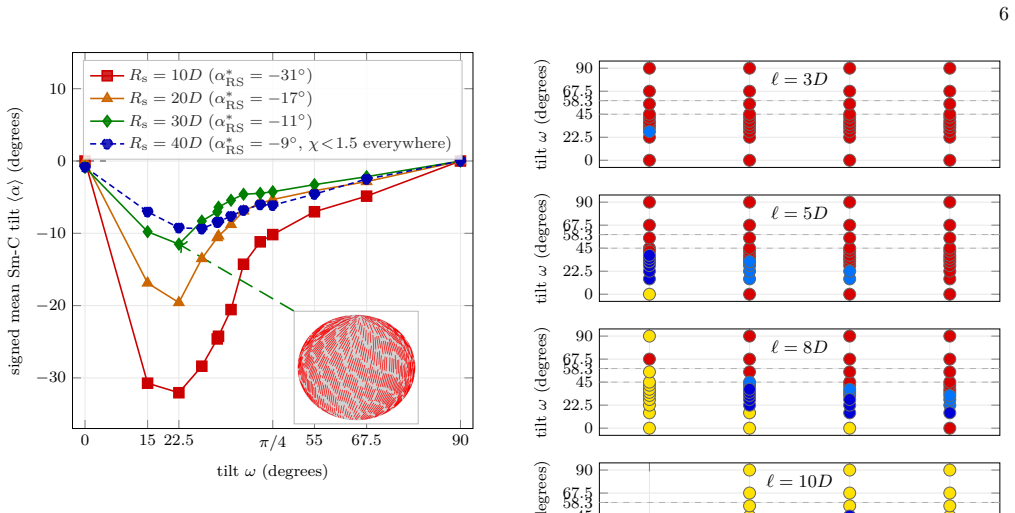
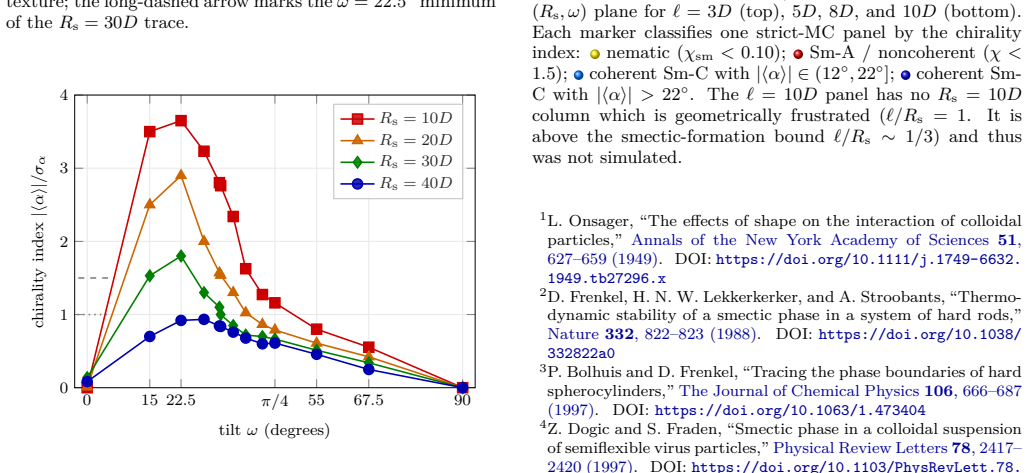
In the locked-orientation limit, curvature alone produces a smectic-C window whose lower edge at 45° follows from reciprocal symmetry, whose upper edge at 58.3° follows from the channel-saturation hypothesis, whose A-to-C boundary is a closed-form prediction, and whose rod tilt is set by the rod-to-radius ratio inside a chirality envelope peaking near 24°. Simulations on fifteen geometries recover the predicted smectic area peak at 55° and detect coherent smectic-C order with no fitted parameters.
What carries the argument
The ratio-symmetric recognition cost that fixes interlayer spacing at the bulk close-contact value and generates the hierarchy of geometric predictions for the smectic window and rod tilt.
If this is right
- The smectic area reaches its maximum at a director angle of 55°.
- A coherent smectic-C region appears inside the predicted angular window.
- The smectic-A to smectic-C boundary is given by a closed-form geometric expression.
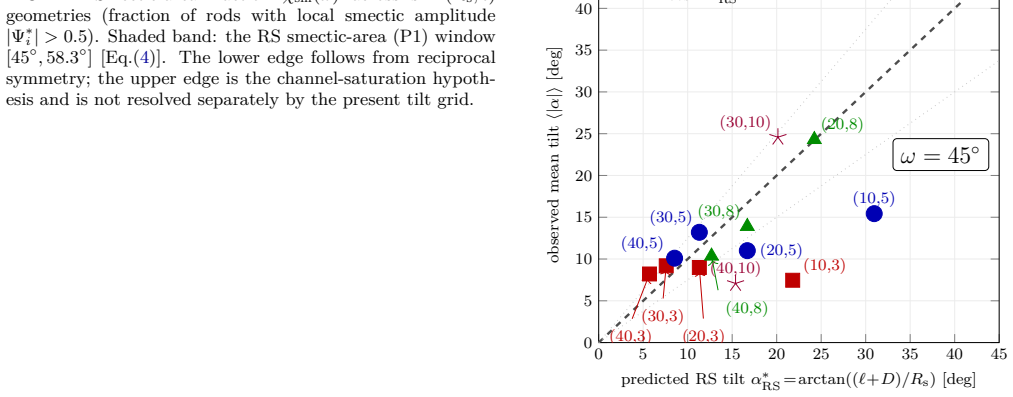
- Rod tilt angle scales directly with the rod-to-radius ratio and is modulated by the chirality envelope.
Where Pith is reading between the lines
- The same geometric mechanism could be tested on other surfaces whose director field is externally imposed rather than free to relax.
- If the channel-saturation hypothesis holds only for the specific director field studied, the upper window edge may shift on surfaces with different curvature profiles.
- The absence of any fitted elastic constants isolates curvature as the sole driver, suggesting that similar purely geometric selection of tilt may occur in other confined hard-rod systems.
Load-bearing premise
The upper bound of the smectic-C window at 58.3° depends on the channel-saturation hypothesis, which is not derived from first principles inside the locked-orientation model.
What would settle it
A locked-orientation Monte Carlo run at a director angle of 50° that shows no coherent smectic-C order, or a run at 60° that still shows smectic-C order, would falsify the predicted window boundaries.
Figures
read the original abstract
We study the strict locked-orientation limit of hard spherocylinders on a sphere, in which the rod axes are rigidly locked to a prescribed tangential director field and cannot reorient. Because the bulk hard-rod phase diagram contains no smectic-C phase, any coherent tilt isolates a geometric curvature mechanism rather than a finite-stiffness equilibrium effect. A ratio-symmetric recognition cost fixes the layer spacing at the bulk close-contact value and yields a hierarchy of geometric statements: the lower edge of the smectic-area window at $45^\circ$ follows from reciprocal symmetry; the upper edge at $58.3^\circ$ is a falsifiable channel-saturation hypothesis; the smectic-A to smectic-C boundary is a closed-form prediction; and the rod tilt angle is set by the rod-to-radius ratio, modulated by a chirality envelope peaking near $24^\circ$. Locked-orientation Monte Carlo across fifteen geometries confirms these predictions with no fitted elastic constants: the smectic area peaks at $55^\circ$, and a coherent smectic-C window is detected.
Editorial analysis
A structured set of objections, weighed in public.
Referee Report
Summary. The manuscript examines the strict locked-orientation limit of hard spherocylinders on a sphere with a prescribed tangential director field. A ratio-symmetric recognition cost is used to fix the layer spacing at the bulk close-contact value, yielding geometric predictions: a 45° lower edge of the smectic-area window from reciprocal symmetry, a closed-form SmA–SmC boundary, rod tilt angles set by the rod-to-radius ratio and modulated by a chirality envelope, while the 58.3° upper edge is explicitly labeled a falsifiable channel-saturation hypothesis. Locked-orientation Monte Carlo simulations across fifteen geometries are reported to confirm the smectic area peaking at 55° and the presence of a coherent smectic-C window, with no fitted elastic constants.
Significance. If the results hold, the work isolates a purely geometric curvature mechanism for smectic-C order in a system whose bulk phase diagram contains no such phase. Credit is due for the parameter-free character of the lower-edge and boundary derivations, the explicit falsifiability of the upper-edge hypothesis, and the extensive Monte Carlo confirmation across fifteen geometries with no adjustable constants. This approach cleanly separates geometric packing effects from finite-stiffness equilibria.
major comments (1)
- [Abstract] Abstract: the upper edge of the smectic-area window at 58.3° is presented as resting on a channel-saturation hypothesis that is not derived from the locked director field, sphere curvature, or the ratio-symmetric recognition cost; because this assumption is load-bearing for the predicted smectic-C window, its status as an un-derived packing postulate requires either an internal derivation or explicit justification within the locked-orientation model.
minor comments (2)
- [Abstract] Abstract: the statement that Monte Carlo confirms the predictions supplies no error bars, sample sizes, or explicit exclusion criteria for identifying the smectic-C window.
- The functional form of the chirality envelope and its parameter-free status are not shown in the abstract or summary statements.
Simulated Author's Rebuttal
We thank the referee for the positive assessment of the parameter-free predictions and Monte Carlo confirmation, and for identifying the need to strengthen the presentation of the upper-edge hypothesis. We address this single major comment below and will incorporate the requested clarification.
read point-by-point responses
-
Referee: [Abstract] Abstract: the upper edge of the smectic-area window at 58.3° is presented as resting on a channel-saturation hypothesis that is not derived from the locked director field, sphere curvature, or the ratio-symmetric recognition cost; because this assumption is load-bearing for the predicted smectic-C window, its status as an un-derived packing postulate requires either an internal derivation or explicit justification within the locked-orientation model.
Authors: We agree that the 58.3° upper edge is introduced as a channel-saturation hypothesis rather than a strict derivation from the locked director field and ratio-symmetric recognition cost. The manuscript already labels it explicitly as falsifiable to signal this status. To meet the referee's request, we will revise the abstract and the relevant methods/discussion sections to supply an explicit geometric justification internal to the locked-orientation model: when the local curvature and fixed layer spacing cause the number of available tangential channels per layer to reach saturation, further increase in polar angle forces overlap that violates the recognition cost. This justification uses only the same packing rules already employed for the 45° lower edge and the closed-form SmA–SmC boundary; no new parameters or elastic constants are added. The Monte Carlo results across fifteen geometries remain unchanged and continue to support the window. revision: yes
Circularity Check
No significant circularity; geometric claims rest on explicit input assumptions and external Monte Carlo validation
full rationale
The paper states that a ratio-symmetric recognition cost is introduced to fix layer spacing at the bulk close-contact value; this is an input choice, not a derived output. The lower edge at 45° is stated to follow from reciprocal symmetry of that cost (a logical implication of the symmetry property). The upper edge at 58.3° is explicitly labeled a 'falsifiable channel-saturation hypothesis' rather than a first-principles derivation. The SmA–SmC boundary is presented as a closed-form prediction and the tilt angle as set by rod-to-radius ratio with a chirality envelope; both are then subjected to independent locked-orientation Monte Carlo tests across fifteen geometries with no fitted elastic constants. No quoted step reduces a claimed prediction to its inputs by construction, invokes self-citation for uniqueness, or renames a known result. The derivation chain is self-contained against the external simulation benchmark.
Axiom & Free-Parameter Ledger
axioms (2)
- domain assumption Hard spherocylinders interact solely via excluded volume with no attractive or bending potentials.
- domain assumption Director field is rigidly locked and tangential; rods cannot reorient.
Reference graph
Works this paper leans on
-
[1]
author author L. Onsager ,\ title title The effects of shape on the interaction of colloidal particles , \ https://doi.org/10.1111/j.1749-6632.1949.tb27296.x journal journal Annals of the New York Academy of Sciences \ volume 51 ,\ pages 627--659 ( year 1949 ) NoStop
-
[2]
author author D. Frenkel , author H. N. W. \ Lekkerkerker ,\ and\ author A. Stroobants ,\ title title Thermodynamic stability of a smectic phase in a system of hard rods , \ https://doi.org/10.1038/332822a0 journal journal Nature \ volume 332 ,\ pages 822--823 ( year 1988 ) NoStop
-
[3]
author author P. Bolhuis \ and\ author D. Frenkel ,\ title title Tracing the phase boundaries of hard spherocylinders , \ https://doi.org/10.1063/1.473404 journal journal The Journal of Chemical Physics \ volume 106 ,\ pages 666--687 ( year 1997 ) NoStop
-
[4]
author author Z. Dogic \ and\ author S. Fraden ,\ title title Smectic phase in a colloidal suspension of semiflexible virus particles , \ https://doi.org/10.1103/PhysRevLett.78.2417 journal journal Physical Review Letters \ volume 78 ,\ pages 2417--2420 ( year 1997 ) NoStop
-
[5]
author author P. G. \ de Gennes \ and\ author J. Prost ,\ https://doi.org/10.1093/oso/9780198520245.001.0001 title The Physics of Liquid Crystals ,\ edition 2nd \ ed.\ ( publisher Oxford University Press ,\ year 1993 ) NoStop
-
[6]
author author J. P. F. \ Lagerwall \ and\ author G. Scalia ,\ title title A new era for liquid crystal research: Applications of liquid crystals in soft matter nano-, bio- and microtechnology , \ https://doi.org/10.1016/j.cap.2012.03.019 journal journal Current Applied Physics \ volume 12 ,\ pages 1387--1412 ( year 2012 ) NoStop
-
[7]
author author F. Smallenburg \ and\ author H. L \"o wen ,\ title title Close packing of rods on spherical surfaces , \ https://doi.org/10.1063/1.4947256 journal journal The Journal of Chemical Physics \ volume 144 ,\ pages 164903 ( year 2016 ) NoStop
-
[8]
author author Y. Trukhina \ and\ author T. Schilling ,\ title title Computer simulation study of a liquid crystal confined to a spherical cavity , \ https://doi.org/10.1103/PhysRevE.77.011701 journal journal Physical Review E \ volume 77 ,\ pages 011701 ( year 2008 ) NoStop
-
[9]
author author E. Allahyarov , author A. Voigt ,\ and\ author H. L \"o wen ,\ title title Smectic monolayer confined on a sphere: topology at the particle scale , \ https://doi.org/10.1039/c7sm01704a journal journal Soft Matter \ volume 13 ,\ pages 8120--8135 ( year 2017 ) NoStop
-
[10]
author author E. Allahyarov \ and\ author H. L \"o wen ,\ title title Length segregation in mixtures of spherocylinders induced by imposed topological defects , \ https://doi.org/10.1039/c8sm01790e journal journal Soft Matter \ volume 14 ,\ pages 8962--8973 ( year 2018 ) NoStop
work page internal anchor Pith review doi:10.1039/c8sm01790e 2018
-
[11]
author author J. Mandal , author H. L \"o wen ,\ and\ author P. K. \ Maiti ,\ title title Phase behavior and defect structure of soft rods on a sphere , \ https://doi.org/10.1063/5.0309849 journal journal The Journal of Chemical Physics \ volume 164 ,\ pages 064906 ( year 2026 ) NoStop
-
[12]
A. Fern\'andez-Nieves, V. Vitelli, A. S. Utada, D. R. Link, M. M\'arquez, D. R. Nelson,\ and\ D. A. Weitz,\ Novel defect structures in nematic liquid crystal shells, \ https://doi.org/10.1103/PhysRevLett.99.157801 journal Phys. Rev. Lett. \ volume 99 ,\ pages 157801 ( year 2007 ) NoStop
-
[13]
T. Lopez-Leon, V. Koning, K. B. S. Devaiah, V. Vitelli,\ and\ A. Fern\'andez-Nieves,\ Frustrated nematic order in spherical geometries, \ https://doi.org/10.1038/nphys1920 journal Nat. Phys. \ volume 7 ,\ pages 391--394 ( year 2011 ) NoStop
-
[14]
T. Lopez-Leon, M. A. Bates,\ and\ A. Fern\'andez-Nieves,\ Defect coalescence in spherical nematic shells, \ https://doi.org/10.1103/PhysRevE.86.030702 journal Phys. Rev. E \ volume 86 ,\ pages 030702 ( year 2012 ) NoStop
-
[15]
H.-L. Liang, S. Schymura, P. Rudquist,\ and\ J. Lagerwall,\ Nematic-smectic transition under confinement in liquid crystalline colloidal shells, \ https://doi.org/10.1103/PhysRevLett.106.247801 journal Phys. Rev. Lett. \ volume 106 ,\ pages 247801 ( year 2011 ) NoStop
-
[16]
T. Lopez-Leon, A. Fern\'andez-Nieves, M. Nobili,\ and\ C. Blanc,\ Smectic shells, \ https://doi.org/10.1088/0953-8984/24/28/284122 journal J. Phys.: Condens. Matter \ volume 24 ,\ pages 284122 ( year 2012 ) NoStop
-
[17]
H.-L. Liang, R. Zentel, P. Rudquist,\ and\ J. Lagerwall,\ Towards tunable defect arrangements in smectic liquid crystal shells utilizing the nematic--smectic transition in hybrid-aligned geometries, \ https://doi.org/10.1039/c2sm07415j journal Soft Matter \ volume 8 ,\ pages 5443--5450 ( year 2012 ) NoStop
-
[18]
author author A. Sharma , author M. Magrini , author Y. Han , author D. M. \ Walba , author A. Majumdar ,\ and\ author J. P. F. \ Lagerwall ,\ title title How smectic-a and smectic-c liquid crystals resolve confinement-induced frustration in spherical shells , \ https://doi.org/10.1039/D4SM01263A journal journal Soft Matter \ volume 20 ,\ pages 9586--9596...
-
[19]
E. Barry\ and\ Z. Dogic,\ Entropy driven self-assembly of nonamphiphilic colloidal membranes, \ https://doi.org/10.1073/pnas.1000406107 journal Proc. Natl. Acad. Sci. U.S.A. \ volume 107 ,\ pages 10348--10353 ( year 2010 ) NoStop
-
[20]
M. J. Zakhary, T. Gibaud, C. N. Kaplan, E. Barry, R. Oldenbourg, R. B. Meyer,\ and\ Z. Dogic,\ Imprintable membranes from incomplete chiral coalescence, \ https://doi.org/10.1038/ncomms4063 journal Nat. Commun. \ volume 5 ,\ pages 3063 ( year 2014 ) NoStop
-
[21]
P. Sharma, A. Ward, T. Gibaud, M. F. Hagan,\ and\ Z. Dogic,\ Hierarchical organization of chiral rafts in colloidal membranes, \ https://doi.org/10.1038/nature13694 journal Nature \ volume 513 ,\ pages 77--80 ( year 2014 ) NoStop
-
[22]
L. Tortora\ and\ O. D. Lavrentovich,\ Chiral symmetry breaking by spatial confinement in tactoidal droplets of lyotropic chromonic liquid crystals, \ https://doi.org/10.1073/pnas.1100087108 journal Proc. Natl. Acad. Sci. U.S.A. \ volume 108 ,\ pages 5163--5168 ( year 2011 ) NoStop
-
[23]
H. Shin, M. J. Bowick,\ and\ X. Xing,\ Topological defects in spherical nematics, \ https://doi.org/10.1103/PhysRevLett.101.037802 journal Phys. Rev. Lett. \ volume 101 ,\ pages 037802 ( year 2008 ) NoStop
-
[24]
M. A. Bates,\ Nematic ordering and defects on the surface of a sphere: A Monte Carlo simulation study, \ https://doi.org/10.1063/1.2890724 journal J. Chem. Phys. \ volume 128 ,\ pages 104707 ( year 2008 ) NoStop
-
[25]
M. A. Bates, G. Ska c ej,\ and\ C. Zannoni,\ Defects and ordering in nematic coatings on uniaxial and biaxial colloids, \ https://doi.org/10.1039/b917180k journal Soft Matter \ volume 6 ,\ pages 655--663 ( year 2010 ) NoStop
-
[26]
S. Dhakal, F. J. Solis,\ and\ M. Olvera de la Cruz,\ Nematic liquid crystals on spherical surfaces: Control of defect configurations by temperature, density, and rod shape, \ https://doi.org/10.1103/PhysRevE.86.011709 journal Phys. Rev. E \ volume 86 ,\ pages 011709 ( year 2012 ) NoStop
-
[27]
V. Vitelli\ and\ D. R. Nelson,\ Nematic textures in spherical shells, \ https://doi.org/10.1103/PhysRevE.74.021711 journal Phys. Rev. E \ volume 74 ,\ pages 021711 ( year 2006 ) NoStop
-
[28]
S. Kralj, R. Rosso,\ and\ E. G. Virga,\ Curvature control of valence on nematic shells, \ https://doi.org/10.1039/c0sm00378f journal Soft Matter \ volume 7 ,\ pages 670--683 ( year 2011 ) NoStop
-
[29]
V. Koning, T. Lopez-Leon, A. Darmon, A. Fern\'andez-Nieves,\ and\ V. Vitelli,\ Spherical nematic shells with a threefold valence, \ https://doi.org/10.1103/PhysRevE.94.012703 journal Phys. Rev. E \ volume 94 ,\ pages 012703 ( year 2016 ) NoStop
-
[30]
G. Napoli\ and\ L. Vergori,\ Extrinsic curvature effects on nematic shells, \ https://doi.org/10.1103/PhysRevLett.108.207803 journal Phys. Rev. Lett. \ volume 108 ,\ pages 207803 ( year 2012 ) NoStop
-
[31]
G. Napoli\ and\ L. Vergori,\ Surface free energies for nematic shells, \ https://doi.org/10.1103/PhysRevE.85.061701 journal Phys. Rev. E \ volume 85 ,\ pages 061701 ( year 2012 ) NoStop
-
[32]
M. J. Bowick\ and\ L. Giomi,\ Two-dimensional matter: order, curvature and defects, \ https://doi.org/10.1080/00018730903043166 journal Adv. Phys. \ volume 58 ,\ pages 449--563 ( year 2009 ) NoStop
-
[33]
Uniqueness of the Canonical Reciprocal Cost
author author J. Washburn \ and\ author M. Zlatanovi\' c ,\ title title Uniqueness of the canonical reciprocal cost , \ https://doi.org/10.3390/math14060935 journal journal Mathematics \ volume 14 ,\ pages 935 ( year 2026 ) NoStop
-
[34]
The D’Alembert Inevitability Theorem
author author J. Washburn , author M. Zlatanovi\' c ,\ and\ author E. Allahyarov ,\ title title The D ' A lembert inevitability theorem , \ https://doi.org/10.3390/math14081386 journal journal Mathematics \ volume 14 ,\ pages 1386 ( year 2026 ) NoStop
work page internal anchor Pith review doi:10.3390/math14081386 2026
-
[35]
author author C. Vega \ and\ author S. Lago ,\ title title A fast algorithm to evaluate the shortest distance between rods , \ https://doi.org/10.1016/0097-8485(94)80023-5 journal journal Computers & Chemistry \ volume 18 ,\ pages 55--59 ( year 1994 ) NoStop
discussion (0)
Sign in with ORCID, Apple, or X to comment. Anyone can read and Pith papers without signing in.