REVIEW 4 major objections 7 minor 34 references
Antibody Design and Optimization with Multi-scale Equivariant Graph Diffusion Models for Accurate Complex Antigen Binding
T0 review · 4 major / 7 minor · reviewed 2026-08-06 · deepseek-v4-flash
Pith's one-line read AbMEGD, a multi-scale equivariant graph diffusion model, lifts CDR-H3 antibody sequence recovery by 10.13 percentage points over DiffAb while trimming RMSD by 0.062 Å.
desk verdict AbMEGD is a sensible fusion of known geometric building blocks, but the 19-complex evaluation cannot support the headline gains over DiffAb. read the letter →
The pith
A machine-rendered reading of the paper's core claim, the machinery that carries it, and where it could break.
The reading
What carries the argument
The central machinery is a multi-scale E(3)-equivariant graph diffusion model. Residue-level features encode amino-acid type, $\mathrm{C}_\alpha$ position, $\mathrm{SO}(3)$ orientation, dihedral angles, and pairwise geometry, while atom-level features over heavy atoms are updated by vector–scalar interactive message passing (ViS-MP), which exchanges scalar and vector embeddings while preserving equivariance. An invariant point attention module integrates the two scales. Three coupled diffusion processes generate the CDR: multinomial diffusion for amino-acid types, Gaussian diffusion for $\mathrm{C}_\alpha$ coordinates, and isotropic Gaussian diffusion on $\mathrm{SO}(3)$ for orientations. This coupling is what lets the model use local atomic details, such as bond angles and torsions, to guide global residue-level design decisions.
What would settle it
Re-run the comparison on a much larger SAbDab split, such as all non-redundant clusters with at least 50 complexes, and compute per-cluster bootstrap confidence intervals; if the CDR-H3 AAR advantage over DiffAb has a confidence interval crossing zero, the benchmark claim fails. Separately, wet-lab binding measurements on several generated CDR-H3 antibodies would confirm or refute whether the IMP gains correspond to real affinity improvements.
Extended reading notes
Core claim
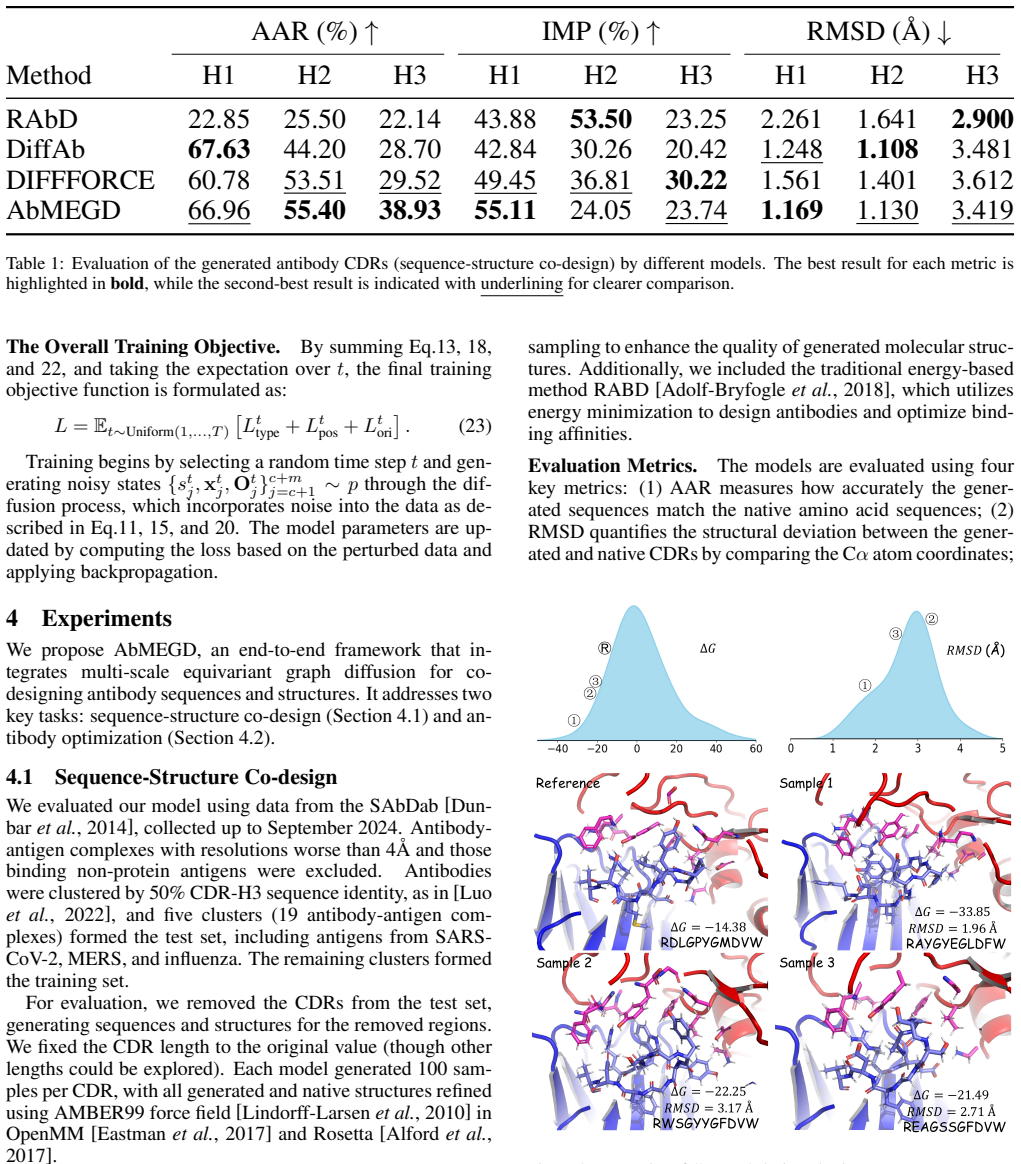
On its own terms, the paper claims that AbMEGD establishes a new benchmark for sequence-structure co-design and affinity optimization in antibodies. Compared with DiffAb on the 19-complex, five-cluster SAbDab test set, AbMEGD raises CDR-H3 amino acid recovery from 28.70% to 38.93%, raises the improvement percentage from 20.42% to 23.74%, and reduces CDR-H3 RMSD from 3.481 Å to 3.419 Å. It also reports the lowest RMSD among baselines for CDR-H1 and strong AAR for CDR-H2, while DIFFFORCE retains an edge in IMP for H2 and H3. As an optimizer, AbMEGD at four diffusion steps reaches the improvement-percentage level of de novo design while keeping RMSD near 1.28 Å, a better conservation-energy trade-off than DiffAb. The authors read these results as showing that multi-scale geometric modeling maintains structural fidelity while improving functional binding.
Load-bearing premise
The load-bearing assumption is that a five-cluster, 19-complex CDR-H3 test set is representative enough that the reported AAR, IMP, and RMSD differences are not sampling noise, and that Rosetta's computed interface $\Delta G$ is a valid stand-in for real binding affinity.
Editorial extensions
If this is right
- The CDR-H3 improvements translate into a 38.93% amino acid recovery and 3.419 Å RMSD on the test set, which is the paper's demonstration that sequence and structure can be improved together.
- Stopping the forward diffusion at t = 4 steps and then denoising yields optimized antibodies with an IMP score comparable to de novo design while staying structurally close to the original CDR, an operating point suited to affinity maturation.
- The model reports the lowest CDR-H1 RMSD (1.169 Å) and strong CDR-H2 AAR (55.40%) across compared methods, so the benefit is not restricted to the H3 loop.
- Because the test set includes SARS-CoV-2, MERS, and influenza antigens, the paper claims the framework generalizes to novel and out-of-distribution antigen interfaces.
Reading between the lines
- The reported gains rest on 19 test complexes; a meaningful next step is a larger non-redundant antigen panel with per-cluster bootstrap intervals to see whether the AAR gap over DiffAb is separable from sampling noise.
- The multi-scale residue-plus-atom design could transfer to other protein binder families, such as nanobodies or designed repeat proteins, where loop conformation controls target recognition.
- Rosetta InterfaceAnalyzer $\Delta G$ is a computational proxy; surface-plasmon-resonance or similar binding measurements on the optimized CDR-H3 designs would test whether the IMP gains reflect true affinity.
- Since generation fixes CDR length to the native value, coupling the framework with a length-prediction module is a natural extension that could increase design diversity.
Editorial analysis
A structured set of objections, weighed in public.
Referee Report
Summary. The paper proposes AbMEGD, a sequence-structure co-design model for antibody CDRs that combines residue-level features with atom-level equivariant graph representations (ViS-MP from ViSNet) and diffusion processes over amino acid types, Cα coordinates, and SO(3) orientations. The model is evaluated on SAbDab against DiffAb, DIFFFORCE, and RAbD on CDR-H1/H2/H3, with a focus on CDR-H3, where the authors claim a 10.13% AAR increase, 3.32% IMP increase, and 0.062 Å RMSD reduction relative to DiffAb. An additional antibody-optimization experiment shows improvements at intermediate diffusion steps. The methodology is a reasonable assembly of published components, but the empirical evidence supporting the headline claims is limited by the very small test set, missing statistical analysis, and an arithmetic inconsistency in the reported AAR improvement.
Significance. If the reported effects are real, AbMEGD would offer a modest, incremental improvement over DiffAb for CDR-H3 sequence-structure co-design, and the combination of atomic- and residue-level features in a diffusion framework is a plausible direction. The paper ships a public code repository, describes standard loss functions, and benchmarks against external baselines and Rosetta energy evaluation, which are strengths. However, the central quantitative claims are not yet established: the test set has only 19 complexes from five clusters, all headline numbers are aggregate means without error bars or significance tests, and the 'new benchmark' language is stronger than the table supports. The significance for the field is therefore conditional on a more rigorous evaluation.
major comments (4)
- [Abstract and Section 4.1, Table 1] The headline '10.13% increase in amino acid recovery' is arithmetically inconsistent with Table 1: 38.93 − 28.70 = 10.23 percentage points, not 10.13. In addition, the text describes these as 'percent' increases, but they are absolute percentage-point differences in AAR/IMP and an absolute RMSD difference in Å. This must be corrected and stated precisely, since the abstract's central claim is built on this number.
- [Section 4.1 (test set and Table 1)] The evaluation uses only 19 antibody-antigen complexes drawn from five CDR-H3 identity clusters, yet no per-complex results, standard deviations, confidence intervals, cluster-level statistics, or significance tests are reported. With an effective sample size of five clusters, the reported differences of 3.32 percentage points in IMP and 0.062 Å in RMSD are within plausible sampling noise; a single outlier cluster could shift these means substantially. The paper must provide cluster-level or per-complex breakdowns and some measure of uncertainty (e.g., bootstrap CIs or paired tests) before the claimed advantages over DiffAb can be accepted.
- [Section 4.1, Table 1, and Section 1] The abstract and introduction claim that AbMEGD 'establishes a new benchmark' and shows superior performance across tasks, but Table 1 shows DIFFFORCE has higher IMP on H2 (36.81 vs. 24.05) and H3 (30.22 vs. 23.74), and DiffAb has a better H2 IMP (30.26 vs. 24.05) and lower H2 RMSD (1.108 vs. 1.130). The model does not dominate the baselines on either the affinity proxy or structural accuracy. The claims should be narrowed to the specific metrics and CDR regions where AbMEGD actually wins, and the discussion should acknowledge the trade-offs visible in Table 1.
- [Section 3.3, Eqs. (19)-(20)] The SO(3) forward diffusion process appears to be defined circularly. Eq. (19) defines T_t^j = O_t^j · ScaleRot(sqrt(ᾱ_t^ori), O_0^j, 1−ᾱ_t^ori), and Eq. (20) then sets q(O_t^j | O_0^j) = IG_SO(3)(T_t^j). If O_t^j on the right-hand side of Eq. (19) is the random variable being sampled, then the mean of q depends on the sample itself, which is not a valid forward noising distribution. The standard construction would have T_t^j = ScaleRot(...), or otherwise the notation must be clarified. As written, this part of the methodology is not implementable as a diffusion forward process and needs correction.
minor comments (7)
- [Section 4.1, Evaluation Metrics] The text says the models are evaluated using 'four key metrics' but lists only three: AAR, RMSD, and IMP. Either a fourth metric is missing or the wording should be changed to 'three metrics.'
- [Section 3.3, Eq. (15)] In Eq. (15), the cumulative product is written as ᾱ^0_pos, but from the definitions it should be ᾱ^t_pos; the superscript appears to be a typo. The same notation should be checked for consistency in Eqs. (14)-(17).
- [Section 4.1, Baselines] The baseline is referred to as both 'RAbD' in Table 1 and 'RABD' in the baseline list in Section 4.1. Please standardize the capitalization and spell out the full model name consistently.
- [Section 4.1, Table 1] The paper does not report any variability across the 100 generated samples per CDR or across the 19 complexes. Reporting standard deviations or interquartile ranges alongside the means would greatly improve interpretability, especially given the small test set.
- [Section 4.2, Table 2] Table 2 reports optimization results at many different t values, but no statistical significance or error bars are given for the IMP, RMSD, or AAR differences between AbMEGD and DiffAb. Given the single-row-per-t design, the authors should at least state whether these are pooled estimates or averages over the test complexes.
- [Section 3.2, Eq. (9)] The equation for the IPA module is written as h_rj = IPA(e_ri, z_ri,rj, h_ai, v_ai), but the input indices mix residue-level and atom-level variables without explicitly describing how the atom features are pooled or mapped onto residues. Clarifying this integration would improve reproducibility.
- [Section 4.1] The description of the test set mentions antigens from SARS-CoV-2, MERS, and influenza, but does not report the composition of the five clusters or how many complexes belong to each cluster. This information is necessary to judge the representativeness of the evaluation.
Circularity Check
No significant circularity: the reported gains are benchmark measurements against external baselines and an external Rosetta energy function, with only tangential self-citations.
full rationale
The paper's derivation chain is an empirical pipeline: it defines a conditional generative model P(R|C), trains a neural network on SAbDab training clusters, and evaluates on a held-out five-cluster test set. None of the headline quantities (AAR, RMSD, IMP) is defined in terms of the model's own fitted parameters or its own outputs: AAR is sequence identity against native CDRs, RMSD is C-alpha deviation against native structures, and IMP is computed with Rosetta InterfaceAnalyzer, an external energy function. The model components in Eqs. (1)-(8) are cited from Luo et al. (2022) and Wang et al. (2024), but those citations supply building blocks rather than the benchmark result; the reported improvements over DiffAb, DIFFFORCE, and RAbD are measured, not derived from the equations alone. The only self-citations are [Li et al., 2024a,b] in the introduction, used as general context for out-of-distribution generalization; they are not load-bearing for the architecture, the training objective, or the evaluation. Concerns about the small 19-complex / five-cluster test set and the absence of error bars are statistical-correctness risks, not circularity. No step in the claimed derivation chain reduces to its own inputs.
Assumptions & free parameters
free parameters (5)
- diffusion noise schedules (beta_type, beta_pos, beta_ori)
- hidden dimension K
- number of ViS-MP blocks
- cutoff distance for atom neighbors
- loss weights =
equal weight 1
assumptions (3)
- domain assumption Isotropic Gaussian distribution on SO(3) (IG_SO(3)) is well-defined and can be parameterized by a mean rotation and scalar variance.
- domain assumption Rosetta InterfaceAnalyzer ΔG and AMBER99 refinement provide valid metrics for binding affinity and structural quality.
- domain assumption SAbDab clustering at 50% CDR-H3 identity yields a test set representative of novel antigen interfaces.
Cite this review
Pith. "Pith review of Antibody Design and Optimization with Multi-scale Equivariant Graph Diffusion Models for Accurate Complex Antigen Binding." pith.science (2026). https://pith.science/paper/UBRQPHAQ
@misc{pith2026250620957,
  author       = {Pith},
  title        = {Pith review of: Antibody Design and Optimization with Multi-scale Equivariant Graph Diffusion Models for Accurate Complex Antigen Binding},
  year         = {2026},
  howpublished = {\url{https://pith.science/paper/UBRQPHAQ}},
  note         = {Machine review of arXiv:2506.20957}
}
read the original abstract
Antibody design remains a critical challenge in therapeutic and diagnostic development, particularly for complex antigens with diverse binding interfaces. Current computational methods face two main limitations: (1) capturing geometric features while preserving symmetries, and (2) generalizing novel antigen interfaces. Despite recent advancements, these methods often fail to accurately capture molecular interactions and maintain structural integrity. To address these challenges, we propose \textbf{AbMEGD}, an end-to-end framework integrating \textbf{M}ulti-scale \textbf{E}quivariant \textbf{G}raph \textbf{D}iffusion for antibody sequence and structure co-design. Leveraging advanced geometric deep learning, AbMEGD combines atomic-level geometric features with residue-level embeddings, capturing local atomic details and global sequence-structure interactions. Its E(3)-equivariant diffusion method ensures geometric precision, computational efficiency, and robust generalizability for complex antigens. Furthermore, experiments using the SAbDab database demonstrate a 10.13\% increase in amino acid recovery, 3.32\% rise in improvement percentage, and a 0.062~\AA\ reduction in root mean square deviation within the critical CDR-H3 region compared to DiffAb, a leading antibody design model. These results highlight AbMEGD's ability to balance structural integrity with improved functionality, establishing a new benchmark for sequence-structure co-design and affinity optimization. The code is available at: https://github.com/Patrick221215/AbMEGD.
Figures


Figures from the paper (1 more)

Reference graph
Works this paper leans on
-
[1]
Rosettaantibodydesign (rabd): A general frame- work for computational antibody design
[Adolf-Bryfogle et al., 2018] Jared Adolf-Bryfogle, Oleks Kalyuzhniy, Michael Kubitz, Brian D Weitzner, Xiaozhen Hu, Yumiko Adachi, William R Schief, and Roland L Dun- brack Jr. Rosettaantibodydesign (rabd): A general frame- work for computational antibody design. PLoS computa- tional biology, 14(4):e1006112,
2018
-
[8]
Com- puting exponentials of skew-symmetric matrices and log- arithms of orthogonal matrices
[Gallier and Xu, 2003] Jean Gallier and Dianna Xu. Com- puting exponentials of skew-symmetric matrices and log- arithms of orthogonal matrices. International Journal of Robotics and Automation, 18(1):10–20,
2003
-
[12]
Iterative Refinement Graph Neural Network for Antibody Sequence-Structure Co-design
[Jin et al., 2021] Wengong Jin, Jeremy Wohlwend, Regina Barzilay, and Tommi Jaakkola. Iterative refinement graph neural network for antibody sequence-structure co-design. arXiv preprint arXiv:2110.04624,
work page Pith review arXiv 2021
-
[13]
Antibody design using deep learning: from sequence and structure design to affinity maturation
[Joubbi et al., 2024] Sara Joubbi, Alessio Micheli, Paolo Mi- lazzo, Giuseppe Maccari, Giorgio Ciano, Dario Carda- mone, and Duccio Medini. Antibody design using deep learning: from sequence and structure design to affinity maturation. Briefings in Bioinformatics , 25(4):bbae307,
work page 2024
-
[14]
Highly accu- rate protein structure prediction with alphafold
[Jumper et al., 2021] John Jumper, Richard Evans, Alexan- der Pritzel, Tim Green, Michael Figurnov, Olaf Ron- neberger, Kathryn Tunyasuvunakool, Russ Bates, Au- gustin ˇZ´ıdek, Anna Potapenko, et al. Highly accu- rate protein structure prediction with alphafold. nature, 596(7873):583–589,
work page 2021
-
[15]
Conditional antibody design as 3d equivariant graph translation
[Kong et al., 2022] Xiangzhe Kong, Wenbing Huang, and Yang Liu. Conditional antibody design as 3d equivariant graph translation. arXiv preprint arXiv:2208.06073,
arXiv 2022
-
[17]
Denois- ing diffusion probabilistic models on so (3) for rotational alignment
[Leach et al., 2022] Adam Leach, Sebastian M Schmon, Matteo T Degiacomi, and Chris G Willcocks. Denois- ing diffusion probabilistic models on so (3) for rotational alignment
work page 2022
-
[18]
Main Track. [Lin et al., 2024] Haitao Lin, Lirong Wu, Yufei Huang, Yun- fan Liu, Odin Zhang, Yuanqing Zhou, Rui Sun, and Stan Z. Li. GeoAB: Towards realistic antibody design and reliable affinity maturation. In Ruslan Salakhutdinov, Zico Kolter, Katherine Heller, Adrian Weller, Nuria Oliver, Jonathan Scarlett, and Felix Berkenkamp, editors, Proceedings of...
work page 2024
Show all 34 references
-
[19]
Improved side-chain torsion potentials for the amber ff99sb protein force field
[Lindorff-Larsen et al., 2010] Kresten Lindorff-Larsen, Ste- fano Piana, Kim Palmo, Paul Maragakis, John L Klepeis, Ron O Dror, and David E Shaw. Improved side-chain torsion potentials for the amber ff99sb protein force field. Proteins: Structure, Function, and Bioinformatics ...
2010
-
[21]
Abdiffuser: full-atom generation of in-vitro functioning antibodies
[Martinkus et al., 2024] Karolis Martinkus, Jan Ludwiczak, Wei-Ching Liang, Julien Lafrance-Vanasse, Isidro Hotzel, Arvind Rajpal, Yan Wu, Kyunghyun Cho, Richard Bon- neau, Vladimir Gligorijevic, et al. Abdiffuser: full-atom generation of in-vitro functioning antibodies. Advan...
2024
-
[22]
On the normal distribution in the orientation space
[Matthies et al., 1988] Siegfried Matthies, J Muller, and GW Vinel. On the normal distribution in the orientation space. Texture, Stress, and Microstructure, 10(1):77–96,
1988
-
[26]
Fast, accurate antibody structure prediction from deep learning on mas- sive set of natural antibodies
[Ruffolo et al., 2023] Jeffrey A Ruffolo, Lee-Shin Chu, Sai Pooja Mahajan, and Jeffrey J Gray. Fast, accurate antibody structure prediction from deep learning on mas- sive set of natural antibodies. Nature communications , 14(1):2389,
2023
-
[28]
Molecular geometric deep learning
[Shen et al., 2023] Cong Shen, Jiawei Luo, and Kelin Xia. Molecular geometric deep learning. Cell reports methods, 3(11),
2023
-
[29]
Protein design and variant prediction using au- toregressive generative models
[Shin et al., 2021] Jung-Eun Shin, Adam J Riesselman, Aaron W Kollasch, Conor McMahon, Elana Simon, Chris Sander, Aashish Manglik, Andrew C Kruse, and Debora S Marks. Protein design and variant prediction using au- toregressive generative models. Nature communications, 12(1):2403,
2021
-
[30]
Deep unsupervised learning using nonequilibrium thermody- namics
[Sohl-Dickstein et al., 2015] Jascha Sohl-Dickstein, Eric Weiss, Niru Maheswaranathan, and Surya Ganguli. Deep unsupervised learning using nonequilibrium thermody- namics. In International conference on machine learning, pages 2256–2265. PMLR,
2015
-
[32]
Torchmd-net: equivariant transformers for neural network based molecular potentials
[Th¨olke and De Fabritiis, 2022] Philipp Th ¨olke and Gianni De Fabritiis. Torchmd-net: equivariant transformers for neural network based molecular potentials. arXiv preprint arXiv:2202.02541,
2022 arXiv
-
[33]
Enhancing geometric representa- tions for molecules with equivariant vector-scalar interac- tive message passing
[Wang et al., 2024] Yusong Wang, Tong Wang, Shaoning Li, Xinheng He, Mingyu Li, Zun Wang, Nanning Zheng, Bin Shao, and Tie-Yan Liu. Enhancing geometric representa- tions for molecules with equivariant vector-scalar interac- tive message passing. Nature Communications, 15(1):313,
2024
-
[34]
Antibody design using a score-based diffusion model guided by evolutionary, physical and geometric constraints
[Zhu et al., 2024] Tian Zhu, Milong Ren, and Haicang Zhang. Antibody design using a score-based diffusion model guided by evolutionary, physical and geometric constraints. In Forty-first International Conference on Ma- chine Learning, 2024
2024
-
[1988]
Normal distribution on the rotation group so (3)
[Nikolayev and Savyolov, 1997] Dmitry I Nikolayev and Tatjana I Savyolov. Normal distribution on the rotation group so (3). Texture, Stress, and Microstructure, 29(3- 4):201–233,
1997
-
[1997]
A new clustering of antibody cdr loop conformations
[North et al., 2011] Benjamin North, Andreas Lehmann, and Roland L Dunbrack Jr. A new clustering of antibody cdr loop conformations. Journal of molecular biology , 406(2):228–256,
2011
-
[2003]
E (n) equivariant normalizing flows
[Garcia Satorras et al., 2021] Victor Garcia Satorras, Emiel Hoogeboom, Fabian Fuchs, Ingmar Posner, and Max Welling. E (n) equivariant normalizing flows. Advances in Neural Information Processing Systems, 34:4181–4192,
2021
-
[2006]
Sabdab: the structural antibody database
[Dunbar et al., 2014] James Dunbar, Konrad Krawczyk, Jin- woo Leem, Terry Baker, Angelika Fuchs, Guy Georges, Jiye Shi, and Charlotte M Deane. Sabdab: the structural antibody database. Nucleic acids research , 42(D1):D1140–D1146,
2014
-
[2010]
Antigen-specific antibody design and optimization with diffusion-based generative models for protein structures.Advances in Neu- ral Information Processing Systems, 35:9754–9767,
[Luo et al., 2022] Shitong Luo, Yufeng Su, Xingang Peng, Sheng Wang, Jian Peng, and Jianzhu Ma. Antigen-specific antibody design and optimization with diffusion-based generative models for protein structures.Advances in Neu- ral Information Processing Systems, 35:9754–9767,
2022
-
[2011]
Deciphering antibody affinity matura- tion with language models and weakly supervised learn- ing
[Ruffolo et al., 2021] Jeffrey A Ruffolo, Jeffrey J Gray, and Jeremias Sulam. Deciphering antibody affinity matura- tion with language models and weakly supervised learn- ing. arXiv preprint arXiv:2112.07782,
2021 arXiv
-
[2014]
Openmm 7: Rapid development of high performance algorithms for molecular dynamics
[Eastman et al., 2017] Peter Eastman, Jason Swails, John D Chodera, Robert T McGibbon, Yutong Zhao, Kyle A Beauchamp, Lee-Ping Wang, Andrew C Simmonett, Matthew P Harrigan, Chaya D Stern, et al. Openmm 7: Rapid development of high performance algorithms for molecular dynamics....
2017
-
[2015]
Generative modeling by estimating gradients of the data distribution
[Song and Ermon, 2019] Yang Song and Stefano Ermon. Generative modeling by estimating gradients of the data distribution. Advances in neural information processing systems, 32,
2019
-
[2017]
Unified rational protein engineering with sequence-based deep representation learning
[Alley et al., 2019] Ethan C Alley, Grigory Khimulya, Suro- jit Biswas, Mohammed AlQuraishi, and George M Church. Unified rational protein engineering with sequence-based deep representation learning. Nature methods, 16(12):1315–1322,
2019
-
[2018]
The rosetta all-atom energy function for macromolecular mod- eling and design
[Alford et al., 2017] Rebecca F Alford, Andrew Leaver-Fay, Jeliazko R Jeliazkov, Matthew J O’Meara, Frank P Di- Maio, Hahnbeom Park, Maxim V Shapovalov, P Douglas Renfrew, Vikram K Mulligan, Kalli Kappel, et al. The rosetta all-atom energy function for macromolecular mod- elin...
2017
-
[2019]
Pretrainable geometric graph neural network for antibody affinity maturation
[Cai et al., 2024] Huiyu Cai, Zuobai Zhang, Mingkai Wang, Bozitao Zhong, Quanxiao Li, Yuxuan Zhong, Yanling Wu, Tianlei Ying, and Jian Tang. Pretrainable geometric graph neural network for antibody affinity maturation. Nature communications, 15(1):7785,
2024
-
[2020]
Argmax flows and multinomial diffusion: Learning categorical distributions
[Hoogeboom et al., 2021] Emiel Hoogeboom, Didrik Nielsen, Priyank Jaini, Patrick Forr ´e, and Max Welling. Argmax flows and multinomial diffusion: Learning categorical distributions. Advances in Neural Information Processing Systems, 34:12454–12465,
2021
-
[2021]
Denoising diffusion probabilistic models
[Ho et al., 2020] Jonathan Ho, Ajay Jain, and Pieter Abbeel. Denoising diffusion probabilistic models. Advances in neural information processing systems , 33:6840–6851,
2020
-
[2022]
Improving antibody design with force-guided sampling in diffusion models
[Kulyt˙e et al., 2024] Paulina Kulyt ˙e, Francisco Vargas, Si- mon Valentin Mathis, Yu Guang Wang, Jos ´e Miguel Hern´andez-Lobato, and Pietro Li `o. Improving antibody design with force-guided sampling in diffusion models. arXiv preprint arXiv:2406.05832,
2024 arXiv
-
[2023]
Equivariant message passing for the prediction of tensorial properties and molecular spectra
[Sch¨utt et al., 2021] Kristof Sch ¨utt, Oliver Unke, and Michael Gastegger. Equivariant message passing for the prediction of tensorial properties and molecular spectra. In International Conference on Machine Learning , pages 9377–9388. PMLR,
2021
-
[2024]
Potent antibody therapeutics by design
[Carter, 2006] Paul J Carter. Potent antibody therapeutics by design. Nature reviews immunology, 6(5):343–357,
2006
Reviewed August 6, 2026 · model on record in the stance chip above.
Discussion (0). Continue with ORCID to comment.