REVIEW 4 major objections 5 minor 1 cited by
Explainable AI Systems Must Be Contestable: Here's How to Make It Happen
T0 review · 4 major / 5 minor · reviewed 2026-08-07 · deepseek-v4-flash
Pith's one-line read This paper argues that contestability—the ability of affected people to challenge, review, and change AI decisions—can be defined formally and measured with a single score from 0 to 1.
desk verdict Useful taxonomy and a real gap, but the formal definition is ill-typed and the CAS arithmetic does not reproduce, so the quantitative claims collapse as printed. read the letter →
The pith
A machine-rendered reading of the paper's core claim, the machinery that carries it, and where it could break.
The reading
What carries the argument
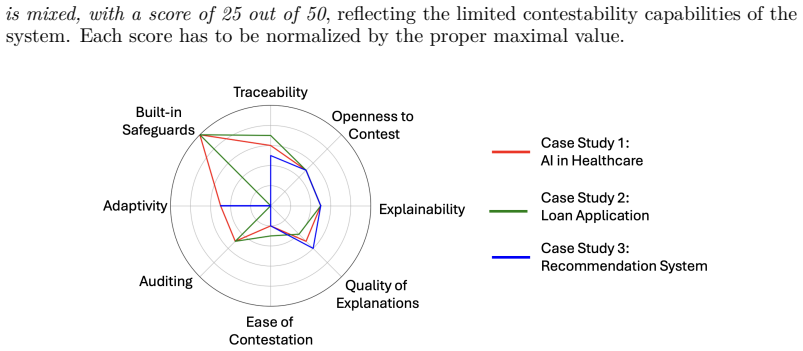
The central object is the Contestability Assessment Score (CAS), a composite metric defined by $CAS = \sum_{p=1}^{8} \lambda_p s_p n_p$, with weights $\lambda_p$ summing to one, raw scores $s_p$, and normalization term $n_p = 1/s_p^{\max}$. It merges eight self-assessed properties: explainability, openness to contestation, traceability, built-in safeguards, adaptivity, auditing, ease of contestation, and explanation quality. The score is the quantitative engine of the paper: case-study recommendations are validated by recomputing it after simulated changes, so all improvement claims in the paper travel through this formula.
What would settle it
Take any deployed AI system whose actual appeal outcomes are logged, have independent assessors score it with the CAS questionnaire, and compare the scores with the measured fraction of contests that change a decision. If the CAS order across systems fails to match the observed reversal rates, or if two assessors give the same system very different scores, the claim that CAS quantifies contestability is falsified.
Extended reading notes
Core claim
The core claim is that contestability holds at two levels: explanation-level contestability, where every stakeholder with given capabilities can turn an explanation of a decision into a contestation action, and system-level contestability, where some action can either correct the decision or adapt the system. The paper formalizes these with $Contest_{XLC}(E)$ and $Contest_{SLC}(A)$ and combines them with a success-rate term into an aggregate $Contest(A) = \alpha\,Contest_{XLC}(E) + \beta\,Contest_{SLC}(A) + \gamma\min_s SR(A,s)$. To operationalize this, it introduces the CAS, a linear weighted average of eight properties - explainability, openness to contestation, traceability, built-in safeguards, adaptivity, auditing, ease of contestation, and explanation quality - with explainability carrying weight 0.30 and the remaining weights descending from 0.12 to 0.07. The case studies assign scores of 0.551, 0.44, and 0.32 to the three example systems and show how feasible interventions would raise them, in the high-risk radiology case from 0.551 to 0.622 or 0.927 depending on scope.
Load-bearing premise
The load-bearing premise is that contestability can be adequately captured by eight self-assessed property scores whose fixed weights, chosen by the authors, can be added up into one meaningful number.
Editorial extensions
If this is right
- If CAS measures what it claims, contestability becomes an auditable quantity that can be compared across systems and tracked over the AI lifecycle.
- The taxonomy and criterion clusters give designers a concrete checklist for building contestation mechanisms before deployment, not only retrofitting appeals after harm.
- The case-study method shows that feasible, low-cost changes can lift a high-risk system's score substantially, making regulatory compliance look like targeted engineering rather than an open-ended obligation.
- The distinction between by-design and post-hoc contestability clarifies that black-box systems are not automatically non-contestable; approximate explanations, audits, and appeals can carry contestability.
- A formal definition separating contestability from explainability and recourse gives researchers a shared target for further work.
Reading between the lines
- A testable extension is to validate CAS against observed contestation success rates, for example by measuring whether a system scored 0.9 actually reverses appeals more often than one scored 0.3; the paper does not report such validation.
- Because the weights are selected to respect a priority ordering rather than derived from data, a natural next step is to estimate weights from stakeholder surveys or from appeal-outcome statistics, which would turn the score into an empirical instrument.
- The context constraints the paper lists (latency, opacity, capability disparities, adaptivity) could be recast as explicit adjustment terms in the CAS formula, so that a system in a high-latency domain is compared against its feasible contestability ceiling rather than an absolute ideal.
Editorial analysis
A structured set of objections, weighed in public.
Referee Report
Summary. The paper proposes to operationalize contestability in explainable AI by providing a formal definition, a taxonomy of contestability criteria, a design framework of by-design and post-hoc mechanisms, and a composite metric called the Contestability Assessment Score (CAS). The CAS aggregates eight self-assessed properties with hand-selected weights to produce a 0–1 score, and three case studies (radiology, credit scoring, news recommendation) are used to demonstrate how the score diagnoses shortcomings and quantifies targeted improvements. The paper claims to be the first to give a rigorous formal definition of contestability aligned with regulatory mandates.
Significance. If the framework and metric were sound, the paper would make a useful contribution by turning an abstract regulatory requirement into a structured checklist and a quantitative score that practitioners could use for benchmarking and gap analysis. The qualitative taxonomy and the mapping of contestability to human-centered, technical, legal, and organizational dimensions are sensible and reflect a reasonable synthesis of the literature. However, the paper's central quantitative and formal claims are currently not supported: the formal definition in Section 3.2 is not well-formed, the case-study CAS totals do not follow from the stated formula, and the self-assessment design makes the reported improvements partly guaranteed by construction. These issues are load-bearing because the paper's headline contributions are the formal definition and the quantitative evaluation.
major comments (4)
- [Section 3.2 (Aggregate Contestability)] The formal definition is not well-formed. ContestXLC(E) and ContestSLC(A) are introduced via biconditionals as truth-valued predicates, yet in the equation for Contest(A) they appear as additive scalar terms multiplied by coefficients α and β. Additionally, the predicate φ(c,d,A) and the contestation success rate SR(A,s) are never defined. To make the formalism coherent, the authors should either define real-valued measures of explanation-level and system-level contestability or explicitly convert the predicates to indicator functions, and they must define φ and SR with clear domains and interpretation.
- [Section 6 and Appendix E (Tables 1, 3, 4)] The reported CAS totals are inconsistent with the paper's own formula CAS = Σ λp · sp · np. Using the stated weights (0.30, 0.12, 0.12, 0.12, 0.10, 0.10, 0.07, 0.07) and maxima (2, 2, 10, 1, 2, 2, 10, 50), the scores printed in Table 3 yield system/HF/MF totals of 0.513, 0.801, and 0.960, not the reported 0.44, 0.62, and 0.85. Table 4 yields 0.376, 0.540, and 0.872, not 0.32, 0.44, and 0.60. In Table 1, the MF column for Openness to Contestation lists a raw score of 1 and a CAS contribution of 0.120, but the formula gives 0.12 × 1/2 = 0.060. Because Finding 3 and the case-study improvement claims are based on these totals, the quantitative evidence is invalid as printed and must be recomputed.
- [Section 8 and Appendix D (Self-assessment circularity)] The CAS is a self-assessment instrument, and the post-improvement scores are generated by the same authors who selected the property scores and the recommendations. Since the recommendations are explicitly designed to increase the eight property scores, any intervention that raises a property from 0 to 1 mechanically raises the composite score. The paper does not provide inter-rater reliability, external outcome validation, or any comparison against an independent measure of contestability. The Section 8 limitation that the framework 'relies on subjective assessments' does not address this constructional circularity, so the claim that the case studies demonstrate 'targeted improvements' is not supported.
- [Appendix A, Table 2 (PRISMA counts)] The systematic-review flow counts are internally inconsistent. The table reports 75 unique records after duplicate removal and 60 papers after title/abstract screening, yet the final synthesis row states 92 included papers. The Arxiv row lists 0 initial records but 23 final inclusions, which is not possible under the reported flow from 0 to 60 to 92. These inconsistencies undermine the claim that the review followed PRISMA and need to be corrected or explained.
minor comments (5)
- [Abstract and Section 1] The claim of presenting 'the first rigorous formal definition' is overstated given the formal issues in Section 3.2; the wording should be softened until the formalism is repaired.
- [Section 3.4] The notation Θ = {τ, Ω, Δ, Γ, ...} is informal; the set elements are not fully defined and the ellipsis makes the definition ambiguous.
- [Section 5] The sentence 'Let P = 8 be the number of AI system's properties ... and let sp∈S p be the raw score' is garbled; it should be 'let s_p ∈ S_p' with proper subscripting, and S_p should be defined as the set of possible raw scores for property p.
- [Appendix D.1 (Explainability)] The questionnaire lists 'Approximated Explanations (1 pt)' and 'Post-Hoc Explanations (1 pt)' as distinct options, but Section 5 only describes post-hoc explanations at level 1; the relationship between these two levels should be clarified.
- [Tables 1, 3, 4] The column headers in Tables 1, 3, and 4 are ambiguous (e.g., 'Score CAS System ScoreHF CAS HF'); they should be restructured so that each scenario's raw score and weighted contribution are clearly separated.
Circularity Check
Case-study CAS improvements are largely by construction: recommendations raise the same eight self-assessed properties that define the score, and the reported totals do not even reproduce from the stated formula.
-
fitted input called prediction
[Section 6.1 (Case Study 1) and Table 1; similar before/after tables in Appendix E]
"The revised CAS for the updated system would be: 0.622 (if only highly feasible changes are implemented), 0.927 (if only the moderately feasible recommendations are implemented)."
The recommendations are scored by increasing exactly the eight sp properties in CAS = Σ λp·sp·np (Section 5, Appendix D.4). For instance, Table 1 raises Explainability from 1 to 2 and Openness to Contestation from 1 to 2; each increment directly adds λp·Δsp inside the same weighted sum. The claimed 'targeted improvements' are therefore a mechanical result of substituting the chosen higher self-assessment scores into the metric that the recommendations were designed to raise. No external outcome, independent audit result, or user-behavior benchmark is used to verify that contestability actually improved. The case-study demonstration is a self-evaluation tautology rather than an empirical prediction.
full rationale
The paper's conceptual contribution—the multidimensional definition, taxonomy, and by-design/post-hoc distinction—has independent content and does not reduce to its inputs. No load-bearing self-citation chain is present; the author citation [29] is incidental. However, the quantitative contribution (Finding 3) is partly circular: the CAS is defined as the weighted sum of exactly the eight properties that the recommendations modify, so before/after case-study comparisons improve by construction. The weights are hand-selected with no external validation ('among the acceptable configurations, the following set of weights was selected'), and the paper admits in Section 8 that the CAS 'relies on subjective assessments.' Additionally, the case-study arithmetic is internally inconsistent: using the stated formula and printed scores, Table 3 sums to approximately 0.513/0.801/0.960 rather than the reported 0.44/0.62/0.85, and Table 4 sums to 0.376/0.540/0.872 rather than 0.32/0.44/0.60; Table 1's MF Openness row is also mis-normalized, listing 0.120 for a score of 1 out of 2 with weight 0.12. This inconsistency invalidates the printed totals, though it is an arithmetic defect rather than a circularity. On balance, the core definitional work is not circular, but the case-study 'predictions' reduce largely to construction, warranting a moderate circularity score of 5.
Assumptions & free parameters
free parameters (3)
- Lambda weights lambda_1..lambda_8 =
0.30, 0.12 x3, 0.10 x2, 0.07 x2
- Alpha, beta, gamma in aggregate Contest(A)
- Case-study property scores =
Hand-assigned values, e.g., 1,1,6,1,1,1,2,25 for the radiology system
assumptions (3)
- ad hoc to paper The eight self-assessed properties are jointly sufficient to measure contestability.
- domain assumption The four dimensions (human, technical, legal, organizational) are orthogonal and their criteria non-overlapping.
- ad hoc to paper A weighted average of normalized property scores is an interval-level measure of contestability.
invented entities (3)
-
Contestation success rate SR(A,s)
-
Successful contestation predicate phi(c,d,A)
-
Contestability Assessment Score as a validated 0-1 scale
Cite this review
Pith. "Pith review of Explainable AI Systems Must Be Contestable: Here's How to Make It Happen." pith.science (2026). https://pith.science/paper/UCDR66OJ
@misc{pith2026250601662,
  author       = {Pith},
  title        = {Pith review of: Explainable AI Systems Must Be Contestable: Here's How to Make It Happen},
  year         = {2026},
  howpublished = {\url{https://pith.science/paper/UCDR66OJ}},
  note         = {Machine review of arXiv:2506.01662}
}
read the original abstract
As AI regulations around the world intensify their focus on system safety, contestability has become a mandatory, yet ill-defined, safeguard. In XAI, "contestability" remains an empty promise: no formal definition exists, no algorithm guarantees it, and practitioners lack concrete guidance to satisfy regulatory requirements. Grounded in a systematic literature review, this paper presents the first rigorous formal definition of contestability in explainable AI, directly aligned with stakeholder requirements and regulatory mandates. We introduce a modular framework of by-design and post-hoc mechanisms spanning human-centered interfaces, technical architectures, legal processes, and organizational workflows. To operationalize our framework, we propose the Contestability Assessment Scale, a composite metric built on more than twenty quantitative criteria. Through multiple case studies across diverse application domains, we reveal where state-of-the-art systems fall short and show how our framework drives targeted improvements. By converting contestability from regulatory theory into a practical framework, our work equips practitioners with the tools to embed genuine recourse and accountability into AI systems.
Figures

Forward citations
Cited by 1 Pith paper
-
ConGaIT: A Clinician-Centered Dashboard for Contestable AI in Parkinson's Disease Care
The paper presents ConGaIT, a dashboard embedding contestable AI mechanisms for PD gait analysis, and reports a high contestability score based on an unvalidated proxy evaluation.
Reference graph
Works this paper leans on
-
[1]
Sarath Sreedharan, Utkarsh Soni, Mudit Verma, Siddharth Srivastava, and Subbarao Kambhampati. Bridging the gap: Providing post-hoc symbolic explanations for se- quential decision-making problems with inscrutable representations.arXiv preprint arXiv:2002.01080, 2020
arXiv 2002
-
[2]
Ai, global governance, and digital sovereignty
Swati Srivastava and Justin Bullock. Ai, global governance, and digital sovereignty. arXiv preprint arXiv:2410.17481, 2024
arXiv 2024
-
[3]
Federico Marengo et al. The challenges of the general data protection regulation to protect data subjects against the adverse effects of artificial intelligence. 2023
work page 2023
-
[4]
Kars Alfrink, Ianus Keller, Neelke Doorn, and Gerd Kortuem. Contestable camera cars: a speculative design exploration of public ai that is open and responsive to dispute. In Proceedings of the 2023 CHI conference on human factors in computing systems, pages 1–16, 2023
work page 2023
-
[5]
The european union ai act.Bruselj: Brookings Institution, 2022
Josh Meltzer and Aaron Tielemans. The european union ai act.Bruselj: Brookings Institution, 2022
work page 2022
-
[6]
Henrietta Lyons, Eduardo Velloso, and Tim Miller. Conceptualising contestability: Perspectives on contesting algorithmic decisions.Proceedings of the ACM on Human- Computer Interaction, 5(CSCW1):1–25, 2021
work page 2021
-
[7]
Artificial intelligence and the value of transparency.AI & society, 36(2): 585–595, 2021
Joel Walmsley. Artificial intelligence and the value of transparency.AI & society, 36(2): 585–595, 2021
work page 2021
-
[8]
Contestable ai by design: Towards a framework.Minds and Machines, 33(4):613–639, 2023
Kars Alfrink, Ianus Keller, Gerd Kortuem, and Neelke Doorn. Contestable ai by design: Towards a framework.Minds and Machines, 33(4):613–639, 2023
work page 2023
Show all 59 references
-
[9]
Making algorithms public: Reimagining auditing from matters of fact to matters of concern
R Stuart Geiger, Udayan Tandon, Anoolia Gakhokidze, Lian Song, and Lilly Irani. Making algorithms public: Reimagining auditing from matters of fact to matters of concern. 2024
2024
-
[10]
Antonio Aloisi. Regulating algorithmic management at work in the european union: Data protection, non-discrimination and collective rights.International Journal of Comparative Labour Law and Industrial Relations, 40(1), 2024
2024
-
[11]
Misfitting with ai: How blind people verify and contest ai errors
Rahaf Alharbi, Pa Lor, Jaylin Herskovitz, Sarita Schoenebeck, and Robin N Brewer. Misfitting with ai: How blind people verify and contest ai errors. InProceedings of the 26th International ACM SIGACCESS Conference on Computers and Accessibility, pages 1–17, 2024
2024
-
[12]
Argumentative large language models for explainable and contestable claim verification
Gabriel Freedman, Adam Dejl, Deniz Gorur, Xiang Yin, Antonio Rago, and Francesca Toni. Argumentative large language models for explainable and contestable claim verification. InProceedings of the AAAI Conference on Artificial Intelligence, volume 39, pages 14930–14939, 2025
2025
-
[13]
Winston Maxwell and Bruno Dumas. Meaningful xai based on user-centric design methodology: Combining legal and human-computer interaction (hci) approaches to achieve meaningful algorithmic explainability.Available at SSRN 4520754, 2023
2023
-
[14]
Human intervention in automated decision-making: Toward the construc- tion of contestable systems
Marco Almada. Human intervention in automated decision-making: Toward the construc- tion of contestable systems. InProceedings of the Seventeenth International Conference on artificial intelligence and law, pages 2–11, 2019
2019
-
[15]
Qualification and quantification in machine learning
Mireille Hildebrandt. Qualification and quantification in machine learning. from expla- nation to explication. 2022
2022
-
[16]
Enhancing human agency through redress in artificial intelligence systems.AI & society, 38(2): 537–547, 2023
Rosanna Fanni, Valerie Eveline Steinkogler, Giulia Zampedri, and Jo Pierson. Enhancing human agency through redress in artificial intelligence systems.AI & society, 38(2): 537–547, 2023. 11
2023
-
[17]
Isil Guzey, Ozlem Ucar, Nukhet Aladag Ciftdemir, and Betul Acunas. Context-dependent explainability and contestability for trustworthy medical artificial intelligence: Misclassi- fication identification of morbidity recognition models in preterm infants.arXiv preprint arXiv:22...
2022 arXiv
-
[18]
Public value principles for secure and trusted ai
Sukumar Ganapati and Kevin Desouza. Public value principles for secure and trusted ai. InProceedings of the 25th Annual International Conference on Digital Government Research, pages 251–257, 2024
2024
-
[19]
Towards substantive conceptions of algorithmic fairness: Normative guidance from equal opportunity doctrines
Falaah Arif Khan, Eleni Manis, and Julia Stoyanovich. Towards substantive conceptions of algorithmic fairness: Normative guidance from equal opportunity doctrines. InPro- ceedings of the 2nd ACM Conference on Equity and Access in Algorithms, Mechanisms, and Optimization, pages...
2022
-
[20]
A risk-based approach to assessing liability risk for ai-driven harms considering eu liability directive.arXiv preprint arXiv:2401.11697, 2023
Sundaraparipurnan Narayanan and Mark Potkewitz. A risk-based approach to assessing liability risk for ai-driven harms considering eu liability directive.arXiv preprint arXiv:2401.11697, 2023
2023 arXiv
-
[21]
Hard choices in artificial intelligence.Artificial Intelligence, 300:103555, 2021
Roel Dobbe, Thomas Krendl Gilbert, and Yonatan Mintz. Hard choices in artificial intelligence.Artificial Intelligence, 300:103555, 2021
2021
-
[22]
Shaping our tools: Contestability as a means to promote responsible algorithmic decision making in the professions.Available at SSRN 3311894, 2019
Deirdre K Mulligan, Daniel Kluttz, and Nitin Kohli. Shaping our tools: Contestability as a means to promote responsible algorithmic decision making in the professions.Available at SSRN 3311894, 2019
2019
-
[23]
Designing contestability: Interaction design, machine learning, and mental health
Tad Hirsch, Kritzia Merced, Shrikanth Narayanan, Zac E Imel, and David C Atkins. Designing contestability: Interaction design, machine learning, and mental health. In Proceedings of the 2017 Conference on Designing Interactive Systems, pages 95–99, 2017
2017
-
[24]
Binary governance: Lessons from the gdpr’s approach to algorithmic accountability.S
Margot E Kaminski. Binary governance: Lessons from the gdpr’s approach to algorithmic accountability.S. Cal. L. Rev., 92:1529, 2018
2018
-
[25]
Con- testable black boxes
Andrea Aler Tubella, Andreas Theodorou, Virginia Dignum, and Loizos Michael. Con- testable black boxes. InRules and Reasoning: 4th International Joint Conference, RuleML+ RR 2020, Oslo, Norway, June 29–July 1, 2020, Proceedings 4, pages 159–167. Springer, 2020
2020
-
[26]
Contestable ai needs computational argumentation.arXiv preprint arXiv:2405.10729, 2024
Francesco Leofante, Hamed Ayoobi, Adam Dejl, Gabriel Freedman, Deniz Gorur, Junqi Jiang, Guilherme Paulino-Passos, Antonio Rago, Anna Rapberger, Fabrizio Russo, et al. Contestable ai needs computational argumentation.arXiv preprint arXiv:2405.10729, 2024
2024 arXiv
-
[27]
From explainable to interactive ai: A literature review on current trends in human-ai interaction.International Journal of Human-Computer Studies, page 103301, 2024
Muhammad Raees, Inge Meijerink, Ioanna Lykourentzou, Vassilis-Javed Khan, and Konstantinos Papangelis. From explainable to interactive ai: A literature review on current trends in human-ai interaction.International Journal of Human-Computer Studies, page 103301, 2024
2024
-
[28]
Generating process-centric ex- planations to enable contestability in algorithmic decision-making: Challenges and opportunities.arXiv preprint arXiv:2305.00739, 2023
Mireia Yurrita, Agathe Balayn, and Ujwal Gadiraju. Generating process-centric ex- planations to enable contestability in algorithmic decision-making: Challenges and opportunities.arXiv preprint arXiv:2305.00739, 2023
2023 arXiv
-
[29]
Intelligent systems in healthcare: A systematic survey of explainable user interfaces.Computers in Biology and Medicine, 180:108908, 2024
João Cálem, Catarina Moreira, and Joaquim Jorge. Intelligent systems in healthcare: A systematic survey of explainable user interfaces.Computers in Biology and Medicine, 180:108908, 2024
2024
-
[30]
Litigating algorithms: Challenging government use of algorithmic decision systems.AI Now Institute, 2018
AI Now. Litigating algorithms: Challenging government use of algorithmic decision systems.AI Now Institute, 2018
2018
-
[31]
Litigatingalgorithms: 2019 us report.AI Now Institute, 2019
RashidaRichardson, JasonMSchultz, andVincentMSoutherland. Litigatingalgorithms: 2019 us report.AI Now Institute, 2019
2019
-
[32]
Understanding contestability on the margins: Implications for the design of algorithmic decision-making in public services
Naveena Karusala, Sohini Upadhyay, Rajesh Veeraraghavan, and Krzysztof Z Gajos. Understanding contestability on the margins: Implications for the design of algorithmic decision-making in public services. InProceedings of the 2024 CHI Conference on Human Factors in Computing Sy...
2024
-
[33]
Legal and human rights issues of ai: Gaps, challenges and vulnera- bilities.Journal of Responsible Technology, 4:100005, 2020
Rowena Rodrigues. Legal and human rights issues of ai: Gaps, challenges and vulnera- bilities.Journal of Responsible Technology, 4:100005, 2020
2020
-
[34]
Virginia Eubanks.Automating inequality: How high-tech tools profile, police, and punish the poor. St. Martin’s Press, 2018
2018
-
[35]
Assessing risk, automating racism.Science, 366(6464):421–422, 2019
Ruha Benjamin. Assessing risk, automating racism.Science, 366(6464):421–422, 2019
2019
-
[36]
The frontiers of fairness in machine learning
Alexandra Chouldechova and Aaron Roth. The frontiers of fairness in machine learning. arXiv preprint arXiv:1810.08810, 2018
2018 arXiv
-
[37]
Censored, suspended, shadowbanned: User interpretations of content moderation on social media platforms.New Media & Society, 20(11):4366–4383, 2018
Sarah Myers West. Censored, suspended, shadowbanned: User interpretations of content moderation on social media platforms.New Media & Society, 20(11):4366–4383, 2018
2018
-
[38]
Algorithmic content modera- tion: Technical and political challenges in the automation of platform governance.Big Data & Society, 7(1):2053951719897945, 2020
Robert Gorwa, Reuben Binns, and Christian Katzenbach. Algorithmic content modera- tion: Technical and political challenges in the automation of platform governance.Big Data & Society, 7(1):2053951719897945, 2020
2020
-
[39]
The right not to be subject to automated decisions based on profiling.EU internet law: Regulation and enforcement, pages 77–98, 2017
Isak Mendoza and Lee A Bygrave. The right not to be subject to automated decisions based on profiling.EU internet law: Regulation and enforcement, pages 77–98, 2017
2017
-
[40]
Empowering individuals in automated decision-making: Explainability, con- testability and beyond
Yulu Pi. Empowering individuals in automated decision-making: Explainability, con- testability and beyond. InCompanion Publication of the 2024 Conference on Computer- Supported Cooperative Work and Social Computing, pages 1–4, 2024
2024
-
[41]
Towards implementing responsible ai
Conrad Sanderson, Qinghua Lu, David Douglas, Xiwei Xu, Liming Zhu, and Jon Whittle. Towards implementing responsible ai. In2022 IEEE International Conference on Big Data (Big Data), pages 5076–5081. IEEE, 2022
2022
-
[42]
Actionable recourse in linear classifi- cation
Berk Ustun, Alexander Spangher, and Yang Liu. Actionable recourse in linear classifi- cation. InProceedings of the conference on fairness, accountability, and transparency, pages 10–19, 2019
2019
-
[43]
The philosophical basis of algorith- mic recourse
Suresh Venkatasubramanian and Mark Alfano. The philosophical basis of algorith- mic recourse. InProceedings of the 2020 conference on fairness, accountability, and transparency, pages 284–293, 2020
2020
-
[44]
Interpretable to whom? a role-based model for analyzing interpretable machine learning systems.arXiv preprint arXiv:1806.07552, 2018
Richard Tomsett, Dave Braines, Dan Harborne, Alun Preece, and Supriyo Chakraborty. Interpretable to whom? a role-based model for analyzing interpretable machine learning systems.arXiv preprint arXiv:1806.07552, 2018
2018 arXiv
-
[45]
The prisma 2020 statement: an updated guideline for reporting systematic reviews.bmj, 372, 2021
Matthew J Page, Joanne E McKenzie, Patrick M Bossuyt, Isabelle Boutron, Tammy C Hoffmann, Cynthia D Mulrow, Larissa Shamseer, Jennifer M Tetzlaff, Elie A Akl, Sue E Brennan, et al. The prisma 2020 statement: an updated guideline for reporting systematic reviews.bmj, 372, 2021
2020
-
[46]
Retrieval-augmented generation for knowledge-intensive nlp tasks
Patrick Lewis, Ethan Perez, Aleksandra Piktus, Fabio Petroni, Vladimir Karpukhin, Naman Goyal, Heinrich Küttler, Mike Lewis, Wen-tau Yih, Tim Rocktäschel, Sebastian Riedel, and Douwe Kiela. Retrieval-augmented generation for knowledge-intensive nlp tasks. In H. Larochelle, M. ...
2020
-
[47]
Measuring the quality of explanations: the system causability scale (scs) comparing human and machine explanations.KI-Künstliche Intelligenz, 34(2):193–198, 2020
Andreas Holzinger, André Carrington, and Heimo Müller. Measuring the quality of explanations: the system causability scale (scs) comparing human and machine explanations.KI-Künstliche Intelligenz, 34(2):193–198, 2020
2020
-
[48]
Adopted 13 June 2024
Regulation (eu) 2024/1689 of the european parliament and of the council of 13 june 2024 laying down harmonised rules on artificial intelligence (artificial intelligence act). Adopted 13 June 2024
2024
-
[49]
Artificial Intelligence
Thomas B Sheridan.Telerobotics, automation, and human supervisory control. MIT press, 1992. 13 A Semi-Automated Systematic Literature Review To ensure a comprehensive and unbiased synthesis of the literature on contestability in XAI, we followed the PRISMA methodology [45]. Ou...
1992
-
[50]
I found that the data included all relevant known causal factors with sufficient precision and granularity
-
[51]
I understood the explanations within the context of my work
-
[52]
I could change the level of detail on demand
-
[53]
I did not need support to understand the explanations
-
[54]
I found the explanations helped me to understand causality
-
[55]
I was able to use the explanations with my knowledge base
-
[56]
I did not find inconsistencies between explanations
-
[57]
I think that most people would learn to understand the explanations very quickly
-
[58]
I did not need more references in the explanations; e.g., medical guidelines, regulations
-
[59]
insufficient credit history
I received the explanations in a timely and efficient manner. D.2 Stakeholder Impact Severity We adopt a risk-based classification of stakeholder impact from the European Union AI Act [48]. Select the risk category level that most accurately reflects your AI system. For furthe...
Reviewed August 7, 2026 · model on record in the stance chip above.
Discussion (0). Sign in to comment.