REVIEW 3 major objections 7 minor 85 references
Topological states and flat bands in exactly solvable decorated Cayley trees
T0 review · 3 major / 7 minor · reviewed 2026-08-03 · deepseek-v4-flash
Pith's one-line read This paper establishes an exact correspondence between a Lieb-decorated Cayley tree and an ensemble of Su-Schrieffer-Heeger chains, showing that the tree's flat band is a set of topologically protected edge states localized in the bulk.
desk verdict Finite-tree exact results and the SSH mapping are solid and worth citing; the infinite-tree flat-band claim overreaches because the lifted states are not square-integrable. read the letter →
The pith
A machine-rendered reading of the paper's core claim, the machinery that carries it, and where it could break.
The reading
What carries the argument
The key machinery is the symmetry-adapted basis for Cayley trees: states are built by symmetrizing or weighing with roots of unity over all sites within a shell or within the sub-branches of a seed node, which block-diagonalizes the tight-binding Hamiltonian into one-dimensional sectors whose length scales logarithmically with tree size. Each sector Hamiltonian for the Lieb decoration is a Su-Schrieffer-Heeger chain with hopping amplitudes 1 and √K, so the SSH topological index governs the flat band. Completing the picture are the rank-nullity theorem, which fixes the zero-energy degeneracy from sublattice imbalance, and the covering-graph argument, which lifts Euclidean compact localized st
What would settle it
Construct the universal-cover lift of the Euclidean Lieb compact localized state and compute its ℓ² norm over the infinite tree; the sum of squared amplitudes along the infinite string diverges, so no square-integrable eigenstate exists at E=0 on the infinite tree. This directly tests the Sec. VII claim.
Extended reading notes
Core claim
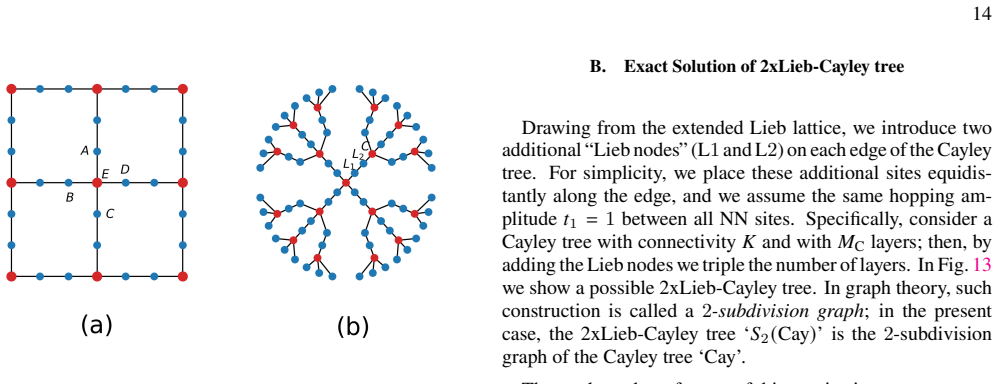
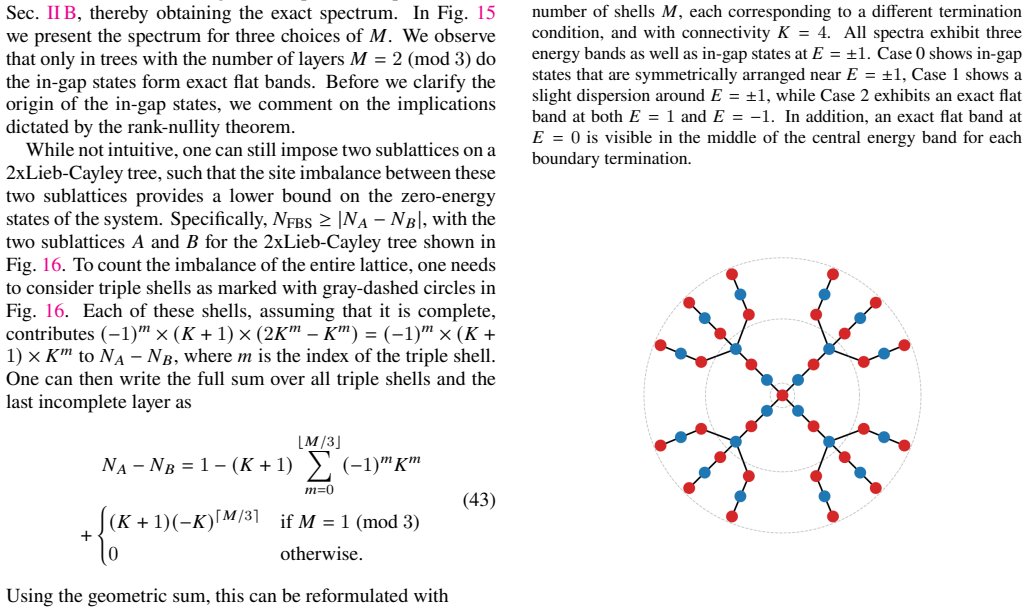
Central claim: the flat band of the Lieb-Cayley tree, which looks like leaf-localized compact states, is actually the collection of topological zero modes of effective Su-Schrieffer-Heeger chains obtained by block-diagonalizing the tree's permutation-symmetric sectors. Each sector Hamiltonian is an SSH chain with alternating hoppings √K and 1; the topological phase places an edge state at the chain's start, which maps back to a zero-energy state exponentially localized at the seed of that sector, deep inside the tree. The zero-energy degeneracy saturates the rank-nullity bound from the sublattice imbalance. Double Lieb, Husimi, and clique decorations show analogous flat-band states with topo
Load-bearing premise
The claim that exact flat bands persist on infinite decorated trees rests on accepting non-normalizable string states as flat-band eigenstates; if a flat band requires square-integrable states, that claim is false.
Editorial extensions
If this is right
- The flat band at E=0 in Lieb-Cayley trees is topologically protected by chiral symmetry of the effective SSH chains, so it survives bond disorder as long as the tree terminates on a Lieb layer.
- Changing the termination (odd vs even number of layers) switches between exact flat bands and exponentially split near-zero states, because SSH edge states on opposite ends of short chains hybridize.
- For the double Lieb decoration, flat bands at E=±1 exist exactly only for one termination (Case 2); the rank-nullity bound then matches the number of non-symmetric sectors, each contributing one edge-state pair.
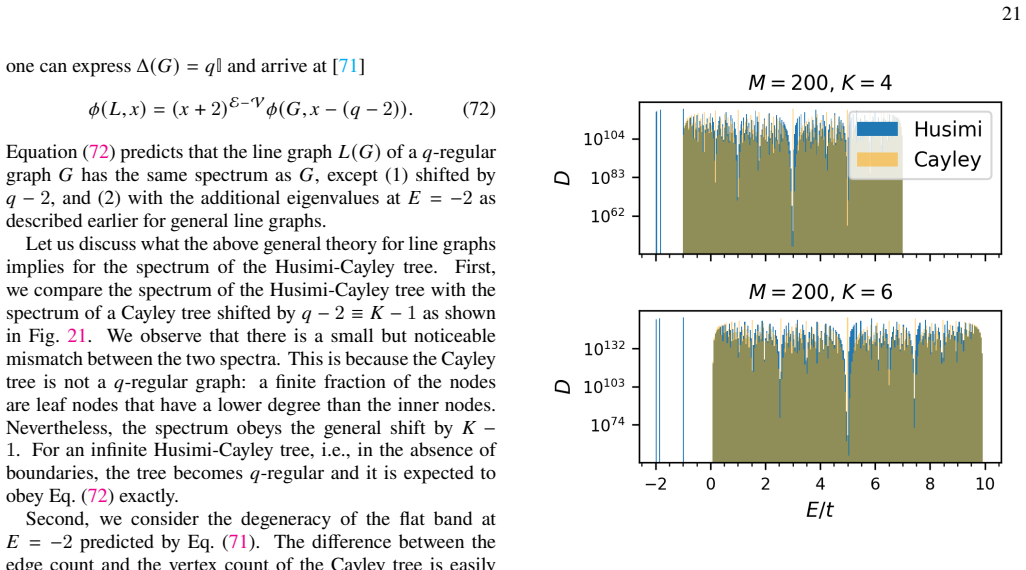
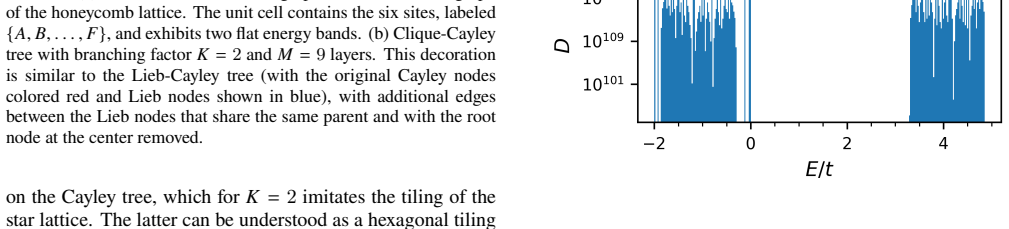
- Husimi and clique trees do not host topological edge states, but their near-flat bands approach exact energies exponentially with tree size, and their infinite limits inherit the Euclidean parent's flat band.
- Because the effective chains have length logarithmic in tree size, spectra of trees with roughly 10^15 sites can be computed exactly, making quantitative predictions for experiments.
Reading between the lines
- If the SSH mapping is physically realized in a circuit or photonic tree network, one should be able to observe the SSH phase transition by tuning the ratio of branching to mono hoppings: the in-gap states would move from the tree's bulk to its outer boundary across the transition.
- The non-normalizability of the infinite-tree string states implies that the exact flat band on the Bethe lattice is a spectral feature (a delta peak in the density of states) rather than a set of physical bound states; any finite-size realization will show exponentially small splittings, and 'exact' flatness is recovered only in the thermodynamic-limit spectrum.
- The covering argument suggests a general rule: any Euclidean lattice whose flat band comes from compact localized states on cycles should have a decorated-tree analog with the same flat-band energy, provided the decoration respects the local neighborhood structure.
- The bulk-localized topological states found here might extend to other expander graphs with negative curvature, connecting to recent observations of bulk topological states in quasicrystals.
Editorial analysis
A structured set of objections, weighed in public.
Referee Report
Summary. The paper studies tight-binding models on decorated Cayley trees (Lieb, double Lieb, Husimi/kagome, and clique/star decorations) as tree analogs of Euclidean lattices with flat bands. Using a symmetry-adapted basis, the authors block-diagonalize the finite-tree Hamiltonian into one-dimensional chains, compute exact spectra, and identify flat (or nearly flat) bands. They show that flat-band states in the Lieb and double-Lieb decorations map to topological edge states of SSH and SSH3 chains, with degeneracies saturating rank-nullity bounds. The final section argues, via a covering-graph construction, that exact flat bands persist on infinite decorated trees (Bethe lattices) by lifting Euclidean compact localized states to infinite string states.
Significance. If the central claims hold, this is a valuable contribution: it provides exactly solvable decorated-tree models with a parameter-free derivation, explicit block-diagonalization, completeness proofs in the Supplemental Material, and a saturating rank-nullity count. The finite-size results are internally consistent and well-supported by explicit matrix identities, line-graph spectral relations, and checkable recurrence arguments. The claimed SSH mapping for the Lieb-Cayley tree is an exact structural correspondence and gives a concrete topological interpretation to the degenerate zero-energy subspace. The main weakness is the infinite-tree persistence claim in Sec. VII, which as written does not establish square-integrable flat-band eigenstates; this gap affects the paper's most general advertised result, though a repair appears plausible via the semi-infinite sector Hamiltonians.
major comments (3)
- [§VII, Eqs. (94)–(95) and text after Eq. (95)] The abstract claims 'persistence of exact flat bands on infinite decorated trees', but the covering-lift construction produces states that the authors themselves state 'do not belong to the space ℓ²(ℒ)'. If 'flat band' means a degenerate subspace of normalizable eigenstates, the proof does not deliver this for infinite trees; it delivers only non-normalizable formal eigenvectors. This is compounded by the remark in Sec. II that the infinite-tree DOS is a dense set of Dirac deltas, making the term 'flat band' ambiguous. The finite-tree results are unaffected, but the abstract's most general claim outruns the proven statement. Please either define a precise notion of flat band on infinite trees (e.g., as a spectral/DOS statement) and reconcile it with the abstract, or construct normalizable ℓ² states at the flat-band energies using the semi-infinite sector Hamiltonians of Eqs. (29b), (42b)
- [§VII, Eq. (96)] The bound ||(H−ε)ψ_L|| ≤ c/√L is asserted without derivation. The 'appropriately chosen norm' is unspecified, and the scaling is not demonstrated. If this inequality is meant to justify that finite-tree spectra converge to the Euclidean flat-band energy, it needs a proof or a precise reference. The later statement that convergence is 'in practice much faster' (e.g., the Husimi result in Eq. (76)) does not substitute for a rigorous statement of the general bound. This gap is directly relevant to the 'nearly flat bands' claim for finite trees.
- [§VII, first paragraph] The covering argument relies on a 'slightly more restrictive definition of local isomorphism' that includes triangles in the neighborhoods. The claim that the decorated trees constructed in Secs. III–VI are universal covers of the corresponding Euclidean lattices under this definition is not proved. In particular, for the Husimi and clique decorations, which contain loops (triangles/simplices), the existence of a covering map to the Euclidean kagome/star lattice should be established explicitly. Without this, the lifting step from Eq. (91) to Eq. (92) is not fully justified. This is part of the same load-bearing infinite-tree argument.
minor comments (7)
- [Fig. 3 caption] Typo: 'Calyey tree' should be 'Cayley tree'.
- [§II B, after Eq. (16)] Duplicate article: 'the the shell-symmetric sector'.
- [§II, near Eq. (30)] Inconsistent abbreviation: 'CSLs' should be 'CLSs' for compact localized states.
- [Eq. (81b)] The Pauli decomposition is missing the σ_y factor on the d_y term; as written, the expression is dimensionally inconsistent.
- [Fig. 10 caption] Typo: 'correspondingle large' should be 'correspondingly large'.
- [§VIC] Typo: 'implitudes' should be 'amplitudes'.
- [References] Refs. [48] and [57] are the same paper (Bzdušek and Maciejko, Phys. Rev. B 106, 155146 (2022)); the duplication should be removed and citations renumbered.
Circularity Check
No significant circularity; the central SSH mapping and degeneracy counts are derived from explicit sector Hamiltonians and verified against independent rank-nullity bounds.
full rationale
The derivation is self-contained. The symmetry-adapted basis is constructed and proven complete in Sec. II and the Supplemental Material, yielding explicit sector Hamiltonians (e.g., Eqs. (29a,b), (42a,b), (67a,b), (80a,b)) without fitting any parameter to the target flat-band states. The correspondence to SSH / SSH3 chains is an exact operator mapping, and the identification of zero-energy edge states follows from the known topological properties of those 1D models (Refs. 59, 64, 65) rather than from the tree spectrum itself. The flat-band degeneracy (Eq. 39) is independently cross-checked against the rank-nullity lower bound (Eq. 37), which is an external linear-algebra theorem; the equality is a nontrivial verification, not a construction. Self-citations (Refs. 27, 48/57, 72) occur for the general method, the rank-nullity application, and naming, but the load-bearing content is re-derived in the paper or is standard, so these citations are not load-bearing. The only significant weakness is in Sec. VII: the covering lift defined by Eq. (94) is explicitly noted not to belong to ℓ² (text after Eq. (95)), so the claim of exact flat bands on infinite trees as square-integrable eigenstates is not established. This is a proof-gap/validity concern about the infinite-size limit, not a circular reduction of the result to its inputs.
Assumptions & free parameters
assumptions (6)
- standard math Rank-nullity theorem applied to bipartite sublattice imbalance
- domain assumption Permutation symmetry of (decorated) Cayley trees generates a complete block-diagonalizing symmetry-adapted basis
- standard math SSH and SSH3 edge-state topology from prior literature
- ad hoc to paper Restricted (enlarged-neighborhood) covering map definition
- domain assumption Partial-isometry conditions Z†Z = I and YY† = I for the double-Lieb rank-nullity reduction
- domain assumption Nearest-neighbor tight-binding on loopless graphs with open/leaf boundaries
Cite this review
Pith. "Pith review of Topological states and flat bands in exactly solvable decorated Cayley trees." pith.science (2026). https://pith.science/paper/UCDTUCSU
@misc{pith2026251111261,
  author       = {Pith},
  title        = {Pith review of: Topological states and flat bands in exactly solvable decorated Cayley trees},
  year         = {2026},
  howpublished = {\url{https://pith.science/paper/UCDTUCSU}},
  note         = {Machine review of arXiv:2511.11261}
}
read the original abstract
We derive the full spectrum of decorated Cayley trees that constitute tree analogs of selected two-dimensional Euclidean lattices; namely of the Lieb, the double Lieb, the kagome, and the star lattice. The common feature of these Euclidean lattices is that their nearest-neighbor models give rise to flat energy bands interpretable through compact localized states. We find that the tree analogs exhibit similar flat or nearly flat energy bands at the corresponding energies. Interestingly, such flat bands in the decorated Cayley trees acquire an interpretation that is absent in their Euclidean counterparts: as edge states localized to the inner or the outer boundary of the tree branches. In particular, we establish an exact correspondence between the Lieb-Cayley tree and an ensemble of one-dimensional Su-Schrieffer-Heeger chains, which maps topological edge states on one side of the chains to flat-band states localized in the bulk of the tree, furnishing the flat energy band with a topological stability. Similar mapping to topological edge states or to states bound to edge defects in one-dimensional chains is shown for flat-band states in all the considered tree decorations. We finally show that the persistence of exact flat bands on infinite decorated trees (i.e., Bethe lattices) arises naturally from a covering interpretation of tree graphs. Our findings reveal a rich landscape of flat-band and topological phenomena in non-Euclidean systems, where geometry alone can generate and stabilize unconventional quantum states.
Figures


Figures from the paper (20 more)








Reference graph
Works this paper leans on
-
[1]
Husimi-Lieb
For an infinite Husimi-Cayley tree, i.e., in the absence of boundaries, the tree becomes𝑞-regular and it is expected to obey Eq. (72) exactly. Second, we consider the degeneracy of the flat band at 𝐸=−2predicted by Eq. (71). The difference between the edge count and the vertex count of the Cayley tree is easily found to beE−V=−1. This result can be seen i...
-
[2]
Weneglectmixingwiththebulkstates,sincetheyarefarin energy from the edge states for the SSH model. We can solve this effective Hamiltonian for its eigenvalues to find 𝐸±(𝐽)= 𝐽± √ 𝐽2+4𝛿 2 2 .(86a) For large𝐽, we can approximate 𝐸+(𝐽)≈𝐽+ 𝛿2 𝐽 , 𝐸 −(𝐽)≈− 𝛿2 𝐽 .(86b) This implies that one of the states remains close to𝐸=0 while the other moves with𝐽. However, ...
-
[3]
Georges and G
A. Georges and G. Kotliar, Hubbard model in infinite dimen- sions, Phys. Rev. B45, 6479 (1992)
1992
-
[4]
Jarrell, Hubbard model in infinite dimensions: A quantum Monte Carlo study, Phys
M. Jarrell, Hubbard model in infinite dimensions: A quantum Monte Carlo study, Phys. Rev. Lett.69, 168 (1992)
1992
-
[5]
Eckstein, M
M. Eckstein, M. Kollar, K. Byczuk, and D. Vollhardt, Hopping on the Bethe lattice: Exact results for densities of states and dynamical mean-field theory, Phys. Rev. B71, 235119 (2005)
2005
-
[6]
Kollar, M
M. Kollar, M. Eckstein, K. Byczuk, N. Blümer, P. van Dongen, M. Radke de Cuba, W. Metzner, D. Tanasković, V. Dobrosavl- jević, G. Kotliar, and D. Vollhardt, Green functions for nearest- 28 and next-nearest-neighbor hopping on the Bethe lattice, Ann. Phys.517, 642 (2005)
2005
-
[7]
R.PetersandT.Pruschke,Half-filledHubbardmodelonaBethe lattice with next-nearest-neighbor hopping, Phys. Rev. B79, 045108 (2009)
2009
-
[8]
Semerjian, M
G. Semerjian, M. Tarzia, and F. Zamponi, Exact solution of the Bose-Hubbard model on the Bethe lattice, Phys. Rev. B80, 014524 (2009)
2009
Show all 85 references
-
[9]
Lunts, A
P. Lunts, A. Georges, E. M. Stoudenmire, and M. Fishman, HubbardmodelontheBethelatticeviavariationaluniformtree states: Metal-insulator transition and a Fermi liquid, Phys. Rev. Res.3, 023054 (2021)
2021
-
[10]
Lepetit, M
M.-B. Lepetit, M. Cousy, and G. M. Pastor, Density-matrix renormalization study of the Hubbard model on a Bethe lattice, Eur. Phys. J. B13, 421 (2000)
2000
-
[11]
J.-L. Chen, Z. Fan, B. Zhan, J. Hu, T. Liu, J. Ji, K. Wang, H.-J. Liao, and T. Xiang, Thermodynamics of the Hubbard model on the Bethe lattice, Phys. Rev. B112, 125130 (2025)
2025
-
[12]
V.Bashmakov,A.Iliasov,T.Bzdušek,andA.A.Bagrov,Super- conductivity in hyperbolic spaces: Regular hyperbolic lattices and Ginzburg-Landau theory (2025), arXiv:2509.09330 [cond- mat.supr-con]
2025 arXiv
-
[13]
Pavliuk, T
M. Pavliuk, T. Bzdušek, and A. Iliasov, Superconductivity in hyperbolic spaces: Cayley trees, hyperbolic continuum, and BCS theory (2025), arXiv:2510.26528 [cond-mat.supr-con]
2025
-
[14]
Vidal and R
J. Vidal and R. Mosseri, Kitaev model in regular hyperbolic tilings (2025), arXiv:2506.17981 [cond-mat.str-el]
2025
-
[15]
D. J. Thouless, Spin-Glass on a Bethe lattice, Phys. Rev. Lett. 56, 1082 (1986)
1986
-
[16]
Laumann, A
C. Laumann, A. Scardicchio, and S. L. Sondhi, Cavity method for quantum spin glasses on the Bethe lattice, Phys. Rev. B78, 134424 (2008)
2008
-
[17]
Mézard and G
M. Mézard and G. Parisi, The Bethe lattice spin glass revisited, Eur. Phys. J. B20, 217 (2001)
2001
-
[18]
Savitz, C
S. Savitz, C. Peng, and G. Refael, Anderson localization on the Bethe lattice using cages and the Wegner flow, Phys. Rev. B 100, 094201 (2019)
2019
-
[19]
Abou-Chacra, D
R. Abou-Chacra, D. J. Thouless, and P. W. Anderson, A self- consistent theory of localization, J. Phys. C6, 1734 (1973)
1973
-
[20]
Aizenman and S
M. Aizenman and S. Warzel, The Canopy Graph and Level Statistics for Random Operators on Trees, J. Math. Phys. Anal. Geom.9, 291 (2006)
2006
-
[21]
T.RizzoandM.Tarzia,LocalizedphaseoftheAndersonmodel on the Bethe lattice, Phys. Rev. B110, 184210 (2024)
2024
-
[22]
T. P. Eggarter, Cayley trees, the Ising problem, and the thermo- dynamic limit, Phys. Rev. B9, 2989 (1974)
1974
-
[23]
Bing and C
H. Bing and C. Shu, Correlation Function of Potts Model on Bethe Lattice, Chin. Phys. Lett.17, 549 (2000)
2000
-
[24]
T. K. Kopeć and K. D. Usadel, Short-range±J interaction Ising spin glass in a transverse field on a Bethe lattice: a quantum- spherical approach, Phys. Status Solidi B243, 502 (2006)
2006
-
[25]
Hu and N
C.-K. Hu and N. S. Izmailian, Exact correlation functions of Bethelatticespinmodelsinexternalmagneticfields,Phys.Rev. E58, 1644 (1998)
1998
-
[26]
K. S. Tikhonov and A. D. Mirlin, Fractality of wave functions on a Cayley tree: Difference between tree and locally treelike graph without boundary, Phys. Rev. B94, 184203 (2016)
2016
-
[27]
Sonner, K
M. Sonner, K. S. Tikhonov, and A. D. Mirlin, Multifractality of wavefunctionsonaCayleytree: Fromroottoleaves,Phys.Rev. B96, 214204 (2017)
2017
-
[28]
Trauzettel, Non-Hermitian quantum fractals, Phys
J.Sun,C.-A.Li,Q.Guo,W.Zhang,S.Feng,X.Zhang,H.Guo, and B. Trauzettel, Non-Hermitian quantum fractals, Phys. Rev. B110, L201103 (2024)
2024
-
[29]
Hamanaka, A
S. Hamanaka, A. A. Iliasov, T. Neupert, T. Bzdušek, and T. Yoshida, Multifractal statistics of non-Hermitian skin effect on the Cayley tree, Phys. Rev. B111, 075162 (2025)
2025
-
[30]
J.Sun,C.-A.Li,P.Li,S.Feng,andH.Guo,Innernon-Hermitian skineffectontheBethelattice,Phys.Rev.B111,075120(2025)
2025
-
[31]
N.Hatano,H.Katsura,andK.Kawabata,Quantumtransporton Bethe lattices with non-Hermitian sources and a drain (2024), arXiv:2409.01873 [quant-ph]
2024 arXiv
-
[32]
S. S. Gubser, J. Knaute, S. Parikh, A. Samberg, and P. Witaszczyk, p-Adic AdS/CFT, Commun. Math. Phys.352, 1019 (2017)
2017
-
[33]
Manoj and V
N. Manoj and V. B. Shenoy, Arboreal topological and fracton phases, Phys. Rev. B107, 165136 (2023)
2023
-
[34]
C.R.Laumann,S.A.Parameswaran,andS.L.Sondhi,Absence of Goldstone bosons on the Bethe lattice, Phys. Rev. B80, 144415 (2009)
2009
-
[35]
O.Breach,B.Placke,P.W.Claeys,andS.Parameswaran,Solv- able Quantum Circuits inTree+1Dimensions, PRX Quantum 6, 040316 (2025)
2025
-
[36]
Placke, G
B. Placke, G. M. Sommers, N. P. Breuckmann, T. Rakovszky, and V. Khemani, Expansion creates spin-glass order in finite- connectivity models: a rigorous and intuitive approach from the theory of LDPC codes (2025), arXiv:2507.13342 [cond- mat.stat-mech]
2025 arXiv
-
[37]
15, 218 (2023)
P.Basteiro,R.N.Das,G.D.Giulio,andJ.Erdmenger,Aperiodic spin chains at the boundary of hyperbolic tilings, SciPost Phys. 15, 218 (2023)
2023
-
[38]
G. D. Mahan, Energy bands of the Bethe lattice, Phys. Rev. B 63, 155110 (2001)
2001
-
[39]
D.AryalandS.Kettemann,Completesolutionofthetightbind- ing model on a Cayley tree: strongly localised versus extended states, J. Phys. Commun.4, 105010 (2020)
2020
-
[40]
Ostilli, C
M. Ostilli, C. G. Bezerra, and G. M. Viswanathan, Spectrum of the tight-binding model on Cayley trees and comparison with Bethe lattices, Phys. Rev. E105, 034123 (2022)
2022
-
[41]
H.Yorikawa,DensityofstatesoftheCayleytree,J.Phys.Com- mun.2, 125009 (2018)
2018
-
[42]
X. Wang, Z. Nussinov, and G. Ortiz, Emergence of a Boundary-Sensitive Phase in Hyperbolic Ising Models (2025), arXiv:2507.21044 [cond-mat.stat-mech]
2025
-
[43]
F.R.LuxandE.Prodan,ConvergingPeriodicBoundaryCondi- tionsandDetectionofTopologicalGapsonRegularHyperbolic Tessellations, Phys. Rev. Lett.131, 176603 (2023)
2023
-
[44]
S. Yu, X. Piao, and N. Park, Topological Hyperbolic Lattices, Phys. Rev. Lett.125, 053901 (2020)
2020
-
[45]
D. M. Urwyler, P. M. Lenggenhager, I. Boettcher, R. Thomale, T. Neupert, and T. Bzdušek, Hyperbolic Topological Band In- sulators, Phys. Rev. Lett.129, 246402 (2022)
2022
-
[46]
Liu, C.-B
Z.-R. Liu, C.-B. Hua, T. Peng, and B. Zhou, Chern insulator in a hyperbolic lattice, Phys. Rev. B105, 245301 (2022)
2022
-
[47]
Tao and Y
Y.-L. Tao and Y. Xu, Higher-order topological hyperbolic lat- tices, Phys. Rev. B107, 184201 (2023)
2023
-
[48]
A. Chen, Y. Guan, P. M. Lenggenhager, J. Maciejko, I. Boettcher, and T. Bzdušek, Symmetry and topology of hy- perbolic Haldane models, Phys. Rev. B108, 085114 (2023)
2023
-
[49]
Tummuru, A
T. Tummuru, A. Chen, P. M. Lenggenhager, T. Neupert, J. Ma- ciejko, and T. Bzdušek, Hyperbolic Non-Abelian Semimetal , Phys. Rev. Lett.132, 206601 (2024)
2024
-
[51]
A.Westström,W.Duan,K.Yao,X.Wang,J.Liu,andJ.Li,Topo- logical Phases on Quantum Trees (2023), arXiv:2302.03166 [cond-mat.mes-hall]
2023 arXiv
-
[52]
G.Singh,S.Bera,andV.B.Shenoy,Arborealobstructedatomic 29 insulating and metallic phases of fermions, Phys. Rev. B110, 205143 (2024)
2024
-
[53]
The Supplemental Material contains further information about the construction of symmetry-adapted basis states for Lieb- Cayley trees, 2xLieb-Cayley trees, Husimi-Cayley trees, and clique-Cayley trees
-
[54]
Petrova and R
O. Petrova and R. Moessner, Coulomb potential𝑉(𝑟)=1/𝑟 problem on the Bethe lattice, Phys. Rev. E93, 012115 (2016)
2016
-
[55]
D. R. DeFord and D. N. Rockmore, On the Spectrum of Fi- nite, Rooted Homogeneous Trees (2020), arXiv:1903.07134 [math.RT]
2020 arXiv
-
[56]
D. L. Bergman, C. Wu, and L. Balents, Band touching from real-space topology in frustrated hopping models, Phys. Rev. B 78, 125104 (2008)
2008
-
[57]
E. H. Lieb, Two theorems on the Hubbard model, Phys. Rev. Lett.62, 1201 (1989)
1989
-
[58]
M.Niţă,B.Ostahie,andA.Aldea,Spectralandtransportproper- tiesofthetwo-dimensionalLieblattice,Phys.Rev.B87,125428 (2013)
2013
-
[59]
T.BzdušekandJ.Maciejko,Flatbandsandband-touchingfrom real-space topology in hyperbolic lattices, Phys. Rev. B106, 155146 (2022)
2022
-
[60]
Sutherland, Localization of electronic wave functions due to local topology, Phys
B. Sutherland, Localization of electronic wave functions due to local topology, Phys. Rev. B34, 5208 (1986)
1986
-
[61]
W. P. Su, J. R. Schrieffer, and A. J. Heeger, Solitons in Poly- acetylene, Phys. Rev. Lett.42, 1698 (1979)
1979
-
[62]
Zhang, Y
D. Zhang, Y. Zhang, H. Zhong, C. Li, Z. Zhang, Y. Zhang, and M. R. Belić, New edge-centered photonic square lattices with flat bands, Ann. Phys.382, 160 (2017)
2017
-
[63]
A.BhattacharyaandB.Pal,Flatbandsandnontrivialtopological propertiesinanextendedLieblattice,Phys.Rev.B100,235145 (2019)
2019
-
[64]
Rep.13, 12676 (2023)
G.CentałaandJ.W.Kłos,Compactlocalizedstatesinmagnonic Lieb lattices, Sci. Rep.13, 12676 (2023)
2023
-
[65]
Hanafi, P
H. Hanafi, P. Menz, A. McWilliam, J. Imbrock, and C. Denz, Localized dynamics arising from multiple flat bands in a deco- rated photonic Lieb lattice, APL Photonics7, 111301 (2022)
2022
-
[66]
V. M. Martinez Alvarez and M. D. Coutinho-Filho, Edge states in trimer lattices, Phys. Rev. A99, 013833 (2019)
2019
-
[67]
Anastasiadis, G
A. Anastasiadis, G. Styliaris, R. Chaunsali, G. Theocharis, and F. K. Diakonos, Bulk-edge correspondence in the trimer Su- Schrieffer-Heeger model, Phys. Rev. B106, 085109 (2022)
2022
-
[68]
F.HararyandG.E.Uhlenbeck,OntheNumberofHusimiTrees, Natl. Acad. Sci. U. S. A.39, 315 (1953)
1953
-
[69]
H.-M.GuoandM.Franz,TopologicalinsulatorontheKagome lattice, Phys. Rev. B80, 113102 (2009)
2009
-
[70]
Tang, J.-W
E. Tang, J.-W. Mei, and X.-G. Wen, High-Temperature Frac- tionalQuantumHallStates,Phys.Rev.Lett.106,236802(2011)
2011
-
[71]
K.Ohgushi,S.Murakami,andN.Nagaosa,Spinanisotropyand quantum Hall effect in the kagomé lattice: Chiral spin state based on a ferromagnet, Phys. Rev. B62, R6065 (2000)
2000
-
[72]
A. J. Kollár, M. Fitzpatrick, P. Sarnak, and A. A. Houck, Line- Graph Lattices: Euclidean and Non-Euclidean Flat Bands, and Implementations in Circuit Quantum Electrodynamics, Com- mun. Math. Phys.376, 1909 (2020)
1909
-
[73]
Godsil and G
C. Godsil and G. Royle,Algebraic Graph Theory, Graduate TextsinMathematics,Vol.207(Springer,NewYork,NY,2001)
2001
-
[74]
W. P. Duss,Exploration of Topological Bands on Cayley Trees, Master’s thesis, University of Zurich, Zurich, Switzer- land (2025)
2025
-
[75]
H.YaoandS.A.Kivelson,ExactChiralSpinLiquidwithNon- Abelian Anyons, Phys. Rev. Lett.99, 247203 (2007)
2007
-
[76]
W.-C. Chen, R. Liu, Y.-F. Wang, and C.-D. Gong, Topological quantumphasetransitionsandtopologicalflatbandsonthestar lattice, Phys. Rev. B86, 085311 (2012)
2012
-
[77]
R. Fan, L. Sun, X. Shao, Y. Li, and M. Zhao, Two-dimensional Diracmaterials: Tight-bindinglatticemodelsandmaterialcan- didates, ChemPhysMater2, 30 (2023)
2023
-
[78]
O.Rojas,GeometricallyfrustratedIsing-Heisenbergspinmodel on expanded Kagomé lattice, J. Magn. Magn. Mat473, 442 (2019)
2019
-
[79]
A.J.Kollár,M.Fitzpatrick,andA.A.Houck,Hyperboliclattices in circuit quantum electrodynamics, Nature571, 45 (2019)
2019
-
[80]
P. M. Lenggenhager, A. Stegmaier, L. K. Upreti, T. Hofmann, T. Helbig, A. Vollhardt, M. Greiter, C. H. Lee, S. Imhof, H. Brand, T. Kießling, I. Boettcher, T. Neupert, R. Thomale, andT.Bzdušek,Simulatinghyperbolicspaceonacircuitboard, Nat. Commun.13, 4373 (2022)
2022
-
[81]
Boettcher, P
I. Boettcher, P. Bienias, R. Belyansky, A. J. Kollár, and A. V. Gorshkov,Quantumsimulationofhyperbolicspacewithcircuit quantumelectrodynamics: Fromgraphstogeometry,Phys.Rev. A102, 032208 (2020)
2020
-
[82]
S. Dey, A. Chen, P. Basteiro, A. Fritzsche, M. Greiter, M. Kaminski, P. M. Lenggenhager, R. Meyer, R. Sorbello, A.Stegmaier,R.Thomale,J.Erdmenger,andI.Boettcher,Sim- ulating Holographic Conformal Field Theories on Hyperbolic Lattices, Phys. Rev. Lett.133, 061603 (2024)
2024
-
[83]
Johnstone, M
D. Johnstone, M. J. Colbrook, A. E. B. Nielsen, P. Öhberg, and C. W. Duncan, Bulk localized transport states in infinite and finitequasicrystalsviamagneticaperiodicity,Phys.Rev.B106, 045149 (2022)
2022
-
[84]
F.Balling-Ansø,J.L.Krogh,E.E.Lassen,andA.E.B.Nielsen, Identification and Properties of Topological States in the Bulk of Quasicrystals (2025), arXiv:2507.20722 [quant-ph]
2025
-
[85]
Boyle, M
L. Boyle, M. Dickens, and F. Flicker, Conformal Quasicrystals and Holography, Phys. Rev. X10, 011009 (2020)
2020
-
[86]
Boyle and J
L. Boyle and J. Kulp, Holographic foliations: Self-similar quasicrystals from hyperbolic honeycombs, Phys. Rev. D111, 046001 (2025). Supplemental Material for Topological states and flat bands in exactly solvable decorated Cayley trees Wanda P. Duss,∗ Askar Iliasov,† and Tomáš...
2025
Reviewed August 3, 2026 · model on record in the stance chip above.
Discussion (0). Continue with ORCID to comment.