Estimating Cosmological Parameters from Localized Fast Radio Bursts: A Method for Removing Milky Way Dispersion-Measure Contributions
Pith reviewed 2026-06-30 05:35 UTC · model grok-4.3
The pith
Differences in dispersion measures of localized fast radio bursts in the same sky region remove Milky Way contributions without Galactic models.
A machine-rendered reading of the paper's core claim, the machinery that carries it, and where it could break.
Core claim
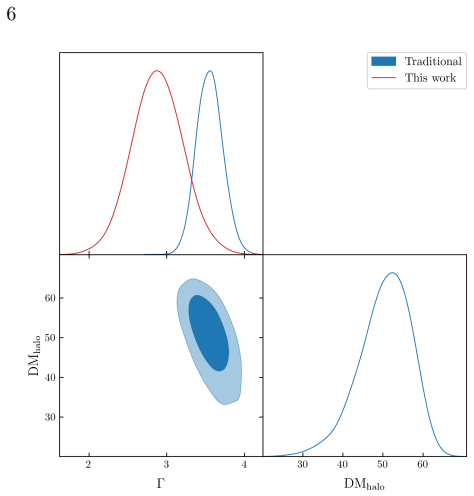
Subtracting the dispersion measures of localized fast radio bursts that lie within the same sky region cancels the shared Milky Way contribution, leaving only the intergalactic-medium term that depends on cosmological parameters. The method therefore requires no adopted Galactic electron-density model and no prior on the Galactic halo DM. Mock data tests recover the fiducial cosmology. Real localized FRB observations produce a constraint on Γ ≡ Ω_b H_0 f_d that differs from the conventional treatment.
What carries the argument
The dispersion-measure difference between localized FRBs within the same sky region, which cancels the common Milky Way term while preserving the cosmological intergalactic signal.
If this is right
- Mock FRB samples recover the fiducial cosmological parameters.
- Current localized FRB data produce a Γ constraint different from the conventional Milky Way treatment.
- The difference demonstrates that Milky Way DM systematics affect FRB cosmology.
- The differential approach can be applied to future large samples of localized FRBs.
Where Pith is reading between the lines
- Sky-region consistency checks on larger samples could test whether the identical-Milky-Way assumption holds across different Galactic latitudes.
- The method could be paired with other foreground-sensitive probes to reduce shared model dependencies in joint cosmological analyses.
- If the assumption remains valid for many pairs, the technique would tighten constraints on the baryon density without introducing Galactic-model priors.
Load-bearing premise
The Milky Way dispersion-measure contribution is the same for all localized FRBs that lie in the same sky region.
What would settle it
A large mock catalog in which the differential method recovers parameters that deviate from the known input values, or real data pairs from the same sky region that produce inconsistent Γ constraints, would falsify the method.
Figures
read the original abstract
Fast radio bursts (FRBs) are emerging as powerful probes for cosmology. However, cosmological inference based on FRB dispersion measures (DMs) is limited by uncertainties in the Milky Way contribution, including those from the Galactic interstellar medium and the Galactic halo. In this Letter, we propose a method that eliminates the Milky Way contribution by using DM differences between localized FRBs within the same sky region. The method removes the need to adopt a specific Galactic electron-density model or a prior assumption for the Galactic halo DM. We validate the reliability of the method using mock FRB samples and show that it successfully recovers the fiducial cosmological parameter. Applying the method to current localized FRB data, we obtain a constraint on $\Gamma \equiv \Omega_b H_0 f_{\rm d}$ that differs from that inferred using the conventional treatment of the Milky Way contribution. This difference highlights the importance of Milky Way DM systematics in FRB cosmology and demonstrates the potential of differential DM methods for future large samples of localized FRBs.
Editorial analysis
A structured set of objections, weighed in public.
Referee Report
Summary. The paper proposes a differential method for FRB cosmology that cancels the Milky Way DM contribution (ISM + halo) by subtracting DMs of localized FRBs within the same sky region, thereby avoiding explicit Galactic electron-density models or halo priors. It reports successful recovery of the fiducial cosmological parameter in mock samples and, when applied to existing localized FRB data, derives a constraint on Γ ≡ Ω_b H_0 f_d that differs from the result obtained with conventional MW modeling.
Significance. If the cancellation assumption holds, the approach offers a model-independent route to reduce a dominant systematic in FRB-based cosmology and could become valuable for the large localized samples expected from upcoming surveys. The mock recovery and the reported difference in real-data constraints on Γ provide concrete illustrations of the method's potential impact and of the sensitivity of current inferences to MW treatment.
major comments (3)
- [Method (abstract and §2)] Method description: the central claim that DM differences fully eliminate the Milky Way term rests on the assumption that MW DM is identical for FRBs sharing a sky region. The manuscript does not specify the angular sizes of the adopted regions or estimate residual DM_MW fluctuations arising from known Galactic structure (spiral arms, clumps, halo substructure) on 0.1–few degree scales.
- [Validation with mocks (§3)] Mock validation: the reported successful recovery of the fiducial parameter is shown under the assumption of perfect MW DM identity within regions. Because the mocks do not incorporate realistic angular variations in the Galactic electron density, they do not test whether the method remains unbiased when the cancellation is imperfect; this is load-bearing for interpreting both the mock success and the real-data result.
- [Application to real data (§4)] Real-data application: the differing constraint on Γ is presented as evidence that MW systematics matter, yet without quantitative assessment of possible residual bias from finite angular separations in the actual sample, it remains unclear whether the shift reflects improved accuracy or an artifact of incomplete cancellation.
minor comments (2)
- [Abstract] The abstract states that the method 'removes the need to adopt a specific Galactic electron-density model' but does not clarify whether any residual modeling (e.g., for IGM or host contributions) is still required; a brief statement would improve clarity.
- [Throughout] Notation: Γ is defined as Ω_b H_0 f_d; ensure f_d is explicitly defined at first use and that all symbols in equations are introduced before they appear.
Simulated Author's Rebuttal
We thank the referee for the detailed and constructive report. We address each major comment below. We agree that additional details on angular scales, residual fluctuations, and limitations of the mocks are needed for clarity and will revise the manuscript accordingly.
read point-by-point responses
-
Referee: [Method (abstract and §2)] Method description: the central claim that DM differences fully eliminate the Milky Way term rests on the assumption that MW DM is identical for FRBs sharing a sky region. The manuscript does not specify the angular sizes of the adopted regions or estimate residual DM_MW fluctuations arising from known Galactic structure (spiral arms, clumps, halo substructure) on 0.1–few degree scales.
Authors: We agree that explicit specification of angular scales and an estimate of residuals are required to substantiate the cancellation assumption. In the revised manuscript we will state the typical angular sizes of the same-sky regions used (determined by the localization uncertainties and sample distribution, typically a few degrees) and provide a quantitative estimate of residual DM_MW fluctuations on those scales, drawing on standard Galactic electron-density models that include spiral-arm and halo substructure contributions. revision: yes
-
Referee: [Validation with mocks (§3)] Mock validation: the reported successful recovery of the fiducial parameter is shown under the assumption of perfect MW DM identity within regions. Because the mocks do not incorporate realistic angular variations in the Galactic electron density, they do not test whether the method remains unbiased when the cancellation is imperfect; this is load-bearing for interpreting both the mock success and the real-data result.
Authors: The mocks were constructed to verify unbiased recovery under the ideal case where the cancellation assumption holds exactly, which is a necessary first validation step. We acknowledge that they do not yet incorporate realistic angular DM variations and therefore do not quantify bias from imperfect cancellation. In revision we will add an explicit discussion of this limitation and, where space permits in the Letter format, include a supplementary test with a simple angular-variation model to illustrate the magnitude of any resulting bias. revision: partial
-
Referee: [Application to real data (§4)] Real-data application: the differing constraint on Γ is presented as evidence that MW systematics matter, yet without quantitative assessment of possible residual bias from finite angular separations in the actual sample, it remains unclear whether the shift reflects improved accuracy or an artifact of incomplete cancellation.
Authors: We present the shift in Γ primarily to demonstrate sensitivity to MW modeling choices rather than to claim definitive improvement. To address the referee’s concern we will add, in the revised §4, a quantitative bound on residual bias by reporting the median angular separations of the real localized FRB pairs and estimating the corresponding DM_MW fluctuation amplitude from Galactic structure models. This will allow readers to judge whether the observed difference is likely dominated by improved cancellation or by residual effects. revision: yes
Circularity Check
No significant circularity; derivation uses direct observational subtraction
full rationale
The paper's central chain proposes DM differencing between localized FRBs in the same sky region to cancel the Milky Way contribution (ISM + halo), validates the approach by recovering the fiducial cosmological parameter on mock samples, and applies it to real data to constrain Γ ≡ Ω_b H_0 f_d. This is a direct observational subtraction that does not reduce any claimed result to a fitted parameter by construction, nor does it rely on self-citation chains or ansatzes smuggled from prior work. Mock recovery tests the subtraction under the method's own assumptions but does not force the real-data Γ constraint; the result remains independent of the input data reduction. No load-bearing step matches the enumerated circularity patterns.
Axiom & Free-Parameter Ledger
axioms (1)
- domain assumption Milky Way DM contribution is identical for FRBs in the same sky region
Reference graph
Works this paper leans on
-
[1]
Abbott, T. C., et al. 2025, Astrophys. J. Lett., 989, L48, doi: 10.3847/2041-8213/adf62f
-
[2]
Aghanim, N., et al. 2020, Astron. Astrophys., 641, A6, doi: 10.1051/0004-6361/201833910
-
[3]
Amiri, M., et al. 2025, Astrophys. J. Suppl., 280, 6, doi: 10.3847/1538-4365/addbda
-
[4]
Anna-Thomas, R., et al. 2025, Astrophys. J., 993, 221, doi: 10.3847/1538-4357/ae1014
-
[5]
Bannister, K. W., et al. 2019, arXiv, doi: 10.1126/science.aaw5903
-
[6]
Becker, G. D., Bolton, J. S., Haehnelt, M. G., & Sargent, W. L. W. 2011, Mon. Not. Roy. Astron. Soc., 410, 1096, doi: 10.1111/j.1365-2966.2010.17507.x
-
[7]
Beniamini, P., Kumar, P., Ma, X., & Quataert, E. 2021, Mon. Not. Roy. Astron. Soc., 502, 5134, doi: 10.1093/mnras/stab309
-
[8]
Bhandari, S., et al. 2020, Astrophys. J. Lett., 895, L37, doi: 10.3847/2041-8213/ab672e
-
[9]
Bhandari, S., et al. 2022, Astron. J., 163, 69, doi: 10.3847/1538-3881/ac3aec
-
[10]
Bhandari, S., et al. 2023, Astrophys. J., 948, 67, doi: 10.3847/1538-4357/acc178
-
[11]
Bhardwaj, M., et al. 2021, Astrophys. J. Lett., 919, L24, doi: 10.3847/2041-8213/ac223b
-
[12]
Bhardwaj, M., et al. 2024, Astrophys. J. Lett., 971, L51, doi: 10.3847/2041-8213/ad64d1
-
[13]
Bonetti, L., Ellis, J., Mavromatos, N. E., et al. 2017, Phys. Lett. B, 768, 326, doi: 10.1016/j.physletb.2017.03.014
-
[14]
Bonetti, L., Ellis, J., Mavromatos, N. E., et al. 2016, Phys. Lett. B, 757, 548, doi: 10.1016/j.physletb.2016.04.035
-
[15]
Caleb, M., Flynn, C., & Stappers, B. 2019, Mon. Not. Roy. Astron. Soc., 485, 2281, doi: 10.1093/mnras/stz571
-
[16]
Caleb, M., et al. 2023, Mon. Not. Roy. Astron. Soc., 524, 2064, doi: 10.1093/mnras/stad1839
- [17]
-
[18]
2024, Nature Astron., 8, 1429, doi: 10.1038/s41550-024-02357-x
Cassanelli, T., et al. 2024, Nature Astron., 8, 1429, doi: 10.1038/s41550-024-02357-x
-
[19]
Chang, C. M., Wei, J. J., Meng, K. L., et al. 2025, Phys. Rev. D, 111, L041304, doi: 10.1103/PhysRevD.111.L041304
-
[20]
Chang, C. M., Wei, J. J., Zhang, S. B., & Wu, X. F. 2023, JCAP, 2023, 010, doi: 10.1088/1475-7516/2023/01/010
-
[21]
2017, Nature, 541, 58, doi: 10.1038/nature20797 7
Chatterjee, S., et al. 2017, Nature, 541, 58, doi: 10.1038/nature20797 7
-
[22]
S., Simha, S., Mannings, A., et al
Chittidi, J. S., Simha, S., Mannings, A., et al. 2021, Astrophys. J., 922, 173, doi: 10.3847/1538-4357/ac2818
-
[23]
2025, Nature Astron., 9, 1226, doi: 10.1038/s41550-025-02566-y
Connor, L., et al. 2025, Nature Astron., 9, 1226, doi: 10.1038/s41550-025-02566-y
-
[24]
Cook, A. M., et al. 2023, Astrophys. J., 946, 58, doi: 10.3847/1538-4357/acbbd0
-
[25]
NE2001.I. A New Model for the Galactic Distribution of Free Electrons and its Fluctuations
Cordes, J. M., & Lazio, T. J. W. 2002, arXiv. https://arxiv.org/abs/astro-ph/0207156
work page internal anchor Pith review Pith/arXiv arXiv 2002
-
[26]
Curtin, A. P., et al. 2026, Astrophys. J., 998, 97, doi: 10.3847/1538-4357/ae2ea0
-
[27]
Deng, W., & Zhang, B. 2014, Astrophys. J. Lett., 783, L35, doi: 10.1088/2041-8205/783/2/L35
-
[28]
Driessen, L. N., et al. 2023, Mon. Not. Roy. Astron. Soc., 527, 3659, doi: 10.1093/mnras/stad3329
-
[29]
Foreman-Mackey, D., Hogg, D. W., Lang, D., & Goodman, J. 2013, Publ. Astron. Soc. Pac., 125, 306, doi: 10.1086/670067
-
[30]
Fortunato, J. A. S., Bacon, D. J., Hipólito-Ricaldi, W. S., & Wands, D. 2025, JCAP, 2025, 018, doi: 10.1088/1475-7516/2025/01/018
-
[31]
Gao, D. H., Wu, Q., Hu, J. P., et al. 2025, Astron. Astrophys., 698, A215, doi: 10.1051/0004-6361/202453006
-
[32]
2023, The Astrophysical Journal, 949, 25, doi: 10.3847/1538-4357/acc1e3
Glowacki, M., Lee-Waddell, K., Deller, A., et al. 2023, The Astrophysical Journal, 949, 25, doi: 10.3847/1538-4357/acc1e3
-
[33]
Gordon, A. C., et al. 2023, Astrophys. J., 954, 80, doi: 10.3847/1538-4357/ace5aa
-
[34]
Hagstotz, S., Reischke, R., & Lilow, R. 2022, Mon. Not. Roy. Astron. Soc., 511, 662, doi: 10.1093/mnras/stac077
-
[35]
Hashimoto, T., Goto, T., Lu, T.-Y., et al. 2021, Mon. Not. Roy. Astron. Soc., 502, 2346, doi: 10.1093/mnras/stab186
-
[36]
Heintz, K. E., Prochaska, J. X., Simha, S., et al. 2020, Astrophys. J., 903, 152, doi: 10.3847/1538-4357/abb6fb
-
[37]
Ibik, A. L., et al. 2024, Astrophys. J., 961, 99, doi: 10.3847/1538-4357/ad0893
-
[38]
James, C., Ghosh, E., Prochaska, J., et al. 2022, Mon. Not. Roy. Astron. Soc., 516, 4862, doi: 10.1093/mnras/stac2524
-
[39]
Jia, J. Y., Qiang, D. C., Li, L. Y., & Wei, H. 2026, Phys. Lett. B, 877, 140473, doi: 10.1016/j.physletb.2026.140473
-
[40]
2022, Nature, 602, 585, doi: 10.1038/s41586-021-04354-w
Kirsten, F., et al. 2022, Nature, 602, 585, doi: 10.1038/s41586-021-04354-w
-
[41]
Konietzka, R. M., Connor, L., Semenov, V. A., et al. 2025, arXiv. https://arxiv.org/abs/2507.07090
-
[42]
Law, C. J., et al. 2020, Astrophys. J., 899, 161, doi: 10.3847/1538-4357/aba4ac
-
[43]
Law, C. J., et al. 2024, Astrophys. J., 967, 29, doi: 10.3847/1538-4357/ad3736
- [44]
-
[45]
The impact of FRB dispersion measure probability distribution functions on cosmographic estimates
Lemos, T., Gonçalves, R., & Alcaniz, J. 2026, arXiv. https://arxiv.org/abs/2606.20471
work page internal anchor Pith review Pith/arXiv arXiv 2026
-
[46]
2025, JCAP, 2025, 019, doi: 10.1088/1475-7516/2025/11/019
Lemos, T., Gonçalves, R., Carvalho, J., & Alcaniz, J. 2025, JCAP, 2025, 019, doi: 10.1088/1475-7516/2025/11/019
-
[47]
Li, Z. X., Gao, H., Ding, X. H., Wang, G. J., & Zhang, B. 2018, Nature Commun., 9, 3833, doi: 10.1038/s41467-018-06303-0
-
[48]
Li, Z. X., Gao, H., Wei, J. J., et al. 2019, Astrophys. J., 876, 146, doi: 10.3847/1538-4357/ab18fe
-
[49]
Li, Z. X., Gao, H., Wei, J. J., et al. 2020, Mon. Not. Roy. Astron. Soc., 496, L28, doi: 10.1093/mnrasl/slaa070
-
[50]
Lin, H. N., Tang, L., & Zou, R. 2023, Mon. Not. Roy. Astron. Soc., 520, 1324, doi: 10.1093/mnras/stad228
-
[51]
Lin, H. N., & Zou, R. 2023, Mon. Not. Roy. Astron. Soc., 520, 6237, doi: 10.1093/mnras/stad509
-
[52]
Liu, Y., Wang, B., Wu, P. X., Wei, J. J., & Wu, X. F. 2026a, Astrophys. J., 998, 15, doi: 10.3847/1538-4357/ae355a
-
[53]
Dispersion Measure Distribution of Unlocalized Fast Radio Bursts as a Probe of the Hubble Constant
Liu, Y., Wei, J.-J., Wu, P., & Wu, X.-F. 2026b, arXiv. https://arxiv.org/abs/2604.03769
work page internal anchor Pith review Pith/arXiv arXiv
-
[54]
Liu, Y., Yu, H. W., & Wu, P. X. 2023, Astrophys. J. Lett., 946, L49, doi: 10.3847/2041-8213/acc650
- [55]
-
[56]
Lorimer, D. R., Bailes, M., McLaughlin, M. A., Narkevic, D. J., & Crawford, F. 2007, Science, 318, 777, doi: 10.1126/science.1147532
-
[57]
Macquart, J. P., et al. 2020, Nature, 581, 391, doi: 10.1038/s41586-020-2300-2
-
[58]
Mahony, E. K., et al. 2018, Astrophys. J. Lett., 867, L10, doi: 10.3847/2041-8213/aae7cb
-
[59]
2020, Nature, 577, 190, doi: 10.1038/s41586-019-1866-z
Marcote, B., et al. 2020, Nature, 577, 190, doi: 10.1038/s41586-019-1866-z
-
[60]
McQuinn, M. 2014, Astrophys. J. Lett., 780, L33, doi: 10.1088/2041-8205/780/2/L33
work page internal anchor Pith review doi:10.1088/2041-8205/780/2/l33 2014
-
[61]
Meiksin, A. A. 2009, Rev. Mod. Phys., 81, 1405, doi: 10.1103/RevModPhys.81.1405
-
[62]
Michilli, D., et al. 2023, Astrophys. J., 950, 134, doi: 10.3847/1538-4357/accf89 Muñoz, J. B., & Loeb, A. 2018, Phys. Rev. D, 98, 103518, doi: 10.1103/PhysRevD.98.103518
-
[63]
Muthusami, G., & Kashyap, G. 2026, arXiv. https://arxiv.org/abs/2603.11657
-
[64]
Niu, C. H., et al. 2022, Nature, 606, 873, doi: 10.1038/s41586-022-04755-5
-
[65]
Ocker, S. K., & Cordes, J. M. 2026, Astrophys. J., 1002, 3, doi: 10.3847/1538-4357/ae5825
-
[66]
Pastor-Marazuela, I., et al. 2026, Mon. Not. Roy. Astron. Soc., 545, staf2144, doi: 10.1093/mnras/staf2144 8
-
[67]
Piratova-Moreno, E. F., García, L. Á., Benavides-Gallego, C. A., & Cabrera, C. 2025, arXiv. https://arxiv.org/abs/2502.08509
-
[68]
Prochaska, J. X., & Zheng, Y. 2019, Mon. Not. Roy. Astron. Soc., 485, 648, doi: 10.1093/mnras/stz261
-
[69]
X., Macquart, J.-P., McQuinn, M., et al
Prochaska, J. X., Macquart, J.-P., McQuinn, M., et al. 2019, Science, 366, 231, doi: 10.1126/science.aay0073
-
[70]
Qiang, D. C., & Wei, H. 2021, Phys. Rev. D, 103, 083536, doi: 10.1103/PhysRevD.103.083536
-
[71]
Rajwade, K. M., et al. 2022, Mon. Not. Roy. Astron. Soc., 514, 1961, doi: 10.1093/mnras/stac1450
-
[72]
Rajwade, K. M., et al. 2024, Mon. Not. Roy. Astron. Soc., 532, 3881, doi: 10.1093/mnras/stae1652
-
[73]
Ran, J. Y., Wang, B., & Wei, J. J. 2024, Chin. Phys. Lett., 41, 059501, doi: 10.1088/0256-307X/41/5/059501
-
[74]
Ravi, V. 2019, Astrophys. J., 872, 88, doi: 10.3847/1538-4357/aafb30
-
[75]
Great Walls of Cosmic Baryons in the Northern Sky
Ravi, V., Sharma, K., & Connor, L. 2026, arXiv. https://arxiv.org/abs/2604.05093
work page internal anchor Pith review Pith/arXiv arXiv 2026
-
[76]
2019, Nature, 572, 352, doi: 10.1038/s41586-019-1389-7
Ravi, V., et al. 2019, Nature, 572, 352, doi: 10.1038/s41586-019-1389-7
-
[77]
Ravi, V., et al. 2022, Mon. Not. Roy. Astron. Soc., 513, 982, doi: 10.1093/mnras/stac465
-
[78]
Ravi, V., et al. 2023, Astrophys. J. Lett., 949, L3, doi: 10.3847/2041-8213/acc4b6
-
[79]
Ravi, V., et al. 2025, Astron. J., 169, 330, doi: 10.3847/1538-3881/adc725
-
[80]
Ribeiro, F. S., Silva, P. D. S., Casana, R., & Ferreira, M. M. 2026, arXiv. https://arxiv.org/abs/2602.22996
discussion (0)
Sign in with ORCID, Apple, or X to comment. Anyone can read and Pith papers without signing in.