REVIEW 1 major objections 93 references
Parametric correlations in non-Hermitian quantum chaos: random matrix approach
T0 review · 1 major / 0 minor · reviewed 2026-06-26 · grok-4.3
Pith's one-line read Complex Ginibre matrices yield a closed-form expression for the parametric number covariance of eigenvalues.
desk verdict Closed-form parametric covariance for Ginibre is the concrete new result, but universality to other ensembles rests only on numerics. read the letter →
The pith
A machine-rendered reading of the paper's core claim, the machinery that carries it, and where it could break.
The reading
What carries the argument
The parametric number covariance derived from the complex Ginibre ensemble, which quantifies correlations in eigenvalue counts under parameter variation.
What would settle it
A measurement or simulation of parametric number covariance in a non-Ginibre non-Hermitian system that deviates significantly from the derived formula.
Extended reading notes
Core claim
For parameter-dependent ensembles of complex Ginibre matrices, an explicit closed-form expression is derived for the parametric number covariance in symmetry class A for eigenvalues in a circular domain containing on average a finite number of eigenvalues in the spectral bulk. This is expected to be universal for non-Hermitian random matrices and physical dissipative systems.
Load-bearing premise
That the closed-form result for the complex Ginibre ensemble applies universally to other non-Hermitian ensembles and physical systems, based primarily on numerical evidence.
Editorial extensions
If this is right
- The derived expression characterizes parametric correlations of spectral densities in non-Hermitian quantum chaos.
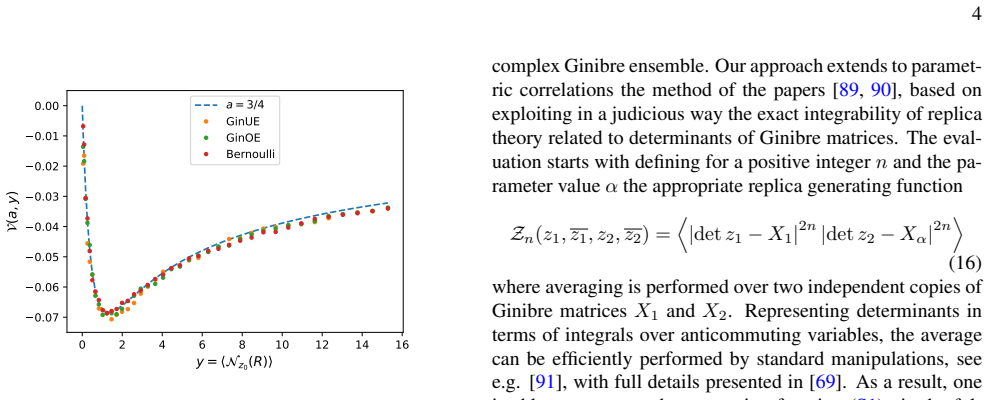
- Numerical evidence indicates the result extends to the real Ginibre ensemble, non-Hermitian Bernoulli Wigner matrices, and bi-unitarily invariant ensembles.
- The parametric correlations are related to the distribution of the eigenvector non-orthogonality factor.
Reading between the lines
- This formula could be used to predict spectral statistics in open quantum systems with varying parameters.
- Further analytical work might extend the closed-form result to other symmetry classes beyond A.
- Experimental measurements of eigenvalue correlations in dissipative systems could test the universality claim.
Signed reviews
Editorial analysis
A structured set of objections, weighed in public.
Referee Report
Summary. The paper derives an explicit closed-form expression for the parametric number covariance of eigenvalues lying in a circular domain (with finite mean count in the bulk) for the complex Ginibre ensemble in symmetry class A. It states that this behavior is expected to be universal, citing numerical support from the real Ginibre ensemble, non-Hermitian Bernoulli Wigner matrices, and bi-unitarily invariant ensembles, and relates the result to the distribution of eigenvector non-orthogonality factors.
Significance. If the derivation holds, the explicit closed-form for the Ginibre case supplies a concrete, parameter-free result for parametric spectral correlations in non-Hermitian ensembles, which is a clear technical strength. The numerical checks across multiple ensembles provide supporting evidence for broader applicability to dissipative quantum chaos, though the analytic justification for exact universality remains open.
major comments (1)
- [Abstract] Abstract: The claim that the derived closed-form 'is expected to be universal' rests on numerical evidence for the real Ginibre ensemble, non-Hermitian Bernoulli Wigner matrices, and bi-unitarily invariant ensembles, but supplies no analytic extension, symmetry mapping, or large-N asymptotic argument showing why the Ginibre result carries over exactly; this assumption is load-bearing for the connection to physical dissipative systems.
Simulated Author's Rebuttal
We thank the referee for their detailed review and constructive criticism. We address the single major comment below and agree that the universality statement requires clarification.
read point-by-point responses
-
Referee: [Abstract] Abstract: The claim that the derived closed-form 'is expected to be universal' rests on numerical evidence for the real Ginibre ensemble, non-Hermitian Bernoulli Wigner matrices, and bi-unitarily invariant ensembles, but supplies no analytic extension, symmetry mapping, or large-N asymptotic argument showing why the Ginibre result carries over exactly; this assumption is load-bearing for the connection to physical dissipative systems.
Authors: We agree with the referee that the manuscript provides no analytic extension, symmetry mapping, or large-N argument establishing exact universality beyond the complex Ginibre case. The statement in the abstract rests entirely on the numerical checks reported in the paper. We will revise the abstract (and the corresponding sentence in the introduction) to read that the closed-form result is derived for the complex Ginibre ensemble of class A and that numerical evidence from the real Ginibre ensemble, non-Hermitian Bernoulli Wigner matrices, and bi-unitarily invariant ensembles suggests the same functional form may hold more generally. The connection to dissipative quantum chaos will be retained strictly as motivation, with the universality presented as a conjecture supported by numerics rather than a proven fact. revision: yes
Circularity Check
Derivation of closed-form parametric covariance for Ginibre ensemble is direct from ensemble definition; no reduction to inputs or self-citation.
full rationale
The paper states it derives an explicit closed-form expression for the parametric number covariance directly from the parameter-dependent complex Ginibre ensemble in symmetry class A, for a circular domain with finite mean eigenvalue count in the bulk. Universality to other ensembles is stated as an expectation and supported only by separate numerical checks on real Ginibre, Bernoulli Wigner, and bi-unitarily invariant cases; no analytic extension, self-citation chain, or redefinition is invoked to justify the main result. No load-bearing step equates a prediction to a fitted input or renames a known result. The derivation chain is therefore self-contained against the ensemble definition and does not reduce by construction.
Assumptions & free parameters
Cite this review
Pith. "Pith review of Parametric correlations in non-Hermitian quantum chaos: random matrix approach." pith.science (2026). https://pith.science/paper/UFTON6RD
@misc{pith2026260620824,
  author       = {Pith},
  title        = {Pith review of: Parametric correlations in non-Hermitian quantum chaos: random matrix approach},
  year         = {2026},
  howpublished = {\url{https://pith.science/paper/UFTON6RD}},
  note         = {Machine review of arXiv:2606.20824}
}
abstract
Motivated by the surge of interest in statistics of non-Hermitian random matrices as a framework for description of universal characteristics of dissipative chaotic quantum many-body systems, we address the problem of characterizing the parametric correlations of spectral densities. Considering parameter-dependent ensemble of complex Ginibre matrices we derive an explicit, closed-form expression for the parametric number covariance in the systems of symmetry class $\mathbf{A}$ for eigenvalues in a circular domain containing on average a finite number of eigenvalues in the spectral bulk. This behavior is expected to be universal, as further supported by numerical evidence for the real Ginibre ensemble, non-Hermitian Bernoulli Wigner matrices and bi-unitarily invariant ensembles. We also discuss a relation between parametric correlations of spectral densities and the distribution of the so-called eigenvector non-orthogonality factor, which attracted considerable interest in recent years.
Figures
Reference graph
Works this paper leans on
-
[1]
Bohigas, M.-J
O. Bohigas, M.-J. Giannoni, and C. Schmit, Characterization of chaotic quantum spectra and universality of level fluctuation laws, Physical review letters52, 1 (1984)
1984
-
[2]
Gaspard, S
P. Gaspard, S. Rice, H. Mikeska, and K. Nakamura, Parametric motion of energy levels: Curvature distribution, Physical Re- view A42, 4015 (1990)
1990
-
[3]
Goldberg, M
J. Goldberg, M. Berry, W. Schweizer, G. Wunner, and G. Zeller, The parametric number variance, Nonlinearity4, 1 (1991)
1991
-
[4]
Akkermans and G
E. Akkermans and G. Montambaux, Conductance and statis- tical properties of metallic spectra, Physical review letters68, 642 (1992)
1992
-
[5]
Sierant, A
P. Sierant, A. Maksymov, M. Ku ´s, and J. Zakrzewski, Fidelity susceptibility in gaussian random ensembles, Physical Review E99, 050102 (2019)
2019
-
[6]
Szafer and B
A. Szafer and B. L. Altshuler, Universal correlation in the spec- tra of disordered systems with an aharonov-bohm flux, Physical review letters70, 587 (1993)
1993
-
[7]
Beenakker, Brownian-motion model for parametric correla- tions in the spectra of disordered metals, Physical review letters 70, 4126 (1993)
C. Beenakker, Brownian-motion model for parametric correla- tions in the spectra of disordered metals, Physical review letters 70, 4126 (1993)
1993
-
[8]
Frahm and J.-L
K. Frahm and J.-L. Pichard, Brownian motion ensembles and parametric correlations of the transmission eigenvalues: appli- cation to coupled quantum billiards and to disordered wires, Journal de Physique I5, 877 (1995)
1995
Show all 93 references
-
[9]
Berry and J
M. Berry and J. Keating, Persistent current flux correlations cal- culated by quantum chaology, Journal of Physics A: Mathemat- ical and General27, 6167 (1994)
1994
-
[10]
Simons and B
B. Simons and B. L. Altshuler, Universal velocity correlations in disordered and chaotic systems, Physical review letters70, 4063 (1993)
1993
-
[11]
Simons and B
B. Simons and B. Altshuler, Universalities in the spectra of disordered and chaotic systems, Physical Review B48, 5422 (1993)
1993
-
[12]
Simons, P
B. Simons, P. Lee, and B. Altshuler, Exact results for quan- tum chaotic systems and one-dimensional fermions from matrix models, Nuclear Physics B409, 487 (1993)
1993
-
[13]
Beenakker and B
C. Beenakker and B. Rejaei, Random-matrix theory of paramet- ric correlations in the spectra of disordered metals and chaotic billiards, Physica A: Statistical Mechanics and its Applications 203, 61 (1994)
1994
-
[14]
Nagao and P
T. Nagao and P. J. Forrester, Multilevel dynamical correlation functions for dyson’s brownian motion model of random matri- ces, Physics Letters A247, 42 (1998)
1998
-
[15]
Simons, A
B. Simons, A. Hashimoto, M. Courtney, D. Kleppner, and B. Altshuler, New class of universal correlations in the spec- tra of hydrogen in a magnetic field, Physical review letters71, 2899 (1993)
1993
-
[16]
Bertelsen, C
P. Bertelsen, C. Ellegaard, T. Guhr, M. Oxborrow, and K. Schaadt, Measurement of parametric correlations in spec- tra of resonating quartz blocks, Physical review letters83, 2171 (1999)
1999
-
[17]
Schaadt and A
K. Schaadt and A. Kudrolli, Experimental investigation of uni- versal parametric correlators using a vibrating plate, Physical Review E60, R3479 (1999)
1999
-
[18]
Savytskyy, A
N. Savytskyy, A. Kohler, S. Bauch, R. Bl ¨umel, and L. Sirko, Parametric correlations of the energy levels of ray-splitting bil- liards, Physical Review E64, 036211 (2001)
2001
-
[19]
J. Lu, J. Che, X. Zhang, and B. Dietz, Experimental and numer- ical investigation of parametric spectral properties of quantum graphs with unitary or symplectic symmetry, Physical Review E102, 022309 (2020)
2020
-
[20]
Aleiner and K
I. Aleiner and K. Matveev, Shifts of random energy levels by a local perturbation, Physical review letters80, 814 (1998)
1998
-
[21]
Marchetti, I
F. Marchetti, I. Smolyarenko, and B. Simons, Universality of parametric spectral correlations: Local versus extended per- turbing potentials, Physical Review E68, 036217 (2003)
2003
-
[22]
Smolyarenko and B
I. Smolyarenko and B. Simons, Parametric spectral statistics in unitary random matrix ensembles: from distribution functions to intra-level correlations, Journal of Physics A: Mathematical and General36, 3551 (2003)
2003
-
[23]
Monthus, Many-body-localization transition: sensitivity to twisted boundary conditions, Journal of Physics A: Mathemat- ical and Theoretical50, 095002 (2017)
C. Monthus, Many-body-localization transition: sensitivity to twisted boundary conditions, Journal of Physics A: Mathemat- ical and Theoretical50, 095002 (2017)
2017
-
[24]
Maksymov, P
A. Maksymov, P. Sierant, and J. Zakrzewski, Energy level dy- namics across the many-body localization transition, Physical Review B99, 224202 (2019)
2019
-
[25]
Garratt, S
S. Garratt, S. Roy, and J. Chalker, Local resonances and para- metric level dynamics in the many-body localized phase, Phys- ical Review B104, 184203 (2021)
2021
-
[26]
Ashida, Z
Y . Ashida, Z. Gong, and M. Ueda, Non-Hermitian physics, Adv. Phys.69, 249 (2020)
2020
-
[27]
Grobe, F
R. Grobe, F. Haake, and H.-J. Sommers, Quantum distinction of regular and chaotic dissipative motion, Phys. Rev. Lett.61, 1899 (1988)
1988
-
[28]
Akemann, M
G. Akemann, M. Kieburg, A. Mielke, and T. Prosen, Universal signature from integrability to chaos in dissipative open quan- tum systems, Phys. Rev. Lett.123, 254101 (2019)
2019
-
[29]
Denisov, T
S. Denisov, T. Laptyeva, W. Tarnowski, D. Chru ´sci´nski, and K. ˙Zyczkowski, Universal spectra of random Lindblad opera- tors, Phys. Rev. Lett.123, 140403 (2019)
2019
-
[30]
A. B. Jaiswal, A. Pandey, and R. Prakash, Universality classes of quantum chaotic dissipative systems, Europhys. Lett127, 6 30004 (2019)
2019
-
[31]
Can, Random Lindblad dynamics, J
T. Can, Random Lindblad dynamics, J. Phys. A: Math. Theor. 52, 485302 (2019)
2019
-
[32]
Hamazaki, K
R. Hamazaki, K. Kawabata, and M. Ueda, Non-Hermitian many-body localization, Phys. Rev. Lett.123, 090603 (2019)
2019
-
[33]
L. S ´a, P. Ribeiro, and T. Prosen, Spectral and steady-state prop- erties of random Liouvillians, J. Phys. A: Math. Theor.53, 305303 (2020)
2020
-
[34]
L. S ´a, P. Ribeiro, T. Can, and T. Prosen, Spectral transitions and universal steady states in random Kraus maps and circuits, Phys. Rev. B102, 134310 (2020)
2020
-
[35]
L. S ´a, P. Ribeiro, and T. Prosen, Complex spacing ratios: A sig- nature of dissipative quantum chaos, Phys. Rev. X10, 021019 (2020)
2020
-
[36]
K. Wang, F. Piazza, and D. J. Luitz, Hierarchy of relaxation timescales in local random Liouvillians, Phys. Rev. Lett.124, 100604 (2020)
2020
-
[37]
J. Li, T. Prosen, and A. Chan, Spectral statistics of non- Hermitian matrices and dissipative quantum chaos, Phys. Rev. Lett.127, 170602 (2021)
2021
-
[38]
Tarnowski, I
W. Tarnowski, I. Yusipov, T. Laptyeva, S. Denisov, D. Chru ´sci´nski, and K. ˙Zyczkowski, Random generators of Markovian evolution: A quantum-classical transition by su- perdecoherence, Phys. Rev. E104, 034118 (2021)
2021
-
[39]
Lange and C
S. Lange and C. Timm, Random-matrix theory for the Lindblad master equation, Chaos31, 023101 (2021)
2021
-
[40]
A. M. Garc ´ıa-Garc´ıa, L. S ´a, and J. J. Verbaarschot, Symme- try classification and universality in non-Hermitian many-body quantum chaos by the Sachdev-Ye-Kitaev model, Phys. Rev. X 12, 021040 (2022)
2022
-
[41]
Kulkarni, T
A. Kulkarni, T. Numasawa, and S. Ryu, Lindbladian dynam- ics of the Sachdev-Ye-Kitaev model, Phys. Rev. B106, 075138 (2022)
2022
-
[42]
Ghosh, S
S. Ghosh, S. Gupta, and M. Kulkarni, Spectral properties of dis- ordered interacting non-Hermitian systems, Phys. Rev. B106, 134202 (2022)
2022
-
[43]
Suthar, Y .-C
K. Suthar, Y .-C. Wang, Y .-P. Huang, H. Jen, and J.-S. You, Non- Hermitian many-body localization with open boundaries, Phys. Rev. B106, 064208 (2022)
2022
-
[44]
Cipolloni and J
G. Cipolloni and J. Kudler-Flam, Entanglement entropy of non- Hermitian eigenstates and the Ginibre ensemble, Phys. Rev. Lett.130, 010401 (2023)
2023
-
[45]
L. S ´a, P. Ribeiro, and T. Prosen, Symmetry classification of many-body Lindbladians: Tenfold way and beyond, Phys. Rev. X13, 031019 (2023)
2023
-
[46]
De Tomasi and I
G. De Tomasi and I. M. Khaymovich, non-Hermitian Rosenzweig-Porter random-matrix ensemble: Obstruction to the fractal phase, Phys. Rev. B106, 094204 (2022)
2022
-
[47]
De Tomasi and I
G. De Tomasi and I. M. Khaymovich, Non-Hermiticity induces localization: Good and bad resonances in power-law random banded matrices, Phys. Rev. B108, L180202 (2023)
2023
-
[48]
Ghosh, M
S. Ghosh, M. Kulkarni, and S. Roy, Eigenvector correlations across the localisation transition in non-Hermitian power-law banded random matrices, Phys. Rev. B108, L060201 (2023)
2023
-
[49]
Orgad, V
D. Orgad, V . Oganesyan, and S. Gopalakrishnan, Dynamical transitions from slow to fast relaxation in random open quantum systems, Phys. Rev. Lett.132, 040403 (2024)
2024
-
[50]
Jisha and R
C. Jisha and R. Prakash, Universality of spectral fluctuations in open quantum chaotic systems, EPL146, 11001 (2024)
2024
-
[51]
Richter, L
J. Richter, L. S´a, and M. Haque, Integrability versus chaos in the steady state of many-body open quantum systems, Phys. Rev. E 111, 064103 (2025)
2025
-
[52]
Almeida, P
G. Almeida, P. Ribeiro, M. Haque, and L. S ´a, Universality, ro- bustness, and limits of the eigenstate thermalization hypothe- sis in open quantum systems, Physical Review E113, L012101 (2026)
2026
-
[53]
G. Rufo, S. Rufo, P. Ribeiro, and S. Chesi, Quantum and semi- classical signatures of dissipative chaos in the steady state, arXiv preprint arXiv:2506.14961 10.48550/arXiv.2506.14961 (2025)
2025 doi
-
[54]
K. Wold, Z. Zhu, F. Jin, X. Zhu, Z. Bao, J. Zhong, F. Shen, P. Zhang, H. Li, Z. Wang,et al., Experimental detection of dissipative quantum chaos, arXiv preprint arXiv:2506.04325 10.48550/arXiv.2506.04325 (2025)
2025 doi
- [55]
-
[56]
Villase ˜nor, L
D. Villase ˜nor, L. F. Santos, and P. Barberis-Blostein, Break- down of the quantum distinction of regular and chaotic classical dynamics in dissipative systems, Physical Review Letters133, 240404 (2024)
2024
-
[57]
Villase ˜nor, H
D. Villase ˜nor, H. Yan, M. Orel, and M. Robnik, Correspon- dence principle, dissipation, and Ginibre ensemble, Physical Review E113, L042204 (2025)
2025
-
[58]
Ferrari, L
F. Ferrari, L. Gravina, D. Eeltink, P. Scarlino, V . Savona, and F. Minganti, Dissipative quantum chaos unveiled by stochas- tic quantum trajectories, Physical Review Research7, 013276 (2025)
2025
-
[59]
Mondal, L
D. Mondal, L. F. Santos, and S. Sinha, Transient and steady- state chaos in dissipative quantum systems, Physical Review Letters136, 040401 (2026)
2026
-
[60]
Hamazaki, K
R. Hamazaki, K. Kawabata, N. Kura, and M. Ueda, Universality classes of non-Hermitian random matrices, Phys. Rev. Research 2, 023286 (2020)
2020
-
[61]
Byun and P
S.-S. Byun and P. J. Forrester,Progress on the Study of the Gini- bre Ensembles(Springer Nature, 2025)
2025
-
[62]
Akemann, N
G. Akemann, N. Ayg ¨un, M. Kieburg, and P. P ¨aßler, Complex symmetric, self-dual, and Ginibre random matrices: analytical results for three classes of bulk and edge statistics, J. Phys. A: Math. Theor.58, 125204 (2025)
2025
-
[63]
Kulkarni, K
A. Kulkarni, K. Kawabata, and S. Ryu, Non-linear sigma mod- els for non-Hermitian random matrices in symmetry classes AI† and AII†, J. Phys. A: Math. Theor.58, 225202 (2025)
2025
-
[64]
P. J. Forrester, Dualities for characteristic polynomial averages of complex symmetric and self dual non-Hermitian random ma- trices, J. Phys. A: Math. Theor.58, 075201 (2025)
2025
-
[65]
Akemann, Y
G. Akemann, Y . V . Fyodorov, and D. V . Savin, Spectral density and eigenvector nonorthogonality in complex sym- metric random matrices, arXiv preprint arXiv:2511.21643 10.48550/arXiv.2511.21643 (2025)
2025 doi
-
[66]
Kurilov and P
M. Kurilov and P. Ostrovsky, Density of scattering reso- nances in a disordered system, arXiv preprint arXiv:2512.18717 10.48550/arXiv.2512.18717 (2025)
2025 doi
-
[67]
Bourgade, G
P. Bourgade, G. Cipolloni, and J. Huang, Fluctuations for non-hermitian dynamics, arXiv preprint arXiv:2409.02902 10.48550/arXiv.2409.02902 (2024)
2024 doi
-
[68]
Kumar, and A
Vinayak, S. Kumar, and A. Pandey, Parametric number covari- ance in quantum chaotic spectra, Physical Review E93, 032217 (2016)
2016
-
[69]
See Supplemental Material at [URL will be inserted by pub- lisher] for further details of the method and calculations
-
[70]
J. T. Chalker and B. Mehlig, Eigenvector statistics in non- Hermitian random matrix ensembles, Phys. Rev. Lett.81, 3367 (1998)
1998
-
[71]
Bourgade and G
P. Bourgade and G. Dubach, The distribution of overlaps be- tween eigenvectors of Ginibre matrices, Probabil. Theor. Re- lated Fields177, 397 (2020)
2020
-
[72]
Y . V . Fyodorov, On statistics of bi-orthogonal eigenvectors in 7 real and complex Ginibre ensembles: combining partial schur decomposition with supersymmetry, Comm. Math. Phys.363, 579 (2018)
2018
-
[73]
Kravtsov and M
V . Kravtsov and M. Zirnbauer, Kramers degeneracy and quan- tum jumps in the persistent current of disordered metal rings, Physical Review B46, 4332 (1992)
1992
-
[74]
Y . V . Fyodorov, Distribution of” level velocities” in quasi-1d disordered or chaotic systems with localization, Physical review letters73, 2688 (1994)
1994
-
[75]
level cur- vature
Y . V . Fyodorov and H.-J. Sommers, Universality of “level cur- vature” distribution for large random matrices: systematic ana- lytical approaches, Zeitschrift f ¨ur Physik B Condensed Matter 99, 123 (1995)
1995
-
[76]
level curva- ture
Y . V . Fyodorov and H.-J. Sommers, “level curva- ture”distribution for diffusive aharonov-bohm systems: Analytical results, Physical Review E51, R2719 (1995)
1995
-
[77]
Y . V . Fyodorov and A. D. Mirlin, Mesoscopic fluctuations of eigenfunctions and level-velocity distribution in disordered metals, Physical Review B51, 13403 (1995)
1995
-
[78]
Zakrzewski and D
J. Zakrzewski and D. Delande, Parametric motion of energy lev- els in quantum chaotic systems. i. curvature distributions, Phys- ical Review E47, 1650 (1993)
1993
-
[79]
von Oppen, Exact distribution of eigenvalue curvatures of chaotic quantum systems, Physical review letters73, 798 (1994)
F. von Oppen, Exact distribution of eigenvalue curvatures of chaotic quantum systems, Physical review letters73, 798 (1994)
1994
-
[80]
von Oppen, Exact distributions of eigenvalue curvatures for time-reversal-invariant chaotic systems, Physical Review E51, 2647 (1995)
F. von Oppen, Exact distributions of eigenvalue curvatures for time-reversal-invariant chaotic systems, Physical Review E51, 2647 (1995)
1995
-
[81]
Y . V . Fyodorov and D. V . Savin, Statistics of resonance width shifts as a signature of eigenfunction nonorthogonality, Phys. Rev. Lett.108, 184101 (2012)
2012
-
[82]
Shirai, Large deviations for the fermion point process asso- ciated with the exponential kernel, Journal of statistical physics 123, 615 (2006)
T. Shirai, Large deviations for the fermion point process asso- ciated with the exponential kernel, Journal of statistical physics 123, 615 (2006)
2006
-
[83]
Lacroix-A-Chez-Toine, S
B. Lacroix-A-Chez-Toine, S. N. Majumdar, and G. Schehr, Ro- tating trapped fermions in two dimensions and the complex ginibre ensemble: Exact results for the entanglement entropy and number variance, Physical Review A99, 021602 (2019)
2019
-
[84]
Fenzl and G
M. Fenzl and G. Lambert, Precise deviations for disk count- ing statistics of invariant determinantal processes, International Mathematics Research Notices2022, 7420 (2022)
2022
-
[85]
Akemann, S.-S
G. Akemann, S.-S. Byun, and M. Ebke, Universality of the number variance in rotational invariant two-dimensional coulomb gases, Journal of Statistical Physics190, 9 (2023)
2023
-
[86]
Maltsev and M
A. Maltsev and M. Osman, Bulk universality for complex non- hermitian matrices with independent and identically distributed entries, Probability Theory and Related Fields193, 289 (2025)
2025
-
[87]
Osman, Universality for diagonal eigenvector overlaps of non-hermitian random matrices, Electronic Journal of Proba- bility31, 1 (2026)
M. Osman, Universality for diagonal eigenvector overlaps of non-hermitian random matrices, Electronic Journal of Proba- bility31, 1 (2026)
2026
-
[88]
Belinschi, M
S. Belinschi, M. A. Nowak, R. Speicher, and W. Tarnowski, Squared eigenvalue condition numbers and eigenvector corre- lations from the single ring theorem, J. Phys. A: Math. Theor. 50, 105204 (2017)
2017
-
[89]
Kanzieper, Replica field theories, painlev ´e transcendents, and exact correlation functions, Physical review letters89, 250201 (2002)
E. Kanzieper, Replica field theories, painlev ´e transcendents, and exact correlation functions, Physical review letters89, 250201 (2002)
2002
-
[90]
Kanzieper, Exact replica treatment of non-hermitean com- plex random matrices, inFrontiers in Field Theory, edited by O
E. Kanzieper, Exact replica treatment of non-hermitean com- plex random matrices, inFrontiers in Field Theory, edited by O. Kovras (Nova Science Publishers, 2005) Chap. 3, pp. 23 – 51
2005
-
[91]
S. M. Nishigaki and A. Kamenev, Replica treatment of non- hermitian disordered hamiltonians, Journal of Physics A: Math- ematical and General35, 4571 (2002)
2002
-
[92]
Dea ˜no and N
A. Dea ˜no and N. Simm, Characteristic polynomials of com- plex random matrices and painlev´e transcendents, International Mathematics Research Notices2022, 210 (2022)
2022
-
[93]
u11 0 † u21 0 † u12 0 † u22 0 † ! 0u 12 0 u21 0 0 + u11 0 u12 0 u21 0 u22 0 0u 21 0 † u12 0 † 0 !# (S23) = 2√r∗Tr h u12 0 u12 0 † +u 21 0 u21 0 †i , Tr h ΛU † 0ΛU0 i = Tr
J.-B. Gros, U. Kuhl, O. Legrand, F. Mortessagne, E. Richalot, and D. V . Savin, Experimental width shift distribution: A test of nonorthogonality for local and global perturbations, Phys. Rev. Lett.113, 224101 (2014). END MA TTER Appendix: Relating(6)to distribution of diagona...
2014
Reviewed June 26, 2026 · model on record in the stance chip above.
Discussion (0). Continue with ORCID to comment.