REVIEW 6 major objections 6 minor 233 references
On AI Safety and Security Technical Debt in Engineering AI-Enabled Systems
T0 review · 6 major / 6 minor · reviewed 2026-07-31 · deepseek-v4-flash
Pith's one-line read This paper argues that AI technical debt can be systematically organized into 31 root-cause types across seven classes, mapped to specific safety and security risks, and mitigated through 34 targeted guidelines.
desk verdict A useful but unpolished synthesis: the AITD taxonomy and safety/security mapping are plausible and citable, but the specific counts and mapping edges should be treated as provisional until consistency and coding-reliability issues are fixed. read the letter →
The pith
A machine-rendered reading of the paper's core claim, the machinery that carries it, and where it could break.
The reading
What carries the argument
The central object is AITD-MAP, an integrative framework that connects three layers: the 31-debt taxonomy (the root-cause classification), the impact mappings (how each debt undermines quality, safety, and security), and the 34 mitigation guidelines (how to prevent, detect, or reduce each debt). The taxonomy itself is the load-bearing machinery: the authors construct it through three-stage grounded theory coding (open, axial, selective) of 60 primary studies, yielding 101 initial codes refined to 31 debts.
What would settle it
Have independent researchers code the same 60 studies with the same grounded-theory procedure and check whether they converge on the same 31 debts, seven classes, and 6/12 safety/security mappings; substantial divergence would refute the taxonomy's stability. Alternatively, a large-scale empirical scan of real AI repositories that finds several claimed debt types are vanishingly rare would undercut the completeness claim.
Extended reading notes
Core claim
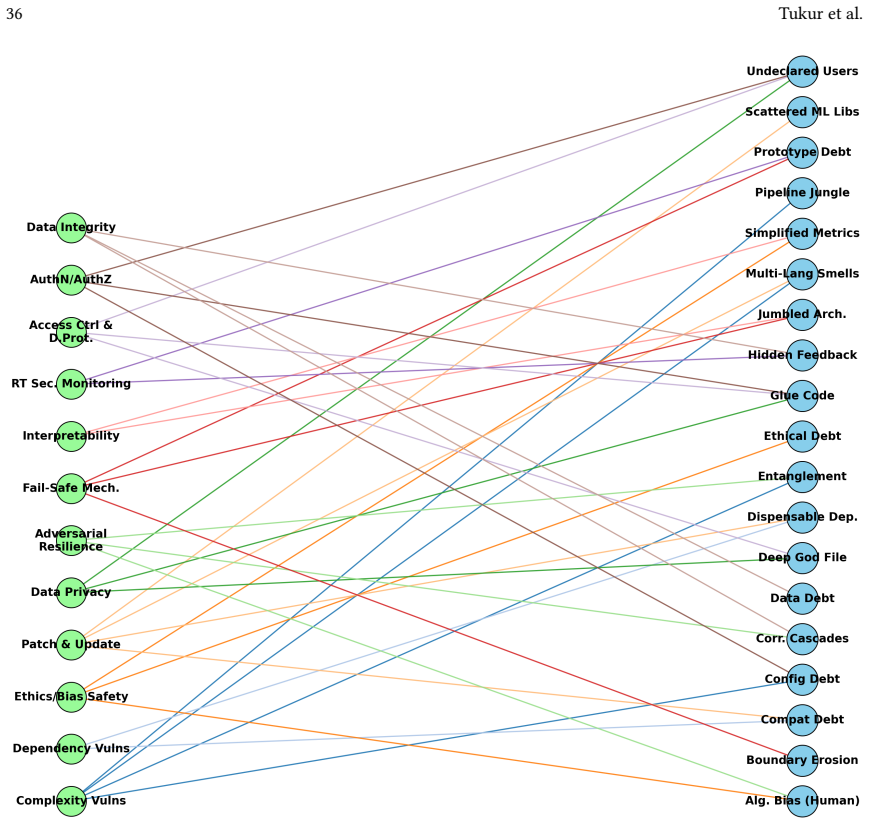
The central claim is that AI-specific technical debt is best understood through a root-cause taxonomy of 31 debt types in seven classes: Data & Library, Model & Code, Algorithm, Design & Architecture, Operational & Lifecycle, Documentation & Communication, and Testing & QA. Building on that taxonomy, the paper claims each debt can be associated with concrete safety and security concerns—6 safety (explainability, robustness, transparency, bias/fairness, adversarial/poisoning, out-of-distribution generalization) and 12 security (authentication, data integrity, patching, privacy, adversarial resilience, fail-safe, interpretability, monitoring, access control, complexity-induced, dependency-rela
Load-bearing premise
Everything rests on the authors' manual coding of 60 studies from four databases—if that sample or that coding is unrepresentative, the 31-debt taxonomy and its safety/security mappings lose their foundation.
Editorial extensions
If this is right
- Engineers can use the AITD taxonomy and its prevalence rankings (Data Debt 45%, Glue Code 30%, Test Debt 28%) to prioritize where to look for latent debt first.
- Because a single debt can map to multiple safety and security risks, debt management becomes a safety/security activity, not just a maintenance concern.
- The 34 mapped guidelines give teams a concrete menu: e.g., for Undeclared Consumers, use controlled output consumers and API-governed access.
- The taxonomy provides a shared vocabulary for research and tooling, enabling automated debt detectors to be built around the 31 defined types.
Reading between the lines
- A natural next step the authors leave implicit is to weight debts by their mapped safety/security severity rather than by reported frequency, which would reprioritize low-frequency but high-severity debts like Boundary Erosion and Correction Cascades.
- The safety/security mappings are the most contestable layer; an independent replication with a second coder pool and inter-rater agreement statistics would test whether the 6/12 mapping is stable or an artifact of the authors' interpretive lens.
- The four-database search is likely to be biased toward academic software-engineering venues; extending the same coding procedure to industrial case studies or grey literature would test the completeness of the 31-debt taxonomy.
- If operationalized as a scoring rubric, AITD-MAP could be plugged into MLOps pipelines as a debt-aware risk gate, but the paper does not yet provide the quantitative thresholds needed to do so.
Editorial analysis
A structured set of objections, weighed in public.
Referee Report
Summary. The paper reports a PRISMA-ScR scoping review of 60 primary studies on technical debt in AI-enabled systems. It proposes a root-cause-oriented taxonomy of 31 AI Technical Debts (AITDs) across seven classes, maps these debts to 6 safety and 12 security concerns, synthesizes 34 mitigation guidelines (8 safety, 26 security), and introduces the AITD-MAP framework connecting debt types, impacts, and mitigations. The central claim is that this is the first systematic, security-aware, mitigation-driven characterization of AITDs that enables engineers to trace symptoms to root causes and select targeted interventions.
Significance. If the taxonomy and mappings are stable and reproducible, this is a useful synthesis: it consolidates fragmented AITD literature, provides frequency-ranked evidence from 60 studies, and offers a practical framework for debt-aware AI engineering. The paper's strengths include its explicit PRISMA-ScR methodology, grounded-theory coding procedure, detailed tables (Tables 4–8) and visual mappings, and the AITD-MAP framework that integrates three research questions into a single artifact. The main risk is that the manual coding and interpretive safety/security mappings are not yet demonstrably reliable, and the manuscript contains several internal inconsistencies in the reported counts and percentages that underpin the framework's exact claims.
major comments (6)
- [§4.1 vs. §4 and Table 4] The abstract, §4, and Table 4 consistently report 31 AITDs, but the first paragraph of §4.1 states 'the thirty-two identified debts were systematically classified according to their root causes.' This is not merely cosmetic: the completeness of the taxonomy is a central contribution. Please correct the count and audit all references to totals throughout the manuscript.
- [§2 and Table 1 vs. §6 and §7] Related work (second paragraph of §2) says the study 'synthesizes 16 actionable guidelines for mitigating these issues,' while the abstract, §6, §7, and Table 1 report 34 synthesized mitigation guidelines (8 safety + 26 security). This discrepancy affects the magnitude of the mitigation contribution as stated in the paper's own claims. Reconcile the number and ensure all sections use the same total.
- [§4.2, Table 4 row 4] Documentation Debt is listed with frequency 15/60 and percentage 25.33%. However, 15/60 = 25.00%. The same incorrect percentage is repeated in §7. Recalculate all percentages (checking also 17/60 = 28.33%, which is correct, and 27/60 = 45.00%, which is correct) and correct the Documentation Debt row.
- [§6.2.22] The Related AITDs list for Input Sanitization contains the unresolved author annotation '(not sure - double check)'. An annotation of this kind in a submitted artifact signals that at least one mapping edge was not completed or verified. Because AITD-MAP's traceability claim depends on the correctness of every guideline→AITD and AITD→safety/security mapping, this annotation must be resolved and the full mapping set in Tables 5–8 should be systematically re-checked for consistency and completeness.
- [§3.8 and §7.1] The coding procedure is described as two co-authors independently analyzing the 60 studies and achieving 'full consensus' after structured deliberation, but no inter-rater reliability metric, coding manual excerpt, or conflict-resolution log is provided. The paper itself acknowledges in §7.1 that manual selection/coding 'still poses a risk of human bias or oversight.' Given that the 31-debt taxonomy and the safety/security mappings are the core artifacts, please report an inter-rater reliability statistic (e.g., Cohen's kappa or percent agreement on a sample), provide the coding protocol and replication data referenced in §3.7.1, or explicitly reframe the taxonomy and mappings as author-interpretive syntheses requiring external validation.
- [Table 8] Table 8 maps several guidelines to 'SATD' as a related AITD (rows 4 and 9), but SATD (self-admitted technical debt) is not one of the 31 AITDs in Table 4 and is not defined as a debt type in this review. Including an entity outside the taxonomy in the guideline mapping undermines the internal consistency of AITD-MAP. Remove SATD from the mapping or reconcile it with the taxonomy.
minor comments (6)
- [§3.7.3 and Figure 2] Text refers to 'c.f. 2. Figure 2.B' and 'c.f. Table 2' in a way that reads as leftover editing artifacts. Clean up cross-references and figure callouts throughout.
- [§4.1.1 iv] The debt name is spelled 'Dispensible Dependency' in the heading but 'Dispensable Dependency' in the text and Table 4. Standardize the spelling.
- [§4.1 RQ1.1] Typo: 'Assuarance' should be 'Assurance' in 'Testing & Quality Assuarance Debts'.
- [§5.2.3] The security concern 'Security Patch and Update' uses 'Inconsistent Use of ML Libraries' in the text, while the taxonomy in §4.1.1 and Table 4 calls this 'Scattered Use of ML Libraries (SML)'. Align terminology.
- [§5.2.12] 'Ethics Debt' is used interchangeably with 'Ethical Debt'. Use a single consistent term, preferably matching the taxonomy entry 'Ethical Debt'.
- [Table 6 vs. §5.2.5] Table 6 row 5 lists 'Algorithmic Inclination / Human Bias, Correction Cascades, Entanglement' for 'Adversarial Attack Resilience,' and §5.2.5 text lists the same three. However, the explanation in Table 6 row 5 mentions 'lack of algorithm diversity,' which is not directly tied to the listed AITDs; clarify the reasoning or adjust the explanation.
Circularity Check
No circularity: the taxonomy, mappings, and guidelines are synthesized from 60 external primary studies and established best practices, not derived from the paper's own outputs.
full rationale
The paper's derivation chain runs from an external literature corpus (60 primary studies selected via PRISMA-ScR) through grounded-theory coding to a taxonomy, then to interpretive safety/security mappings and synthesized mitigation guidelines. No link in this chain is self-referential: the inclusion criteria are literature-relevance criteria, not derived from the resulting taxonomy; the safety and security concerns are drawn from external literature (e.g., safety literature cited in Section 5.1 and security literature such as [164,178]); and the guidelines are explicitly described as consolidations of established practices: 'Our contribution lies in systematically consolidating, synthesizing, and mapping these established guidelines to the concrete forms of AITD uncovered in this review.' There are no fitted parameters, no equations, no uniqueness theorems, and no load-bearing self-citations visible in the text. The internal inconsistencies noted in the manuscript—31 vs. 32 debts in Section 4.1, 16 vs. 34 guidelines in Section 2 vs. the abstract, and the '(not sure - double check)' annotation in Section 6.2.22—are reliability/consistency concerns about the manual coding and mapping process, not circular derivations. The paper also acknowledges that the mitigation guidelines' 'practical applicability remains to be validated through industrial case studies or empirical trials,' confirming that the framework is a synthesis of external evidence rather than a self-validating derivation. Accordingly, no specific circular step can be quoted or exhibited, and the appropriate finding is no significant circularity.
Assumptions & free parameters
assumptions (3)
- domain assumption The 60 selected primary studies are representative of the AI technical debt literature.
- domain assumption The grounded-theory coding (open, axial, selective) reliably captures the constructs of technical debt.
- domain assumption AI TRiSM provides a valid conceptual lens for linking technical debt to safety and security.
Cite this review
Pith. "Pith review of On AI Safety and Security Technical Debt in Engineering AI-Enabled Systems." pith.science (2026). https://pith.science/paper/UIT3XEHM
@misc{pith2026260723365,
  author       = {Pith},
  title        = {Pith review of: On AI Safety and Security Technical Debt in Engineering AI-Enabled Systems},
  year         = {2026},
  howpublished = {\url{https://pith.science/paper/UIT3XEHM}},
  note         = {Machine review of arXiv:2607.23365}
}
read the original abstract
Artificial intelligence (AI) systems are increasingly deployed in high-stakes domains such as healthcare, autonomous driving, finance, and education. While these systems offer powerful data-driven and adaptive capabilities, their complexity, rapid evolution, and dependence on dynamic data pipelines introduce new forms of engineering liability collectively referred to as AI Technical Debts (AITDs). AITDs arise from root causes spanning data governance, model implementation, algorithm design, architectural decisions, operational processes, documentation practices, and testing adequacy. Unlike conventional technical debt, many AITDs are latent and propagate across tightly coupled AI pipelines, leading to maintenance challenges, reliability degradation, and heightened safety or security risks. Guided by the principles of AI Trust, Risk, and Security Management (AI TRiSM), this study reinterprets technical debt through the interconnected dimensions of trustworthiness, focusing on AI safety and security technical debts. We conduct a systematic review of 60 primary studies and identify 31 distinct types of AITD, which are organized into a root-cause-oriented taxonomy comprising seven classes. The analysis examines how these debts map to 18 trust-related concerns, including 6 safety hazards and 12 security vulnerabilities. To support mitigation, the review synthesizes 34 actionable guidelines (8 safety and 26 security) targeting the prevention, detection, and reduction of AITDs across the AI lifecycle. Building on these findings, we introduce AITD-MAP, an integrated framework that connects the AITD taxonomy, quality and risk impacts, and mitigation strategies into a unified structure for risk-aware AI engineering. The framework aims to assist AI software engineers in making AI safety and security technical debts visible, understanding their root causes, and mitigating their presence.
Figures


Figures from the paper (4 more)



Reference graph
Works this paper leans on
-
[1]
Nikolaj Aagaard, Eske K Aasvang, and Christian S Meyhoff. 2024. Discrepancies between Promised and Actual AI Capabilities in the Continuous Vital Sign Monitoring of In-Hospital Patients: A Review of the Current Evidence.Sensors (Basel, Switzerland)24, 19 (2024), 6497
2024
-
[2]
Amina Adadi and Mohammed Berrada. 2018. Peeking Inside the Black-Box: A Survey on Explainable Artificial Intelligence (XAI).IEEE Access6 (2018), 52138–52160. doi:10.1109/ACCESS.2018.2870052
arXiv 2018
-
[3]
Nilay Yorgancılar Akgül, Tuğba Taşkaya Temizel, Özden Özcan Top, and Pelin Dayan Akman. 2025. Aligning Data Debt with AI-Integrated Software Project Lifecycle Processes: A Standard-Based Mapping Approach. In2025 IEEE/ACM International Conference on Technical Debt (TechDebt). IEEE, 1–11
2025
-
[4]
Pelin Dayan Akman, Özden Özcan Top, and Tugba Taskaya Temizel. 2025. People and Management Debt in ML-Integrated Software Projects: Structuring Industry Insights.IEEE Access(2025)
2025
-
[5]
Mohammed Naveed Akram, Akshatha Ambekar, Ioannis Sorokos, Koorosh Aslansefat, and Daniel Schneider. 2022. StaDRe and StaDRo: reliability and robustness estimation of ML-based forecasting using statistical distance measures. InInternational Conference on Computer Safety, Reliability, and Security. Springer, 289–301
2022
-
[6]
Md Abdullah Al Alamin and Gias Uddin. 2021. Quality assurance challenges for machine learning software applications during software development life cycle phases. In2021 IEEE International Conference on Autonomous Systems (ICAS). IEEE, 1–5
2021
-
[7]
Mohannad Alahdab and Gül Çalıklı. 2019. Empirical analysis of hidden technical debt patterns in machine learning software. InProduct-Focused Software Process Improvement: 20th International Conference, PROFES 2019, Barcelona, Spain, November 27–29, 2019, Proceedings 20. Springer, 195–202
2019
-
[8]
Albahri, Ali M
A.S. Albahri, Ali M. Duhaim, Mohammed A. Fadhel, Alhamzah Alnoor, Noor S. Baqer, Laith Alzubaidi, O.S. Albahri, A.H. Alamoodi, Jinshuai Bai, Asma Salhi, Jose Santamaría, Chun Ouyang, Ashish Gupta, Yuantong Gu, and Muhammet Deveci. 2023. A systematic review of trustworthy and explainable artificial intelligence in healthcare: Assessment of quality, bias ri...
2023
Show all 233 references
-
[9]
Danyllo Albuquerque, Everton Guimaraes, Graziela Tonin, Mirko Perkusich, Hyggo Almeida, and Angelo Perkusich. 2022. Comprehending the use of intelligent techniques to support technical debt management. InProceedings of the International Conference on Technical Debt. 21–30
2022
-
[10]
Nastoska Aleksandra, Jancheska Bojana, Rizinski Maryan, and Trajanov Dimitar. 2025. Evaluating Trustworthiness in AI: Risks, Metrics, and Applications Across Industries.Electronics14, 13 (2025), 2717
2025
-
[11]
Reem Alfayez, Wesam Alwehaibi, Robert Winn, Elaine Venson, and Barry Boehm. 2020. A systematic literature review of technical debt prioritization. InProceedings of the 3rd international conference on technical debt. 1–10
2020
-
[12]
Muhammad Ali, Yim-Fun Hu, Doanh Kim Luong, George Oguntala, Jian-Ping Li, and Kanaan Abdo. 2020. Adversarial Attacks on AI based Intrusion Detection System for Heterogeneous Wireless Communications Networks. In2020 AIAA/IEEE 39th Digital A vionics Systems Conference (DASC). 1–...
2020
-
[13]
Sultan Alneyadi, Elankayer Sithirasenan, and Vallipuram Muthukkumarasamy. 2016. A survey on data leakage prevention systems.Journal of Network and Computer Applications62 (2016), 137–152
2016
-
[14]
Nicolli SR Alves, Thiago S Mendes, Manoel G De Mendonça, Rodrigo O Spínola, Forrest Shull, and Carolyn Seaman. 2016. Identification and management of technical debt: A systematic mapping study.Information and Software Technology70 (2016), 100–121
2016
-
[15]
Areti Ampatzoglou, Apostolos Ampatzoglou, Alexander Chatzigeorgiou, and Paris Avgeriou. 2015. The financial aspect of managing technical debt: A systematic literature review.Information and Software Technology64 (2015), 52–73
2015
-
[16]
Giusy Annunziata, Stefano Lambiase, Damian A Tamburri, Willem-Jan Van Den Heuvel, Fabio Palomba, Gemma Catolino, Filomena Ferrucci, and Andrea De Lucia. 2025. Uncovering community smells in machine learning-enabled systems: Causes, effects, and mitigation strategies.ACM Transa...
2025
-
[17]
Fabio Arnez, Huascar Espinoza, Ansgar Radermacher, and François Terrier. 2021. Improving Robustness of Deep Neural Networks for Aerial Navigation by Incorporating Input Uncertainty. InComputer Safety, Reliability, and Security. SAFECOMP 2021 Workshops, Ibrahim Habli, Mark Suja...
2021
-
[18]
Fabio Arnez, Huascar Espinoza, Ansgar Radermacher, and François Terrier. 2021. Improving robustness of deep neural networks for aerial navigation by incorporating input uncertainty. InInternational Conference on Computer Safety, Reliability, and Security. Springer, 219–225
2021
-
[19]
Anders Arpteg, Bjørn Brinne, Luka Crnkovic-Friis, and Jan Bosch. 2018. Software engineering challenges of deep learning. In2018 44th euromicro conference on software engineering and advanced applications (SEAA). IEEE, 50–59
2018
-
[20]
Paris Avgeriou, Philippe Kruchten, Ipek Ozkaya, and Carolyn Seaman. 2016. Managing technical debt in software engineering (dagstuhl seminar 16162).Dagstuhl reports6, 4 (2016), 110–138
2016
-
[21]
Litan Avivah. 2024. Tackling Trust, Risk and Security in AI Models.https://www.gartner.com/en/articles/ai-trust-and-ai-risk(2024)
2024
-
[22]
Yuntao Bai, Andy Jones, Kamal Ndousse, Amanda Askell, Anna Chen, Nova DasSarma, Dawn Drain, Stanislav Fort, Deep Ganguli, Tom Henighan, et al. 2022. Training a helpful and harmless assistant with reinforcement learning from human feedback.arXiv preprint arXiv:2204.05862(2022)
2022 arXiv
-
[23]
Sourav Banerjee, Mathews Thomas, Vinod Chavan, Utpal Mangla, and Srinivas Tummalapenta. 2025. Securing the future of AI: a holistic approach to trust and robustness. InAssurance and Security for AI-enabled Systems 2025, Vol. 13476. SPIE, 121–142
2025
-
[24]
Efe Barlas, Xin Du, and James C Davis. 2022. Exploiting input sanitization for regex denial of service. InProceedings of the 44th International Conference on Software Engineering. 883–895. Manuscript submitted to ACM On AI Safety and Security Technical Debt in Engineering AI-E...
2022
-
[25]
Gabriele Bavota and Barbara Russo. 2016. A large-scale empirical study on self-admitted technical debt. InProceedings of the 13th international conference on mining software repositories. 315–326
2016
-
[26]
Hrvoje Belani, Marin Vukovic, and Željka Car. 2019. Requirements engineering challenges in building AI-based complex systems. In2019 IEEE 27th International Requirements Engineering Conference Workshops (REW). IEEE, 252–255
2019
-
[27]
Gueltoum Bendiab, Amina Hameurlaine, Georgios Germanos, Nicholas Kolokotronis, and Stavros Shiaeles. 2023. Autonomous vehicles security: Challenges and solutions using blockchain and artificial intelligence.IEEE Transactions on Intelligent Transportation Systems24, 4 (2023), 3614–3637
2023
-
[28]
Aaditya Bhatia, Foutse Khomh, Bram Adams, and Ahmed E Hassan. 2023. An Empirical Study of Self-Admitted Technical Debt in Machine Learning Software.arXiv preprint arXiv:2311.12019(2023)
2023
-
[29]
Goutham Bilakanti. [n. d.]. Secure Data Masking for Healthcare Data Protection. ([n. d.])
-
[30]
Justus Bogner, Roberto Verdecchia, and Ilias Gerostathopoulos. 2021. Characterizing technical debt and antipatterns in AI-based systems: A systematic mapping study. In2021 IEEE/ACM International Conference on Technical Debt (TechDebt). IEEE, 64–73
2021
-
[31]
Gusseppe Bravo-Rocca, Peini Liu, Jordi Guitart, Ajay Dholakia, David Ellison, and Miroslav Hodak. 2022. Human-in-the-loop online multi-agent approach to increase trustworthiness in ML models through trust scores and data augmentation. In2022 IEEE 46th Annual Computers, Softwar...
2022
-
[32]
Eric Breck, Shanqing Cai, Eric Nielsen, Michael Salib, and D Sculley. 2017. The ML test score: A rubric for ML production readiness and technical debt reduction. In2017 IEEE international conference on big data (big data). IEEE, 1123–1132
2017
-
[33]
Alessio Bucaioni, Rick Kazman, and Patrizio Pelliccione. 2025. A checklist of quality concerns for architecting ML-intensive systems.Journal of Systems and Software(2025), 112612
2025
-
[34]
Anna L Buczak, Benjamin D Baugher, Adam J Berlier, Kayla E Scharfstein, and Christine S Martin. 2022. Explainable forecasts of disruptive events using recurrent neural networks. In2022 IEEE international conference on assured autonomy (ICAA). IEEE, 64–73
2022
-
[35]
Jean-Christophe Bélisle-Pipon, Erica Monteferrante, Marie-Christine Roy, and Vincent Couture. 2023. Artificial intelligence ethics has a black box problem.AI and Society38, 4 (2023), 1507 – 1522. Cited by: 32. doi:10.1007/s00146-021-01380-0
2023 doi
-
[36]
Rojas Camilo, Sato Yuki, and Bennett Eleanor. 2024. AI-DRIVEN THREAT INTELLIGENCE: ENHANCING CYBERSECURITY IN MODERN SOFTWARE SYSTEMS.Journal of Adaptive Learning Technologies1, 8 (2024), 53–68
2024
-
[37]
Nicholas Carlini and David Wagner. 2017. Towards evaluating the robustness of neural networks. In2017 ieee symposium on security and privacy (sp). Ieee, 39–57
2017
-
[38]
Albana Celepija, Bruno Lepri, and Raman Kazhamiakin. 2025. Towards a structured AI development lifecycle for reusable AI products in the public sector. (2025)
2025
-
[39]
Vinay Chamola, Vikas Hassija, A Razia Sulthana, Debshishu Ghosh, Divyansh Dhingra, and Biplab Sikdar. 2023. A review of trustworthy and explainable artificial intelligence (xai).IEEe Access11 (2023), 78994–79015
2023
-
[40]
Jiyoo Chang and Christine Custis. 2022. Understanding implementation challenges in machine learning documentation. InProceedings of the 2nd ACM Conference on Equity and Access in Algorithms, Mechanisms, and Optimization. 1–8
2022
-
[41]
Yupeng Chang, Xu Wang, Jindong Wang, Yuan Wu, Linyi Yang, Kaijie Zhu, Hao Chen, Xiaoyuan Yi, Cunxiang Wang, Yidong Wang, et al. 2024. A survey on evaluation of large language models.ACM Transactions on Intelligent Systems and Technology15, 3 (2024), 1–45
2024
-
[42]
Dev Kumar Chaudhary, Sandeep Srivastava, and Vikas Kumar. 2018. A review on hidden debts in machine learning systems. In2018 Second International Conference on Green Computing and Internet of Things (ICGCIoT). IEEE, 619–624
2018
-
[43]
Chhavi Chawla, Siddharth Chatterjee, Sanketh Siddanna Gadadinni, Pulkit Verma, and Sourav Banerjee. 2024. Agentic AI: The building blocks of sophisticated AI business applications.Journal of AI, Robotics & Workplace Automation3, 3 (2024), 1–15
2024
-
[44]
Junjie Chen, Yihua Liang, Qingchao Shen, Jiajun Jiang, and Shuochuan Li. 2023. Toward understanding deep learning framework bugs.ACM Transactions on Software Engineering and Methodology32, 6 (2023), 1–31
2023
-
[45]
Uma Maheswari, Rajanikanth Aluvalu, and K
Krishna Keerthi Chennam, Swapna Mudrakola, V. Uma Maheswari, Rajanikanth Aluvalu, and K. Gangadhara Rao. 2023.Black Box Models for eXplainable Artificial Intelligence. Springer International Publishing, Cham, 1–24. doi:10.1007/978-3-031-12807-3_1
2023 doi
-
[46]
Dinesh Reddy Chirra. 2020. AI-Based Real-Time Security Monitoring for Cloud-Native Applications in Hybrid Cloud Environments.Revista de Inteligencia Artificial en Medicina11, 1 (2020), 382–402
2020
-
[47]
Seok-Hwan Choi, Jin-Myeong Shin, Peng Liu, and Yoon-Ho Choi. 2022. ARGAN: Adversarially robust generative adversarial networks for deep neural networks against adversarial examples.IEEE Access10 (2022), 33602–33615
2022
-
[48]
Jessica Cooper, Ognjen Arandjelović, and David J Harrison. 2022. Believe the HiPe: Hierarchical perturbation for fast, robust, and model-agnostic saliency mapping.Pattern Recognition129 (2022), 108743
2022
-
[49]
Juliet M Corbin and Anselm Strauss. 1990. Grounded theory research: Procedures, canons, and evaluative criteria.Qualitative sociology13, 1 (1990), 3–21. doi:10.1007/BF00988593
1990 doi
-
[50]
Davide Corsi, Enrico Marchesini, and Alessandro Farinelli. 2021. Formal verification of neural networks for safety-critical tasks in deep reinforcement learning. InProceedings of the Thirty-Seventh Conference on Uncertainty in Artificial Intelligence (Proceedings of Machine Le...
2021
-
[51]
Dolors Costal, Cristina Gómez, Santiago del Rey, and Silverio Martínez-Fernández. 2024. Using Metrics for Code Smells of ML Pipelines. In2024 IEEE 21st International Conference on Software Architecture Companion (ICSA-C). 289–294. doi:10.1109/ICSA-C63560.2024.00055 Manuscript ...
2024
-
[52]
Pierre-Olivier Côté, Amin Nikanjam, Rached Bouchoucha, Ilan Basta, Mouna Abidi, and Foutse Khomh. 2024. Quality issues in machine learning software systems.Empirical Software Engineering29, 6 (2024), 1–47
2024
-
[53]
Warteruzannan Soyer Cunha, Guisella Angulo Armijo, and Valter Vieira de Camargo. 2020. Investigating non-usually employed features in the identification of architectural smells: A machine learning-based approach. InProceedings of the 14th Brazilian Symposium on Software Compon...
2020
-
[54]
Ward Cunningham. 1992. The WyCash portfolio management system.ACM Sigplan Oops Messenger4, 2 (1992), 29–30
1992
-
[55]
Guangye Dai, Saurav Sthapit, Gregory Epiphaniou, and Carsten Maple. 2021. Artificial intelligence technologies in building resilient machine learning. InCompetitive Advantage in the Digital Economy (CADE 2021), Vol. 2021. IET, 50–55
2021
-
[56]
Ning Dang, Keyong Shao, Long Chen, and Min Yang. 2022. Multi-model decision-making seizure types classification based on transfer learning. Proceedings - 2022 International Symposium on Control Engineering and Robotics, ISCER 2022(2022), 192 – 201. Cited by: 6. doi:10.1109/ISC...
2022
-
[57]
Manas Dave and Neil Patel. 2023. Artificial intelligence in healthcare and education.British dental journal234, 10 (2023), 761–764
2023
-
[58]
Evren Dağlarli. 2020. Explainable Artificial Intelligence (xAI) Approaches and Deep Meta-Learning Models. InAdvances and Applications in Deep Learning, Marco Antonio Aceves-Fernandez (Ed.). IntechOpen, Rijeka, Chapter 5. doi:10.5772/intechopen.92172
2020 doi
-
[59]
Jip WTM de Kok, Miguel Á Armengol de la Hoz, Ymke de Jong, Véronique Brokke, Paul WG Elbers, Patrick Thoral, Alejandro Castillejo, Tomás Trenor, Jose M Castellano, Alberto E Bronchalo, et al. 2023. A guide to sharing open healthcare data under the General Data Protection Regul...
2023
-
[60]
Ronnie de Souza Santos, Felipe Fronchetti, Sávio Freire, and Rodrigo Spinola. 2025. Software fairness debt: Building a research agenda for addressing bias in AI systems.ACM Transactions on Software Engineering and Methodology34, 5 (2025), 1–21
2025
-
[61]
Shouki A Ebad. 2022. Exploring how to apply secure software design principles.IEEE Access10 (2022), 128983–128993
2022
-
[62]
2021.Technical Debt in Practice: How to Find It and Fix It
Neil Ernst, Rick Kazman, and Julien Delange. 2021.Technical Debt in Practice: How to Find It and Fix It. MIT Press
2021
-
[63]
Marie Farrell, Matt Luckcuck, Laura Pullum, Michael Fisher, Ali Hessami, Danit Gal, Zvikomborero Murahwi, and Ken Wallace. 2021. Evolution of the IEEE P7009 standard: Towards fail-safe design of autonomous systems. In2021 IEEE International Symposium on Software Reliability En...
2021
-
[64]
Michael Feffer, Anusha Sinha, Wesley H Deng, Zachary C Lipton, and Hoda Heidari. 2024. Red-teaming for generative AI: Silver bullet or security theater?. InProceedings of the AAAI/ACM Conference on AI, Ethics, and Society, Vol. 7. 421–437
2024
-
[65]
Phillips, Ivana Malenica, Andrew Bishara, Alan E
Jean Feng, Rachael V. Phillips, Ivana Malenica, Andrew Bishara, Alan E. Hubbard, Leo A. Celi, and Romain Pirracchio. 2022. Clinical artificial intelligence quality improvement: towards continual monitoring and updating of AI algorithms in healthcare.npj Digital Medicine5, 1 (2...
2022 doi
-
[66]
Emilio Ferrara. 2023. Fairness and bias in artificial intelligence: A brief survey of sources, impacts, and mitigation strategies.Sci6, 1 (2023), 3
2023
-
[67]
Michael Fisher, Viviana Mascardi, Kristin Yvonne Rozier, Bernd-Holger Schlingloff, Michael Winikoff, and Neil Yorke-Smith. 2021. Towards a framework for certification of reliable autonomous systems.Autonomous Agents and Multi-Agent Systems35 (2021), 1–65
2021
-
[68]
Harald Foidl and Michael Felderer. 2019. Risk-based data validation in machine learning-based software systems. Inproceedings of the 3rd ACM SIGSOFT international workshop on machine learning techniques for software quality evaluation. 13–18
2019
-
[69]
Harald Foidl, Michael Felderer, and Stefan Biffl. 2019. Technical debt in data-intensive software systems. In2019 45th Euromicro conference on software engineering and advanced applications (SEAA). IEEE, 338–341
2019
-
[70]
Harald Foidl, Michael Felderer, and Rudolf Ramler. 2022. Data smells: Categories, causes and consequences, and detection of suspicious data in ai-based systems. InProceedings of the 1st International Conference on AI Engineering: Software Engineering for AI. 229–239
2022
-
[71]
Valentina Franzoni. 2023. From black box to glass box: advancing transparency in artificial intelligence systems for ethical and trustworthy AI. In International Conference on Computational Science and Its Applications. Springer, 118–130
2023
-
[72]
Narayana Gaddam. 2024. AI-POWERED DATA MASKING FOR PRIVACY-PRESERVING CLOUD DATA SHARING.International Journal of Advanced Research in Cloud Computing5, 2 (2024), 12–22
2024
-
[73]
Ming-Feng Ge, Jing-Zhe Xu, Zhi-Wei Liu, and Jian Huang. 2024. A mode-switched control architecture for human-in-the-loop teleoperation of multislave robots via data-training-based observer.IEEE Transactions on Systems, Man, and Cybernetics: Systems54, 4 (2024), 2471–2483
2024
-
[74]
Jiri Gesi, Siqi Liu, Jiawei Li, Iftekhar Ahmed, Nachiappan Nagappan, David Lo, Eduardo Santana de Almeida, Pavneet Singh Kochhar, and Lingfeng Bao. 2022. Code Smells in Machine Learning Systems. (2022)
2022
-
[75]
Julien Girard-Satabin, Michele Alberti, François Bobot, Zakaria Chihani, and Augustin Lemesle. 2022. CAISAR: A platform for Characterizing Artificial Intelligence Safety and Robustness. InAISafety
2022
-
[76]
Mansi Girdhar, Junho Hong, and John Moore. 2023. Cybersecurity of autonomous vehicles: A systematic literature review of adversarial attacks and defense models.IEEE Open Journal of Vehicular Technology4 (2023), 417–437
2023
-
[77]
Paolo Giudici and Emanuela Raffinetti. 2023. SAFE Artificial Intelligence in finance.Finance Research Letters56 (2023), 104088
2023
-
[78]
Kseniia Gnitko. 2024. Systematic overview of AI security standards.A vailable at SSRN 4922592(2024)
2024
-
[79]
David Groombridge et al. 2022. Gartner top 10 strategic technology trends for 2023.https://www. gartner. com/en/articles/gartner-top-10-strategic- technology-trends-for-2023(2022)
2022
-
[80]
Praveen Gujar. 2025. Data standardization and interoperability. InData usability in the enterprise: how usability leads to optimal digital experiences. Springer, 89–110. Manuscript submitted to ACM On AI Safety and Security Technical Debt in Engineering AI-Enabled Systems 59
2025
-
[81]
Jiajia Guo, Shaodan Ma, Chao-Kai Wen, and Shi Jin. 2025. Performance Monitoring-Enabled Reliable AI-Based CSI Feedback.IEEE Transactions on Wireless Communications24, 1 (2025), 197 – 212. Cited by: 1. doi:10.1109/TWC.2024.3490600
2025
-
[82]
Pooja Gupta, Ravinder Singh, Harshdeep Kaur, N Subramanian, Neha Jain, et al. 2025. Optimizing Cryptocurrency Trading Strategies through Artificial Intelligence and Blockchain Integration: A Multi-Model Framework for Predictive Analytics.Advances in Consumer Research2, 3 (2025)
2025
-
[83]
Sameeksha Gupta. 2025. GPU Reliability in AI Clusters: A Study of Failure Modes and Effects.Journal Of Engineering And Computer Sciences4, 6 (2025), 298–306
2025
-
[84]
Bálint Gyevnár and Atoosa Kasirzadeh. 2025. AI safety for everyone.Nature Machine Intelligence7, 4 (2025), 531 – 542. Cited by: 0. doi:10.1038/s42256- 025-01020-y
2025 doi
-
[85]
Adib Habbal, Mohamed Khalif Ali, and Mustafa Ali Abuzaraida. 2024. Artificial Intelligence Trust, risk and security management (AI trism): Frameworks, applications, challenges and future research directions.Expert Systems with Applications240 (2024), 122442
2024
-
[86]
Thilo Hagendorff. 2021. Linking human and machine behavior: A new approach to evaluate training data quality for beneficial machine learning. Minds and Machines31, 4 (2021), 563–593
2021
-
[87]
Tom Haider, Karsten Roscher, Felippe Schmoeller da Roza, and Stephan Günnemann. 2023. Out-of-Distribution Detection for Reinforcement Learning Agents with Probabilistic Dynamics Models.Proceedings of the International Joint Conference on Autonomous Agents and Multiagent System...
2023
-
[88]
Ronan Hamon, Henrik Junklewitz, Josep Soler Garrido, and Ignacio Sanchez. 2024. Three challenges to secure AI systems in the context of AI regulations.Ieee Access12 (2024), 61022–61035
2024
-
[89]
Moritz Hardt, Eric Price, and Nathan Srebro. 2016. Equality of opportunity in supervised learning. InProceedings of the 30th International Conference on Neural Information Processing Systems(Barcelona, Spain)(NIPS’16). Curran Associates Inc., Red Hook, NY, USA, 3323–3331
2016
-
[90]
Hongmei He, John Gray, Angelo Cangelosi, Qinggang Meng, T Martin McGinnity, and Jörn Mehnen. 2021. The challenges and opportunities of human-centered AI for trustworthy robots and autonomous systems.IEEE Transactions on Cognitive and Developmental Systems14, 4 (2021), 1398–1412
2021
-
[91]
Elena Hernández, Mehmet Öztürk, Inés Sittón, and Sara Rodríguez. 2019. Data protection on FinTech platforms. InHighlights of Practical Applications of Survivable Agents and Multi-Agent Systems. The PAAMS Collection: International Workshops of PAAMS 2019, Ávila, Spain, June 26–...
2019
-
[92]
Kalle Hjerppe, Jukka Ruohonen, and Ville Leppänen. 2019. The general data protection regulation: Requirements, architectures, and constraints. Proceedings of the IEEE International Conference on Requirements Engineering2019-September (2019), 265 – 275. Cited by: 39; All Open A...
2019
-
[93]
Anh Hoang and Hien Phan. 2024. Explainable AI in Finance: an Overview. (2024)
2024
-
[94]
Ben Hutchinson, Andrew Smart, Alex Hanna, Emily Denton, Christina Greer, Oddur Kjartansson, Parker Barnes, and Margaret Mitchell. 2021. Towards accountability for machine learning datasets: Practices from software engineering and infrastructure. InProceedings of the 2021 ACM C...
2021
-
[95]
IBM. 2025. What is AI TRiSM? Accessed: 16 January 2026. https://www.ibm.com/think/topics/ai-trism
2025
-
[96]
2022.List of ISO 27002:2022 Controls — What Changed in 2022?Accessed: Dec 02, 2025
ISO/IEC 27002. 2022.List of ISO 27002:2022 Controls — What Changed in 2022?Accessed: Dec 02, 2025
2022
-
[97]
M Jaeyalakshmi, P Rohit Gangadhar, M Srivatsan, and M Bhavani. 2023. A Self-learning Ai-Based Information Leak Protection System. In International Conference on Advances in Artificial Intelligence and Machine Learning in Big Data Processinging. Springer, 68–78
2023
-
[98]
Nikita Jaipuria, Katherine Stevo, Xianling Zhang, Meghana L Gaopande, Ian Calle, Jinesh Jain, and Vidya N Murali. 2022. deepPIC: Deep perceptual image clustering for identifying bias in vision datasets. InProceedings of the IEEE/CVF Conference on Computer Vision and Pattern Re...
2022
-
[99]
Shadi Jawhar, Jeremy Miller, and Zeina Bitar. 2024. AI-based cybersecurity policies and procedures. In2024 IEEE 3rd International Conference on AI in Cybersecurity (ICAIC). IEEE, 1–5
2024
-
[100]
Hadhemi Jebnoun, Md Saidur Rahman, Foutse Khomh, and Biruk Asmare Muse. 2022. Clones in deep learning code: what, where, and why? Empirical Software Engineering27, 4 (2022), 84
2022
-
[101]
Gavin Jones, Dimitrios Kasimatis, Nikolaos Pitropakis, Richard Macfarlane, and William J Buchanan. 2025. Analysing the role of LLMs in cybersecurity incident management.International Journal of Information Security24, 6 (2025), 1–14
2025
-
[102]
2019.Transfer Learning: Domain Adaptation
Uday Kamath, John Liu, and James Whitaker. 2019.Transfer Learning: Domain Adaptation. Springer International Publishing, Cham, 495–535. doi:10.1007/978-3-030-14596-5_11
2019 doi
-
[103]
Ryo Kamoi and Kei Kobayashi. 2020. Out-of-Distribution Detection with Likelihoods Assigned by Deep Generative Models Using Multimodal Prior Distributions. InSafeAI@AAAI. https://api.semanticscholar.org/CorpusID:212419400
2020
-
[104]
Stefan Katzenbeisser, Ilia Polian, Francesco Regazzoni, and Marc Stöttinger. 2019. Security in autonomous systems. In2019 IEEE European Test Symposium (ETS). IEEE, 1–8
2019
-
[105]
Omkar Khanvilkar, Mohamed Wiem Mkaouer, Eman Abdullah AlOmar, Abdelrahman ElSaid, Amal Chaaben, and Mohamed Touati. 2025. Automated Identification of Machine Learning Technical Debt Code Comments. In2025 International Conference on Emerging Technologies and Computing (IC_ETC)....
2025
-
[106]
Anton Khritankov. 2021. Hidden feedback loops in machine learning systems: A simulation model and preliminary results. InSoftware Quality: Future Perspectives on Software Engineering Quality: 13th International Conference, SWQD 2021, Vienna, Austria, January 19–21, 2021, Proce...
2021
-
[107]
Jin-Young Kim and Sung-Bae Cho. 2020. Fair representation for safe artificial intelligence via adversarial learning of unbiased information bottleneck.. InSafeAI@ AAAI. 105–112
2020
-
[108]
MNV Kiranbabu, A Jeraldine Viji, Amit Kumar Chandanan, Vijay Birchha, Tushar Kumar Pandey, and Sumit Kumar Sar. 2025. The Challenge of Adversarial Attacks on AI-Driven Cybersecurity Systems.Journal of Cybersecurity & Information Management15, 1 (2025)
2025
-
[109]
Howard Kleinwaks, Ann Batchelor, and Thomas H Bradley. 2023. An Ontology for Technical Debt in Systems Engineering.IEEE Open Journal of Systems Engineering(2023)
2023
-
[110]
Howard Kleinwaks, Ann Batchelor, and Thomas H Bradley. 2023. Technical debt in systems engineering—A systematic literature review.Systems Engineering26, 5 (2023), 675–687
2023
-
[111]
Agneza Krajna, Mihael Kovac, Mario Brcic, and Ana Šarčević. 2022. Explainable artificial intelligence: An updated perspective. In2022 45th Jubilee International Convention on Information, Communication and Electronic Technology (MIPRO). IEEE, 859–864
2022
-
[112]
Nina Kshetry and Lav R Varshney. 2019. Safety in the face of unknown unknowns: Algorithm fusion in data-driven engineering systems. InICASSP 2019-2019 IEEE International Conference on Acoustics, Speech and Signal Processing (ICASSP). IEEE, 8162–8166
2019
-
[113]
P Vishnu Kumar, Tanaya Ganguly, Rolly Gupta, Kiran Sree Pokkuluri, Avinash Kumar V Mishra, and V Selvi. 2024. ML and AI Based Healthcare Model to more Interpretable and Transparent in Medical Diagnosis.African Journal of Biological Sciences(2024)
2024
-
[114]
Valentina Lenarduzzi, Francesco Lomio, Sergio Moreschini, Davide Taibi, and Damian Andrew Tamburri. 2021. Software quality for ai: Where we are now?. InSoftware Quality: Future Perspectives on Software Engineering Quality: 13th International Conference, SWQD 2021, Vienna, Aust...
2021
-
[115]
Bo Li, Peng Qi, Bo Liu, Shuai Di, Jingen Liu, Jiquan Pei, Jinfeng Yi, and Bowen Zhou. 2023. Trustworthy AI: From principles to practices.Comput. Surveys55, 9 (2023), 1–46
2023
-
[116]
Yikun Li, Mohamed Soliman, and Paris Avgeriou. 2022. Identifying self-admitted technical debt in issue tracking systems using machine learning. Empirical Software Engineering27, 6 (2022), 131
2022
-
[117]
Yikun Li, Mohamed Soliman, and Paris Avgeriou. 2023. Automatic identification of self-admitted technical debt from four different sources. Empirical Software Engineering28, 3 (2023), 65
2023
-
[118]
Yikun Li, Mohamed Soliman, Paris Avgeriou, and Maarten Van Ittersum. 2023. DebtViz: A Tool for Identifying, Measuring, Visualizing, and Monitoring Self-Admitted Technical Debt. In2023 IEEE International Conference on Software Maintenance and Evolution (ICSME). IEEE, 558–562
2023
-
[119]
Zengyang Li, Paris Avgeriou, and Peng Liang. 2015. A systematic mapping study on technical debt and its management.Journal of Systems and Software101 (2015), 193–220
2015
-
[120]
Jiakun Liu, Qiao Huang, Xin Xia, Emad Shihab, David Lo, and Shanping Li. 2020. Is using deep learning frameworks free? characterizing technical debt in deep learning frameworks. InProceedings of the ACM/IEEE 42nd International Conference on Software Engineering: Software Engin...
2020
-
[121]
Jiakun Liu, Qiao Huang, Xin Xia, Emad Shihab, David Lo, and Shanping Li. 2021. An exploratory study on the introduction and removal of different types of technical debt in deep learning frameworks.Empirical Software Engineering26 (2021), 1–36
2021
-
[122]
Kristina Loncar, Jasmin Redzepagic, and Vedran Dakic. 2024. SECURE CODING GUIDELINES AND STANDARDS.Annals of DAAAM & Proceedings 35 (2024)
2024
-
[123]
Qinghua Lu, Yuxiu Luo, Liming Zhu, Mingjian Tang, Xiwei Xu, and Jon Whittle. 2023. Developing responsible chatbots for financial services: a pattern-oriented responsible artificial intelligence engineering approach.IEEE Intelligent Systems38, 6 (2023), 42–51
2023
-
[124]
Qinghua Lu, Liming Zhu, Xiwei Xu, and Jon Whittle. 2023. Responsible-AI-by-design: A pattern collection for designing responsible artificial intelligence systems.Ieee Software40, 3 (2023), 63–71
2023
-
[125]
Qinghua Lu, Liming Zhu, Xiwei Xu, Jon Whittle, David Douglas, and Conrad Sanderson. 2022. Software engineering for responsible AI: An empirical study and operationalised patterns. InProceedings of the 44th International Conference on Software Engineering: Software Engineering ...
2022
-
[126]
Qinghua Lu, Liming Zhu, Xiwei Xu, Jon Whittle, Didar Zowghi, and Aurelie Jacquet. 2024. Responsible AI pattern catalogue: A collection of best practices for AI governance and engineering.Comput. Surveys56, 7 (2024), 1–35
2024
-
[127]
Majdi Maabreh, Omar Darwish, Ola Karajeh, and Yahya Tashtoush. 2022. On developing deep learning models with particle swarm optimization in the presence of poisoning attacks. In2022 International Arab Conference on Information Technology (ACIT). IEEE, 1–5
2022
-
[128]
Majdi Maabreh, Arwa Maabreh, Basheer Qolomany, and Ala Al-Fuqaha. 2022. The robustness of popular multiclass machine learning models against poisoning attacks: Lessons and insights.International Journal of Distributed Sensor Networks18, 7 (2022), 15501329221105159
2022
-
[129]
Alina Mailach and Norbert Siegmund. 2023. Socio-technical anti-patterns in building ML-enabled software: insights from leaders on the forefront. In2023 IEEE/ACM 45th International Conference on Software Engineering (ICSE). IEEE, 690–702
2023
-
[131]
Silverio Martínez-Fernández, Justus Bogner, Xavier Franch, Marc Oriol, Julien Siebert, Adam Trendowicz, Anna Maria Vollmer, and Stefan Wagner
-
[132]
Wataru Matsuda, Mariko Fujimoto, Tomomi Aoyama, and Takuho Mitsunaga. 2019. Cyber security risk assessment on industry 4.0 using ics testbed with ai and cloud. In2019 IEEE conference on application, information and network security (AINS). IEEE, 54–59
2019
-
[133]
Mohcin Mekhfioui, Nabil El Bazi, Oussama Laayati, Amal Satif, Marouan Bouchouirbat, Chaïmaâ Kissi, Tarik Boujiha, and Ahmed Chebak. 2025. Optimized digital watermarking for robust information security in embedded systems.Information16, 4 (2025), 322
2025
-
[134]
Cited by: Manuscript submitted to ACM On AI Safety and Security Technical Debt in Engineering AI-Enabled Systems 61 138; All Open Access, Green Open Access
Software Engineering for AI-Based Systems: A Survey.ACM Transactions on Software Engineering and Methodology31, 2 (2022). Cited by: Manuscript submitted to ACM On AI Safety and Security Technical Debt in Engineering AI-Enabled Systems 61 138; All Open Access, Green Open Access...
2022 doi
-
[135]
Ahmed Menshawy, Zeeshan Nawaz, and Mahmoud Fahmy. 2024. Navigating Challenges and Technical Debt in Large Language Models Deployment. InProceedings of the 4th Workshop on Machine Learning and Systems. 192–199
2024
-
[136]
Faisal Mohammed. 2024. Developing Transparent AI Models to Enhance Interpretability and Trust in Medical Diagnostics: Implementing explainable AI techniques to provide transparent explanations for medical diagnoses, enhancing trust and acceptance among healthcare professionals...
2024
-
[137]
Mark Huasong Meng, Guangdong Bai, Sin Gee Teo, Zhe Hou, Yan Xiao, Yun Lin, and Jin Song Dong. 2022. Adversarial Robustness of Deep Neural Networks: A Survey from a Formal Verification Perspective.ArXivabs/2206.12227 (2022). https://api.semanticscholar.org/CorpusID:249223202
2022 arXiv
-
[138]
Sergio Moreschini, Valentina Lenarduzzi, and Ludovik Coba. 2024. Towards a Technical Debt for AI-based Recommender System. InProceedings of the 7th ACM/IEEE International Conference on Technical Debt. 36–39
2024
-
[139]
Mohan Vamsi Musunuru, Chiranjeevi Devi, and Swaminathan Sethuraman. 2025. Optimizing Hot Standby Redundancy Using AI for Network Traffic Balancing and Failover Management.Journal of Knowledge Learning and Science Technology ISSN: 2959-6386 (online)4, 3 (2025), 14–26
2025
-
[140]
Vasilica-Andreea Moldovan, Liviu-Marian Berciu, and Rares-Danut Patcas. 2024. The python software quality dataset. In2024 50th Euromicro Conference on Software Engineering and Advanced Applications (SEAA). IEEE, 395–398
2024
-
[141]
Muhammad Naeem, Tauseef Jamal, Jorge Diaz-Martinez, Shariq Aziz Butt, Nicolo Montesano, Muhammad Imran Tariq, Emiro De-la Hoz-Franco, and Ethel De-La-Hoz-Valdiris. 2021. Trends and future perspective challenges in big data. InAdvances in intelligent data analysis and applicati...
2021
-
[142]
Nadia Nahar, Shurui Zhou, Grace Lewis, and Christian Kästner. 2022. Collaboration challenges in building ml-enabled systems: Communication, documentation, engineering, and process. InProceedings of the 44th international conference on software engineering. 413–425
2022
-
[143]
Mallek Mziou Sallami, Mohamed Ibn Khedher, Asma Trabelsi, Samy Kerboua-Benlarbi, and Dimitri Bettebghor. 2019. Safety and robustness of deep neural networks object recognition under generic attacks. InInternational conference on neural information processing. Springer, 274–286
2019
-
[144]
Mary Nankya, Allan Mugisa, Yusuf Usman, Aadesh Upadhyay, and Robin Chataut. 2024. Security and Privacy in E-Health Systems: A Review of AI and Machine Learning Techniques.IEEE Access(2024)
2024
-
[145]
Sidhant Narula, Mohammad Ghasemigol, Javier Carnerero-Cano, Amanda Minnich, Emil Lupu, and Daniel Takabi. 2025. Exploring AI Security: A Systematic Mapping Study.IEEE Access(2025)
2025
-
[146]
MK Nallakaruppan, Balamurugan Balusamy, M Lawanya Shri, V Malathi, and Siddhartha Bhattacharyya. 2024. An Explainable AI framework for credit evaluation and analysis.Applied Soft Computing153 (2024), 111307
2024
-
[147]
NIST. 2024. AI Risks and Trustworthiness.https://airc.nist.gov/airmf-resources/airmf/3-sec-characteristics/(2024)
2024
-
[148]
David OBrien, Sumon Biswas, Sayem Imtiaz, Rabe Abdalkareem, Emad Shihab, and Hridesh Rajan. 2022. 23 shades of self-admitted technical debt: An empirical study on machine learning software. InProceedings of the 30th ACM Joint European Software Engineering Conference and Sympos...
2022
-
[149]
Amin Nikanjam and Foutse Khomh. 2021. Design smells in Deep Learning programs: an empirical study. In2021 IEEE International conference on software maintenance and evolution (ICSME). IEEE, 332–342
2021
-
[150]
Long Ouyang, Jeffrey Wu, Xu Jiang, Diogo Almeida, Carroll Wainwright, Pamela Mishkin, Chong Zhang, Sandhini Agarwal, Katarina Slama, Alex Ray, et al. 2022. Training language models to follow instructions with human feedback.Advances in neural information processing systems35 (...
2022
-
[151]
Pavan Paidy and Krishna Chaganti. 2024. Securing AI-driven APIs: Authentication and abuse prevention.International Journal of Emerging Research in Engineering and Technology5, 1 (2024), 27–37
2024
-
[152]
Abayomi Titilola Olutimehin, Adekunbi Justina Ajayi, Olufunke Cynthia Metibemu, Adebayo Yusuf Balogun, Tunboson Oyewale Oladoyinbo, and Oluwaseun Oladeji Olaniyi. 2025. Adversarial threats to AI-driven systems: Exploring the attack surface of machine learning models and counte...
2025
-
[153]
Jay Patel and Harshal Shah. 2021. Creating Safe and Secure AI-From Computer Design to Cloud Technology.INTERNATIONAL RESEARCH JOURNAL OF ENGINEERING & APPLIED SCIENCES9, 4 (2021), 10–55083
2021
-
[154]
Dino Pedreschi, Fosca Giannotti, Riccardo Guidotti, Anna Monreale, Salvatore Ruggieri, and Franco Turini. 2019. Meaningful explanations of black box AI decision systems. InProceedings of the AAAI conference on artificial intelligence, Vol. 33. 9780–9784
2019
-
[155]
Gaurav Parmar, Rimi Gupta, Tejas Bhatt, GJ Sahani, Brijeshkumar Y Panchal, and Hiren Patel. 2023. A review on data balancing techniques and machine learning methods. In2023 5th International Conference on Smart Systems and Inventive Technology (ICSSIT). IEEE, 1004–1008
2023
-
[156]
Boris Pérez, Darío Correal, and Hernán Astudillo. 2019. A proposed model-driven approach to manage architectural technical debt life cycle. In 2019 IEEE/ACM International Conference on Technical Debt (TechDebt). IEEE, 73–77. Manuscript submitted to ACM 62 Tukur et al
2019
-
[157]
Kai Petersen, Robert Feldt, Shahid Mujtaba, and Michael Mattsson. 2008. Systematic mapping studies in software engineering. In12th international conference on evaluation and assessment in software engineering (EASE). BCS Learning & Development
2008
-
[158]
Boris Pérez, Camilo Castellanos, Darío Correal, Nicolli Rios, Sávio Freire, Rodrigo Spínola, Carolyn Seaman, and Clemente Izurieta. 2021. Technical debt payment and prevention through the lenses of software architects.Information and Software Technology140 (2021), 106692
2021
-
[159]
Neoklis Polyzotis, Sudip Roy, Steven Euijong Whang, and Martin Zinkevich. 2018. Data lifecycle challenges in production machine learning: a survey.ACM SIGMOD Record47, 2 (2018), 17–28
2018
-
[160]
Mitra Pooyandeh, Ki-Jin Han, and Insoo Sohn. 2022. Cybersecurity in the AI-Based metaverse: A survey.Applied Sciences12, 24 (2022), 12993
2022
-
[161]
Catherine Petrozzino. 2021. Who pays for ethical debt in AI?AI and Ethics1, 3 (2021), 205–208
2021
-
[162]
Rajendran, Huascar Espinoza, Agnes Delaborde, and Chokri Mraidha
Prajit T. Rajendran, Huascar Espinoza, Agnes Delaborde, and Chokri Mraidha. 2021. Human-in-the-Loop Learning Methods Toward Safe DL-Based Autonomous Systems: A Review. InComputer Safety, Reliability, and Security. SAFECOMP 2021 Workshops: DECSoS, MAPSOD, DepDevOps, USDAI, and ...
2021 doi
-
[163]
Legha Mamta Ranjitsingh and TV Subba Rao. 2025. Establish legal and regulatory standards for the testing and validation of AI systems to ensure their reliability and safety in operational environments.International Journal of System Assurance Engineering and Management16, 10 (...
2025
-
[164]
Gopi Krishnan Rajbahadur, Keheliya Gallaba, Elyas Rashno, Arthit Suriyawongkul, Karen Bennet, Kate Stewart, and Ahmed E Hassan. 2025. Building an Open AIBOM Standard in the Wild.arXiv preprint arXiv:2510.07070(2025)
2025 arXiv
-
[165]
Gilberto Recupito, Raimondo Rapacciuolo, Dario Di Nucci, and Fabio Palomba. 2024. Unmasking data secrets: An empirical investigation into data smells and their impact on data quality. InProceedings of the IEEE/ACM 3rd International Conference on AI Engineering-Software Enginee...
2024
-
[166]
Xavier Renard, Thibault Laugel, and Marcin Detyniecki. 2024. Understanding prediction discrepancies in classification.Machine Learning113, 10 (2024), 7997–8026
2024
-
[167]
Gilberto Recupito, Fabiano Pecorelli, Gemma Catolino, Valentina Lenarduzzi, Davide Taibi, Dario Di Nucci, and Fabio Palomba. 2024. Technical debt in AI-enabled systems: On the prevalence, severity, impact, and management strategies for code and architecture.Journal of Systems ...
2024
-
[168]
Drew Roselli, Jeanna Matthews, and Nisha Talagala. 2019. Managing bias in AI. InCompanion proceedings of the 2019 world wide web conference. 539–544
2019
-
[169]
Giulio Rossolini, Alessandro Biondi, and Giorgio Buttazzo. 2022. Increasing the Confidence of Deep Neural Networks by Coverage Analysis. 802 – 815 pages
2022
-
[170]
Roberto Riggio, Estefanía Coronado, Neiva Linder, Adzic Jovanka, Gianpiero Mastinu, Leonardo Goratti, Miguel Rosa, Hans Schotten, and Marco Pistore. 2021. Ai@ edge: A secure and reusable artificial intelligence platform for edge computing. In2021 Joint European Conference on N...
2021
-
[171]
Wissam Salhab, Darine Ameyed, Fehmi Jaafar, and Hamid Mcheick. 2024. A systematic literature review on ai safety: Identifying trends, challenges and future directions.IEEE Access(2024)
2024
-
[172]
Amir Samadi, Amir Shirian, Konstantinos Koufos, Kurt Debattista, and Mehrdad Dianati. 2023. SAFE: Saliency-aware counterfactual explanations for DNN-based automated driving systems. In2023 IEEE 26th International Conference on Intelligent Transportation Systems (ITSC). IEEE, 5655–5662
2023
-
[173]
Christoph Ruland and Jochen Sassmannshausen. 2018. Access control in safety critical environments. In2018 12th International Conference on Reliability, Maintainability, and Safety (ICRMS). IEEE, 223–229
2018
-
[174]
Iqbal H Sarker. 2024. Introduction to AI-driven cybersecurity and threat intelligence. InAI-driven cybersecurity and threat intelligence: Cyber automation, intelligent decision-making and explainability. Springer, 3–19
2024
-
[175]
Darius Sas and Paris Avgeriou. 2023. An architectural technical debt index based on machine learning and architectural smells.IEEE Transactions on Software Engineering49, 8 (2023), 4169–4195
2023
-
[176]
Olusoji John Samuel. 2025. Adversarial AI the New Frontier in Cybersecurity Threats and Defenses.Journal of Science, Technology and Engineering Research3, 1 (2025), 1–13
2025
-
[177]
Daniel Schwartz, Yigit Alparslan, and Edward Kim. 2020. Regularization and sparsity for adversarial robustness and stable attribution. InAdvances in Visual Computing: 15th International Symposium, ISVC 2020, San Diego, CA, USA, October 5–7, 2020, Proceedings, Part I 15. Springer, 3–14
2020
-
[178]
David Sculley, Gary Holt, Daniel Golovin, Eugene Davydov, Todd Phillips, Dietmar Ebner, Vinay Chaudhary, Michael Young, Jean-Francois Crespo, and Dan Dennison. 2015. Hidden technical debt in machine learning systems.Advances in neural information processing systems28 (2015)
2015
-
[179]
Simon Schneider, Ananya Saha, Emanuele Mezzi, Katja Tuma, and Riccardo Scandariato. 2024. Designing Secure AI-based Systems: a Multi-Vocal Literature Review. In2024 IEEE Secure Development Conference (SecDev). IEEE, 13–19
2024
-
[180]
Sakib Shahriar, Sonal Allana, Seyed Mehdi Hazratifard, and Rozita Dara. 2023. A survey of privacy risks and mitigation strategies in the Artificial Intelligence life cycle.IEEE Access11 (2023), 61829–61854
2023
-
[181]
Yonadav Shavit, Sandhini Agarwal, Miles Brundage, Steven Adler, Cullen O’Keefe, Rosie Campbell, Teddy Lee, Pamela Mishkin, Tyna Eloundou, Alan Hickey, et al. 2023. Practices for governing agentic AI systems.Research Paper, OpenAI, December(2023)
2023
-
[182]
Osama R Shahin, Hamoud H Alshammari, Raed N Alabdali, Ahmed M Salaheldin, and Neven Saleh. 2025. Automated multi-model framework for malaria detection using deep learning and feature fusion.Scientific Reports15, 1 (2025), 25672
2025
-
[183]
Raymond Sheh. 2021. Explainable artificial intelligence requirements for safe, intelligent robots. In2021 IEEE international conference on intelligence and safety for robotics (ISR). IEEE, 382–387
2021
-
[184]
Virat Shejwalkar, Amir Houmansadr, Peter Kairouz, and Daniel Ramage. 2022. Back to the Drawing Board: A Critical Evaluation of Poisoning Attacks on Production Federated Learning.Proceedings - IEEE Symposium on Security and Privacy2022-May (2022), 1354 – 1371. Cited by: 192; Al...
2022
-
[185]
R Sheeba, Jay Prakash Mahto, Syed Sabith Ansari, Zian Rajeshkumar Surani, P Chinnasamy, and Manjunathan Alagarsamy. 2025. Decentralized Data Validation for Ethical AI Training. In2025 International Conference on Computational Robotics, Testing and Engineering Evaluation (ICCRT...
2025
-
[186]
Karthik Shivashankar and Antonio Martini. 2022. Maintainability challenges in ML: A systematic literature review. In2022 48th Euromicro Conference on Software Engineering and Advanced Applications (SEAA). IEEE, 60–67
2022
-
[187]
Ben Shneiderman. 2020. Bridging the gap between ethics and practice: guidelines for reliable, safe, and trustworthy human-centered AI systems. ACM Transactions on Interactive Intelligent Systems (TiiS)10, 4 (2020), 1–31
2020
-
[188]
Yuxin Shi, Han Yu, and Cyril Leung. 2023. Towards fairness-aware federated learning.IEEE Transactions on Neural Networks and Learning Systems (2023)
2023
-
[189]
Raj Mani Shukla and John Cartlidge. 2022. Challenges faced by industries and their potential solutions in deploying machine learning applications. In2022 IEEE 12th Annual Computing and Communication Workshop and Conference (CCWC). IEEE, 0119–0124
2022
-
[190]
Emmanuel Iko-Ojo Simon, Melina Vidoni, and Fatemeh H Fard. 2023. Algorithm Debt: Challenges and Future Paths. In2023 IEEE/ACM 2nd International Conference on AI Engineering–Software Engineering for AI (CAIN). IEEE, 90–91
2023
-
[191]
Arumoy Shome, Luis Cruz, and Arie Van Deursen. 2022. Data smells in public datasets. InProceedings of the 1st International Conference on AI Engineering: Software Engineering for AI. 205–216
2022
-
[192]
2019.Advanced API security: OAuth 2.0 and beyond
Prabath Siriwardena. 2019.Advanced API security: OAuth 2.0 and beyond. Apress
2019
-
[193]
Dionysios Sklavenitis and Dimitris Kalles. 2024. Measuring Technical Debt in AI-Based Competition Platforms. InProceedings of the 13th Hellenic Conference on Artificial Intelligence. 1–10
2024
-
[194]
Alessandro Simonetta and Maria Cristina Paoletti. 2024. ISO/IEC Standards and Design of an Artificial Intelligence System. (2024)
2024
-
[195]
Aditya K Sood and Sherali Zeadally. 2025. Malicious AI Models Undermine Software Supply-Chain Security.Commun. ACM68, 6 (2025), 62–71
2025
-
[196]
Balaji Soundararajan. [n. d.]. Secure Configuration Management for Microservices Architecture. ([n. d.])
-
[197]
Kacper Sokol and Peter Flach. 2019. Counterfactual explanations of machine learning predictions: opportunities and challenges for AI safety. In 2019 AAAI Workshop on Artificial Intelligence Safety, SafeAI 2019. CEUR Workshop Proceedings
2019
-
[198]
K. G. Srinivasa, Muralidhar Kurni, and Kuppala Saritha. 2022.Harnessing the Power of AI to Education. Springer Nature Singapore, Singapore, 311–342. doi:10.1007/978-981-19-6734-4_13
2022 doi
-
[199]
Ramya Srinivasan and Ajay Chander. 2019. Understanding Bias in Datasets using Topological Data Analysis.. InAISafety@ IJCAI
2019
-
[200]
Petr Spelda and Vit Stritecky. 2025. Security practices in AI development.AI & SOCIETY(2025), 1–11
2025
-
[201]
Mark A Sujan. 2023. Looking at the Safety of AI from a Systems Perspective: Two Healthcare Examples. InSafety in the Digital Age: Sociotechnical Perspectives on Algorithms and Machine Learning. Springer Nature Switzerland Cham, 79–90
2023
-
[202]
Sujatha, K
B. Sujatha, K. Anas Faraz, N. Pranathi, Ch. B. R. Saranya, and B.S.V. Chaitanya. 2023. Securing data with blockchain and AI.AIP Conference Proceedings2492 (2023). Cited by: 1. doi:10.1063/5.0115385
2023 doi
-
[203]
André Steimers and Thomas Bömer. 2021. Sources of risk and design principles of trustworthy artificial intelligence. InInternational Conference on Human-Computer Interaction. Springer, 239–251
2021
-
[204]
Yiming Tang, Raffi Khatchadourian, Mehdi Bagherzadeh, Rhia Singh, Ajani Stewart, and Anita Raja. 2021. An empirical study of refactorings and technical debt in machine learning systems. In2021 IEEE/ACM 43rd international conference on software engineering (ICSE). IEEE, 238–250
2021
-
[205]
Bilel Tarchoun, Anouar Ben Khalifa, and Mohamed Ali Mahjoub. 2022. Investigating the robustness of multi-view detection to current adversarial patch threats. In2022 6th International Conference on Advanced Technologies for Signal and Image Processing (ATSIP). IEEE, 1–6
2022
-
[206]
Edi Sutoyo and Andrea Capiluppi. 2024. SATDAUG-A Balanced and Augmented Dataset for Detecting Self-Admitted Technical Debt. InProceedings of the 21st International Conference on Mining Software Repositories. 289–293
2024
-
[207]
Haileleol Tibebu. 2024. Framework for Data Protection, Security, and Privacy in AI Applications.The Broadcast Centre Here East, London(2024)
2024
-
[208]
Andrea C Tricco, Erin Lillie, Wasifa Zarin, Kelly K O’Brien, Heather Colquhoun, Danielle Levac, David Moher, Micah DJ Peters, Tanya Horsley, Laura Weeks, et al. 2018. PRISMA extension for scoping reviews (PRISMA-ScR): checklist and explanation.Annals of internal medicine169, 7...
2018 doi
-
[209]
Chandu Thota, Revathi Sundarasekar, Gunasekaran Manogaran, R Varatharajan, and MK Priyan. 2018. Centralized fog computing security platform for IoT and cloud in healthcare system. InFog computing: Breakthroughs in research and practice. IGI global, 365–378
2018
-
[210]
Bart Van Oort, Luís Cruz, Maurício Aniche, and Arie Van Deursen. 2021. The prevalence of code smells in machine learning projects. In2021 IEEE/ACM 1st Workshop on AI Engineering-Software Engineering for AI (W AIN). IEEE, 1–8
2021
-
[211]
Mathew J Walter, Aaron Barrett, and Kimberly Tam. 2024. A red teaming framework for securing AI in maritime autonomous systems.Applied Artificial Intelligence38, 1 (2024), 2395750
2024
-
[212]
Bekir Tolga Tutuncuoglu. 2024. Zero-Downtime AI: Predictive and Autonomous Server Restoration Without Human Input.A vailable at SSRN 5249062(2024)
2024
-
[213]
Xiaofei Wang, Herbert Schuster, Reuben Borrison, and Benjamin Kløpper. 2023. Technical Debt Management in Industrial ML-State of Practice and Management Model Proposal. In2023 IEEE 21st International Conference on Industrial Informatics (INDIN). IEEE, 1–9
2023
-
[214]
Xinda Wang, Shu Wang, Pengbin Feng, Kun Sun, Sushil Jajodia, Sanae Benchaaboun, and Frank Geck. 2021. Patchrnn: A deep learning-based system for security patch identification. InMILCOM 2021-2021 IEEE Military Communications Conference (MILCOM). IEEE, 595–600
2021
-
[215]
Hao Wang, Chen Li, Jinzhe Jiang, Xin Zhang, Yaqian Zhao, and Weifeng Gong. 2023. Distribution-restrained Softmax Loss for the Model Robustness. arXiv preprint arXiv:2303.12363(2023). Manuscript submitted to ACM 64 Tukur et al
2023 arXiv
-
[216]
Benjamin D Werner, Benjamin J Schumeg, Tiffany M Mills, and Elizabeth V Velilla. 2023. An Assurance Case for the DoD Ethical Principles of Artificial Intelligence. In2023 Annual Reliability and Maintainability Symposium (RAMS). IEEE, 1–7
2023
-
[217]
Claes Wohlin. 2014. Guidelines for snowballing in systematic literature studies and a replication in software engineering. InProceedings of the 18th international conference on evaluation and assessment in software engineering. 1–10
2014
-
[218]
Hironori Washizaki, Hiromu Uchida, Foutse Khomh, and Yann-Gael Gueheneuc. 2019. Studying software engineering patterns for designing machine learning systems. In2019 10th International Workshop on Empirical Software Engineering in Practice (IWESEP). IEEE, 49–495
2019
-
[219]
Boming Xia, Tingting Bi, Zhenchang Xing, Qinghua Lu, and Liming Zhu. 2023. An Empirical Study on Software Bill of Materials: Where We Stand and the Road Ahead.Proceedings - International Conference on Software Engineering(2023), 2630 – 2642. Cited by: 37; All Open Access, Gree...
2023
-
[220]
Rodrigo Ximenes, Antonio Pedro Santos Alves, Tatiana Escovedo, Rodrigo Spinola, and Marcos Kalinowski. 2025. Investigating Issues that Lead to Code Technical Debt in Machine Learning Systems. In2025 IEEE/ACM 4th International Conference on AI Engineering–Software Engineering f...
2025
-
[221]
2025.Operationalising Safe and Responsible AI: A System Level Perspective
Boming Xia. 2025.Operationalising Safe and Responsible AI: A System Level Perspective. Ph. D. Dissertation. UNSW Sydney
2025
-
[222]
Meng Yan, Xin Xia, Emad Shihab, David Lo, Jianwei Yin, and Xiaohu Yang. 2018. Automating change-level self-admitted technical debt determination. IEEE Transactions on Software Engineering45, 12 (2018), 1211–1229
2018
-
[223]
Haoran Yang, Yu Nong, Shaowei Wang, and Haipeng Cai. 2024. Multi-language software development: Issues, challenges, and solutions.IEEE Transactions on Software Engineering50, 3 (2024), 512–533
2024
-
[224]
Feiyu Xu, Hans Uszkoreit, Yangzhou Du, Wei Fan, Dongyan Zhao, and Jun Zhu. 2019. Explainable AI: A Brief Survey on History, Research Areas, Approaches and Challenges.Lecture Notes in Computer Science (including subseries Lecture Notes in Artificial Intelligence and Lecture Not...
2019 doi
-
[225]
Kaiyue Zhang, Xuan Song, Chenhan Zhang, and Shui Yu. 2022. Challenges and future directions of secure federated learning: a survey.Frontiers of Computer Science16, 5 (2022). Cited by: 94; All Open Access, Bronze Open Access, Green Open Access. doi:10.1007/s11704-021-0598-z
2022 doi
-
[226]
Weimin Zhao, Sanaa Alwidian, and Qusay H. Mahmoud. 2022. Adversarial Training Methods for Deep Learning: A Systematic Review.Algorithms 15, 8 (2022). doi:10.3390/a15080283
2022 doi
-
[227]
Haiyin Zhang, Luís Cruz, and Arie Van Deursen. 2022. Code smells for machine learning applications. InProceedings of the 1st international conference on AI engineering: software engineering for AI. 217–228
2022
-
[228]
Xingyu Zhao, Wei Huang, Sven Schewe, Yi Dong, and Xiaowei Huang. 2021. Detecting operational adversarial examples for reliable deep learning. In2021 51st Annual IEEE/IFIP International Conference on Dependable Systems and Networks-Supplemental Volume (DSN-S). IEEE, 5–6
2021
-
[229]
Lanyue Zhi, Shaoguang Liu, Haoqi Dai, Mingwei Liu, and Jinhe Wang. 2024. Algorithm for Data Format Conversion and Compatibility Guarantee in Technical Platforms for Cross Platform Application Integration. In2024 IEEE 4th International Conference on Data Science and Computer Ap...
2024
-
[230]
Xingyu Zhao, Alec Banks, James Sharp, Valentin Robu, David Flynn, Michael Fisher, and Xiaowei Huang. 2020. A safety framework for critical systems utilising deep neural networks. InComputer Safety, Reliability, and Security: 39th International Conference, SAFECOMP 2020, Lisbon...
2020
-
[231]
Daniel M. Ziegler, Seraphina Nix, Lawrence Chan, Tim Bauman, Peter Schmidt-Nielsen, Tao Lin, Adam Scherlis, Noa Nabeshima, Ben Weinstein- Raun, Daniel de Haas, Buck Shlegeris, and Nate Thomas. 2022. Adversarial training for high-stakes reliability. InProceedings of the 36th In...
2022
-
[233]
Fuzhen Zhuang, Zhiyuan Qi, Keyu Duan, Dongbo Xi, Yongchun Zhu, Hengshu Zhu, Hui Xiong, and Qing He. 2021. A Comprehensive Survey on Transfer Learning.Proc. IEEE109, 1 (2021), 43–76. doi:10.1109/JPROC.2020.3004555
2021
-
[359]
doi:10.1016/j.inffus.2023.03.008
2023 doi
-
[2022]
Software engineering for AI-based systems: a survey.ACM Transactions on Software Engineering and Methodology (TOSEM)31, 2 (2022), 1–59
2022
Reviewed July 31, 2026 · model on record in the stance chip above.
Discussion (0). Sign in to comment.