War in the Abstract: The Rise and Consequences of Militarized Language in Scientific Communication
Pith reviewed 2026-06-26 08:29 UTC · model grok-4.3
The pith
Militarized terms in scientific abstracts rose 48% from 2010 to 2025 and reduce credibility when used.
A machine-rendered reading of the paper's core claim, the machinery that carries it, and where it could break.
Core claim
Between 2010 and 2025 the presence of militaristic terms in scientific abstracts rose 48% in OpenAlex and 32% in PubMed, with the rise accelerating sharply after 2019 and aligning with conflict data at country and annual scales; war framing reduced credibility by a mean shift of -0.18 Likert units, funding willingness, and policy support.
What carries the argument
Corpus analysis of a predefined list of militaristic terms applied to 21.4 million abstracts, paired with a within-subject experiment measuring framing effects on credibility and support measures.
If this is right
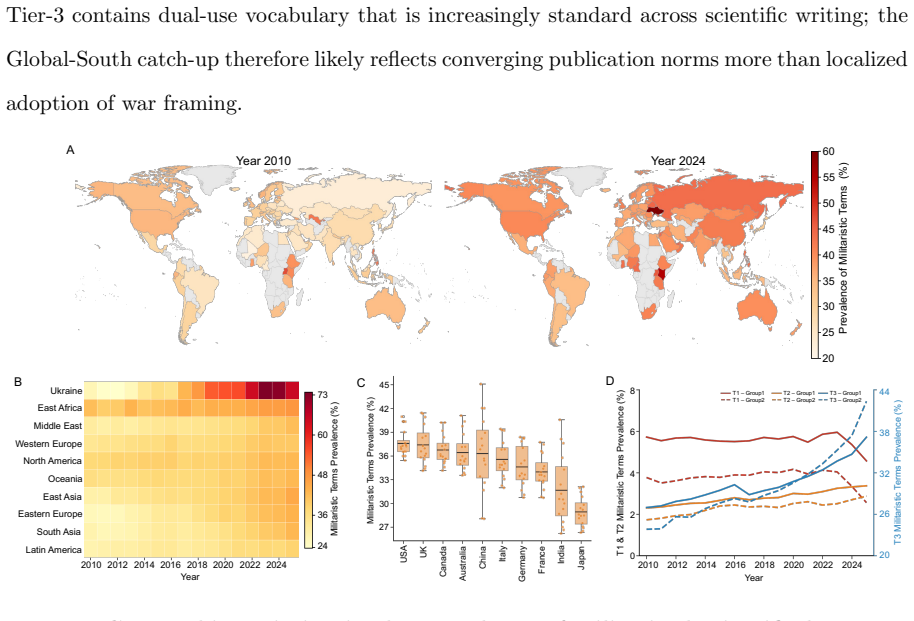
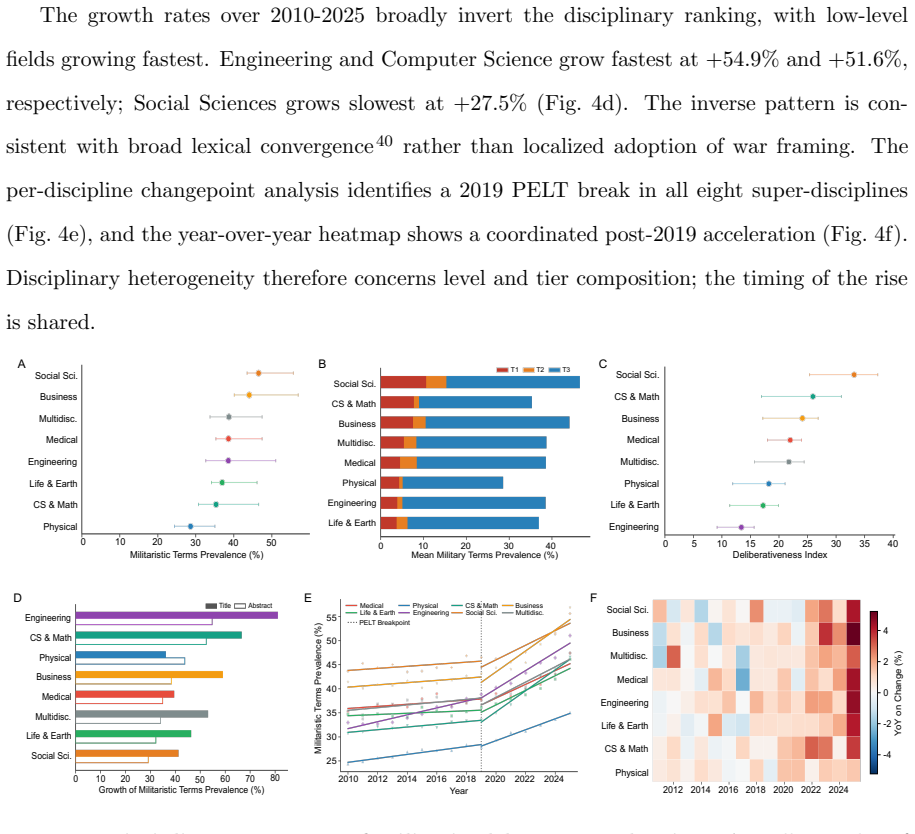
- Social sciences show the highest levels of militaristic language while engineering and computer science show the fastest growth.
- Abstracts from the Global South display the fastest rise.
- The COVID and post-2022 large-language-model periods saw both a rise in use and a narrowing of the gap between native-English and non-English authors.
- War framing produces a small trend-level increase in sense of urgency alongside the negative effects on credibility and support.
Where Pith is reading between the lines
- Continued growth in such language could gradually lower public willingness to act on scientific findings.
- Disciplines might develop style guidelines that discourage militaristic metaphors in abstracts to protect perceived trustworthiness.
- Similar experiments could test whether other loaded metaphors produce comparable drops in support.
Load-bearing premise
The predefined list of militaristic terms used to label abstracts accurately captures the intended construct without substantial false positives or context-dependent misclassification.
What would settle it
Re-analysis of the same 21.4 million papers with a different term list or different conflict dataset that finds no rise or no correlation with conflicts would undermine the prevalence and alignment results.
Figures




read the original abstract
Scientists do not, by profession, wage war. Yet warfare's vocabulary consistently appears in their abstracts. To quantify the extent to which warfare's vocabulary pervades scientific abstracts, we analyze 21.4 million papers (2010-2025; OpenAlex, PubMed). We additionally run a within-subject war-framing experiment (N = 801; 32,040 trials) designed to provide causal insight into the effects of militaristic language on persuasion. Between 2010 and 2025, the presence of militaristic terms in scientific abstracts rose 48% in OpenAlex and 32% in PubMed, with the rise accelerating sharply after 2019 (cross-database r = 0.96, p < 10^-8). The prevalence of militaristic language is conflict-aligned at both country and annual scales (Uppsala Conflict Data Program; r = 0.77-0.84), with the abstracts from the Global South displaying the fastest rise in militaristic language. Among disciplines, social sciences leads in level of such language while engineering and computer science lead in growth. The COVID and post-2022 large-language-model eras also saw the rise and narrowed the language gap between native-English and non-English authors. In our follow-up experiment, we found that war framing reduced credibility (mean shift -0.18 Likert units, 95% CI [-0.21, -0.14]; d_z = -0.28, p < 10^-20), funding willingness (d_z = -0.12) and policy support (d_z = -0.08), with a trend-level increase in sense of urgency (d_z = +0.07). Collectively, findings reveal that while scientific abstracts drift toward warfare, the use of militaristic language may erode credibility, funding willingness, and policy support.
Editorial analysis
A structured set of objections, weighed in public.
Referee Report
Summary. The paper analyzes 21.4 million scientific abstracts (2010-2025) from OpenAlex and PubMed, reporting a 48% and 32% rise in militaristic terms respectively, with post-2019 acceleration (cross-database r=0.96) and correlations to real-world conflict data (r=0.77-0.84). It additionally reports results from a within-subject experiment (N=801, 32,040 trials) in which war framing reduced credibility (d_z=-0.28), funding willingness (d_z=-0.12), and policy support (d_z=-0.08).
Significance. Large sample sizes, cross-database consistency, conflict-aligned correlations, and effect sizes reported with confidence intervals provide directional support for the claims if the measurement is valid. The experimental component supplies causal evidence on potential downstream effects. If the term-list measurement holds, the work identifies a measurable shift in scientific communication with possible implications for credibility and persuasion.
major comments (2)
- [Methods (corpus analysis)] Corpus analysis / term-list construction (described in the methods for the 21.4M-abstract study): no validation, human coding, precision/recall, or false-positive audit is reported for the fixed militaristic term list. Polysemous terms (e.g., 'campaign', 'target', 'attack', 'defense', 'strategy') occur frequently in non-militaristic technical contexts; without evidence that such usages were excluded or quantified, the 48%/32% prevalence rises, post-2019 acceleration, Global-South patterns, and conflict correlations (r=0.77-0.84) cannot be unambiguously attributed to militarized language rather than topic or database shifts.
- [Methods (experiment)] Experimental methods (N=801 study): the exact framing stimuli, control sentences, and any pre-registration or attention-check details are not supplied. These omissions are load-bearing for interpreting the reported effect sizes (credibility d_z=-0.28, funding d_z=-0.12) as specifically due to militaristic language rather than other lexical or affective differences between conditions.
minor comments (1)
- [Abstract] Abstract: the size of the militaristic term list and one or two concrete examples would help readers assess face validity without needing the full methods.
Simulated Author's Rebuttal
We thank the referee for these constructive comments on methodological transparency. We agree that both the corpus term-list validation and the experimental stimuli details require fuller reporting. We will revise the manuscript to address these points directly.
read point-by-point responses
-
Referee: [Methods (corpus analysis)] Corpus analysis / term-list construction (described in the methods for the 21.4M-abstract study): no validation, human coding, precision/recall, or false-positive audit is reported for the fixed militaristic term list. Polysemous terms (e.g., 'campaign', 'target', 'attack', 'defense', 'strategy') occur frequently in non-militaristic technical contexts; without evidence that such usages were excluded or quantified, the 48%/32% prevalence rises, post-2019 acceleration, Global-South patterns, and conflict correlations (r=0.77-0.84) cannot be unambiguously attributed to militarized language rather than topic or database shifts.
Authors: We agree this is a substantive limitation in the current reporting. The methods section does not include a validation study, precision/recall metrics, or false-positive audit for the fixed term list, and polysemy in terms such as 'campaign' or 'target' is a genuine concern that could inflate counts. In the revised manuscript we will add a dedicated subsection on term-list construction that reports any pilot human coding performed, quantifies false-positive rates on a sampled subset of abstracts, and discusses mitigation steps for polysemy. We will also note that while cross-database consistency (r=0.96) and alignment with external conflict data provide convergent support, these do not substitute for direct validation; the added audit will allow readers to assess the degree of contamination. revision: yes
-
Referee: [Methods (experiment)] Experimental methods (N=801 study): the exact framing stimuli, control sentences, and any pre-registration or attention-check details are not supplied. These omissions are load-bearing for interpreting the reported effect sizes (credibility d_z=-0.28, funding d_z=-0.12) as specifically due to militaristic language rather than other lexical or affective differences between conditions.
Authors: We concur that the stimuli, controls, pre-registration status, and attention-check procedures must be supplied for the effects to be interpretable. The revised manuscript will include the full set of war-framed and control sentences in an appendix, along with all attention-check wording, exclusion criteria, and data-quality metrics. The study was not pre-registered; we will state this explicitly as a limitation. These additions will enable direct evaluation of whether the observed shifts (e.g., d_z = -0.28 on credibility) are attributable to militaristic framing rather than other lexical differences. revision: yes
Circularity Check
No circularity: direct corpus counts, external correlations, and independent experiment
full rationale
The paper reports prevalence trends from applying a fixed term list to 21.4 million external abstracts (OpenAlex/PubMed), correlations against the independent Uppsala Conflict Data Program, and effect sizes from a separate N=801 within-subject experiment. No equations, fitted parameters, self-definitional constructs, or load-bearing self-citations are present that would make any reported quantity reduce to the authors' own inputs by construction. The measurement pipeline and causal test remain independent of the target statistics.
Axiom & Free-Parameter Ledger
axioms (1)
- domain assumption A fixed list of militaristic terms validly and exhaustively measures the construct of militarized language in abstracts
Reference graph
Works this paper leans on
-
[1]
& Dillard, J
Sopory, P. & Dillard, J. P. The persuasive effects of metaphor: A meta-analysis.Human Communication Research28, 382–419 (2002)
2002
-
[2]
& Johnson, M.Metaphors We Live By(University of Chicago Press, 1980)
Lakoff, G. & Johnson, M.Metaphors We Live By(University of Chicago Press, 1980)
1980
-
[3]
J., Meier, B
Landau, M. J., Meier, B. P. & Keefer, L. A. A metaphor-enriched social cognition.Psy- chological Bulletin136, 1045–1067 (2010)
2010
-
[4]
J., Matlock, T
Flusberg, S. J., Matlock, T. & Thibodeau, P. H. Metaphors for the war (or race) against climate change.Environmental Communication11, 769–783 (2017)
2017
-
[5]
T., Schapira, L., Daniels, K
Penson, R. T., Schapira, L., Daniels, K. J., Chabner, B. A. & Lynch, T. J. Cancer as metaphor.The Oncologist9, 708–716 (2004)
2004
-
[6]
Thibodeau, P. H. & Boroditsky, L. Metaphors we think with: The role of metaphor in reasoning.PLoS ONE6, e16782 (2011)
2011
-
[7]
Sontag, S.Illness as Metaphor(Farrar, Straus and Giroux, 1978)
1978
-
[8]
Hauser, D. J. & Schwarz, N. The war on prevention: Bellicose cancer metaphors hurt (some) prevention intentions.Personality and Social Psychology Bulletin41, 66–77 (2015)
2015
-
[9]
K., Demj´ en, Z., Semino, E
Hendricks, R. K., Demj´ en, Z., Semino, E. & Boroditsky, L. Emotional implications of metaphor: Consequences of metaphor framing for mindset about cancer.Metaphor and Symbol33, 267–279 (2018)
2018
-
[10]
& Bolognesi, M
Wicke, P. & Bolognesi, M. M. Framing covid-19: How we conceptualize and discuss the pandemic on twitter.PLoS ONE15, e0240010 (2020)
2020
-
[11]
‘not soldiers but fire-fighters’: Metaphors and covid-19.Health Communication 36, 50–58 (2021)
Semino, E. ‘not soldiers but fire-fighters’: Metaphors and covid-19.Health Communication 36, 50–58 (2021)
2021
-
[12]
Martin, E.Flexible Bodies: Tracking Immunity in American Culture from the Days of Polio to the Age of AIDS(Beacon Press, 1994)
1994
-
[13]
& on Microbial Threats, F.Ending the War Metaphor: The Chang- ing Agenda for Unraveling the Host-Microbe Relationship: Workshop Summary(National Academies Press, 2006)
on Global Health, B. & on Microbial Threats, F.Ending the War Metaphor: The Chang- ing Agenda for Unraveling the Host-Microbe Relationship: Workshop Summary(National Academies Press, 2006). 27
2006
-
[14]
Science communication and public trust in science.Interdisciplinary Science Reviews48, 350–365 (2023)
Intemann, K. Science communication and public trust in science.Interdisciplinary Science Reviews48, 350–365 (2023)
2023
-
[15]
Reshaping science communication in a critical period of disinformation and distrust.Journal of Science Communication25(2026)
Moreno-Castro, C. Reshaping science communication in a critical period of disinformation and distrust.Journal of Science Communication25(2026)
2026
-
[16]
W.The Poetics of Mind: Figurative Thought, Language, and Understanding (Cambridge University Press, 1994)
Gibbs, R. W.The Poetics of Mind: Figurative Thought, Language, and Understanding (Cambridge University Press, 1994)
1994
-
[17]
Does language shape thought?: Mandarin and english speakers’ conceptions of time.Cognitive Psychology43, 1–22 (2001)
Boroditsky, L. Does language shape thought?: Mandarin and english speakers’ conceptions of time.Cognitive Psychology43, 1–22 (2001)
2001
-
[18]
Bargh, J. A. & Chartrand, T. L. The unbearable automaticity of being.American Psy- chologist54, 462–479 (1999)
1999
-
[19]
& Druckman, J
Chong, D. & Druckman, J. N. Framing theory.Annual Review of Political Science10, 103–126 (2007)
2007
-
[20]
Steen, G. J. The paradox of metaphor: Why we need a three-dimensional model of metaphor.Metaphor and Symbol23, 213–241 (2008)
2008
-
[21]
Fiske, S. T. & Dupree, C. Gaining trust as well as respect in communicating to motivated audiences about science topics.Proceedings of the National Academy of Sciences111, 13593–13597 (2014)
2014
-
[22]
& Bromme, R
Hendriks, F., Kienhues, D. & Bromme, R. Measuring laypeople’s trust in experts in a digital age: The muenster epistemic trustworthiness inventory (meti).PLoS ONE10, e0139309 (2015)
2015
-
[23]
& ¨Oberg, M
Pettersson, T. & ¨Oberg, M. Organized violence, 1989-2019.Journal of Peace Research57, 597–613 (2020)
1989
-
[24]
On the Opportunities and Risks of Foundation Models
Bommasani, R., Hudson, D. A., Adeli, E.et al.On the opportunities and risks of foundation models.arXiv:2108.07258(2021)
work page internal anchor Pith review Pith/arXiv arXiv 2021
-
[25]
Liang, W.et al.Quantifying large language model usage in scientific papers.Nature Human Behaviour9, 2599–2609 (2025). 28
2025
-
[26]
& Lause, J
Kobak, D., Gonz´ alez-M´ arquez, R., Horv´ at, E.-´A. & Lause, J. Delving into llm-assisted writ- ing in biomedical publications through excess vocabulary.Science Advances11, eadt3813 (2025)
2025
-
[27]
Geng, M. & Trotta, R. Is ChatGPT transforming academics’ writing style? arXiv:2404.08627(2024)
-
[28]
G., Rzhetsky, A
Foster, J. G., Rzhetsky, A. & Evans, J. A. Tradition and innovation in scientists’ research strategies.American Sociological Review80, 875–908 (2015)
2015
-
[29]
F., Uzzi, B
Liu, L., Jones, B. F., Uzzi, B. & Wang, D. Data, measurement and empirical methods in the science of science.Nature Human Behaviour7, 1046–1058 (2023)
2023
-
[30]
E.et al.Negativity drives online news consumption.Nature Human Be- haviour7, 812–822 (2023)
Robertson, C. E.et al.Negativity drives online news consumption.Nature Human Be- haviour7, 812–822 (2023)
2023
-
[31]
H., Tijdink, J
Vinkers, C. H., Tijdink, J. K. & Otte, W. M. Use of positive and negative words in scientific PubMed abstracts published between 1974 and 2014: Retrospective analysis.BMJ351, h6467 (2015)
1974
-
[32]
& Budgell, B
Millar, N., Salager-Meyer, F. & Budgell, B. ‘it is important to reinforce the importance of . . . ’: ‘hype’ in reports of randomized controlled trials.English for Specific Purposes54, 139–151 (2019)
2019
-
[33]
J., Schiffler, B
Plav´ en-Sigray, P., Matheson, G. J., Schiffler, B. C. & Thompson, W. H. The readability of scientific texts is decreasing over time.eLife6, e27725 (2017)
2017
-
[34]
W., Cruz, N
Burton, J. W., Cruz, N. & Hahn, U. Reconsidering evidence of moral contagion in online social networks.Nature Human Behaviour5, 1629–1635 (2021)
2021
-
[35]
L., Leskovec, J
Hamilton, W. L., Leskovec, J. & Jurafsky, D. Diachronic word embeddings reveal statistical laws of semantic change.Proceedings of the 54th Annual Meeting of the Association for Computational Linguistics1489–1501 (2016)
2016
-
[36]
& Skiena, S
Kulkarni, V., Al-Rfou, R., Perozzi, B. & Skiena, S. Statistically significant detection of linguistic change.Proceedings of the 24th International Conference on World Wide Web 625–635 (2015). 29
2015
-
[37]
Wintterlin, F.et al.Predicting public trust in science: The role of basic orientations toward science, perceived trustworthiness of scientists, and experiences with science.Frontiers in Communication6, 822757 (2022)
2022
-
[38]
Annenberg Public Policy Center. Annenberg survey finds public perceptions of scientists’ credibility slips.https://www.annenbergpublicpolicycenter.org/ annenberg-survey-finds-public-perceptions-of-scientists-credibility-slips/ (2024). Annenberg Public Policy Center, University of Pennsylvania
2024
-
[39]
& Wang, L
Confraria, H., Mira Godinho, M. & Wang, L. Determinants of citation impact: A com- parative analysis of the global south versus the global north.Research Policy46, 265–279 (2017)
2017
-
[40]
A.et al.Finding cultural holes: How structure and culture diverge in networks of scholarly communication.Sociological Science1, 221–238 (2014)
Vilhena, D. A.et al.Finding cultural holes: How structure and culture diverge in networks of scholarly communication.Sociological Science1, 221–238 (2014)
2014
-
[41]
OpenAlex: A fully-open index of scholarly works, authors, venues, institutions, and concepts
Priem, J., Piwowar, H. & Orr, R. OpenAlex: A fully-open index of scholarly works, authors, venues, institutions, and concepts.arXiv:2205.01833(2022)
work page internal anchor Pith review Pith/arXiv arXiv 2022
-
[42]
& Eckley, I
Killick, R., Fearnhead, P. & Eckley, I. A. Optimal detection of changepoints with a linear computational cost.Journal of the American Statistical Association107, 1590–1598 (2012)
2012
-
[43]
P., Wallensteen, P., Eriksson, M., Sollenberg, M
Gleditsch, N. P., Wallensteen, P., Eriksson, M., Sollenberg, M. & Strand, H. Armed conflict 1946-2001: A new dataset.Journal of Peace Research39, 615–637 (2002)
1946
-
[44]
& Damer, E
Peer, E., Rothschild, D., Gordon, A., Evernden, Z. & Damer, E. Data quality of plat- forms and panels for online behavioral research.Behavior Research Methods54, 1643–1662 (2022)
2022
-
[45]
Calculating and reporting effect sizes to facilitate cumulative science: A prac- tical primer fort-tests and ANOVAs.Frontiers in Psychology4, 863 (2013)
Lakens, D. Calculating and reporting effect sizes to facilitate cumulative science: A prac- tical primer fort-tests and ANOVAs.Frontiers in Psychology4, 863 (2013)
2013
-
[46]
The new statistics: Why and how.Psychological Science25, 7–29 (2014)
Cumming, G. The new statistics: Why and how.Psychological Science25, 7–29 (2014)
2014
-
[47]
Funder, D. C. & Ozer, D. J. Evaluating effect size in psychological research: Sense and nonsense.Advances in Methods and Practices in Psychological Science2, 156–168 (2019)
2019
-
[48]
Corbie-Smith, G., Thomas, S. B. & St. George, D. M. M. Distrust, race, and research. Archives of Internal Medicine162, 2458–2463 (2002). 30
2002
-
[49]
M., Campbell, W
Twenge, J. M., Campbell, W. K. & Carter, N. T. Declines in trust in others and confi- dence in institutions among american adults and late adolescents, 1972-2012.Psychological Science25, 1914–1923 (2014)
1972
-
[50]
Bakdash, J. Z. & Marusich, L. R. Repeated measures correlation.Frontiers in Psychology 8, 456 (2017)
2017
-
[51]
M., Lange, S
Mitchell, S. M., Lange, S. & Brus, H. Gendered citation patterns in international relations journals.International Studies Perspectives14, 485–492 (2013)
2013
-
[52]
L., Sumner, J
Dion, M. L., Sumner, J. L. & Mitchell, S. M. Gendered citation patterns across political science and social science methodology fields.Political Analysis26, 312–327 (2018)
2018
-
[53]
& Birrer, S
Caplar, N., Tacchella, S. & Birrer, S. Quantitative evaluation of gender bias in astronomical publications from citation counts.Nature Astronomy1, 0141 (2017)
2017
-
[54]
& Walter, B
Maliniak, D., Powers, R. & Walter, B. F. The gender citation gap in international relations. International Organization67, 889–922 (2013)
2013
-
[55]
D.et al.The extent and drivers of gender imbalance in neuroscience ref- erence lists.bioRxiv(2020)
Dworkin, J. D.et al.The extent and drivers of gender imbalance in neuroscience ref- erence lists.bioRxiv(2020). URLhttps://www.biorxiv.org/content/early/2020/ 01/11/2020.01.03.894378.https://www.biorxiv.org/content/early/2020/01/11/ 2020.01.03.894378.full.pdf
2020
-
[56]
A.et al.Racial and ethnic imbalance in neuroscience reference lists and intersections with gender.bioRxiv(2020)
Bertolero, M. A.et al.Racial and ethnic imbalance in neuroscience reference lists and intersections with gender.bioRxiv(2020)
2020
-
[57]
Wang, X.et al.Gendered citation practices in the field of communication.Annals of the International Communication Association(2021)
2021
-
[58]
& Werner, R
Chatterjee, P. & Werner, R. M. Gender disparity in citations in high-impact journal articles.JAMA Netw Open4, e2114509 (2021)
2021
-
[59]
M., Akinnola, I
Fulvio, J. M., Akinnola, I. & Postle, B. R. Gender (im)balance in citation practices in cognitive neuroscience.J Cogn Neurosci33, 3–7 (2021)
2021
-
[60]
URLhttps: //doi.org/10.5281/zenodo.3672110
Zhou, D.et al.Gender diversity statement and code notebook v1.0 (2020). URLhttps: //doi.org/10.5281/zenodo.3672110. 31
-
[61]
& Skiena, S
Ambekar, A., Ward, C., Mohammed, J., Male, S. & Skiena, S. Name-ethnicity classification from open sources. InProceedings of the 15th ACM SIGKDD international conference on Knowledge Discovery and Data Mining, 49–58 (2009)
2009
-
[62]
Sood, G. & Laohaprapanon, S. Predicting race and ethnicity from the sequence of charac- ters in a name.arXiv preprint arXiv:1805.02109(2018). 32 Acknowledgments S.M. and D.S.B. acknowledge support from the Army Research Office MURI program (through grant number W911NF2410228). D.L-S acknowledges support from the National Institute on Drug Abuse (K01 DA047...
discussion (0)
Sign in with ORCID, Apple, or X to comment. Anyone can read and Pith papers without signing in.