REVIEW 3 major objections 1 minor 26 references
Reviewed by Pith at T0; open to challenge.
T0 means a machine referee read the full paper against a public rubric. The mark states how deep the mechanical check went, never who wrote it. the ladder, T0–T4 →
T0 review · grok-4.3
Dual-branch temporal modeling with key-frame selection distinguishes bleeding IAEs from residual blood in surgical videos.
2026-06-26 09:35 UTC pith:UL56TGXI
load-bearing objection DBT-Bleed adds a dual-branch adapter model, HiRED selection, and the first neurosurgery IAE dataset, with reported gains, but the claims rest on untested assumptions without ablations or verification. the 3 major comments →
DBT-Bleed: Dual-Branch Temporal Modeling with Key-Frame Selection for Surgical Bleeding Detection
The pith
A machine-rendered reading of the paper's core claim, the machinery that carries it, and where it could break.
Core claim
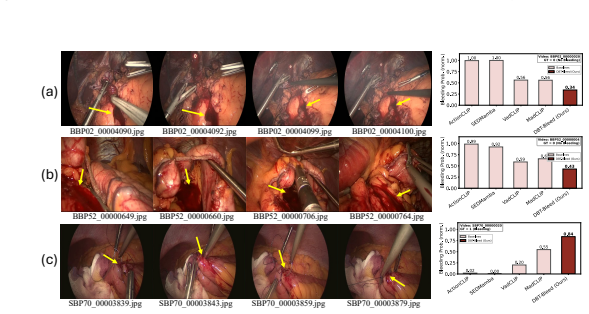
DBT-Bleed is a dual-branch multi-scale temporal modeling framework that disentangles bleeding and normal representations using layer-wise temporal adapters for short- and long-term bleeding progression. HiRED, the Hierarchical Entropy-Driven frame selection strategy, retains temporally informative segments while removing redundancy to process long surgical videos efficiently. On the MultiBypass dataset this produces gains of 6.53% in F1, 5.62% in Recall and 9% in MCC for bleeding IAE detection over video-level baselines, and achieves 6% F1 and 8% MCC gains under zero-shot evaluation on the newly introduced EndoPit-IAE dataset from endonasal pituitary surgery.
What carries the argument
Dual-branch architecture with layer-wise temporal adapters that separate bleeding progression representations, paired with HiRED hierarchical entropy-driven key-frame selection.
Load-bearing premise
The layer-wise temporal adapters successfully disentangle bleeding progression from residual blood without procedure-specific retraining, and HiRED frame selection preserves all critical temporal dynamics needed for accurate IAE labeling.
What would settle it
On a held-out set of videos containing visually similar residual blood and active bleeding, the model shows no F1 or MCC improvement over standard video classifiers, or selected frames omit bleeding onset moments and cause missed detections.
If this is right
- Outperforms video-level baselines by 6.53% F1, 5.62% Recall and 9% MCC on MultiBypass for bleeding IAE detection.
- Demonstrates 6% F1 and 8% MCC gains under zero-shot transfer to EndoPit-IAE from a different surgical procedure.
- Enables efficient processing of long videos without loss of fine-grained temporal information via HiRED selection.
- Supports introduction of the first IAE-annotated dataset in neurosurgery (EndoPit-IAE).
Where Pith is reading between the lines
- The approach could support real-time IAE alert systems in operating rooms across multiple surgery types.
- HiRED-style selection may reduce compute needs for other long redundant video tasks such as procedural logging.
- Cross-procedure transfer suggests a path toward unified models for IAE detection if additional annotated datasets become available.
- Lower computational cost for video processing could make advanced analysis practical on standard hospital hardware.
Editorial analysis
A structured set of objections, weighed in public.
Referee Report
Summary. The manuscript introduces DBT-Bleed, a dual-branch multi-scale temporal modeling framework that uses layer-wise temporal adapters to disentangle short- and long-term bleeding progression representations from residual blood, paired with HiRED, a hierarchical entropy-driven key-frame selection strategy for efficient processing of long surgical videos. On the MultiBypass dataset it reports gains of 6.53% F1, 5.62% Recall and 9% MCC for bleeding IAE detection over video-level baselines; it further claims 6% F1 and 8% MCC gains under zero-shot transfer to the newly introduced EndoPit-IAE dataset from endonasal pituitary surgery, presented as the first IAE-annotated neurosurgical dataset. Code release is promised upon acceptance.
Significance. If the empirical claims are substantiated, the work targets an important clinical problem in intraoperative safety monitoring. The release of EndoPit-IAE and the public code commitment constitute concrete contributions that could enable follow-on research in surgical video analysis.
major comments (3)
- [Experiments] Experiments section: no ablation studies are reported that isolate the contribution of the dual-branch architecture or the layer-wise temporal adapters versus the HiRED selection module. Without these controls the attribution of the stated 6.53% F1 / 9% MCC gains specifically to the proposed disentanglement mechanism cannot be verified.
- [Method] Method and Experiments sections: the central modeling assumption that layer-wise adapters successfully separate bleeding-progression features from residual-blood appearance is stated but unsupported by any representation visualizations, feature-space analyses, or quantitative disentanglement metrics.
- [Experiments] Experiments section: the manuscript supplies no verification that HiRED-selected frames retain every IAE onset/offset required for accurate labeling, nor any comparison of temporal coverage before and after selection. This leaves the claim that fine-grained dynamics are preserved untested.
minor comments (1)
- [Abstract] Abstract: the phrase 'video-level baselines' is used without naming the specific methods or architectures being compared.
Simulated Author's Rebuttal
We thank the referee for the constructive comments. We address each major comment below and will incorporate the requested analyses in the revised manuscript to strengthen the empirical validation of our claims.
read point-by-point responses
-
Referee: [Experiments] Experiments section: no ablation studies are reported that isolate the contribution of the dual-branch architecture or the layer-wise temporal adapters versus the HiRED selection module. Without these controls the attribution of the stated 6.53% F1 / 9% MCC gains specifically to the proposed disentanglement mechanism cannot be verified.
Authors: We agree that explicit ablations are required to isolate the dual-branch temporal adapters from the HiRED module. The submitted manuscript reports overall gains against video-level baselines but does not include component-wise removals. In the revision we will add ablation experiments on MultiBypass that remove the dual-branch structure (single-branch variant) and disable HiRED (full-frame variant), reporting the resulting drops in F1, Recall and MCC to quantify each contribution. revision: yes
-
Referee: [Method] Method and Experiments sections: the central modeling assumption that layer-wise adapters successfully separate bleeding-progression features from residual-blood appearance is stated but unsupported by any representation visualizations, feature-space analyses, or quantitative disentanglement metrics.
Authors: The layer-wise adapter design is intended to capture multi-scale temporal dynamics at different network depths, thereby separating progression signals from static appearance. We acknowledge that the current manuscript provides no supporting visualizations or metrics. The revision will add t-SNE plots of branch-specific features on bleeding versus residual-blood frames together with a quantitative measure (e.g., inter-branch feature correlation or clustering separation) to substantiate the disentanglement claim. revision: yes
-
Referee: [Experiments] Experiments section: the manuscript supplies no verification that HiRED-selected frames retain every IAE onset/offset required for accurate labeling, nor any comparison of temporal coverage before and after selection. This leaves the claim that fine-grained dynamics are preserved untested.
Authors: We will augment the experiments section with a temporal-coverage analysis. This will report the percentage of IAE onset and offset frames retained by HiRED across the MultiBypass test set and will include before/after comparisons of video length and the number of preserved key events to confirm that critical temporal boundaries remain intact. revision: yes
Circularity Check
No circularity; empirical claims rest on held-out dataset comparisons
full rationale
The paper proposes an architecture (dual-branch with layer-wise adapters) and a frame selection method (HiRED), then reports F1/Recall/MCC gains on MultiBypass and zero-shot transfer on the newly introduced EndoPit-IAE dataset. No equations, derivations, fitted parameters renamed as predictions, or self-citation chains appear in the provided text. Performance numbers are direct empirical comparisons against baselines on held-out data; the central claims do not reduce to inputs by construction.
Axiom & Free-Parameter Ledger
read the original abstract
Intraoperative Adverse Events (IAEs) detection is critical for improving surgical safety, with bleeding being among the most frequent events across many surgery types. Existing methods struggle to distinguish bleeding IAE from visually similar residual blood due to limited temporal reasoning. Moreover, modeling long surgical videos while preserving fine-grained temporal dynamics remains computationally challenging. We propose DBT-Bleed, a dual-branch multi-scale temporal modeling framework disentangling bleeding and normal representations using layer-wise temporal adapters for short- and long-term bleeding progression. To efficiently process long surgical videos without sacrificing fine-grained temporal information, we introduce HiRED, a Hierarchical Entropy-Driven frame selection strategy that retains temporally informative segments while removing redundancy. Experiments on the MultiBypass dataset demonstrate gains of 6.53% in F1, 5.62% in Recall and 9% in MCC values for bleeding IAE detection, consistently outperforming video-level baselines. Additionally, we evaluate cross-procedure generalization on a newly curated dataset from a different surgical procedure type, where DBT-Bleed demonstrates robust transferability by achieving gain of 6% in F1 and 8% in MCC under zero-shot setting. To support this evaluation, we introduce EndoPit-IAE, an Endonasal Pituitary Surgery dataset annotated for IAEs, representing the first IAE-annotated dataset in neurosurgery. Code will be made publicly available upon acceptance.
Figures


Reference graph
Works this paper leans on
-
[1]
In: International Conference on Medical Image Computing and Computer-Assisted Intervention
Bose, R., Nwoye, C.I., Lazo, J.F., Lavanchy, J.L., Padoy, N.: Feature mixing ap- proach for detecting intraoperative adverse events in laparoscopic roux-en-y gas- tric bypass surgery. In: International Conference on Medical Image Computing and Computer-Assisted Intervention. pp. 178–188. Springer (2025)
2025
-
[2]
BMC genomics 21(1), 6 (2020)
Chicco, D., Jurman, G.: The advantages of the matthews correlation coefficient (mcc) over f1 score and accuracy in binary classification evaluation. BMC genomics 21(1), 6 (2020)
2020
-
[3]
Surgical Endoscopy38(6), 3461–3469 (2024)
Horita, K., Hida, K., Itatani, Y., Fujita, H., Hidaka, Y., Yamamoto, G., Ito, M., Obama, K.: Real-time detection of active bleeding in laparoscopic colectomy using artificial intelligence. Surgical Endoscopy38(6), 3461–3469 (2024)
2024
-
[4]
Annals of Translational Medicine 10(10), 546 (2022)
Hua, S., Gao, J., Wang, Z., Yeerkenbieke, P., Li, J., Wang, J., He, G., Jiang, J., Lu, Y., Yu, Q., et al.: Automatic bleeding detection in laparoscopic surgery based on a faster region-based convolutional neural network. Annals of Translational Medicine 10(10), 546 (2022)
2022
-
[5]
Surgical Endoscopy39(3), 2026–2036 (2025) 10 Mishra et al
Lavanchy, J.L., Alapatt, D., Sestini, L., Kraljević, M., Nett, P.C., Mutter, D., Müller-Stich, B.P., Padoy, N.: Analyzing the impact of surgical technique on in- traoperative adverse events in laparoscopic roux-en-y gastric bypass surgery by video-based assessment. Surgical Endoscopy39(3), 2026–2036 (2025) 10 Mishra et al
2026
-
[6]
Surgical endoscopy37(3), 2070–2077 (2023)
Lavanchy, J.L., Gonzalez, C., Kassem, H., Nett, P.C., Mutter, D., Padoy, N.: Pro- posal and multicentric validation of a laparoscopic roux-en-y gastric bypass surgery ontology. Surgical endoscopy37(3), 2070–2077 (2023)
2070
-
[7]
International journal of computer assisted radiology and surgery19(11), 2249– 2257 (2024)
Lavanchy, J.L., Ramesh, S., Dall’Alba, D., Gonzalez, C., Fiorini, P., Müller-Stich, B.P., Nett, P.C., Marescaux, J., Mutter, D., Padoy, N.: Challenges in multi-centric generalization: phase and step recognition in roux-en-y gastric bypass surgery. International journal of computer assisted radiology and surgery19(11), 2249– 2257 (2024)
2024
-
[8]
Bmj353(2016)
Makary, M.A., Daniel, M.: Medical error—the third leading cause of death in the us. Bmj353(2016)
2016
-
[9]
In: 2024 International Symposium on Medical Robotics (ISMR)
Miao, A.J., Lin, S., Lu, J., Richter, F., Ostrander, B., Funk, E.K., Orosco, R.K., Yip, M.C.: Hemoset: The first blood segmentation dataset for automation of hemostasis management. In: 2024 International Symposium on Medical Robotics (ISMR). pp. 1–7. IEEE (2024)
2024
-
[10]
arXiv preprint arXiv:2503.22174 (2025)
Pei, J., Zhou, Z., Guo, D., Li, Z., Qin, J., Du, B., Heng, P.A.: Synergistic bleed- ing region and point detection in laparoscopic surgical videos. arXiv preprint arXiv:2503.22174 (2025)
-
[11]
In: Medical Imaging with Deep Learning (2022)
Rabbani, N., Seve, C., Bourdel, N., Bartoli, A.: Video-based computer-aided la- paroscopic bleeding management: a space-time memory neural network with po- sitional encoding and adversarial domain adaptation. In: Medical Imaging with Deep Learning (2022)
2022
-
[12]
The International Journal of Medical Robotics and Computer Assisted Surgery16(6), 1–9 (2020)
Rahbar, M.D., Reisner, L., Ying, H., Pandya, A.: An entropy-based approach to detect and localize intraoperative bleeding during minimally invasive surgery. The International Journal of Medical Robotics and Computer Assisted Surgery16(6), 1–9 (2020)
2020
-
[13]
IEEE Transactions on Med- ical Imaging42(9), 2592–2602 (2023)
Ramesh, S., Dall’Alba, D., Gonzalez, C., Yu, T., Mascagni, P., Mutter, D., Marescaux, J., Fiorini, P., Padoy, N.: Weakly supervised temporal convolutional networks for fine-grained surgical activity recognition. IEEE Transactions on Med- ical Imaging42(9), 2592–2602 (2023)
2023
-
[14]
In- ternational journal of computer assisted radiology and surgery16(7), 1111–1119 (2021)
Ramesh, S., Dall’Alba, D., Gonzalez, C., Yu, T., Mascagni, P., Mutter, D., Marescaux, J., Fiorini, P., Padoy, N.: Multi-task temporal convolutional networks for joint recognition of surgical phases and steps in gastric bypass procedures. In- ternational journal of computer assisted radiology and surgery16(7), 1111–1119 (2021)
2021
-
[15]
IEEE Robotics and Automation Letters6(2), 1383– 1390 (2021)
Richter, F., Shen, S., Liu, F., Huang, J., Funk, E.K., Orosco, R.K., Yip, M.C.: Autonomous robotic suction to clear the surgical field for hemostasis using image- based blood flow detection. IEEE Robotics and Automation Letters6(2), 1383– 1390 (2021)
2021
-
[16]
International Journal of Spine Surgery16(4), 740 (2022)
Sciubba, D.M., Khanna, N., Pennington, Z., Singh, R.K.: Vibe scale: validation of the intraoperative bleeding severity scale by spine surgeons. International Journal of Spine Surgery16(4), 740 (2022)
2022
-
[17]
In: International Conference on Medical Image Computing and Computer-Assisted Intervention
Shiri, M., Beyan, C., Murino, V.: Madclip: few-shot medical anomaly detec- tion with clip. In: International Conference on Medical Image Computing and Computer-Assisted Intervention. pp. 416–426. Springer (2025)
2025
-
[18]
Array19, 100308 (2023)
Sogabe, M., Ishikawa, K., Takamatsu, T., Takeuchi, K., Kanno, T., Fujimoto, K., Miyazaki, T., Kawase, T., Sato, T., Kawashima, K.: Bleeding alert map (bam): The identification method of the bleeding source in real organs using datasets made on mimicking organs. Array19, 100308 (2023)
2023
-
[19]
In: Proceedings of the IEEE/CVF International Conference on Computer Vision
Spadaro, G., Renzulli, R., Bragagnolo, A., Giraldo, J.H., Fiandrotti, A., Grangetto, M., Tartaglione, E.: Shannon strikes again! entropy-based pruning in deep neural Title Suppressed Due to Excessive Length 11 networks for transfer learning under extreme memory and computation budgets. In: Proceedings of the IEEE/CVF International Conference on Computer V...
2023
-
[20]
IEEE transactions on neural networks and learning systems (2023)
Wang, M., Xing, J., Mei, J., Liu, Y., Jiang, Y.: Actionclip: Adapting language- image pretrained models for video action recognition. IEEE transactions on neural networks and learning systems (2023)
2023
-
[21]
In: Machine Learning for Healthcare Conference
Wei, H., Rudzicz, F., Fleet, D., Grantcharov, T., Taati, B.: Intraoperative adverse event detection in laparoscopic surgery: Stabilized multi-stage temporal convolu- tional network with focal-uncertainty loss. In: Machine Learning for Healthcare Conference. pp. 283–307. PMLR (2021)
2021
-
[22]
In: Proceedings of the AAAI Conference on Artificial Intelligence
Wu, P., Zhou, X., Pang, G., Zhou, L., Yan, Q., Wang, P., Zhang, Y.: Vadclip: Adapting vision-language models for weakly supervised video anomaly detection. In: Proceedings of the AAAI Conference on Artificial Intelligence. vol. 38, pp. 6074–6082 (2024)
2024
-
[23]
IEEE Robotics and Automation Letters10(1), 232–239 (2024)
Xu, J., Sirajudeen, N., Boal, M., Francis, N., Stoyanov, D., Mazomenos, E.B.: Sedmamba: Enhancing selective state space modelling with bottleneck mechanism and fine-to-coarse temporal fusion for efficient error detection in robot-assisted surgery. IEEE Robotics and Automation Letters10(1), 232–239 (2024)
2024
-
[24]
arXiv preprint arXiv:2507.15094 (2025)
Xu, M., Zhou, R., Wang, A., Lyu, C., Li, Z., Zhong, N., Ren, H.: Bleedorigin: Dynamic bleeding source localization in endoscopic submucosal dissection via dual- stage detection and tracking. arXiv preprint arXiv:2507.15094 (2025)
-
[25]
Patient safety in surgery5(1), 13 (2011)
Zegers, M., de Bruijne, M.C., de Keizer, B., Merten, H., Groenewegen, P.P., van der Wal, G., Wagner, C.: The incidence, root-causes, and outcomes of adverse events in surgical units: implication for potential prevention strategies. Patient safety in surgery5(1), 13 (2011)
2011
-
[26]
arXiv preprint arXiv:2512.21284 (2025)
Zou, S., Li, J., Ji, W., Huang, J., Wang, K., Dan, G., Si, W., Pan, Y.: Surgical scene segmentation using a spike-driven video transformer with real-time potential. arXiv preprint arXiv:2512.21284 (2025)
discussion (0)
Sign in with ORCID, Apple, or X to comment. Anyone can read and Pith papers without signing in.