REVIEW 3 major objections 5 minor 17 cited by
Consistency of the Standard Model Effective Field Theory
T0 review · 3 major / 5 minor · reviewed 2026-08-14 · deepseek-v4-flash
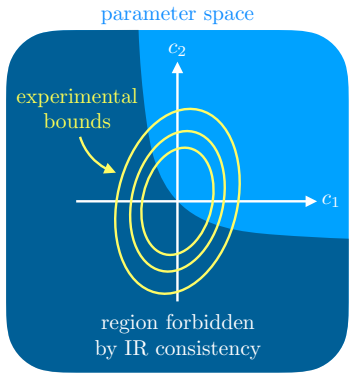
Pith's one-line read Causality and analyticity force the 64 quartic dimension-eight SMEFT couplings into 27 inequalities, banning much of the experimentally accessible parameter space.
desk verdict A systematic, mostly solid set of IR-consistency bounds on 64 dimension-eight bosonic SMEFT operators; the central 27 inequalities hold up, with two minor unproven peripheral steps. read the letter →
The pith
A machine-rendered reading of the paper's core claim, the machinery that carries it, and where it could break.
The reading
What carries the argument
The load-bearing object is the forward scattering amplitude $A(s)$ at $t=0$. Analyticity lets one write the coefficient of $s^2$ as a contour integral that, after deforming around the branch cuts, equals a positive integral over the total cross section via the optical theorem; hence that coefficient is positive. Causality gives the same inequality by computing the correction to the speed of a small fluctuation in a constant background and demanding $v\le 1$. To make the bounds isolate the dimension-eight operators, the authors scatter states whose gauge charges lie in the Cartan subalgebra, the commuting diagonal generators of the gauge group, so that the dimension-six triple-gauge operators and the Yang-Mills $t$-channel pole cancel, leaving the desired $s^2$ coefficient.
What would settle it
Compute the dimension-eight Wilson coefficients of any explicit, unitary, causal UV completion of the SMEFT and check the 27 inequalities of Eqs. (95)-(96); a counterexample with, say, $(\tilde{c}_{B^4_1})^2 \ge 4c_{B^4_1}c_{B^4_2}$ or $c_{B^4_1}<0$ would falsify the claim. Alternatively, a future measurement that extracts the sign and magnitude of one of these operators, such as a QGC at the LHC or the neutron EDM, could land outside the allowed cone.
Extended reading notes
Core claim
The central claim is that the coefficient of $s^2$ in the forward two-to-two scattering amplitude for pure-boson states is forced to be positive by unitarity and analyticity, and the same positivity follows from demanding that small fluctuations in nontrivial bosonic backgrounds propagate at or below the speed of light. Applied to the 64-operator basis, this yields 27 bounds: for example, for hypercharge, $c_{B^4_1}>0$, $c_{B^4_2}>0$, and $(\tilde{c}_{B^4_1})^2<4c_{B^4_1}c_{B^4_2}$; for SU(2), $c_{W^4_1}+c_{W^4_3}>0$ and $c_{W^4_2}+c_{W^4_4}>0$ with the analogous cone on the CP-odd combination; and for SU(3), four positivity conditions and two cone conditions on gluon combinations. The mixed operators follow the same pattern, while the three $(DH)^4$ coefficients obey $c_{H^4_2}>0$, $c_{H^4_1}+c_{H^4_2}>0$, and $c_{H^4_1}+c_{H^4_2}+c_{H^4_3}>0$. As the paper puts it, the CP-violating bounds take the form of a cone, $\tilde{c}^2 + c_-^2 < c_+^2$ for $c_+>0$.
Load-bearing premise
The bounds depend on being able to choose scattering states with commuting gauge charges so that the dimension-six triple-gauge operators drop out of the $s^2$ forward amplitude; if that cancellation fails, the inequalities would constrain mixtures of dimension-six and dimension-eight couplings instead of the 64 coefficients.
Editorial extensions
If this is right
- For the hypercharge, weak-isospin, and color sectors, the positivity bounds single out specific linear combinations of CP-even coefficients, and every CP-odd bound is a cone inequality of the form $(\tilde{c})^2<4c_+c_-$.
- The standard aQGC operator basis used in LHC searches is incomplete: it misses at least one independent operator, and several one-at-a-time positivity bounds from earlier analyses are violated by simple loop completions, whereas the complete-basis bounds derived here survive those checks.
- A neutron EDM generated by the gluonic dimension-eight operators would, through the CP-odd/CP-even cone inequalities, force the corresponding CP-even gluon couplings to be large enough to be searched for in multijet or other collider observables, linking two seemingly unrelated measurements.
- Every conventional UV completion examined—heavy scalars, fermions, or vectors at one loop, Born-Infeld actions, and tree-level exchanges of singlet, triplet, bifundamental, or symmetric-tensor states—automatically satisfies the 27 bounds, so a violation would point to a breakdown of causality, locality, unitarity, or Lorentz invariance in the UV theory.
Reading between the lines
- An immediate use not developed in the paper would be to impose the 27 inequalities as a hard prior in global SMEFT fits; because the constraints are independent, the allowed coefficient volume shrinks substantially, sharpening collider limits without assuming one operator at a time.
- The Cartan-subalgebra choice is not the only possible scattering configuration: superposing different boson species, such as $B+W^3$, generates additional bounds, and a full exploration could close the gap between the 27 bounds here and the full positivity cone of the 64 operators.
- If a future aQGC or EDM measurement lands outside one of the cones, the most natural interpretation, given the paper's argument, would be that the low-energy EFT is not the limit of a conventional local, unitary, causal UV completion—rather than merely evidence for new physics at a higher scale.
Signed reviews
Editorial analysis
A structured set of objections, weighed in public.
Referee Report
Summary. This paper derives constraints on the Wilson coefficients of dimension-eight bosonic SMEFT operators using infrared consistency: analyticity and unitarity of two-to-two scattering amplitudes, together with causality of signal propagation in nonvacuum backgrounds. The authors construct a minimal basis of 64 quartic four-derivative operators, explain how dimension-six operators can be avoided by scattering states with commuting colors (the Cartan-subalgebra condition of Eq. (24)), and derive 27 independent inequalities. These include positivity of CP-even combinations and cone bounds of the form ~c^2 < 4c_+c_- for CP-odd couplings. The bounds are checked against several classes of UV completions and applied to anomalous quartic gauge couplings and the neutron electric dipole moment.
Significance. If the derived bounds hold, they provide a model-independent theoretical prior on a substantial portion of the SMEFT parameter space and can connect disparate experimental searches, such as LHC aQGC constraints and neutron EDM limits. Strengths of the paper include a self-contained derivation, the successful reproduction of known U(1) positivity results, a careful treatment of the operator basis with group-theoretic reductions, and explicit UV-completion checks that all satisfy the bounds. The Cartan-subalgebra choice is a legitimate method for isolating dimension-eight coefficients, and the paper makes falsifiable predictions about forbidden regions of Wilson-coefficient space. The remaining gaps are local and, in my view, fixable through the revisions described below.
major comments (3)
- [§4.1.1, Eq. (38)] The reduction of the SU(3) bounds to the two endpoint values cos^2ζ = 0 and cos^2ζ = 1 is not justified as written. The quantities A, B, and C in Eq. (37) are linear in cos^2ζ, so endpoint positivity suffices for the conditions A>0 and B>0, but the cone inequality C^2 < 4AB is quadratic in cos^2ζ. Linearity of the coefficients does not by itself imply that a quadratic inequality need only be checked at endpoints. The authors should supply the missing argument, for example by showing that g(x)=4A(x)B(x)-C(x)^2 is minimized on the interval x∈[0,1] at an endpoint, using the specific coefficient relations in Eq. (37). This point is load-bearing for the completeness of the two SU(3) cone bounds in Eq. (38).
- [§4.3, Eq. (54)] The analyticity/unitarity derivation of the three Higgs-quartic bounds is asserted through the statement 'Numerical analysis shows' without any details of the reduction of Eq. (53) to Eq. (54). Since the causality calculation in Eqs. (48)-(50) independently yields the same three conditions, this omission does not invalidate the final bounds, but the paper's claim that analyticity gives the same result is not fully demonstrated. Please provide an analytic derivation or a reproducible description of the numerical method, including how the positivity of the quartic form was verified.
- [§6.1, Eq. (90)] The claimed aQGC inequalities in Eq. (90) do not follow from the bounds listed in Eqs. (40), (42), and (4.2) together with the mapping in Eq. (89). For example, with all CP-odd coefficients set to zero, choose cW4_1 = cW4_3 = 0.5, cW4_4 = -10, and cW4_2 = 11, while setting all other operators to satisfy the stated bounds. This satisfies cW4_1+cW4_3 = 1 > 0 and cW4_2+cW4_4 = 1 > 0, but using Eq. (89) gives 2cT,0+2cT,1+cT,2 = (g2^4/16)(9(cW4_1+cW4_3)+cW4_4) < 0, contradicting the first inequality of Eq. (90). A similar issue affects the claimed positivity of cT,7, which involves the unbounded combination cB2W2_1+cB2W2_3+cB2W2_4. The mapping, the operator definitions, or the derivation must be corrected before the experimental conclusions in this section can be relied upon.
minor comments (5)
- [§5.4] Typo: 'one van verify' should read 'one can verify'.
- [§5.4, after Eq. (84)] The phrase 'delineate a the triangular cone' contains a stray article and should be corrected.
- [§4.1, Eq. (28)] The notation VW in Eq. (28) is ambiguous because V and W are color vectors; writing V·W would improve clarity.
- [References] Reference [152] is listed as 'Forthcoming'; if the EFThedron paper has appeared by publication time, it should be updated.
- [§5.1, Table 5 caption] The caption states that all ci have been multiplied by 6!π^2; it would be helpful to state this normalization explicitly in the main text where Table 5 is first used.
Circularity Check
No significant circularity: the bounds follow from analyticity, unitarity, and causality applied directly to the dimension-eight operator basis, with self-citations only methodological.
full rationale
The derivation is self-contained. The 27 bounds in Eqs. (95)-(96) follow from the standard positivity machinery of Sec. 2: either the contour-deformation/optical-theorem argument or the causality/subluminality argument, applied to forward amplitudes and dispersion relations computed directly from the dimension-eight bosonic operators in Tables 1 and 2. The only load-bearing external premise is Eq. (24), the choice of scattering states with commuting colors (Cartan subalgebra); this is a well-defined physical choice that removes the dimension-six triple-gauge operators and the Yang-Mills t-channel pole, allowing the s^2 coefficient to isolate dimension-eight Wilson coefficients. That premise is not defined in terms of the bounds, and it is made explicitly and checked through the color-factor structure described in Sec. 3.2. The individual bounds, e.g. Eq. (42) for U(1), Eq. (40) for SU(2), Eq. (38) for SU(3), Eqs. (46) for cross-quartics, Eqs. (54) for Higgs quartics, and Eq. (57) for Higgs/field-strength cross-quartics, are obtained by requiring positivity of a quadratic form in external polarizations or state superpositions; the analyticity and causality computations independently give the same inequalities, as stated around Eqs. (34)-(36), (44)-(45), (48)-(54), and (55)-(59). The UV completions in Sec. 5 are external consistency checks rather than inputs, and the literature citations to [34], [40,41,44,58,67], etc. are methodological or standard background, not load-bearing self-citations that force the conclusions. One genuinely unproven step is the reduction in Eq. (54) labeled 'Numerical analysis shows' that the quartic-form positivity condition on the Higgs sector reduces to three inequalities; this is an omitted proof or routine computational verification, but it is independently corroborated by the causality calculation in Eqs. (48)-(50), which yields the same three bounds. Therefore this gap does not introduce circularity. No parameter is fitted to a subset of data and then renamed a prediction; no bound is defined in terms of the result it is supposed to constrain; and no uniqueness theorem from the authors' prior work is invoked to forbid alternatives.
Assumptions & free parameters
assumptions (6)
- domain assumption The forward amplitude A(s) is analytic away from real-axis discontinuities, and the boundary term at infinity in the contour deformation vanishes (subtraction-free dispersion relation).
- domain assumption Unitarity and the optical theorem: Im A(s) = s sigma(s), with sigma(s) >= 0.
- domain assumption Crossing symmetry for forward real-polarization amplitudes: A(-s) = A(s).
- domain assumption Above the weak scale, SM bosons can be treated as massless and SM background plus dimension-six insertions are subleading at O(s^2).
- standard math The 64-operator basis of Tables 1-2 is complete and minimal for quartic four-derivative bosonic operators.
- domain assumption Commuting color or isospin states satisfying Eq. (24) eliminate dimension-six triple-gauge and Yang-Mills t-channel contributions.
Cite this review
Pith. "Pith review of Consistency of the Standard Model Effective Field Theory." pith.science (2026). https://pith.science/paper/UMB7LZ7T
@misc{pith2026190809845,
  author       = {Pith},
  title        = {Pith review of: Consistency of the Standard Model Effective Field Theory},
  year         = {2026},
  howpublished = {\url{https://pith.science/paper/UMB7LZ7T}},
  note         = {Machine review of arXiv:1908.09845}
}
read the original abstract
We derive bounds on couplings in the standard model effective field theory (SMEFT) as a consequence of causality and the analytic structure of scattering amplitudes. In the SMEFT, there are 64 independent operators at mass dimension eight that are quartic in bosons (either Higgs or gauge fields) and that contain four derivatives and/or field strengths, including both CP-conserving and CP-violating operators. Using analytic dispersion relation arguments for two-to-two bosonic scattering amplitudes, we derive 27 independent bounds on the sign or magnitude of the couplings. We show that these bounds also follow as a consequence of causality of signal propagation in nonvacuum SM backgrounds. These bounds come in two qualitative forms: i) positivity of (various linear combinations of) couplings of CP-even operators and ii) upper bounds on the magnitude of CP-odd operators in terms of (products of) CP-even couplings. We exhibit various classes of example completions, which all satisfy our EFT bounds. These bounds have consequences for current and future particle physics experiments, as part of the observable parameter space is inconsistent with causality and analyticity. To demonstrate the impact of our bounds, we consider applications both to SMEFT constraints derived at colliders and to limits on the neutron electric dipole moment, highlighting the connection between such searches suggested by infrared consistency.
Figures


Figures from the paper (7 more)


Forward citations
Cited by 17 Pith papers
-
Multipositivity Bounds for Scattering Amplitudes
Scattering residues at any multiplicity form positive semidefinite moment matrices, yielding an infinite web of multipositivity bounds that the open string exactly saturates.
-
Positivity in the Renormalization of Effective Field Theory
A general theorem fixes the sign of one-loop renormalization of even-dimension EFT couplings induced by equal-even-dimension operator pairs, with applications to SMEFT dimension-eight running and new non-renormalizati...
-
Partial Waves for Multipositivity
The paper constructs kinematic charts and partial-wave expansions for four-, five-, and six-point massless planar amplitudes tailored to multipositivity bounds.
-
Geometry of effective field theory positivity cones
For three particle flavors, the positivity cone C_W has exactly three families of extremal rays, one of which yields genuinely new inelastic constraints not implied by elastic bounds.
-
Strings from Almost Nothing
Ultrasoft, minimally structured scattering amplitudes are forced onto the Veneziano and Virasoro-Shapiro amplitudes of string theory.
-
Scalar weak gravity bound from full unitarity
For a shift-symmetric scalar EFT with gravity, unitarity and dispersion relations imply Λ/M_P < 2.38 \tilde{g}_2^{1/5} and, in an improved smeared version, Λ^2/M_P^2 < 0.0115 |\tilde{g}_2|.
-
Running EFT-hedron with null constraints at loop level
One-loop massless corrections modify the null constraints of shift-symmetric scalar EFTs, and IR-finite combinations of them reproduce tree-level bounds in the weak-coupling limit while deforming bounds in five and si...
-
General form of effective operators from hidden sectors
Hidden sectors coupled through the Higgs, neutrino, or hypercharge portal always generate a fixed set of dimension-six SMEFT operators, with signs fixed by causality and unitarity when the UV scaling is mild.
-
Towards the HEFT-hedron: the complete set of positivity constraints at NLO
Complete positivity constraints from causality and unitarity are derived for the 15 NLO HEFT operators contributing to longitudinal gauge-Higgs scattering, shrinking the allowed space to about 5 percent.
-
Matrix moment approach to positivity bounds and UV reconstruction from IR
Positivity bounds for multi-field EFTs are formulated as matrix moment problems, yielding optimal bounds and a method to reverse engineer the UV mass, spin, and coupling spectrum from low-energy coefficients.
-
Impact of dimension-8 SMEFT operators on baryogenesis via sphaleron decoupling
Five of seven CP-violating dimension-8 SMEFT operators can individually reproduce the observed baryon asymmetry, with effective new-physics scales near 3-7 TeV.
-
Positivity and partial wave unitarity bounds on ALP theories via amplitude methods
Complete partial-wave unitarity and positivity bounds are derived for ALP effective interactions up to dimension 8, with new SMEFT positivity constraints as a byproduct.
-
The Rise of Linear Trajectories
Numerical S-matrix bootstrap shows that maximized couplings of the second and third higher-spin resonances select spectra lying on a linear Regge trajectory, anchored by the graviton in gravitational theories.
-
Flavor and CP Symmetries in the Standard Model Effective Field Theory
A CP classification of dimension-six and dimension-eight SMEFT operators is combined with minimal flavor violation to reduce independent CP-violating Wilson coefficient phases to 26 and 655 respectively.
-
On the EFT validity for Drell-Yan tails at the LHC
For t-channel mediators such as the U1 leptoquark, Drell-Yan EFT bounds are accurate at the 10% level for masses above about 1.5 TeV when the series is truncated at amplitude level, while s-channel mediators need E mu...
-
Combined effective field theory interpretation of measurements sensitive to quartic gauge boson couplings in $pp$ collisions at $\sqrt{s}=13$ TeV with the ATLAS detector
Combined ATLAS VBS and triboson data constrain 17 Éboli-model dimension-8 Wilson coefficients for anomalous quartic gauge couplings, with and without unitarity clipping.
-
Causality bounds from charged shockwaves in 5d
Causality on 5d charged shockwaves gives positivity bounds on four-derivative Einstein-Maxwell couplings, with gravity weakening the pure-field-theory bounds and near-horizon photons providing the strongest constraints.
Reference graph
Works this paper leans on
-
[1]
ATLAS Collaboration, G. Aad et al., “Observation of a new particle in the search for the Standard Model Higgs boson with the ATLAS detector at the LHC,”Phys. Lett. B716 (2012) 1, arXiv:1207.7214 [hep-ex]
arXiv 2012
-
[2]
Observation of a new boson at a mass of 125 GeV with the CMS experiment at the LHC,
CMS Collaboration, S. Chatrchyan et al., “Observation of a new boson at a mass of 125 GeV with the CMS experiment at the LHC,”Phys. Lett.B716 (2012) 30, arXiv:1207.7235 [hep-ex]
arXiv 2012
-
[3]
Supersymmetry, Part II (Experiment),
Particle Data Group, O. Buchmueller and P. de Jong, “Supersymmetry, Part II (Experiment),” in M. Tanabashi et al., “Review of Particle Physics,” Phys. Rev.D98 (2018) 030001
2018
-
[4]
The Dawn of the Post-Naturalness Era,
G. F. Giudice, “The Dawn of the Post-Naturalness Era,” inFrom My Vast Repertoire ...: Guido Altarelli’s Legacy, A. Levy, S. Forte, and G. Ridolfi, eds., p. 267. 2019. arXiv:1710.07663 [physics.hist-ph]
arXiv 2019
-
[5]
Naturalness and the Status of Supersymmetry,
J. L. Feng, “Naturalness and the Status of Supersymmetry,”Ann. Rev. Nucl. Part. Sci. 63 (2013) 351, arXiv:1302.6587 [hep-ph]
arXiv 2013
-
[6]
Naturalness and the Weak Gravity Conjecture,
C. Cheung and G. N. Remmen, “Naturalness and the Weak Gravity Conjecture,”Phys. Rev. Lett.113 (2014) 051601, arXiv:1402.2287 [hep-ph]
arXiv 2014
-
[7]
LHC, SSC and the universe,
S. Dimopoulos, “LHC, SSC and the universe,”Phys. Lett.B246 (1990) 347
1990
- [8]
Show all 154 references
-
[9]
Report on the Physics at the HL-LHC and Perspectives for the HE-LHC,
ATLAS and CMS Collaborations, “Report on the Physics at the HL-LHC and Perspectives for the HE-LHC,”arXiv:1902.10229 [hep-ex]
1902 arXiv
-
[10]
Beyond the Standard Model Physics at the HL-LHC and HE-LHC,
Working Group 3, X. Cid Vidal et al., “Beyond the Standard Model Physics at the HL-LHC and HE-LHC,”arXiv:1812.07831 [hep-ph]
-
[11]
The Structure of the Proton in the LHC Precision Era,
J. Gao, L. Harland-Lang, and J. Rojo, “The Structure of the Proton in the LHC Precision Era,”Phys. Rept.742 (2018) 1, arXiv:1709.04922 [hep-ph]
2018 arXiv
-
[12]
Electroweak Precision Tests of the Standard Model after the Discovery of the Higgs Boson,
J. Erler and M. Schott, “Electroweak Precision Tests of the Standard Model after the Discovery of the Higgs Boson,”Prog. Part. Nucl. Phys.106 (2019) 68, arXiv:1902.05142 [hep-ph]
2019 arXiv
-
[13]
Physics at a Higgs Factory,
M. Reece, “Physics at a Higgs Factory,”Int. J. Mod. Phys.A31 (2016) 1644003, arXiv:1609.03018 [hep-ph]
2016 arXiv
-
[14]
Improved experimental limit on the electric dipole moment of the neutron,
C. A. Baker et al., “Improved experimental limit on the electric dipole moment of the neutron,”Phys. Rev. Lett.97 (2006) 131801, arXiv:hep-ex/0602020 [hep-ex]
2006 arXiv
-
[15]
Revised experimental upper limit on the electric dipole moment of the neutron,
J. M. Pendlebury et al., “Revised experimental upper limit on the electric dipole moment of the neutron,”Phys. Rev.D92 (2015) 092003, arXiv:1509.04411 [hep-ex]
2015 arXiv
-
[16]
Reduced Limit on the Permanent Electric Dipole Moment of199Hg,
B. Graner, Y. Chen, E. G. Lindahl, and B. R. Heckel, “Reduced Limit on the Permanent Electric Dipole Moment of199Hg,”Phys. Rev. Lett.116 (2016) 161601, arXiv:1601.04339 [physics.atom-ph] . [Erratum: Phys. Rev. Lett.119 (2017) 119901]
2016 arXiv
-
[17]
Improved limit on the electric dipole moment of the electron,
ACME Collaboration, V. Andreev et al., “Improved limit on the electric dipole moment of the electron,”Nature562 (2018) 355
2018
-
[18]
Order of Magnitude Smaller Limit on the Electric Dipole Moment of the Electron,
ACME Collaboration, J. Baron et al., “Order of Magnitude Smaller Limit on the Electric Dipole Moment of the Electron,”Science 343 (2014) 269, arXiv:1310.7534 [physics.atom-ph]
2014 arXiv
-
[19]
Precision Measurement of the Electron’s Electric Dipole Moment Using Trapped Molecular Ions,
W. B. Cairncross, D. N. Gresh, M. Grau, K. C. Cossel, T. S. Roussy, Y. Ni, Y. Zhou, J. Ye, and E. A. Cornell, “Precision Measurement of the Electron’s Electric Dipole Moment Using Trapped Molecular Ions,”Phys. Rev. Lett.119 (2017) 153001, arXiv:1704.07928 [physics.atom-ph] . 52
2017 arXiv
-
[20]
Final Report of the Muon E821 Anomalous Magnetic Moment Measurement at BNL,
Muon (g − 2) Collaboration, G. W. Bennett et al., “Final Report of the Muon E821 Anomalous Magnetic Moment Measurement at BNL,”Phys. Rev.D73 (2006) 072003, arXiv:hep-ex/0602035 [hep-ex]
2006 arXiv
-
[21]
Muon(g− 2) Technical Design Report,
Muon (g − 2) Collaboration, J. Grange et al., “Muon(g− 2) Technical Design Report,”arXiv:1501.06858 [physics.ins-det]
-
[22]
Dimension-Six Terms in the Standard Model Lagrangian,
B. Grzadkowski, M. Iskrzynski, M. Misiak, and J. Rosiek, “Dimension-Six Terms in the Standard Model Lagrangian,”JHEP 10 (2010) 085, arXiv:1008.4884 [hep-ph]
2010 arXiv
-
[23]
2, 84, 30, 993, 560, 15456, 11962, 261485, ...: Higher dimension operators in the SM EFT,
B. Henning, X. Lu, T. Melia, and H. Murayama, “2, 84, 30, 993, 560, 15456, 11962, 261485, ...: Higher dimension operators in the SM EFT,”JHEP 08 (2017) 016, arXiv:1512.03433 [hep-ph]
2017 arXiv
-
[24]
Enumerating the operators of an effective field theory,
R. M. Fonseca, “Enumerating the operators of an effective field theory,” arXiv:1907.12584 [hep-ph]
1907 arXiv
-
[25]
The Standard Model as an Effective Field Theory,
I. Brivio and M. Trott, “The Standard Model as an Effective Field Theory,”Phys. Rept. 793 (2019) 1, arXiv:1706.08945 [hep-ph]
2019 arXiv
-
[26]
On the Validity of the Effective Field Theory Approach to SM Precision Tests,
R. Contino, A. Falkowski, F. Goertz, C. Grojean, and F. Riva, “On the Validity of the Effective Field Theory Approach to SM Precision Tests,”JHEP 07 (2016) 144, arXiv:1604.06444 [hep-ph]
2016 arXiv
-
[27]
Evidence for light-by-light scattering in heavy-ion collisions with the ATLAS detector at the LHC,
ATLAS Collaboration, M. Aaboud et al., “Evidence for light-by-light scattering in heavy-ion collisions with the ATLAS detector at the LHC,”Nature Phys.13 (2017) 852, arXiv:1702.01625 [hep-ex]
2017 arXiv
-
[28]
Observation of electroweakW±Z boson pair production in association with two jets inpp collisions at√s = 13 TeV with the ATLAS detector,
ATLAS Collaboration, M. Aaboud et al., “Observation of electroweakW±Z boson pair production in association with two jets inpp collisions at√s = 13 TeV with the ATLAS detector,”Phys. Lett.B793 (2019) 469, arXiv:1812.09740 [hep-ex]
2019 arXiv
-
[29]
Observation of electroweak production of a same-signW boson pair in association with two jets inpp collisions at√s = 13 TeV with the ATLAS detector,
ATLAS Collaboration, M. Aaboud et al., “Observation of electroweak production of a same-signW boson pair in association with two jets inpp collisions at√s = 13 TeV with the ATLAS detector,”arXiv:1906.03203 [hep-ex]
1906 arXiv
-
[30]
Measurement of vector boson scattering and constraints on anomalous quartic couplings from events with four leptons and two 53 jets in proton–proton collisions at√s = 13 TeV,
CMS Collaboration, A. M. Sirunyan et al., “Measurement of vector boson scattering and constraints on anomalous quartic couplings from events with four leptons and two 53 jets in proton–proton collisions at√s = 13 TeV,”Phys. Lett.B774 (2017) 682, arXiv:1708.02812 [hep-ex]
2017 arXiv
-
[31]
Observation of electroweak production of same-sign W boson pairs in the two jet and two same-sign lepton final state in proton-proton collisions at√s = 13 TeV,
CMS Collaboration, A. M. Sirunyan et al., “Observation of electroweak production of same-sign W boson pairs in the two jet and two same-sign lepton final state in proton-proton collisions at√s = 13 TeV,”Phys. Rev. Lett.120 (2018) 081801, arXiv:1709.05822 [hep-ex]
2018 arXiv
-
[32]
Measurement of electroweak WZ boson production and search for new physics in WZ + two jets events in pp collisions at√s = 13 TeV,
CMS Collaboration, A. M. Sirunyan et al., “Measurement of electroweak WZ boson production and search for new physics in WZ + two jets events in pp collisions at√s = 13 TeV,”Phys. Lett.B795 (2019) 281, arXiv:1901.04060 [hep-ex]
2019 arXiv
-
[33]
Updated Global SMEFT Fit to Higgs, Diboson and Electroweak Data,
J. Ellis, C. W. Murphy, V. Sanz, and T. You, “Updated Global SMEFT Fit to Higgs, Diboson and Electroweak Data,”JHEP 06 (2018) 146, arXiv:1803.03252 [hep-ph]
2018 arXiv
-
[34]
Causality, analyticity and an IR obstruction to UV completion,
A. Adams, N. Arkani-Hamed, S. Dubovsky, A. Nicolis, and R. Rattazzi, “Causality, analyticity and an IR obstruction to UV completion,”JHEP 10 (2006) 014, arXiv:hep-th/0602178 [hep-th]
2006 arXiv
-
[35]
Evaluation of the derivative quartic terms of the meson chiral Lagrangian from forward dispersion relations,
T. N. Pham and T. N. Truong, “Evaluation of the derivative quartic terms of the meson chiral Lagrangian from forward dispersion relations,”Phys. Rev.D31 (1985) 3027
1985
-
[36]
Consistency of the chiral pion-pion scattering amplitudes with axiomatic constraints,
B. Ananthanarayan, D. Toublan, and G. Wanders, “Consistency of the chiral pion-pion scattering amplitudes with axiomatic constraints,”Phys. Rev.D51 (1995) 1093, arXiv:hep-ph/9410302 [hep-ph]
1995 arXiv
-
[37]
The chiral lagrangian parameters,𝓁1, 𝓁2, are determined by theρ-resonance,
M. R. Pennington and J. Portoles, “The chiral lagrangian parameters,𝓁1, 𝓁2, are determined by theρ-resonance,”Phys. Lett.B344 (1995) 399, arXiv:hep-ph/9409426 [hep-ph]
1995 arXiv
-
[38]
The Story ofO: Positivity constraints in effective field theories,
A. Jenkins and D. O’Connell, “The Story ofO: Positivity constraints in effective field theories,”arXiv:hep-th/0609159 [hep-th]
-
[39]
Road Signs for UV-Completion,
G. Dvali, A. Franca, and C. Gomez, “Road Signs for UV-Completion,”arXiv:1204.6388 [hep-th]
-
[40]
Quantum Gravity Constraints from Unitarity and Analyticity,
B. Bellazzini, C. Cheung, and G. N. Remmen, “Quantum Gravity Constraints from Unitarity and Analyticity,”Phys. Rev.D93 (2016) 064076, arXiv:1509.00851 [hep-th]. 54
2016 arXiv
-
[41]
Positivity of Curvature-Squared Corrections in Gravity,
C. Cheung and G. N. Remmen, “Positivity of Curvature-Squared Corrections in Gravity,”Phys. Rev. Lett.118 (2017) 051601, arXiv:1608.02942 [hep-th]
2017 arXiv
-
[42]
Causality Constraints on Corrections to the Graviton Three-Point Coupling,
X. O. Camanho, J. D. Edelstein, J. Maldacena, and A. Zhiboedov, “Causality Constraints on Corrections to the Graviton Three-Point Coupling,”JHEP 02 (2016) 020, arXiv:1407.5597 [hep-th]
2016 arXiv
-
[43]
A note on causality constraining higher curvature corrections to gravity,
A. Gruzinov and M. Kleban, “A note on causality constraining higher curvature corrections to gravity,”Class. Quant. Grav.24 (2007) 3521, arXiv:hep-th/0612015 [hep-th]
2007 arXiv
-
[44]
Positive Signs in Massive Gravity,
C. Cheung and G. N. Remmen, “Positive Signs in Massive Gravity,”JHEP 04 (2016) 002, arXiv:1601.04068 [hep-th]
2016 arXiv
-
[45]
Improved Positivity Bounds and Massive Gravity,
C. de Rham, S. Melville, and A. J. Tolley, “Improved Positivity Bounds and Massive Gravity,”JHEP 04 (2018) 083, arXiv:1710.09611 [hep-th]
2018 arXiv
-
[46]
Causality Constraints on Massive Gravity,
X. O. Camanho, G. Lucena Gómez, and R. Rahman, “Causality Constraints on Massive Gravity,”Phys. Rev.D96 (2017) 084007, arXiv:1610.02033 [hep-th]
2017 arXiv
-
[47]
Beyond Positivity Bounds and the Fate of Massive Gravity,
B. Bellazzini, F. Riva, J. Serra, and F. Sgarlata, “Beyond Positivity Bounds and the Fate of Massive Gravity,”Phys. Rev. Lett.120 (2018) 161101, arXiv:1710.02539 [hep-th]
2018 arXiv
-
[48]
Softness and amplitudes’ positivity for spinning particles,
B. Bellazzini, “Softness and amplitudes’ positivity for spinning particles,”JHEP 02 (2017) 034, arXiv:1605.06111 [hep-th]
2017 arXiv
-
[49]
Bounds on Amplitudes in Effective Theories with Massive Spinning Particles,
J. Bonifacio and K. Hinterbichler, “Bounds on Amplitudes in Effective Theories with Massive Spinning Particles,”Phys. Rev.D98 (2018) 045003, arXiv:1804.08686 [hep-th]
2018 arXiv
-
[50]
Positivity constraints for pseudolinear massive spin-2 and vector Galileons,
J. Bonifacio, K. Hinterbichler, and R. A. Rosen, “Positivity constraints for pseudolinear massive spin-2 and vector Galileons,”Phys. Rev.D94 (2016) 104001, arXiv:1607.06084 [hep-th]
2016 arXiv
-
[51]
UV complete me: positivity bounds for particles with spin,
C. de Rham, S. Melville, A. J. Tolley, and S.-Y. Zhou, “UV complete me: positivity bounds for particles with spin,”JHEP 03 (2018) 011, arXiv:1706.02712 [hep-th]
2018 arXiv
-
[52]
Massive Spin-2 Scattering and Asymptotic Superluminality,
K. Hinterbichler, A. Joyce, and R. A. Rosen, “Massive Spin-2 Scattering and Asymptotic Superluminality,”JHEP 03 (2018) 051, arXiv:1708.05716 [hep-th] . 55
2018 arXiv
-
[53]
Positivity Bounds for Massive Spin-1 and Spin-2 Fields,
C. de Rham, S. Melville, A. J. Tolley, and S.-Y. Zhou, “Positivity Bounds for Massive Spin-1 and Spin-2 Fields,”JHEP 03 (2019) 182, arXiv:1804.10624 [hep-th]
2019 arXiv
-
[54]
Massive Higher Spins: Effective Theory and Consistency,
B. Bellazzini, F. Riva, J. Serra, and F. Sgarlata, “Massive Higher Spins: Effective Theory and Consistency,”arXiv:1903.08664 [hep-th]
1903 arXiv
-
[55]
Energy’s and amplitudes’ positivity,
A. Nicolis, R. Rattazzi, and E. Trincherini, “Energy’s and amplitudes’ positivity,”JHEP 05 (2010) 095, arXiv:0912.4258 [hep-th] . [Erratum: JHEP 11 (2011) 128]
2010 arXiv
-
[56]
On renormalization group flows and thea-theorem in 6d,
H. Elvang, D. Z. Freedman, L.-Y. Hung, M. Kiermaier, R. C. Myers, and S. Theisen, “On renormalization group flows and thea-theorem in 6d,”JHEP 10 (2012) 011, arXiv:1205.3994 [hep-th]
2012 arXiv
-
[57]
Massive Galileon Positivity Bounds,
C. de Rham, S. Melville, A. J. Tolley, and S.-Y. Zhou, “Massive Galileon Positivity Bounds,”JHEP 09 (2017) 072, arXiv:1702.08577 [hep-th]
2017 arXiv
-
[58]
Higher-Point Positivity,
V. Chandrasekaran, G. N. Remmen, and A. Shahbazi-Moghaddam, “Higher-Point Positivity,”JHEP 11 (2018) 015, arXiv:1804.03153 [hep-th]
2018 arXiv
-
[59]
To Positivity and Beyond, where Higgs-Dilaton Inflation has never gone before,
M. Herrero-Valea, I. Timiryasov, and A. Tokareva, “To Positivity and Beyond, where Higgs-Dilaton Inflation has never gone before,”arXiv:1905.08816 [hep-ph]
1905 arXiv
-
[60]
On Renormalization Group Flows in Four Dimensions,
Z. Komargodski and A. Schwimmer, “On Renormalization Group Flows in Four Dimensions,”JHEP 12 (2011) 099, arXiv:1107.3987 [hep-th]
2011 arXiv
-
[61]
The other effective fermion compositeness,
B. Bellazzini, F. Riva, J. Serra, and F. Sgarlata, “The other effective fermion compositeness,”JHEP 11 (2017) 020, arXiv:1706.03070 [hep-ph]
2017 arXiv
-
[62]
Falsifying Models of New Physics viaWW Scattering,
J. Distler, B. Grinstein, R. A. Porto, and I. Z. Rothstein, “Falsifying Models of New Physics viaWW Scattering,”Phys. Rev. Lett.98 (2007) 041601, arXiv:hep-ph/0604255 [hep-ph]
2007 arXiv
-
[63]
Causal versus analytic constraints on anomalous quartic gauge couplings,
L. Vecchi, “Causal versus analytic constraints on anomalous quartic gauge couplings,” JHEP 11 (2007) 054, arXiv:0704.1900 [hep-ph]
2007 arXiv
-
[64]
New phenomenological and theoretical perspective on anomalous ZZ and Zγ processes,
B. Bellazzini and F. Riva, “New phenomenological and theoretical perspective on anomalous ZZ and Zγ processes,”Phys. Rev.D98 (2018) 095021, arXiv:1806.09640 [hep-ph]. 56
2018 arXiv
-
[65]
Positivity bounds on vector boson scattering at the LHC,
C. Zhang and S.-Y. Zhou, “Positivity bounds on vector boson scattering at the LHC,” arXiv:1808.00010 [hep-ph]
-
[66]
Positivity constraints on aQGC: carving out the physical parameter space,
Q. Bi, C. Zhang, and S.-Y. Zhou, “Positivity constraints on aQGC: carving out the physical parameter space,”JHEP 06 (2019) 137, arXiv:1902.08977 [hep-ph]
2019 arXiv
-
[67]
Infrared Consistency and the Weak Gravity Conjecture,
C. Cheung and G. N. Remmen, “Infrared Consistency and the Weak Gravity Conjecture,”JHEP 12 (2014) 087, arXiv:1407.7865 [hep-th]
2014 arXiv
-
[68]
Proof of the Weak Gravity Conjecture from Black Hole Entropy,
C. Cheung, J. Liu, and G. N. Remmen, “Proof of the Weak Gravity Conjecture from Black Hole Entropy,”JHEP 10 (2018) 004, arXiv:1801.08546 [hep-th]
2018 arXiv
-
[69]
Entropy Bounds on Effective Field Theory from Rotating Dyonic Black Holes,
C. Cheung, J. Liu, and G. N. Remmen, “Entropy Bounds on Effective Field Theory from Rotating Dyonic Black Holes,”Phys. Rev.D100 (2019) 046003, arXiv:1903.09156 [hep-th]
2019 arXiv
-
[70]
Amplitudes’ Positivity, Weak Gravity Conjecture, and Modified Gravity,
B. Bellazzini, M. Lewandowski, and J. Serra, “Amplitudes’ Positivity, Weak Gravity Conjecture, and Modified Gravity,”arXiv:1902.03250 [hep-th]
1902 arXiv
-
[71]
The Weak Gravity Conjecture, RG Flows, and Supersymmetry,
A. M. Charles, “The Weak Gravity Conjecture, RG Flows, and Supersymmetry,” arXiv:1906.07734 [hep-th]
1906 arXiv
-
[72]
The String Landscape and the Swampland,
C. Vafa, “The String Landscape and the Swampland,”arXiv:hep-th/0509212 [hep-th]
-
[73]
On the Geometry of the String Landscape and the Swampland,
H. Ooguri and C. Vafa, “On the Geometry of the String Landscape and the Swampland,” Nucl. Phys.B766 (2007) 21, arXiv:hep-th/0605264 [hep-th]
2007 arXiv
-
[74]
The string landscape, black holes and gravity as the weakest force,
N. Arkani-Hamed, L. Motl, A. Nicolis, and C. Vafa, “The string landscape, black holes and gravity as the weakest force,”JHEP 06 (2007) 060, arXiv:hep-th/0601001 [hep-th]
2007 arXiv
-
[75]
Multiboson interactions at the LHC,
D. R. Green, P. Meade, and M.-A. Pleier, “Multiboson interactions at the LHC,”Rev. Mod. Phys.89 (2017) 035008, arXiv:1610.07572 [hep-ex]
2017 arXiv
-
[76]
pp→jje±µ±νν and jje±µ∓νν atO(α6 em) andO(α4 emα2 s) for the study of the quartic electroweak gauge boson vertex at CERN LHC,
O. J. P. Eboli, M. C. Gonzalez-Garcia, and J. K. Mizukoshi, “pp→jje±µ±νν and jje±µ∓νν atO(α6 em) andO(α4 emα2 s) for the study of the quartic electroweak gauge boson vertex at CERN LHC,”Phys. Rev.D74 (2006) 073005, arXiv:hep-ph/0606118 [hep-ph]. 57
2006 arXiv
-
[77]
Theoretical Constraints on the Higgs Effective Couplings,
I. Low, R. Rattazzi, and A. Vichi, “Theoretical Constraints on the Higgs Effective Couplings,”JHEP 04 (2010) 126, arXiv:0907.5413 [hep-ph]
2010 arXiv
-
[78]
TheˆH-Parameter: An Oblique Higgs View,
C. Englert, G. F. Giudice, A. Greljo, and M. Mccullough, “TheˆH-Parameter: An Oblique Higgs View,”arXiv:1903.07725 [hep-ph]
1903 arXiv
-
[79]
Asymptotic behavior and subtractions in the Mandelstam representation,
M. Froissart, “Asymptotic behavior and subtractions in the Mandelstam representation,” Phys. Rev.123 (1961) 1053
1961
-
[80]
Unitarity and high-energy behavior of scattering amplitudes,
A. Martin, “Unitarity and high-energy behavior of scattering amplitudes,”Phys. Rev. 129 (1963) 1432
1963
-
[81]
Extension of the Axiomatic Analyticity Domain of Scattering Amplitudes by Unitarity – I.,
A. Martin, “Extension of the Axiomatic Analyticity Domain of Scattering Amplitudes by Unitarity – I.,”Nuovo Cim.A42 (1966) 930
1966
-
[82]
Determination of the Pion-Nucleon Scattering Amplitude from Dispersion Relations and Unitarity. General Theory,
S. Mandelstam, “Determination of the Pion-Nucleon Scattering Amplitude from Dispersion Relations and Unitarity. General Theory,”Phys. Rev.112 (1958) 1344
1958
-
[83]
Analytic properties of scattering amplitudes as functions of momentum transfer,
H. Lehmann, “Analytic properties of scattering amplitudes as functions of momentum transfer,”Nuovo Cim.10 (1958) 579
1958
-
[84]
The tachyonic antitelephone,
G. A. Benford, D. L. Book, and W. A. Newcomb, “The tachyonic antitelephone,”Phys. Rev.D2 (1970) 263
1970
-
[85]
R. C. Tolman,The Theory of Relativity of Motion. University of California Press, Berkeley, 1917
1917
-
[86]
Mixing matrices for scalar and vector operators of dimensiond≤ 8 in QCD,
A. Yu. Morozov, “Mixing matrices for scalar and vector operators of dimensiond≤ 8 in QCD,”Yad. Fiz.40 (1984) 788. [In Russian.] English translation: Sov. J. Nucl. Phys.40 (1984) 505
1984
-
[87]
On the impact of dimension-eight SMEFT operators on Higgs measurements,
C. Hays, A. Martin, V. Sanz, and J. Setford, “On the impact of dimension-eight SMEFT operators on Higgs measurements,”JHEP 02 (2019) 123, arXiv:1808.00442 [hep-ph]
2019 arXiv
-
[88]
A. Martin. Private communication, 2019
2019
-
[89]
Baryon- and Lepton-Nonconserving Processes,
S. Weinberg, “Baryon- and Lepton-Nonconserving Processes,”Phys. Rev. Lett.43 (1979) 1566
1979
-
[90]
Effective Lagrangian Analysis of New Interactions and Flavor Conservation,
W. Buchmuller and D. Wyler, “Effective Lagrangian Analysis of New Interactions and Flavor Conservation,”Nucl. Phys.B268 (1986) 621. 58
1986
-
[91]
Renormalization Group Evolution of the Standard Model Dimension Six Operators I: Formalism andλ Dependence,
E. E. Jenkins, A. V. Manohar, and M. Trott, “Renormalization Group Evolution of the Standard Model Dimension Six Operators I: Formalism andλ Dependence,”JHEP 10 (2013) 087, arXiv:1308.2627 [hep-ph]
2013 arXiv
-
[92]
Renormalization Group Evolution of the Standard Model Dimension Six Operators II: Yukawa Dependence,
E. E. Jenkins, A. V. Manohar, and M. Trott, “Renormalization Group Evolution of the Standard Model Dimension Six Operators II: Yukawa Dependence,”JHEP 01 (2014) 035, arXiv:1310.4838 [hep-ph]
2014 arXiv
-
[93]
Renormalization Group Evolution of the Standard Model Dimension Six Operators III: Gauge Coupling Dependence and Phenomenology,
R. Alonso, E. E. Jenkins, A. V. Manohar, and M. Trott, “Renormalization Group Evolution of the Standard Model Dimension Six Operators III: Gauge Coupling Dependence and Phenomenology,”JHEP 04 (2014) 159, arXiv:1312.2014 [hep-ph]
2014 arXiv
-
[94]
Low-Energy Effective Field Theory below the Electroweak Scale: Operators and Matching,
E. E. Jenkins, A. V. Manohar, and P. Stoffer, “Low-Energy Effective Field Theory below the Electroweak Scale: Operators and Matching,”JHEP 03 (2018) 016, arXiv:1709.04486 [hep-ph]
2018 arXiv
-
[95]
Low-Energy Effective Field Theory below the Electroweak Scale: Anomalous Dimensions,
E. E. Jenkins, A. V. Manohar, and P. Stoffer, “Low-Energy Effective Field Theory below the Electroweak Scale: Anomalous Dimensions,”JHEP 01 (2018) 084, arXiv:1711.05270 [hep-ph]
2018 arXiv
-
[96]
Scattering Amplitudes,
H. Elvang and Y.-t. Huang, “Scattering Amplitudes,”arXiv:1308.1697 [hep-th]
-
[97]
New recursion relations for tree amplitudes of gluons,
R. Britto, F. Cachazo, and B. Feng, “New recursion relations for tree amplitudes of gluons,”Nucl. Phys.B715 (2005) 499, arXiv:hep-th/0412308 [hep-th]
2005 arXiv
-
[98]
Direct proof of tree-level recursion relation in Yang-Mills theory,
R. Britto, F. Cachazo, B. Feng, and E. Witten, “Direct proof of tree-level recursion relation in Yang-Mills theory,”Phys. Rev. Lett.94 (2005) 181602, arXiv:hep-th/0501052 [hep-th]
2005 arXiv
-
[99]
Arkani-Hamed, J
N. Arkani-Hamed, J. L. Bourjaily, F. Cachazo, A. B. Goncharov, A. Postnikov, and J. Trnka,Grassmannian Geometry of Scattering Amplitudes. Cambridge University Press, 2016. arXiv:1212.5605 [hep-th]
2016 arXiv
-
[100]
Pions as Gluons in Higher Dimensions,
C. Cheung, G. N. Remmen, C.-H. Shen, and C. Wen, “Pions as Gluons in Higher Dimensions,”JHEP 04 (2018) 129, arXiv:1709.04932 [hep-th]
2018 arXiv
-
[101]
A Relation Between Tree Amplitudes of Closed and Open Strings,
H. Kawai, D. C. Lewellen, and S. H. H. Tye, “A Relation Between Tree Amplitudes of Closed and Open Strings,”Nucl. Phys.B269 (1986) 1. 59
1986
-
[102]
Polarization effects in light-by-light scattering: Euler–Heisenberg versus Born–Infeld,
A. Rebhan and G. Turk, “Polarization effects in light-by-light scattering: Euler–Heisenberg versus Born–Infeld,”Int. J. Mod. Phys.A32 (2017) 1750053, arXiv:1701.07375 [hep-ph]
2017 arXiv
-
[103]
Born-Infeld theory and stringy causality,
G. W. Gibbons and C. A. R. Herdeiro, “Born-Infeld theory and stringy causality,”Phys. Rev.D63 (2001) 064006, arXiv:hep-th/0008052 [hep-th]
2001 arXiv
-
[104]
Limits on nonlinear electrodynamics,
M. Fouché, R. Battesti, and C. Rizzo, “Limits on nonlinear electrodynamics,”Phys. Rev. D93 (2016) 093020, arXiv:1605.04102 [physics.optics] . [Erratum: Phys. Rev.D95 (2017) 099902]
2016 arXiv
-
[105]
Nonlinear electrodynamics as a symmetric hyperbolic system,
F. Abalos, F. Carrasco, É. Goulart, and O. Reula, “Nonlinear electrodynamics as a symmetric hyperbolic system,”Phys. Rev.D92 (2015) 084024, arXiv:1507.02262 [gr-qc]
2015 arXiv
-
[106]
Consequences of Dirac’s theory of positrons,
W. Heisenberg and H. Euler, “Consequences of Dirac’s theory of positrons,”Z. Phys.98 (1936) 714, arXiv:physics/0605038 [physics]
1936 arXiv
-
[107]
On gauge invariance and vacuum polarization,
J. S. Schwinger, “On gauge invariance and vacuum polarization,”Phys. Rev.82 (1951) 664
1951
-
[108]
The electrodynamics of the vacuum based on the quantum theory of the electron,
V. Weisskopf, “The electrodynamics of the vacuum based on the quantum theory of the electron,”Kong.Dans.Vid.Selsk.Mat-fys.Medd. XIV (1936) 1
1936
-
[109]
Effective action for gauge bosons,
J. Quevillon, C. Smith, and S. Touati, “Effective action for gauge bosons,”Phys. Rev. D99 (2019) 013003, arXiv:1810.06994 [hep-ph]
2019 arXiv
-
[110]
SU(n) Multiplets and Young Diagrams,
Particle Data Group, C.G. Wohl, “SU(n) Multiplets and Young Diagrams,” in M. Tanabashi et al., “Review of Particle Physics,” Phys. Rev.D98 (2018) 030001
2018
-
[111]
Comment on gauge theories without anomalies,
J. Banks and H. Georgi, “Comment on gauge theories without anomalies,”Phys. Rev. D14 (1976) 1159
1976
-
[112]
Foundations of the new field theory,
M. Born and L. Infeld, “Foundations of the new field theory,”Proc. Roy. Soc. Lond. A144 (1934) 425
1934
-
[113]
Nonlinear Electrodynamics from Quantized Strings,
E. S. Fradkin and A. A. Tseytlin, “Nonlinear Electrodynamics from Quantized Strings,” Phys. Lett.163B (1985) 123. 60
1985
-
[114]
Born-Infeld action, supersymmetry and string theory,
A. A. Tseytlin, “Born-Infeld action, supersymmetry and string theory,” arXiv:hep-th/9908105 [hep-th]
-
[115]
Unifying Relations for Scattering Amplitudes,
C. Cheung, C.-H. Shen, and C. Wen, “Unifying Relations for Scattering Amplitudes,” JHEP 02 (2018) 095, arXiv:1705.03025 [hep-th]
2018 arXiv
-
[116]
Vector Effective Field Theories from Soft Limits,
C. Cheung, K. Kampf, J. Novotny, C.-H. Shen, J. Trnka, and C. Wen, “Vector Effective Field Theories from Soft Limits,”Phys. Rev. Lett.120 (2018) 261602, arXiv:1801.01496 [hep-th]
2018 arXiv
-
[117]
Constraining Gluonic Quartic Gauge Coupling Operators with gg→γγ,
J. Ellis and S.-F. Ge, “Constraining Gluonic Quartic Gauge Coupling Operators with gg→γγ,”Phys. Rev. Lett.121 (2018) 041801, arXiv:1802.02416 [hep-ph]
2018 arXiv
-
[118]
Dilaton–Axion Symmetry,
J. H. Schwarz, “Dilaton–Axion Symmetry,” inString Theory, Quantum Gravity and the Unification of Fundamental Interactions, M. Bianchi, F. Fucito, E. Marinari, and A. Sagnotti, eds., p. 503. 1992.arXiv:hep-th/9209125 [hep-th]
1992 arXiv
-
[119]
Supergravity, M theory and cosmology,
R. Kallosh, “Supergravity, M theory and cosmology,” inThe Future of Theoretical Physics and Cosmology: Celebrating Stephen Hawking’s 60th Birthday, G. W. Gibbons, E. P. S. Shellard, S. J. Rankin, and S. M. Carroll, eds., p. 592. 2002. arXiv:hep-th/0205315 [hep-th]
2002 arXiv
-
[120]
The QCD axion and moduli stabilisation,
J. P. Conlon, “The QCD axion and moduli stabilisation,”JHEP 05 (2006) 078, arXiv:hep-th/0602233 [hep-th]
2006 arXiv
-
[121]
Dimensional oxidation and modular completion of non-geometric type IIB action,
X. Gao and P. Shukla, “Dimensional oxidation and modular completion of non-geometric type IIB action,”JHEP 05 (2015) 018, arXiv:1501.07248 [hep-th]
2015 arXiv
-
[122]
An effective formalism for testing extensions to General Relativity with gravitational waves,
S. Endlich, V. Gorbenko, J. Huang, and L. Senatore, “An effective formalism for testing extensions to General Relativity with gravitational waves,”JHEP 09 (2017) 122, arXiv:1704.01590 [gr-qc]
2017 arXiv
-
[123]
Theoretical Aspects of Massive Gravity,
K. Hinterbichler, “Theoretical Aspects of Massive Gravity,”Rev. Mod. Phys.84 (2012) 671, arXiv:1105.3735 [hep-th]
2012 arXiv
-
[124]
A Monte Carlo global analysis of the Standard Model Effective Field Theory: the top quark sector,
N. P. Hartland, F. Maltoni, E. R. Nocera, J. Rojo, E. Slade, E. Vryonidou, and C. Zhang, “A Monte Carlo global analysis of the Standard Model Effective Field Theory: the top quark sector,”JHEP 04 (2019) 100, arXiv:1901.05965 [hep-ph] . 61
2019 arXiv
-
[125]
Constraining the SMEFT with Bayesian reweighting,
S. van Beek, E. R. Nocera, J. Rojo, and E. Slade, “Constraining the SMEFT with Bayesian reweighting,”arXiv:1906.05296 [hep-ph]
1906 arXiv
-
[126]
Colored Dark Matter,
V. De Luca, A. Mitridate, M. Redi, J. Smirnov, and A. Strumia, “Colored Dark Matter,” Phys. Rev.D97 (2018) 115024, arXiv:1801.01135 [hep-ph]
2018 arXiv
-
[127]
Anomalous quartic gauge boson couplings at hadron colliders,
O. J. P. Eboli, M. C. Gonzalez-Garcia, S. M. Lietti, and S. F. Novaes, “Anomalous quartic gauge boson couplings at hadron colliders,”Phys. Rev.D63 (2001) 075008, arXiv:hep-ph/0009262 [hep-ph]
2001 arXiv
-
[128]
Search for anomalous quarticWWγγ couplings in dielectron and missing energy final states inp¯p collisions at√s = 1.96 TeV,
D0 Collaboration, V. M. Abazov et al., “Search for anomalous quarticWWγγ couplings in dielectron and missing energy final states inp¯p collisions at√s = 1.96 TeV,” Phys. Rev.D88 (2013) 012005, arXiv:1305.1258 [hep-ex]
2013 arXiv
-
[129]
Study of Exclusive Two-Photon Production ofW +W− in pp Collisions at√s = 7 TeV and Constraints on Anomalous Quartic Gauge Couplings,
CMS Collaboration, S. Chatrchyan et al., “Study of Exclusive Two-Photon Production ofW +W− in pp Collisions at√s = 7 TeV and Constraints on Anomalous Quartic Gauge Couplings,”JHEP 07 (2013) 116, arXiv:1305.5596 [hep-ex]
2013 arXiv
-
[130]
Evidence for exclusiveγγ→W +W− production and constraints on anomalous quartic gauge couplings inpp collisions at√s = 7 and 8 TeV,
CMS Collaboration, V. Khachatryan et al., “Evidence for exclusiveγγ→W +W− production and constraints on anomalous quartic gauge couplings inpp collisions at√s = 7 and 8 TeV,”JHEP 08 (2016) 119, arXiv:1604.04464 [hep-ex]
2016 arXiv
-
[131]
Measurements ofZγ and Zγγ production in pp collisions at√s = 8 TeV with the ATLAS detector,
ATLAS Collaboration, G. Aad et al., “Measurements ofZγ and Zγγ production in pp collisions at√s = 8 TeV with the ATLAS detector,”Phys. Rev.D93 (2016) 112002, arXiv:1604.05232 [hep-ex]
2016 arXiv
-
[132]
Light-by-Light Scattering Constraint on Born-Infeld Theory,
J. Ellis, N. E. Mavromatos, and T. You, “Light-by-Light Scattering Constraint on Born-Infeld Theory,”Phys. Rev. Lett.118 (2017) 261802, arXiv:1703.08450 [hep-ph]
2017 arXiv
-
[133]
The Gauge-Higgs Legacy of the LHC Run I,
A. Butter, O. J. P. Éboli, J. Gonzalez-Fraile, M. C. Gonzalez-Garcia, T. Plehn, and M. Rauch, “The Gauge-Higgs Legacy of the LHC Run I,”JHEP 07 (2016) 152, arXiv:1604.03105 [hep-ph]
2016 arXiv
-
[134]
Higgs Couplings without the Higgs,
B. Henning, D. Lombardo, M. Riembau, and F. Riva, “Higgs Couplings without the Higgs,”arXiv:1812.09299 [hep-ph]
-
[135]
Monte Carlo tools for studies of non-standard electroweak gauge boson interactions in multi-boson processes: A Snowmass White 62 Paper,
C. Degrande, O. Eboli, B. Feigl, B. Jäger, W. Kilian, O. Mattelaer, M. Rauch, J. Reuter, M. Sekulla, and D. Wackeroth, “Monte Carlo tools for studies of non-standard electroweak gauge boson interactions in multi-boson processes: A Snowmass White 62 Paper,” inProceedings, 2013 ...
2013 arXiv
-
[136]
Vector-Boson Fusion and Vector-Boson Scattering,
M. Rauch, “Vector-Boson Fusion and Vector-Boson Scattering,”arXiv:1610.08420 [hep-ph]
-
[137]
Patterns of Strong Coupling for LHC Searches,
D. Liu, A. Pomarol, R. Rattazzi, and F. Riva, “Patterns of Strong Coupling for LHC Searches,”JHEP 11 (2016) 141, arXiv:1603.03064 [hep-ph]
2016 arXiv
-
[138]
Prospects for precision measurement of diboson processes in the semileptonic decay channel in future LHC runs,
D. Liu and L.-T. Wang, “Prospects for precision measurement of diboson processes in the semileptonic decay channel in future LHC runs,”Phys. Rev.D99 (2019) 055001, arXiv:1804.08688 [hep-ph]
2019 arXiv
-
[139]
A basis of dimension-eight operators for anomalous neutral triple gauge boson interactions,
C. Degrande, “A basis of dimension-eight operators for anomalous neutral triple gauge boson interactions,”JHEP 02 (2014) 101, arXiv:1308.6323 [hep-ph]
2014 arXiv
-
[140]
Probing the Scale of New Physics in the ZZγ Coupling ate+e− Colliders,
J. Ellis, S.-F. Ge, H.-J. He, and R.-Q. Xiao, “Probing the Scale of New Physics in the ZZγ Coupling ate+e− Colliders,”arXiv:1902.06631 [hep-ph]
1902 arXiv
-
[141]
Dimension-6 gluon operators as probes of new physics,
E. H. Simmons, “Dimension-6 gluon operators as probes of new physics,”Phys. Lett. B226 (1989) 132
1989
-
[142]
Higher-dimension gluon operators and hadronic scattering,
E. H. Simmons, “Higher-dimension gluon operators and hadronic scattering,”Phys. Lett. B246 (1990) 471
1990
-
[143]
Top-pair production at the LHC through NNLO QCD and NLO EW,
M. Czakon, D. Heymes, A. Mitov, D. Pagani, I. Tsinikos, and M. Zaro, “Top-pair production at the LHC through NNLO QCD and NLO EW,”JHEP 10 (2017) 186, arXiv:1705.04105 [hep-ph]
2017 arXiv
-
[144]
Larger Higgs Exchange Terms in the Neutron Electric Dipole Moment,
S. Weinberg, “Larger Higgs Exchange Terms in the Neutron Electric Dipole Moment,” Phys. Rev. Lett.63 (1989) 2333
1989
-
[145]
Nucleon electric dipole moment and dimension-8 gluonic operators,
M. Chemtob, “Nucleon electric dipole moment and dimension-8 gluonic operators,”Phys. Rev.D48 (1993) 283
1993
-
[146]
Chromoelectric dipole moment of the heavy quark and purely gluonicCP violating operators,
D. Chang, T. W. Kephart, W.-Y. Keung, and T. C. Yuan, “Chromoelectric dipole moment of the heavy quark and purely gluonicCP violating operators,”Phys. Rev. Lett. 68 (1992) 439. 63
1992
-
[147]
Chiral Quarks and the Nonrelativistic Quark Model,
A. Manohar and H. Georgi, “Chiral Quarks and the Nonrelativistic Quark Model,”Nucl. Phys. B234 (1984) 189
1984
-
[148]
Flavor Conserving CP Violation in Invisible Axion Models,
H. Georgi and L. Randall, “Flavor Conserving CP Violation in Invisible Axion Models,” Nucl. Phys.B276 (1986) 241
1986
-
[149]
Measurement of inclusive jet and dijet cross-sections in proton-proton collisions at√s = 13 TeV with the ATLAS detector,
ATLAS Collaboration, M. Aaboud et al., “Measurement of inclusive jet and dijet cross-sections in proton-proton collisions at√s = 13 TeV with the ATLAS detector,” JHEP 05 (2018) 195, arXiv:1711.02692 [hep-ex]
2018 arXiv
-
[150]
Measurement of the triple-differential dijet cross section in proton-proton collisions at√s = 8TeV and constraints on parton distribution functions,
CMS Collaboration, A. M. Sirunyan et al., “Measurement of the triple-differential dijet cross section in proton-proton collisions at√s = 8TeV and constraints on parton distribution functions,”Eur. Phys. J.C77 (2017) 746, arXiv:1705.02628 [hep-ex]
2017 arXiv
-
[151]
NP-hardness of deciding convexity of quartic polynomials and related problems,
A. A. Ahmadi, A. Olshevsky, P. A. Parrilo, and J. N. Tsitsiklis, “NP-hardness of deciding convexity of quartic polynomials and related problems,”Mathematical Programming137 (2013) 453, arXiv:1012.1908 [math.OC]
2013 arXiv
-
[152]
Arkani-Hamed, T.-C
N. Arkani-Hamed, T.-C. Huang, Y.-t. Huang, and S.-H. Shao. Forthcoming
-
[153]
Conformal window ofSU(N) gauge theories with fermions in higher dimensional representations,
D. D. Dietrich and F. Sannino, “Conformal window ofSU(N) gauge theories with fermions in higher dimensional representations,”Phys. Rev.D75 (2007) 085018, arXiv:hep-ph/0611341 [hep-ph]
2007 arXiv
-
[154]
Modified Fourth Order Casimir Invariants and Indices for Simple Lie Algebras,
S. Okubo, “Modified Fourth Order Casimir Invariants and Indices for Simple Lie Algebras,”J. Math. Phys.23 (1982) 8. 64
1982
Reviewed August 14, 2026 · model on record in the stance chip above.
Discussion (0). Continue with ORCID to comment.