We Need No Pixels: Video Manipulation Detection Using Stream Descriptors
Pith reviewed 2026-05-25 19:30 UTC · model grok-4.3
The pith
Video manipulation can be detected by analyzing stream descriptors with binary classifiers, without using pixels.
A machine-rendered reading of the paper's core claim, the machinery that carries it, and where it could break.
Core claim
We propose to identify forged videos by analyzing their multimedia stream descriptors with simple binary classifiers, completely avoiding the pixel space. Using well-known datasets, this scalable approach can achieve a high manipulation detection score if the manipulators have not done a careful data sanitization of the multimedia stream descriptors.
What carries the argument
Multimedia stream descriptors processed by simple binary classifiers to detect forgeries
If this is right
- High manipulation detection scores on well-known datasets
- Scalable detection without pixel analysis
- Detection works unless careful sanitization of descriptors is performed by manipulators
- Applicable to video content where metadata is harder to forge than in images
Where Pith is reading between the lines
- Video editing tools may need to include automatic descriptor sanitization to evade detection
- This method could serve as a first-pass filter before more computationally intensive pixel analysis
- Manipulators might need to develop new techniques to sanitize stream descriptors effectively
Load-bearing premise
Manipulators have not performed careful data sanitization of the multimedia stream descriptors.
What would settle it
A dataset of manipulated videos where the stream descriptors have been carefully sanitized by the forgers, resulting in low detection scores.
Figures
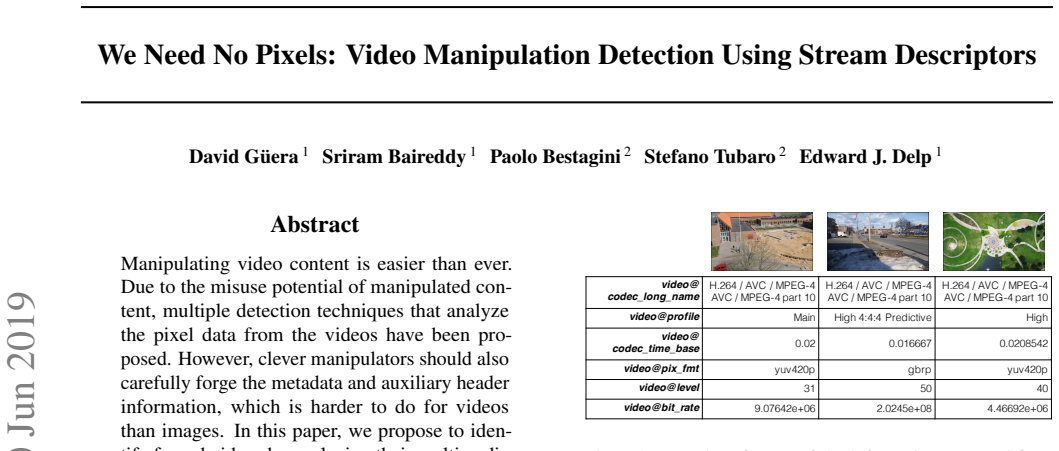


read the original abstract
Manipulating video content is easier than ever. Due to the misuse potential of manipulated content, multiple detection techniques that analyze the pixel data from the videos have been proposed. However, clever manipulators should also carefully forge the metadata and auxiliary header information, which is harder to do for videos than images. In this paper, we propose to identify forged videos by analyzing their multimedia stream descriptors with simple binary classifiers, completely avoiding the pixel space. Using well-known datasets, our results show that this scalable approach can achieve a high manipulation detection score if the manipulators have not done a careful data sanitization of the multimedia stream descriptors.
Editorial analysis
A structured set of objections, weighed in public.
Referee Report
Summary. The paper proposes identifying forged videos by analyzing their multimedia stream descriptors with simple binary classifiers, avoiding the pixel space. It claims that this approach can achieve a high manipulation detection score on well-known datasets if the manipulators have not performed careful data sanitization of the descriptors.
Significance. If the results hold, this provides a scalable method for video manipulation detection that leverages metadata which is harder to forge than pixels. The explicit acknowledgment of the condition under which the method works is a positive aspect. The work could complement existing pixel-based techniques.
minor comments (1)
- [Abstract] Abstract: the claim of a 'high manipulation detection score' is not supported by any specific metrics, classifier architecture, dataset names, or baseline comparisons, which would strengthen the summary.
Simulated Author's Rebuttal
We thank the referee for the positive assessment of our manuscript, the accurate summary of our approach, and the recommendation for minor revision. The referee correctly notes both the scalability of the method and the explicit condition regarding data sanitization of descriptors.
Circularity Check
No significant circularity identified
full rationale
The paper presents a direct classification approach on existing multimedia stream descriptors to detect video manipulations, with results reported on well-known datasets under the explicit condition that manipulators have not performed careful sanitization. No equations, fitted parameters, or derivation steps are described that reduce to self-definition, fitted inputs renamed as predictions, or load-bearing self-citations. The central claim remains independent of any internal circular reduction and is self-contained against external benchmarks.
Axiom & Free-Parameter Ledger
Lean theorems connected to this paper
-
IndisputableMonolith/Cost/FunctionalEquation.leanwashburn_uniqueness_aczel unclear?
unclearRelation between the paper passage and the cited Recognition theorem.
we propose to identify forged videos by analyzing their multimedia stream descriptors with simple binary classifiers, completely avoiding the pixel space
-
IndisputableMonolith/Foundation/ArithmeticFromLogic.leanLogicNat recovery unclear?
unclearRelation between the paper passage and the cited Recognition theorem.
we use an ensemble of a random forest and an SVM trained on multimedia stream descriptors
What do these tags mean?
- matches
- The paper's claim is directly supported by a theorem in the formal canon.
- supports
- The theorem supports part of the paper's argument, but the paper may add assumptions or extra steps.
- extends
- The paper goes beyond the formal theorem; the theorem is a base layer rather than the whole result.
- uses
- The paper appears to rely on the theorem as machinery.
- contradicts
- The paper's claim conflicts with a theorem or certificate in the canon.
- unclear
- Pith found a possible connection, but the passage is too broad, indirect, or ambiguous to say the theorem truly supports the claim.
Reference graph
Works this paper leans on
-
[1]
" write newline "" before.all 'output.state := FUNCTION n.dashify 't := "" t empty not t #1 #1 substring "-" = t #1 #2 substring "--" = not "--" * t #2 global.max substring 't := t #1 #1 substring "-" = "-" * t #2 global.max substring 't := while if t #1 #1 substring * t #2 global.max substring 't := if while FUNCTION format.date year duplicate empty "emp...
-
[2]
Recycle- GAN : Unsupervised video retargeting
Bansal, A., Ma, S., Ramanan, D., and Sheikh, Y. Recycle- GAN : Unsupervised video retargeting. Proceedings of the European Conference on Computer Vision, pp.\ 119--135, September 2018. URL https://doi.org/10.1007/978-3-030-01228-1_8. Munich, Germany
-
[3]
Barnes, C., Shechtman, E., Finkelstein, A., and Goldman, D. B. Patchmatch: A randomized correspondence algorithm for structural image editing. ACM Transactions on Graphics, 28 0 (3): 0 24:1--24:11, July 2009. URL https://doi.org/10.1145/1531326.1531330
-
[4]
Bayram, S., Sencar, H. T., and Memon, N. Video copy detection based on source device characteristics: A complementary approach to content-based methods. Proceedings of the ACM International Conference on Multimedia Information Retrieval, pp.\ 435--442, October 2008. URL https://doi.org/10.1145/1460096.1460167. Vancouver, British Columbia, Canada
-
[5]
Bellard, F. et al. ffprobe documentation. April 2019. URL https://www.ffmpeg.org/ffprobe.html. (Accessed on 04/17/2019)
work page 2019
-
[6]
Local tampering detection in video sequences
Bestagini, P., Milani, S., Tagliasacchi, M., and Tubaro, S. Local tampering detection in video sequences. Proceedings of the IEEE International Workshop on Multimedia Signal Processing, pp.\ 488--493, September 2013. URL https://doi.org/10.1109/MMSP.2013.6659337. Pula, Italy
-
[7]
Codec and gop identification in double compressed videos
Bestagini , P., Milani , S., Tagliasacchi , M., and Tubaro , S. Codec and gop identification in double compressed videos. IEEE Transactions on Image Processing, 25 0 (5): 0 2298--2310, May 2016. URL https://doi.org/10.1109/TIP.2016.2541960
-
[8]
Exposing fake bit rate videos and estimating original bit rates
Bian , S., Luo , W., and Huang , J. Exposing fake bit rate videos and estimating original bit rates. IEEE Transactions on Circuits and Systems for Video Technology, 24 0 (12): 0 2144--2154, December 2014. URL https://doi.org/10.1109/TCSVT.2014.2334031
-
[9]
Bianchi , T. and Piva , A. Image forgery localization via block-grained analysis of jpeg artifacts. IEEE Transactions on Information Forensics and Security, 7 0 (3): 0 1003--1017, June 2012. URL https://doi.org/10.1109/TIFS.2012.2187516
-
[10]
Bird, M. The video in which Greece 's finance minister gives Germany the finger has several bizarre new twists. March 2015. URL https://www.businessinsider.com/yanis-varoufakis-middle-finger-controversy-real-fake-bohmermann-jauch-2015-3. (Accessed on 04/17/2019)
work page 2015
-
[11]
C., Steinhardt, J., Flynn, C., h\' E igeartaigh, S
Brundage, M., Avin, S., Clark, J., Toner, H., Eckersley, P., Garfinkel, B., Dafoe, A., Scharre, P., Zeitzoff, T., Filar, B., Anderson, H., Roff, H., Allen, G. C., Steinhardt, J., Flynn, C., h\' E igeartaigh, S. \' O ., Beard, S., Belfield, H., Farquhar, S., Lyle, C., Crootof, R., Evans, O., Page, M., Bryson, J., Yampolskiy, R., and Amodei, D. The maliciou...
-
[12]
Geometric distortion signatures for printer identification
Bulan , O., Mao , J., and Sharma , G. Geometric distortion signatures for printer identification. Proceedings of the IEEE International Conference on Acoustics, Speech and Signal Processing, pp.\ 1401--1404, April 2009. URL https://doi.org/10.1109/ICASSP.2009.4959855
-
[13]
Chesney, R. and Citron, D. K. Disinformation on steroids: The threat of deep fakes. October 2018. URL https://www.cfr.org/report/deep-fake-disinformation-steroids. (Accessed on 04/17/2019)
work page 2018
-
[14]
Fake porn makers are worried about accidentally making child porn
Cole, S. Fake porn makers are worried about accidentally making child porn. February 2018. URL https://motherboard.vice.com/en_us/article/evmkxa/ai-fake-porn-deepfakes-child-pornography-emma-watson-elle-fanning. (Accessed on 04/17/2019)
work page 2018
-
[15]
Deepfakes are being weaponized to silence women — but this woman is fighting back
Curtis, C. Deepfakes are being weaponized to silence women — but this woman is fighting back. October 2018. URL https://thenextweb.com/code-word/2018/10/05/deepfakes-are-being-weaponized-to-silence-women-but-this-woman-is-fighting-back/. (Accessed on 04/17/2019)
work page 2018
-
[16]
Video forgery detection and localization based on 3d PatchMatch
D'Amiano , L., Cozzolino , D., Poggi , G., and Verdoliva , L. Video forgery detection and localization based on 3d PatchMatch . Proceedings of the IEEE International Conference on Multimedia Expo Workshops, pp.\ 1--6, June 2015. URL https://doi.org/10.1109/ICMEW.2015.7169805. Turin, Italy
-
[17]
A PatchMatch -based dense-field algorithm for video copy–move detection and localization
D'Amiano , L., Cozzolino , D., Poggi , G., and Verdoliva , L. A PatchMatch -based dense-field algorithm for video copy–move detection and localization. IEEE Transactions on Circuits and Systems for Video Technology, 29 0 (3): 0 669--682, March 2019. URL https://doi.org/10.1109/TCSVT.2018.2804768
-
[18]
Autoencoder with recurrent neural networks for video forgery detection
D'Avino, D., Cozzolino, D., Poggi, G., and Verdoliva, L. Autoencoder with recurrent neural networks for video forgery detection. Proceedings of the IS&T Electronic Imaging, 2017 0 (7): 0 92--99, January 2017. URL https://doi.org/10.2352/ISSN.2470-1173.2017.7.MWSF-330. Burlingame, CA
-
[19]
Fan , J., Kot , A. C., Cao , H., and Sattar , F. Modeling the exif-image correlation for image manipulation detection. Proceedings of the IEEE International Conference on Image Processing, pp.\ 1945--1948, September 2011. URL https://doi.org/10.1109/ICIP.2011.6115853. Brussels, Belgium
-
[20]
N., Delgado , A., Zhou , D., Kheyrkhah , T., Smith , J., and Fiscus , J
Guan , H., Kozak , M., Robertson , E., Lee , Y., Yates , A. N., Delgado , A., Zhou , D., Kheyrkhah , T., Smith , J., and Fiscus , J. Mfc datasets: Large-scale benchmark datasets for media forensic challenge evaluation. Proceedings of the IEEE Winter Applications of Computer Vision Workshops, pp.\ 63--72, January 2019. URL https://doi.org/10.1109/WACVW.201...
-
[21]
G\" u era , D. and Delp , E. J. Deepfake video detection using recurrent neural networks. Proceedings of the IEEE International Conference on Advanced Video and Signal Based Surveillance, pp.\ 1--6, November 2018. URL https://doi.org/10.1109/AVSS.2018.8639163. Auckland, New Zealand
-
[22]
Video forgery detection using correlation of noise residue
Hsu, C.-C., Hung, T.-Y., Lin, C.-W., and Hsu, C.-T. Video forgery detection using correlation of noise residue. Proceedings of IEEE Workshop on Multimedia Signal Processing, pp.\ 170--174, October 2008. URL https://doi.org/10.1109/MMSP.2008.4665069. Cairns, Qld, Australia
-
[23]
Huh, M., Liu, A., Owens, A., and Efros, A. A. Fighting fake news: Image splice detection via learned self-consistency. Proceedings of the European Conference on Computer Vision, pp.\ 106--124, September 2018. URL https://doi.org/10.1007/978-3-030-01252-6_7. Munich, Germany
-
[24]
A video forensic framework for the unsupervised analysis of MP4 -like file container
Iuliani , M., Shullani , D., Fontani , M., Meucci , S., and Piva , A. A video forensic framework for the unsupervised analysis of MP4 -like file container. IEEE Transactions on Information Forensics and Security, 14 0 (3): 0 635--645, March 2019. URL https://doi.org/10.1109/TIFS.2018.2859760
-
[25]
Jack, K. Chapter 13 - MPEG -2. In Jack, K. (ed.), Video Demystified: A Handbook for the Digital Engineer, pp.\ 577--737. Newnes, Burlington, MA , 2007. URL https://doi.org/10.1016/B978-075068395-1/50013-4
-
[26]
Khanna , N., Chiu , G. T. ., Allebach , J. P., and Delp , E. J. Forensic techniques for classifying scanner, computer generated and digital camera images. pp.\ 1653--1656, March 2008. URL https://doi.org/10.1109/ICASSP.2008.4517944. Las Vegas, NV
-
[27]
DeepFakes: a New Threat to Face Recognition? Assessment and Detection
Korshunov, P. and Marcel, S. Deepfakes: a new threat to face recognition? assessment and detection. arXiv:1812.08685v1, March 2018. URL https://arxiv.org/abs/1812.08685v1
work page internal anchor Pith review Pith/arXiv arXiv 2018
-
[28]
Fast face-swap using convolutional neural networks
Korshunova , I., Shi , W., Dambre , J., and Theis , L. Fast face-swap using convolutional neural networks. Proceedings of the IEEE International Conference on Computer Vision, pp.\ 3697--3705, October 2017. URL https://doi.org/10.1109/ICCV.2017.397. Venice, Italy
-
[29]
Near-duplicate video detection exploiting noise residual traces
Lameri , S., Bondi , L., Bestagin , P., and Tubaro , S. Near-duplicate video detection exploiting noise residual traces. Proceedings of the IEEE International Conference on Image Processing, pp.\ 1497--1501, September 2017. URL https://doi.org/10.1109/ICIP.2017.8296531. Beijing, China
-
[30]
In ictu oculi: Exposing AI created fake videos by detecting eye blinking
Li , Y., Chang , M., and Lyu , S. In ictu oculi: Exposing AI created fake videos by detecting eye blinking. Proceedings of the IEEE International Workshop on Information Forensics and Security, pp.\ 1--7, December 2018. URL https://doi.org/10.1109/WIFS.2018.8630787. Hong Kong, China
-
[31]
Blind detection and localization of video temporal splicing exploiting sensor-based footprints
Mandelli , S., Bestagini , P., Tubaro , S., Cozzolino , D., and Verdoliva , L. Blind detection and localization of video temporal splicing exploiting sensor-based footprints. Proceedings of the European Signal Processing Conference, pp.\ 1362--1366, September 2018. URL https://doi.org/10.23919/EUSIPCO.2018.8553511. Rome, Italy
-
[32]
Exploiting visual artifacts to expose deepfakes and face manipulations
Matern , F., Riess , C., and Stamminger , M. Exploiting visual artifacts to expose deepfakes and face manipulations. Proceedings of the IEEE Winter Applications of Computer Vision Workshops, pp.\ 83--92, January 2019. URL https://doi.org/10.1109/WACVW.2019.00020. Waikoloa Village, HI
-
[33]
Data structures for statistical computing in python
McKinney, W. Data structures for statistical computing in python. Proceedings of the Python in Science Conference, pp.\ 51--56, June 2010. URL http://conference.scipy.org/proceedings/scipy2010/mckinney.html. Austin, TX
work page 2010
-
[34]
An overview on video forensics
Milani, S., Fontani, M., Bestagini, P., Barni, M., Piva, A., Tagliasacchi, M., and Tubaro, S. An overview on video forensics. APSIPA Transactions on Signal and Information Processing, 1: 0 e2, August 2012. URL https://doi.org/10.1017/ATSIP.2012.2
-
[35]
Near-duplicate video detection exploiting noise residual traces
Mullan, P., Cozzolino, D., Verdoliva, L., and Riess, C. Residual-based forensic comparison of video sequences. Proceedings of the IEEE International Conference on Image Processing, pp.\ 1507--1511, September 2017. URL https://doi.org/10.1109/ICIP.2017.8296533. Beijing, China
-
[36]
Scikit-learn: Machine learning in P ython
Pedregosa, F., Varoquaux, G., Gramfort, A., Michel, V., Thirion, B., Grisel, O., Blondel, M., Prettenhofer, P., Weiss, R., Dubourg, V., Vanderplas, J., Passos, A., Cournapeau, D., Brucher, M., Perrot, M., and Duchesnay, E. Scikit-learn: Machine learning in P ython. Journal of Machine Learning Research, 12: 0 2825--2830, November 2011. URL http://dl.acm.or...
-
[37]
FaceForensics: A Large-scale Video Dataset for Forgery Detection in Human Faces
R\" o ssler, A., Cozzolino, D., Verdoliva, L., Riess, C., Thies, J., and Nie ner, M. Faceforensics: A large-scale video dataset for forgery detection in human faces. arXiv:1803.09179, March 2018. URL https://arxiv.org/abs/1803.09179
work page internal anchor Pith review Pith/arXiv arXiv 2018
-
[38]
Saito, T. and Rehmsmeier, M. The precision-recall plot is more informative than the roc plot when evaluating binary classifiers on imbalanced datasets. PLoS ONE, 10 0 (3): 0 e0118432, March 2015. URL https://doi.org/10.1371/journal.pone.0118432
-
[39]
Stamm , M. C., Lin , W. S., and Liu , K. J. R. Forensics vs. anti-forensics: A decision and game theoretic framework. Proceedings of the IEEE International Conference on Acoustics, Speech and Signal Processing, pp.\ 1749--1752, March 2012 a . URL https://doi.org/10.1109/ICASSP.2012.6288237. Kyoto, Japan
-
[40]
Stamm , M. C., Lin , W. S., and Liu , K. J. R. Temporal forensics and anti-forensics for motion compensated video. IEEE Transactions on Information Forensics and Security, 7 0 (4): 0 1315--1329, August 2012 b . URL https://doi.org/10.1109/TIFS.2012.2205568
-
[41]
Face2 F ace: Real-time face capture and reenactment of RGB videos
Thies, J., Zollh\" o fer, M., Stamminger, M., Theobalt, C., and Nie ner, M. Face2 F ace: Real-time face capture and reenactment of RGB videos. Proceedings of the IEEE Conference on Computer Vision and Pattern Recognition, pp.\ 2387--2395, June 2016. URL https://doi.org/10.1109/CVPR.2016.262. Las Vegas, NV
-
[42]
US lawmakers say AI deepfakes ‘have the potential to disrupt every facet of our society’
Vincent, J. US lawmakers say AI deepfakes ‘have the potential to disrupt every facet of our society’. September 2018. URL https://www.theverge.com/2018/9/14/17859188/ai-deepfakes-national-security-threat-lawmakers-letter-intelligence-community. (Accessed on 04/17/2019)
work page 2018
-
[43]
The good, the bad and the bait: Detecting and characterizing clickbait on youtube
Zannettou , S., Chatzis , S., Papadamou , K., and Sirivianos , M. The good, the bad and the bait: Detecting and characterizing clickbait on youtube. Proceedings of the IEEE Security and Privacy Workshops, pp.\ 63--69, May 2018. URL https://doi.org/10.1109/SPW.2018.00018. San Francisco, CA
discussion (0)
Sign in with ORCID, Apple, or X to comment. Anyone can read and Pith papers without signing in.