++nnU-Net: Scaling nnU-Net with Prefix-Based Data Augmentation
Pith reviewed 2026-06-27 11:33 UTC · model grok-4.3
The pith
A registration-based data augmentation step added before nnU-Net training raises Dice scores on 2D medical segmentation tasks.
A machine-rendered reading of the paper's core claim, the machinery that carries it, and where it could break.
Core claim
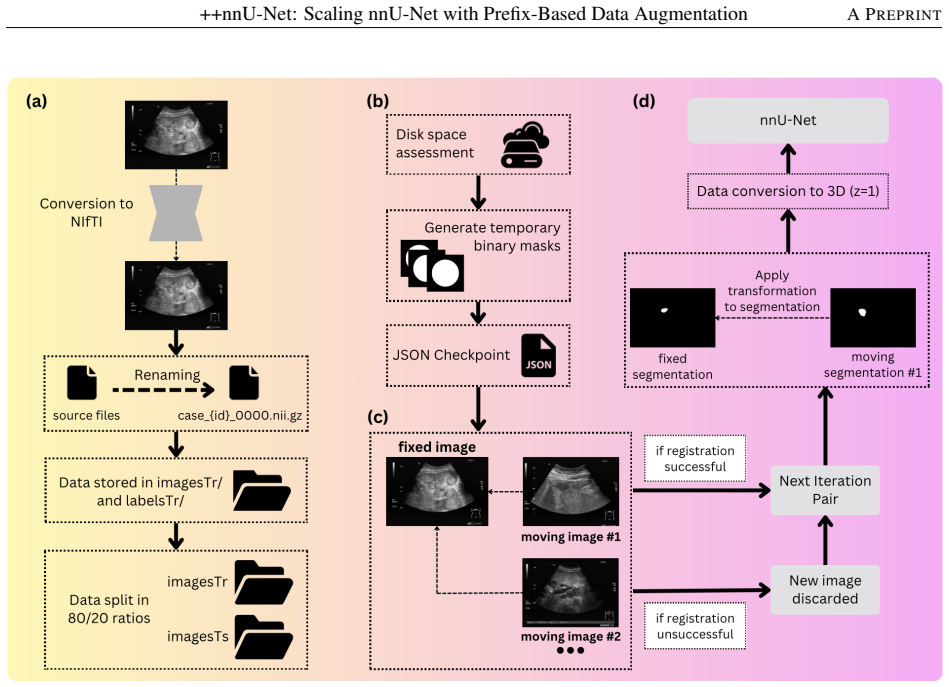
The ++nnU-Net framework uses a prefix module that performs two-stage image registration to generate warped images and transformed segmentations, which are then fed into the nnU-Net preprocessing and training. This yields higher Dice Similarity Coefficient scores than the standard nnU-Net across five 2D datasets, with gains up to approximately 22 percent in prominent cases. The method also includes computing disk space, generating binary synthetic masks, and creating checkpoints as part of the scalable pipeline.
What carries the argument
The two-stage registration process that generates warped images and applies transformations to segmentations before preprocessing.
Load-bearing premise
The two-stage registration process generates anatomically feasible warped images and segmentations that improve rather than degrade model training.
What would settle it
Retraining nnU-Net with and without the ++ prefix on the same five 2D datasets and finding no Dice score improvement or a decrease would falsify the performance claim.
Figures
read the original abstract
The nnU-Net has demonstrated continuous success in medical segmentation tasks, which heavily rely on the availability and diversity of annotated biomedical data. However, assembling medical imaging cohorts remains challenging due to numerous factors such as privacy regulations and annotation costs. As a result, data augmentation plays a crucial role in increasing data availability while maintaining anatomical feasibility. Hence, we propose the ++nnU-Net, a novel data augmentation module based on image registration that operates prior to preprocessing and training take place. Our framework was evaluated across five different 2D datasets. In this workflow, image data go through a two-stage registration process, generating new warped images. The transformations are then applied to the respective segmentation. In addition, the pipeline computes available disk space, generates supplementary binary synthetic masks and generates checkpoints. We demonstrate that the ++nnU-Net outperforms the nnU-Net baseline, yielding improvements in Dice Similarity Coefficient scores. In the most prominent cases, we observe performance gains of approximately 22\%. These findings highlight the effectiveness of registration-based data augmentation, particularly for 2D medical imaging datasets and suggest that the ++nnU-Net provides a practical and scalable approach for enhancing segmentation performance in data-limited settings. The source code for the ++nnU-Net is available at: https://github.com/sofia-adelie/plusplusnnunet.git
Editorial analysis
A structured set of objections, weighed in public.
Referee Report
Summary. The paper introduces ++nnU-Net, a data augmentation module that applies a two-stage image registration process to generate warped images and transformed segmentations prior to nnU-Net preprocessing and training. Evaluated on five 2D medical imaging datasets, it claims consistent outperformance over the nnU-Net baseline with Dice Similarity Coefficient gains reaching approximately 22% in prominent cases, positioning the approach as a scalable solution for data-limited segmentation tasks. The source code is provided via GitHub.
Significance. If the registration-based augmentations are shown to be anatomically valid and the gains are reproducible with proper controls, the work could offer a practical extension to nnU-Net for increasing training diversity without additional annotations. The emphasis on pre-processing augmentation and supplementary mask generation addresses a real constraint in biomedical imaging, though the current presentation supplies insufficient evidence to establish this contribution.
major comments (3)
- [Abstract] Abstract: The central claim of ~22% Dice improvement is presented without any description of the registration algorithm (affine vs. deformable, similarity metric, regularization term), post-warp validation (Jacobian checks, label overlap, topology preservation), or comparison against standard nnU-Net augmentations; this directly undermines assessment of whether the reported gains arise from the proposed method rather than uncontrolled factors.
- [Abstract] Abstract / Methods (implied): The two-stage registration workflow is asserted to produce 'anatomically feasible' warped images and segmentations, yet no quantitative checks or failure cases are reported; because every downstream Dice number depends on this assumption, the absence of validation constitutes a load-bearing gap for the performance claims.
- [Abstract] Abstract: No experimental details are supplied on dataset characteristics, train/validation/test splits, baseline nnU-Net configurations, number of runs, or statistical testing; without these, the cross-dataset superiority claim cannot be evaluated for robustness or confounds such as data leakage.
minor comments (3)
- [Abstract] Abstract: Typo in 'prior to preprocessing and training take place' should read 'takes place'.
- [Abstract] Abstract: The title refers to 'Prefix-Based Data Augmentation' while the text describes registration-based augmentation; clarify the relationship or intended terminology.
- [Abstract] Abstract: The GitHub link is provided but the manuscript does not indicate whether the released code reproduces the exact experimental pipeline and results reported.
Simulated Author's Rebuttal
We thank the referee for the constructive comments, which identify key gaps in the clarity and supporting evidence of our work. We address each point below and will perform a major revision to incorporate the requested details, validations, and experimental summaries.
read point-by-point responses
-
Referee: [Abstract] Abstract: The central claim of ~22% Dice improvement is presented without any description of the registration algorithm (affine vs. deformable, similarity metric, regularization term), post-warp validation (Jacobian checks, label overlap, topology preservation), or comparison against standard nnU-Net augmentations; this directly undermines assessment of whether the reported gains arise from the proposed method rather than uncontrolled factors.
Authors: We agree that the abstract requires additional methodological context to allow proper evaluation. In the revised manuscript we will expand the abstract to include a concise description of the two-stage registration (specifying affine followed by deformable components, the similarity metric, and regularization), note that post-warp validation was performed, and reference the comparison against standard nnU-Net augmentations that appears in the Experiments section. revision: yes
-
Referee: [Abstract] Abstract / Methods (implied): The two-stage registration workflow is asserted to produce 'anatomically feasible' warped images and segmentations, yet no quantitative checks or failure cases are reported; because every downstream Dice number depends on this assumption, the absence of validation constitutes a load-bearing gap for the performance claims.
Authors: We acknowledge this as a substantive gap. Although the original submission relied on the design of the registration pipeline to support anatomical feasibility, we will add explicit quantitative validation in the revised version, including Jacobian determinant statistics, label-overlap metrics between warped and original segmentations, and a summary of observed failure cases. revision: yes
-
Referee: [Abstract] Abstract: No experimental details are supplied on dataset characteristics, train/validation/test splits, baseline nnU-Net configurations, number of runs, or statistical testing; without these, the cross-dataset superiority claim cannot be evaluated for robustness or confounds such as data leakage.
Authors: We agree that these details must be summarized for the abstract to stand alone. The full manuscript contains a Datasets section and an Experimental Setup section that describe the five 2D datasets, split ratios, nnU-Net baseline configuration, number of runs, and statistical testing. We will insert a compact summary of these elements into the abstract and explicitly address data-leakage safeguards. revision: yes
Circularity Check
No circularity: purely empirical method proposal with direct experimental comparison
full rationale
The paper introduces ++nnU-Net as a registration-based data augmentation pipeline applied before nnU-Net training and reports Dice improvements on five 2D datasets. No equations, parameters fitted to target metrics, or derivation steps appear in the provided text. Performance claims rest on direct empirical comparison to the nnU-Net baseline rather than any reduction to self-referential quantities or self-citations. The two-stage registration assumption is a methodological premise subject to external validation, not a circularity in a claimed derivation chain. This is the standard case of an independent empirical contribution.
Axiom & Free-Parameter Ledger
axioms (1)
- domain assumption Image registration transformations applied to segmentations produce anatomically feasible training examples.
Reference graph
Works this paper leans on
-
[1]
nnu-net: a self- configuring method for deep learning-based biomedical image segmentation.Nature methods, 18(2):203–211, 2021
Fabian Isensee, Paul F Jaeger, Simon AA Kohl, Jens Petersen, and Klaus H Maier-Hein. nnu-net: a self- configuring method for deep learning-based biomedical image segmentation.Nature methods, 18(2):203–211, 2021
2021
-
[2]
Fully convolutional networks for semantic segmentation
Jonathan Long, Evan Shelhamer, and Trevor Darrell. Fully convolutional networks for semantic segmentation. InProceedings of the IEEE conference on computer vision and pattern recognition, pages 3431–3440, 2015
2015
-
[3]
U-net: Convolutional networks for biomedical image seg- mentation
Olaf Ronneberger, Philipp Fischer, and Thomas Brox. U-net: Convolutional networks for biomedical image seg- mentation. InMedical image computing and computer-assisted intervention–MICCAI 2015: 18th international conference, Munich, Germany, October 5-9, 2015, proceedings, part III 18, pages 234–241. Springer, 2015
2015
-
[4]
The medical segmentation decathlon.Nature Communications, 2022
Michela Antonelli. The medical segmentation decathlon.Nature Communications, 2022
2022
-
[5]
How much data do you need? an analysis of pelvic multi-organ segmentation in a limited data context.Physical and Engineering Sciences in Medicine, 2025
Febrio Lunardo. How much data do you need? an analysis of pelvic multi-organ segmentation in a limited data context.Physical and Engineering Sciences in Medicine, 2025
2025
-
[6]
Data augmentation for medical imaging: A systematic literature review.Computers in Biology and Medicine, 2023
Fabio Garcea. Data augmentation for medical imaging: A systematic literature review.Computers in Biology and Medicine, 2023
2023
-
[7]
Medical image data augmentation: techniques, comparisons and interpretations.Artificial Intelli- gence Review, 56:12561–12605, 2023
Evgin Goceri. Medical image data augmentation: techniques, comparisons and interpretations.Artificial Intelli- gence Review, 56:12561–12605, 2023
2023
-
[8]
Deep learning using augmentation via registration: 1st place solution to the autoimplant 2020 challenge
David G Ellis and Michele R Aizenberg. Deep learning using augmentation via registration: 1st place solution to the autoimplant 2020 challenge. InTowards the Automatization of Cranial Implant Design in Cranioplasty: First Challenge, AutoImplant 2020, Held in Conjunction with MICCAI 2020, Lima, Peru, October 8, 2020, Proceedings 1, pages 47–55. Springer, 2...
2020
-
[9]
brainminds.jp/ants-tutorial
Tutorial: Registering the brain/minds marmoset atlas to new data using ants.https://dataportal. brainminds.jp/ants-tutorial
-
[10]
Data augmentation for liver tumor segmentation using structure, texture, and contrast.Bild- verarbeitung für die Medizin 2025, 2025
Serouj Khajarian. Data augmentation for liver tumor segmentation using structure, texture, and contrast.Bild- verarbeitung für die Medizin 2025, 2025
2025
-
[11]
Gbm-reservoir: Brain tumor (glioblastoma multiforme) mri dataset collection with ground truth segmentation masks author links open overlay panel.Data in Brief, 2025
Naida Solak. Gbm-reservoir: Brain tumor (glioblastoma multiforme) mri dataset collection with ground truth segmentation masks author links open overlay panel.Data in Brief, 2025
2025
-
[12]
En- hanced data augmentation using synthetic data for brain tumour segmentation, 2024
André Ferreira, Naida Solak, Jianning Li, Philipp Dammann, Jens Kleesiek, Victor Alves, and Jan Egger. En- hanced data augmentation using synthetic data for brain tumour segmentation, 2024
2024
-
[13]
100+ 2d us images and tumor segmentation masks.https://doi.org/10.13140/RG.2.2.36586
Jan Egger. 100+ 2d us images and tumor segmentation masks.https://doi.org/10.13140/RG.2.2.36586. 77761
-
[14]
Dataset of breast ultrasound images.Data in Brief, 2020
Walid Al-Dhabyani. Dataset of breast ultrasound images.Data in Brief, 2020
2020
-
[15]
B. Killeen, M. Liu, P.-C. Ku, S. Yudi, Y . Liu, S. Yibulayimu, G. Zhu, X. Wu, C. Zhao, Y . Wang, M. Armand, and M. Unberath. Pengwin task 2: Pelvic fragment segmentation on synthetic x-ray images.https://doi.org/ 10.5281/zenodo.10913196
-
[16]
Breast ultrasound images dataset (busi).https://scholar.cu.edu.eg/?q=afahmy/ pages/dataset
Walid Al-Dhabyani. Breast ultrasound images dataset (busi).https://scholar.cu.edu.eg/?q=afahmy/ pages/dataset
-
[17]
Maxim popov. Arcade: Automatic region-based coronary artery disease diagnostics using x-ray angiography images dataset.https://zenodo.org/records/10390295
-
[18]
Teeth segmentation on dental x-ray images, 2023
Humans In The Loop. Teeth segmentation on dental x-ray images, 2023
2023
-
[19]
Popov, A
M. Popov, A. Amanturdieva, and N. Zhaksylyk. Dataset for automatic region-based coronary artery disease diagnostics using x-ray angiography images.Scientific Data, 2024. 7
2024
discussion (0)
Sign in with ORCID, Apple, or X to comment. Anyone can read and Pith papers without signing in.