REVIEW 3 major objections 5 minor 64 references
Lipschitz-constrained SSD detectors improve adversarial robustness by design and combine with adversarial training for gains on unseen attacks.
Reviewed by Pith at T0; open to challenge. T0 means a machine referee read the full paper against a public rubric. the ladder, T0–T4 →
T0 review · grok-4.5
2026-07-11 13:19 UTC pith:UP46VX6U
load-bearing objection Solid empirical methods paper: orthonormalized LipSSD gives real multi-attack robustness and stacks with AT, but the headline 15-point claim is a single-seed held-out gap and the Lipschitz story is only partial. the 3 major comments →
LipSSD: Lipschitz-Constrained Single-Shot Detection for Adversarially Robust Object Detection
The pith
A machine-rendered reading of the paper's core claim, the machinery that carries it, and where it could break.
Core claim
Architectural Lipschitz control yields attack-agnostic robustness for single-shot object detection. Under identical training, an adversarially trained LipSSD/SLipSSD improves mAP@50 on unseen white-box attacks by up to 15 points over a classical adversarially trained SSD on Pascal VOC, and on KITTI and LARD the Lipschitz variants raise robustness while largely preserving clean performance.
What carries the argument
LipSSD: every convolutional block is replaced by an orthonormalized 1-Lipschitz block (RKO or AOC orthogonal convolution + GroupSort + ℓ2-norm pooling), the classification head is kept Lipschitz, the box-regression head is left unconstrained, and temperature scaling of the classification cross-entropy steers the accuracy–robustness frontier.
Load-bearing premise
Leaving the box-regression head unconstrained (and one overlapping max-pool only 3-Lipschitz) still keeps overall detector sensitivity low enough for the claimed robustness gains.
What would settle it
Train LipSSD and standard SSD under the same adversarial-training recipe on Pascal VOC, then measure mAP@50 under the paper’s held-out white-box attacks at the reported budgets; if the Lipschitz model no longer gains the claimed ~15 points on unseen attacks, or if clean mAP collapses on KITTI/LARD, the central claim fails.
Editorial analysis
A structured set of objections, weighed in public.
Referee Report
Summary. The paper proposes LipSSD (and a scaled SLipSSD variant), a Single Shot MultiBox Detector whose backbone, extra layers, and classification head are built from 1-Lipschitz orthonormalized convolutions (RKO/AOC), GroupSort, and ℓ2-norm pooling, while the box-regression head and NMS remain unconstrained. A temperature-scaled classification loss is used to control the accuracy–robustness trade-off. Empirical evaluation on Pascal VOC under multiple white-box attacks (PGD on classification/localization, DAG, TOG-F/V/M), plus safety-critical KITTI and LARD, shows improved robust mAP@50 relative to vanilla SSD; combining SLipSSD with MTD adversarial training further improves performance on attacks not used in training (up to ~15 mAP points on TOG-M). An appendix extends the design to LipFCOS.
Significance. Adversarial robustness for object detection is less developed than for classification, and most defenses remain tied to attack-specific adversarial training. An architectural, attack-agnostic Lipschitz design that is complementary to AT and that largely preserves clean performance on KITTI/LARD is a useful practical contribution. Strengths include multi-attack evaluation, budget curves, an explicit temperature Pareto front, honest reporting of the clean/robust trade-off on VOC, and a non-trivial extension to FCOS. Code release is promised. The work does not claim certificates (correctly, given NMS/IoU), so its value is empirical robust design rather than formal guarantees.
major comments (3)
- Abstract and §4.2.2 / Table 2: the headline claim that adversarially trained LipSSD improves mAP@50 on unseen attacks by up to 15 points over classical AT-SSD rests on a single-seed MTD comparison (SLipSSD-MTD vs MTD-SSD at ε=5). On the two attacks used in training (Acls/Areg) the Lip model is slightly worse; gains appear only on held-out attacks. Without multi-seed variance or repeated runs, it is unclear whether the ~15-point TOG-M gap is a stable architectural effect or an optimization artifact. At least multi-seed means/std or a second AT recipe would be needed to support the abstract claim as stated.
- §3.2.3 and §2.3: the box-regression head is left unconstrained and the overlapping max-pool remains 3-Lipschitz, so the global Lipschitz constant of the detector is only partially controlled. The paper correctly notes that Lipschitz expressivity for regression is open and that NMS/IoU block certificates. Given that localization-targeted attacks (Areg) are a main evaluation axis, the manuscript should either (i) quantify how much of the robust mAP gain survives when the free head is also constrained or ablated, or (ii) clearly reframe the contribution as “Lipschitz backbone + classification head” rather than a fully Lipschitz detector. Without that, the architectural story is weaker than the abstract suggests.
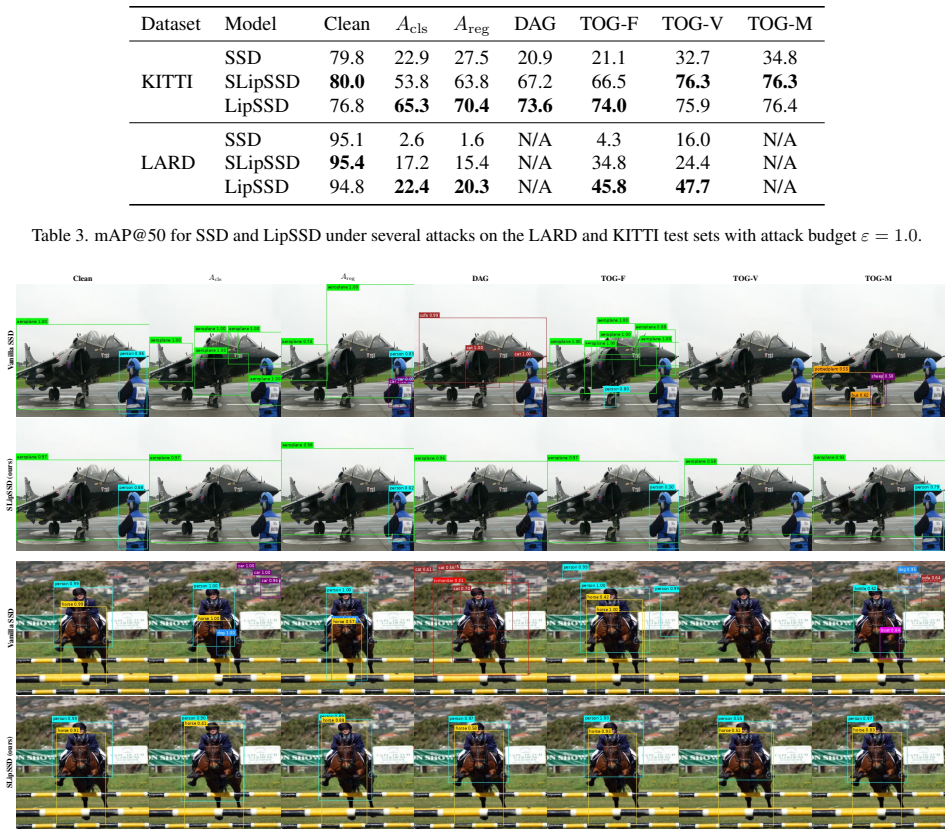
- §4.3 / Table 3: LARD robust mAP is reported on a random 1000-image subset of the ~52k test set, with no error bars or repeated sampling. Clean performance is on the full set. For a safety-critical dataset this is a load-bearing evaluation detail; either evaluate the full test set under attack (or a stratified multi-seed subsample with variance) or qualify the LARD robustness claims more carefully.
minor comments (5)
- Figure 1 caption and abstract use “LipSSD” while several VOC tables emphasize SLipSSD; clarify which variant is the primary proposed model and keep naming consistent in the abstract.
- §4.1: attack iteration counts (40/100/50) and ε choices differ by dataset; a short justification that the budget is saturated for all models would help reproducibility.
- Appendix A (LipFCOS) is a valuable generalization but is only briefly mentioned in the main text; a one-sentence pointer in the contributions list would improve visibility.
- Typos / polish: “accuracyrobustness” (abstract), occasional spacing around ε and mAP@50, and “Bj ¨orck” encoding artifacts in the PDF.
- Related work on certified detection (Appendix C) is useful; a brief cross-reference in §2.3 would help readers who stop at the main text.
Circularity Check
No significant circularity: robustness claims are empirical measurements against external white-box attacks and public datasets, not reductions of outputs to fitted or self-defined inputs.
full rationale
The paper's central claims (attack-agnostic robustness of LipSSD/SLipSSD, temperature-controlled accuracy-robustness trade-off, complementarity with MTD adversarial training, and gains on KITTI/LARD) are established by training models with known Lipschitz building blocks (RKO/AOC orthonormalized convolutions, GroupSort, ℓ2-pooling from TorchLip/Orthogonium and prior classification/segmentation work) and then measuring mAP@50 under independent white-box attacks (PGD Acls/Areg, DAG, TOG-F/V/M) on public datasets. Temperature τ and the RMS fan-out/fan-in scale are free hyperparameters whose effect is plotted empirically (Figs. 3–5, 10); they do not redefine the evaluation metric or force the reported mAP numbers by construction. The unconstrained box-regression head and residual 3-Lipschitz max-pool are openly acknowledged limitations, not hidden redefinitions of the Lipschitz claim. Self-citations supply reusable operators and the temperature idea, not the measured robustness outcomes. No equation equates a claimed prediction to a fitted quantity, no uniqueness theorem is imported to forbid alternatives, and no known empirical pattern is merely renamed. The derivation chain is therefore self-contained against external benchmarks; the single minor self-citation load is non-load-bearing tooling.
Axiom & Free-Parameter Ledger
free parameters (4)
- classification temperature τ
- SLipSSD RMS fan-out/fan-in scale
- attack budgets ε and iteration counts
- learning rates / optimizer settings
axioms (4)
- standard math Composition bound: Lip(f_n ∘ … ∘ f_1) ≤ product of layer Lipschitz constants, so 1-Lipschitz layers yield a globally controlled network.
- domain assumption Orthogonal/spectral reparametrizations (RKO, AOC, Björck) plus GroupSort and ℓ2 pooling sufficiently control sensitivity for empirical robustness even without certificates.
- ad hoc to paper Leaving the box-regression head unconstrained does not erase the robustness benefit of a Lipschitz backbone and classification head.
- domain assumption White-box ℓ2 attacks (PGD/DAG/TOG) are an adequate stress test of detector stability for safety-critical claims.
invented entities (2)
-
LipSSD / SLipSSD architectures
no independent evidence
-
LipFCOS architecture
no independent evidence
read the original abstract
Object detectors have many applications in safety-critical systems, but they are known to be sensitive to worst-case perturbations such as adversarial attacks, which limits their applicability in real-world scenarios. Compared with classification, adversarial robustness for object detection has received less attention, and existing methods are often tied to adversarial training, whose performance may not transfer across attacks, perturbation budgets, or architectures. In this work, we introduce Lipschitz-constrained variants of object detection architectures as robust-by-design alternatives to standard detectors. We validate this approach with LipSSD, a Lipschitz-constrained Single Shot MultiBox Detector (SSD), and provide a comprehensive study of its adversarial robustness using multiple white-box adversarial attacks and datasets. We first analyze the accuracyrobustness trade-off induced by Lipschitz constraints and show that it can be controlled through a single training hyperparameter. We then demonstrate that Lipschitzconstrained detectors are complementary to adversarial training: under the same training setup on the Pascal VOC dataset, adversarially trained LipSSD improves mAP@50 on unseen attacks by up to 15 points over classical adversarially trained SSD. Finally, we use more specific safety-critical datasets such as LARD and KITTI, and show that Lipschitz-constrained detectors can improve robustness while largely preserving clean performance. These results suggest that architectural Lipschitz control is a practical and attack-agnostic direction for improving the robustness of object detectors.
Figures




Reference graph
Works this paper leans on
-
[1]
Adver- sarial defenses for object detectors based on gabor convolu- tional layers
Abdollah Amirkhani and Mohammad Parsa Karimi. Adver- sarial defenses for object detectors based on gabor convolu- tional layers. The visual computer, 38(6):1929–1944, 2022. 3
1929
-
[2]
Sorting out Lips- chitz function approximation
Cem Anil, James Lucas, and Roger Grosse. Sorting out Lips- chitz function approximation. In Proceedings of the 36th In- ternational Conference on Machine Learning. PMLR, 2019. 2, 3, 4
2019
-
[3]
Analytical bounds on the local lipschitz constants of relu networks
Trevor Avant and Kristi A Morgansen. Analytical bounds on the local lipschitz constants of relu networks. IEEE Trans- actions on Neural Networks and Learning Systems , 35(10): 13902–13913, 2023. 4
2023
-
[4]
Lipschitz Con- strained Neural Networks for Robust Object Detection at Sea
Jonathan Becktor, Frederik Sch ¨oller, Evangelos Boukas, Mogens Blanke, and Lazaros Nalpantidis. Lipschitz Con- strained Neural Networks for Robust Object Detection at Sea. IOP Conference Series: Materials Science and Engi- neering, 929(1), 2020. 2, 3, 5
2020
-
[5]
Batch nor- malization increases adversarial vulnerability and decreases adversarial transferability: A non-robust feature perspective
Philipp Benz, Chaoning Zhang, and In So Kweon. Batch nor- malization increases adversarial vulnerability and decreases adversarial transferability: A non-robust feature perspective. In ICCV, pages 7818–7827, 2021. 6
2021
-
[6]
Pay attention to your loss : understanding misconceptions about Lipschitz neural networks
Louis B ´ethune, Thibaut Boissin, Mathieu Serrurier, Franck Mamalet, Corentin Friedrich, and Alberto Gonzalez Sanz. Pay attention to your loss : understanding misconceptions about Lipschitz neural networks. In NeurIPS, 2022. 2, 3, 5, 6
2022
-
[7]
˚Ake Bj ¨orck and C. Bowie. An iterative algorithm for com- puting the best estimate of an orthogonal matrix.SIAM Jour- nal on Numerical Analysis, 8(2):358–364, 1971. 3, 4
1971
-
[8]
An adaptive orthogonal convolution scheme for efficient and flexible CNN architectures
Thibaut Boissin, Franck Mamalet, Thomas Fel, Agustin Martin Picard, Thomas Massena, and Mathieu Serrurier. An adaptive orthogonal convolution scheme for efficient and flexible CNN architectures. In ICML, 2025. 2, 4, 5
2025
-
[9]
Lard 2.0: Enhanced datasets 1https://www.deel.ai/ and benchmarking for autonomous landing systems
Yassine Bougacha, Geoffrey Delhomme, M ´elanie Ducoffe, Augustin Fuchs, Jean-Brice Ginestet, Jacques Girard, Sofi- ane Kraiem, Franck Mamalet, Vincent Mussot, Claire Pagetti, and Thierry Sammour. Lard 2.0: Enhanced datasets 1https://www.deel.ai/ and benchmarking for autonomous landing systems. In ERTS, 2026. 2, 7
2026
-
[10]
A theoretical analysis of feature pooling in visual recognition
Y-Lan Boureau, Jean Ponce, and Yann LeCun. A theoretical analysis of feature pooling in visual recognition. In ICML,
-
[11]
End- to-end object detection with transformers
Nicolas Carion, Francisco Massa, Gabriel Synnaeve, Nicolas Usunier, Alexander Kirillov, and Sergey Zagoruyko. End- to-end object detection with transformers. In ECCV, pages 213–229. Springer, 2020. 4
2020
-
[12]
Towards evaluating the robustness of neural networks
Nicholas Carlini and David Wagner. Towards evaluating the robustness of neural networks. In 2017 ieee symposium on security and privacy (sp), pages 39–57. Ieee, 2017. 2
2017
-
[13]
Overload: Latency attacks on object detection for edge devices
Erh-Chung Chen, Pin-Yu Chen, I Chung, Che-Rung Lee, et al. Overload: Latency attacks on object detection for edge devices. In CVPR, 2024. 2
2024
-
[14]
Class- Aware Robust Adversarial Training for Object Detection
Pin-Chun Chen, Bo-Han Kung, and Jun-Cheng Chen. Class- Aware Robust Adversarial Training for Object Detection. In CVPR, 2021. 2, 3, 4, 5
2021
-
[15]
Robust and accurate object detection via adversarial learning
Xiangning Chen, Cihang Xie, Mingxing Tan, Li Zhang, Cho- Jui Hsieh, and Boqing Gong. Robust and accurate object detection via adversarial learning. In CVPR, 2021. 2, 3
2021
-
[16]
Adversarial intensity awareness for ro- bust object detection
Jikang Cheng, Baojin Huang, Yan Fang, Zhen Han, and Zhongyuan Wang. Adversarial intensity awareness for ro- bust object detection. Computer Vision and Image Under- standing, 251:104252, 2025. 4, 5
2025
-
[17]
Detec- tion as Regression: Certified Object Detection with Median Smoothing
Ping-yeh Chiang, Michael Curry, Ahmed Abdelkader, Aounon Kumar, John Dickerson, and Tom Goldstein. Detec- tion as Regression: Certified Object Detection with Median Smoothing. In NeurIPS. Curran Associates, Inc., 2020. 17
2020
-
[18]
Adversarial Attack and De- fense of YOLO Detectors in Autonomous Driving Scenarios
Jung Im Choi and Qing Tian. Adversarial Attack and De- fense of YOLO Detectors in Autonomous Driving Scenarios. In 2022 IEEE Intelligent Vehicles Symposium (IV), 2022. 3
2022
-
[19]
Adversarial objectness gradient attacks in real- time object detection systems
Ka-Ho Chow, Ling Liu, Margaret Loper, Juhyun Bae, Mehmet Emre Gursoy, Stacey Truex, Wenqi Wei, and Yanzhao Wu. Adversarial objectness gradient attacks in real- time object detection systems. In 2020 Second IEEE Inter- national Conference on Trust, Privacy and Security in Intel- ligent Systems and Applications (TPS-ISA) , pages 263–272,
2020
-
[20]
Certi- fied Adversarial Robustness via Randomized Smoothing
Jeremy Cohen, Elan Rosenfeld, and Zico Kolter. Certi- fied Adversarial Robustness via Randomized Smoothing. In ICML, 2019. 2
2019
-
[21]
VerifIoU: Robustness of object detection to perturbations
No ´emie Cohen, M ´elanie Ducoffe, Ryma Boumazouza, Christophe Gabreau, Claire Pagetti, Xavier Pucel, and Au- drey Galametz. VerifIoU: Robustness of object detection to perturbations. In 44th Digital Avionics Systems Conference (DASC), pages 1–10, Montreal, Canada, 2025. IEEE. 17
2025
-
[22]
Adversarially-Aware Robust Object Detector
Ziyi Dong, Pengxu Wei, and Liang Lin. Adversarially-Aware Robust Object Detector. In ECCV, 2022. 2, 3, 4, 5, 6
2022
-
[23]
Lard–landing approach runway detection–dataset for vision based landing
M ´elanie Ducoffe, Maxime Carrere, L ´eo F ´eliers, Adrien Gauffriau, Vincent Mussot, Claire Pagetti, and Thierry Sam- mour. Lard–landing approach runway detection–dataset for vision based landing. arXiv preprint arXiv:2304.09938 ,
-
[24]
The Pascal Visual Object Classes Challenge: A retrospective
Mark Everingham, SM Ali Eslami, Luc Van Gool, Christo- pher KI Williams, John Winn, and Andrew Zisserman. The Pascal Visual Object Classes Challenge: A retrospective. IJCV, 111(1):98–136, 2015. 5 9
2015
-
[25]
Vision meets robotics: The kitti dataset
Andreas Geiger, Philip Lenz, Christoph Stiller, and Raquel Urtasun. Vision meets robotics: The kitti dataset. The in- ternational journal of robotics research, 32(11):1231–1237,
-
[26]
Goodfellow, Jonathon Shlens, and Christian Szegedy
Ian J. Goodfellow, Jonathon Shlens, and Christian Szegedy. Explaining and harnessing adversarial examples. CoRR, abs/1412.6572, 2014. 1, 2
Pith/arXiv arXiv 2014
-
[27]
LipNeXt: Scal- ing up Lipschitz-based Certified Robustness to Billion- parameter Models
Kai Hu, Haoqi Hu, and Matt Fredrikson. LipNeXt: Scal- ing up Lipschitz-based Certified Robustness to Billion- parameter Models. In ICLR, 2025. 2, 3
2025
-
[28]
Adversar- ial examples are not bugs, they are features
Andrew Ilyas, Shibani Santurkar, Dimitris Tsipras, Logan Engstrom, Brandon Tran, and Aleksander Madry. Adversar- ial examples are not bugs, they are features. Advances in neural information processing systems, 32, 2019. 14
2019
-
[29]
Adam: A method for stochastic optimization
Diederik P Kingma and Jimmy Ba. Adam: A method for stochastic optimization. arXiv preprint arXiv:1412.6980 ,
-
[30]
Preventing gradient at- tenuation in lipschitz constrained convolutional networks
Qiyang Li, Saminul Haque, Cem Anil, James Lucas, Roger Grosse, and J ¨orn-Henrik Jacobsen. Preventing gradient at- tenuation in lipschitz constrained convolutional networks. In NeurIPS, 2019. 2, 4
2019
-
[31]
On the importance of backbone to the adversarial robustness of object detectors
Xiao Li, Hang Chen, and Xiaolin Hu. On the importance of backbone to the adversarial robustness of object detectors. IEEE Transactions on Information Forensics and Security ,
-
[32]
Robust adversarial perturbation on deep proposal-based models
Yuezun Li, Daniel Tian, Ming-Ching Chang, Xiao Bian, and Siwei Lyu. Robust adversarial perturbation on deep proposal-based models. In BMVC, 2018. 2
2018
-
[33]
Segment and complete: Defending object detectors against adversarial patch attacks with robust patch detection
Jiang Liu, Alexander Levine, Chun Pong Lau, Rama Chel- lappa, and Soheil Feizi. Segment and complete: Defending object detectors against adversarial patch attacks with robust patch detection. In CVPR, pages 14973–14982, 2022. 2, 3
2022
-
[34]
Wei Liu, Dragomir Anguelov, Dumitru Erhan, Christian Szegedy, Scott Reed, Cheng-Yang Fu, and Alexander C. Berg. SSD: Single Shot MultiBox Detector. In ECCV, 2016. 2, 4, 6
2016
-
[35]
Dpatch: An adversarial patch attack on object detectors
Xin Liu, Huanrui Yang, Ziwei Liu, Linghao Song, Hai Li, and Yiran Chen. Dpatch: An adversarial patch attack on object detectors. arXiv preprint arXiv:1806.02299, 2018. 2
Pith/arXiv arXiv 2018
-
[36]
Towards Deep Learning Models Resistant to Adversarial Attacks
Aleksander Madry, Aleksandar Makelov, Ludwig Schmidt, Dimitris Tsipras, and Adrian Vladu. Towards Deep Learning Models Resistant to Adversarial Attacks. In ICLR, 2018. 2
2018
-
[37]
Fast and flexible robustness certificates for semantic segmentation
Thomas Massena, Corentin Friedrich, Franck Mamalet, and Mathieu Serrurier. Fast and flexible robustness certificates for semantic segmentation. arXiv preprint arXiv:2512.06010, 2025. 2, 3, 5
arXiv 2025
-
[38]
Spectral Normalization for Generative Ad- versarial Networks
Takeru Miyato, Toshiki Kataoka, Masanori Koyama, and Yuichi Yoshida. Spectral Normalization for Generative Ad- versarial Networks. In ICLR, 2018. 3, 4
2018
-
[39]
A Survey and Evaluation of Adversarial Attacks in Object Detection
Khoi Nguyen Tiet Nguyen, Wenyu Zhang, Kangkang Lu, Yu-Huan Wu, Xingjian Zheng, Hui Li Tan, and Liangli Zhen. A Survey and Evaluation of Adversarial Attacks in Object Detection. IEEE Transactions on Neural Networks and Learning Systems, 36(9):15706–15722, 2025. 2
2025
-
[40]
Towards Cer- tified Object Detectors: Certified Runway Detection Using Yolo
Ashutosh Kumar Nirala and Soumalya Sarkar. Towards Cer- tified Object Detectors: Certified Runway Detection Using Yolo. In ICIP, 2025. 17
2025
-
[41]
You only look once: Unified, real-time object de- tection
Joseph Redmon, Santosh Divvala, Ross Girshick, and Ali Farhadi. You only look once: Unified, real-time object de- tection. In CVPR, pages 779–788, 2016. 4
2016
-
[42]
Faster r-cnn: Towards real-time object detection with region proposal networks
Shaoqing Ren, Kaiming He, Ross Girshick, and Jian Sun. Faster r-cnn: Towards real-time object detection with region proposal networks. In NeurIPS, 2015. 4
2015
-
[43]
Achieving robustness in classification using optimal transport with hinge regularization
Mathieu Serrurier, Franck Mamalet, Alberto Gonzalez-Sanz, Thibaut Boissin, Jean-Michel Loubes, and Eustasio Del Bar- rio. Achieving robustness in classification using optimal transport with hinge regularization. In CVPR, 2021. 2, 3, 4, 5
2021
-
[44]
Adversarial training for free! In NeurIPS, 2019
Ali Shafahi, Mahyar Najibi, Mohammad Amin Ghiasi, Zheng Xu, John Dickerson, Christoph Studer, Larry S Davis, Gavin Taylor, and Tom Goldstein. Adversarial training for free! In NeurIPS, 2019. 3
2019
-
[45]
In- triguing properties of Neural Networks
Christian Szegedy, Wojciech Zaremba, Ilya Sutskever, Joan Bruna, Dumitru Erhan, Ian Goodfellow, and Rob Fergus. In- triguing properties of Neural Networks. In ICLR, 2014. 1, 2
2014
-
[46]
A comprehensive review of YOLO architectures in computer vision: From YOLOv1 to YOLOv8 and YOLO-NAS
Juan Terven, Diana-Margarita C ´ordova-Esparza, and Julio- Alejandro Romero-Gonz ´alez. A comprehensive review of YOLO architectures in computer vision: From YOLOv1 to YOLOv8 and YOLO-NAS. Machine learning and knowl- edge extraction, 5(4):1680–1716, 2023. 4
2023
-
[47]
Defenses Against Adversarial Attacks on Object Detection: Methods and Future Directions
Anant Thunuguntla, Prasad Tadepalli, Giuseppe Raffa, Anant Thunuguntla, Prasad Tadepalli, and Giuseppe Raffa. Defenses Against Adversarial Attacks on Object Detection: Methods and Future Directions. Information, 16(11), 2025. 3
2025
-
[48]
FCOS: Fully Convolutional One-Stage Object Detection
Zhi Tian, Chunhua Shen, Hao Chen, and Tong He. FCOS: Fully Convolutional One-Stage Object Detection. In ICCV,
-
[49]
Lipschitz regularity of deep neural networks: analysis and efficient estimation
Aladin Virmaux and Kevin Scaman. Lipschitz regularity of deep neural networks: analysis and efficient estimation. In NeurIPS, 2018. 3
2018
-
[50]
Zico Kolter
Shiqi Wang, Huan Zhang, Kaidi Xu, Xue Lin, Suman Jana, Cho-Jui Hsieh, and J. Zico Kolter. Beta-CROWN: Effi- cient Bound Propagation with Per-neuron Split Constraints for Neural Network Robustness Verification. In NeurIPS,
-
[51]
Improving Adversarial Robustness Requires Revisiting Misclassified Examples
Yisen Wang, Difan Zou, Jinfeng Yi, James Bailey, Xingjun Ma, and Quanquan Gu. Improving Adversarial Robustness Requires Revisiting Misclassified Examples. In ICLR, 2019. 2
2019
-
[52]
Adversarial attacks and defenses in machine learning-empowered communication systems and networks: A contemporary survey
Yulong Wang, Tong Sun, Shenghong Li, Xin Yuan, Wei Ni, Ekram Hossain, and H Vincent Poor. Adversarial attacks and defenses in machine learning-empowered communication systems and networks: A contemporary survey. IEEE Com- munications Surveys & Tutorials, 25(4):2245–2298, 2023. 2
2023
-
[53]
Re- visiting Adversarial Training at Scale
Zeyu Wang, Xianhang Li, Hongru Zhu, and Cihang Xie. Re- visiting Adversarial Training at Scale. In CVPR, 2024. 2
2024
-
[54]
Transferable adversarial attacks for image and video object detection
Xingxing Wei, Siyuan Liang, Ning Chen, and Xiaochun Cao. Transferable adversarial attacks for image and video object detection. arXiv preprint arXiv:1811.12641, 2018. 2
Pith/arXiv arXiv 2018
-
[55]
Ex- ploring Model Learning Heterogeneity for Boosting Ensem- ble Robustness
Yanzhao Wu, Ka-Ho Chow, Wenqi Wei, and Ling Liu. Ex- ploring Model Learning Heterogeneity for Boosting Ensem- ble Robustness. In 2023 IEEE International Conference on Data Mining (ICDM), 2023. 3 10
2023
-
[56]
Adversarial Examples for Se- mantic Segmentation and Object Detection
Cihang Xie, Jianyu Wang, Zhishuai Zhang, Yuyin Zhou, Lingxi Xie, and Alan Yuille. Adversarial Examples for Se- mantic Segmentation and Object Detection. In ICCV, 2017. 2, 5
2017
-
[57]
Automatic Perturbation Analysis for Scal- able Certified Robustness and Beyond
Kaidi Xu, Zhouxing Shi, Huan Zhang, Yihan Wang, Kai- Wei Chang, Minlie Huang, Bhavya Kailkhura, Xue Lin, and Cho-Jui Hsieh. Automatic Perturbation Analysis for Scal- able Certified Robustness and Beyond. In NeurIPS, 2020. 2
2020
-
[58]
Adversarial attention perturbations for large object de- tection transformers
Zachary Yahn, Selim Furkan Tekin, Fatih Ilhan, Sihao Hu, Tiansheng Huang, Yichang Xu, Margaret Loper, and Ling Liu. Adversarial attention perturbations for large object de- tection transformers. In ICCV, 2025. 2
2025
-
[59]
A spectral condition for feature learning
Greg Yang, James B Simon, and Jeremy Bernstein. A spectral condition for feature learning. arXiv preprint arXiv:2310.17813, 2023. 5
Pith/arXiv arXiv 2023
-
[60]
Towards adversarially ro- bust object detection
Haichao Zhang and Jianyu Wang. Towards adversarially ro- bust object detection. In ICCV, 2019. 2, 3, 4, 5, 6, 7
2019
-
[61]
Efficient Neural Network Robustness Cer- tification with General Activation Functions
Huan Zhang, Tsui-Wei Weng, Pin-Yu Chen, Cho-Jui Hsieh, and Luca Daniel. Efficient Neural Network Robustness Cer- tification with General Activation Functions. In NeurIPS,
-
[62]
Xing, Laurent El Ghaoui, and Michael I
Hongyang Zhang, Yaodong Yu, Jiantao Jiao, Eric P. Xing, Laurent El Ghaoui, and Michael I. Jordan. Theoretically principled trade-off between robustness and accuracy. In ICML, 2019. 2
2019
-
[63]
Revisiting transferable adversarial images: System- ization, evaluation, and new insights
Zhengyu Zhao, Hanwei Zhang, Renjue Li, Ronan Sicre, Lau- rent Amsaleg, Michael Backes, Qi Li, Qian Wang, and Chao Shen. Revisiting transferable adversarial images: System- ization, evaluation, and new insights. IEEE Transactions on Pattern Analysis and Machine Intelligence, 2025. 2 11 A. LipFCOS This section studies the generalization of the proposed Lips...
2025
-
[64]
More recently, Nirala and Sarkar [40] trained and certified a modified YOLOv2-based runway detector with IBP on 128×128 LARD [23] crops under ℓ∞ perturbations
proposed to formally verify the localization robustness of single-object detectors by bounding the worst-case IoU over a perturbation set. More recently, Nirala and Sarkar [40] trained and certified a modified YOLOv2-based runway detector with IBP on 128×128 LARD [23] crops under ℓ∞ perturbations. These formal verification works remain limited in scope an...
2000
discussion (0)
Sign in with ORCID, Apple, or X to comment. Anyone can read and Pith papers without signing in.