REVIEW 3 major objections 5 minor 1 cited by
Two-flavor color superconductivity in a general Nambu-Jona-Lasinio model with color and charge neutrality
T0 review · 3 major / 5 minor · reviewed 2026-08-06 · deepseek-v4-flash
Pith's one-line read A Fierz-complete NJL analysis of charge-neutral two-flavor quark matter finds a gapless 2SC phase between the normal and gapped superconducting phases.
desk verdict Solid NJL extension with new dominant channels, but the gapless phase is flagged without stability check, so the phase sequence is not established. read the letter →
The pith
A machine-rendered reading of the paper's core claim, the machinery that carries it, and where it could break.
The reading
What carries the argument
The central machinery is the Fierz-complete form of the NJL Lagrangian, in which all four-fermion interaction channels are generated from a minimal set of couplings by Fierz transformation, reducing the parameter count and relating quark-antiquark condensates to diquark condensates. The argument then runs through a Hartree-Fock-Bogoliubov mean-field treatment of the thermodynamic potential, with constituent quark masses, effective chemical potentials, and 2SC gaps determined by the gap equations, and with the electron and color chemical potentials fixed by the neutrality conditions. The gapless criterion is a zero-energy quasiparticle condition, Eq. (17), which reduces to $\Delta \le |\delta\mu|$ in the limit where the other condensates vanish.
What would settle it
Compute the gluon Meissner mass matrix in the self-consistent gapless solutions of Eq. (14) inside the window $0.67 \lesssim H/G_s^{(0)} \lesssim 0.81$; one negative mass-squared eigenvalue would show the claimed gapless phase is not the stable ground state, and the claimed phase sequence would not hold.
Extended reading notes
Core claim
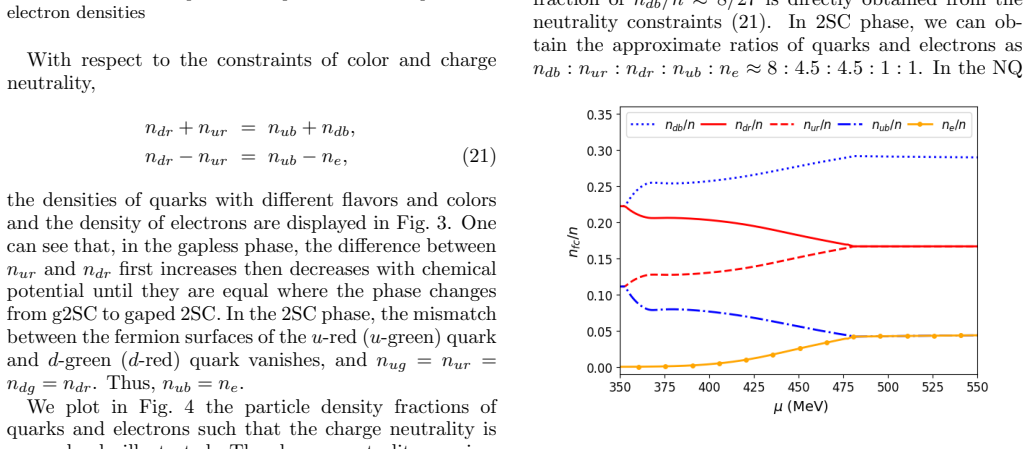
The paper works with the most general Lorentz-invariant NJL Lagrangian consistent with the relevant symmetries, then uses Fierz transformations to show that its eight four-fermion couplings are determined by four independent ones, plus the determinant interaction. Solving the Hartree-Fock-Bogoliubov gap equations under color and charge neutrality in the one-gluon-exchange limit, it finds that the surviving condensates are the diquark gap $\Delta$, the vector density $n$, the scalar-isovector condensate $\phi_I$, and the vector-isovector densities $n_I$ and $n_{I8}$; the other channels contribute negligibly. In this solution the system passes, as the chemical potential rises, from a chirally broken normal phase through a gapless 2SC (g2SC) phase into a gapped 2SC phase, with the g2SC-to-2SC transition near $\mu\simeq 480$ MeV. In the $H/G_s^{(0)}$--$\mu$ plane the gapless window is $0.67 \lesssim H/G_s^{(0)} \lesssim 0.81$, and the chiral transition becomes a crossover above $H/G_s^{(0)}=1.1$, with a critical endpoint at $(H/G_s^{(0)},\mu)=(1.1,312\ \mathrm{MeV})$ and $\Delta=138$ MeV. The paper also reports flavor-color density fractions in the 2SC phase, approximately $n_{db}:n_{ur}:n_{dr}:n_{ub}:n_e \simeq 8:4.5:4.5:1:1$, and an up-down constituent mass splitting of up to 140 MeV driven by the scalar-isovector channel.
Load-bearing premise
The load-bearing premise is that the zero-energy quasiparticle condition defines a real phase, even though the known chromomagnetic instability of gapless 2SC matter may push the system into a crystalline, gluonic, or otherwise different state.
Editorial extensions
If this is right
- Neutron-star matter at moderate densities will pass from the normal quark phase through a gapless 2SC phase before entering the gapped 2SC phase, so single-transition models miss a whole density interval.
- Any NJL-based study of 2SC matter that keeps only the scalar and diquark channels will misplace phase boundaries: the vector channel shifts them to higher $\mu$, the scalar-isovector channel widens the gapless window, and the isovector channel lowers both boundaries.
- The chiral transition in charge-neutral 2SC matter is a crossover rather than a first-order transition once the vector channel is included and $H/G_s^{(0)}>1.1$.
- The approximate density fractions $n_{db}:n_{ur}:n_{dr}:n_{ub}:n_e \simeq 8:4.5:4.5:1:1$ in the 2SC phase give concrete input for transport and cooling models of neutron stars.
Reading between the lines
- Editorial inference: If the chromomagnetic instability survives in the self-consistent gapless solutions, the true ground state in the claimed g2SC window may be a crystalline or gluonic phase, making the NQ-g2SC-2SC sequence a mean-field artifact rather than the physical transition chain.
- Editorial inference: The Fierz-complete coupling reduction implies that equations of state computed with only scalar-plus-diquark NJL Lagrangians are not closed under Fierz transformations; comparing tidal deformability predictions with and without isovector channels would test whether these channels matter for neutron-star observables.
- Editorial inference: The zero-energy quasiparticle criterion could be applied at finite temperature to map a gapless surface in the $(T,\mu,H/G_s^{(0)})$ space, and the stability of that surface against meson fluctuations is not addressed here.
- Editorial inference: The predicted electron fraction $n_e/n \simeq 1/27$ in the 2SC phase is a testable compositional prediction; observations of neutron-star cooling or transport that require a specific charged-lepton content could indirectly discriminate between this 2SC picture and alternatives.
Editorial analysis
A structured set of objections, weighed in public.
Referee Report
Summary. The paper studies two-flavor color superconductivity in a general Nambu-Jona-Lasinio model with color and charge neutrality. Using Fierz identities, the authors reduce the number of independent couplings and construct a Fierz-complete set of interaction channels. Solving the gap equations in the one-gluon-exchange parametrization, they identify the scalar-isovector, vector-isovector, and vector-isovector-color-octet channels as important in addition to the diquark and vector channels. They predict a gapless 2SC (g2SC) phase between the normal quark phase and the gapped 2SC phase, with boundaries around H/G_s^(0) \approx 0.67 and 0.81, and a critical endpoint at H/G_s^(0)=1.1, mu=312 MeV. They also compute particle fractions in the gapped and gapless phases and discuss how individual channels affect the phase diagram.
Significance. The paper's Fierz-complete treatment is a useful systematic step beyond the usual diquark-plus-vector NJL studies, and its dense-matter results are parameter-free in the sense that couplings are determined by vacuum observables and Fierz relations rather than by fitting the phase diagram. The reproduction of the known lower g2SC boundary from Ref. [35] provides a nontrivial check. If the gapless region is actually the ground state, the predicted phase boundaries and particle fractions would be directly relevant to NJL-model studies of neutron-star matter. However, the central phase label rests on an unverified stability assumption, so the significance of the claimed phase sequence depends on the outcome of a stability analysis.
major comments (3)
- [Sec. IV A, Eq. (17), and Figs. 8–13] The g2SC phase boundaries are located by the zero-energy quasiparticle criterion (17), which is an existence condition for a zero in one dispersion branch and is not a thermodynamic or dynamical stability criterion. The paper itself cites Refs. [38,39], which show that g2SC (and 2SC for |delta mu| > Delta/sqrt(2)) suffers from chromomagnetic instability in closely related NJL treatments. Since the central claim is that a g2SC region exists between the normal and gapped 2SC phases, the manuscript should compute the Meissner masses (or the full curvature matrix) for its solutions and compare the free energy of the g2SC branch with candidate competitor phases such as crystalline, solitonic, or gluonic phases. Without this check, the phase sequence in Figs. 8–13 describes a branch of solutions rather than an established phase.
- [Eqs. (14) and (17)] The characteristic equation (14) and the g2SC criterion (17) are load-bearing for the definition and location of the g2SC phase, but they are asserted without derivation. The reader cannot verify that inequality (17) is the correct condition for a zero eigenvalue of (14) when delta M_r and Delta_0 are nonzero. Please provide a derivation or a precise reference that contains it.
- [Sec. IV (general)] The paper does not state how competing self-consistent branches are compared when the normal, gapped 2SC, and gapless 2SC solutions coexist. Drawing the phase diagrams in Figs. 8–13 requires the global minimum of the thermodynamic potential Omega over all branches; the zero-mode boundaries alone do not locate first-order transitions or select the stable phase. Please clarify whether each point in these figures is chosen by free-energy minimization, and if so, show the relevant free-energy comparisons.
minor comments (5)
- [Eq. (5)] In the expression for G3, the term 'C2' appears where 'C'_2' seems required for consistency with Eq. (3); please verify this relation.
- [Throughout] The manuscript contains numerous language and typographical errors, including 'obgained' in Sec. II, 'In additiotn' in Sec. III, 'gaped' for 'gapped' in the abstract, and '[24?–26]' in the Introduction; a careful proofread is needed.
- [Abstract and Sec. IV] The upper boundary of the g2SC region is quoted as 0.81 in the abstract and Sec. IV A, but as 0.8 in Sec. IV B ('0.67−0.8 to 0.67−0.85'); please use a consistent value or clarify that the boundary is chemical-potential dependent.
- [Sec. III B] The statement that the effects of n_I8 'can be mimicked by n_I totally' is not self-evident; please show the combination of couplings that enters the gap equations and quantify the error made by neglecting n_I8 in the later analysis.
- [Sec. III B, Eq. (25)] The approximate particle fractions in Eq. (26) are leading-order results obtained after dropping terms of order G mu^2 in Eq. (25); the text should state more explicitly that fractions such as n_e/n \approx 1/27 receive corrections and are not exact.
Circularity Check
No significant circularity: the dense-matter phase diagram is computed from Fierz relations and vacuum-fitted parameters, not fitted to the target phase boundaries.
full rationale
The derivation chain is self-contained and non-circular. The Fierz transformations in Sec. II are exact mathematical identities that relate the many four-fermion couplings; they are not fitted to the phase diagram. The model parameters (cutoff Λ = 631 MeV, current mass m = 5.5 MeV, and scalar coupling G_s^(0) = 2.188/Λ^2) are fixed by vacuum observables (⟨¯uu⟩, f_π, m_π) and cited to Ref. [63], not to any dense-matter output. The one-gluon-exchange choice L_int = -g(ψbar γ^μ λ^a ψ)^2 fixes the relative channel couplings, including H/G_s^(0) = 3/4, as an input assumption, but the resulting condensates, the location of the g2SC region, the particle fractions, and the critical endpoint at H/G_s^(0) = 1.1, µ = 312 MeV are all self-consistent solutions of the gap equations (18)-(20) with the neutrality conditions (20), and none of these outputs is used to adjust the input constants. The g2SC phase is defined by the zero-energy quasiparticle criterion Eq. (17), but the existence and boundaries of the region where this criterion holds are computed results rather than inserted by hand. The paper's acknowledgement that g2SC may suffer from chromomagnetic instability (Refs. [38,39]) is a physical stability caveat, not a circularity: it undermines the interpretation of which phase is the ground state, but it does not mean the derivation assumes its conclusion. The only self-citation (Ref. [54], by one of the authors) appears in a list of previous NJL studies and plays no load-bearing role in the derivation. Therefore no circular step reduces the paper's claims to its inputs by construction.
Assumptions & free parameters
free parameters (8)
- Momentum cutoff Lambda =
631 MeV
- Current quark mass m =
5.5 MeV
- Scalar coupling G_s^(0) =
2.188 / Lambda^2
- OGE coupling g =
approximately 2.46 / Lambda^2
- Diquark coupling ratio H/G_s^(0) =
0.75 in OGE; scanned in Fig. 8
- Scalar-isovector coupling ratio G_sIv^(0)/G_s^(0) =
1.0 (chosen)
- Vector coupling ratio G_v^(0)/G_s^(0) =
-0.3 (chosen)
- Vector-isovector coupling ratio G_vIv^(0)/G_s^(0) =
-1.0 (chosen)
assumptions (8)
- standard math Fierz completeness: all four-fermion interactions can be generated from an independent Fierz-complete basis, reducing the independent couplings from eight to five.
- domain assumption The one-gluon-exchange interaction (6) fixes the relative strengths of all NJL channels through Eq. (11).
- domain assumption The Hartree-Fock-BCS mean-field approximation is valid for the NJL model.
- domain assumption Color-sextet diquark channels are negligible.
- domain assumption Red-green color symmetry is preserved in the 2SC phase.
- ad hoc to paper The gapless phase boundary is determined by the zero-mode criterion of Eq. (17), and unstable modes do not invalidate the phase labels.
- domain assumption Hard momentum cutoff regularization with Lambda=631 MeV.
- domain assumption Charge and color neutrality constraints n_Q=0 and n_8=0 apply to neutron star matter.
Cite this review
Pith. "Pith review of Two-flavor color superconductivity in a general Nambu-Jona-Lasinio model with color and charge neutrality." pith.science (2026). https://pith.science/paper/URSGE46X
@misc{pith2026250706676,
  author       = {Pith},
  title        = {Pith review of: Two-flavor color superconductivity in a general Nambu-Jona-Lasinio model with color and charge neutrality},
  year         = {2026},
  howpublished = {\url{https://pith.science/paper/URSGE46X}},
  note         = {Machine review of arXiv:2507.06676}
}
read the original abstract
By using a general NJL model including as many interaction channels as possible, and taking into account the constraints imposed by color and charge neutrality, we analyze how the different interaction channels contribute to the charge-neutral two-flavor color-superconducting matter. After taking the Fierz transformation, the number of parameters in the NJL model is reduced and thereby quark-antiquark condensates and diquark condensates are related. Through a self-consistent solution of the gap equations, we find that in addition to the diquark and vector channels, the scalar-isovector, vector-isovector, and vector-isovector-color-octet channels are also important, while other channels can be neglected. Moreover, between the normal quark matter phase and two-flavor color-superconducting phase, there is a gapless two-flavor color-superconducting phase. The fractions of quarks with different flavors and colors are calculated in both gaped and gapless two-flavor color-superconducting phases. In addition, We illustrate the phase diagrams in the diquark coupling and chemical potential plane, and discuss in detail how the dominant channels influence these phase diagrams.
Figures


Figures from the paper (9 more)


Forward citations
Cited by 1 Pith paper
-
Graph Learning for Foreign Exchange Rate Prediction and Statistical Arbitrage
An FX prediction and arbitrage method is claimed in the abstract, but the manuscript body is an unrelated quark matter paper, leaving the result unverifiable.
Reference graph
Works this paper leans on
- [35]
-
[1]
J. C. Collins and M. J. Perry, Phys. Rev. Lett.34, 1353 (1975)
1975
-
[2]
B. C. Barrois, Nuclear Physics B129, 390 (1977)
1977
-
[3]
Asymptotic freedom and color superconductivity in dense quark matter,
S. C. Frautschi, “Asymptotic freedom and color superconductivity in dense quark matter,” in Hadronic Matter at Extreme Energy Density, edited by N. Cabibbo and L. Sertorio (Springer US, Boston, 12 MA, 1980) pp. 19–27
work page 1980
-
[4]
L. N. Cooper, Phys. Rev.104, 1189 (1956)
1956
- [5]
-
[6]
Bardeen, L
J. Bardeen, L. N. Cooper, and J. R. Schrieffer, Phys. Rev.108, 1175 (1957)
1957
-
[7]
Bailin and A
D. Bailin and A. Love, Physics Reports107, 325 (1984)
1984
Show all 67 references
-
[8]
R. Rapp, T. Sch¨ afer, E. Shuryak, and M. Velkovsky, Phys. Rev. Lett.81, 53 (1998)
1998
-
[9]
Alford, K
M. Alford, K. Rajagopal, and F. Wilczek, Physics Let- ters B422, 247 (1998)
1998
-
[10]
Iwasaki and T
M. Iwasaki and T. Iwado, Phys. Lett. B350, 163 (1995)
1995
-
[11]
R. D. Pisarski and D. H. Rischke, Phys. Rev. D60, 094013 (1999), arXiv:nucl-th/9903023
1999 arXiv
-
[12]
R. D. Pisarski and D. H. Rischke, Phys. Rev. D61, 051501 (2000), arXiv:nucl-th/9907041
2000 arXiv
-
[13]
Alford, K
M. Alford, K. Rajagopal, and F. Wilczek, Nuclear Physics B537, 443 (1999)
1999
- [14]
-
[15]
S. B. R¨ uster, V. Werth, M. Buballa, I. A. Shovkovy, and D. H. Rischke, Phys. Rev. D72, 034004 (2005)
2005
-
[16]
K. Iida, T. Matsuura, M. Tachibana, and T. Hatsuda, Phys. Rev. Lett.93, 132001 (2004)
2004
-
[17]
Gholami, M
H. Gholami, M. Hofmann, and M. Buballa, Phys. Rev. D111, 014006 (2025)
2025
-
[18]
Roupas, G
Z. Roupas, G. Panotopoulos, and I. Lopes, Phys. Rev. D103, 083015 (2021), arXiv:2010.11020 [astro-ph.HE]
2021 arXiv
-
[19]
Blaschke, S
D. Blaschke, S. Fredriksson, H. Grigorian, A. M. ¨Ozta¸ s, and F. Sandin, Phys. Rev. D72, 065020 (2005)
2005
-
[20]
Kl¨ ahn, D
T. Kl¨ ahn, D. Blaschke, F. Sandin, C. Fuchs, A. Faessler, H. Grigorian, G. R¨ opke, and J. Tr¨ umper, Physics Letters B654, 170 (2007)
2007
-
[21]
Alford and A
M. Alford and A. Sedrakian, Phys. Rev. Lett.119, 161104 (2017)
2017
-
[22]
Kurkela, K
A. Kurkela, K. Rajagopal, and R. Steinhorst, Phys. Rev. Lett.132, 262701 (2024)
2024
-
[23]
Christian, I
J.-E. Christian, I. A. Rather, H. Gholami, and M. Hof- mann, (2025), arXiv:2503.13626 [astro-ph.HE]
2025 arXiv
-
[24]
Alford, J
M. Alford, J. A. Bowers, and K. Rajagopal, Phys. Rev. D63, 074016 (2001)
2001
-
[25]
M. G. Alford, A. Schmitt, K. Rajagopal, and T. Sch¨ afer, Rev. Mod. Phys.80, 1455 (2008)
2008
-
[26]
Anglani, R
R. Anglani, R. Casalbuoni, M. Ciminale, N. Ippolito, R. Gatto, M. Mannarelli, and M. Ruggieri, Rev. Mod. Phys.86, 509 (2014)
2014
-
[27]
Buballa, Physics Reports407, 205 (2005)
M. Buballa, Physics Reports407, 205 (2005)
2005
-
[28]
Wang, Prog
Q. Wang, Prog. Phys.30, 173 (2010)
2010
-
[29]
Schmitt, Phys
A. Schmitt, Phys. Rev. D71, 054016 (2005)
2005
-
[30]
Sch¨ afer, Nuclear Physics B575, 269 (2000)
T. Sch¨ afer, Nuclear Physics B575, 269 (2000)
2000
-
[31]
Shovkovy and L
I. Shovkovy and L. Wijewardhana, Physics Letters B 470, 189 (1999)
1999
-
[32]
Alford, J
M. Alford, J. Berges, and K. Rajagopal, Nuclear Physics B558, 219 (1999)
1999
-
[33]
D. H. Rischke, D. T. Son, and M. A. Stephanov, Phys. Rev. Lett.87, 062001 (2001)
2001
-
[34]
HUANG, International Journal of Modern Physics E14, 675 (2005), https://doi.org/10.1142/S0218301305003491
M. HUANG, International Journal of Modern Physics E14, 675 (2005), https://doi.org/10.1142/S0218301305003491
2005 doi
-
[36]
Shovkovy and M
I. Shovkovy and M. Huang, Physics Letters B564, 205 (2003)
2003
-
[37]
I. A. Shovkovy, Found. Phys.35, 1309 (2005), arXiv:nucl- th/0410091
2005
-
[38]
Huang and I
M. Huang and I. A. Shovkovy, Phys. Rev. D70, 051501 (2004)
2004
-
[39]
Huang and I
M. Huang and I. A. Shovkovy, Phys. Rev. D70, 094030 (2004)
2004
-
[40]
Giannakis and H.-C
I. Giannakis and H.-C. Ren, Physics Letters B611, 137 (2005)
2005
-
[41]
Giannakis and H.-C
I. Giannakis and H.-C. Ren, Nuclear Physics B723, 255 (2005)
2005
-
[42]
E. V. Gorbar, M. Hashimoto, and V. A. Miransky, Phys. Rev. Lett.96, 022005 (2006)
2006
-
[43]
Nickel and M
D. Nickel and M. Buballa, Phys. Rev. D79, 054009 (2009)
2009
-
[44]
Gorbar, M
E. Gorbar, M. Hashimoto, and V. Miransky, Physics Letters B632, 305 (2006)
2006
-
[45]
E. V. Gorbar, M. Hashimoto, V. A. Miransky, and I. A. Shovkovy, Phys. Rev. D73, 111502 (2006)
2006
-
[46]
Nambu and G
Y. Nambu and G. Jona-Lasinio, Phys. Rev.122, 345 (1961)
1961
-
[47]
Nambu and G
Y. Nambu and G. Jona-Lasinio, Phys. Rev.124, 246 (1961)
1961
-
[48]
Vogl and W
U. Vogl and W. Weise, Prog. Part. Nucl. Phys.27, 195 (1991)
1991
-
[49]
S. P. Klevansky, Rev. Mod. Phys.64, 649 (1992)
1992
-
[50]
Hatsuda and T
T. Hatsuda and T. Kunihiro, Phys. Rept.247, 221 (1994), arXiv:hep-ph/9401310
1994 arXiv
-
[51]
H. Liu, J. Xu, L.-W. Chen, and K.-J. Sun, Phys. Rev. D94, 065032 (2016)
2016
-
[52]
Tanimoto, W
T. Tanimoto, W. Bentz, and I. C. Clo¨ et, Phys. Rev. C 101, 055204 (2020)
2020
-
[53]
Kitazawa, T
M. Kitazawa, T. Koide, T. Kunihiro, and Y. Nemoto, Nuclear Physics A721, C289 (2003)
2003
-
[54]
L.-K. Yang, X. Luo, and H.-S. Zong, Phys. Rev. D100, 094012 (2019)
2019
-
[55]
P. B. Arnold, D. T. Son, and L. G. Yaffe, Phys. Rev. D 59, 105020 (1999), arXiv:hep-ph/9810216
1999 arXiv
-
[56]
D. T. Son, Phys. Rev. D59, 094019 (1999), arXiv:hep- ph/9812287
1999
-
[57]
N. J. Evans, S. D. H. Hsu, and M. Schwetz, Phys. Lett. B449, 281 (1999), arXiv:hep-ph/9810514
1999 arXiv
-
[58]
D. K. Hong, V. A. Miransky, I. A. Shovkovy, and L. C. R. Wijewardhana, Phys. Rev. D61, 056001 (2000), [Erratum: Phys.Rev.D 62, 059903 (2000)], arXiv:hep- ph/9906478
2000
-
[59]
Buballa, J
M. Buballa, J. Hoˇ sek, and M. Oertel, Phys. Rev. D65, 014018 (2001)
2001
-
[60]
W.-L. Yuan, J. Chao, and A. Li, Phys. Rev. D108, 043008 (2023)
2023
-
[61]
Klimt, M
S. Klimt, M. Lutz, U. Vogl, and W. Weise, Nuclear Physics A516, 429 (1990)
1990
-
[62]
Braun, M
J. Braun, M. Leonhardt, and M. Pospiech, Phys. Rev. D96, 076003 (2017)
2017
-
[63]
Masayuki and Y
A. Masayuki and Y. Koichi, Nuclear Physics A504, 668 (1989)
1989
-
[64]
Du, Z.-f
Y.-l. Du, Z.-f. Cui, Y.-h. Xia, and H.-s. Zong, Phys. Rev. D88, 114019 (2013), arXiv:1312.1796 [hep-ph]
2013 arXiv
-
[65]
Huang, P
M. Huang, P. Zhuang, and W. Chao, Phys. Rev. D65, 076012 (2002)
2002
-
[66]
Huang, P
M. Huang, P. Zhuang, and W. Chao, Phys. Rev. D67, 065015 (2003)
2003
- [67]
Reviewed August 6, 2026 · model on record in the stance chip above.
Discussion (0). Continue with ORCID to comment.