REVIEW 3 major objections 5 minor 114 references
DiRIM draws joint pixel-space posterior samples of the lensed source and foreground mass, fitting realistic simulations down to the noise level.
Reviewed by Pith at T0; open to challenge. T0 means a machine referee read the full paper against a public rubric. the ladder, T0–T4 →
T0 review · deepseek-v4-flash
2026-08-01 12:40 UTC pith:UU33OCDC
load-bearing objection DiRIM looks like a real step forward for pixel-space lensing posteriors, but the trained loss and the score identity don't quite match; worth fixing before the 'down to the noise level' claim is taken literally. the 3 major comments →
Strong Gravitational Lensing Posterior Sampling in Pixel-Space Using Diffusion Models and Recurrent Inference Machines
The pith
A machine-rendered reading of the paper's core claim, the machinery that carries it, and where it could break.
Core claim
DiRIM's central claim: the joint posterior of a pixelated source image and a pixelated convergence map, given one noisy lens observation, can be sampled directly in pixel space. A U-Net conditioned on the observation, likelihood gradients, and normalized residuals acts as a denoiser for (s, log κ), refined over five recurrent inference iterations. The refined estimate is fed to the score identity ∇_xt log p_t(x_t|y) = (x̂0^(M) − x_t)/σ²(t), and a 1000-step reverse-SDE solve yields posterior samples. The appendix proves the required conditional-mean property only for a loss weighting that supervises the final iteration, not the equal weighting used in training. Empirically, the method fits re
What carries the argument
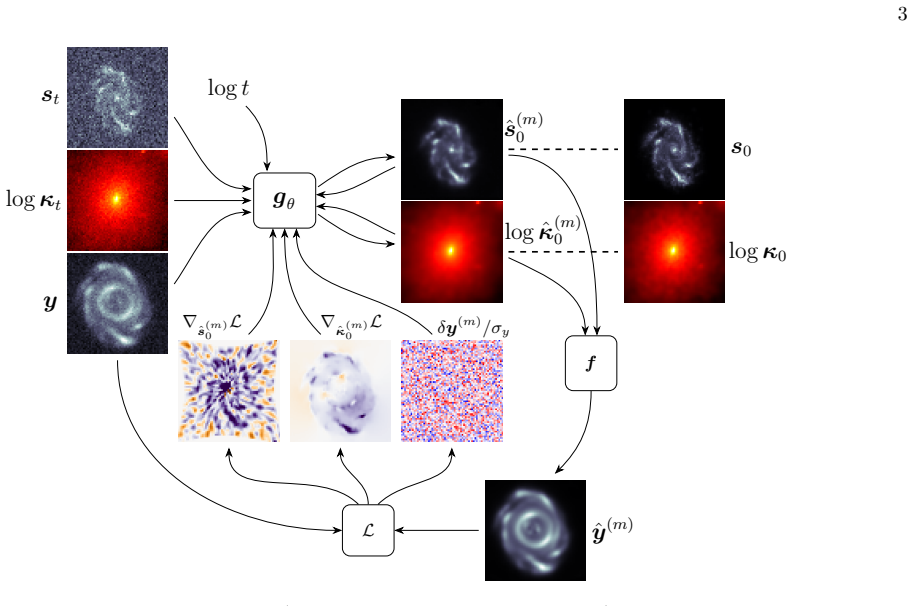
The carrying mechanism is the DiRIM denoiser: a U-Net (a convolutional encoder-decoder network) g_θ that, at each diffusion time t, receives the noisy pair (s_t, log κ_t), the observation y, likelihood gradients, and normalized residuals, and outputs a refined estimate of the clean pair after M=5 recurrent iterations. The load-bearing identity is the posterior-score formula ∇_xt log p_t(x_t|y) = (x̂0^(M) − x_t)/σ²(t), which turns the refined denoiser output into the score needed to integrate the reverse SDE, replacing the unknown posterior with a trained refinement. The recurrent inference machine is what makes the score accurate enough: with M=1 the method collapses to biased conditional sc
Load-bearing premise
The samples are draws from the true joint posterior only if the five-step refined denoiser is the exact conditional mean the score formula requires — a property proven in Appendix A.2 for a loss weighting that supervises only the final iteration, not the equal weighting over the last four iterations that the model actually trained with (Table 4).
What would settle it
Generate mock lenses from a source and mass distribution distinct from the training set and compare DiRIM's pixel-space credible regions against an independent reference sampler — nested sampling or Hamiltonian Monte Carlo on the same forward model — for the same observations. If empirical coverage leaves the diagonal beyond the bootstrap 2σ band, or if the χ² distribution shifts off the theoretical k-degree-of-freedom curve, the score identity behind the sampler is not holding.
If this is right
- Pixel-space Bayesian lens modeling becomes routine: joint source and convergence-map samples at roughly five seconds each, with no parametric assumptions and no user-supplied source or mass models.
- The recurrent refinement is what makes it work: with the RIM disabled (M=1), the model leaves structured residuals and a badly shifted χ² distribution, so plain conditional diffusion is insufficient for this problem.
- Dark-matter substructure is detectable at significance: in the analytic test set all 740 samples retained the injected subhalo, and fitted subhalo mass, position, and concentration posteriors contain the truth.
- Degeneracies are sampled, not smoothed over: the source-size versus mass-slope degeneracy appears as an elongated posterior ellipse with samples spanning the full range.
- The method extends beyond its training distribution: it models a convergence map made of two unrelated merged halos and recovers the morphology of an out-of-distribution source, with residuals degrading as expected.
Where Pith is reading between the lines
- The decisive stress test is calibration on conditions outside the training distribution — or on real survey data — since the coverage and χ² checks shown are computed on the same simulation distribution used for training; the paper's own multi-deflector and out-of-distribution examples show small residual biases that would likely grow there.
- The gap between the proven loss weighting (final iteration only) and the trained one (equal weights on the last four iterations) is a concrete suspect for those biases: annealing the weights toward the proven limit, or directly checking whether the refined denoiser is the conditional mean, would isolate whether the score identity is the bottleneck.
- Because the method needs only a differentiable forward model, the same recipe should transfer to other nonlinear imaging inverse problems — interferometric lensing, deconvolution, radio imaging — whenever a fast differentiable simulator exists.
- The planned latent-space version would trade the pixel-space guarantees derived here for resolution and speed; the score identity and the calibration demonstrated in this paper would have to be re-established for the latent representation.
Editorial analysis
A structured set of objections, weighed in public.
Referee Report
Summary. The paper introduces DiRIM, a method for joint posterior sampling of pixelated source galaxy images and foreground convergence maps in strong gravitational lensing. DiRIM combines a conditional diffusion model with a recurrent inference machine (RIM): the diffusion model provides the score-based sampling framework, while the RIM iteratively refines denoiser outputs before they are converted to posterior scores via Eq. (18). The method is trained on realistic mock observations built from SKIRT-TNG source images, IllustrisTNG convergence maps, and analytic convergence profiles, and is evaluated with residual/p-value checks, TARP calibration, chi-square distributions, subhalo detection, parameter recovery, and out-of-distribution tests. The central claim is that DiRIM can jointly sample the high-dimensional, non-linear posterior p(s,kappa|y) enough to model simulated observations down to the noise level.
Significance. If the central claim holds, DiRIM would close an open problem identified in the introduction: joint pixel-space posterior sampling for strong lensing with non-linear dependence on the foreground mass distribution. The paper's empirical case is substantial and genuinely useful: public code/data, a clean M=1 ablation showing that the RIM component is essential, noise-level residuals on many test examples, near-flat TARP curves, and explicit recovery of a known degeneracy (source size vs. density slope). The method also demonstrates a concrete subhalo-detection use case. However, the theoretical bridge between the trained objective and the posterior score is weaker than the presentation suggests, and the calibration checks are performed on the same simulation distribution used for training. The contribution is significant if that gap is closed or if the method is honestly reframed as an approximate posterior sampler.
major comments (3)
- [§2.2.1, Eq. (18), Table 4] Eq. (18) is the only theoretical link between the trained denoiser and the reverse-SDE sampler. Appendix A.2 proves the equivalence between L_DiRIM and L_CDSM only for the iteration weights of Eq. (17) (w_M=1, w_m=0 otherwise). Table 4 states that the actual training weights are {0,1/4,1/4,1/4,1/4}. With shared parameters and iterative refinement, the minimizer of Eq. (16) for these weights is not shown to equal E[x0|xt,y,t], so Eq. (18) is not justified for the trained objective. The TARP and chi-square checks, computed on the same simulator used for training, are empirical substitutes but do not replace the missing proof. I recommend retraining with Eq. (17) weights, proving the score identity for the actual weights, or explicitly reframing DiRIM as an approximate posterior sampler.
- [Appendix D, Figure 21] The text states that during training loss gradients are backpropagated through green edges only, and not through orange/red edges. This means the actual training objective is not exactly L_DiRIM in Eq. (16), even setting aside the weight mismatch. Appendix A.2's equivalence argument assumes the minimizer of the unmodified loss. Please state precisely which loss is optimized and whether the theoretical claim applies to it, or train with full backpropagation through the unrolled graph.
- [§3.1–§3.2, Figs. 7, 8, 20] Given the score-identity gap, the posterior-sampling claim rests on the empirical calibration evidence. TARP and chi-square are computed on observations drawn from the same simulation distribution used for training, and the paper itself acknowledges small residual biases (Fig. 6, Sec. 4). To make the posterior claim credible, I would like to see at least one validation against an independent posterior—for example, Hamiltonian Monte Carlo or an analytic posterior on a reduced-dimensional or parametric subset of the same forward model. This is a concrete test within the paper's scope and would substantially strengthen the claim.
minor comments (5)
- [§2.3.2, Table 1] The text mentions 'EPL, external shear and multipole components' and says the total is 14 parameters, but Table 1 lists no external shear parameters. Please add or remove external shear consistently; as written the dataset description is internally inconsistent.
- [Table 4, Fig. 11] For the M=1 ablation, the iteration loss weights are not specified. 'Keeping everything else fixed' is ambiguous because the weight vector dimension changes with M; please state the weights used for the M=1 model.
- [Appendix B] The time-weight function W(t) is a heuristic with a free parameter bar_sigma. Since the score-matching minimizer is independent of W(t) only in the infinite-capacity limit, a brief remark or sensitivity check on bar_sigma would clarify the finite-capacity behavior.
- [§3.2, Table 2] The statement that 740/740 samples containing the subhalo corresponds to '>~3 sigma detection' should specify the null hypothesis and detection criterion. Without a prior or a no-subhalo reference, the statistical significance is not well defined.
- [Figures 5, 6] The p-values in the panels are defined in footnote 8, but the notation 'p = 0.23' could be confused with a model parameter. Consider relabeling as 'p_chi2' or 'p-value' in the figure panels.
Circularity Check
No significant circularity: central derivation is self-contained against standard external score-matching results; only minor non-load-bearing self-citations.
full rationale
I walked the derivation chain. The forward model (Eq. 3) and Gaussian likelihood (Eq. 19) define the target posterior; the conditional score is estimated by minimizing the standard conditional denoising score-matching loss (Eqs. 8, 10), whose minimizer equals the posterior score by external results (Vincent 2011; Song et al. 2020; Batzolis et al. 2021). DiRIM's loss (Eq. 16) is shown in Appendix A.2 to have the same minimizer only for the last-iteration-only weights (Eq. 17), and Eq. 18 then follows from the algebraic relation between score and denoiser (Eq. 11/A.1-A.2), not from a quantity fitted to the evaluated posterior. No fitted parameter is renamed as a prediction: TARP (Figs. 7, 20) and chi-square (Fig. 8) are computed on held-out test observations from the same simulator, which is internal validation rather than circular reasoning. Self-citations (Adam et al. 2023 for convergence-map dataset; Lemos et al. 2023 for TARP; Sharief et al. 2026 for motivation) are contextual or tooling citations and are not load-bearing in the derivation. The notable gap is that Table 4 trains with RIM weights {0,1/4,1/4,1/4,1/4}, while Appendix A.2 proves the score identity only for w_M=1 and other weights zero; consequently Eq. 18 is not formally justified for the actual trained objective. This is a soundness/validation concern, not a circularity: the training target is not the posterior itself, and the calibration checks are independent of the identity. Overall the central claim has independent content and is not forced by definition or self-citation.
Axiom & Free-Parameter Ledger
free parameters (5)
- bar_sigma (time-weight transition in W(t)) =
2e-2 (analytic kappa model), 4e-2 (simulated kappa model)
- VP-SDE noise schedule endpoints beta_min, beta_max =
2e-3, 250
- likelihood-gradient normalization factors c_s, c_kappa =
100, 100
- RIM iteration loss weights w_m =
{0, 1/4, 1/4, 1/4, 1/4} for M=5
- RIM iteration count M =
5 for main models; 1 for ablation
axioms (5)
- standard math Denoising score matching yields the true conditional score in the limit of infinite data and model capacity
- domain assumption The thin-screen ray-tracing forward model with Gaussian PSF and additive Gaussian noise is an exact generator of observations y from (s,kappa)
- domain assumption Training priors (SKIRT-TNG source images and TNG or analytic convergence maps) are representative of real lensing sources and mass distributions
- domain assumption Source images and convergence maps can be treated as independent priors via unpaired shuffling during training
- ad hoc to paper The heuristic time-weight function W(t) preserves unbiased posterior sampling
invented entities (1)
-
None
no independent evidence
read the original abstract
Modeling galaxy-galaxy strong gravitational lenses to infer the brightness of the source galaxy and the mass distribution of the foreground galaxy is computationally challenging, particularly for high-resolution, high signal-to-noise ratio observations. In this regime, high-dimensional representations of both the source and the foreground mass distribution are necessary to model the data down to the noise level. This inference problem has been challenging for both traditional and machine learning-based methods because of its high dimensionality and its non-linearity in the foreground mass distribution. We present a method to generate joint posterior samples of the source galaxy and foreground mass distribution as pixelated images conditioned on observations. The method combines diffusion-based generative modeling and recurrent inference machines. It can model realistic gravitational lensing simulations with background and foreground galaxies drawn from cosmological hydrodynamical simulations down to the noise level.
Figures


Reference graph
Works this paper leans on
-
[1]
The Astrophysical Journal , author=
Pixelated Reconstruction of Foreground Density and Background Surface Brightness in Gravitational Lensing Systems Using Recurrent Inference Machines , volume=. The Astrophysical Journal , author=. 2023 , month=july, pages=. doi:10.3847/1538-4357/accf84 , abstractNote=
-
[2]
Score-Based Generative Modeling through Stochastic Differential Equations , url=. arXiv e-prints , author=. 2020 , month=nov, pages=. doi:10.48550/arXiv.2011.13456 , abstractNote=
-
[3]
Introduction to Gravitational Lensing: With Python Examples , author=
Introduction to Gravitational Lensing: With Python Examples , url=. Introduction to Gravitational Lensing: With Python Examples , author=. 2022 , language=
2022
-
[4]
Journal of Open Source Software , author=
Caustics: A Python Package for Accelerated Strong Gravitational Lensing Simulations , volume=. Journal of Open Source Software , author=. 2024 , month=nov, pages=. doi:10.21105/joss.07081 , abstractNote=
-
[5]
Stochastic Processes and their Applications , author=
Reverse-time diffusion equation models , volume=. Stochastic Processes and their Applications , author=. 1982 , month=may, pages=. doi:10.1016/0304-4149(82)90051-5 , number=
-
[6]
Conditional Image Generation with Score-Based Diffusion Models , url=
Batzolis, Georgios and Stanczuk, Jan and Schönlieb, Carola-Bibiane and Etmann, Christian , year=. Conditional Image Generation with Score-Based Diffusion Models , url=. doi:10.48550/arXiv.2111.13606 , abstractNote=
-
[7]
The Principles of Diffusion Models , url=
Lai, Chieh-Hsin and Song, Yang and Kim, Dongjun and Mitsufuji, Yuki and Ermon, Stefano , year=. The Principles of Diffusion Models , url=. doi:10.48550/arXiv.2510.21890 , abstractNote=
-
[8]
Recurrent Inference Machines for Solving Inverse Problems
Putzky, Patrick and Welling, Max , year=. Recurrent Inference Machines for Solving Inverse Problems , url=. doi:10.48550/arXiv.1706.04008 , abstractNote=
work page internal anchor Pith review Pith/arXiv arXiv doi:10.48550/arxiv.1706.04008
-
[9]
Estimation of Non-Normalized Statistical Models by Score Matching , author=. J. Mach. Learn. Res. , year=
-
[10]
A Connection Between Score Matching and Denoising Autoencoders , volume=. Neural Computation , author=. 2011 , month=july, pages=. doi:10.1162/NECO_a_00142 , abstractNote=
-
[11]
Monthly Notices of the Royal Astronomical Society: Letters , author=
Posterior sampling of the initial conditions of the universe from non-linear large scale structures using score-based generative models , volume=. Monthly Notices of the Royal Astronomical Society: Letters , author=. 2023 , month=oct, pages=. doi:10.1093/mnrasl/slad152 , abstractNote=
-
[12]
and Norouzi, Mohammad and Chan, William , year=
Chen, Nanxin and Zhang, Yu and Zen, Heiga and Weiss, Ron J. and Norouzi, Mohammad and Chan, William , year=. WaveGrad: Estimating Gradients for Waveform Generation , url=. doi:10.48550/arXiv.2009.00713 , abstractNote=
-
[13]
Saharia, Chitwan and Ho, Jonathan and Chan, William and Salimans, Tim and Fleet, David J. and Norouzi, Mohammad , year=. Image Super-Resolution via Iterative Refinement , url=. doi:10.48550/arXiv.2104.07636 , abstractNote=
-
[14]
and Ho, Jonathan and Salimans, Tim and Fleet, David J
Saharia, Chitwan and Chan, William and Chang, Huiwen and Lee, Chris A. and Ho, Jonathan and Salimans, Tim and Fleet, David J. and Norouzi, Mohammad , year=. Palette: Image-to-Image Diffusion Models , url=. doi:10.48550/arXiv.2111.05826 , abstractNote=
-
[15]
U-Net: Convolutional Networks for Biomedical Image Segmentation , url=
Ronneberger, Olaf and Fischer, Philipp and Brox, Thomas , year=. U-Net: Convolutional Networks for Biomedical Image Segmentation , url=. doi:10.48550/arXiv.1505.04597 , abstractNote=
-
[16]
Elucidating the Design Space of Diffusion-Based Generative Models , url=
Karras, Tero and Aittala, Miika and Aila, Timo and Laine, Samuli , year=. Elucidating the Design Space of Diffusion-Based Generative Models , url=. doi:10.48550/arXiv.2206.00364 , abstractNote=
-
[17]
Medical Image Analysis , author =
Recurrent inference machines for reconstructing heterogeneous. Medical Image Analysis , author =. 2019 , pmid =. doi:10.1016/j.media.2019.01.005 , abstract =
-
[18]
The Astrophysical Journal , author =
Data-driven. The Astrophysical Journal , author =. 2019 , pages =. doi:10.3847/1538-4357/ab35d7 , abstract =
-
[19]
Deconvolving X-ray Galaxy Cluster Spectra Using a Recurrent Inference Machine
Rhea, Carter and Hlavacek-Larrondo, Julie and Adam, Alexandre and Kraft, Ralph and Bogdan, Akos and Perreault-Levasseur, Laurence and Prunier, Marine , month = sep, year =. Deconvolving. doi:10.48550/arXiv.2409.10711 , abstract =
work page internal anchor Pith review Pith/arXiv arXiv doi:10.48550/arxiv.2409.10711
-
[20]
Morningstar, Warren R. and Hezaveh, Yashar D. and Levasseur, Laurence Perreault and Blandford, Roger D. and Marshall, Philip J. and Putzky, Patrick and Wechsler, Risa H. , month = jul, year =. Analyzing interferometric observations of strong gravitational lenses with recurrent and convolutional neural networks , url =. doi:10.48550/arXiv.1808.00011 , abstract =
-
[21]
Medical Image Analysis , author =
Recurrent inference machines as inverse problem solvers for. Medical Image Analysis , author =. 2021 , pages =. doi:10.1016/j.media.2021.102220 , language =
arXiv 2021
-
[22]
PyTorch: An Imperative Style, High-Performance Deep Learning Library , url=
Paszke, Adam and Gross, Sam and Massa, Francisco and Lerer, Adam and Bradbury, James and Chanan, Gregory and Killeen, Trevor and Lin, Zeming and Gimelshein, Natalia and Antiga, Luca and Desmaison, Alban and Köpf, Andreas and Yang, Edward and DeVito, Zach and Raison, Martin and Tejani, Alykhan and Chilamkurthy, Sasank and Steiner, Benoit and Fang, Lu and B...
-
[23]
Colvin, Samuel and Jolibois, Eric and Ramezani, Hasan and Garcia Badaracco, Adrian and Dorsey, Terrence and Montague, David and Matveenko, Serge and Trylesinski, Marcelo and Runkle, Sydney and Hewitt, David and Hall, Alex and Plot, Victorien , license =
-
[24]
Harris, Charles R. and Millman, K. Jarrod and Walt, Stéfan J. van der and Gommers, Ralf and Virtanen, Pauli and Cournapeau, David and Wieser, Eric and Taylor, Julian and Berg, Sebastian and Smith, Nathaniel J. and Kern, Robert and Picus, Matti and Hoyer, Stephan and Kerkwijk, Marten H. van and Brett, Matthew and Haldane, Allan and Río, Jaime Fernández del...
-
[25]
Computing in Science & Engineering , author=
Matplotlib: A 2D Graphics Environment , volume=. Computing in Science & Engineering , author=. 2007 , pages=. doi:10.1109/MCSE.2007.55 , number=
-
[26]
Monthly Notices of the Royal Astronomical Society , author=. 2023 , month=nov, pages=. doi:10.1093/mnras/stad2971 , abstractNote=
-
[27]
Camps, P. and Baes, M. , year=. SKIRT 9: Redesigning an advanced dust radiative transfer code to allow kinematics, line transfer and polarization by aligned dust grains , volume=. doi:10.1016/j.ascom.2020.100381 , journal=
arXiv 2020
-
[28]
Computational Astrophysics and Cosmology , author=
The IllustrisTNG simulations: public data release , volume=. Computational Astrophysics and Cosmology , author=. 2019 , month=dec, pages=. doi:10.1186/s40668-019-0028-x , abstractNote=
-
[29]
The Astrophysical Journal , author=
Fast Calculation of a Family of Elliptical Gravitational Lens Models , volume=. The Astrophysical Journal , author=. 1998 , month=aug, pages=. doi:10.1086/305950 , number=
doi:10.1086/305950 1998
-
[30]
The Astrophysical Journal , author=
A Universal Density Profile from Hierarchical Clustering , volume=. The Astrophysical Journal , author=. 1997 , month=dec, pages=. doi:10.1086/304888 , number=
doi:10.1086/304888 1997
-
[31]
Rendiconti del Circolo Matematico di Palermo , volume =
Continuous Markov processes and stochastic equations , author =. Rendiconti del Circolo Matematico di Palermo , volume =. 1955 , doi =
1955
-
[32]
1992 , doi =
Numerical Solution of Stochastic Differential Equations , author =. 1992 , doi =
1992
-
[33]
Sampling-Based Accuracy Testing of Posterior Estimators for General Inference , url=
Lemos, Pablo and Coogan, Adam and Hezaveh, Yashar and Perreault-Levasseur, Laurence , year=. Sampling-Based Accuracy Testing of Posterior Estimators for General Inference , url=. doi:10.48550/arXiv.2302.03026 , abstractNote=
-
[34]
The revolution in strong lensing discoveries from Euclid , volume=. Nature Astronomy , author=. 2025 , month=aug, pages=. doi:10.1038/s41550-025-02616-5 , abstractNote=
-
[35]
Strong gravitational lenses from the Vera C. Rubin Observatory , volume=. Philosophical Transactions of the Royal Society A: Mathematical, Physical and Engineering Sciences , author=. 2025 , month=may, pages=. doi:10.1098/rsta.2024.0117 , abstractNote=
arXiv 2025
-
[36]
and Perreault-Levasseur, Laurence , year=
Modi, Chirag and Lanusse, François and Seljak, Uroš and Spergel, David N. and Perreault-Levasseur, Laurence , year=. CosmicRIM: Reconstructing Early Universe by Combining Differentiable Simulations with Recurrent Inference Machines , rights=. doi:10.48550/ARXIV.2104.12864 , abstractNote=
-
[37]
Inpainting Galaxy Counts onto N-Body Simulations over Multiple Cosmologies and Astrophysics
Bourdin, Antoine and Legin, Ronan and Ho, Matthew and Adam, Alexandre and Hezaveh, Yashar and Perreault-Levasseur, Laurence , year=. Inpainting Galaxy Counts onto N-Body Simulations over Multiple Cosmologies and Astrophysics , url=. doi:10.48550/arXiv.2408.00839 , abstractNote=
work page internal anchor Pith review Pith/arXiv arXiv doi:10.48550/arxiv.2408.00839
-
[38]
Adam, Alexandre and Coogan, Adam and Malkin, Nikolay and Legin, Ronan and Perreault-Levasseur, Laurence and Hezaveh, Yashar and Bengio, Yoshua , year=. Posterior samples of source galaxies in strong gravitational lenses with score-based priors , rights=. doi:10.48550/ARXIV.2211.03812 , abstractNote=
-
[39]
The Astronomical Journal , author=
Echoes in the Noise: Posterior Samples of Faint Galaxy Surface Brightness Profiles with Score-based Likelihoods and Priors , volume=. The Astronomical Journal , author=. 2025 , month=may, pages=. doi:10.3847/1538-3881/adb039 , abstractNote=
-
[40]
Appa: Bending Weather Dynamics with Latent Diffusion Models for Global Data Assimilation , url=
Andry, Gérôme and Lewin, Sacha and Rozet, François and Rochman, Omer and Mangeleer, Victor and Pirlet, Matthias and Faulx, Elise and Grégoire, Marilaure and Louppe, Gilles , year=. Appa: Bending Weather Dynamics with Latent Diffusion Models for Global Data Assimilation , url=. doi:10.48550/arXiv.2504.18720 , abstractNote=
-
[41]
The Astrophysical Journal , author=
Tackling the Problem of Distributional Shifts: Correcting Misspecified, High-dimensional Data-driven Priors for Inverse Problems , volume=. The Astrophysical Journal , author=. 2025 , month=feb, pages=. doi:10.3847/1538-4357/ad9b92 , abstractNote=
-
[42]
Barco, Gabriel Missael and Legin, Ronan and Stone, Connor and Hezaveh, Yashar and Perreault-Levasseur, Laurence , year=. Blind Strong Gravitational Lensing Inversion: Joint Inference of Source and Lens Mass with Score-Based Models , rights=. doi:10.48550/ARXIV.2511.04792 , abstractNote=
-
[43]
Diffusion-based mass map reconstruction from weak lensing data , volume=. Physical Review D , author=. 2025 , month=apr, pages=. doi:10.1103/PhysRevD.111.083542 , number=
-
[44]
A point cloud approach to generative modeling for galaxy surveys at the field level , url=
Cuesta-Lazaro, Carolina and Mishra-Sharma, Siddharth , year=. A point cloud approach to generative modeling for galaxy surveys at the field level , url=. doi:10.48550/arXiv.2311.17141 , abstractNote=
-
[45]
Dia, Noe and Yantovski-Barth, M. J. and Adam, Alexandre and Bowles, Micah and Lemos, Pablo and Scaife, Anna M. M. and Hezaveh, Yashar and Perreault-Levasseur, Laurence , year=. Bayesian Imaging for Radio Interferometry with Score-Based Priors , url=. doi:10.48550/arXiv.2311.18012 , abstractNote=
work page internal anchor Pith review Pith/arXiv arXiv doi:10.48550/arxiv.2311.18012
-
[46]
Diffusion Models for Medical Image Analysis: A Comprehensive Survey , rights=
Kazerouni, Amirhossein and Aghdam, Ehsan Khodapanah and Heidari, Moein and Azad, Reza and Fayyaz, Mohsen and Hacihaliloglu, Ilker and Merhof, Dorit , year=. Diffusion Models for Medical Image Analysis: A Comprehensive Survey , rights=. doi:10.48550/ARXIV.2211.07804 , abstractNote=
-
[47]
Legin, Ronan and Stone, Connor and Adam, Alexandre and Barco, Gabriel Missael and Coogan, Adam and Malkin, Nikolay and Perreault-Levasseur, Laurence and Hezaveh, Yashar , year=. Mind the Information Gap: Unveiling Detailed Morphologies of z 0.5-1.0 Galaxies with SLACS Strong Lenses and Data-Driven Analysis , rights=. doi:10.48550/ARXIV.2511.19595 , abstractNote=
-
[48]
Astronomy & Astrophysics , author=
Probabilistic mass-mapping with neural score estimation , volume=. Astronomy & Astrophysics , author=. 2023 , month=apr, pages=. doi:10.1051/0004-6361/202243054 , abstractNote=
-
[49]
Machine Learning: Science and Technology , author=
Conditional Diffusion-Flow models for generating 3D cosmic density fields: applications to f ( R ) cosmologies , volume=. Machine Learning: Science and Technology , author=. 2025 , month=sept, pages=. doi:10.1088/2632-2153/adf8b1 , abstractNote=
-
[50]
Learning Diffusion Priors from Observations by Expectation Maximization , url=
Rozet, François and Andry, Gérôme and Lanusse, François and Louppe, Gilles , year=. Learning Diffusion Priors from Observations by Expectation Maximization , url=. doi:10.48550/arXiv.2405.13712 , abstractNote=
-
[51]
Pixellated Posterior Sampling of Point Spread Functions in Astronomical Images , rights=
Stone, Connor and Legin, Ronan and Adam, Alexandre and Malkin, Nikolay and Barco, Gabriel Missael and Perreault-Levasseur, Laurence and Hezaveh, Yashar , year=. Pixellated Posterior Sampling of Point Spread Functions in Astronomical Images , rights=. doi:10.48550/ARXIV.2511.19594 , abstractNote=
-
[52]
Wu, Zihui and Sun, Yu and Chen, Yifan and Zhang, Bingliang and Yue, Yisong and Bouman, Katherine L. , year=. Principled Probabilistic Imaging using Diffusion Models as Plug-and-Play Priors , url=. doi:10.48550/arXiv.2405.18782 , abstractNote=
work page internal anchor Pith review Pith/arXiv arXiv doi:10.48550/arxiv.2405.18782
-
[53]
Diffusion Models for Probabilistic Deconvolution of Galaxy Images
Xue, Zhiwei and Li, Yuhang and Patel, Yash and Regier, Jeffrey , year=. Diffusion Models for Probabilistic Deconvolution of Galaxy Images , rights=. doi:10.48550/ARXIV.2307.11122 , abstractNote=
work page internal anchor Pith review Pith/arXiv arXiv doi:10.48550/arxiv.2307.11122
-
[54]
Solving Inverse Problems in Medical Imaging with Score-Based Generative Models , rights=
Song, Yang and Shen, Liyue and Xing, Lei and Ermon, Stefano , year=. Solving Inverse Problems in Medical Imaging with Score-Based Generative Models , rights=. doi:10.48550/ARXIV.2111.08005 , abstractNote=
-
[55]
Denoising Diffusion Probabilistic Models , rights=
Ho, Jonathan and Jain, Ajay and Abbeel, Pieter , year=. Denoising Diffusion Probabilistic Models , rights=. doi:10.48550/ARXIV.2006.11239 , abstractNote=
-
[56]
Generative Modeling by Estimating Gradients of the Data Distribution , rights=
Song, Yang and Ermon, Stefano , year=. Generative Modeling by Estimating Gradients of the Data Distribution , rights=. doi:10.48550/ARXIV.1907.05600 , abstractNote=
-
[57]
Space Science Reviews , author=
Time-Delay Cosmography: Measuring the Hubble Constant and Other Cosmological Parameters with Strong Gravitational Lensing , volume=. Space Science Reviews , author=. 2024 , month=aug, pages=. doi:10.1007/s11214-024-01079-w , abstractNote=
-
[58]
The European Physical Journal C , author=
A joint analysis of strong lensing and type Ia supernovae to determine the Hubble constant , volume=. The European Physical Journal C , author=. 2025 , month=may, pages=. doi:10.1140/epjc/s10052-025-14315-6 , abstractNote=
-
[59]
Monthly Notices of the Royal Astronomical Society , author=
Measurements of the Hubble constant and cosmic curvature with quasars: ultracompact radio structure and strong gravitational lensing , volume=. Monthly Notices of the Royal Astronomical Society , author=. 2021 , month=mar, pages=. doi:10.1093/mnras/stab638 , abstractNote=
-
[60]
Monthly Notices of the Royal Astronomical Society , author=
STRIDES: a 3.9 per cent measurement of the Hubble constant from the strong lens system DES J0408-5354 , volume=. Monthly Notices of the Royal Astronomical Society , author=. 2020 , month=june, pages=. doi:10.1093/mnras/staa828 , abstractNote=
-
[61]
H0LiCOW – XIII. A 2.4 per cent measurement of H0 from lensed quasars: 5.3 tension between early- and late-Universe probes , volume=. Monthly Notices of the Royal Astronomical Society , author=. 2020 , month=oct, pages=. doi:10.1093/mnras/stz3094 , abstractNote=
-
[62]
TDCOSMO: XII. Improved Hubble constant measurement from lensing time delays using spatially resolved stellar kinematics of the lens galaxy , volume=. Astronomy & Astrophysics , author=. 2023 , month=may, pages=. doi:10.1051/0004-6361/202345878 , abstractNote=
-
[63]
Monthly Notices of the Royal Astronomical Society , author=
The low-mass end of the fundamental relation for gravitationally lensed star-forming galaxies at 1 < z < 6: Low-mass lensed galaxies , volume=. Monthly Notices of the Royal Astronomical Society , author=. 2012 , month=dec, pages=. doi:10.1111/j.1365-2966.2012.22006.x , number=
arXiv 2012
-
[64]
The Astrophysical Journal , author=
CLASH: THREE STRONGLY LENSED IMAGES OF A CANDIDATE z ≈ 11 GALAXY , volume=. The Astrophysical Journal , author=. 2013 , month=jan, pages=. doi:10.1088/0004-637X/762/1/32 , number=
-
[65]
The Astrophysical Journal Letters , author=
The Discovery of a Gravitationally Lensed Quasar at z = 6.51 , volume=. The Astrophysical Journal Letters , author=. 2019 , month=jan, pages=. doi:10.3847/2041-8213/aaeffe , abstractNote=
-
[66]
Monthly Notices of the Royal Astronomical Society , author=
Finding high-redshift strong lenses in DES using convolutional neural networks , volume=. Monthly Notices of the Royal Astronomical Society , author=. 2019 , month=apr, pages=. doi:10.1093/mnras/stz272 , number=
-
[67]
Monthly Notices of the Royal Astronomical Society , author=
Rest-frame UV properties of luminous strong gravitationally lensed Ly emitters from the BELLS GALLERY Survey , volume=. Monthly Notices of the Royal Astronomical Society , author=. 2020 , month=feb, pages=. doi:10.1093/mnras/stz3500 , abstractNote=
-
[68]
The Astrophysical Journal , author=
The Strong Gravitationally Lensed Herschel Galaxy HLock01: Optical Spectroscopy Reveals a Close Galaxy Merger with Evidence of Inflowing Gas , volume=. The Astrophysical Journal , author=. 2018 , month=feb, pages=. doi:10.3847/1538-4357/aaabb7 , abstractNote=
-
[69]
The Astrophysical Journal Letters , author=
Discovery of a Very Bright and Intrinsically Very Luminous, Strongly Lensed Ly Emitting Galaxy at z = 2.82 in the BOSS Emission-Line Lens Survey* , volume=. The Astrophysical Journal Letters , author=. 2017 , month=jan, pages=. doi:10.3847/2041-8213/834/2/L18 , abstractNote=
-
[70]
Nightingale, James and Mahler, Guillaume and McCleary, Jacqueline and He, Qiuhan and Hogg, Natalie B. and Amvrosiadis, Aristeidis and Gozaliasl, Ghassem and Mercier, Wilfried and Scognamiglio, Diana and Berman, Edward and Leroy, Gavin and Liu, Daizhong and Massey, Richard J. and Shuntov, Marko and von Wietersheim-Kramsta, Maximilian and Franco, Maximilien...
work page internal anchor Pith review Pith/arXiv arXiv doi:10.48550/arxiv.2503.08777
-
[71]
The Astrophysical Journal , author=
A Census of Optically Dark Massive Galaxies in the Early Universe from Magnification by Lensing Galaxy Clusters , volume=. The Astrophysical Journal , author=. 2022 , month=feb, pages=. doi:10.3847/1538-4357/ac3de5 , abstractNote=
-
[72]
High-redshift, strong-lens search in the Hyper Suprime-Cam Subaru Strategic Program , volume=
HOLISMOKES: VIII. High-redshift, strong-lens search in the Hyper Suprime-Cam Subaru Strategic Program , volume=. Astronomy & Astrophysics , author=. 2022 , month=june, pages=. doi:10.1051/0004-6361/202243203 , abstractNote=
-
[73]
Monthly Notices of the Royal Astronomical Society , author=
Spectroscopic detection of C iv 1548 in a galaxy at z = 7.045: implications for the ionizing spectra of reionization-era galaxies , volume=. Monthly Notices of the Royal Astronomical Society , author=. 2015 , month=dec, pages=. doi:10.1093/mnras/stv1907 , number=
-
[74]
The Astrophysical Journal , author=
CLASH: DISCOVERY OF A BRIGHT z ≃ 6.2 DWARF GALAXY QUADRUPLY LENSED BY MACS J0329.6-0211 , volume=. The Astrophysical Journal , author=. 2012 , month=mar, pages=. doi:10.1088/2041-8205/747/1/L9 , number=
-
[75]
Space Science Reviews , author=
Strong Lensing by Galaxies , volume=. Space Science Reviews , author=. 2024 , month=nov, pages=. doi:10.1007/s11214-024-01105-x , abstractNote=
-
[76]
Space Science Reviews , author=
Strong Gravitational Lensing as a Probe of Dark Matter , volume=. Space Science Reviews , author=. 2024 , month=aug, pages=. doi:10.1007/s11214-024-01087-w , abstractNote=
-
[77]
Monthly Notices of the Royal Astronomical Society , author=
Estimating the warm dark matter mass from strong lensing images with truncated marginal neural ratio estimation , volume=. Monthly Notices of the Royal Astronomical Society , author=. 2022 , month=nov, pages=. doi:10.1093/mnras/stac3215 , abstractNote=
-
[78]
Monthly Notices of the Royal Astronomical Society , author=
Gravitational imaging through a triple source plane lens: revisiting the CDM-defying dark subhalo in SDSSJ0946+1006 , volume=. Monthly Notices of the Royal Astronomical Society , author=. 2024 , month=feb, pages=. doi:10.1093/mnras/stae514 , abstractNote=
-
[79]
Probing sub-galactic mass structure with the power spectrum of surface-brightness anomalies in high-resolution observations of galaxy–galaxy strong gravitational lenses. II. Observational constraints on the subgalactic matter power spectrum , volume=. Monthly Notices of the Royal Astronomical Society , author=. 2023 , month=may, pages=. doi:10.1093/mnras/...
-
[80]
Power-spectrum measurement and feasibility study , volume=
Probing sub-galactic mass structure with the power spectrum of surface-brightness anomalies in high-resolution observations of galaxy-galaxy strong gravitational lenses – I. Power-spectrum measurement and feasibility study , volume=. Monthly Notices of the Royal Astronomical Society , author=. 2023 , month=may, pages=. doi:10.1093/mnras/stad1403 , abstractNote=
discussion (0)
Sign in with ORCID, Apple, or X to comment. Anyone can read and Pith papers without signing in.