REVIEW 4 major objections 6 minor 42 references
Bridging Generative and Discriminative Learning: Few-Shot Relation Extraction via Two-Stage Knowledge-Guided Pre-training
T0 review · 4 major / 6 minor · reviewed 2026-08-15 · deepseek-v4-flash
Pith's one-line read TKRE, a two-stage knowledge-guided pre-training framework, converts LLM-generated explanations and synthetic data into span-masking and contrastive learning signals, and reports state-of-the-art few-shot relation extraction results, with…
desk verdict TKRE is a solid, incremental FSRE paper with real but under-specified gains; send it to review but demand the span-extraction details. read the letter →
The pith
A machine-rendered reading of the paper's core claim, the machinery that carries it, and where it could break.
The reading
What carries the argument
The load-bearing mechanism is the two-stage pre-training loss that combines Masked Span Language Modeling and Span-level Contrastive Learning. MSLM extends BERT-style masking to continuous spans, with a token-type-dependent masking probability that makes relation-indicative spans the primary reconstruction target, teaching the model which lexical cues signal a relation. SCL sharpens the resulting span representations by contrasting positive spans that express the relation with negative spans that are contextually plausible but relationally wrong. The synthetic data and explanation corpus are the raw material that makes these objectives effective; without the LLM-generated knowledge, the span-level tasks have no relation-specific signal to learn from.
What would settle it
Run TKRE with the relation-indicative span annotation replaced by random spans of matched length, keeping all other components fixed; if the F1 advantage over GenPT and TYP Marker disappears, the gains are caused by the span-identification assumption rather than by the MSLM/SCL objectives themselves.
Extended reading notes
Core claim
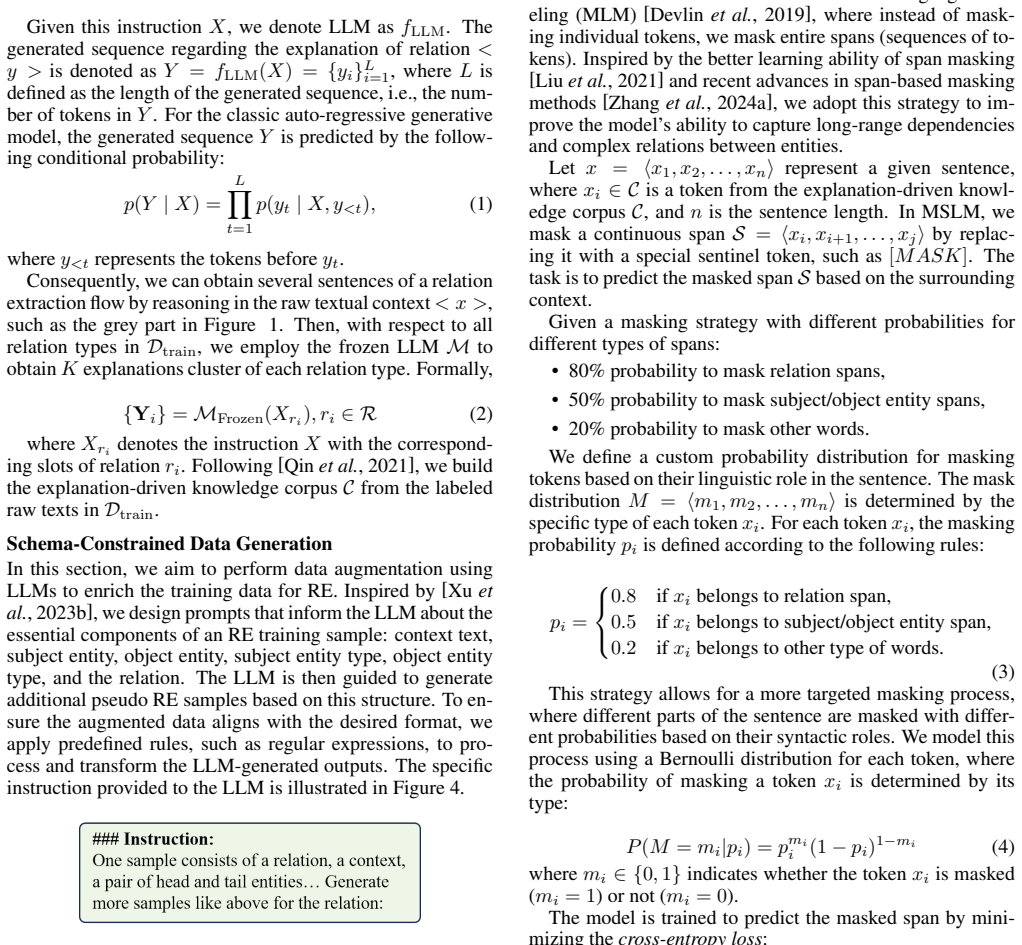
The central claim is that a small discriminative relation-extraction model can be made to learn the relational logic that LLMs encode by exposing it to two kinds of LLM-generated signal—free-text explanations of why an entity pair holds a relation, and schema-constrained pseudo-instances—and then training it with two span-level objectives. The first objective, MSLM, masks continuous spans with probabilities tuned by syntactic role (relation spans are masked with 0.8 probability, entity spans with 0.5, and other words with 0.2), forcing the model to reconstruct the relational words that carry the semantics. The second, SCL, uses a contrastive loss that pulls the embedding of a relation-relevant span (e.g., "was born in") toward the relation-type anchor and pushes a relation-irrelevant span (e.g., "New York") away. Together with fine-tuning on the few golden examples plus the synthetic data, this pipeline yields the reported state-of-the-art F1 scores on four benchmark datasets.
Load-bearing premise
The method assumes that the spans marked as relation-indicative and as positive/negative contrastive examples can be identified reliably in the LLM-generated corpus; the paper never specifies the extraction or annotation procedure, so if that identification is noisy or leaks the relation label, the reported gains could come from the synthetic data rather than from the pre-training objectives.
Editorial extensions
If this is right
- TKRE's reported F1 gains of 7.8 points over TYP Marker and 5.0 points over GenPT imply that LLM knowledge can be transferred to small relation-extraction models without parameter-heavy fine-tuning of the LLM itself.
- The framework outperforms pure LLM in-context learning (GPT-4, GPT-3.5, LLaMA-2) in few-shot settings, suggesting that discriminative models with LLM-guided pre-training are a more sample-efficient route to low-resource relation extraction than relying on the generative model alone.
- Ablations show that both the explanation corpus and the schema-constrained synthetic data contribute, and that replacing MSLM with BERT-style random token masking or removing SCL degrades performance, so the span-level objectives are not redundant.
- The best performance is achieved at a moderate amount of synthetic data; adding more generated data beyond a threshold degrades results, so the method's gains depend on controlling synthetic-data noise.
Reading between the lines
- The same recipe could transfer to other structured prediction tasks (e.g., named entity recognition, event extraction) where LLMs can verbalize the decision rule and a small model can be pre-trained to reconstruct and contrast the spans that embody that rule.
- The paper does not specify how relation-indicative and positive/negative spans are identified in the LLM-generated corpus; one testable extension is to replace the manual span annotation with attention-based selection from the small model itself, which would tell us whether the gains come from the annotation or from the objectives.
- The observed decline with excessive synthetic data suggests that adding a quality filter or confidence threshold on LLM-generated instances could push the performance frontier further, a check that the paper does not run.
- If the method truly transfers knowledge without leaking relation labels through span selection, it should also work when the LLM explanations are generated from a different domain or language than the target dataset, which would be a strong test of the 'relational logic' hypothesis.
Signed reviews
Editorial analysis
A structured set of objections, weighed in public.
Referee Report
Summary. The paper proposes TKRE, a two-stage framework for few-shot relation extraction. In the first stage, a frozen LLM generates relation explanations conditioned on the golden relation label and schema-constrained synthetic instances. In the second stage, a small discriminative model (TYP Marker or GenPT) is pre-trained with Masked Span Language Modeling (MSLM) and Span-Level Contrastive Learning (SCL), then fine-tuned on a mixture of golden and synthetic examples. Experiments on SemEval, TACRED, TACREV, and Re-TACRED under 8/16/32-shot settings report state-of-the-art F1, including average gains of 7.8 points over TYP Marker and 5.0 points over GenPT. Ablations attribute the gains to the knowledge-guided pre-training components, and additional analysis examines sensitivity to the LLM used for explanation generation and to the volume of synthetic data.
Significance. If the central claim is correct, TKRE provides a practical recipe for transferring generative LLM knowledge into compact discriminative relation-extraction models, and the two-stage pre-training objectives would be a reusable contribution. The paper has clear strengths: it releases code and data, evaluates on four standard datasets under multiple few-shot settings, ablates every proposed component, and shows robustness across three different LLM generators. However, the manuscript does not specify the span-selection procedure that defines MSLM/SCL, does not report variance or statistical significance, and does not establish that all baselines are compared under identical backbones and training conditions. These gaps must be closed before the paper's central claim about the pre-training objectives can be accepted.
major comments (4)
- [Sec. 3.3, Eqs. (3)-(6)] The central pre-training mechanism is not specified operationally. Eq. (3) assigns masking probabilities by 'linguistic role' (relation span, subject/object entity span, other), and Eq. (6) requires identifying positive spans such as 'was born in' and negative spans such as 'New York', but the manuscript never states how these spans are extracted from the LLM-generated corpus. Because the explanations in Eq. (2) are generated with the golden relation label r in the prompt, an unspecified span-selection rule could make MSLM reconstruct label-carrying tokens and SCL use an anchor derived from the same label, effectively turning the pre-training losses into a supervised relation-classification signal. Please provide the exact span-extraction algorithm (or the parsing rules and prompts used), give the hyperparameter values for lambda_1, lambda_2, and tau, and report an ablation with random spans to rule out label leakage.
- [Sec. 3.2, Explanation-Driven Knowledge Generation] The prose in this section repeatedly describes entity recognition rather than relation extraction: it says the instruction asks the LLM to explain 'why a given text span should be recognized as an entity' and mentions 'domains relevant to NER tasks.' As written, this does not describe how the relation explanation corpus C is built, even though Eq. (2), Figure 3, and the downstream pre-training all depend on relation-level explanations. Please rewrite this section to specify the exact instruction template for relation explanations and the post-processing steps used to construct C.
- [Sec. 4.2 and 4.3, Tables 2 and 3] All reported F1 scores appear to come from a single run with no standard deviation or significance test. Several key comparisons are small in magnitude (e.g., Table 3: w/oSCL is 57.9 vs. 59.6 for TKRE on the averaged columns; w/oMSLM is 57.2), yet the text repeatedly uses the word 'significant.' Please report means and standard deviations over at least three seeds with different random few-shot splits, and, ideally, paired significance tests for the main comparisons.
- [Appendix A.2, Table 2] The baseline comparison may not be apples-to-apples. The appendix states that RoBERTa-large is the base architecture for the authors' TYP Marker and GenPT implementations, but it does not state whether CP, KnowPrompt, PTRE, Unleash, and S2ynRE were re-run under the same backbone, hyperparameters, and training budgets. If those numbers are quoted from the original papers, differences in backbone or tuning could account for part of the reported gains. Please clarify this explicitly, and ideally re-run the key baselines under the same settings as TKRE.
minor comments (6)
- [Table 3] The table caption says 'Ablation study results for TACRED' but the table reports columns for both SemEval and TACRED; please correct the caption or reorganize the table.
- [Table 1] The column layout is confusing: the header includes '8-Shot 16-Shot 32-Shot All' but the rows then list numbers such as 148, 295, 589, 6,507, 1,439, 2,717, and 19. Please clarify what each number denotes and split the few-shot statistics from the full-dataset statistics.
- [Sec. 4.2, observation 2] The sentence 'However, it exhibits the generation performance in FSRE' appears to be missing a qualifier; it should likely read 'poor generation performance' or 'suboptimal generation performance.'
- [Eq. (5)] The symbol gamma is defined as the maximum input sequence length but is used as if it were the number of masked tokens; please make the notation consistent.
- [Fig. 6] The line labeled 'RE-TACRED (Supervised w/ Golden)' is not explained in the caption or text; please state what this baseline represents and how it was computed.
- [Appendix A.1] The description of Unleash duplicates the description given for GenPT/KnowPrompt; please replace it with an accurate summary of Unleash's method.
Circularity Check
No significant circularity: TKRE's pre-training objectives are supervised auxiliary losses, and the reported gains are empirical evaluations against held-out test data.
full rationale
The paper's central claim is that the TKRE framework improves few-shot relation extraction performance. This claim is supported by direct empirical comparison on standard benchmarks (SemEval, TACRED, TACREV, Re-TACRED), with the reported F1 scores measured on held-out test sets. The two-stage pre-training losses, MSLM and SCL, are auxiliary training objectives rather than predictions derived from fitted parameters; their hyperparameters (masking probabilities, lambda_1, lambda_2, tau) are chosen by the authors and are not fitted to the test data. The LLM-generated explanations and synthetic data are conditioned on golden relation labels, but this is standard supervised knowledge distillation / data augmentation, not circular fitting: no downstream result is obtained by algebraic identity with the inputs. The self-citations in the paper (e.g., Guo et al. 2025, Zhang and Kang 2024, Zhu et al. 2024) are peripheral, supporting general background claims, and are not load-bearing for the main result. The main legitimate concern is the under-specification of how relation-indicative spans are extracted for MSLM and SCL, which is a reproducibility and correctness risk, not a circularity, because the paper does not define the span labels in terms of the downstream evaluation outcome. Consequently, no step in the derivation chain reduces, by construction or by self-citation, to its own inputs.
Assumptions & free parameters
free parameters (6)
- lambda_1 =
not reported
- lambda_2 =
not reported
- temperature tau =
not reported
- masking probabilities p_i =
0.8/0.5/0.2
- pre-training epochs =
not reported
- synthetic data scale =
K per relation
assumptions (3)
- domain assumption LLM-generated explanations and synthetic data are accurate enough to serve as training signal.
- ad hoc to paper Relation-indicative spans and positive/negative contrastive spans can be automatically extracted from the generated corpus.
- domain assumption The small few-shot corpus (K x |R| sentences) is sufficient for task-adaptive pre-training of a RoBERTa-large model.
Cite this review
Pith. "Pith review of Bridging Generative and Discriminative Learning: Few-Shot Relation Extraction via Two-Stage Knowledge-Guided Pre-training." pith.science (2026). https://pith.science/paper/UUK2M5JV
@misc{pith2026250512236,
  author       = {Pith},
  title        = {Pith review of: Bridging Generative and Discriminative Learning: Few-Shot Relation Extraction via Two-Stage Knowledge-Guided Pre-training},
  year         = {2026},
  howpublished = {\url{https://pith.science/paper/UUK2M5JV}},
  note         = {Machine review of arXiv:2505.12236}
}
read the original abstract
Few-Shot Relation Extraction (FSRE) remains a challenging task due to the scarcity of annotated data and the limited generalization capabilities of existing models. Although large language models (LLMs) have demonstrated potential in FSRE through in-context learning (ICL), their general-purpose training objectives often result in suboptimal performance for task-specific relation extraction. To overcome these challenges, we propose TKRE (Two-Stage Knowledge-Guided Pre-training for Relation Extraction), a novel framework that synergistically integrates LLMs with traditional relation extraction models, bridging generative and discriminative learning paradigms. TKRE introduces two key innovations: (1) leveraging LLMs to generate explanation-driven knowledge and schema-constrained synthetic data, addressing the issue of data scarcity; and (2) a two-stage pre-training strategy combining Masked Span Language Modeling (MSLM) and Span-Level Contrastive Learning (SCL) to enhance relational reasoning and generalization. Together, these components enable TKRE to effectively tackle FSRE tasks. Comprehensive experiments on benchmark datasets demonstrate the efficacy of TKRE, achieving new state-of-the-art performance in FSRE and underscoring its potential for broader application in low-resource scenarios. \footnote{The code and data are released on https://github.com/UESTC-GQJ/TKRE.
Figures


Figures from the paper (3 more)


Reference graph
Works this paper leans on
-
[1]
Josh Achiam, Steven Adler, Sandhini Agarwal, Lama Ahmad, Ilge Akkaya, Florencia Leoni Aleman, Diogo Almeida, Janko Altenschmidt, Sam Altman, Shyamal Anadkat, et al. Gpt-4 technical report. arXiv preprint arXiv:2303.08774 , 2023
arXiv 2023
-
[2]
Tacred revisited: A thorough evaluation of the tacred relation extraction task
Christoph Alt, Aleksandra Gabryszak, and Leonhard Hennig. Tacred revisited: A thorough evaluation of the tacred relation extraction task. In Proceedings of the 58th Annual Meeting of the Association for Computational Linguistics . Association for Computational Linguistics, 2020
work page 2020
-
[3]
Ateret Anaby-Tavor, Boaz Carmeli, Esther Goldbraich, Amir Kantor, George Kour, Segev Shlomov, Naama Tepper, and Naama Zwerdling. Do not have enough data? deep learning to the rescue! In Proceedings of the AAAI conference on artificial intelligence , volume 34, pages 7383--7390, 2020
work page 2020
-
[4]
Knowprompt: Knowledge-aware prompt-tuning with synergistic optimization for relation extraction
Xiang Chen, Ningyu Zhang, Xin Xie, Shumin Deng, Yunzhi Yao, Chuanqi Tan, Fei Huang, Luo Si, and Huajun Chen. Knowprompt: Knowledge-aware prompt-tuning with synergistic optimization for relation extraction. In Proceedings of the ACM Web conference 2022 , pages 2778--2788, 2022
work page 2022
-
[5]
Bert: Pre-training of deep bidirectional transformers for language understanding
Jacob Devlin, Ming-Wei Chang, et al. Bert: Pre-training of deep bidirectional transformers for language understanding. In NAACL-HLT , 2019
work page 2019
-
[6]
Making pre-trained language models better few-shot learners
Tianyu Gao, Adam Fisch, and Danqi Chen. Making pre-trained language models better few-shot learners. In Proceedings of the 59th Annual Meeting of the Association for Computational Linguistics and the 11th International Joint Conference on Natural Language Processing (Volume 1: Long Papers) , pages 3816--3830, 2021
work page 2021
-
[7]
Baner: Boundary-aware llms for few-shot named entity recognition
Quanjiang Guo, Yihong Dong, Ling Tian, Zhao Kang, Yu Zhang, and Sijie Wang. Baner: Boundary-aware llms for few-shot named entity recognition. In Proceedings of the 31st International Conference on Computational Linguistics , pages 10375--10389, 2025
work page 2025
-
[8]
Generative prompt tuning for relation classification
Jiale Han, Shuai Zhao, Bo Cheng, Shengkun Ma, and Wei Lu. Generative prompt tuning for relation classification. In Findings of the Association for Computational Linguistics: EMNLP 2022 , pages 3170--3185, 2022
work page 2022
Show all 42 references
-
[9]
Semeval-2010 task 8: Multi-way classification of semantic relations between pairs of nominals
Iris Hendrickx, Su Nam Kim, Zornitsa Kozareva, Preslav Nakov, Diarmuid O S \'e aghdha, Sebastian Pad \'o , Marco Pennacchiotti, Lorenza Romano, and Stan Szpakowicz. Semeval-2010 task 8: Multi-way classification of semantic relations between pairs of nominals. ACL 2010 , page 33, 2010
2010
-
[10]
Tinybert: Distilling bert for natural language understanding
Xiaoqi Jiao, Yichun Yin, Lifeng Shang, Xin Jiang, Xiao Chen, Linlin Li, Fang Wang, and Qun Liu. Tinybert: Distilling bert for natural language understanding. In Findings of the Association for Computational Linguistics: EMNLP 2020 , pages 4163--4174, 2020
2020
-
[11]
Fastre: Towards fast relation extraction with convolutional encoder and improved cascade binary tagging framework
Guozheng Li, Xu Chen, et al. Fastre: Towards fast relation extraction with convolutional encoder and improved cascade binary tagging framework. In IJCAI , 2022
2022
-
[12]
Synthetic data generation with large language models for text classification: Potential and limitations
Zhuoyan Li, Hangxiao Zhu, Zhuoran Lu, and Ming Yin. Synthetic data generation with large language models for text classification: Potential and limitations. In Proceedings of the 2023 Conference on Empirical Methods in Natural Language Processing , pages 10443--10461, 2023
2023
-
[13]
Roberta: A robustly optimized bert pretraining approach
Yinhan Liu, Myle Ott, et al. Roberta: A robustly optimized bert pretraining approach. arXiv preprint arXiv:1907.11692 , 2019
1907 arXiv
-
[14]
Crossner: Evaluating cross-domain named entity recognition
Zihan Liu, Yan Xu, Tiezheng Xu, Wenliang Dai, Ziwei Ji, Samuel Cahyawijaya, Andrea Madotto, and Pascale Fung. Crossner: Evaluating cross-domain named entity recognition. In Proceedings of the AAAI Conference on Artificial Intelligence , volume 35, pages 13452--13460, 2021
2021
-
[15]
Decoupled weight decay regularization
I Loshchilov. Decoupled weight decay regularization. arXiv preprint arXiv:1711.05101 , 2017
2017 arXiv
-
[16]
Distant supervision for relation extraction without labeled data
Mike Mintz, Steven Bills, Rion Snow, and Dan Jurafsky. Distant supervision for relation extraction without labeled data. In Proceedings of the Joint Conference of the 47th Annual Meeting of the ACL and the 4th International Joint Conference on Natural Language Processing of th...
2009
-
[17]
Training language models to follow instructions with human feedback
Long Ouyang, Jeffrey Wu, Xu Jiang, Diogo Almeida, Carroll Wainwright, Pamela Mishkin, Chong Zhang, Sandhini Agarwal, Katarina Slama, Alex Ray, et al. Training language models to follow instructions with human feedback. Advances in neural information processing systems , 35:277...
2022
-
[18]
Learning from context or names? an empirical study on neural relation extraction
Hao Peng, Tianyu Gao, Xu Han, Yankai Lin, Peng Li, Zhiyuan Liu, Maosong Sun, and Jie Zhou. Learning from context or names? an empirical study on neural relation extraction. In Proceedings of the 2020 Conference on Empirical Methods in Natural Language Processing (EMNLP) , page...
2020
-
[19]
Erica: Improving entity and relation understanding for pre-trained language models via contrastive learning
Yujia Qin, Yankai Lin, Ryuichi Takanobu, Zhiyuan Liu, Peng Li, Heng Ji, Minlie Huang, Maosong Sun, and Jie Zhou. Erica: Improving entity and relation understanding for pre-trained language models via contrastive learning. In Proceedings of the 59th Annual Meeting of the Associ...
2021
-
[20]
Exploiting cloze-questions for few-shot text classification and natural language inference
Timo Schick and Hinrich Sch \"u tze. Exploiting cloze-questions for few-shot text classification and natural language inference. In Proceedings of the 16th Conference of the European Chapter of the Association for Computational Linguistics: Main Volume , pages 255--269, 2021
2021
-
[21]
Matching the blanks: Distributional similarity for relation learning
Livio Baldini Soares, Nicholas Fitzgerald, Jeffrey Ling, and Tom Kwiatkowski. Matching the blanks: Distributional similarity for relation learning. In Proceedings of the 57th Annual Meeting of the Association for Computational Linguistics , pages 2895--2905, 2019
2019
-
[22]
Learning from noisy labels with deep neural networks: A survey
Hwanjun Song, Minseok Kim, Dongmin Park, Yooju Shin, and Jae-Gil Lee. Learning from noisy labels with deep neural networks: A survey. IEEE transactions on neural networks and learning systems , 34(11):8135--8153, 2022
2022
-
[23]
Re-tacred: Addressing shortcomings of the tacred dataset
George Stoica, Emmanouil Antonios Platanios, and Barnab \'a s P \'o czos. Re-tacred: Addressing shortcomings of the tacred dataset. In Proceedings of the AAAI conference on artificial intelligence , volume 35, pages 13843--13850, 2021
2021
-
[24]
Qwen Team. Qwen2. 5 technical report. arXiv preprint arXiv:2412.15115 , 2024
2024 arXiv
-
[25]
Llama 2: Open foundation and fine-tuned chat models
Hugo Touvron, Louis Martin, Kevin Stone, Peter Albert, Amjad Almahairi, Yasmine Babaei, Nikolay Bashlykov, Soumya Batra, Prajjwal Bhargava, Shruti Bhosale, et al. Llama 2: Open foundation and fine-tuned chat models. arXiv preprint arXiv:2307.09288 , 2023
2023 arXiv
-
[26]
Wikidata: a free collaborative knowledgebase
Denny Vrande c i \'c and Markus Kr \"o tzsch. Wikidata: a free collaborative knowledgebase. Communications of the ACM , 57(10):78--85, 2014
2014
-
[27]
Strata: Self-training with task augmentation for better few-shot learning
Tu Vu, Minh-Thang Luong, Quoc Le, Grady Simon, and Mohit Iyyer. Strata: Self-training with task augmentation for better few-shot learning. In Proceedings of the 2021 Conference on Empirical Methods in Natural Language Processing , pages 5715--5731, 2021
2021
-
[28]
Pascore: a chinese overlapping relation extraction model based on global pointer annotation strategy
Peng Wang, Jiafeng Xie, et al. Pascore: a chinese overlapping relation extraction model based on global pointer annotation strategy. In IJCAI , 2023
2023
-
[29]
Instructuie: Multi-task instruction tuning for unified information extraction
Xiao Wang, Weikang Zhou, et al. Instructuie: Multi-task instruction tuning for unified information extraction. arXiv preprint arXiv:2304.08085 , 2023
2023 arXiv
-
[30]
Eda: Easy data augmentation techniques for boosting performance on text classification tasks
Jason Wei and Kai Zou. Eda: Easy data augmentation techniques for boosting performance on text classification tasks. In Proceedings of the 2019 Conference on Empirical Methods in Natural Language Processing and the 9th International Joint Conference on Natural Language Process...
2019
-
[31]
A novel cascade binary tagging framework for relational triple extraction
Zhepei Wei, Jianlin Su, et al. A novel cascade binary tagging framework for relational triple extraction. In ACL , 2020
2020
-
[32]
Llm-powered data augmentation for enhanced cross-lingual performance
Chenxi Whitehouse, Monojit Choudhury, and Alham Fikri Aji. Llm-powered data augmentation for enhanced cross-lingual performance. In The 2023 Conference on Empirical Methods in Natural Language Processing , 2023
2023
-
[33]
S2ynre: Two-stage self-training with synthetic data for low-resource relation extraction
Benfeng Xu, Quan Wang, Yajuan Lyu, Dai Dai, Yongdong Zhang, and Zhendong Mao. S2ynre: Two-stage self-training with synthetic data for low-resource relation extraction. In Proceedings of the 61st Annual Meeting of the Association for Computational Linguistics (Volume 1: Long Pa...
2023
-
[34]
Xin Xu, Yuqi Zhu, Xiaohan Wang, and Ningyu Zhang. How to unleash the power of large language models for few-shot relation extraction? In Proceedings of The Fourth Workshop on Simple and Efficient Natural Language Processing (SustaiNLP) , pages 190--200, 2023
2023
-
[35]
Harnessing the power of llms in practice: A survey on chatgpt and beyond
Jingfeng Yang, Hongye Jin, Ruixiang Tang, Xiaotian Han, Qizhang Feng, Haoming Jiang, Shaochen Zhong, Bing Yin, and Xia Hu. Harnessing the power of llms in practice: A survey on chatgpt and beyond. ACM Transactions on Knowledge Discovery from Data , 18(6):1--32, 2024
2024
-
[36]
Tpn: Transferable proto-learning network towards few-shot document-level relation extraction
Yu Zhang and Zhao Kang. Tpn: Transferable proto-learning network towards few-shot document-level relation extraction. In 2024 International Joint Conference on Neural Networks (IJCNN) , pages 1--9. IEEE, 2024
2024
-
[37]
Position-aware attention and supervised data improve slot filling
Yuhao Zhang, Victor Zhong, Danqi Chen, Gabor Angeli, and Christopher D Manning. Position-aware attention and supervised data improve slot filling. In Conference on empirical methods in natural language processing , 2017
2017
-
[38]
Cross-domain ner with generated task-oriented knowledge: An empirical study from information density perspective
Zhihao Zhang, Sophia Lee, Junshuang Wu, Dong Zhang, Shoushan Li, Erik Cambria, and Guodong Zhou. Cross-domain ner with generated task-oriented knowledge: An empirical study from information density perspective. In Proceedings of the 2024 Conference on Empirical Methods in Natu...
2024
-
[39]
Prompt tuning for few-shot relation extraction via modeling global and local graphs
Zirui Zhang, Yiyu Yang, and Benhui Chen. Prompt tuning for few-shot relation extraction via modeling global and local graphs. In Proceedings of the 2024 Joint International Conference on Computational Linguistics, Language Resources and Evaluation (LREC-COLING 2024) , pages 13...
2024
-
[40]
An improved baseline for sentence-level relation extraction
Wenxuan Zhou and Muhao Chen. An improved baseline for sentence-level relation extraction. In Proceedings of the 2nd Conference of the Asia-Pacific Chapter of the Association for Computational Linguistics and the 12th International Joint Conference on Natural Language Processin...
2022
-
[41]
Fcds: Fusing constituency and dependency syntax into document-level relation extraction
Xudong Zhu, Zhao Kang, and Bei Hui. Fcds: Fusing constituency and dependency syntax into document-level relation extraction. In Proceedings of the 2024 Joint International Conference on Computational Linguistics, Language Resources and Evaluation (LREC-COLING 2024) , pages 714...
2024
-
[42]
write newline
" write newline "" before.all 'output.state := FUNCTION fin.entry add.period write newline FUNCTION new.block output.state before.all = 'skip after.block 'output.state := if FUNCTION new.sentence output.state after.block = 'skip output.state before.all = 'skip after.sentence '...
Reviewed August 15, 2026 · model on record in the stance chip above.
Discussion (0). Continue with ORCID to comment.