Vitriflow: calibrated amorphous structure ensembles from melt-quench simulation
Pith reviewed 2026-07-03 19:20 UTC · model grok-4.3
The pith
Vitriflow turns implicit melt-quench choices into an explicit material-specific decision chain for amorphous ensembles.
A machine-rendered reading of the paper's core claim, the machinery that carries it, and where it could break.
Core claim
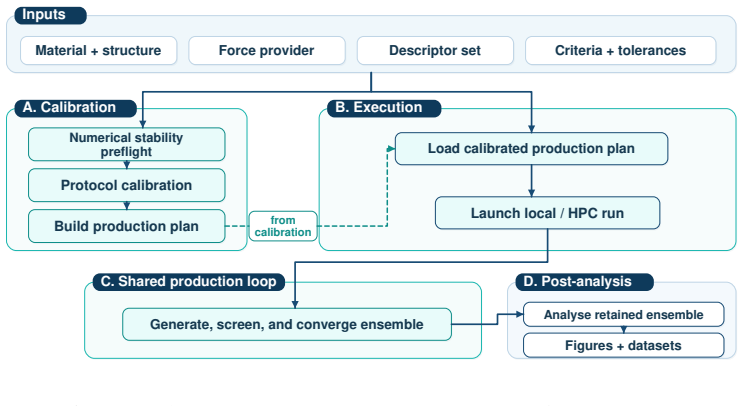
Vitriflow couples numerical stability, descriptor-based protocol calibration, user-defined artefact screening, and statistical convergence of the generated analysis ensemble in a material-specific descriptor space. This yields a reproducible route for generating amorphous ensembles whose numerical settings, thermal protocol, screening actions, and statistical precision are selected from the materials question rather than assumed a priori.
What carries the argument
vitriflow, a computational materials methodology that converts implicit melt-quench simulation choices into an explicit, calibrated decision chain using material-specific structural descriptors.
If this is right
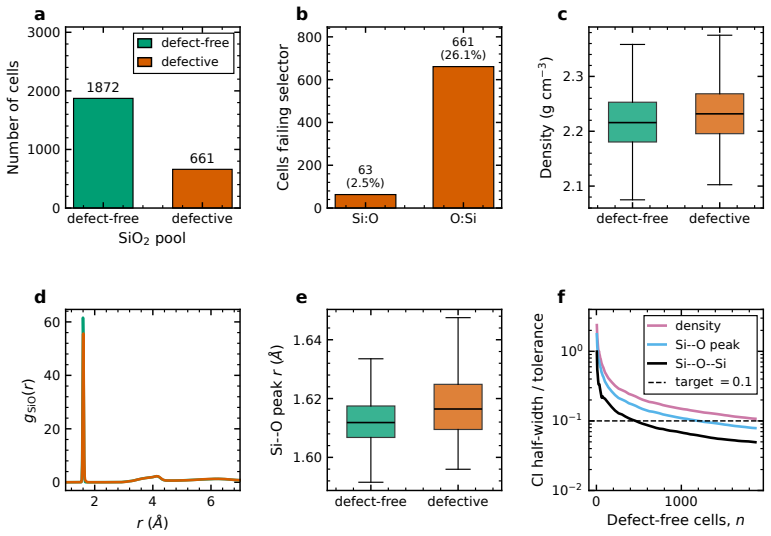
- Silica ensembles can be separated into defect-free and oxygen-bridge-defective subsets by the screening step.
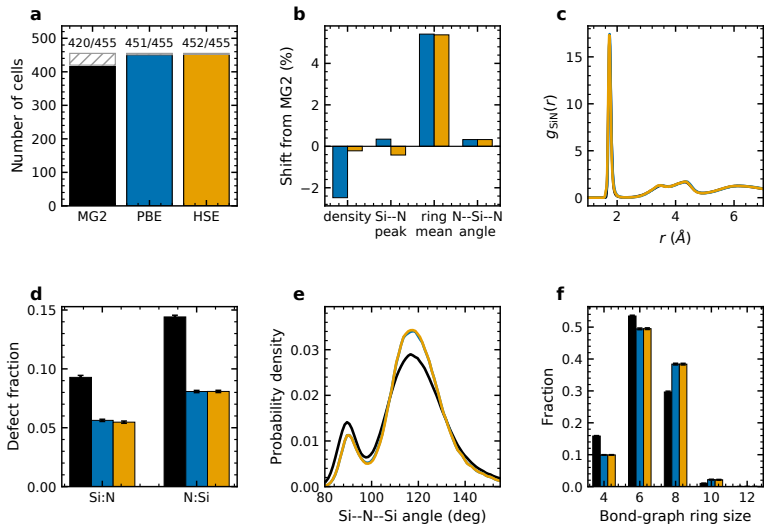
- A single a-Si3N4 population can be used to quantify structural changes when moving from MG2 to PBE to HSE06 DFT descriptions.
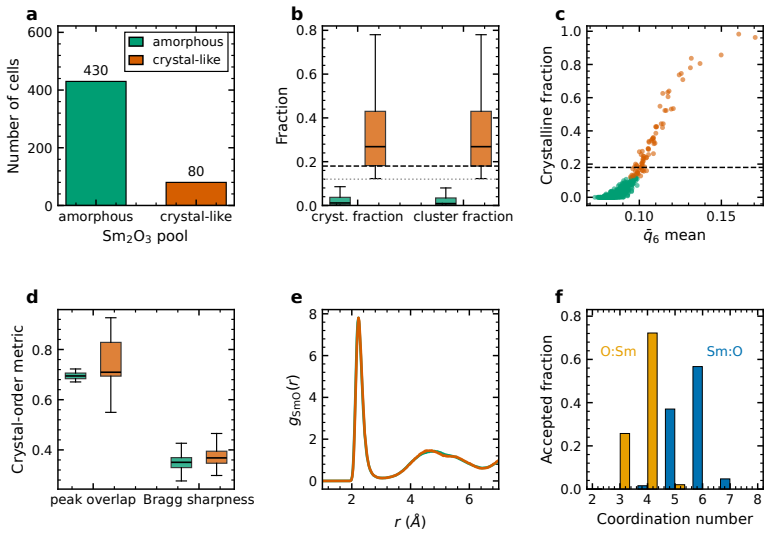
- Recrystallised a-Sm2O3 structures can be removed without imposing any fixed coordination constraint.
- Numerical settings and thermal protocols become selectable from the specific materials question under study.
- Statistical precision of the final ensemble is tied directly to convergence in the chosen descriptor space.
Where Pith is reading between the lines
- The calibration workflow could be ported to other generation methods such as ab initio random structure searching or reverse Monte Carlo for amorphous solids.
- Shared libraries of vitriflow-calibrated ensembles might reduce duplication when multiple groups study the same amorphous compound.
- The descriptor-convergence step offers a template for checking hidden bias in any workflow that relies on post-simulation filtering of atomistic data.
Load-bearing premise
The chosen descriptors and screening criteria faithfully capture the relevant structural features for the target material without introducing systematic bias invisible to the convergence test.
What would settle it
Running vitriflow on an additional material, passing all internal convergence checks, yet producing an ensemble whose pair-distribution function or coordination statistics deviate systematically from experiment in a manner traceable to an unexamined descriptor choice would falsify the central claim.
Figures
read the original abstract
Melt--quench molecular dynamics is widely used to construct amorphous materials models, but the resulting ensemble is defined by choices that are often made implicitly: numerical settings, melt temperature, liquid-hold time, quench rate, system size, and post-generation screening. We introduce vitriflow, a computational materials methodology that turns these choices into an explicit decision chain. The framework couples numerical stability, descriptor-based protocol calibration, user-defined artefact screening, and statistical convergence of the generated analysis ensemble in a material-specific descriptor space. We demonstrate the approach for a-SiO$_2$, a-Si$_3$N$_4$, and a-Sm$_2$O$_3$, which respectively test tetrahedral network fidelity, MG2 $\rightarrow$ PBE $\rightarrow$ HSE06 DFT refinement of a heteropolar nitride, and amorphous/crystal discrimination in a mixed-coordination rare-earth oxide. vitriflow separates defect-free from oxygen-bridge-defective silica, quantifies DFT-refinement response in a common a-Si$_3$N$_4$ structural population, and removes recrystallised Sm$_2$O$_3$ structures without imposing fixed coordination. The result is a reproducible route for generating amorphous ensembles whose numerical settings, thermal protocol, screening actions, and statistical precision are selected from the materials question rather than assumed a priori.
Editorial analysis
A structured set of objections, weighed in public.
Referee Report
Summary. The manuscript introduces Vitriflow, a methodology that converts implicit choices in melt-quench MD (numerical settings, melt temperature, quench rate, system size, post-generation screening) into an explicit decision chain coupling numerical stability, descriptor-based protocol calibration, user-defined artefact screening, and statistical convergence of the analysis ensemble in a material-specific descriptor space. Demonstrations are given for a-SiO2 (separating defect-free from oxygen-bridge-defective structures to test tetrahedral network fidelity), a-Si3N4 (quantifying structural response under MG2 → PBE → HSE06 DFT refinement), and a-Sm2O3 (removing recrystallised structures without fixed coordination constraints). The central claim is a reproducible, materials-question-driven route for generating statistically converged amorphous ensembles.
Significance. If the central claim holds, Vitriflow would address a persistent reproducibility issue in amorphous materials modeling by making protocol decisions traceable to the scientific question and certifying convergence in descriptor space. The three demonstrations illustrate applicability across network glasses, heteropolar nitrides, and mixed-coordination oxides. The framework's emphasis on explicit calibration and screening is a constructive contribution, though its impact depends on whether the chosen descriptors faithfully encode the relevant physics.
major comments (3)
- [Demonstrations section (a-SiO2)] Demonstrations (a-SiO2 case): the separation of defect-free from oxygen-bridge-defective silica is presented as evidence that the framework distinguishes structural populations, but no quantitative convergence metrics (e.g., descriptor-distribution variance, Kolmogorov-Smirnov statistics, or threshold values) are reported to show that the ensemble has reached statistical convergence in the chosen descriptor space.
- [a-Sm2O3 demonstration] a-Sm2O3 demonstration: removal of recrystallised structures is achieved without imposing fixed coordination, yet the manuscript provides no test that an alternative descriptor set would produce a materially different ensemble or that the convergence metric would flag the discrepancy; this directly bears on whether the convergence test certifies faithful capture of relevant features rather than internal consistency within an incomplete representation.
- [Methodology overview] Overall framework description: the claim that outputs are 'selected from the materials question rather than assumed a priori' rests on the descriptors and screening rules faithfully encoding the relevant structural degrees of freedom, but no independent validation (comparison to experimental structure factors, alternative protocols, or cross-descriptor consistency checks) is supplied to rule out undetected material-specific bias.
minor comments (2)
- [Abstract] Abstract: the acronym 'MG2' is introduced without definition; this should be expanded on first use.
- [Figures] Figure captions: several figures would benefit from explicit mention of the descriptor space dimensionality and the numerical convergence criterion applied.
Simulated Author's Rebuttal
We thank the referee for the constructive report. We address each major comment below, indicating where the manuscript will be revised to strengthen the presentation of the Vitriflow framework.
read point-by-point responses
-
Referee: Demonstrations (a-SiO2 case): the separation of defect-free from oxygen-bridge-defective silica is presented as evidence that the framework distinguishes structural populations, but no quantitative convergence metrics (e.g., descriptor-distribution variance, Kolmogorov-Smirnov statistics, or threshold values) are reported to show that the ensemble has reached statistical convergence in the chosen descriptor space.
Authors: We agree that explicit quantitative metrics would strengthen the demonstration of convergence. In the revised manuscript we will add descriptor-distribution variance and Kolmogorov-Smirnov statistics comparing successive ensemble sizes for the a-SiO2 case, together with the threshold values used to declare convergence. revision: yes
-
Referee: a-Sm2O3 demonstration: removal of recrystallised structures is achieved without imposing fixed coordination, yet the manuscript provides no test that an alternative descriptor set would produce a materially different ensemble or that the convergence metric would flag the discrepancy; this directly bears on whether the convergence test certifies faithful capture of relevant features rather than internal consistency within an incomplete representation.
Authors: The framework treats descriptor choice as an explicit, user-defined step tied to the materials question (here, amorphous/crystal discrimination without coordination constraints). A full cross-descriptor sensitivity study would require additional large-scale simulations beyond the scope of the present work. We will add a dedicated paragraph in the revised manuscript acknowledging this limitation and recommending that users perform such checks when the scientific question demands it. revision: partial
-
Referee: Overall framework description: the claim that outputs are 'selected from the materials question rather than assumed a priori' rests on the descriptors and screening rules faithfully encoding the relevant structural degrees of freedom, but no independent validation (comparison to experimental structure factors, alternative protocols, or cross-descriptor consistency checks) is supplied to rule out undetected material-specific bias.
Authors: The manuscript's central claim concerns the explicitness and traceability of the decision chain, not the universal correctness of any particular descriptor set. Material-specific validation against experiment or alternative protocols is an application-level task that the framework is intended to support rather than perform. We will revise the text to make this scope distinction clearer while retaining the three demonstrations as illustrations of the workflow. revision: partial
Circularity Check
No circularity; procedural methodology without self-referential reductions
full rationale
The paper presents vitriflow as an explicit decision-chain methodology for melt-quench ensemble generation, with all numerical settings, protocols, descriptors, and screening rules treated as user-specified inputs selected from the materials question. No equations, fitted parameters, or predictions are defined that reduce by construction to other quantities inside the same work; demonstrations (silica defect screening, DFT refinement, Sm2O3 discrimination) apply the framework to chosen descriptors without claiming those descriptors are derived from the outputs. The framework is therefore self-contained as a reproducible procedure rather than a derivation that collapses to its own inputs.
Axiom & Free-Parameter Ledger
axioms (1)
- domain assumption Melt-quench molecular dynamics can generate representative amorphous structures when numerical settings and screening are chosen appropriately.
Reference graph
Works this paper leans on
-
[1]
M. P. Allen, D. J. Tildesley, Computer Simulation of Liquids, 2nd Edition, Oxford University Press, Oxford, 2017.doi:10.1093/oso/9780198803195.001.0001
-
[2]
H. E. Fischer, A. C. Barnes, P. S. Salmon, Neutron and x-ray diffraction studies of liquids and glasses, Reports on Progress in Physics 69 (1) (2006) 233–299.doi:10. 1088/0034-4885/69/1/R05
2006
-
[3]
D. S. Franzblau, Computation of ring statistics for network models of solids, Physical Review B 44 (10) (1991) 4925–4930.doi:10.1103/PhysRevB.44.4925
-
[4]
P. J. Steinhardt, D. R. Nelson, M. Ronchetti, Bond-orientational order in liquids and glasses, Physical Review B 28 (2) (1983) 784–805.doi:10.1103/PhysRevB.28.784
-
[5]
W. Lechner, C. Dellago, Accurate determination of crystal structures based on averaged local bond order parameters, The Journal of Chemical Physics 129 (11) (2008) 114707. doi:10.1063/1.2977970
-
[6]
S. Nosé, A unified formulation of the constant temperature molecular dynamics meth- ods, The Journal of Chemical Physics 81 (1) (1984) 511–519.doi:10.1063/1.447334
-
[7]
W. G. Hoover, Canonical dynamics: Equilibrium phase-space distributions, Physical Review A 31 (3) (1985) 1695–1697.doi:10.1103/PhysRevA.31.1695
-
[8]
M. Parrinello, A. Rahman, Crystal structure and pair potentials: A molecular-dynamics study, Physical Review Letters 45 (14) (1980) 1196–1199.doi:10.1103/PhysRevLett. 45.1196
-
[9]
G. J. Martyna, D. J. Tobias, M. L. Klein, Constant pressure molecular dynam- ics algorithms, The Journal of Chemical Physics 101 (5) (1994) 4177–4189.doi: 10.1063/1.467468
-
[10]
H. Kim, B. Fábián, G. Hummer, Neighbor list artifacts in molecular dynamics sim- ulations, Journal of Chemical Theory and Computation 19 (23) (2023) 8919–8929. doi:10.1021/acs.jctc.3c00777
- [11]
-
[12]
J. F. Ziegler, J. P. Biersack, U. Littmark, The Stopping and Range of Ions in Solids, Pergamon Press, New York, 1985
1985
-
[13]
Student, The probable error of a mean, Biometrika 6 (1) (1908) 1–25.doi:10.1093/ biomet/6.1.1
1908
-
[14]
W. Hoeffding, Probability inequalities for sums of bounded random variables, Journal of the American Statistical Association 58 (301) (1963) 13–30.doi:10.1080/01621459. 1963.10500830. 24
-
[15]
Empirical Bernstein Bounds and Sample Variance Penalization
A. Maurer, M. Pontil, Empirical bernstein bounds and sample variance penalization, arXiv:0907.3740 (2009).doi:10.48550/arXiv.0907.3740
work page internal anchor Pith review Pith/arXiv arXiv doi:10.48550/arxiv.0907.3740 2009
-
[16]
Villani, Optimal Transport: Old and New, Vol
C. Villani, Optimal Transport: Old and New, Vol. 338 of Grundlehren der math- ematischen Wissenschaften, Springer, Berlin, Heidelberg, 2009.doi:10.1007/ 978-3-540-71050-9
2009
-
[17]
F. J. Massey Jr., The kolmogorov-smirnov test for goodness of fit, Journal of the American Statistical Association 46 (253) (1951) 68–78.doi:10.1080/01621459.1951. 10500769
-
[18]
S. Sundararaman, L. Huang, S. Ispas, W. Kob, New optimization scheme to obtain interaction potentials for oxide glasses, The Journal of Chemical Physics 148 (19) (2018) 194504.doi:10.1063/1.5023707
-
[19]
C. M. Marian, M. Gastreich, J. D. Gale, Empirical two-body potential for solid silicon nitride, boron nitride, and borosilazane modifications, Physical Review B 62 (5) (2000) 3117–3124.doi:10.1103/PhysRevB.62.3117
-
[20]
J. P. Perdew, K. Burke, M. Ernzerhof, Generalized gradient approximation made simple, Physical Review Letters 77 (18) (1996) 3865–3868.doi:10.1103/PhysRevLett.77. 3865
-
[21]
J. Heyd, G. E. Scuseria, M. Ernzerhof, Hybrid functionals based on a screened coulomb potential, The Journal of Chemical Physics 118 (18) (2003) 8207–8215.doi:10.1063/ 1.1564060
2003
-
[22]
hybridfunctionalsbasedonascreened coulomb potential
J.Heyd, G.E.Scuseria, M.Ernzerhof, Erratum: “hybridfunctionalsbasedonascreened coulomb potential” [J. Chem. Phys.118, 8207 (2003)], The Journal of Chemical Physics 124 (21) (2006) 219906.doi:10.1063/1.2204597
-
[23]
A. V. Krukau, O. A. Vydrov, A. F. Izmaylov, G. E. Scuseria, Influence of the exchange screening parameter on the performance of screened hybrid functionals, The Journal of Chemical Physics 125 (22) (2006) 224106.doi:10.1063/1.2404663. 25
discussion (0)
Sign in with ORCID, Apple, or X to comment. Anyone can read and Pith papers without signing in.