REVIEW 4 major objections 4 minor 60 references
Field-free superconducting diode effect in two-dimensional Shiba lattices
T0 review · 4 major / 4 minor · reviewed 2026-08-05 · deepseek-v4-flash
Pith's one-line read A two-dimensional Shiba lattice with a conical spin texture can support a superconducting diode effect with zero applied magnetic field, with efficiency exceeding 40% and reaching about 50%.
desk verdict The conical-texture mechanism is real and the two-model BdG calculation is careful, but every headline number sits at a pitch an order of magnitude shorter than the proposed Fe/Ta(110) platform and the paper never shows efficiency versus pitch. read the letter →
The pith
A machine-rendered reading of the paper's core claim, the machinery that carries it, and where it could break.
The reading
What carries the argument
The load-bearing object is the conical spin texture $S(\mathbf{r}) = (\sin\theta\cos\phi(\mathbf{r}), \sin\theta\sin\phi(\mathbf{r}), \cos\theta)$, with azimuth $\phi(\mathbf{r}) = \mathbf{g}\cdot\mathbf{r}$ set by pitches $g_x, g_y$. A local spin-gauge rotation $U = e^{-i\phi\sigma_z/2}$ converts it into an effective spin–orbit coupling $\propto (\mathbf{g}\cdot\mathbf{k})\sigma_z$ plus Zeeman terms $J\sin\theta\,\sigma_x$ and $J\cos\theta\,\sigma_z$; this texture-induced SOC makes the Bogoliubov spectrum asymmetric. The self-consistent gap is an FFLO order parameter $\Delta e^{i\mathbf{q}\cdot\mathbf{r}}$ with momentum $\mathbf{q}_0$ fixed by minimizing the condensation energy; supercurren
What would settle it
Two checks would settle it. Spin-polarized STM of the Fe monolayer on Ta(110): if the ~6 nm spiral has zero out-of-plane component, the conical condition $0 < \theta < \pi/2$ fails and no zero-field diode should appear. And a zero-field transport measurement: the claim predicts $I_c(\alpha) \neq I_c(\alpha+\pi)$ with efficiency around 50% along the texture diagonal, so observing symmetric critical currents at $B = 0$ within resolution falsifies the result. A mean-field calculation that includes orbital coupling to the texture's net magnetization is the numerical equivalent.
Extended reading notes
Core claim
Real-space Bogoliubov–de Gennes calculations show that a conical spin texture alone makes the quasiparticle spectrum asymmetric: in-plane spin winding breaks time reversal, a finite out-of-plane component breaks inversion. The ground state is a finite-momentum FFLO superconductor with Cooper pair momentum $q_0 \neq 0$ only for cone angles $0 < \theta < \pi/2$; planar and trivial textures give no diode effect. Critical currents obey $I_c(\alpha) \neq I_c(\alpha+\pi)$, with efficiency peaking near $\alpha = \pi/4$ and vanishing at $\alpha = 3\pi/4$, where inversion is restored. For $\theta = \pi/4$, $g_x = g_y = \pi/2$, $J/\Delta_0 = 0.5$, $\mu/\Delta_0 = 1$, efficiency reaches about 50%; plan
Load-bearing premise
Everything rests on treating the magnetic layer as a two-dimensional superconductor with a rigid conical texture that acts only as an exchange field; if the real texture is planar rather than conical, or if the net out-of-plane moment generates orbital currents, the field-free effect disappears.
Editorial extensions
If this is right
- A conventional s-wave superconductor covered by a suitable magnetic texture becomes a diode with no applied field, removing the field-generation step that complicates scalability and integration.
- Diode efficiency and sign are tunable: cone angle $\theta$, exchange coupling $J$, chemical potential $\mu$, the pitches $g_x, g_y$, and the current angle $\alpha$ all control $\eta$, and the effect reverses with the sign of $\mu$.
- The effect is directional: maximum efficiency along the spin-texture propagation direction ($\alpha = \pi/4$ for $g_x = g_y$), and exactly zero along the perpendicular direction ($\alpha = 3\pi/4$).
- The Fe monolayer on Ta(110), with its ~6 nm spin spiral on an s-wave superconducting substrate (gap 0.7–0.9 meV), is a concrete platform on which the field-free diode could be tested.
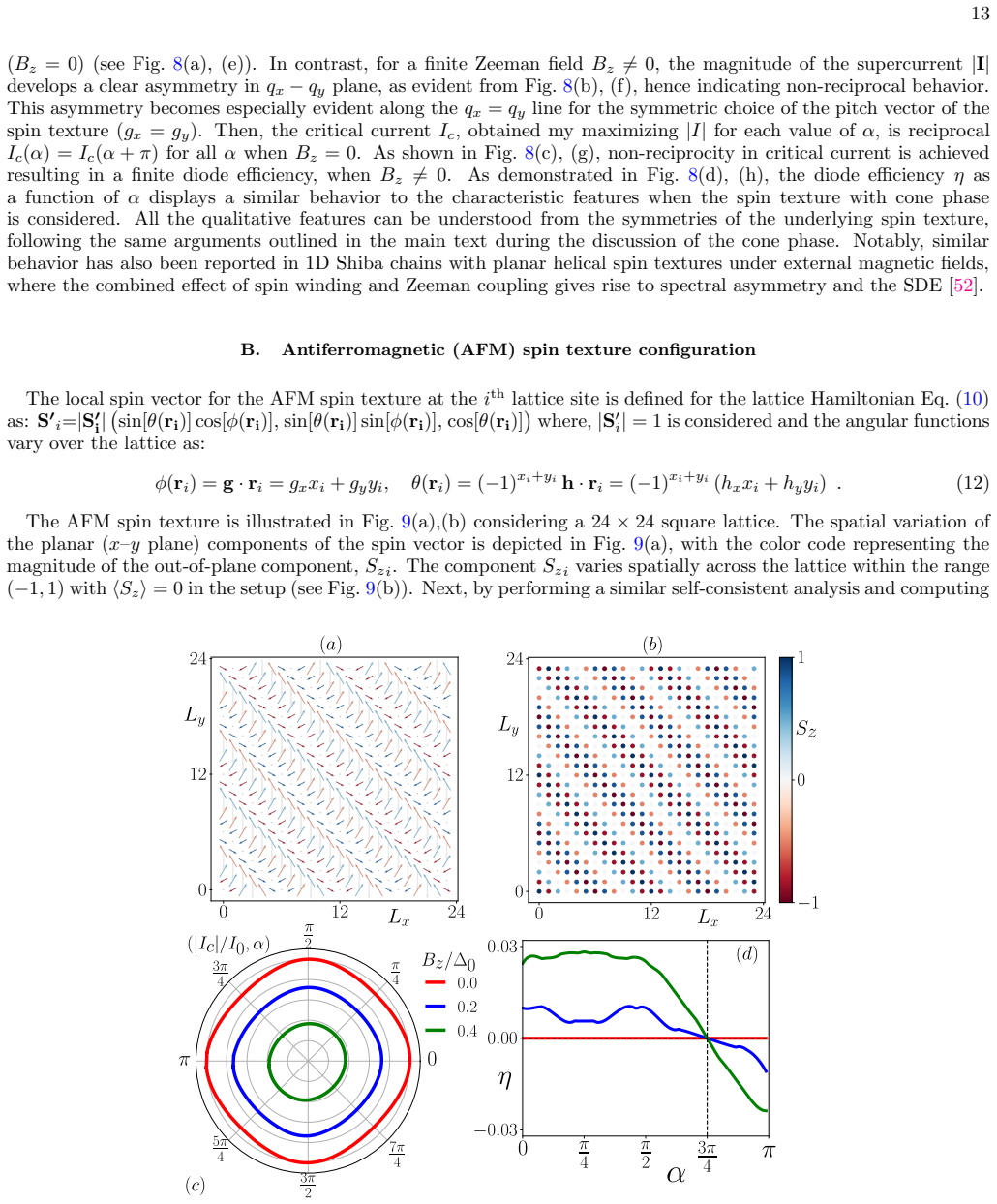
- Conical geometry is essential: planar helical textures give at best ~20% and only under an external Zeeman field, and antiferromagnetic textures only ~3%, so the out-of-plane canting is what buys the field-free operation.
Reading between the lines
- A testable extension the paper leaves implicit: if the cone angle $\theta$ could be tuned in situ (by a gate, strain, or temperature), the diode could be switched on and off and its polarity reversed without any magnetic handle.
- The symmetry logic should transfer to other textures with both in-plane winding and a net out-of-plane component, such as skyrmion lattices; the predicted efficiency would track the canting angle, so comparing textures is a direct check.
- The paper treats the texture as a rigid classical field; a real conical texture carries a net out-of-plane magnetization whose stray fields could act back on the superconductor, so a calculation that includes orbital coupling would show whether about 50% survives in a real film.
- Because the same Shiba-lattice platform hosts topological superconducting bands, the field-free diode may coexist with Majorana physics; a signature to look for is a change in diode efficiency across the topological phase boundary.
Editorial analysis
A structured set of objections, weighed in public.
Referee Report
Summary. The paper proposes a field-free superconducting diode effect in a two-dimensional Shiba lattice with a classical conical spin texture. Using real-space self-consistent BdG theory with an on-site attractive Hubbard interaction, the authors find an FFLO-like finite-momentum superconducting state whose condensation energy is optimized at a nonzero Cooper-pair momentum q0 for conical textures. From the bond-current formalism they compute the supercurrent in q space and extract critical currents as a function of current-flow angle α, obtaining a diode efficiency η that exceeds 40% and approaches about 50% for a particular parameter set. They also study the angular dependence of η and argue it can be tuned by changing the spin-texture pitches along x and y. A material realization based on an Fe monolayer on Ta(110), where a spin spiral with period about 6 nm is reported, is proposed.
Significance. If the central claim holds, the paper offers a conceptually simple route to a field-free SDE: a magnetic texture alone, without an applied field or intrinsic spin-orbit coupling, can break the required symmetries and produce a large nonreciprocal supercurrent. The use of two independent BdG formulations (lattice and effective lattice-regularized) and self-consistent determination of both Δ(q) and q0 are strengths. The qualitative mechanism, including the role of the conical texture and the vanishing of the effect for planar and trivial textures, is physically plausible. However, the quantitative headline results are obtained only for a very short-pitch spiral (g=π/2), and the manuscript contains several internal inconsistencies between the main text and the Supplemental Material. The paper is therefore significant as a proposal but currently does not establish that the high efficiencies survive at realistic material parameters.
major comments (4)
- [Sec. V, Fig. 4/5; Sec. VI] All numerical results for the conical texture in the main text use gx=gy=π/2, i.e., a spin spiral with a four-site period. The abstract claims the angular dependence 'can be tuned by varying the pitches', but no calculation of η as a function of g is presented, nor any case with gx≠gy. This omission is load-bearing because the proposed Fe/Ta(110) platform has a spiral period of about 6 nm; with a≈0.3 nm this corresponds to g≈0.3, roughly an order of magnitude smaller than the value used. Since the effective spin-orbit coupling in Eq. (3) is proportional to g, both q0 and the spectral asymmetry driving the SDE scale with g, so the >40% efficiencies may be an artifact of an unrealistically short spiral. Please provide η(g) over a range down to physical values and state clearly which parameter regime the headline claims refer to.
- [Sec. III, Eq. (3) vs SM Eq. (9)] The continuum Hamiltonian is written inconsistently between the main text and the Supplemental Material. Main-text Eq. (3) has h_k = ε_{k,~g} + t(g·k)σ_z + J sinθ σ_x + J cosθ σ_z with ε = t(k^2+~g^2)−μ, while SM Eq. (9) has h_k = ε_{k,~g} + (1/2)(~g·k)σ_z + ... with ε = (1/2)(k^2+~g^2)−μ. The kinetic term differs by a factor t vs 1/2, and the effective SOC by a factor of 2. This affects the claimed correspondence between the continuum model and the lattice-regularized Hamiltonian, and it matters for the scaling of q0 and the SDE. Please reconcile the definitions and confirm which version was used in the numerical analysis.
- [Sec. V, Fig. 5(c) vs SM, Fig. 6(c)] The optimization of η versus J is contradictory between the two models. Main-text Fig. 5(c) shows that η begins to develop for J/Δ0>0.3 and reaches an optimal value of about 50% near J/Δ0=0.5. In contrast, SM Fig. 6(c) is described in its caption as showing that η 'monotonically decreases as we increase J'. If the lattice and lattice-regularized models are meant to corroborate each other, this is a direct inconsistency that affects the headline claim. Please clarify which model produces the optimized efficiencies and reconcile the two behaviors.
- [Sec. V and SM S2] The symmetry analysis for α=3π/4 is internally inconsistent. The main text states that along kx=−ky the BdG Hamiltonian satisfies H(k)=H(−k), which prevents non-reciprocal current, so η=0 for α=3π/4. However, SM Fig. 7(f) is described as showing that the gap closing along kx=−ky 'remains asymmetric' at finite Cooper-pair momentum. Also, SM Fig. 7(c) shows a symmetric spectrum for q=0 along kx=−ky while Fig. 7(f) shows asymmetry for finite q. This distinction is central to the angular dependence of the SDE and must be clarified.
minor comments (4)
- [SM, caption of Fig. 6] The effective chemical potential is defined as μ′=μ−4t−(t/4)(g_x^2+g_y^2), but the shift implied by Eq. (4) appears to be μ−4t−(1/2)(~g_x^2+~g_y^2), which, with ~g=g/2, differs by a factor of 2 in the g-dependent part. Please harmonize the notation.
- [Sec. V, Eq. (7)] There is a typo in the quasiparticle wavefunction: 'v_m_{n↑}' should read v^m_{i↑}. Please correct.
- [Sec. II / Numerical methods] The manuscript does not state lattice sizes, boundary conditions, or convergence criteria for the self-consistent calculation (except in one SM figure caption, where Lx×Ly=25×25 is mentioned). Including these details would significantly aid reproducibility.
- [Sec. VI] The sentence 'inversion symmetry via its finite out-of-plane component' is imprecise: for a conical texture, the out-of-plane component is uniform, and the symmetry breaking comes from the spatial phase g·r in the in-plane components. Please rephrase to avoid confusion.
Circularity Check
No circular steps: BdG self-consistency and bond-current calculation are independent of the claimed efficiency.
full rationale
Walking the derivation chain, no claim reduces by construction to an input. The conical spin texture is introduced in Eq. (1) as a rigid classical field S(r)=|S|(sinθ cos(g·r), sinθ sin(g·r), cosθ); the paper does not define this texture in terms of the diode effect, nor is any target efficiency or critical-current asymmetry used to set its parameters. The FFLO order parameter Δ e^{iq·r} is solved self-consistently via Eq. (6) and q0 is obtained by minimizing the condensation energy Eq. (5); the calculation explicitly returns q0≈0 for planar/trivial textures, showing the ansatz does not force the result. Supercurrents are computed from the BdG eigenstates through the bond-current formula Eq. (7), and the efficiency η is defined from the resulting Ic(α) in Eq. (8). The symmetry breaking (TRS/inversion) is a stated design property of the conical texture and is a precondition for SDE, not a fitted output. Self-citations (Refs. 39, 40, 52, 60) are used for background or comparison and are not load-bearing; no uniqueness theorem from the authors is invoked to forbid alternatives. The main quantitative claims (η>40%, ~50%) are found by scanning J, μ, θ, α in Figs. 4-5 and are not inserted by hand. The gap between the optimized pitch g=π/2 and the ~6 nm Fe/Ta(110) spiral mentioned in Sec. VI is a parameter-relevance concern for experimental realization, but it does not make the derivation circular.
Assumptions & free parameters
free parameters (6)
- Hubbard interaction U/Delta0 =
2.56 (lattice, Eq. (1)), 1.81 (regularized, Eq. (4))
- Exchange coupling J/Delta0 =
0.5 (optimal for the lattice model)
- Chemical potential mu/Delta0 =
1.0 (optimal)
- Cone angle theta =
pi/4
- Pitch vector gx, gy =
pi/2, pi/2
- Temperature beta^-1/Delta0 =
0.1
assumptions (6)
- domain assumption The superconducting order parameter is assumed to be a single-plane-wave s-wave FFLO form Delta e^{iq.r}, and the ground state is found by minimizing free energy over q.
- domain assumption The spin texture is a rigid, classical, time-independent conical configuration with |S_i| = 1, pitch g, and cone angle theta.
- domain assumption Superconducting correlations are proximity induced, so the 2D adatom lattice can be treated as an effective superconductor with an attractive on-site U.
- domain assumption The magnetic texture enters only through exchange J S(r).sigma; orbital effects, stray fields, and Meissner screening are neglected.
- domain assumption The conical spin texture with g not equal to 0 and 0 < theta < pi/2 breaks both inversion and time-reversal symmetries.
- standard math Self-consistent BdG mean-field and bond-current formalisms give the correct depairing critical current.
Cite this review
Pith. "Pith review of Field-free superconducting diode effect in two-dimensional Shiba lattices." pith.science (2026). https://pith.science/paper/UVHOQASL
@misc{pith2026250810832,
  author       = {Pith},
  title        = {Pith review of: Field-free superconducting diode effect in two-dimensional Shiba lattices},
  year         = {2026},
  howpublished = {\url{https://pith.science/paper/UVHOQASL}},
  note         = {Machine review of arXiv:2508.10832}
}
read the original abstract
The superconducting diode effect (SDE) refers to non-reciprocal transport, where current flows without resistance in one direction but becomes resistive in the opposite direction, but its typical reliance on magnetic field hinders scalability and device integration. In this article, we present a theoretical framework for realizing a field-free SDE based on a two-dimensional (2D) Shiba lattice featuring a conical spin texture. Using the real-space Bogoliubov-de Gennes (BdG) calculations, we illustrate that the conical spin configuration alone is sufficient to break the necessary inversion and time reversal symmetries, enabling nonreciprocal supercurrent flow without any external magnetic field, yielding diode efficiency exceeding 40%. Furthermore, we find that the efficiency of such a diode effect becomes strongly dependent on the direction of current flow, revealing a pronounced angular dependence that can be tuned by varying the pitches of the spin texture along the two spatial lattice directions. Our findings offer a pathway toward scalable, field-free superconducting components for non-dissipative electronics and quantum technologies.
Figures


Figures from the paper (5 more)


Reference graph
Works this paper leans on
-
[1]
Nadeem, M
M. Nadeem, M. S. Fuhrer, and X. Wang, The super- conducting diode effect, Nature Reviews Physics 5, 558 (2023)
2023
-
[2]
Nagaosa and Y
N. Nagaosa and Y. Yanase, Nonreciprocal transport and optical phenomena in quantum materials, Annual Review of Condensed Matter Physics 15, 63 (2024)
2024
-
[3]
P. R. Broussard and T. H. Geballe, Critical currents in sputtered nb-ta multilayers, Phys. Rev. B 37, 68 (1988)
work page 1988
-
[4]
Jiang, P
X. Jiang, P. J. Connolly, S. J. Hagen, and C. J. Lobb, Asymmetric current-voltage characteristics in type-ii su- perconductors, Phys. Rev. B 49, 9244 (1994)
1994
- [5]
-
[6]
H. Narita and T. Ono, Superconducting diode effect in ar- tificial superlattices, JSAP Review 2024, 240206 (2024)
work page 2024
-
[7]
F. Ando, Y. Miyasaka, T. Li, J. Ishizuka, T. Arakawa, Y. Shiota, T. Moriyama, Y. Yanase, and T. Ono, Obser- vation of superconducting diode effect, Nature 584, 373 (2020)
2020
-
[8]
A. Sundaresh, J. I. V¨ ayrynen, Y. Lyanda-Geller, and L. P. Rokhinson, Diamagnetic mechanism of critical current non-reciprocity in multilayered superconductors, Nature Communications 14, 1628 (2023)
work page 2023
Show all 60 references
-
[9]
Wakatsuki, Y
R. Wakatsuki, Y. Saito, S. Hoshino, Y. M. Itahashi, T. Ideue, M. Ezawa, Y. Iwasa, and N. Nagaosa, Nonre- ciprocal charge transport in noncentrosymmetric super- conductors, Science Advances 3, e1602390 (2017)
2017
-
[10]
Y. M. Itahashi, T. Ideue, Y. Saito, S. Shimizu, T. Ouchi, T. Nojima, and Y. Iwasa, Nonreciprocal transport in gate-induced polar superconductor SrTiO 3, Science Ad- vances 6, eaay9120 (2020)
2020
-
[11]
Schumann, L
T. Schumann, L. Galletti, H. Jeong, K. Ahadi, W. M. Strickland, S. Salmani-Rezaie, and S. Stemmer, Possible signatures of mixed-parity superconductivity in doped polar SrTio 3 films, Phys. Rev. B 101, 100503 (2020)
2020
-
[12]
J.-X. Lin, P. Siriviboon, H. D. Scammell, S. Liu, D. Rhodes, K. Watanabe, T. Taniguchi, J. Hone, M. S. Scheurer, and J. Li, Zero-field superconducting diode effect in small-twist-angle trilayer graphene, Na- ture Physics 18, 1221 (2022)
2022
-
[13]
Diez-Merida, A
J. Diez-Merida, A. D ´ ıez-Carl´ on, S. Yang, Y.-M. Xie, X.- J. Gao, J. Senior, K. Watanabe, T. Taniguchi, X. Lu, A. P. Higginbotham, et al., Symmetry-broken joseph- son junctions and superconducting diodes in magic-angle twisted bilayer graphene, Nature Communications 14, 2396 (2023)
2023
-
[14]
Bauriedl, C
L. Bauriedl, C. B¨ auml, L. Fuchs, C. Baumgartner, N. Paulik, J. M. Bauer, K.-Q. Lin, J. M. Lupton, T. Taniguchi, K. Watanabe, et al., Supercurrent diode effect and magnetochiral anisotropy in few-layer nbse2, Nature communications 13, 4266 (2022)
2022
-
[15]
J. Yun, S. Son, J. Shin, G. Park, K. Zhang, Y. J. Shin, J.-G. Park, and D. Kim, Magnetic proximity-induced su- perconducting diode effect and infinite magnetoresistance in a van der waals heterostructure, Phys. Rev. Res. 5, L022064 (2023)
2023
-
[16]
Zhang, Y
Y. Zhang, Y. Gu, P. Li, J. Hu, and K. Jiang, General the- ory of josephson diodes, Phys. Rev. X 12, 041013 (2022)
2022
-
[17]
T. H. Kokkeler, A. A. Golubov, and F. S. Bergeret, Field- free anomalous junction and superconducting diode effect in spin-split superconductor/topological insulator junc- tions, Phys. Rev. B 106, 214504 (2022)
2022
-
[18]
Tanaka, B
Y. Tanaka, B. Lu, and N. Nagaosa, Theory of giant diode effect in d-wave superconductor junctions on the sur- face of a topological insulator, Phys. Rev. B 106, 214524 (2022)
2022
-
[19]
H. F. Legg, K. Laubscher, D. Loss, and J. Klinovaja, Parity-protected superconducting diode effect in topo- logical josephson junctions, Phys. Rev. B 108, 214520 8 (2023)
2023
-
[20]
J. J. Cuozzo, W. Pan, J. Shabani, and E. Rossi, Microwave-tunable diode effect in asymmetric squids with topological josephson junctions, Phys. Rev. Res. 6, 023011 (2024)
2024
-
[21]
R. S. Souto, M. Leijnse, and C. Schrade, Josephson diode effect in supercurrent interferometers, Phys. Rev. Lett. 129, 267702 (2022)
2022
-
[22]
Cheng and Q.-F
Q. Cheng and Q.-F. Sun, Josephson diode based on con- ventional superconductors and a chiral quantum dot, Phys. Rev. B 107, 184511 (2023)
2023
-
[23]
J. F. Steiner, L. Melischek, M. Trahms, K. J. Franke, and F. von Oppen, Diode effects in current-biased josephson junctions, Phys. Rev. Lett. 130, 177002 (2023)
2023
-
[24]
Costa, J
A. Costa, J. Fabian, and D. Kochan, Microscopic study of the josephson supercurrent diode effect in josephson junctions based on two-dimensional electron gas, Phys. Rev. B 108, 054522 (2023)
2023
-
[25]
Wei, H.-L
Y.-J. Wei, H.-L. Liu, J. Wang, and J.-F. Liu, Supercur- rent rectification effect in graphene-based josephson junc- tions, Phys. Rev. B 106, 165419 (2022)
2022
-
[26]
Daido and Y
A. Daido and Y. Yanase, Superconducting diode effect and nonreciprocal transition lines, Phys. Rev. B 106, 205206 (2022)
2022
-
[27]
Daido, Y
A. Daido, Y. Ikeda, and Y. Yanase, Intrinsic supercon- ducting diode effect, Phys. Rev. Lett.128, 037001 (2022)
2022
-
[28]
N. F. Q. Yuan and L. Fu, Supercurrent diode effect and finite-momentum superconductors, Proceedings of the National Academy of Sciences 119, e2119548119 (2022)
2022
-
[29]
J. J. He, Y. Tanaka, and N. Nagaosa, A phenomenological theory of superconductor diodes, New Journal of Physics 24, 053014 (2022)
2022
-
[30]
Ili´ c and F
S. Ili´ c and F. S. Bergeret, Theory of the supercurrent diode effect in rashba superconductors with arbitrary dis- order, Phys. Rev. Lett. 128, 177001 (2022)
2022
-
[31]
H. D. Scammell, J. I. A. Li, and M. S. Scheurer, Theory of zero-field superconducting diode effect in twisted trilayer graphene, 2D Materials 9, 025027 (2022)
2022
-
[32]
Zinkl, K
B. Zinkl, K. Hamamoto, and M. Sigrist, Symmetry con- ditions for the superconducting diode effect in chiral su- perconductors, Phys. Rev. Res. 4, 033167 (2022)
2022
-
[33]
J. J. He, Y. Tanaka, and N. Nagaosa, The supercurrent diode effect and nonreciprocal paraconductivity due to the chiral structure of nanotubes, Nature Communica- tions 14, 3330 (2023)
2023
-
[34]
B. Zhai, B. Li, Y. Wen, F. Wu, and J. He, Prediction of ferroelectric superconductors with reversible supercon- ducting diode effect, Phys. Rev. B 106, L140505 (2022)
2022
-
[35]
Jiang, M
J. Jiang, M. Miloˇ sevi´ c, Y.-L. Wang, Z.-L. Xiao, F. Peeters, and Q.-H. Chen, Field-free superconducting diode in a magnetically nanostructured superconductor, Phys. Rev. Appl. 18, 034064 (2022)
2022
-
[36]
de Picoli, Z
T. de Picoli, Z. Blood, Y. Lyanda-Geller, and J. I. V¨ ayrynen, Superconducting diode effect in quasi-one- dimensional systems, Phys. Rev. B 107, 224518 (2023)
2023
-
[37]
H. F. Legg, D. Loss, and J. Klinovaja, Superconducting diode effect due to magnetochiral anisotropy in topolog- ical insulators and rashba nanowires, Phys. Rev. B 106, 104501 (2022)
2022
-
[38]
Banerjee and M
S. Banerjee and M. S. Scheurer, Enhanced superconduct- ing diode effect due to coexisting phases, Phys. Rev. Lett. 132, 046003 (2024)
2024
-
[39]
Bhowmik, D
S. Bhowmik, D. Samanta, A. K. Nandy, A. Saha, and S. K. Ghosh, Optimizing one dimensional superconduct- ing diodes: interplay of rashba spin-orbit coupling and magnetic fields, Communications Physics 8, 260 (2025)
2025
-
[40]
Samanta and S
D. Samanta and S. K. Ghosh, Field-free supercon- ducting diode effect and topological fulde-ferrell-larkin- ovchinnikov superconductivity in altermagnetic shiba chains, arXiv:2507.21446 (2025)
2025 arXiv
-
[41]
Y. Hou, F. Nichele, H. Chi, A. Lodesani, Y. Wu, M. F. Ritter, D. Z. Haxell, M. Davydova, S. Ili´ c, O. Glezakou- Elbert, A. Varambally, F. S. Bergeret, A. Kamra, L. Fu, P. A. Lee, and J. S. Moodera, Ubiquitous superconduct- ing diode effect in superconductor thin films, Phys. ...
2023
-
[42]
Gupta, G
M. Gupta, G. V. Graziano, M. Pendharkar, J. T. Dong, C. P. Dempsey, C. Palmstrøm, and V. S. Prib- iag, Gate-tunable superconducting diode effect in a three- terminal josephson device, Nature communications 14, 3078 (2023)
2023
-
[43]
Banerjee, M
A. Banerjee, M. Geier, M. A. Rahman, C. Thomas, T. Wang, M. J. Manfra, K. Flensberg, and C. M. Marcus, Phase asymmetry of andreev spectra from cooper-pair momentum, Phys. Rev. Lett. 131, 196301 (2023)
2023
-
[44]
Narita, J
H. Narita, J. Ishizuka, R. Kawarazaki, D. Kan, Y. Sh- iota, T. Moriyama, Y. Shimakawa, A. V. Ognev, A. S. Samardak, Y. Yanase, et al., Field-free superconduct- ing diode effect in noncentrosymmetric superconduc- tor/ferromagnet multilayers, Nature Nanotechnology 17, 823 (2022)
2022
-
[45]
Gutfreund, H
A. Gutfreund, H. Matsuki, V. Plastovets, A. Noah, L. Gorzawski, N. Fridman, G. Yang, A. Buzdin, O. Millo, J. W. Robinson, et al., Direct observation of a supercon- ducting vortex diode, Nature Communications 14, 1630 (2023)
2023
-
[46]
Y. Chen, M. S. Scheurer, and C. Schrade, Intrinsic su- perconducting diode effect and nonreciprocal supercon- ductivity in rhombohedral graphene multilayers, arXiv preprint arXiv:2503.16391 (2025)
2025 arXiv
-
[47]
T.-P. Choy, J. M. Edge, A. R. Akhmerov, and C. W. J. Beenakker, Majorana fermions emerging from magnetic nanoparticles on a superconductor without spin-orbit coupling, Phys. Rev. B 84, 195442 (2011)
2011
-
[48]
Nadj-Perge, I
S. Nadj-Perge, I. K. Drozdov, B. A. Bernevig, and A. Yazdani, Proposal for realizing majorana fermions in chains of magnetic atoms on a superconductor, Phys. Rev. B 88, 020407 (2013)
2013
-
[49]
Pientka, L
F. Pientka, L. I. Glazman, and F. von Oppen, Topological superconducting phase in helical shiba chains, Phys. Rev. B 88, 155420 (2013)
2013
-
[50]
M. M. Vazifeh and M. Franz, Self-organized topologi- cal state with majorana fermions, Phys. Rev. Lett. 111, 206802 (2013)
2013
-
[51]
Heimes, P
A. Heimes, P. Kotetes, and G. Sch¨ on, Majorana fermions from shiba states in an antiferromagnetic chain on top of a superconductor, Phys. Rev. B 90, 060507 (2014)
2014
-
[52]
Bhowmik and A
S. Bhowmik and A. Saha, Topological majorana zero modes and the superconducting diode effect driven by fulde-ferrell-larkin-ovchinnikov pairing in a helical shiba chain, Phys. Rev. B 111, L161402 (2025)
2025
-
[53]
Fulde and R
P. Fulde and R. A. Ferrell, Superconductivity in a strong spin-exchange field, Phys. Rev. 135, A550 (1964)
1964
-
[54]
Larkin and Y
A. Larkin and Y. N. Ovchinnikov, Nonuniform state of superconductors, Soviet Physics-JETP 20, 762 (1965)
1965
-
[55]
Lo Conte, J
R. Lo Conte, J. Wiebe, S. Rachel, D. K. Morr, and R. Wiesendanger, Magnet-superconductor hybrid quan- tum systems: a materials platform for topological super- 9 conductivity, La Rivista del Nuovo Cimento , 1 (2025)
2025
-
[56]
R. Hess, H. F. Legg, D. Loss, and J. Klinovaja, Preva- lence of trivial zero-energy subgap states in nonuniform helical spin chains on the surface of superconductors, Phys. Rev. B 106, 104503 (2022)
2022
-
[57]
Zhu, Bogoliubov-de Gennes method and its applica- tions, Vol
J.-X. Zhu, Bogoliubov-de Gennes method and its applica- tions, Vol. 924 (Springer, 2016)
2016
-
[58]
Br¨ uning, J
R. Br¨ uning, J. Bedow, R. L. Conte, K. von Bergmann, D. Morr, R. Wiesendanger, et al., The non-collinear path to topological superconductivity, arXiv preprint arXiv:2405.14673 (2024)
2024
-
[59]
R´ ozsa, L
L. R´ ozsa, L. Udvardi, L. Szunyogh, and I. A. Szab´ o, Mag- netic phase diagram of an fe monolayer on w(110) and ta(110) surfaces based on ab initio calculations, Phys. Rev. B 91, 144424 (2015)
2015
-
[60]
FIELD-FREE SUPERCONDUCTING DIODE EFFECT IN TWO-DIMENSIONAL SHIBA LA TTICES
P. Chatterjee, S. Banik, S. Bera, A. K. Ghosh, S. Prad- han, A. Saha, and A. K. Nandy, Topological supercon- ductivity by engineering noncollinear magnetism in mag- net/superconductor heterostructures: A realistic pre- scription for the two-dimensional kitaev model, Phys. Rev....
2024
Reviewed August 5, 2026 · model on record in the stance chip above.
Discussion (0). Sign in to comment.