REVIEW 3 major objections 5 minor 30 references
Ensemble approach for natural language question answering problem
T0 review · 3 major / 5 minor · reviewed 2026-08-14 · deepseek-v4-flash
Pith's one-line read A class-aware weighted-voting ensemble of three attention-based reading models reaches F1 81.96 and EM 73.77 on SQuAD, beating its best single model.
desk verdict A clearly written but statistically weak ensemble study: the class-aware weighting idea is real, yet the reported 0.4 F1 gain over the best single model could easily be within run-to-run noise. read the letter →
The pith
A machine-rendered reading of the paper's core claim, the machinery that carries it, and where it could break.
The reading
What carries the argument
The central mechanism is question-class-aware weighted voting. Fourteen question classes are defined by the interrogative phrase opening each SQuAD question: date, during, how are, how big/size, how m/m, how old, what, what time, when, where, who, whom, why, and undefined. For each class, each model's voting weight is the average F1 it scored on that class in a 5% holdout of the training set, using models trained on the remaining 95%. The voting rule then aggregates candidate answers by summing the weights of identical answers, chooses the highest total, and falls back to the globally best model for non-duplicated or undefined cases. The load-bearing observation is that the three base models disagree on most questions, leaving room for voting to correct individual errors.
What would settle it
Repeat the experiment with several different random 5% splits of the SQuAD training set, retraining all three base models from scratch for each split. If the class-aware ensemble fails to beat Mnemonic Reader in the majority of splits, or if the 0.39-point F1 advantage falls inside the split-to-split variance, the claimed improvement is not stable.
Extended reading notes
Core claim
The paper claims that a class-specific weighted-voting ensemble of BiDAF, QANet, and Mnemonic Reader outperforms every one of them on SQuAD. The voting weights come from a 5% pre-evaluation split: models are trained on the other 95% of the training set, scored separately on each of fourteen question classes derived from interrogative phrases, and each model receives the average F1 it achieves in each class as its voting weight. At test time, models trained on the full training set each propose an answer; if two or more models give the same answer, their class weights are summed, and the answer with the highest total is returned. When no answer is duplicated, or the question falls outside the defined classes, the globally best model's answer is returned. This procedure reaches F1 81.96 and EM 73.77 on the SQuAD evaluation set, exceeding the best standalone model, Mnemonic Reader, by 0.39 and 0.52 points, and exceeding a class-blind version of the same voting by 0.10 and 0.05 points.
Load-bearing premise
The class-specific F1 weights measured on a 5% holdout of the SQuAD training set, using models trained on the remaining 95%, are assumed to stay representative when the final models are trained on the full dataset and evaluated on the official evaluation set.
Editorial extensions
If this is right
- An ensemble built from existing attention-based reading models improves over the strongest member on SQuAD without any architectural change, so model diversity across question types is a usable resource.
- Because the class-blind weighted ensemble already beats the best single model, part of the gain comes from voting itself, and the class-aware weighting adds a further 0.10 F1 and 0.05 EM.
- Per-class weights estimated from only 5% of the training set are enough, in this setup, to guide voting on the full evaluation set; the paper reports that splitting factors 0.01 and 0.1 gave worse overall results.
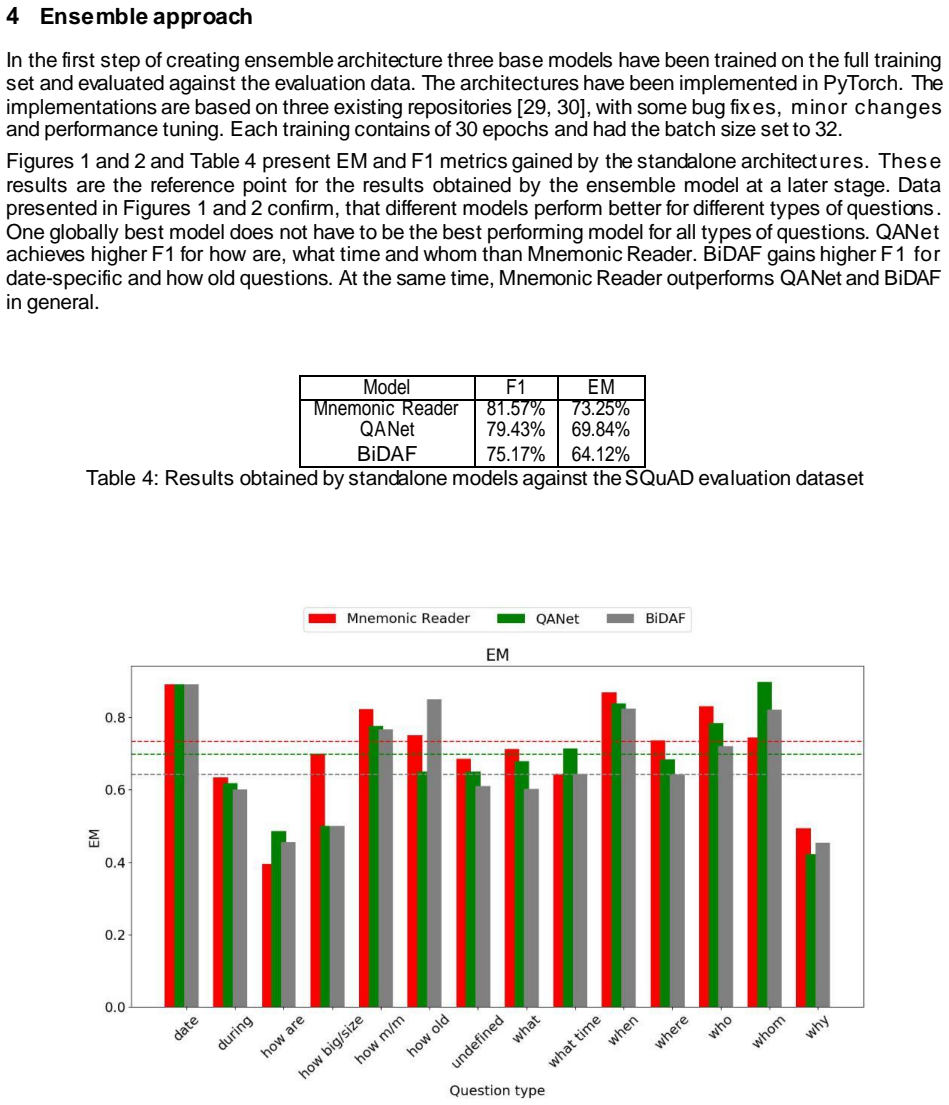
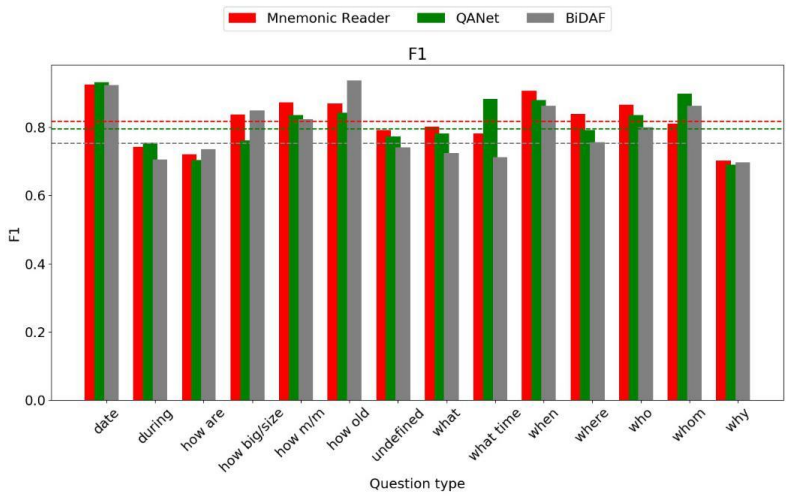
- The ensemble is not better on every question class: for how-old questions it scores below BiDAF because adding the weights of two equal wrong answers can outweigh one correct answer, so the method's value is global rather than per-class.
Reading between the lines
- The reported margins are small enough that a skeptic would want a significance test across several random 5% splits; the paper gives no variance or repeated-run numbers, so the stability of the 0.39-point F1 edge is open.
- Since roughly 53% of SQuAD questions belong to the what class, even a modest improvement concentrated in that dominant class could explain most of the headline gain; testing on a class-balanced evaluation set would show whether the mechanism helps rare question types.
- The same recipe should transfer to other reading-comprehension datasets whose questions can be typed by surface cues, but the 5% holdout may be too small on less skewed collections, where cross-validated or online weight estimation would be a natural extension.
- The method is a form of mixture-of-experts gated by question type; replacing the hand-built interrogative-phrase taxonomy with a learned question embedding could automate grouping and might generalize beyond the fourteen classes used here.
Signed reviews
Editorial analysis
A structured set of objections, weighed in public.
Referee Report
Summary. The paper proposes a class-aware weighted voting ensemble for SQuAD question answering. It uses three published architectures (BiDAF, QANet, Mnemonic Reader), defines 14 question classes, splits the SQuAD training set 95/5, trains the base models on the 95% subset to measure per-class average F1, and uses these as voting weights in Algorithm 2. Answers are combined by summing weights of duplicate candidate answers and otherwise falling back to the globally best model. On the SQuAD dev set, the class-aware ensemble scores F1 81.96 and EM 73.77 versus 81.57/73.25 for the best single model (Mnemonic Reader); the non-class-aware ensemble scores 81.86/73.72. The authors also experiment with variants (sum vs. max weights, undefined-class handling, EM-based weights, length-based classification).
Significance. If the reported gains are real, the paper demonstrates a simple, inexpensive way to push SQuAD accuracy beyond a strong single model, and its per-class error analysis is a useful diagnostic. The main strengths are that the voting weights are estimated on a held-out portion of the training set (a legitimate design) and that Algorithms 1–4 are specified explicitly, making the method easy to implement. However, the measured improvement is very small (0.39 F1, 0.52 EM), comes from a single run with no significance testing, and the final configuration was chosen after trying several variants on the same evaluation set. As it stands, the central 'outperforms' claim is plausible but not statistically established.
major comments (3)
- [§5, Table 11] The central claim rests on a single evaluation run. No error bars, confidence intervals, or significance tests are reported, and the improvements over Mnemonic Reader (0.39 F1, 0.52 EM) and over the non-class ensemble (0.1 F1, 0.05 EM) are small relative to the size of the evaluation set. Since training is stochastic and the 5% pre-evaluation split is random, the reported gain could be within run-to-run variation. Please provide repeated runs with different seeds and split draws, and report paired significance tests (or bootstrap confidence intervals) over the 10,570 evaluation questions.
- [§5, variant testing paragraphs] Several alternative design choices (adding vs. taking the max of duplicate weights, handling undefined questions with voting, using EM rather than F1 weights, and length-based classification) were evaluated directly on the SQuAD evaluation set, and the best-performing variant was then reported as the headline result. This is a form of selection on the test set; the reported advantage may overstate the true improvement of the chosen configuration. The paper should either report results for all variants with error bars, or select the configuration on a separate validation split and then apply it once to the evaluation set.
- [§3, Table 3 and §4, Algorithms 1–2] The class-specific weights are estimated from a single random 5% split of the training set, where several classes have very few examples (how big/size: 4, how old: 6, what time: 11, whom: 20). These noisy estimates are then used to weight the final models trained on the full training set, but the paper does not check whether the weights are stable across different 5% splits or across the 95%-vs-100% training regimes. A k-fold or bootstrap procedure over the training set would show whether the measured substitutions that produce the 0.39 F1 gain are robust.
minor comments (5)
- [Tables 5–10] QANet is evaluated on 10,482 questions rather than 10,570; please explain the discrepancy (e.g., missing predictions) and how Algorithm 2 handles questions without a QANet candidate.
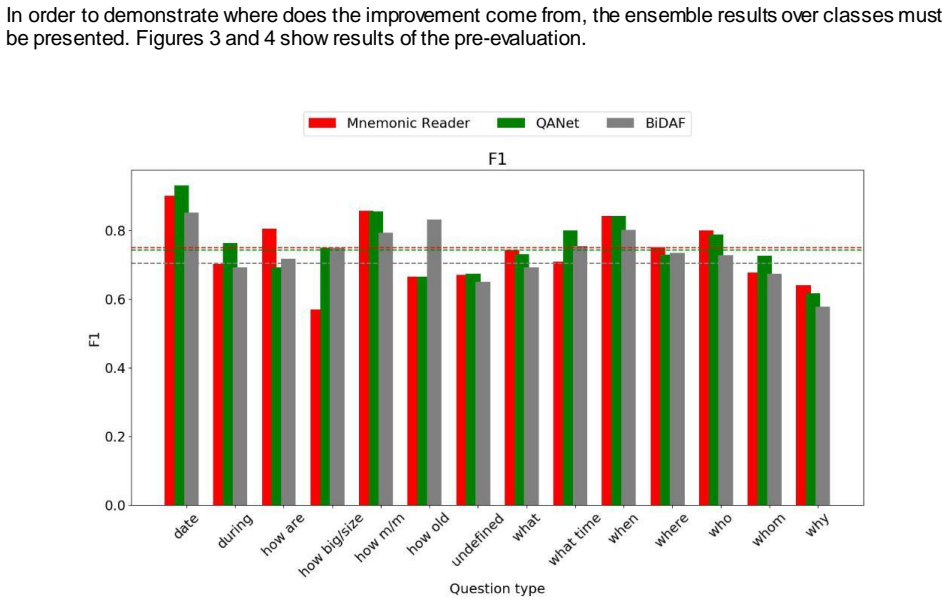
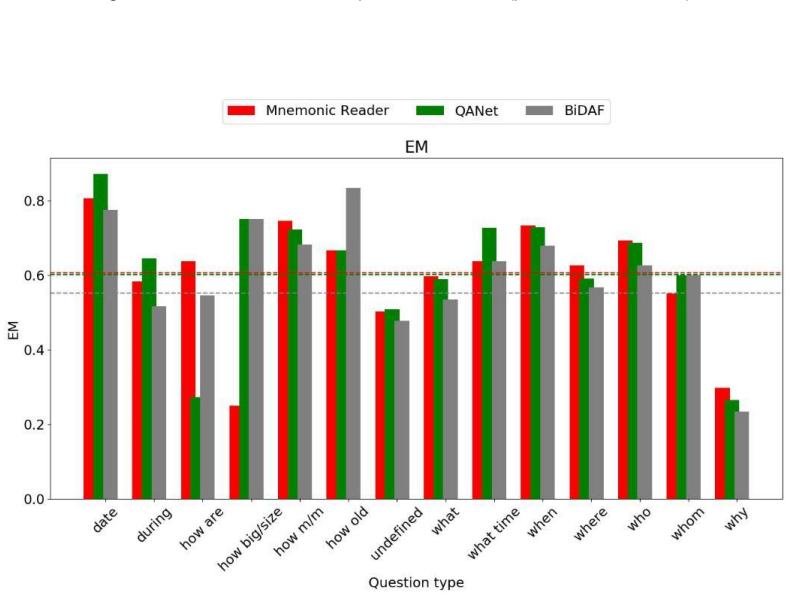
- [Figures 1–6] The figures lack descriptive captions and axis labels; this makes it difficult to interpret the per-class behavior that is central to the paper. Please add proper captions and label the axes.
- [Throughout] The manuscript has many typos and grammatical errors, such as 'Each training contains of 30 epochs', 'Figures 5 ans 6', and 'how has the SQuAD data set been splitted'. A careful proofreading pass is needed.
- [§3, merging which into what] The claim that merging which and what classes 'has no influence on the final results' is unsupported; please provide evidence (e.g., comparative results) or remove the claim.
- [§5, how old example] The description of the 'how old' example is confusing: if BiDAF has the highest voting weight, it is not clear why adding the weights of Mnemonic and QANet would override it unless their summed weight exceeds BiDAF's weight. Please clarify the exact voting arithmetic in this example.
Circularity Check
No circularity: the class-weighted ensemble is derived from a holdout pre-evaluation split and measured against an external SQuAD evaluation set.
full rationale
The paper's derivation chain is empirical and externally anchored, not self-referential. The class-specific voting weights are obtained by training each base model on 95% of the SQuAD training set and evaluating it on the disjoint 5% pre-evaluation split (Section 3; Algorithm 1, steps 1-3). The final ensemble is then applied to the full SQuAD evaluation set (Algorithm 2), and the reported F1/EM numbers in Table 11 are measurements on that hold-out evaluation set, not quantities fed into the weighting procedure. The ensemble decision rule (summing weights of duplicate answers, otherwise returning the globally best model's answer) is a genuine decision rule: the paper even documents a case ('how old' questions) where the rule produces a worse result than the highest-weight base model, demonstrating that the outcome is not forced by construction. There are no load-bearing self-citations: the base architectures are attributed to external papers ([2], [23], [24]) and the implementations to external repositories ([29], [30]); no 'uniqueness' result or prior work by these authors is invoked. Concerns that the improvement over Mnemonic Reader is small, that no significance test or variance estimate is provided, and that several algorithmic variants were compared on the same evaluation set before reporting the best result are legitimate threats to the robustness and external validity of the empirical claim, but they are not circularity: the reported ensemble score is not equivalent to its inputs by definition or by construction. Accordingly, no circular step is identified and the circularity score is 0.
Assumptions & free parameters
free parameters (6)
- class-specific voting weights =
per-class average F1 per model (e.g., QANet highest for date, Mnemonic highest overall)
- splitting factor for pre-evaluation set =
0.05
- weight metric =
F1 instead of EM
- duplicate-answer combination rule =
adding weights instead of taking the max
- undefined-class fallback =
return answer of globally best model
- training epochs and batch size =
30 epochs, batch size 32
assumptions (5)
- domain assumption The SQuAD dataset is a valid and representative benchmark for reading comprehension.
- domain assumption The public implementations of BiDAF and Mnemonic Reader are correct after the authors' bug fixes, and the unnamed QANet implementation is a faithful reproduction.
- domain assumption A random 5% split of the training set reproduces the question-class distribution of the full SQuAD dataset.
- domain assumption Class-specific F1 measured on the pre-evaluation models transfers to the final models trained on the full training set.
- domain assumption F1 is an appropriate proxy for answer quality when setting ensemble weights.
Cite this review
Pith. "Pith review of Ensemble approach for natural language question answering problem." pith.science (2026). https://pith.science/paper/UWBIW7O7
@misc{pith2026190809720,
  author       = {Pith},
  title        = {Pith review of: Ensemble approach for natural language question answering problem},
  year         = {2026},
  howpublished = {\url{https://pith.science/paper/UWBIW7O7}},
  note         = {Machine review of arXiv:1908.09720}
}
read the original abstract
Machine comprehension, answering a question depending on a given context paragraph is a typical task of Natural Language Understanding. It requires to model complex dependencies existing between the question and the context paragraph. There are many neural network models attempting to solve the problem of question answering. The best models have been selected, studied and compared with each other. All the selected models are based on the neural attention mechanism concept. Additionally, studies on a SQUAD dataset were performed. The subsets of queries were extracted and then each model was analyzed how it deals with specific group of queries. Based on these three model ensemble model was created and tested on SQUAD dataset. It outperforms the best Mnemonic Reader model.
Figures
Figures from the paper (3 more)


Reference graph
Works this paper leans on
-
[1]
Dynamic Coattention Networks For Question Answering
Caiming Xiong, Victor Zhong and Richard Socher. Dynamic Coattention Networks For Question Answering. CoRR, https://dblp.org/rec/bib/journals/corr/XiongZS16, 2016
work page 2016
-
[2]
Bidirectional Attention Flow for Machine Comprehension
Min Joon Seo, Aniruddha Kembhavi, Ali Farhadi and Hannaneh Hajishirzi. Bidirectional Attention Flow for Machine Comprehension. CoRR, https://dblp.org/rec/bib/journals/corr/SeoKFH16, 2016
work page 2016
-
[3]
R -NET: Machine Reading Comprehension w ith Self-matching Netw orks
Natural Language Computing Group, Microsoft Research Asia. R -NET: Machine Reading Comprehension w ith Self-matching Netw orks. https://w ww.microsoft.com/en-us/research/w p-content/uploads/2017/05/r-net.pdf, 2017
work page 2017
-
[4]
Pay More Attention - Neural Architectures for Question-Answering
Zia Hasan, Sebastian Fischer Pay More Attention - Neural Architectures for Question-Answering. CoRR, http://arxiv.org/abs/1803.09230, 2018
work page Pith review arXiv 2018
-
[5]
An Analysis of the AskMSR Qu estion -answering System
Brill, Eric and Dumais, Susan and Banko, Michele. An Analysis of the AskMSR Qu estion -answering System. Proceedings of the ACL-02 Conference on Empirical Methods in Natural Language Processing - vol. 10, pp. 257-264, 2002, Association for Computational Linguistics, Stroudsburg, PA, USA
work page 2002
-
[6]
NLP Algorithm Based Question and Answering System
Sarkar, Sanglap and Madasu, Venkateshwar Rao an d SM, Baala Mithra and Rao, Subrahmanya VRK. NLP Algorithm Based Question and Answering System. Proceedings of the 2015 Seventh International Conference on Computational Intelligence, Modelling and Simulation, CIMSIM ’15, 2015, pp. 97-101, IEEE Computer Society, Washington, DC, USA
work page 2015
-
[7]
J. Ramos. Using TF-IDF to Determine Word Relevance in Document Queries. Technical report. http://citeseerx.ist.psu.edu/viewdoc/download?doi=10.1.1.121.1424rep=rep1type=pdf, 2003
work page 2003
-
[8]
Comparative Study of CNN and RNN for Natural Language Processing
Wenpeng Yin and Katharina Kann and Mo Yu and Hinrich Schütze. Comparative Study of CNN and RNN for Natural Language Processing. CoRR, vol. abs/1702.01923, http://arxiv.org/abs/1702.01923, 2017
arXiv 2017
Show all 30 references
-
[9]
Long Short-Term Memory
Hochreiter, Sepp and Schmidhuber, Jürgen. Long Short-Term Memory. Neural Computing, vol.9, pp.1735-1780, November 15, 1997, MIT Press, Cambridge, MA, USA
1997
-
[10]
Deep Learning Approaches for Question Answering System
Sharma, Yashvardhan and Gupta, Sahil. Deep Learning Approaches for Question Answering System. vol.132, pp.785-794, Procedia Computer Science, 2018
2018
-
[11]
Efficient Estimation of Word Representations in Vector Space
Tomas Mikolov and Kai Chen and Greg Corrado and Jeffrey Dean. Efficient Estimation of Word Representations in Vector Space. CoRR, vol.abs/1301.3781, http://arxiv.org/abs/1301.3781, 2013
2013 arXiv
-
[12]
Tow ards AI -Complete Question Answ ering: A Set of Prerequisite Toy Tasks
Jason Weston and Antoine Bordes and Sumit Chopra and Tomas Mikolov. Tow ards AI -Complete Question Answ ering: A Set of Prerequisite Toy Tasks. vol.abs/1502.05698, http://arxiv.org/abs/1502.05698, 2015
2015 arXiv
-
[13]
Memory Networks
Jason Weston and Sumit Chopra and Antoine Bordes. Memory Networks. CoRR, vol.abs/1410.3916, http://arxiv.org/abs/1410.3916, 2014
2014 arXiv
-
[14]
Ask Me Anything: Dynamic Memory Netw orks for Natural Language Processing
Ankit Kumar and Ozan Irsoy and Jonathan Su and James Bradbury and Robert English and Brian Pierce and Peter Ondruska and Ishaan Gulrajani and Richard Socher. Ask Me Anything: Dynamic Memory Netw orks for Natural Language Processing. CoRR, vol.abs/1506.07285, http://arxiv.org/a...
2015 arXiv
-
[15]
Minh-Thang Luong and Hieu Pham and Christopher D. Manning. Effective Approaches to Attention-based Neural Machine Translation, CoRR, vol. abs/1508.04025, http://arxiv.org/abs/1508.04025, 2015
2015 arXiv
-
[16]
Reasoning about Entailment with Neural Attention
Tim Rocktäschel and Edward Grefenstette and Karl Moritz Hermann and Tomás Kociský and Phil Blunsom. Reasoning about Entailment with Neural Attention. CoRR, vol. abs/1509.06664, http://arxiv.org/abs/1509.06664, 2015
2015 arXiv
-
[17]
Vaswani, Ashish and Shazeer, Noam and Parmar, Niki and Uszkoreit, Jakob and Jones, Llion and Gomez, Aidan N and Kaiser, Łukasz and Polosukhin, Illia
Attention is All you Need. Vaswani, Ashish and Shazeer, Noam and Parmar, Niki and Uszkoreit, Jakob and Jones, Llion and Gomez, Aidan N and Kaiser, Łukasz and Polosukhin, Illia. Advances in Neural Information Processing Systems, pp.5998-6008, 2017, Curran Associates, Inc
2017
-
[18]
Frustrati ngly Short Attention Spans in Neural Language Modeling
Michal Daniluk and Tim Rocktäschel and Johannes Welbl and Sebastian Riedel. Frustrati ngly Short Attention Spans in Neural Language Modeling. CoRR, vol. abs/1702.04521, http://arxiv.org/abs/1702.04521, 2017
2017 arXiv
-
[19]
Hierarchical Attention Networks for Document Classification
Yang, Zichao and Yang, Diyi and Dyer, Chris and He, Xiaodong and Smola, Alex and Hovy, Eduard. Hierarchical Attention Networks for Document Classification. Proceedings of the 2016 Conference of the North American Chapter of the Association for Computational Linguistics: Human ...
2016
-
[20]
Multilingual Hierarchical Attention Networks for Document Classifi-cation
Nikolaos Pappas and Andrei Popescu-Belis. Multilingual Hierarchical Attention Networks for Document Classifi-cation. CoRR, vol. abs/1707.00896, http://arxiv.org/abs/1707.00896, 2017
2017 arXiv
-
[21]
Weakly Supervised Memory Networks
Sainbayar Sukhbaatar and Arthur Szlam and Jason Weston and Rob Fergus. Weakly Supervised Memory Networks. CoRR, vol. abs/1503.08895, http://arxiv.org/abs/1503.08895, 2015
2015 arXiv
-
[22]
Jeffrey Pennington and Richard Socher and Christopher D. Manning. booktitle = Empirical Methods in Nat -ural Language Processing (EMNLP), GloVe: Global Vectors for Word Representation, pp. 1532-1543, 2014, http://www.aclweb.org/anthology/D14-1162
2014
-
[23]
Le, QANet: Combining Local Convolution with Global Self-Attention for Reading Comprehension
Adams Wei Yu and David Dohan and Minh -Thang Luong and Rui Zhao and Kai Chen and Mohammad Norouzi and Quoc V. Le, QANet: Combining Local Convolution with Global Self-Attention for Reading Comprehension. CoRR, vol. abs/1804.09541, 2018
2018 arXiv
-
[24]
Mnemonic Reader for Machine Comprehension
Minghao Hu and Yuxing Peng and Xipeng Qiu. Mnemonic Reader for Machine Comprehension. CoRR, vol. abs/1705.02798, http://arxiv.org/abs/1705.02798, 2017
2017 arXiv
-
[25]
FusionNet: Fusing via Fully-Aware At -tention with Application to Machine Comprehension
Hsin-Yuan Huang and Chenguang Zhu and Yelong Shen and Weizhu Chen. FusionNet: Fusing via Fully-Aware At -tention with Application to Machine Comprehension. CoRR, vol. abs/1711.07341, http://arxiv.org/abs/1711.07341, 2017
2017 arXiv
-
[26]
DCN+: Mixed Objective and Deep Residual Coattention for Question Answering
Caiming Xiong and Victor Zhong and Richard Socher. DCN+: Mixed Objective and Deep Residual Coattention for Question Answering. CoRR, vol. abs/1711.00106, http://arxiv.org/abs/1711.00106, 2017
2017 arXiv
-
[27]
Journal of Artificial Intelligence Research vol.11 pp.169-198, 1999
David Opitz and Richard Maclin Popular Ensemble Methods: An Empirical Study. Journal of Artificial Intelligence Research vol.11 pp.169-198, 1999
1999
-
[28]
Bagging Predictors
Breiman, Leo. Bagging Predictors. Machine Learning, vol. 24, pp. 123-140, 1996, Kluwer Academic Publishers, Hingham, MA, USA
1996
-
[29]
Re-implementation of BiDAF in PyTorch
Taeuk Kim. Re-implementation of BiDAF in PyTorch. https://github.com/galsang/BiDAF-pytorch
-
[30]
A PyTorch implementation of Mnemonic Reader for the Machine Comprehension task, https://github.com/HK , UST-KnowComp/MnemonicRea der
Knowledge Computation Group at HKUST, led by Yangqiu Song. A PyTorch implementation of Mnemonic Reader for the Machine Comprehension task, https://github.com/HK , UST-KnowComp/MnemonicRea der
Reviewed August 14, 2026 · model on record in the stance chip above.
Discussion (0). Continue with ORCID to comment.