REVIEW 5 minor 1 cited by
Boundary transitions from a single round of measurements on gapless quantum states
T0 review · 0 major / 5 minor · reviewed 2026-08-11 · deepseek-v4-flash
Pith's one-line read A single round of post-selected measurements on a gapless parent of the cluster state creates long-range order that survives tilting the measurement basis up to a critical angle, beyond which the state crosses over to power-law…
desk verdict A genuinely new measurement-induced boundary transition in a gapless parent of the cluster state, backed by BCFT and DMRG; the main soft spot is the incomplete analytic control of the Z2-breaking intermediate fixed point. read the letter →
The pith
A machine-rendered reading of the paper's core claim, the machinery that carries it, and where it could break.
The reading
What carries the argument
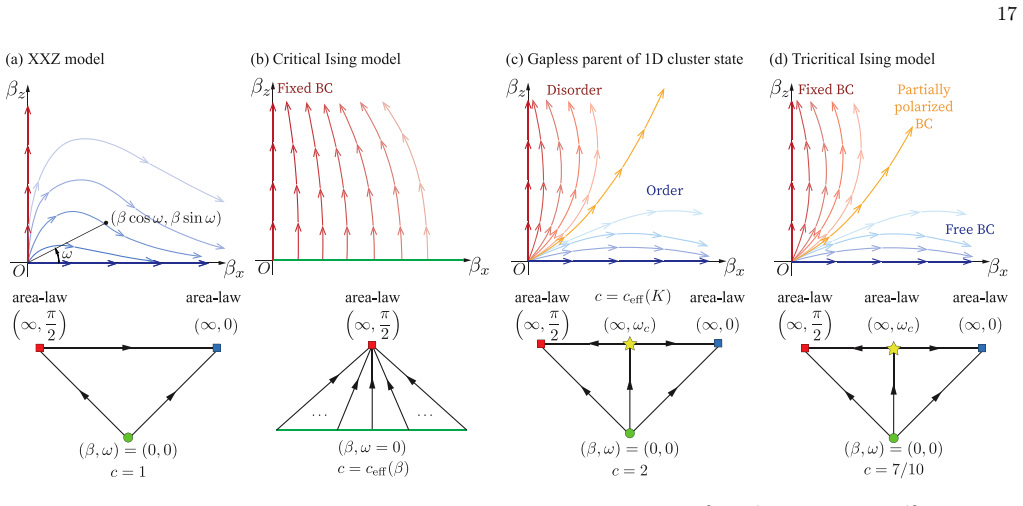
The central object is the gapless parent of the cluster state: the reflection-symmetric completion of the $ZXZ$ commuting-projector Hamiltonian, which under a Kennedy-Tasaki duality maps to two decoupled $XXZ$ chains, i.e., a two-channel Luttinger liquid with Luttinger parameter $K$. The mechanism is the measurement-induced boundary perturbation: a post-selected weak measurement of $X$ operators appears as $\delta S_{\mathrm{meas}}\propto \beta\int dx\,\delta(\tau)\cos\theta\cos\tilde{\theta}$, which in symmetric and antisymmetric field combinations becomes $\cos\theta_+ + \cos\theta_-$, each relevant for $K>1/2$ and driving renormalization-group flow to Dirichlet or Neumann boundary conditions in the boundary conformal field theory. The tilt angle $\omega$ weights the two cosines; at $\omega_c=\pi/4$ the coefficient of $\cos\theta_+$ vanishes, leaving a $c=1$ intermediate fixed point. For the tricritical Ising and three-state Potts models, the same logic operates through the boundary-condition spectrum and boundary RG flows between free, fixed, and mixed boundary conditions.
What would settle it
In the $\mathbb{Z}_2$-preserving protocol with $K=1.5$, the derivative $\frac{d}{d\omega}\langle Z_{L/4,2}Z_{3L/4,2}\rangle$ should develop a peak at $\omega_c=\pi/4$ that sharpens with system size $L$; a numerical scan that shows no sharpening, or long-range order persisting for all $\omega$, would rule out the transition. Equivalently, at $\omega=\pi/4$ the half-chain entanglement should fit $S=\frac{c_{\mathrm{eff}}}{3}\ln[(L/\pi)\sin(\pi l/L)]$ with $c_{\mathrm{eff}}\approx 1$, so a clear area-law fit would falsify the $c=1$ intermediate fixed point.
Extended reading notes
Core claim
The central discovery is that the post-measurement state of a gapless quantum system can realize several stable boundary fixed points, and a single parameter, the tilt angle of the measurement basis, moves the system between them. For the gapless parent state, X-basis measurements in the uniform post-selection sector produce long-range Z order with area-law entanglement, coexisting with power-law X and string correlations; Z-basis measurements yield the dual correlations. Tilting between X and Z exposes an intermediate fixed point at a critical angle, $\omega_c=\pi/4$ for the $\mathbb{Z}_2$-preserving protocol, described by a $c=1$ boson boundary conformal field theory with logarithmic entanglement, separating the two stable regimes. The same measurement-induced boundary transition appears when outcomes are averaged non-linearly through a replica construction, and the phenomenon extends to tricritical Ising and three-state Potts critical points, where tilted measurements flow between free and fixed boundary conditions through unstable mixed boundary conditions.
Load-bearing premise
The load-bearing premise is that a post-selected weak measurement on the lattice is faithfully captured by a relevant boundary perturbation in the field theory, so that the renormalization-group flow to a boundary conformal field theory fixed point determines all universal correlations of the post-measurement state.
Editorial extensions
If this is right
- Weak measurements with any nonzero strength generate the long-range order in the gapless parent, because the boundary perturbation is relevant for $K>1/2$, in contrast to the gapped cluster state where only strict projective $X$ measurement works.
- A decoding protocol that averages over all measurement outcomes with a sign structure yields power-law $ZZ$ correlations with exponent $1/(2K)$, distinct from the pre-measurement exponent $1/2$ whenever $K\neq 1$.
- The $\mathbb{Z}_2$-preserving tilted measurement has a transition at $\omega_c=\pi/4$ with effective central charge $c_{\mathrm{eff}}\approx 1$; the $\mathbb{Z}_2$-breaking tilted measurement also has a transition, at $\omega_c\approx 0.22\pi$ for $K=1.5$, with $c_{\mathrm{eff}}$ depending on $K$.
- Non-linear, Born-squared averages over measurement outcomes show the same transition, so the phenomenon is not an artifact of rare post-selected trajectories.
- Tricritical Ising and three-state Potts critical chains exhibit measurement-induced boundary transitions between free and fixed or mixed boundary conditions, supporting a general criterion: at least two stable boundary fixed points with an unstable fixed point between them.
Reading between the lines
- The sharp contrast with the gapped cluster state suggests that gaplessness is the essential resource: a continuum of low-energy boundary operators supplies the competing relevant perturbations that a single tilt angle can tune between.
- The $K$-dependent effective central charge at the $\mathbb{Z}_2$-breaking intermediate fixed point, which the paper leaves open, may indicate a line of boundary fixed points rather than an isolated transition.
- The criterion that measurement operators with scaling dimension below $1/2$ can drive typical-outcome transitions points to concrete experimental targets, such as Rydberg-atom realizations of tricritical Ising physics, where post-selection-free versions of these transitions could be sought.
- The same boundary-perturbation logic should apply to any gapless state whose low-energy theory supports two competing relevant operators with a symmetry forcing their coefficients to swap as the measurement basis rotates.
Editorial analysis
A structured set of objections, weighed in public.
Referee Report
Summary. The paper studies the effect of a single round of weak or projective measurements on a gapless parent of the one-dimensional cluster state. The parent is a reflection-symmetric ZXZ ladder that maps via a Kennedy-Tasaki transformation to two decoupled XXZ chains, and the authors use this mapping together with boundary conformal field theory (BCFT) to describe post-selected uniform-outcome measurements as relevant boundary perturbations. They report three main results: (i) X-basis measurements generate long-range Z order coexisting with power-law correlations and area-law entanglement, with a decoding protocol that reveals modified power laws without post-selection; (ii) tilting the measurement basis in the XZ plane produces a measurement-induced boundary transition, exact at omega_c = pi/4 for a Z2-preserving protocol and numerically at omega_c ~ 0.22 pi for a Z2-breaking protocol at K = 1.5, with a continuously K-dependent effective central charge at the latter transition; and (iii) analogous transitions occur in the tricritical Ising and three-state Potts chains. The claims are supported by BCFT calculations and extensive DMRG/iDMRG simulations.
Significance. If the results hold, the paper establishes a general and conceptually clean mechanism by which a single round of measurements on a gapless state can induce boundary renormalization-group flows between multiple stable BCFT fixed points, producing transitions that are absent in the gapped cluster-state descendant. The construction of the gapless parent and the duality argument are elegant, and the Z2-preserving critical angle omega_c = pi/4 is obtained without any fitting. The correlation exponents in Eqs. (28), (29), (35), (36), (41) and in Tables III and IV are derived from BCFT and then checked numerically, rather than extracted from the target data. The extension to minimal models uses established Cardy-state data and yields concrete power-law predictions with numerical support. The main caveat is that the Z2-breaking intermediate fixed point is characterized mostly numerically and its K-dependent effective central charge is left unexplained; the authors acknowledge this limitation in the main text.
minor comments (5)
- [Sec. VIB, Tables III and IV] The stability of the omega = 0 and omega = pi/2 fixed points for K > 1 is established by checking a finite set of symmetry-allowed operators. Because the existence of the Z2-breaking transition relies on both endpoints being stable, please add a brief argument clarifying whether the listed operators are expected to exhaust the leading relevant boundary perturbations, or alternatively rephrase the text so that the stability statement is presented as numerical evidence rather than an exhaustive classification. The DMRG data at K = 1.5 and the duality-protected Z2-preserving transition mitigate the risk, so in my reading this is not a blocker.
- [Sec. VIB and Fig. 8(c)] The continuous K-dependence of the effective central charge at the Z2-breaking intermediate fixed point is explicitly left as an open question. Since this is the only quantitative property of that fixed point, please state clearly that ceff is an effective fitting parameter and has not yet been shown to be a true conformal central charge, and comment on what is expected as K approaches 1, where Z_{j,1} becomes marginal at the omega = 0 endpoint.
- [Sec. IVA] The beta << 1 relation tau* ~ beta^{4K/(1-4K)} is obtained by dimensional analysis, while only the beta >> 1 limit is directly matched to the perturbative calculation in Appendix B. Since tau* sets a crossover scale rather than the asymptotic power-law exponents, the central BCFT predictions are unaffected, but the scaling argument could be stated more explicitly to avoid the impression that the beta-dependence at intermediate strength is derived rather than inferred.
- [Sec. VIIB, Eq. (60)] The three-state Potts measurement operator is introduced without explaining why the (V + V^dagger) factors are inserted and how the symmetry of the operator changes with omega. A short derivation of the defect-line action and an explicit mapping of the omega intervals to the A, B, C and mixed boundary conditions would make this section much easier to follow.
- [Appendix F and miscellaneous text] There are a few typographical issues: 'represeatation' in the first sentence of Appendix F, 'obtained obtain' in the text near Fig. 8(c), and the subscript 'uni' first appears in figures before it is defined in the main text. These are minor and should be corrected in a final proofread.
Circularity Check
No significant circularity: the central exponents and transitions are derived from external BCFT input and bosonization, then independently benchmarked with DMRG.
full rationale
The paper's derivation chain is self-contained in the relevant sense. The post-selected weak measurement is converted into a boundary perturbation (Eqs. 16, 23, 44) by standard bosonization of the gapless-parent operators, and the universal correlation exponents (e.g., min(4,4K), 1/(2K), 2K, and the minimal-model exponents 3, 4, 4/3, 4/5) are read off from known boundary CFT spectra (Cardy states; Refs. 32, 56, 57, 63) or from the derived boundary action, not fitted to the post-measurement data. The DMRG/iDMRG simulations serve as an independent benchmark: they simulate the microscopic post-measurement wavefunction and reproduce the predicted exponents (Figs. 3, 16, 17, 23, 28, 29). The one analytically unprotected critical angle (omega_c ~ 0.22pi in the Z2-breaking protocol) and the K-dependent effective central charge are explicitly presented as numerical extractions, with the paper flagging the ceff(K) dependence as an open question, so they are not fitted values renamed as predictions. The omega_c = pi/4 transition in the Z2-preserving protocol follows from an exact duality and the vanishing of a coupling in Eq. (45), not from a fit. The main physical input, that a relevant tau=0 perturbation flows to the assumed BCFT fixed point, is a hypothesis rather than a tautology; its validity is supported by the independent DMRG agreement, and the paper candidly notes where support is incomplete (e.g., the ceff(K) puzzle and the partial operator census). Self-citations (Refs. 12, 13, 49, 55) are contextual or methodological and are not used to force the central results; the load-bearing BCFT data are external.
Assumptions & free parameters
free parameters (2)
- Critical tilt angle omega_c for the Z2-breaking measurement basis =
approx 0.22 pi for K = 1.5
- Effective central charge ceff of the Z2-breaking intermediate fixed point =
varies with K, e.g., approx 0.52 for K = 1.5
assumptions (4)
- standard math The Kennedy-Tasaki duality exactly maps the gapless parent Hamiltonian to two decoupled XXZ chains.
- domain assumption The bosonization dictionary and the Luttinger liquid action for the XXZ chain are valid in the low-energy limit.
- domain assumption A post-selected weak measurement with uniform outcome is equivalent to a relevant boundary perturbation in the CFT, whose RG flow to a BCFT fixed point determines the universal properties.
- domain assumption The perturbative expansion in u = exp(-2 beta) around the projective limit is valid when the strange correlator exponent eta > 1.
Cite this review
Pith. "Pith review of Boundary transitions from a single round of measurements on gapless quantum states." pith.science (2026). https://pith.science/paper/UWCZUDVX
@misc{pith2026241207830,
  author       = {Pith},
  title        = {Pith review of: Boundary transitions from a single round of measurements on gapless quantum states},
  year         = {2026},
  howpublished = {\url{https://pith.science/paper/UWCZUDVX}},
  note         = {Machine review of arXiv:2412.07830}
}
read the original abstract
Measurements can qualitatively alter correlations and entanglement emerging in gapless quantum matter. We show how a single round of measurements on gapless quantum systems can, upon rotating the measurement basis, induce non-trivial transitions separating regimes displaying universal characteristics governed by distinct boundary conformal field theories. We develop the theory of such `measurement-induced boundary transitions' by investigating a gapless parent of the one-dimensional cluster state, obtained by appropriately symmetrizing a commuting projector Hamiltonian for the latter. Projective measurements on the cluster state are known to convert the wavefunction, after post-selection or decoding, into a long-range-ordered Greenberger-Horne-Zeilinger (GHZ) state. Similar measurements applied to the gapless parent (i) generate long-range order coexisting with power-law correlations when post-selecting for uniform outcomes, and (ii) yield power-law correlations distinct from those in the pre-measurement state upon decoding. In the post-selection scenario, rotating the measurement basis preserves long-range order up until a critical tilt angle marking a measurement-induced boundary transition to a power-law-ordered regime. Such a transition -- which does not exist in the descendant cluster state -- establishes new connections between measurement effects on many-body states and non-trivial renormalization-group flows. We extend our analysis to tricritical Ising and three-state Potts critical theories, which also display measurement-induced boundary transitions, and propose general criteria for their existence in other settings.
Figures


Figures from the paper (26 more)




Forward citations
Cited by 1 Pith paper
-
Practical roadmap to measurement-altered criticality in Rydberg arrays
Projective measurements on a periodic subset of Rydberg atoms can controllably alter Ising and tricritical Ising critical correlations, with the most useful outcome occurring in about 10% of runs for 100-site chains.
Reference graph
Works this paper leans on
-
[1]
Y. Li, X. Chen, and M. P. A. Fisher, Phys. Rev. B98, 205136 (2018)
2018
-
[2]
Skinner, J
B. Skinner, J. Ruhman, and A. Nahum, Phys. Rev. X9, 031009 (2019)
2019
-
[3]
M. P. A. Fisher, V. Khemani, A. Nahum, and S. Vijay, Annu. Rev. Condens. Matter Phys. , 335 (2023)
work page 2023
-
[4]
Raussendorf and H
R. Raussendorf and H. J. Briegel, Phys. Rev. Lett.86, 5188 (2001)
2001
-
[5]
J. Y. Lee, W. Ji, Z. Bi, and M. P. A. Fisher, arXiv 10.48550/arXiv.2208.11699 (2022)
-
[6]
S. J. Garratt, Z. Weinstein, and E. Altman, Phys. Rev. X 13, 021026 (2023)
2023
-
[7]
X. Sun, H. Yao, and S.-K. Jian, New critical states in- duced by measurement (2023), arXiv:2301.11337 [quant- ph]
arXiv 2023
-
[8]
Ashida, S
Y. Ashida, S. Furukawa, and M. Oshikawa, Phys. Rev. B 110, 094404 (2024)
2024
Show all 72 references
-
[9]
Tang and X
Q. Tang and X. Wen, A critical state under weak mea- surement is not critical (2024)
2024
-
[10]
Z. Yang, D. Mao, and C.-M. Jian, Phys. Rev. B108, 165120 (2023)
2023
-
[11]
Weinstein, R
Z. Weinstein, R. Sajith, E. Altman, and S. J. Garratt, Phys. Rev. B107, 245132 (2023)
2023
-
[12]
Murciano, P
S. Murciano, P. Sala, Y. Liu, R. S. K. Mong, and J. Al- icea, Phys. Rev. X13, 041042 (2023)
2023
-
[13]
P. Sala, S. Murciano, Y. Liu, and J. Alicea, PRX Quan- tum 5, 030307 (2024)
2024
-
[14]
Paviglianiti, X
A. Paviglianiti, X. Turkeshi, M. Schirò, and A. Silva, arXiv (2023), arXiv:2310.02686 [quant-ph]
2023 arXiv
-
[15]
R. A. Patil and A. W. W. Ludwig, arXiv (2024), arXiv:2409.02107 [cond-mat.stat-mech]
2024 arXiv
-
[17]
Y. Zou, S. Sang, and T. H. Hsieh, Phys. Rev. Lett.130, 250403 (2023)
2023
-
[18]
J. Y. Lee, C.-M. Jian, and C. Xu, PRX Quantum 4, 030317 (2023)
2023
-
[19]
Ma, arXiv (2023), arXiv:2304.08277 [quant-ph]
R. Ma, arXiv (2023), arXiv:2304.08277 [quant-ph]
2023 arXiv
-
[20]
S. J. Garratt and E. Altman, PRX Quantum5, 030311 (2024)
2024
-
[21]
McGinley, PRX Quantum5, 020347 (2024)
M. McGinley, PRX Quantum5, 020347 (2024)
2024
-
[22]
McGinley and M
M. McGinley and M. Fava, Phys. Rev. Lett.131, 160601 (2023)
2023
-
[23]
Rossini and E
D. Rossini and E. Vicari, Phys. Rev. B 102, 035119 (2020)
2020
-
[24]
T.-C. Lu, L. A. Lessa, I. H. Kim, and T. H. Hsieh, PRX Quantum 3, 040337 (2022)
2022
-
[25]
A. Chan, R. M. Nandkishore, M. Pretko, and G. Smith, Phys. Rev. B99, 224307 (2019)
2019
-
[26]
X. Cao, A. Tilloy, and A. D. Luca, SciPost Phys.7, 024 (2019)
2019
-
[27]
Y. Li, X. Chen, A. W. W. Ludwig, and M. P. A. Fisher, Phys. Rev. B104, 104305 (2021)
2021
-
[28]
A. J. Friedman, C. Yin, Y. Hong, and A. Lucas, arXiv (2022), arXiv:2206.09929 [quantum-ph]
2022 arXiv
-
[29]
C.-J. Lin, W. Ye, Y. Zou, S. Sang, and T. H. Hsieh, Quantum 7, 910 (2023)
2023
-
[30]
M. A. Rajabpour, J. Stat. Mech.2016, 063109 (2016)
2016
-
[31]
M. A. Rajabpour, Phys. Rev. B92, 075108 (2015)
2015
-
[32]
J. L. Cardy, Nuclear Physics B240, 514 (1984)
1984
-
[33]
Qian and J
D. Qian and J. Wang, Phys. Rev. B109, 024301 (2024)
2024
-
[34]
S. Sang, Z. Li, T. H. Hsieh, and B. Yoshida, PRX Quan- tum 4, 040332 (2023)
2023
-
[35]
X. Feng, B. Skinner, and A. Nahum, PRX Quantum4, 030333 (2023)
2023
-
[36]
Y. Bao, S. Choi, and E. Altman, Phys. Rev. B 101, 104301 (2020)
2020
-
[37]
Zabalo, M
A. Zabalo, M. J. Gullans, J. H. Wilson, S. Gopalakrish- nan, D. A. Huse, and J. H. Pixley, Phys. Rev. B101, 060301 (2020)
2020
-
[38]
C.-M.Jian, Y.-Z.You, R.Vasseur,andA.W.W.Ludwig, Phys. Rev. B101, 104302 (2020)
2020
-
[39]
17, 342 (2021), arXiv:2004.07243 [quant-ph]
A.Lavasani, Y.Alavirad,andM.Barkeshli,NaturePhys. 17, 342 (2021), arXiv:2004.07243 [quant-ph]
2021 arXiv
-
[40]
Sierant and X
P. Sierant and X. Turkeshi, Phys. Rev. Lett.130, 120402 (2023)
2023
-
[41]
Turkeshi, R
X. Turkeshi, R. Fazio, and M. Dalmonte, Phys. Rev. B 102, 014315 (2020)
2020
-
[42]
Kennedy and H
T. Kennedy and H. Tasaki, Commun. Math. Phys.147, 431 (1992)
1992
-
[43]
Kennedy and H
T. Kennedy and H. Tasaki, Phys. Rev. B45, 304 (1992)
1992
-
[44]
L. Li, M. Oshikawa, and Y. Zheng, Phys. Rev. B108, 214429 (2023)
2023
-
[45]
L. Li, M. Oshikawa, and Y. Zheng, arXiv (2023), arXiv:2307.04788 [cond-mat.str-el]
2023 arXiv
-
[46]
S. R. White, Phys. Rev. Lett.69, 2863 (1992)
1992
-
[47]
T.-C. Lu, Z. Zhang, S. Vijay, and T. H. Hsieh, PRX Quantum 4, 030318 (2023)
2023
-
[48]
Verresen, R
R. Verresen, R. Moessner, and F. Pollmann, Phys. Rev. B 96, 165124 (2017)
2017
-
[49]
Y. Liu, N. Tantivasadakarn, K. Slagle, D. F. Mross, and J. Alicea, Phys. Rev. B108, 184406 (2023)
2023
-
[50]
Giamarchi,Quantum Physics in One Dimension (Ox- ford University Press, 2003)
T. Giamarchi,Quantum Physics in One Dimension (Ox- ford University Press, 2003)
2003
-
[51]
C. L. Kane and M. P. A. Fisher, Phys. Rev. B46, 15233 (1992)
1992
-
[52]
Fendley, K
P. Fendley, K. Sengupta, and S. Sachdev, Phys. Rev. B 69, 075106 (2004)
2004
-
[53]
Slagle, D
K. Slagle, D. Aasen, H. Pichler, R. S. K. Mong, P. Fend- ley, X. Chen, M. Endres, and J. Alicea, Phys. Rev. B 104, 235109 (2021)
2021
-
[54]
O’Brien and P
E. O’Brien and P. Fendley, Phys. Rev. Lett.120, 206403 (2018)
2018
-
[55]
S. Naus, Y. Liu, S. Murciano, P. Sala, M. Endres, and J. Alicea, (in preparation)
-
[56]
J. L. Cardy, Nucl. Phys. B324, 581 (1989)
1989
-
[57]
Affleck, J
I. Affleck, J. Phys. A: Math. Gen.33, 6473 (2000)
2000
-
[58]
J. L. Cardy, Nuclear Physics B324, 581 (1989)
1989
-
[59]
Saleur and M
H. Saleur and M. Bauer, Nuclear Physics B 320, 591 (1989)
1989
-
[60]
R. S. K. Mong, D. J. Clarke, J. Alicea, N. H. Lindner, and P. Fendley, Journal of Physics A: Mathematical and Theoretical 47, 452001 (2014)
2014
-
[61]
Y.-Z. You, Z. Bi, A. Rasmussen, K. Slagle, and C. Xu, Phys. Rev. Lett.112, 247202 (2014)
2014
-
[62]
Di Francesco, P
P. Di Francesco, P. Mathieu, and D. Senechal,Conformal Field Theory, Graduate Texts in Contemporary Physics (Springer-Verlag, New York, 1997)
1997
-
[63]
Chim, Int
L. Chim, Int. J. Mod. Phys. A11, 4491 (1996). 19 Appendix A: More properties of the canonical cluster state SPT
1996
-
[64]
II we primarily reviewed properties of theZ2 × Z2 cluster state SPT by specializing to the zero-correlation limit
Measurement on generic Z2 × Z2 SPTs In Sec. II we primarily reviewed properties of theZ2 × Z2 cluster state SPT by specializing to the zero-correlation limit. There we recalled how projective measurement ofXj,1 for all j in the upper chain yields long-range ordered correlation...
-
[65]
Weak measurements in a tilted basis For the remainder of this Appendix we return to the zero-correlation-length SPT ground state,|ψ0⟩, defined with periodic boundary conditions. Suppose now that weweakly measure the ‘tilted’ operatorcos ωXj,1 + sinωZj,1 for all sites j in the ...
-
[66]
Under the parity transformationτ → −τ, in the presence of DBC, theθ field transforms as θ(z, ¯z) → −θ(¯z, z)
= 0. Under the parity transformationτ → −τ, in the presence of DBC, theθ field transforms as θ(z, ¯z) → −θ(¯z, z). (D2) It was shown by Cardy [32] that an n-point function on the UHP satisfies the same differential equation as the (holomorphic) 2n-point function on the entire ...
2000
-
[67]
IVB that we expect⟨Qx j=0 Xj,2⟩uni ∼ x−2K
Power-law exponent of ⟨Qx j=0 Xj,2⟩uni after uniform projective measurement ofXj,1 In the gapless parent of the cluster state, if one performsXj,1 measurement and post-select the uniform outcome Xj,1 = 1, ∀j, it is shown in Sec. IVB that we expect⟨Qx j=0 Xj,2⟩uni ∼ x−2K. We ex...
2000
-
[68]
(E1) Thus we can compute the correlation function from⟨Qk i=j Yi⟩ of a single X X Zchain
Scaling dimension of Zj,1 In the decoupled-X X Z-chain representation, we have Zj,1Zk,1 = Yj+1 · · · Yk Yk+1 ˜Yj ˜Yj+1 · · ·˜Yk , ⟨Zj,1Zk,1⟩ = ⟨ kY i=j Yi⟩ 2 . (E1) Thus we can compute the correlation function from⟨Qk i=j Yi⟩ of a single X X Zchain. Numerically, we use ...
-
[69]
More numerical results on the weakZ2-preserving measurements InSec.VIA,Fig.6showsnumericallythebehavioroftheorderparameterinthelowerchainofthepost-measurement wavefunction as a function of the parameterω in the projective measurement limit. In Fig. 19 we check that for the wea...
-
[70]
Uniform weak measurement of Xj,1 and Xj,2 As another example of Z2-preserving measurements, we consider weak measurement of both Xj,1 and Xj,2 as described in Eq. (47). Since the low-energy theory is still described by Eq. (45), we expect that the results to be similar to thos...
-
[71]
Then we use the duality argument to find the exponents ofeβ P j Zj,1 measurement
Power-law exponents of specific operators In this short section, we compute power-law exponents of several operators in the gapless parent state aftereβ P j Xj,1 measurement. Then we use the duality argument to find the exponents ofeβ P j Zj,1 measurement. For theeβ P j Xj,1 m...
2000
-
[72]
8, we investigate the entanglement scaling at the intermediate fixed point
Details of DMRG simulations for the entanglement entropy at the intermediate fixed point In Fig. 8, we investigate the entanglement scaling at the intermediate fixed point. The numerical data are ob- tained using finite-size DMRG with open boundary conditions and bond dimensio...
-
[73]
+” and “−
Replica model with different values ofK Since it is difficult to study analytically the replica model of Section VIC, we add more numerical results for the tilted measurement basis with different values ofK. In Fig. 25 we plot the order parameter ,⟨⟨Z L 4 ,2Z 3L 4 ,2⟩⟩, and di...
Reviewed August 11, 2026 · model on record in the stance chip above.
Discussion (0). Continue with ORCID to comment.