REVIEW 4 major objections 6 minor 48 references
FedBKD: Distilled Federated Learning to Embrace Gerneralization and Personalization on Non-IID Data
T0 review · 4 major / 6 minor · reviewed 2026-08-06 · deepseek-v4-flash
Pith's one-line read FedBKD uses a data-free generative network and two-way distillation to give federated models both personalization and generalization without public data.
desk verdict FedBKD's bidirectional distillation idea is worth a look, but the printed Algorithm 1 reverses the two directions and the SOTA claim is not supported by the paper's own table. read the letter →
The pith
A machine-rendered reading of the paper's core claim, the machinery that carries it, and where it could break.
The reading
What carries the argument
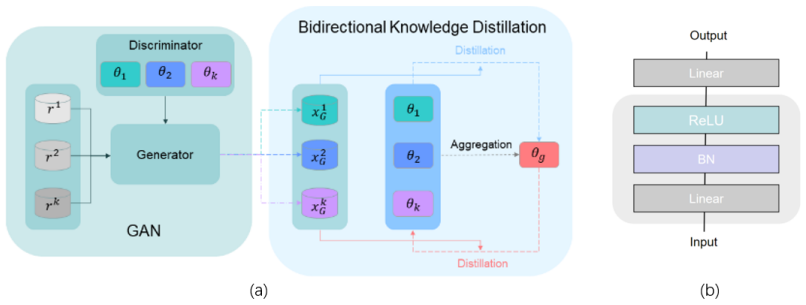
The load-bearing mechanism is the pairing of a data-free generator with bidirectional representation-layer distillation. The generator is an unconditioned generative adversarial network whose discriminators are the frozen local classifier models; it is trained to produce feature maps whose predicted class distribution is close to one-hot, a maximum-response objective, while a mode-seeking regularizer encourages diversity. These synthetic feature maps feed two KL-divergence distillation losses: one that pulls each local representation layer toward the global representation layer, and one that pulls the global representation layer toward each local one. The classification layers are frozen during distillation so that only feature-extraction knowledge is exchanged.
What would settle it
Train FedBKD on a benchmark while replacing the generator's output with random vectors of the same shape; if the resulting accuracies match or beat FedBKD, the data-free generator is not the source of the gains. A distribution-level check: compute a distance, such as maximum mean discrepancy, between generated feature maps and held-out real client feature maps; if the distance is large while FedBKD still improves, the improvement cannot be explained by the claimed distribution matching.
Extended reading notes
Core claim
On the paper's own terms, the central discovery is that global and local models in federated learning can improve each other simultaneously if their representation layers are distilled bidirectionally on synthetic feature data. Clients first train locally with the FedRep strategy, which alternates between freezing representation layers while updating classifiers and freezing classifiers while updating representation layers, and the server averages their parameters. A generative network, trained against the frozen local classifiers with a one-hot maximum-response loss and a diversity regularizer, produces feature maps that mimic real client features without touching client data. Global-to-local distillation sharpens each local model's feature extraction, while local-to-global distillation offsets the parameter drift caused by averaging and gives the global model experience with heterogeneous distributions. The paper reports that this dual distillation outperforms one-way distillation, random synthetic data, and no distillation, and that it reaches its reported state-of-the-art results on all four benchmarks.
Load-bearing premise
The method works only if the synthetic feature maps produced by the generator are close enough to real client feature distributions that distilling on them teaches both models useful knowledge.
Editorial extensions
If this is right
- A global model trained by FedBKD can serve as a strong starting template for a new client after a few rounds of local fine-tuning, because it has been distilled against models specialized to different local distributions.
- Federated systems can avoid the strong assumption that clients contribute samples to a public dataset, since the distillation signal comes from synthesized features rather than real client data.
- Personalized local models gain feature-extraction knowledge from the global model while still keeping their own classifiers, so they can be customized per client.
- The framework currently targets non-IID classification; extending it to other tasks would require a generator that can synthesize useful feature-level data for those tasks.
Reading between the lines
- A natural next test is whether the same dual-distillation scheme helps when clients run different network architectures; the paper's representation-layer distillation assumes the global and local layers are compatible.
- The privacy argument is only as strong as the generator: if the generator memorizes and emits near-duplicates of client features, the data-free claim would not guarantee privacy, so a test of feature-level membership inference would be a useful follow-up.
- Because the ablation shows one-way distillation helps less than two-way, the framework implies that each direction corrects a distinct failure mode; one could test this directly by measuring representation-layer drift under each direction separately.
Editorial analysis
A structured set of objections, weighed in public.
Referee Report
Summary. The paper proposes FedBKD, a federated learning framework for non-IID classification that trains a data-free GAN generator against frozen local client models, then uses the generated synthetic feature data for bidirectional knowledge distillation between the global model and local models. The authors claim that this bidirectional distillation improves both personalization (local model accuracy on client data) and generalization (performance of a fine-tuned global model on a new client), without requiring public data. Experiments are reported on CIFAR-10, CIFAR-100, FEMNIST, and Sent140 under various non-IID settings, with ablation studies comparing against random synthetic data and one-way distillation variants. The abstract states that FedBKD achieves state-of-the-art performance in every case.
Significance. If the claims are confirmed, the work would make a useful empirical contribution: it targets both personalization and generalization in a single data-free framework, releases code, and includes ablations that attribute gains to the generator and to the two distillation directions. The idea of using local models as frozen discriminators to synthesize feature-level data for distillation is plausible and worth investigating. However, the current manuscript contains a load-bearing inconsistency between the textual specification of the distillation directions and the pseudocode, an underspecified per-client synthetic data procedure, and a SOTA claim that is contradicted by the paper's own Table 1. These issues prevent the reader from attributing the reported numbers to a well-defined algorithm.
major comments (4)
- [Section 3.3, Algorithm 1, Eqs. (14)-(17)] The text and the pseudocode specify opposite distillation directions. The text states that global-to-local distillation updates each local client (Eq. 15) and that local-to-global distillation updates the global model (Eq. 17). However, Algorithm 1 line 10 assigns the result of `global→local(θ_g^t, x_st^g, θ_st^t)` to the global parameter θ'^t_g, while line 12 assigns the result of `local→global(θ_i^t, x_i^G, θ_g^t)` to the local parameter θ'^t_i. The equation labels compound the confusion: Eq. (14) names L_{i→g} as global-to-local and Eq. (16) names L_{g→i} as local-to-global, opposite to the arrow convention. Because the central novelty is the direction and target of the two distillations, a reader cannot tell which variant was executed. Please correct the pseudocode and the notation so that the reported results correspond to a single, unambiguous algorithm.
- [Section 3.3, Eqs. (14) and (16)] The distillation losses in Eqs. (14) and (16) are evaluated on per-client synthetic data x_i^G, but no per-client synthetic data generation procedure is defined. Section 3.2 and Algorithm 1 line 8 only describe a single generator output x_g^t obtained from the sampled clients' models. If the same shared synthetic set is used for every client, the notation should be changed and the text should say so; if each client has its own synthetic data, the training procedure, its privacy properties, and its relation to the shared generator must be specified. As written, the losses are underspecified.
- [Table 1, upper block (personalization results)] The abstract claims that FedBKD 'achieves SOTA performances in every case,' but Table 1 contradicts this on the CIFAR-10 (100,2) personalization column: FedBKD reports 88.0, while FedGen reports 89.88 and the non-federated Local baseline reports 89.79. In addition, no error bars, standard deviations, or repeated-run statistics are reported anywhere in the paper, so even the margins in the remaining columns cannot be assessed for significance. Please temper the SOTA claim to match the table and add statistical support (multiple seeds with variance, or at least a clear statement of the experimental protocol for the reported single numbers).
- [Section 4.6, Fig. 2] The load-bearing assumption of the data-free generator is that the synthesized feature data are similar enough to real client feature distributions that distillation on them transfers useful knowledge. The evidence provided for this is indirect: Fig. 2 compares L1 distances between output logits of the global model on synthetic versus real data, which is not a direct measure of feature-distribution fidelity, and the comparison is qualitative. A quantitative distributional metric (e.g., Fréchet distance on features, per-client fidelity statistics, or a classification-based proxy) would materially strengthen the claim that the generator produces client-alike data rather than merely high-confidence samples.
minor comments (6)
- [Title] The title contains a typo: 'Gerneralization' should be 'Generalization'.
- [References] Several references are duplicated with different numbers (e.g., [12] and [13] are the same FedRep paper; [36] and [37] are the same FedAvg paper), and some citations in the text do not match the reference numbering. Please unify the bibliography.
- [Algorithm 1] The notation in Algorithm 1 is inconsistent: line 8 defines x_t_g, while line 10 uses x_st^g. Please define all symbols used in the pseudocode.
- [Section 3.3, sentence after Eq. (13)] The sentence 'As for feature data generation, we use the models of sampled clients are used as discriminators in GAN networks' contains a grammatical error and should be rewritten.
- [Eq. (9)] The notation in Eq. (9) is unclear: the subscript j in θ_j and r_i^j is not defined, and the index structure of the sum is hard to follow. Please clarify the meaning of j and the relationship between the generator samples and the client discriminators.
- [Section 3.2, Eq. (8)] The diversity regularization term L_ms in Eq. (7) is written with a maximum over G inside the loss, but the subsequent optimization in Eq. (9) writes argmin over G. Please make the optimization formalism consistent.
Circularity Check
No significant circularity: FedBKD's results are empirical and supported by external ablations.
full rationale
FedBKD is an empirical federated learning method whose central derivation is a training procedure, not a mathematical claim derived from an assumed conclusion. The generator loss (Eq. 8, L_G = L_oh + λ L_ms) optimizes one-hot confidence and diversity -- not downstream accuracy. The distillation losses (Eqs. 14 and 16) minimize KL divergence between representation layers on synthetic features, again not the reported accuracy. The SOTA claim in the abstract and Table 1 is an experimental outcome, not an equation-level consequence of the method. Ablations in Table 2 provide external controls: random synthetic data, no distillation, and one-way distillation all perform worse, so the reported gains are attributable to the proposed generator and bidirectional distillation rather than to the evaluation metric. Hyperparameters are selected via optimization [3] and sensitivity experiments (GAN epochs, distillation order), which is parameter tuning, not circular fitting. References [7], [13], and [35] are external prior works, not self-citations, and none is used to forbid alternative designs or to import an unverified uniqueness theorem. The inconsistency between Algorithm 1's variable assignments and Section 3.3's distillation direction labels (lines 10 and 12 vs. Eqs. 14-17) is an algorithmic correctness/reproducibility concern, not circularity: even if the printed algorithm is wrong, no equation reduces to its own input. No circular step is present.
Assumptions & free parameters
free parameters (3)
- lambda (diversity regularization weight) =
not reported
- GAN training epochs =
6 (best on CIFAR-10 s=2)
- distillation epochs =
4 (global-to-local), 1 (local-to-global)
assumptions (4)
- domain assumption Local models with frozen parameters can serve as valid discriminators for generating client-alike feature data without access to real data.
- domain assumption Feature maps synthesized by the generator are distributed similarly enough to real client feature maps that distillation on them transfers useful knowledge.
- domain assumption KL divergence between representation-layer outputs on synthetic data is a valid distillation objective.
- domain assumption Representation and classification layers can be optimized and distilled independently (FedRep assumption).
Cite this review
Pith. "Pith review of FedBKD: Distilled Federated Learning to Embrace Gerneralization and Personalization on Non-IID Data." pith.science (2026). https://pith.science/paper/UWHEJF6K
@misc{pith2026250620245,
  author       = {Pith},
  title        = {Pith review of: FedBKD: Distilled Federated Learning to Embrace Gerneralization and Personalization on Non-IID Data},
  year         = {2026},
  howpublished = {\url{https://pith.science/paper/UWHEJF6K}},
  note         = {Machine review of arXiv:2506.20245}
}
read the original abstract
Federated learning (FL) is a decentralized collaborative machine learning (ML) technique. It provides a solution to the issues of isolated data islands and data privacy leakage in industrial ML practices. One major challenge in FL is handling the non-identical and independent distributed (non-IID) data. Current solutions either focus on constructing an all-powerful global model, or customizing personalized local models. Few of them can provide both a well-generalized global model and well-performed local models at the same time. Additionally, many FL solutions to the non-IID problem are benefited from introducing public datasets. However, this will also increase the risk of data leakage. To tackle the problems, we propose a novel data-free distillation framework, Federated Bidirectional Knowledge Distillation (FedBKD). Specifically, we train Generative Adversarial Networks (GAN) for synthetic data. During the GAN training, local models serve as discriminators and their parameters are frozen. The synthetic data is then used for bidirectional distillation between global and local models to achieve knowledge interactions so that performances for both sides are improved. We conduct extensive experiments on 4 benchmarks under different non-IID settings. The results show that FedBKD achieves SOTA performances in every case.
Figures


Figures from the paper (2 more)


Reference graph
Works this paper leans on
-
[1]
Federated learning with personalization layers.arXiv preprint arXiv:1912.00818,
Manoj Ghuhan Arivazhagan, Vinay Aggarwal, Aaditya Ku- mar Singh, and Sunav Choudhary. Federated learning with personalization layers.arXiv preprint arXiv:1912.00818,
arXiv 1912
-
[2]
Federated learning with personalization layers.arXiv: Learning, 2019
Manoj Ghuhan Arivazhagan, Vinay Aggarwal, Aaditya Ku- mar Singh, and Sunav Choudhary. Federated learning with personalization layers.arXiv: Learning, 2019. 5
work page 2019
-
[3]
James Bergstra, R ´emi Bardenet, Yoshua Bengio, and Bal´azs K´egl. Algorithms for hyper-parameter optimization.Ad- vances in neural information processing systems, 24, 2011. 5
work page 2011
-
[4]
Christopher Briggs, Zhong Fan, and Peter Andras. Federated learning with hierarchical clustering of local updates to im- prove training on non-iid data. In2020 International Joint Conference on Neural Networks (IJCNN), pages 1–9. IEEE,
-
[5]
Leaf: A benchmark for federated set- tings.arXiv preprint arXiv:1812.01097, 2018
Sebastian Caldas, Sai Meher Karthik Duddu, Peter Wu, Tian Li, Jakub Kone ˇcn´y, H Brendan McMahan, Virginia Smith, and Ameet Talwalkar. Leaf: A benchmark for federated set- tings.arXiv preprint arXiv:1812.01097, 2018. 5
arXiv 2018
-
[6]
Personalized federated learning with graph
Fengwen Chen, Guodong Long, Zonghan Wu, Tianyi Zhou, and Jing Jiang. Personalized federated learning with graph. arXiv preprint arXiv:2203.00829, 2022. 1
arXiv 2022
-
[7]
Data-free learning of student networks
Hanting Chen, Yunhe Wang, Chang Xu, Zhaohui Yang, Chuanjian Liu, Boxin Shi, Chunjing Xu, Chao Xu, and Qi Tian. Data-free learning of student networks. InProceedings of the IEEE/CVF International Conference on Computer Vi- sion, pages 3514–3522, 2019. 2, 3
work page 2019
-
[8]
Fedbe: Making bayesian model ensemble applicable to federated learning
Hong-You Chen and Wei-Lun Chao. Fedbe: Making bayesian model ensemble applicable to federated learning. arXiv preprint arXiv:2009.01974, 2020. 1, 2
arXiv 2009
Show all 48 references
-
[9]
On bridging generic and personalized federated learning.arXiv preprint arXiv:2107.00778, 2021
Hong-You Chen and Wei-Lun Chao. On bridging generic and personalized federated learning.arXiv preprint arXiv:2107.00778, 2021. 1, 5
2021 arXiv
-
[10]
Fedmatch: Federated learning over heteroge- neous question answering data
Jiangui Chen, Ruqing Zhang, Jiafeng Guo, Yixing Fan, and Xueqi Cheng. Fedmatch: Federated learning over heteroge- neous question answering data. InProceedings of the 30th ACM International Conference on Information & Knowledge Management, pages 181–190, 2021. 3
2021
-
[11]
Meta-learning based knowledge extrapolation for knowl- edge graphs in the federated setting.arXiv preprint arXiv:2205.04692, 2022
Mingyang Chen, Wen Zhang, Zhen Yao, Xiangnan Chen, Mengxiao Ding, Fei Huang, and Huajun Chen. Meta-learning based knowledge extrapolation for knowl- edge graphs in the federated setting.arXiv preprint arXiv:2205.04692, 2022. 1
2022 arXiv
-
[12]
Exploiting shared representations for personal- ized federated learning.arXiv: Learning, 2021
Liam Collins, Hamed Hassani, Aryan Mokhtari, and Sanjay Shakkottai. Exploiting shared representations for personal- ized federated learning.arXiv: Learning, 2021. 3, 5
2021
-
[13]
Exploiting shared representations for personal- ized federated learning.arXiv: Learning, 2021
Liam Collins, Hamed Hassani, Aryan Mokhtari, and Sanjay Shakkottai. Exploiting shared representations for personal- ized federated learning.arXiv: Learning, 2021. 4, 5
2021
-
[14]
Adaptive personalized federated learning.arXiv: Learning, 2021
Yuyang Deng, Mohammad Mahdi Kamani, and Mehrdad Mahdavi. Adaptive personalized federated learning.arXiv: Learning, 2021. 5
2021
-
[15]
Dinh, Tung Thanh Vu, Nguyen H
Canh T. Dinh, Tung Thanh Vu, Nguyen H. Tran, Minh N. Dao, and Hongyu Zhang. Fedu: A unified framework for federated multi-task learning with laplacian regularization. arXiv: Learning, 2021. 5
2021
-
[16]
Private semi- supervised federated learning
Chenyou Fan, Junjie Hu, and Jianwei Huang. Private semi- supervised federated learning. 1
-
[17]
One-shot federated learning.arXiv preprint arXiv:1902.11175, 2019
Neel Guha, Ameet Talwalkar, and Virginia Smith. One-shot federated learning.arXiv preprint arXiv:1902.11175, 2019. 1, 2
1902 arXiv
-
[18]
Federated learning of a mixture of global and local models.arXiv: Learning, 2021
Filip Hanzely and Peter Richt ´arik. Federated learning of a mixture of global and local models.arXiv: Learning, 2021. 5
2021
-
[19]
Towards fair federated learning with zero-shot data augmentation
Weituo Hao, Mostafa El-Khamy, Jungwon Lee, Jianyi Zhang, Kevin J Liang, Changyou Chen, and Lawrence Carin Duke. Towards fair federated learning with zero-shot data augmentation. InProceedings of the IEEE/CVF Conference on Computer Vision and Pattern Recognition, pages 3310– 33...
2021
-
[20]
Group knowledge transfer: Federated learning of large cnns at the edge.Advances in Neural Information Processing Sys- tems, 33:14068–14080, 2020
Chaoyang He, Murali Annavaram, and Salman Avestimehr. Group knowledge transfer: Federated learning of large cnns at the edge.Advances in Neural Information Processing Sys- tems, 33:14068–14080, 2020. 1, 2
2020
-
[21]
Personalized cross-silo federated learning on non-iid data
Yutao Huang, Lingyang Chu, Zirui Zhou, Lanjun Wang, Jiangchuan Liu, Jian Pei, and Yong Zhang. Personalized cross-silo federated learning on non-iid data. InNational Conference on Artificial Intelligence, 2021. 1
2021
-
[22]
Personalized cross-silo federated learning on non-iid data
Yutao Huang, Lingyang Chu, Zirui Zhou, Lanjun Wang, Jiangchuan Liu, Jian Pei, and Yong Zhang. Personalized cross-silo federated learning on non-iid data. InNational Conference on Artificial Intelligence, 2021. 3
2021
-
[23]
Learning multiple layers of features from tiny images
Alex Krizhevsky, Geoffrey Hinton, et al. Learning multiple layers of features from tiny images. 2009. 5
2009
-
[24]
Sur- vey of personalization techniques for federated learning
Viraj Kulkarni, Milind Kulkarni, and Aniruddha Pant. Sur- vey of personalization techniques for federated learning. In 2020 Fourth World Conference on Smart Trends in Sys- tems, Security and Sustainability (WorldS4), pages 794–797. IEEE, 2020. 2
2020
-
[25]
Fedmd: Heterogenous federated learning via model distillation.arXiv preprint arXiv:1910.03581, 2019
Daliang Li and Junpu Wang. Fedmd: Heterogenous federated learning via model distillation.arXiv preprint arXiv:1910.03581, 2019. 1, 2
1910 arXiv
-
[26]
Ditto: Fair and robust federated learning through personalization
Tian Li, Shengyuan Hu, Ahmad Beirami, and Virginia Smith. Ditto: Fair and robust federated learning through personalization. InInternational Conference on Machine Learning, 2021. 5
2021
-
[27]
Federated optimiza- tion in heterogeneous networks.Proceedings of Machine learning and systems, 2:429–450, 2020
Tian Li, Anit Kumar Sahu, Manzil Zaheer, Maziar Sanjabi, Ameet Talwalkar, and Virginia Smith. Federated optimiza- tion in heterogeneous networks.Proceedings of Machine learning and systems, 2:429–450, 2020. 2, 5
2020
-
[28]
Feddkd: Federated learning with decentralized knowledge distillation.arXiv preprint arXiv:2205.00706, 2022
Xinjia Li, Boyu Chen, and Wenlian Lu. Feddkd: Federated learning with decentralized knowledge distillation.arXiv preprint arXiv:2205.00706, 2022. 2
2022 arXiv
-
[29]
Think locally, act glob- ally: Federated learning with local and global representa- tions.arXiv: Learning, 2020
Paul Pu Liang, Terrance Liu, Liu Ziyin, Ruslan Salakhutdi- nov, and Louis-Philippe Morency. Think locally, act glob- ally: Federated learning with local and global representa- tions.arXiv: Learning, 2020. 3
2020
-
[30]
Think locally, act glob- ally: Federated learning with local and global representa- tions.arXiv: Learning, 2020
Paul Pu Liang, Terrance Liu, Liu Ziyin, Ruslan Salakhutdi- nov, and Louis-Philippe Morency. Think locally, act glob- ally: Federated learning with local and global representa- tions.arXiv: Learning, 2020. 5
2020
-
[31]
Ensemble distillation for robust model fusion in fed- erated learning.Advances in Neural Information Processing Systems, 33:2351–2363, 2020
Tao Lin, Lingjing Kong, Sebastian U Stich, and Martin Jaggi. Ensemble distillation for robust model fusion in fed- erated learning.Advances in Neural Information Processing Systems, 33:2351–2363, 2020. 1, 2
2020
-
[32]
Federated learning for privacy- preserving open innovation future on digital health
Guodong Long, Tao Shen, Yue Tan, Leah Gerrard, Alli- son Clarke, and Jing Jiang. Federated learning for privacy- preserving open innovation future on digital health. InHu- manity Driven AI, pages 113–133. Springer, 2022. 1
2022
-
[33]
Federated learning for open banking
Guodong Long, Yue Tan, Jing Jiang, and Chengqi Zhang. Federated learning for open banking. InFederated learning, pages 240–254. Springer, 2020. 1
2020
-
[34]
Adapt to adaptation: Learn- ing personalization for cross-silo federated learning.arXiv preprint arXiv:2110.08394, 2021
Jun Luo and Shandong Wu. Adapt to adaptation: Learn- ing personalization for cross-silo federated learning.arXiv preprint arXiv:2110.08394, 2021. 1
2021 arXiv
-
[35]
Mode seeking generative adversarial networks for diverse image synthesis
Qi Mao, Hsin-Ying Lee, Hung-Yu Tseng, Siwei Ma, and Ming-Hsuan Yang. Mode seeking generative adversarial networks for diverse image synthesis. InProceedings of the IEEE/CVF conference on computer vision and pattern recognition, pages 1429–1437, 2019. 2, 4
2019
-
[36]
Brendan McMahan, Eider Moore, Daniel Ramage, Seth Hampson, and Blaise Aguera y Arcas
H. Brendan McMahan, Eider Moore, Daniel Ramage, Seth Hampson, and Blaise Aguera y Arcas. Communication- efficient learning of deep networks from decentralized data. InInternational Conference on Artificial Intelligence and Statistics, 2017. 1, 2
2017
-
[37]
Brendan McMahan, Eider Moore, Daniel Ramage, Seth Hampson, and Blaise Aguera y Arcas
H. Brendan McMahan, Eider Moore, Daniel Ramage, Seth Hampson, and Blaise Aguera y Arcas. Communication- efficient learning of deep networks from decentralized data. InInternational Conference on Artificial Intelligence and Statistics, 2017. 5
2017
-
[38]
Personalized federated learning using hypernetworks.arXiv: Learning, 2021
Aviv Shamsian, Aviv Navon, Ethan Fetaya, and Gal Chechik. Personalized federated learning using hypernetworks.arXiv: Learning, 2021. 2
2021
-
[39]
Fed- erated learning on heterogeneous and long-tailed data via classifier re-training with federated features.arXiv preprint arXiv:2204.13399, 2022
Xinyi Shang, Yang Lu, Gang Huang, and Hanzi Wang. Fed- erated learning on heterogeneous and long-tailed data via classifier re-training with federated features.arXiv preprint arXiv:2204.13399, 2022. 1
2022 arXiv
-
[40]
Fed-ensemble: Improving generalization through model ensembling in federated learning.arXiv preprint arXiv:2107.10663, 2021
Naichen Shi, Fan Lai, Raed Al Kontar, and Mosharaf Chowdhury. Fed-ensemble: Improving generalization through model ensembling in federated learning.arXiv preprint arXiv:2107.10663, 2021. 1, 2
2021 arXiv
-
[41]
Feded: Federated learning via ensemble distillation for medical relation extraction
Dianbo Sui, Yubo Chen, Jun Zhao, Yantao Jia, Yuantao Xie, and Weijian Sun. Feded: Federated learning via ensemble distillation for medical relation extraction. InProceedings of the 2020 conference on empirical methods in natural lan- guage processing (EMNLP), pages 2118–2128, ...
2020
-
[42]
Personalized federated learning with moreau envelopes.Advances in Neu- ral Information Processing Systems, 33:21394–21405, 2020
Canh T Dinh, Nguyen Tran, and Josh Nguyen. Personalized federated learning with moreau envelopes.Advances in Neu- ral Information Processing Systems, 33:21394–21405, 2020. 3
2020
-
[43]
Personalized federated learning with contextualized generalization
Xueyang Tang, Song Guo, and Jingcai Guo. Personalized federated learning with contextualized generalization. In Proceedings of the Thirty-First International Joint Confer- ence on Artificial Intelligence, IJCAI-22, pages 2241–2247,
-
[44]
Personal- ized federated learning by structured and unstructured prun- ing under data heterogeneity.arXiv: Learning, 2021
Saeed Vahidian, Mahdi Morafah, and Bill Lin. Personal- ized federated learning by structured and unstructured prun- ing under data heterogeneity.arXiv: Learning, 2021. 2
2021
-
[45]
Federated learning with matched averaging.arXiv preprint arXiv:2002.06440,
Hongyi Wang, Mikhail Yurochkin, Yuekai Sun, Dimitris Pa- pailiopoulos, and Yasaman Khazaeni. Federated learning with matched averaging.arXiv preprint arXiv:2002.06440,
2002 arXiv
-
[46]
Fedcg: Leverage conditional gan for protecting privacy and maintaining competitive performance in feder- ated learning.arXiv preprint arXiv:2111.08211, 2021
Yuezhou Wu, Yan Kang, Jiahuan Luo, Yuanqin He, and Qiang Yang. Fedcg: Leverage conditional gan for protecting privacy and maintaining competitive performance in feder- ated learning.arXiv preprint arXiv:2111.08211, 2021. 3
2021 arXiv
-
[47]
Bayesian nonparametric federated learning of neural networks
Mikhail Yurochkin, Mayank Agarwal, Soumya Ghosh, Kristjan Greenewald, Nghia Hoang, and Yasaman Khaza- eni. Bayesian nonparametric federated learning of neural networks. InInternational Conference on Machine Learn- ing, pages 7252–7261. PMLR, 2019. 1, 2
2019
-
[48]
Data-free knowledge distillation for heterogeneous federated learning
Zhuangdi Zhu, Junyuan Hong, and Jiayu Zhou. Data-free knowledge distillation for heterogeneous federated learning. InInternational Conference on Machine Learning, pages 12878–12889. PMLR, 2021. 2, 5
2021
Reviewed August 6, 2026 · model on record in the stance chip above.
Discussion (0). Sign in to comment.