REVIEW 3 major objections 4 minor 1 cited by
$S$-wave kaon-nucleon interactions from lattice QCD at the physical point
T0 review · 3 major / 4 minor · reviewed 2026-08-05 · deepseek-v4-flash
Pith's one-line read From a first-principles lattice QCD simulation at physical quark masses, the S-wave kaon–nucleon interaction shows no bound state or resonance, indicating that the Θ+(1540) pentaquark does not appear in this channel.
desk verdict Solid physical-point HAL QCD calculation of S-wave KN: the scattering lengths are credible, but the no-Θ+ conclusion rests on exactly the momentum region the authors themselves flag as untrusted. read the letter →
The pith
A machine-rendered reading of the paper's core claim, the machinery that carries it, and where it could break.
The reading
What carries the argument
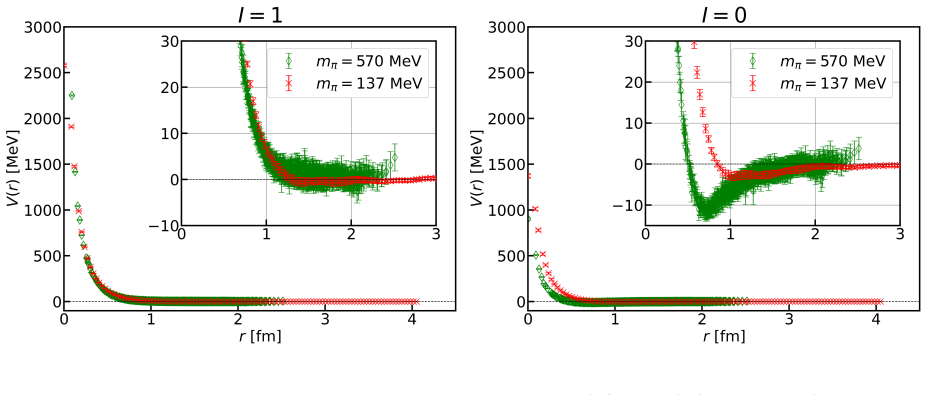
The load-bearing object is the leading-order local potential V_LO(r), obtained from the time-dependent HAL QCD R-correlator—the four-point kaon–nucleon correlation function divided by the kaon and nucleon two-point functions—through Eq. (5), after projecting out the S-wave with the A1+ representation of the cubic group. This single potential encodes the interaction, and once fitted by four-range Gaussian forms (or a three-range Gaussian plus a two-pion-exchange term), it is inserted into the Schrödinger equation to produce phase shifts, scattering lengths, and cross sections. The argument assumes the leading-order derivative expansion, truncated at O(ΔW^3), is adequate; the paper defends thi
What would settle it
A next-to-leading-order analysis of the same HAL QCD R-correlators, or a second ensemble at a different lattice spacing followed by a continuum extrapolation of the phase shifts, would settle it: if the extrapolated I=1 phase shift crosses 90° or the I=0 scattering length moves significantly away from zero, the no-resonance conclusion fails. On the experimental side, a precise measurement of the K+–nucleon S-wave cross section below Plab ≈ 300 MeV/c would discriminate, since this paper predicts about 6 mb while the older data exceed 10 mb.
Extended reading notes
Core claim
The paper's claim is that, in full (2+1)-flavor QCD at a near-physical pion mass, the S-wave kaon–nucleon interaction is non-resonant in both isospin channels. From the extracted leading-order potentials, the S-wave phase shifts decrease monotonically in I=1 and stay near zero below Plab ≈ 180 MeV in I=0, then decrease; they neither rise through 90° nor bind a state. The paper reads this as excluding the Θ+(1540) pentaquark from the S-wave KN system. Quantitatively, it reports a0(I=1) = −0.226(5)(+5/−0) fm, reff(I=1) = −0.297(29)(+24/−0) fm, and a0(I=0) = +0.031(62)(+0/−29) fm, with an I=1 S-wave cross section of about 6.3 ± 0.3 mb at threshold. It further argues that the smallness of the I=
Load-bearing premise
The load-bearing premise is that one leading-order local potential extracted at a single lattice spacing (a ≈ 0.084 fm) captures the full low-energy S-wave interaction; if non-locality or lattice-discretization effects at intermediate distances are sizable, the near-threshold phase shifts—and with them the conclusion that no Θ+(1540) exists in this channel—would change.
Editorial extensions
If this is right
- The S-wave KN channel can be dropped as a candidate for the Θ+(1540) pentaquark; future lattice searches should look to P-waves or to states not coupled to the S-wave KN threshold.
- The two scattering lengths become direct QCD inputs for analyses of kaonic nuclei and the in-medium strange-quark condensate, where precise low-energy KN amplitudes are currently missing.
- The computed I=1 S-wave cross section (~6 mb at threshold, slowly falling) provides a definite first-principles prediction in a momentum region where low-energy kaon-beam data are unavailable.
- The near-zero I=0 S-wave amplitude supports the chiral-unitary expectation of P-wave dominance and motivates a dedicated P-wave KN calculation in lattice QCD.
- The consistency between the potential method and the Lüscher finite-volume analysis, within present errors, shows the two standard lattice approaches to scattering agree for this system; tightening the finite-volume error is the next check.
Reading between the lines
- If the no-resonance conclusion survives the continuum limit, the Θ+(1540) question shifts from 'where is the S-wave resonance?' to 'why do earlier quenched or heavy-quark spectrum calculations see a candidate?'—likely a quark-mass or quenching artifact.
- The growth of the repulsive core as the pion mass decreases, noted qualitatively against two heavier-pion HAL QCD results, implies a quark-mass dependence in the short-range KN interaction that could be mapped quantitatively with one or two intermediate-mass ensembles.
- The discrepancy between the lattice I=1 S-wave cross section and older experimental total cross sections suggests that either the experimental data contain sizable non-S-wave or Coulomb-correction contamination, or the lattice potential misses an intermediate-distance effect; a low-momentum K+ scattering experiment would separate these.
- Using a second source operator to build a next-to-leading-order potential would directly quantify the non-locality that the paper identifies as its main systematic uncertainty—this is the natural next step, and the same data could also yield the P-wave channel needed to test P-wave dominance.
Editorial analysis
A structured set of objections, weighed in public.
Referee Report
Summary. This paper reports a lattice QCD calculation of S-wave KN scattering with strangeness S=+1 using the time-dependent HAL QCD method on a (2+1)-flavor ensemble at m_pi ≈ 137 MeV, m_K ≈ 502 MeV, a ≈ 0.084 fm, and L ≈ 8.1 fm. The leading-order potentials are extracted from R-correlators at t/a = 13–15, fitted to four-range Gaussians (plus a three-Gaussian-plus-TPE form for I = 0), and inserted into the Schrödinger equation to obtain phase shifts, scattering lengths, and S-wave cross sections. The main results are a_0^{I=1} = −0.226(5) fm, r_eff^{I=1} = −0.297(29) fm, and a_0^{I=0} = +0.031(62) fm. The phase shifts show no resonance or bound-state signal, which the authors interpret as evidence against the Θ+(1540) pentaquark in S-wave KN. The paper includes time-dependence checks, a fit-ansatz comparison, a Lüscher finite-volume consistency check (Appendix B), and an explicit discussion of remaining systematic uncertainties.
Significance. If the claims hold, this would be an important first-principles determination of low-energy KN scattering parameters at physical quark masses, relevant for the in-medium strange-quark condensate and for the pentaquark search. The calculation is carefully executed and well documented: 276,480 measurements, jackknife binning, comparison of three time slices, and a finite-volume cross-check. I particularly value the authors' explicit separation of the controlled region (P_lab ≤ 300 MeV) from the higher-momentum region in Figs. 3–5. However, the headline conclusion about the absence of Θ+ relies on phase shifts in the energy window where the LO derivative expansion is admitted to have uncontrolled non-locality. This gap, together with the single lattice spacing, is the basis for my major comments.
major comments (3)
- [§IV B and Eq. (5)] The central no-resonance conclusion is drawn from phase shifts evaluated at P_lab values reaching into the Θ+ region. With m_K = 502.0 MeV and m_N = 942.3 MeV, Θ+(1540) lies ≈96 MeV above threshold, corresponding to P_lab ≈ 420 MeV/c. Fig. 3 explicitly marks P_lab > 300 MeV as carrying larger systematics due to non-locality neglected in the LO analysis, and Eq. (5) drops O(ΔW^3) terms. No NLO potential or source-operator variation is provided to estimate these terms. The I=0 channel is especially delicate because a_0^{I=0} is consistent with zero, so small potential modifications can change the phase-shift trajectory qualitatively. The absence-of-resonance claim is therefore not established to the same standard as the near-threshold scattering lengths; an NLO/non-locality estimate in this window, or a suitably softened conclusion, is needed.
- [§IV C] The lattice-discretization discussion tests only the shortest-range Gaussian coefficient (a_1^{I=1} enhanced fivefold) and explicitly leaves possible artifacts at intermediate distances uncontrolled, noting they may affect low-momentum results. A single lattice spacing a ≈ 0.084 fm cannot exclude a qualitatively different I=0 trajectory, particularly since a_0^{I=0} is consistent with zero. A second lattice spacing or a continuum extrapolation is required before the abstract-level claim about the Θ+ can be regarded as supported beyond this systematic.
- [Appendix B] The Lüscher finite-volume consistency check is too weak to validate the potential-derived phase shifts in the energy range relevant to Θ+. The optimized-operator energy shifts are 0.405(280) MeV (I=1) and −0.161(317) MeV (I=0), and the corresponding scattering lengths from Eq. (14), a_0^{I=1,FV} = −0.261(164) fm and a_0^{I=0,FV} = +0.122(243) fm, have large relative errors. These results are consistent with the potential method but do not constrain non-locality or inelastic contamination at the level needed for the no-resonance conclusion.
minor comments (4)
- [Title and abstract] The phrase 'on the physical point' should be 'at the physical point'.
- [§IV C, Eq. (13)] The systematic error notation (e.g., +5/−0) is asymmetric; the text says it is estimated from differences with t/a=13 and 15, but it would be clearer to state explicitly whether the quoted interval is an envelope or a symmetrized estimate.
- [Figures 3–5] Some experimental data points are plotted without visible error bars; a sentence in the captions describing which errors are included (statistical only, or systematic too) would aid the comparison.
- [§II] The statement that O(ΔW^3) terms are 'numerically confirmed to be negligible' would benefit from a quantitative criterion, e.g., the observed t/a dependence of the potentials or a comparison of V_LO across time slices.
Circularity Check
No significant circularity: KN phase shifts are derived from lattice-derived potentials, not fitted to the claimed conclusion.
full rationale
The derivation chain is: lattice four-point correlators -> R-correlator -> LO potential via Eq. (5) -> analytic fit to the potential (Eqs. 10, 11) -> Schrödinger equation -> phase shifts and scattering lengths. The fit parameters are shape parameters for the potential, not scattering observables, and no phase shift or scattering length is used as an input. The target conclusion (no Θ(1540) resonance) is not imposed or fitted; it emerges from the derived phase shifts. The HAL QCD formalism is self-cited, but it is a methodological framework, and the central result is independently cross-checked within the paper via Lüscher's finite-volume formula (Appendix B) and compared with experimental and partial-wave-analysis data. The acknowledged O(ΔW^3) truncation, non-locality concerns, and lattice-artifact uncertainties are honestly stated limitations that affect the reliability of the high-momentum phase shifts, but they are not circular reasoning. No step reduces to its own input by construction, so no circular step can be exhibited.
Assumptions & free parameters
free parameters (3)
- I=1 potential 4-range Gaussian amplitudes and widths =
a1=1153.3 MeV, b1=0.113 fm, ..., a4=177.8 MeV, b4=0.548 fm (Table I)
- I=0 potential 4-range Gaussian amplitudes and widths =
a1=725.5 MeV, ..., a4=-5.1 MeV, b4=1.640 fm (Table I)
- I=0 3GTPE fit parameters =
c1=944.3 MeV, d1=0.135 fm, ..., alpha=-74.5 MeV fm^2, beta fixed to 2.0 fm^-2 (Table II)
assumptions (5)
- domain assumption The time-dependent HAL QCD R-correlator satisfies Eq. (3) with a nonlocal potential, and the O(Delta W^3) terms are negligible.
- domain assumption The LO potential is local and spin-independent after the Okubo-Marshak decomposition.
- domain assumption Single-channel analysis is sufficient for KN with S=+1.
- ad hoc to paper Lattice discretization errors at intermediate distances do not change low-momentum phase shifts.
- ad hoc to paper The Gaussian fit ansatz for the LO potential is flexible enough to represent the true potential in the region used for the Schrodinger equation.
Cite this review
Pith. "Pith review of $S$-wave kaon-nucleon interactions from lattice QCD at the physical point." pith.science (2026). https://pith.science/paper/UXN6KHMF
@misc{pith2026250900838,
  author       = {Pith},
  title        = {Pith review of: $S$-wave kaon-nucleon interactions from lattice QCD at the physical point},
  year         = {2026},
  howpublished = {\url{https://pith.science/paper/UXN6KHMF}},
  note         = {Machine review of arXiv:2509.00838}
}
abstract
We investigate S-wave kaon-nucleon ($KN$) interactions with strangeness $S=+1$ in lattice QCD using the time-dependent HAL QCD method. Employing the $(2+1)$-flavor gauge configuration with $m_{\pi}\approx 137~\textrm{MeV}$ and $m_{K}\approx 502~\textrm{MeV}$, we calculate the $KN$ potentials at the leading order in the derivative expansion. The potentials in both isospin channels ($I=1$ and $I=0$) exhibit repulsion at short distances, while only the $I=0$ potential has a small attractive pocket at intermediate distances. From these potentials, we compute the phase shifts as well as the low-energy scattering parameters. The obtained phase shifts show no signals corresponding to resonances or bound states in both isospin channels, suggesting the absence of the $\Theta^{+}(1540)$ pentaquark in the S-wave $KN$ systems. The results for $I=0$ suggest that the scattering amplitudes in this channel are dominated by P-wave components rather than S-wave.
Figures


Figures from the paper (5 more)




Forward citations
Cited by 1 Pith paper
-
$S$-wave $KN$ scattering in a renormalizable chiral effective field theory
A renormalizable covariant chiral EFT calculation of s-wave KN scattering yields a good description of I=1 phase shifts with a negative effective range while the I=0 channel remains weakly constrained.
Reference graph
Works this paper leans on
- [1]
-
[2]
S. Aoki, T. Hatsuda, and N. Ishii, Theoretical Foundation of the Nuclear Force in QCD and 19 FIG. 8. Effective energy for the two-point correlation functions with the optimized sink operators for I = 1 (green squares) and 0 (red triangles), and the naive sink operators for I = 1 (blue circles) and 0 (orange crosses). Light-green and pink lines with bands ...
arXiv 2010
- [3]
-
[4]
T. Doi et al., Baryon interactions from lattice QCD with physical quark masses – Nuclear forces and ΞΞ forces –, EPJ Web Conf. 175, 05009 (2018), arXiv:1711.01952 [hep-lat]
work page Pith review arXiv 2018
-
[5]
Gongyo et al., Most Strange Dibaryon from Lattice QCD, Phys
S. Gongyo et al., Most Strange Dibaryon from Lattice QCD, Phys. Rev. Lett. 120, 212001 (2018), arXiv:1709.00654 [hep-lat]
arXiv 2018
-
[6]
T. Iritani et al. (HAL QCD), N Ω dibaryon from lattice QCD near the physical point, Phys. Lett. B 792, 284 (2019), arXiv:1810.03416 [hep-lat]
arXiv 2019
-
[7]
K. Sasaki et al. (HAL QCD), ΛΛ and NΞ interactions from lattice QCD near the physical point, Nucl. Phys. A 998, 121737 (2020), arXiv:1912.08630 [hep-lat]. 20
arXiv 2020
-
[8]
Y. Lyu, H. Tong, T. Sugiura, S. Aoki, T. Doi, T. Hatsuda, J. Meng, and T. Miyamoto, Dibaryon with Highest Charm Number near Unitarity from Lattice QCD, Phys. Rev. Lett. 127, 072003 (2021), arXiv:2102.00181 [hep-lat]
arXiv 2021
Show all 53 references
-
[9]
Y. Lyu, T. Doi, T. Hatsuda, Y. Ikeda, J. Meng, K. Sasaki, and T. Sugiura, Attractive N- ϕ interaction and two-pion tail from lattice QCD near physical point, Phys. Rev. D 106, 074507 (2022), arXiv:2205.10544 [hep-lat]
2022 arXiv
-
[10]
Y. Lyu, S. Aoki, T. Doi, T. Hatsuda, Y. Ikeda, and J. Meng, Doubly Charmed Tetraquark Tcc+ from Lattice QCD near Physical Point, Phys. Rev. Lett. 131, 161901 (2023), arXiv:2302.04505 [hep-lat]
2023 arXiv
-
[11]
Y. Lyu, T. Doi, T. Hatsuda, and T. Sugiura, Nucleon-charmonium interactions from lattice QCD, Phys. Lett. B 860, 139178 (2025), arXiv:2410.22755 [hep-lat]
2025 arXiv
-
[12]
Aoyama, T
T. Aoyama, T. M. Doi, T. Doi, E. Itou, Y. Lyu, K. Murakami, and T. Sugiura (HAL QCD), Scale setting and hadronic properties in the light quark sector with (2+1)-flavor Wilson fermions at the physical point, Phys. Rev. D 110, 094502 (2024), arXiv:2406.16665 [hep-lat]
2024
-
[13]
Aoki and D
K. Aoki and D. Jido, K+-nucleus elastic scattering revisited from perspective of partial restora- tion of chiral symmetry, PTEP 2017, 103D01 (2017), [Erratum: PTEP 2019, 069201 (2019)], arXiv:1705.07548 [nucl-th]
2017 arXiv
-
[14]
Iizawa, D
Y. Iizawa, D. Jido, and S. H¨ ubsch, K+N Elastic Scatterings for Estimation of the In-Medium Quark Condensate with Strange Quarks, PTEP 2024, 053D01 (2024), arXiv:2308.09397 [hep- ph]
2024 arXiv
-
[15]
Hosaka, T
A. Hosaka, T. Hyodo, K. Sudoh, Y. Yamaguchi, and S. Yasui, Heavy Hadrons in Nuclear Matter, Prog. Part. Nucl. Phys. 96, 88 (2017), arXiv:1606.08685 [hep-ph]
2017 arXiv
-
[16]
C. B. Dover and G. E. Walker, THE INTERACTION OF KAONS WITH NUCLEONS AND NUCLEI, Phys. Rept. 89, 1 (1982)
1982
-
[17]
Nakano et al
T. Nakano et al. (LEPS), Evidence for a narrow S = +1 baryon resonance in photoproduction from the neutron, Phys. Rev. Lett. 91, 012002 (2003), arXiv:hep-ex/0301020
2003 arXiv
-
[18]
Danilov and R
M. Danilov and R. Mizuk, Experimental review on pentaquarks, Phys. Atom. Nucl. 71, 605 (2008), arXiv:0704.3531 [hep-ex]
2008 arXiv
-
[19]
Liu and N
K.-F. Liu and N. Mathur, A Review of pentaquark calculations on the lattice, Int. J. Mod. Phys. A 21, 851 (2006), arXiv:hep-lat/0510036
2006 arXiv
-
[20]
Luscher, Two particle states on a torus and their relation to the scattering matrix, Nucl
M. Luscher, Two particle states on a torus and their relation to the scattering matrix, Nucl. 21 Phys. B 354, 531 (1991)
1991
-
[21]
Fukugita, Y
M. Fukugita, Y. Kuramashi, M. Okawa, H. Mino, and A. Ukawa, Hadron scattering lengths in lattice QCD, Phys. Rev. D 52, 3003 (1995)
1995
-
[22]
G.-w. Meng, C. Miao, X.-n. Du, and C. Liu, Lattice study on kaon nucleon scattering length in the I = 1 channel, Int. J. Mod. Phys. A 19, 4401 (2004)
2004
-
[23]
Torok, S
A. Torok, S. R. Beane, W. Detmold, T. C. Luu, K. Orginos, A. Parreno, M. J. Savage, and A. Walker-Loud, Meson-Baryon Scattering Lengths from Mixed-Action Lattice QCD, Phys. Rev. D 81, 074506 (2010)
2010
-
[24]
Detmold and A
W. Detmold and A. N. Nicholson, Baryon masses at nonzero isospin/kaon density, Phys. Rev. D 88, 074501 (2013)
2013
-
[25]
Detmold and A
W. Detmold and A. Nicholson, Low energy scattering phase shifts for meson-baryon systems, Phys. Rev. D 93, 114511 (2016)
2016
-
[26]
Ikeda, S
Y. Ikeda, S. Aoki, T. Doi, T. Hatsuda, T. Inoue, N. Ishii, K. Murano, H. Nemura, and K. Sasaki, Kaon-Nucleon potential from lattice QCD, EPJ Web Conf. 3, 03007 (2010), arXiv:1002.2309 [hep-lat]
2010 arXiv
-
[27]
Ikeda (HAL QCD), S-wave meson-baryon potentials with strangeness from Lattice QCD, PoS LA TTICE2011, 159 (2011), arXiv:1111.2663 [hep-lat]
Y. Ikeda (HAL QCD), S-wave meson-baryon potentials with strangeness from Lattice QCD, PoS LA TTICE2011, 159 (2011), arXiv:1111.2663 [hep-lat]
2011 arXiv
-
[28]
Murakami, Y
K. Murakami, Y. Akahoshi, and S. Aoki (LATTICE-HALQCD), S-wave kaon–nucleon po- tentials with all-to-all propagators in the HAL QCD method, PTEP 2020, 093B03 (2020), arXiv:2006.01383 [hep-lat]
2020 arXiv
-
[29]
Okubo and R
S. Okubo and R. Marshak, Velocity dependence of the two-nucleon interaction, Annals of Physics 4, 166 (1958)
1958
-
[30]
Miyamoto, Y
T. Miyamoto, Y. Akahoshi, S. Aoki, T. Aoyama, T. Doi, S. Gongyo, and K. Sasaki, Partial wave decomposition on the lattice and its applications to the HAL QCD method, Phys. Rev. D 101, 074514 (2020), arXiv:1906.01987 [hep-lat]
2020 arXiv
-
[31]
R. B. Wiringa, R. A. Smith, and T. L. Ainsworth, Nucleon Nucleon Potentials with and Without Delta (1232) Degrees of Freedom, Phys. Rev. C 29, 1207 (1984)
1984
-
[32]
Aaron, R
R. Aaron, R. R. Silbar, and R. D. Amado, Theoretical evidence for i=0 z*’s, Phys. Rev. Lett. 26, 407 (1971)
1971
-
[33]
Goldhaber, W
S. Goldhaber, W. Chinowsky, G. Goldhaber, W. Lee, T. O’Halloran, T. F. Stubbs, G. M. Pjerrou, D. H. Stork, and H. K. Ticho, K+-p Interaction From 140 to 642 MeV/c, Phys. Rev. 22 Lett. 9, 135 (1962)
1962
-
[34]
R. A. Burnstein, J. J. LeFebvre, D. V. Petersen, H. A. Rubin, T. B. Day, J. R. Fram, R. G. Glasser, G. McClellan, B. Sechi-Zorn, and G. A. Snow, K+- proton scattering from 200 to 600 MeV/c, Phys. Rev. D 10, 2767 (1974)
1974
-
[35]
Cameron et al., K+ p Elastic Scattering from 130-MeV/c to 755-MeV/c, Nucl
W. Cameron et al., K+ p Elastic Scattering from 130-MeV/c to 755-MeV/c, Nucl. Phys. B 78, 93 (1974)
1974
-
[36]
V. J. Stenger, W. E. Slater, D. H. Stork, H. K. Ticho, G. Goldhaber, and S. Goldhaber, k − n interaction in the i = 0 state at low energies, Phys. Rev. 134, B1111 (1964)
1964
-
[37]
R. G. Glasser, G. A. Snow, D. Trevvett, R. A. Burnstein, C. Fu, R. Petri, G. Rosenblatt, and H. A. Rubin, Low-momentum K+d scattering, Phys. Rev. D 15, 1200 (1977)
1977
-
[38]
B. R. Martin, Kaon-Nucleon Partial Wave Amplitudes Below 1.5-GeV/c for I=0 and 1, Nucl. Phys. B 94, 413 (1975)
1975
-
[39]
J. S. Hyslop, R. A. Arndt, L. D. Roper, and R. L. Workman, Partial wave analysis of K+ nucleon scattering, Phys. Rev. D 46, 961 (1992), phase shift data is taken from https://gwdac.phys.gwu.edu/
1992
-
[40]
W. R. Gibbs and R. Arceo, Partial-wave analysis of K+ nucleon scattering, Phys. Rev. C 75, 035204 (2007), arXiv:nucl-th/0611095
2007 arXiv
-
[41]
Bowen, P
T. Bowen, P. K. Caldwell, F. N. Dikmen, E. W. Jenkins, R. M. Kalbach, D. V. Petersen, and A. E. Pifer, Kaon-nucleon total cross-sections from 0.36 to 0.72 gev/c, Phys. Rev. D 2, 2599 (1970)
1970
-
[42]
A. S. Carroll, T. F. Kycia, K. K. Li, D. N. Michael, P. M. Mockett, D. C. Rahm, and R. Rubinstein, Structure in the k+ nucleon, i=0 total cross-section below 1.1 gev/c, Phys. Lett. B 45, 531 (1973)
1973
-
[43]
C. J. Adams et al., K+ p elastic scattering between 432 and 939 mev/c and phase shift analysis, Nucl. Phys. B 66, 36 (1973)
1973
-
[44]
Aoki and D
K. Aoki and D. Jido, KN scattering amplitude revisited in a chiral unitary approach and a possible broad resonance in S = +1 channel, PTEP 2019, 013D01 (2019), arXiv:1806.00925 [nucl-th]
2019 arXiv
-
[45]
Slater, D
W. Slater, D. H. Stork, H. K. Ticho, W. Lee, W. Chinowsky, G. Goldhaber, S. Goldhaber, and T. O’Halloran, K++d Charge -Exchange Reaction from 52 to 456 Mev, Phys. Rev. Lett. 7, 378 (1961). 23
1961
-
[46]
Giacomelli et al., Phase-shift analysis of k+ n — > k n scattering in the i=0 state up to 1.5 gev/c, Nucl
G. Giacomelli et al., Phase-shift analysis of k+ n — > k n scattering in the i=0 state up to 1.5 gev/c, Nucl. Phys. B 71, 138 (1974)
1974
-
[47]
Sakitt, J
M. Sakitt, J. Skelly, and J. A. Thompson, Study of K+d elastic scattering in the region of 600 to 900 mev/c, Phys. Rev. D 12, 3386 (1975)
1975
-
[48]
Sakitt, J
M. Sakitt, J. Skelly, and J. Thompson, Differential cross-section measurements of K+n → K0p at K+ momenta of 0.7, 0.8, and 0.9 gev/c, Phys. Rev. D 15, 1846 (1977)
1977
-
[49]
Luscher, Volume Dependence of the Energy Spectrum in Massive Quantum Field Theories
M. Luscher, Volume Dependence of the Energy Spectrum in Massive Quantum Field Theories
-
[50]
Scattering States, Commun. Math. Phys. 105, 153 (1986)
1986
-
[51]
J. R. Green, A. D. Hanlon, P. M. Junnarkar, and H. Wittig, Weakly bound H dibaryon from SU(3)-flavor-symmetric QCD, Phys. Rev. Lett. 127, 242003 (2021), arXiv:2103.01054 [hep-lat]
2021 arXiv
-
[52]
Iritani, S
T. Iritani, S. Aoki, T. Doi, T. Hatsuda, Y. Ikeda, T. Inoue, N. Ishii, H. Nemura, and K. Sasaki (HAL QCD), Consistency between L¨ uscher’s finite volume method and HAL QCD method for two-baryon systems in lattice QCD, JHEP 03, 007, arXiv:1812.08539 [hep-lat]
-
[53]
Y. Lyu, H. Tong, T. Sugiura, S. Aoki, T. Doi, T. Hatsuda, J. Meng, and T. Miyamoto, Optimized two-baryon operators in lattice QCD, Phys. Rev. D 105, 074512 (2022), arXiv:2201.02782 [hep-lat]. 24
2022 arXiv
Reviewed August 5, 2026 · model on record in the stance chip above.
Discussion (0). Sign in to comment.