Investigating causality between principal components in protein dynamics
Pith reviewed 2026-06-25 22:11 UTC · model grok-4.3
The pith
Principal components of protein motions exhibit directed causal influences missed by standard analyses.
A machine-rendered reading of the paper's core claim, the machinery that carries it, and where it could break.
Core claim
By feeding the high-dimensional time series of principal components from long MD trajectories into the causal-discovery framework, the authors obtain directed networks that describe putative causal influences between components across time scales; these asymmetries are not recovered by covariance-based methods and supply information complementary to PCA and TICA.
What carries the argument
The causal-discovery framework that infers putative causal asymmetries between high-dimensional time series of principal components.
If this is right
- Directed networks of principal-component influences can be constructed directly from MD data.
- These networks supply directional information absent from covariance-based analyses.
- The resulting description is complementary to both PCA and Time-lagged Independent Component Analysis.
- The method can be used to expose previously hidden dynamical organization among collective variables.
Where Pith is reading between the lines
- If the directions map onto functional transitions, the networks could identify which modes drive conformational change.
- Applying the same procedure to other classes of collective variables might reveal hierarchical causal structure across biomolecular systems.
- Cross-validation against known allosteric or folding pathways would provide an external test of the inferred links.
Load-bearing premise
The framework correctly identifies directional asymmetries in the principal-component time series that reflect real influences.
What would settle it
A controlled perturbation of one principal component in simulation or experiment that fails to produce the predicted effect on the downstream components would falsify the inferred directions.
Figures
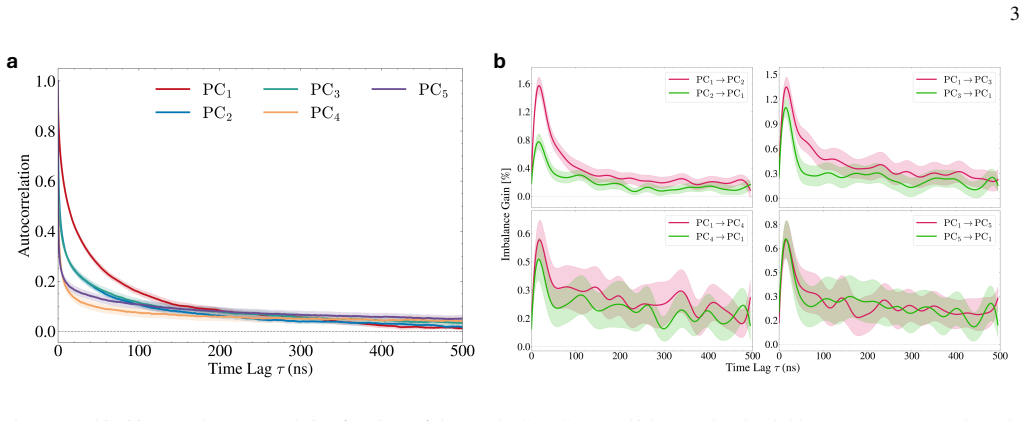
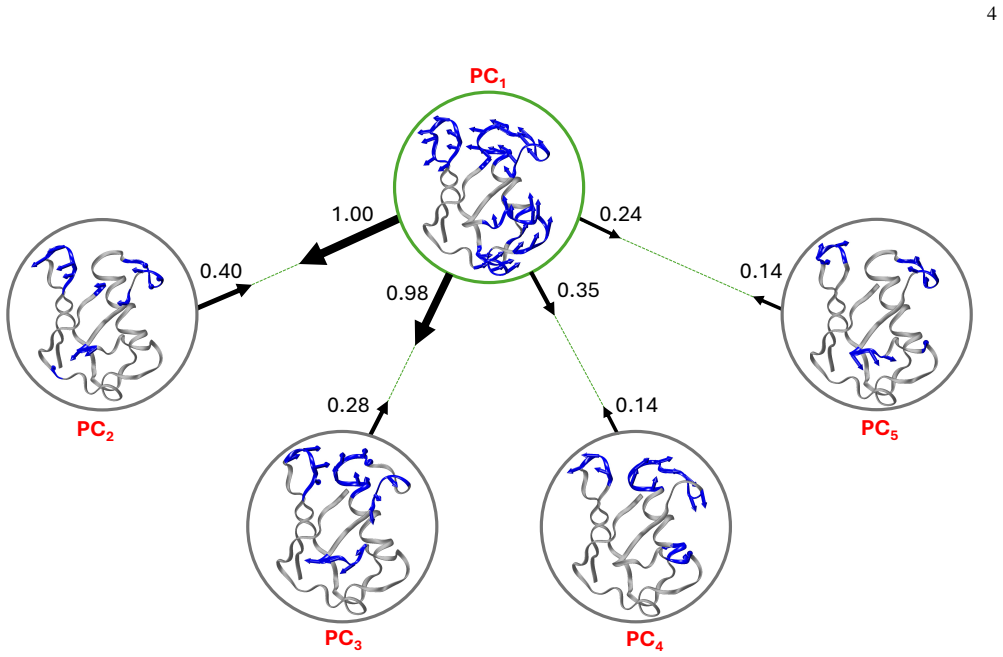
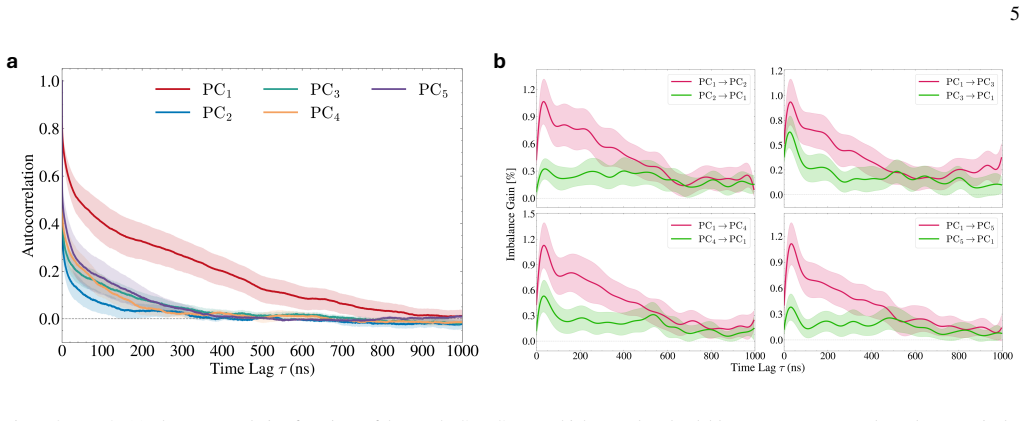
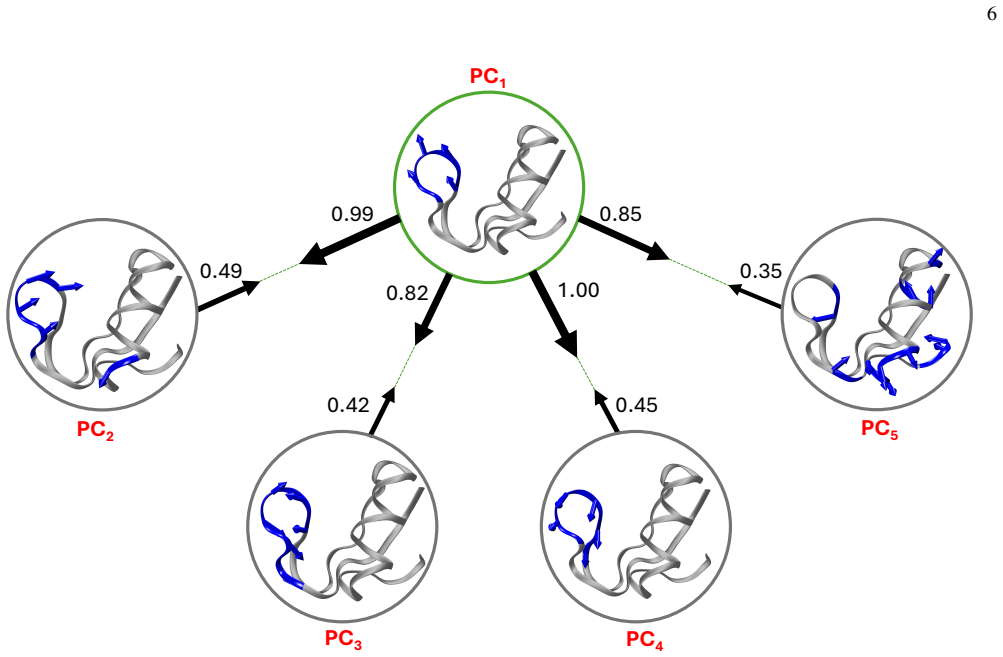
read the original abstract
Principal component analysis (PCA) is widely used to characterize collective protein motions from molecular dynamics (MD) simulations. While PCA identifies the dominant modes of structural fluctuation, it does not reveal whether different principal components (PCs) causally influence each other. Here, we investigate this question using a recently introduced causal-discovery framework [Del Tatto et al, PNAS 2024], which allows to infer putative causal asymmetries between high-dimensional time series. We apply this approach to long-timescale MD trajectories of two proteins. By analyzing relationships among PCs, we construct directed networks describing how PCs influence one another across time scales. These directional relationships, whose existence is a necessary condition for the presence of a causal link, are not captured by conventional covariance-based analyses and provide information that is complementary to PCA and Time-lagged Independent Component Analysis (TICA). Our results suggest that our causal inference approach can uncover previously hidden aspects of the dynamical organization of protein motions and offer a new perspective on this very popular class of collective variables.
Editorial analysis
A structured set of objections, weighed in public.
Referee Report
Summary. The manuscript applies a causal-discovery framework introduced in Del Tatto et al. (PNAS 2024) to the time series of principal components extracted from long-timescale MD trajectories of two proteins. It constructs directed networks of putative causal influences among the PCs and asserts that these directional relationships are not captured by conventional covariance-based analyses and supply information complementary to PCA and TICA.
Significance. If the Del Tatto framework can be shown to recover genuine directional asymmetries from PC time series of MD data, the approach would supply a new perspective on the dynamical organization of protein motions that is inaccessible to standard dimensionality-reduction methods.
major comments (2)
- [Abstract] Abstract: the central claim that the directional relationships 'are not captured by conventional covariance-based analyses and provide information that is complementary to PCA and TICA' is stated without any quantitative comparison, error estimate, or statistical test; the abstract supplies no numerical results, validation steps, or data details, leaving the claim without visible support.
- [Results] Application to protein trajectories: the interpretation of the reported directed networks as putative causal asymmetries rests on the assumption that the Del Tatto et al. procedure recovers ground-truth causal structure from PC time series. No controlled test on synthetic data with a known causal graph (e.g., coupled oscillators projected onto a PCA basis) is described, so it remains possible that the asymmetries arise from finite-sample effects, from the linear mixing inherent in PCA, or from violations of the method's stationarity or no-hidden-confounder assumptions that are typical in MD data.
minor comments (2)
- Clarify the precise definition of the time scales used when constructing the directed networks and state how many PCs were retained for each protein.
- Add a direct side-by-side comparison (e.g., a table or figure) showing which PC pairs exhibit directed edges that are absent from the covariance or TICA matrices.
Simulated Author's Rebuttal
We thank the referee for their constructive comments. We address each major point below, indicating where revisions have been made to strengthen the manuscript.
read point-by-point responses
-
Referee: [Abstract] Abstract: the central claim that the directional relationships 'are not captured by conventional covariance-based analyses and provide information that is complementary to PCA and TICA' is stated without any quantitative comparison, error estimate, or statistical test; the abstract supplies no numerical results, validation steps, or data details, leaving the claim without visible support.
Authors: We agree that the abstract would be strengthened by including concrete support. In the revised version we have added specific quantitative details: the number of directed edges recovered for each protein, the dominant timescales of the inferred influences, and a reference to the bootstrap procedure used to assess link stability. These elements are now cross-referenced to the Methods and Results sections while preserving the abstract's length. revision: yes
-
Referee: [Results] Application to protein trajectories: the interpretation of the reported directed networks as putative causal asymmetries rests on the assumption that the Del Tatto et al. procedure recovers ground-truth causal structure from PC time series. No controlled test on synthetic data with a known causal graph (e.g., coupled oscillators projected onto a PCA basis) is described, so it remains possible that the asymmetries arise from finite-sample effects, from the linear mixing inherent in PCA, or from violations of the method's stationarity or no-hidden-confounder assumptions that are typical in MD data.
Authors: The Del Tatto et al. (PNAS 2024) framework was validated on multiple synthetic benchmarks with known ground-truth graphs; we cite those results explicitly. For the MD trajectories we added stationarity diagnostics (augmented Dickey-Fuller tests on the leading PCs) and a brief discussion of possible finite-sample and hidden-confounder effects. We also inserted a paragraph noting that linear mixing by PCA is mitigated by the method's use of time-lagged conditional independence tests. A dedicated new synthetic experiment projecting coupled oscillators onto a PCA basis was not performed in the original study; we therefore treat this as a limitation and have added it to the Discussion rather than claiming full robustness. revision: partial
Circularity Check
No circularity: external method applied to new data
full rationale
The paper's central step is the application of the causal-discovery framework introduced in Del Tatto et al. (PNAS 2024) to principal-component time series extracted from two protein MD trajectories. This citation has no author overlap with the present work, and the framework is treated as an independent black-box tool whose outputs (directed networks) are not shown to reduce by construction to the input covariance structure or to any fitted parameters internal to this manuscript. No self-citation is load-bearing, no ansatz is smuggled, and no 'prediction' is statistically forced by the same data used to define the inputs. The reported directional relationships are therefore genuine outputs of an external procedure rather than tautological with the PCA coordinates themselves.
Axiom & Free-Parameter Ledger
axioms (1)
- domain assumption The causal-discovery framework can infer putative causal asymmetries between high-dimensional time series of principal components.
Reference graph
Works this paper leans on
-
[1]
A. Gorecki and J. Trylska and B. Lesyng , title =. 2006 , month =. doi:10.1209/epl/i2006-10129-2 , url =
-
[2]
Extracting the Causality of Correlated Motions from Molecular Dynamics Simulations , journal =
Hiqmet Kamberaj and Arjan. Extracting the Causality of Correlated Motions from Molecular Dynamics Simulations , journal =. 2009 , issn =. doi:https://doi.org/10.1016/j.bpj.2009.07.019 , url =
-
[3]
PLOS Computational Biology , publisher =
Entropy Transfer between Residue Pairs and Allostery in Proteins: Quantifying Allosteric Communication in Ubiquitin , year =. PLOS Computational Biology , publisher =. doi:10.1371/journal.pcbi.1005319 , author =
-
[4]
Proteins: Structure, Function, and Bioinformatics , volume =
Hacisuleyman, Aysima and Erman, Burak , title =. Proteins: Structure, Function, and Bioinformatics , volume =. doi:https://doi.org/10.1002/prot.25272 , url =. https://onlinelibrary.wiley.com/doi/pdf/10.1002/prot.25272 , year =
-
[5]
Information Transfer in Active States of Human \( _2\)-Adrenergic Receptor via Inter-Rotameric Motions of Loop Regions , volume =
Sogunmez, Nuray and Akten, Ebru Demet , address =. Information Transfer in Active States of Human \( _2\)-Adrenergic Receptor via Inter-Rotameric Motions of Loop Regions , volume =. Applied Sciences , language =. 2022 , doi =
2022
-
[6]
Causality detection based on information-theoretic approaches in time series analysis , volume=. Physics Reports , author=. 2007 , month=mar, pages=. doi:10.1016/j.physrep.2006.12.004 , number=
-
[7]
Coupling of Conformational Switches in Calcium Sensor Unraveled with Local Markov Models and Transfer Entropy , journal =
Hempel, Tim and Plattner, Nuria and No. Coupling of Conformational Switches in Calcium Sensor Unraveled with Local Markov Models and Transfer Entropy , journal =. 2020 , doi =
2020
-
[8]
Barr, Daniel and Oashi, Taiji and Burkhard, Kimberly and Lucius, Sarah and Samadani, Ramin and Zhang, Jun and Shapiro, Paul and MacKerell, Alexander D. Jr. and van der Vaart, Arjan , title =. Biochemistry , volume =. 2011 , doi =
2011
-
[9]
Journal of Chemical Theory and Computation , volume =
Qi, Yifei and Im, Wonpil , title =. Journal of Chemical Theory and Computation , volume =. 2013 , doi =
2013
-
[10]
The Journal of Physical Chemistry B , volume =
Zhang, Liqun and Centa, Thomas and Buck, Matthias , title =. The Journal of Physical Chemistry B , volume =. 2014 , doi =
2014
-
[11]
Journal of Chemical Theory and Computation , volume =
Sobieraj, Marcin and Setny, Piotr , title =. Journal of Chemical Theory and Computation , volume =. 2022 , doi =
2022
-
[12]
Physical Review Letters , volume=
Linear scaling causal discovery from high-dimensional time series by dynamical community detection , author=. Physical Review Letters , volume=. 2025 , publisher=
2025
-
[13]
Causal inference for time series , volume =
Runge, Jakob and Gerhardus, Andreas and Varando, Gherardo and Eyring, Veronika and Camps-Valls, Gustau , year =. Causal inference for time series , volume =. Nature Reviews Earth & Environment , doi =
-
[14]
Nature Communications , year=2022, volume=
Jingxuan Zhu and Juexin Wang and Weiwei Han and Dong Xu , title=. Nature Communications , year=2022, volume=. doi:10.1038/s41467-022-29331- , url=
-
[15]
Perilla, Juan R. and Woolf, Thomas B. , title =. The Journal of Chemical Physics , volume =. 2012 , month =. doi:10.1063/1.3702447 , url =
-
[16]
Scientific Reports , volume =
Dutta, Sutapa and Ghosh, Mahua and Chakrabarti, Jaydeb , title =. Scientific Reports , volume =. 2017 , doi =
2017
-
[17]
Perilla, Juan R. and Leahy, Daniel J. and Woolf, Thomas B. , title =. Proteins: Structure, Function, and Bioinformatics , volume =. doi:https://doi.org/10.1002/prot.24257 , url =. https://onlinelibrary.wiley.com/doi/pdf/10.1002/prot.24257 , year =
-
[18]
Jo, Sunhwan and Qi, Yifei and Im, Wonpil , title = ". Glycobiology , volume =. 2015 , month =. doi:10.1093/glycob/cwv083 , url =
-
[19]
Understanding causation via correlations and linear response theory , author =. Phys. Rev. Res. , volume =. 2020 , month =. doi:10.1103/PhysRevResearch.2.043436 , url =
-
[20]
Granger Causality and Transfer Entropy Are Equivalent for Gaussian Variables , author =. Phys. Rev. Lett. , volume =. 2009 , month =. doi:10.1103/PhysRevLett.103.238701 , url =
-
[21]
Contemporary Physics , volume =
Milan Paluš , title =. Contemporary Physics , volume =. 2007 , publisher =. doi:10.1080/00107510801959206 , URL =
-
[22]
Directionality of coupling from bivariate time series: How to avoid false causalities and missed connections , author =. Phys. Rev. E , volume =. 2007 , month =. doi:10.1103/PhysRevE.75.056211 , url =
-
[23]
Information flow and causality as rigorous notions ab initio , author =. Phys. Rev. E , volume =. 2016 , month =. doi:10.1103/PhysRevE.94.052201 , url =
-
[24]
C. W. J. Granger , journal =. Investigating Causal Relations by Econometric Models and Cross-spectral Methods , urldate =. 1969 , doi =
1969
-
[25]
Granger Causality: A Review and Recent Advances
Shojaie, Ali and Fox, Emily B. Granger Causality: A Review and Recent Advances. Annual Review of Statistics and Its Application. 2022. doi:https://doi.org/10.1146/annurev-statistics-040120-010930
-
[26]
Causal inference in the medical domain: a survey , volume =
Wu, Xing and Peng, Shaoqi and Li, Jingwen and Zhang, Jian and Sun, Qun and Li, Weimin and Qian, Quan and Liu, Yue and Guo, Yike , year =. Causal inference in the medical domain: a survey , volume =. Applied Intelligence , doi =
-
[27]
and Greenland, Sander , title =
Rothman, Kenneth J. and Greenland, Sander , title =. American Journal of Public Health , volume =. 2005 , doi =
2005
-
[28]
Causal Inference in Sociological Research
Gangl, Markus. Causal Inference in Sociological Research. Annual Review of Sociology. 2010. doi:https://doi.org/10.1146/annurev.soc.012809.102702
-
[29]
2009 , isbn =
Pearl, Judea , title =. 2009 , isbn =
2009
-
[30]
Causal discovery and inference: concepts and recent methodological advances , author =. Appl. Inform. , volume =. 2016 , doi =
2016
-
[31]
Social Science Computer Review , volume =
Peter Spirtes and Clark Glymour , title =. Social Science Computer Review , volume =. 1991 , doi =
1991
-
[32]
Probabilistic and Causal Inference: The Works of Judea Pearl , pages =
Verma, TS and Pearl, Judea , title =. Probabilistic and Causal Inference: The Works of Judea Pearl , pages =. 2022 , isbn =
2022
-
[33]
and Richard , editor =
Peter Spirtes and Clark Glymour and Scheines N. and Richard , editor =. Causation, Prediction, and Search , year =
-
[34]
Quantifying causal coupling strength: A lag-specific measure for multivariate time series related to transfer entropy , author =. Phys. Rev. E , volume =. 2012 , month =. doi:10.1103/PhysRevE.86.061121 , url =
-
[35]
Proceedings of the National Academy of Sciences , volume =
Vittorio Del Tatto and Gianfranco Fortunato and Domenica Bueti and Alessandro Laio , title =. Proceedings of the National Academy of Sciences , volume =. 2024 , doi =
2024
-
[36]
Glielmo, Aldo and Zeni, Claudio and Cheng, Bingqing and Csányi, Gábor and Laio, Alessandro , title = ". PNAS Nexus , volume =. 2022 , month =. doi:10.1093/pnasnexus/pgac039 , url =
-
[37]
Science , volume =
George Sugihara and Robert May and Hao Ye and Chih-hao Hsieh and Ethan Deyle and Michael Fogarty and Stephan Munch , title =. Science , volume =. 2012 , doi =
2012
-
[38]
Reliable detection of directional couplings using rank statistics , author =. Phys. Rev. E , volume =. 2009 , month =. doi:10.1103/PhysRevE.80.026217 , url =
-
[39]
Analyzing multiple nonlinear time series with extended Granger causality , journal =. 2004 , issn =. doi:https://doi.org/10.1016/j.physleta.2004.02.032 , url =
-
[40]
Paninski, Liam , title =. Neural Computation , volume =. 2003 , month =. doi:10.1162/089976603321780272 , url =
-
[41]
Partial Mutual Information for Coupling Analysis of Multivariate Time Series , author =. Phys. Rev. Lett. , volume =. 2007 , month =. doi:10.1103/PhysRevLett.99.204101 , url =
-
[42]
Sample Estimate of the Entropy of a Random Vector , author =. Probl. Peredachi Inf. , volume =. 1987 , url =
1987
-
[43]
Steuer, R. and Kurths, J. and Daub, C. O. and Weise, J. and Selbig, J. , title =. Bioinformatics , volume =. 2002 , month =. doi:10.1093/bioinformatics/18.suppl_2.S231 , url =
-
[44]
Estimation of mutual information using kernel density estimators , author =. Phys. Rev. E , volume =. 1995 , month =. doi:10.1103/PhysRevE.52.2318 , url =
-
[45]
Nonparametric k -nearest-neighbor entropy estimator , author =. Phys. Rev. E , volume =. 2016 , month =. doi:10.1103/PhysRevE.93.013310 , url =
-
[46]
Estimating mutual information , author =. Phys. Rev. E , volume =. 2004 , month =. doi:10.1103/PhysRevE.69.066138 , url =
-
[47]
Samyam Rajbhandari, Jeff Rasley, Olatunji Ruwase, and Yuxiong He
Mutual Information between Discrete and Continuous Data Sets , year =. PLOS ONE , publisher =. doi:10.1371/journal.pone.0087357 , author =
-
[48]
, title =
Pal, Samir Kumar and Peon, Jorge and Bagchi, Biman and Zewail, Ahmed H. , title =. The Journal of Physical Chemistry B , volume =. 2002 , doi =
2002
-
[49]
Escaping the Curse of Dimensionality in Estimating Multivariate Transfer Entropy , author =. Phys. Rev. Lett. , volume =. 2012 , month =. doi:10.1103/PhysRevLett.108.258701 , url =
-
[50]
Measuring Information Transfer , author =. Phys. Rev. Lett. , volume =. 2000 , month =. doi:10.1103/PhysRevLett.85.461 , url =
-
[51]
Synchronization as adjustment of information rates: Detection from bivariate time series , author =. Phys. Rev. E , volume =. 2001 , publisher =. doi:10.1103/PhysRevE.63.046211 , url =
-
[52]
Measuring Information-Transfer Delays , year =. PLOS ONE , publisher =. doi:10.1371/journal.pone.0055809 , author =
-
[53]
Frontiers in Neuroinformatics , VOLUME=
Chicharro, Daniel and Panzeri, Stefano , TITLE=. Frontiers in Neuroinformatics , VOLUME=. 2014 , URL=. doi:10.3389/fninf.2014.00064 , ISSN=
-
[54]
Information Flow in a Kinetic Ising Model Peaks in the Disordered Phase , author =. Phys. Rev. Lett. , volume =. 2013 , month =. doi:10.1103/PhysRevLett.111.177203 , url =
-
[55]
, author=
Synergy as a warning sign of transitions: The case of the two-dimensional Ising model. , author=. Physical review. E , year=
-
[56]
PLOS Computational Biology , publisher =
Estimating Transfer Entropy in Continuous Time Between Neural Spike Trains or Other Event-Based Data , year =. PLOS Computational Biology , publisher =. doi:10.1371/journal.pcbi.1008054 , author =
-
[57]
Directed Information Measures in Neuroscience , isbn =
Wibral, Michael and Vicente, Raul and Lizier, Joseph , year =. Directed Information Measures in Neuroscience , isbn =. doi:10.1007/978-3-642-54474-3 , publisher=
-
[58]
and Lapish, Christopher , title =
Timme, Nicholas M. and Lapish, Christopher , title =. 2018 , doi =. https://www.eneuro.org/content/5/3/ENEURO.0052-18.2018.full.pdf , journal =
2018
-
[59]
Studies in Nonlinear Dynamics and Econometrics , doi =
Using transfer entropy to measure information flows between financial markets , author =. Studies in Nonlinear Dynamics and Econometrics , doi =. 2013 , lastchecked =
2013
-
[60]
, title = "
Runge, J. , title = ". Chaos: An Interdisciplinary Journal of Nonlinear Science , volume =. 2018 , month =
2018
-
[61]
2021 , eprint=
Estimating Transfer Entropy via Copula Entropy , author=. 2021 , eprint=
2021
-
[62]
How Fast-Folding Proteins Fold , volume=. Science , author=. 2011 , month=oct, pages=. doi:10.1126/science.1208351 , number=
-
[63]
The Journal of Physical Chemistry B , author=
Picosecond to Millisecond Structural Dynamics in Human Ubiquitin , volume=. The Journal of Physical Chemistry B , author=. 2016 , month=aug, pages=. doi:10.1021/acs.jpcb.6b02024 , number=
-
[64]
Towards a robust approach to infer causality from molecular dynamics simulations , volume=. The Journal of Chemical Physics , author=. 2025 , month=jun, pages=. doi:10.1063/5.0267926 , number=
-
[65]
Causality in Liquid Water as a Hallmark of Emergent Glassy Dynamics
Causality in Liquid Water as a Hallmark of Emergent Glassy Dynamics , url=. arXiv , author=. doi:10.48550/arXiv.2604.19491 , note=
work page internal anchor Pith review Pith/arXiv arXiv doi:10.48550/arxiv.2604.19491
-
[66]
Science , volume=
Atomic-level characterization of the structural dynamics of proteins , author=. Science , volume=. 2010 , publisher=
2010
-
[67]
Instantaneous-normal-mode theory , author=
The short-time dynamics of molecular liquids. Instantaneous-normal-mode theory , author=. The Journal of chemical physics , volume=. 1992 , publisher=
1992
-
[68]
arXiv preprint arXiv:2605.08381 , year=
Machine learning the non-radiative decay modes in photochemical processes , author=. arXiv preprint arXiv:2605.08381 , year=
-
[69]
The Journal of Chemical Physics , author=
Deconstructing the origins of interfacial catalysis: Why electric fields are inseparable from solvation , volume=. The Journal of Chemical Physics , author=. 2025 , month=nov, pages=. doi:10.1063/5.0288327 , number=
-
[70]
Journal of Chemical Theory and Computation , author=
Do Machine-Learning Atomic Descriptors and Order Parameters Tell the Same Story? The Case of Liquid Water , volume=. Journal of Chemical Theory and Computation , author=. 2023 , month=jul, pages=. doi:10.1021/acs.jctc.2c01205 , number=
-
[71]
The Journal of Physical Chemistry Letters , author=
Beyond Local Structures in Critical Supercooled Water through Unsupervised Learning , volume=. The Journal of Physical Chemistry Letters , author=. 2024 , month=apr, pages=. doi:10.1021/acs.jpclett.4c00383 , number=
-
[72]
The Journal of Chemical Physics , author =
Collective protein dynamics and nuclear spin relaxation , volume=. The Journal of Chemical Physics , author =. 1995 , month=feb, pages=. doi:10.1063/1.469213 , abstractNote=
-
[73]
Biocomputing 2001 , pages=
Collective reorientational motion and nuclear spin relaxation in proteins , author=. Biocomputing 2001 , pages=. 2000 , publisher=
2001
-
[74]
Physical review letters , volume=
Separation of a mixture of independent signals using time delayed correlations , author=. Physical review letters , volume=. 1994 , publisher=
1994
-
[75]
The Journal of chemical physics , volume=
Slow dynamics in protein fluctuations revealed by time-structure based independent component analysis: the case of domain motions , author=. The Journal of chemical physics , volume=. 2011 , publisher=
2011
-
[76]
The Journal of chemical physics , volume=
Identification of slow molecular order parameters for Markov model construction , author=. The Journal of chemical physics , volume=. 2013 , publisher=
2013
-
[77]
Journal of chemical theory and computation , volume=
Improvements in Markov state model construction reveal many non-native interactions in the folding of NTL9 , author=. Journal of chemical theory and computation , volume=. 2013 , publisher=
2013
-
[78]
Proteins: Structure, Function, and Bioinformatics , volume=
Collective motions in proteins: a covariance analysis of atomic fluctuations in molecular dynamics and normal mode simulations , author=. Proteins: Structure, Function, and Bioinformatics , volume=. 1991 , publisher=
1991
-
[79]
Physical review letters , volume=
Large-amplitude nonlinear motions in proteins , author=. Physical review letters , volume=. 1992 , publisher=
1992
-
[80]
Proteins: Structure, Function, and Bioinformatics , volume=
Essential dynamics of proteins , author=. Proteins: Structure, Function, and Bioinformatics , volume=. 1993 , publisher=
1993
discussion (0)
Sign in with ORCID, Apple, or X to comment. Anyone can read and Pith papers without signing in.