A Game-Theoretic Approach to Adversarial Linear Support Vector Classification
Pith reviewed 2026-05-25 17:47 UTC · model grok-4.3
The pith
Modeling the adversary-classifier interaction as a game with convex best-response problems produces a robust linear SVM for conditionally Gaussian data.
A machine-rendered reading of the paper's core claim, the machinery that carries it, and where it could break.
Core claim
For conditionally Gaussian data points (conditioned on the class) and linear support vector machine classifiers, the optimization problems of the adversary and the classifier can be rewritten as convex optimization problems; using best response dynamics to learn an equilibrium of the game results in computing a linear support vector machine classifier that is robust against adversarial input manipulations.
What carries the argument
Best-response dynamics on the convex reformulations of the adversary's and classifier's objectives within the two-player game.
If this is right
- The equilibrium classifier obtained is robust to adversarial input manipulations while satisfying the true-negative probability constraint.
- The convex reformulations allow the game to be solved by repeated best-response updates rather than a single joint optimization.
- The same equilibrium can be computed on both synthetic Gaussian data and on the public cardiovascular disease dataset.
Where Pith is reading between the lines
- The same modeling approach might be tried on other linear classifiers whose objectives admit convex reformulations under the Gaussian assumption.
- Empirical checks on data sets that violate conditional Gaussianity would indicate how far the robustness guarantee extends beyond the paper's stated setting.
- The game-theoretic equilibrium could be used as a benchmark when comparing heuristic defenses that do not explicitly solve for an adversary best response.
Load-bearing premise
The data points are conditionally Gaussian given their class label.
What would settle it
Running the best-response procedure on the cardiovascular dataset and finding that the resulting classifier fails to keep the true-negative probability above the prescribed lower bound when the adversary applies the optimal perturbation would falsify the central claim.
Figures

read the original abstract
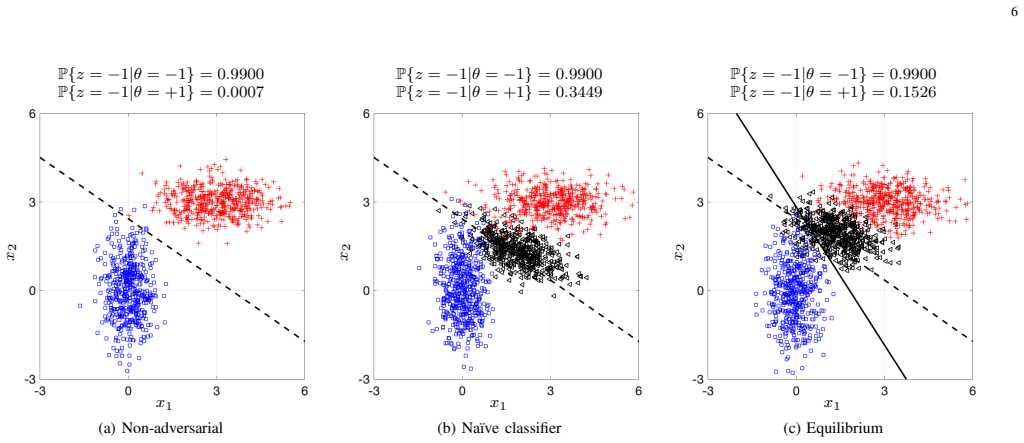
In this paper, we employ a game-theoretic model to analyze the interaction between an adversary and a classifier. There are two classes (i.e., positive and negative classes) to which data points can belong. The adversary is interested in maximizing the probability of miss-detection for the positive class (i.e., false negative probability). The adversary however does not want to significantly modify the data point so that it still maintains favourable traits of the original class. The classifier, on the other hand, is interested in maximizing the probability of correct detection for the positive class (i.e., true positive probability) subject to a lower-bound on the probability of correct detection for the negative class (i.e., true negative probability). For conditionally Gaussian data points (conditioned on the class) and linear support vector machine classifiers, we rewrite the optimization problems of the adversary and the classifier as convex optimization problems and use best response dynamics to learn an equilibrium of the game. This results in computing a linear support vector machine classifier that is robust against adversarial input manipulations. We illustrate the framework on a synthetic dataset and a public Cardiovascular Disease dataset.
Editorial analysis
A structured set of objections, weighed in public.
Referee Report
Summary. The paper models the interaction between an adversary and a linear SVM classifier as a game on conditionally Gaussian data. The adversary maximizes the false-negative probability for the positive class while constraining modifications to preserve class traits; the classifier maximizes the true-positive probability subject to a lower bound on the true-negative probability. Both optimization problems are rewritten as convex programs, and best-response dynamics are applied to compute an equilibrium, yielding a robust linear SVM. The approach is illustrated on synthetic data and the Cardiovascular Disease dataset.
Significance. Under the stated conditional-Gaussian assumption the construction supplies an explicit convex-game route to a robust linear classifier. If the reformulations are exact and the dynamics converge, the result supplies a concrete, computable robust SVM that can be compared against standard training; this is a modest but well-scoped contribution to adversarial classification literature.
major comments (2)
- [§3] §3 (Convex Reformulations): the manuscript must exhibit the explicit transformation from the probability expressions (under conditional Gaussianity) to the convex programs; without the intermediate steps it is impossible to verify that the adversary’s and classifier’s objectives remain convex after the change of variables.
- [§4] §4 (Best-Response Dynamics): the claim that iterated best responses reach an equilibrium requires either a convergence proof or a citation to known conditions for the specific convex game; the current text only states that the dynamics are run.
minor comments (2)
- [§2] Notation for the two classes and the decision threshold should be introduced once and used consistently; the abstract and §2 currently mix “positive/negative” with “class 1/class 0.”
- [§5] The experimental figures would benefit from an explicit baseline column (standard SVM under the same attack model) so that the robustness gain is immediately quantifiable.
Simulated Author's Rebuttal
We thank the referee for the careful reading and constructive comments. We address each major comment below and will revise the manuscript to incorporate the requested clarifications and justifications.
read point-by-point responses
-
Referee: [§3] §3 (Convex Reformulations): the manuscript must exhibit the explicit transformation from the probability expressions (under conditional Gaussianity) to the convex programs; without the intermediate steps it is impossible to verify that the adversary’s and classifier’s objectives remain convex after the change of variables.
Authors: We agree that the explicit intermediate steps are required for verification. In the revised manuscript we will add a dedicated subsection in §3 that derives the convex programs step-by-step from the original probability expressions, showing the change-of-variables, the resulting quadratic forms, and why convexity is preserved under the conditional-Gaussian assumption. revision: yes
-
Referee: [§4] §4 (Best-Response Dynamics): the claim that iterated best responses reach an equilibrium requires either a convergence proof or a citation to known conditions for the specific convex game; the current text only states that the dynamics are run.
Authors: We acknowledge the need for a convergence justification. In the revision we will augment §4 with either a short argument establishing convergence for this continuous convex game (leveraging the compactness of the strategy sets and the strict convexity of the objectives) or an appropriate citation to known results on best-response dynamics in convex games. revision: yes
Circularity Check
No significant circularity in derivation chain
full rationale
The paper explicitly scopes its contribution to conditionally Gaussian data and linear SVM classifiers. It rewrites the adversary's and classifier's optimization problems as convex programs (enabled directly by the Gaussian conditioning) and applies standard best-response dynamics to compute a Nash equilibrium. No equation or step reduces by construction to a fitted parameter, self-citation, or renamed input; the equilibrium is obtained from the defined game rather than presupposed. The approach is self-contained against external benchmarks and contains no load-bearing self-citations or ansatz smuggling. This is the normal, non-circular outcome for a modeling paper that states its assumptions and solution method upfront.
Axiom & Free-Parameter Ledger
axioms (1)
- domain assumption Data points are conditionally Gaussian given class label.
Reference graph
Works this paper leans on
-
[1]
Notes from the AI frontier: Modeling the impact of AI on the world economy,
McKinsey Global Institute, “Notes from the AI frontier: Modeling the impact of AI on the world economy,” 2018
work page 2018
-
[2]
N. Dalvi, P . Domingos, S. Sanghai, and D. V erma, “Adversa rial clas- sification,” in Proceedings of the tenth ACM SIGKDD International Conference on Knowledge Discovery and Data Mining , pp. 99–108, ACM, 2004
work page 2004
-
[3]
Explaining and harnessing adversarial examples,
I. J. Goodfellow, J. Shlens, and C. Szegedy, “Explaining and harnessing adversarial examples,” in Proceedings of the 3rd International Confer- ence on Learning Representations , 2015
work page 2015
-
[4]
Adversarial examples: A ttacks and defenses for deep learning,
X. Y uan, P . He, Q. Zhu, and X. Li, “Adversarial examples: A ttacks and defenses for deep learning,” IEEE transactions on Neural Networks and Learning Systems , 2019
work page 2019
-
[5]
Evasion attacks against machine l earning at test time,
B. Biggio, I. Corona, D. Maiorca, B. Nelson, N. ˇSrndi´ c, P . Laskov, G. Giacinto, and F. Roli, “Evasion attacks against machine l earning at test time,” in Joint European conference on machine learning and knowledge discovery in databases , pp. 387–402, Springer, 2013
work page 2013
-
[6]
Dis tillation as a defense to adversarial perturbations against deep neur al networks,
N. Papernot, P . McDaniel, X. Wu, S. Jha, and A. Swami, “Dis tillation as a defense to adversarial perturbations against deep neur al networks,” in 2016 IEEE Symposium on Security and Privacy (SP) , pp. 582–597, IEEE, 2016
work page 2016
-
[7]
Adversarial m achine learn- ing at scale,
A. Kurakin, I. Goodfellow, and S. Bengio, “Adversarial m achine learn- ing at scale,” in Proceedings of the 5rd International Conference on Learning Representations, 2017
work page 2017
-
[8]
At tack strength vs. detectability dilemma in adversarial machine learning ,
C. Frederickson, M. Moore, G. Dawson, and R. Polikar, “At tack strength vs. detectability dilemma in adversarial machine learning ,” in 2018 International Joint Conference on Neural Networks (IJCNN) , pp. 1–8, IEEE, 2018
work page 2018
-
[9]
Adequacy of the gradient-desc ent method for classifier evasion attacks,
Y . Han and B. Rubinstein, “Adequacy of the gradient-desc ent method for classifier evasion attacks,” in W orkshops at the Thirty-Second AAAI Conference on Artificial Intelligence , 2018
work page 2018
-
[10]
Secure kernel machines against evasion attacks,
P . Russu, A. Demontis, B. Biggio, G. Fumera, and F. Roli, “Secure kernel machines against evasion attacks,” in Proceedings of the 2016 ACM W orkshop on Artificial Intelligence and Security, pp. 59–69, ACM, 2016
work page 2016
-
[11]
Strategic information tra nsmission,
V . P . Crawford and J. Sobel, “Strategic information tra nsmission,” Econometrica: Journal of the Econometric Society , pp. 1431–1451, 1982
work page 1982
-
[12]
Estimat ion with strategic sensors,
F. Farokhi, A. M. H. Teixeira, and C. Langbort, “Estimat ion with strategic sensors,” IEEE Transactions on Automatic Control , vol. 62, no. 2, pp. 724–739, 2016
work page 2016
-
[13]
J. Farrell and M. Rabin, “Cheap talk,” Journal of Economic Perspectives, vol. 10, no. 3, pp. 103–118, 1996
work page 1996
-
[14]
E. Kamenica and M. Gentzkow, “Bayesian persuasion,” American Eco- nomic Review, vol. 101, no. 6, pp. 2590–2615, 2011
work page 2011
-
[15]
Algorithmic bayesian persuasion,
S. Dughmi and H. Xu, “Algorithmic bayesian persuasion, ” in Pro- ceedings of the forty-eighth annual ACM symposium on Theory of Computing, pp. 412–425, ACM, 2016
work page 2016
-
[16]
Effects o f subjective biases on strategic information transmission,
V . S. S. Nadendla, C. Langbort, and T. Bas ¸ar, “Effects o f subjective biases on strategic information transmission,” IEEE Transactions on Communications, vol. 66, no. 12, pp. 6040–6049, 2018
work page 2018
-
[17]
Existence of an equilibrium f or a com- petitive economy,
K. J. Arrow and G. Debreu, “Existence of an equilibrium f or a com- petitive economy,” Econometrica: Journal of the Econometric Society , pp. 265–290, 1954
work page 1954
-
[18]
Parameter-free convex equivalent and du al programs of fractional programming problems,
S. Schaible, “Parameter-free convex equivalent and du al programs of fractional programming problems,” Zeitschrift f¨ ur Operations Research, vol. 18, no. 5, pp. 187–196, 1974
work page 1974
-
[19]
Best response dynamics for continuous games,
E. N. Barron, R. Goebel, and R. R. Jensen, “Best response dynamics for continuous games,” Proceedings of the American Mathematical Society , vol. 138, no. 3, pp. 1069–1083, 2010
work page 2010
-
[20]
S. Ulianova, “Cardiovascular disease dataset: The dat aset consists of 70 000 records of patients data, 11 features + target.,” 20 19. https://www.kaggle.com/sulianova/cardiovascular-disease-dataset
discussion (0)
Sign in with ORCID, Apple, or X to comment. Anyone can read and Pith papers without signing in.