REVIEW 3 major objections 5 minor 5 cited by
An Effective Sphaleron Awakens
T0 review · 3 major / 5 minor · reviewed 2026-08-07 · deepseek-v4-flash
Pith's one-line read A gauge-invariant 3D effective field theory computation reduces the electroweak sphaleron rate to a one-parameter action and sets universal baryon-preservation bounds.
desk verdict A genuinely useful 3D EFT reformulation of the Higgs-phase sphaleron rate, but the headline BNPC bounds rest on an uncomputed prefactor estimate and should be read as provisional. read the letter →
The pith
A machine-rendered reading of the paper's core claim, the machinery that carries it, and where it could break.
The reading
What carries the argument
The load-bearing object is the rescaled 3D sphaleron action $\hat{S}_{3D}=v_3(x,y)\,C_{\mathrm{sph}}(x,y)$, where $x=\lambda_3/g_3^2$ and $y=\mu_3^2/g_3^4$ are the two dimensionless parameters of the SU(2)+Higgs 3D EFT. The key structural fact is that after rescaling by the Higgs condensate $v_3$, the Yang-Mills and covariant-derivative kinetic terms dominate $C_{\mathrm{sph}}$, and the scalar potential contributes only through the boundary value $v_3$; for first-order transitions, with the cubic term coefficient $q=1/(4\sqrt{2\pi})$ from integrating out the soft gauge bosons, $C_{\mathrm{sph}}\approx 29$. This factorization converts the washout integral into a closed form $I(x)$ and fixes the freeze-out curve $y_f(x)$ through the condition $\hat{S}_{3D}=S_0\approx 39$.
What would settle it
Compute the Higgs-phase sphaleron rate on the lattice in the SU(2)+Higgs 3D EFT for $x$ in the first-order range 0.01 to 0.1, with $y$ as an input parameter; if $\log_{10}(\Gamma_{\mathrm{sph}}/T^4)$ is not well described by $-29\,v_3(x,y)/\ln 10$ plus a mildly varying prefactor, the leading-order action approximation fails. Alternatively, evaluate the fluctuation determinant and dynamical prefactor directly: if their product differs from $T^4$ by a factor of ten, $S_0$ shifts from 39 by about 2.3 and the claimed $x$ boundaries move by roughly 0.005.
Extended reading notes
Core claim
The paper's central claim is that the Higgs-phase sphaleron rate after a radiatively induced first-order transition can be computed consistently in a two-loop resummed 3D EFT, in a semi-classical approximation, without the gauge dependence and double-counting problems of earlier approaches. The discovery is a compact factorization: rescaling fields by the effective gauge coupling $g_3$ and then by the Higgs condensate $v_3(x,y)$ turns the sphaleron action into $\hat{S}_{3D}=v_3(x,y)\,C_{\mathrm{sph}}(x,y)$, with $C_{\mathrm{sph}}\approx 29$ in the first-order regime, so the leading rate is $\Gamma_{\mathrm{sph}}\approx T^4\,e^{-29\,v_3(x,y)}$. The scalar potential fixes only the boundary value $v_3$ at the supersoft scale and otherwise enters at next-to-leading order. This yields a freeze-out condition $S_0\approx 39$, a universal strong baryon-number-preservation criterion $x(T_n)<0.025$, and a weak criterion $0.025<x(T_n)<0.036$. For the real triplet Standard Model, once the two-loop soft-triplet correction to $\lambda_3$ in Eq. (5.3) is included, all identified one-step transitions have $x_c\gtrsim 0.06$ and are too weak to avoid washout.
Load-bearing premise
The freeze-out threshold $S_0\approx 39$ is set by guessing that the dynamical prefactor times the fluctuation determinant is of order $T^4$; the paper does not compute either factor, and because the washout bounds are exponentially sensitive to the action, an order-of-magnitude error in that prefactor would shift the strong and weak baryon-preservation boundaries by an appreciable amount.
Editorial extensions
If this is right
- For any BSM theory mappable to this 3D EFT, preserving any generated baryon asymmetry requires $x(T_c)\lesssim 0.036$, and $x(T_c)<0.025$ guarantees sphalerons are already decoupled at nucleation.
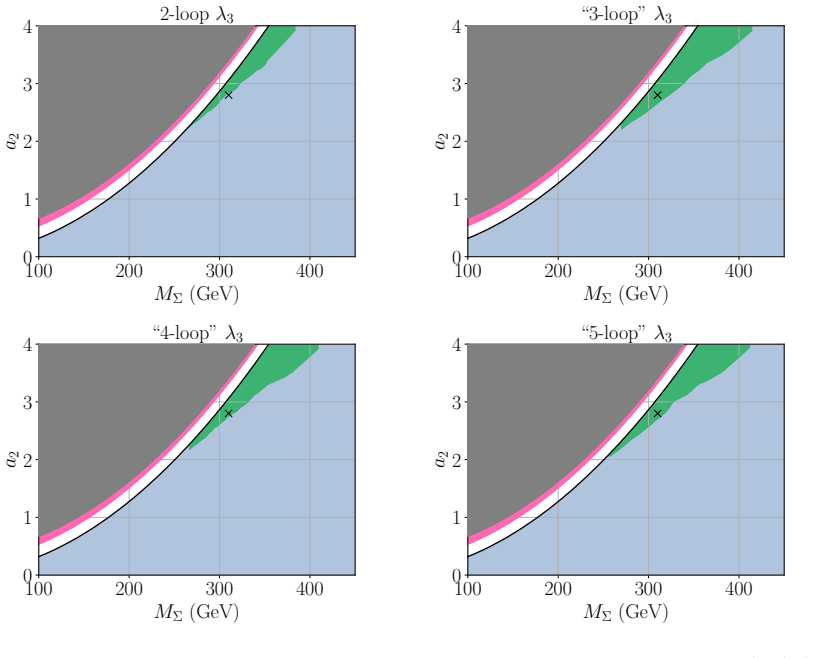
- The real triplet-extended Standard Model regions previously claimed to support strong one-step transitions are qualitatively altered by two-loop soft-triplet corrections: none of the remaining first-order points has $x_c<0.06$, so they cannot prevent washout.
- The sphaleron rate below the Standard Model crossover at one- and two-loop dimensional reduction agrees reasonably with lattice simulations, with the two-loop mapping much less sensitive to the renormalization scale than the one-loop mapping.
- The same $(x,y)$-plane framework now contains critical, nucleation, and freeze-out curves, so the status of any mapped model—no washout, partial washout, or full erasure—can be read off directly.
- The washout exponent factorizes into a UV part from dimensional reduction and a pure 3D integral $I(x)$, so model-specific thermal data and universal infrared dynamics are cleanly separated.
Reading between the lines
- If the uncomputed fluctuation determinant and dynamical prefactor alter $A_{\mathrm{dyn}}\,[\det]_{\mathrm{sph}}$ from $T^4$ by an order of magnitude, the threshold $S_0\approx 39$ shifts by about 2.3, which would move $\bar{x}$ and $\hat{x}$ at the 0.005 level; the bounds should be read with that uncertainty.
- A lattice simulation of the SU(2)+Higgs 3D EFT at small $x$, treating $y$ as input, should see the predicted universal $e^{-29\,v_3}$ scaling; any substantial deviation would signal missing next-to-leading-order or marginal-operator effects.
- The same two-loop soft-scale corrections that erase the real triplet's strong transitions likely affect other Higgs-portal models with heavy soft scalars, so one-loop scans in those models deserve re-examination.
- If transitions are systematically weakened, gravitational-wave signals from these models would also weaken, making the conflicting one-loop predictions relevant for gravitational-wave forecasts.
Signed reviews
Editorial analysis
A structured set of objections, weighed in public.
Referee Report
Summary. The paper develops a perturbative, gauge-invariant 3D effective field theory (EFT) description of the Higgs-phase sphaleron rate after a first-order electroweak phase transition. Working at semi-classical leading order with two-loop dimensional reduction, the authors show that the rescaled sphaleron action is approximately S_3D(x,y) = v3(x,y) * Csph with Csph ≈ 29, and that the scalar potential contributes only through the vacuum boundary condition. They combine this sphaleron freeze-out curve yf(x) with earlier nucleation curves yn(x) to derive universal baryon number preservation criteria: a strong BNPC x(Tc) ≲ 0.025 and a weak BNPC 0.025 ≲ x(Tc) ≲ 0.036, with the washout exponent computed from an integral over the 3D action. As an application, the paper studies the real-triplet-extended Standard Model and concludes that, once two-loop soft-triplet corrections to the effective Higgs self-coupling are included, no one-step transition in the mapped parameter space is strong enough to preserve baryon number.
Significance. If the quantitative claims hold, this is a valuable step toward a consistent perturbative treatment of sphaleron physics in the 3D EFT framework. The paper gives a transparent, gauge-invariant organization of the semi-classical Boltzmann factor, provides compact analytic fits that are easy to reuse, and makes an explicit and honest comparison with lattice results for the Standard Model crossover. The combination of nucleation and freeze-out curves in a single (x,y) diagram is a useful unifying presentation, and the triplet model study highlights the importance of two-loop thermal corrections in a way that agrees with recent related literature. The central limitation—that the fluctuation determinant and dynamical prefactor are not computed—is acknowledged repeatedly, but it is load-bearing for the specific numerical BNPC bounds, so the significance of the paper is partly conditional on future work or on a demonstrated insensitivity of the main conclusions to the prefactor.
major comments (3)
- [Sec. 4.1, Eq. (4.5)] The freeze-out constant S0 ≈ 39 is obtained by estimating Adyn × [det]sph ∼ T^4 by dimensional analysis, while Sec. 3.1 and Appendix B explicitly state that both the dynamical prefactor and the fluctuation determinant are left to future work. The washout exponent W (Eq. 4.18) and the boundaries x_bar ≈ 0.025 and x_hat ≈ 0.036 are obtained by inverting S_3D(x,y) = S0, so an order-of-magnitude correction to the prefactor changes S0 by ln(10) ≈ 2.3 and shifts both thresholds by an amount comparable to the width of the weak-BNPC band. The manuscript should either compute or bound the prefactor in the first-order region, or quantitatively propagate this uncertainty into the quoted BNPC values; currently the bounds are presented with a definiteness that the computation does not support.
- [Sec. 4.2, Eq. (4.20)] The weak BNPC upper limit x_hat ≈ 0.036 is fixed by the hand-set cap W <∼ 100. This cap is not derived from any physical or observational requirement, and the required initial asymmetry grows as e^W, so the exact choice of the cap directly controls x_hat. The authors should justify the cap or demonstrate that x_hat is insensitive to it, for example by reporting d x_hat/dW around W = 100.
- [Sec. 5, Eqs. (5.3)-(5.4)] The triplet-model no-go conclusion relies on the two-loop correction of Eq. (5.3) and on the heuristic higher-loop sequence of Eq. (5.4) with unit coefficients. The heuristic coefficients are admittedly arbitrary, and while the authors state the conclusion is not terribly sensitive to them, no quantitative sensitivity test is shown. Furthermore, the conclusion that none of the mapped one-step transitions are strong enough depends on the BNPC thresholds of Sec. 4, which inherit the S0 uncertainty discussed above. The no-go statement should be qualified accordingly, and the sensitivity of Fig. 11 to the coefficients c3, c4, c5 should be quantified.
minor comments (5)
- [Contents and Sec. 2.1] There are typos in the text: 'Qualitative Overwiew' in the contents and Sec. 2.1, and 'T emporal Gluon Effect' in the Appendix C heading.
- [Sec. 3.5, Fig. 5] The LO and NLO curves differ from the lattice results by more than an order of magnitude at the lower end of the plotted temperature range; this is visible in Fig. 5 but the text only says the behavior is 'reasonable'. A sentence quantifying the discrepancy at, say, T = 120 GeV would be more informative.
- [Sec. 4.1] The value of the coefficient ρ in Nρ = n_G ρ is not defined in the text; the numerical replacement Nρ ≈ (13/4) × 3 appears without explanation, so a reader cannot reproduce the washout normalization without consulting Ref. [87].
- [Sec. 4.2, Eq. (4.16)] The notation η_y is introduced in Eq. (4.15) as T dy/dT, but the same symbol η is used in Eq. (1.1) for the baryon-to-photon ratio. The two are very different quantities and the notation is confusing; a different symbol, e.g. beta_y, would be clearer.
- [References] Reference [229] is listed as 'In preparation' and should either be updated to a published or arXiv version or removed if it is not publicly available by the time of publication.
Circularity Check
No significant circularity: the sphaleron action is solved from the 3D EFT equations, the S0≈39 threshold is an explicitly stated dimensional-analysis estimate rather than a fitted input, and the central results are benchmarked against independent lattice work.
full rationale
The derivation chain is self-contained. The sphaleron action S3D = v3(x,y) Csph(x,y) (Eqs. 3.21–3.22) is obtained by solving the 3D EFT equations of motion (3.25)–(3.26); the approximation Csph ≈ 29 (Eq. 3.31) is validated by the numerical comparison in Fig. 4 and is not fitted to washout or baryon-asymmetry data. The freeze-out input S0 ≈ 39 in Eq. (4.5) is stated as an estimate, not a fit: "by simply estimating Adyn × [det]sph ∼ T^4 using dimensional analysis, we find that the logarithm of Eq. (4.5) is approximately a constant, S0." The strong and weak BNPC bounds (4.19)–(4.20) follow from inverting that condition and intersecting yf(x) with the nucleation curve yn(x), and the paper compares the resulting sphaleron rate against independent lattice results [88,90,113,173,174]. The triplet no-go conclusion is based on the new two-loop matching result (5.3), which the paper states it computes "for the first time." The manuscript itself flags its main limitations: Sec. 3.1 says "we do not compute the fluctuation determinant ... but leave them to future work as well," Sec. 6.1 says "the dynamical, real-time part of the sphaleron rate is entirely out-of-reach of our formulation," and footnote 3 stresses the x(Tc) bound "is obtained in the semi-classical approximation, and is subject to higher order corrections." These are genuine uncertainties (an order-of-magnitude change in the prefactor shifts S0 by ln 10 ≈ 2.3 and moves the x-boundaries), but they are explicit estimates, not parameters fitted to, or defined in terms of, the conclusions they feed. Citations to the authors' earlier EFT framework are contextual; the critical and nucleation curves yc and yn are taken from independent lattice/EFT work [83,88,140], and the sphaleron action itself is computed in this paper. No circular step is present.
Assumptions & free parameters
free parameters (4)
- Csph constant =
≈29
- S0 freeze-out logarithm =
≈39
- Second-order action fit coefficients (A, B, C, D) =
26.12, -2.145, 0.4237, 0.00717
- Higher-loop coefficients c3, c4, c5 =
1, 1, 1
assumptions (8)
- domain assumption 3D EFT matching at O(g^4) including two-loop thermal masses and couplings is sufficient for the sphaleron rate at LO
- domain assumption The U(1) gauge sector can be neglected in the 3D EFT
- domain assumption Temporal gauge field components are heavy enough in the Higgs phase to be integrated out
- domain assumption The scalar potential contributes at NLO to the sphaleron action, so the LO action is v3 * Csph
- ad hoc to paper The dynamical prefactor Adyn is of order T
- domain assumption x(T) varies slowly compared to y(T) (eta_y >> eta_x)
- domain assumption The real triplet can be integrated out at the soft scale and the expansion in a2,3/(4pi mu_Sigma,3) converges
- ad hoc to paper The heuristic higher-loop terms of Eq. (5.4) with unit coefficients approximate the true corrections
Cite this review
Pith. "Pith review of An Effective Sphaleron Awakens." pith.science (2026). https://pith.science/paper/V3DMEH7H
@misc{pith2026250601585,
  author       = {Pith},
  title        = {Pith review of: An Effective Sphaleron Awakens},
  year         = {2026},
  howpublished = {\url{https://pith.science/paper/V3DMEH7H}},
  note         = {Machine review of arXiv:2506.01585}
}
read the original abstract
Using thermal effective field theory, we present a self-consistent perturbative formulation of the Higgs phase sphaleron rate after a radiatively-induced first-order phase transition. This gauge-invariant formulation is based on dimensionally reduced effective field theory (3D EFT) at high temperatures and paves a way for including higher order corrections within the 3D EFT perturbation theory without double counting. Concretely, we compute the Higgs phase sphaleron rate in a semi-classical approximation within the two-loop resummed 3D EFT. We find compact results for the sphaleron rate and the baryon washout factor as well as criteria for the baryon number preservation by providing a clear connection to the results obtained using a similar 3D EFT description for the bubble nucleation. We demonstrate these calculations for the real triplet-extended Standard Model, and conclude that when all two-loop thermal effects for the matching are accounted, no sufficiently strong one-step electroweak phase transitions exist within the parameter space regime that can be mapped onto the 3D EFT we have considered.
Figures


Figures from the paper (9 more)



Forward citations
Cited by 5 Pith papers
-
Hot news on the phase structure of the SMEFT
A full O(g^4) dimensional reduction of the dimension-six SMEFT shows that the top-Higgs operator O_tphi can trigger a first-order electroweak phase transition with zero (phi-dagger phi)^3 coupling at zero temperature.
-
Cosmological phase transitions without high-temperature expansions
A hard-soft split combined with a finite-temperature Loop-Tree Duality method computes the resummed 4d thermal effective potential without high-temperature expansions, demonstrated in a scalar-Yukawa model.
-
DMRadio-Core: A new approach for GUT-scale axion searches
Electroweak-symmetric domain walls produce the observed baryon asymmetry when CP-odd sources and the hierarchy of wall, source, and diffusion lengths suppress face-to-face cancellation.
-
Hard thermal contributions to phase transition observables at NNLO
Three-loop thermal masses and two-loop quartic couplings complete the O(g^6) high-temperature EFT of U(1) and SU(N) gauge-Higgs models, with a missing contribution identified in a known three-loop master integral.
-
Electroweak Baryogenesis: Advances in Sphaleron Rate Calculations and Implications of Thermal Phase Transitions
Sphaleron rates can be computed gauge-invariantly in 3D thermal EFT, yielding a new baryon-washout criterion x = lambda3/g3^2 that replaces v_c/T_c > 1 for electroweak baryogenesis.
Reference graph
Works this paper leans on
-
[89]
Y. Burnier, M. Laine, and M. Shaposhnikov. In: JCAP 02 (2006), p. 007. doi: 10. 1088/1475-7516/2006/02/007. arXiv: hep-ph/0511246
arXiv 2006
-
[1]
Aghanim et al
N. Aghanim et al. In: Astron. Astrophys. 641 (2020). [Erratum: Astron.Astrophys. 652, C4 (2021)], A6. doi: 10 . 1051 / 0004 - 6361 / 201833910. arXiv: 1807 . 06209 [astro-ph.CO]
2020
-
[2]
B. D. Fields et al. In: JCAP 03 (2020). [Erratum: JCAP 11, E02 (2020)], p. 010. doi: 10.1088/1475-7516/2020/03/010. arXiv: 1912.01132 [astro-ph.CO]
arXiv 2020
-
[3]
V. A. Kuzmin, V. A. Rubakov, and M. E. Shaposhnikov. In: Phys. Lett. 155B (1985), p. 36. doi: 10.1016/0370-2693(85)91028-7
-
[4]
M. J. Ramsey-Musolf. In: JHEP 09 (2020), p. 179. doi: 10.1007/JHEP09(2020)179. arXiv: 1912.07189 [hep-ph]
arXiv 2020
-
[5]
V. A. Rubakov and M. E. Shaposhnikov. In: Usp. Fiz. Nauk 166 (1996), pp. 493–537. doi: 10.1070/PU1996v039n05ABEH000145. arXiv: hep-ph/9603208
arXiv 1996
-
[6]
Bernreuther
W. Bernreuther. In: Lect. Notes Phys. 591 (2002), pp. 237–293. arXiv: hep - ph / 0205279
2002
-
[7]
D. E. Morrissey and M. J. Ramsey-Musolf. In: New J. Phys. 14 (2012), p. 125003. doi: 10.1088/1367-2630/14/12/125003. arXiv: 1206.2942 [hep-ph]
arXiv 2012
Show all 295 references
-
[8]
Bodeker and W
D. Bodeker and W. Buchmuller. In: Rev. Mod. Phys. 93.3 (2021), p. 035004. doi: 10.1103/RevModPhys.93.035004. arXiv: 2009.07294 [hep-ph]
2021 arXiv
-
[9]
Biondini et al
S. Biondini et al. In: Int. J. Mod. Phys. A 33.05n06 (2018), p. 1842004. doi: 10.1142/ S0217751X18420046. arXiv: 1711.02864 [hep-ph]
2018 arXiv
-
[10]
A. D. Sakharov. In: Pisma Zh. Eksp. Teor. Fiz. 5 (1967), pp. 32–35. doi: 10.1070/ PU1991v034n05ABEH002497
1967
-
[11]
N. S. Manton. In: Phys. Rev. D 28 (1983), p. 2019. doi: 10.1103/PhysRevD.28.2019
1983 doi
-
[12]
F. R. Klinkhamer and N. S. Manton. In: Phys. Rev. D 30 (1984), p. 2212. doi: 10. 1103/PhysRevD.30.2212
1984
-
[13]
S. L. Adler. In: Phys. Rev. 177 (1969), pp. 2426–2438. doi: 10.1103/PhysRev.177. 2426
1969 doi
-
[14]
J. S. Bell and R. Jackiw. In: Nuovo Cim. A 60 (1969), pp. 47–61. doi: 10 . 1007 / BF02823296
1969
-
[15]
Laine et al
M. Laine et al. In: JHEP 11 (2022), p. 126. doi: 10.1007/JHEP11(2022)126. arXiv: 2209.13804 [hep-ph]
2022 arXiv
-
[16]
Kajantie et al
K. Kajantie et al. In: Phys. Rev. Lett. 77 (1996), pp. 2887–2890. doi: 10 . 1103 / PhysRevLett.77.2887. arXiv: hep-ph/9605288 [hep-ph]. 57
1996 arXiv
-
[17]
Csikor, Z
F. Csikor, Z. Fodor, and J. Heitger. In: Phys. Rev. Lett. 82 (1999), pp. 21–24. doi: 10.1103/PhysRevLett.82.21. arXiv: hep-ph/9809291 [hep-ph]
1999 arXiv
-
[18]
Aaij et al
R. Aaij et al. In: Phys. Rev. Lett. 134.10 (2025), p. 101801.doi: 10.1103/PhysRevLett. 134.101801. arXiv: 2411.12178 [hep-ex]
2025
-
[20]
G. R. Farrar and M. E. Shaposhnikov. In: Phys. Rev. D 50 (1994), p. 774. doi: 10.1103/PhysRevD.50.774. arXiv: hep-ph/9305275
1994 arXiv
-
[21]
G. R. Farrar and M. E. Shaposhnikov. In: Phys. Rev. Lett. 70 (1993). [Erratum: Phys.Rev.Lett. 71, 210 (1993)], pp. 2833–2836. doi: 10.1103/PhysRevLett.70.2833. arXiv: hep-ph/9305274
1993 arXiv
-
[22]
M. B. Gavela et al. In: Nucl. Phys. B 430 (1994), pp. 382–426. doi: 10.1016/0550- 3213(94)00410-2. arXiv: hep-ph/9406289
1994 arXiv
-
[23]
Brauner et al
T. Brauner et al. In: Phys. Rev. Lett. 108 (2012), p. 041601.doi: 10.1103/PhysRevLett. 108.041601. arXiv: 1110.6818 [hep-ph]
2012 arXiv
-
[24]
Brauner et al
T. Brauner et al. In: JHEP 11 (2012), p. 076. doi: 10.1007/JHEP11(2012)076. arXiv: 1208.5609 [hep-ph]
2012 arXiv
-
[25]
Andreev et al
V. Andreev et al. In: Nature 562.7727 (2018), pp. 355–360. doi: 10.1038/s41586- 018-0599-8
2018 doi
-
[26]
V. Keus, N. Koivunen, and K. Tuominen. In: JHEP 09 (2018), p. 059. doi: 10.1007/ JHEP09(2018)059. arXiv: 1712.09613 [hep-ph]
2018 arXiv
-
[27]
V. Keus. In: Phys. Rev. D 101.7 (2020), p. 073007. doi: 10.1103/PhysRevD.101. 073007. arXiv: 1909.09234 [hep-ph]
2020 arXiv
-
[28]
S. J. Huber, K. Mimasu, and J. M. No. In: Phys. Rev. D 107.7 (2023), p. 075042. doi: 10.1103/PhysRevD.107.075042. arXiv: 2208.10512 [hep-ph]
2023 arXiv
-
[29]
Laine and K
M. Laine and K. Rummukainen. In: Nucl. Phys. B 545 (1999), pp. 141–182. doi: 10.1016/S0550-3213(99)00077-2. arXiv: hep-ph/9811369
1999 arXiv
-
[30]
Alanne et al
T. Alanne et al. In: JCAP 08 (2016), p. 057. doi: 10.1088/1475-7516/2016/08/057. arXiv: 1607.03303 [hep-ph]
2016 arXiv
-
[31]
J. M. Cline. In: (2017). Ed. by E. Auge, J. Dumarchez, and J. Tran Thanh Van, pp. 339–348. doi: 10.1098/rsta.2017.0116. arXiv: 1704.08911 [hep-ph]
2017
-
[32]
In: 4/2017 (2017). Ed. by G. Apollinari et al. doi: 10.23731/CYRM-2017-004
2017 doi
-
[33]
In: (June 2013). Ed. by H. Baer et al. arXiv: 1306.6352 [hep-ph]. 58
2013 arXiv
-
[34]
de Blas et al
J. de Blas et al. In: 3/2018 (Dec. 2018). doi: 10 . 23731 / CYRM - 2018 - 003. arXiv: 1812.02093 [hep-ph]
2018 arXiv
-
[35]
Abada et al
A. Abada et al. In: Eur. Phys. J. C 79.6 (2019), p. 474. doi: 10.1140/epjc/s10052- 019-6904-3
2019 doi
-
[36]
Dong et al
M. Dong et al. In: (Nov. 2018). Ed. by J. B. Guimar˜ aes da Costa et al. arXiv: 1811. 10545 [hep-ex]
2018
-
[37]
T. Liu, M. J. Ramsey-Musolf, and J. Shu. In: Phys. Rev. Lett. 108 (2012), p. 221301. doi: 10.1103/PhysRevLett.108.221301. arXiv: 1109.4145 [hep-ph]
2012 arXiv
-
[38]
Shu and Y
J. Shu and Y. Zhang. In: Phys. Rev. Lett. 111.9 (2013), p. 091801. doi: 10.1103/ PhysRevLett.111.091801. arXiv: 1304.0773 [hep-ph]
2013 arXiv
-
[39]
Inoue, G
S. Inoue, G. Ovanesyan, and M. J. Ramsey-Musolf. In: Phys. Rev. D 93 (2016), p. 015013. doi: 10.1103/PhysRevD.93.015013. arXiv: 1508.05404 [hep-ph]
2016 arXiv
-
[40]
Chiang, K
C.-W. Chiang, K. Fuyuto, and E. Senaha. In: Phys. Lett. B 762 (2016), pp. 315–320. doi: 10.1016/j.physletb.2016.09.052. arXiv: 1607.07316 [hep-ph]
2016 arXiv
-
[41]
de Vries et al
J. de Vries et al. In: JHEP 01 (2018), p. 089. doi: 10.1007/JHEP01(2018)089. arXiv: 1710.04061 [hep-ph]
2018 arXiv
-
[42]
M. J. Ramsey-Musolf, P. Winslow, and G. White. In: Phys. Rev. D 97.12 (2018), p. 123509. doi: 10.1103/PhysRevD.97.123509. arXiv: 1708.07511 [hep-ph]
2018 arXiv
-
[43]
N. F. Bell et al. In: JHEP 09 (2019), p. 012. doi: 10.1007/JHEP09(2019)012. arXiv: 1903.11255 [hep-ph]
2019 arXiv
-
[44]
J. M. Cline and K. Kainulainen. In: Phys. Rev. D 101.6 (2020), p. 063525. doi: 10. 1103/PhysRevD.101.063525. arXiv: 2001.00568 [hep-ph]
2020 arXiv
-
[45]
Zhou and L
R. Zhou and L. Bian. In: Phys. Lett. B 829 (2022), p. 137105. doi: 10 . 1016 / j . physletb.2022.137105. arXiv: 2001.01237 [hep-ph]
2022
-
[46]
Enomoto, S
K. Enomoto, S. Kanemura, and Y. Mura. In: JHEP 01 (2022), p. 104. doi: 10.1007/ JHEP01(2022)104. arXiv: 2111.13079 [hep-ph]
2022 arXiv
- [47]
-
[48]
arXiv: 2108.08336 [hep-ph]
-
[49]
J. M. Cline and B. Laurent. In: Phys. Rev. D 104.8 (2021), p. 083507. doi: 10.1103/ PhysRevD.104.083507. arXiv: 2108.04249 [hep-ph]
2021 arXiv
-
[50]
Modak and E
T. Modak and E. Senaha. In: Phys. Lett. B 822 (2021), p. 136695. doi: 10.1016/j. physletb.2021.136695. arXiv: 2107.12789 [hep-ph]
2021
-
[51]
Enomoto, S
K. Enomoto, S. Kanemura, and Y. Mura. In: JHEP 09 (2022), p. 121. doi: 10.1007/ JHEP09(2022)121. arXiv: 2207.00060 [hep-ph]. 59
2022 arXiv
-
[52]
Liu and L
S. Liu and L. Wang. In: Phys. Rev. D 107.11 (2023), p. 115008. doi: 10 . 1103 / PhysRevD.107.115008. arXiv: 2302.04639 [hep-ph]
2023 arXiv
-
[53]
Aoki and H
M. Aoki and H. Shibuya. In: Phys. Lett. B 843 (2023), p. 138041. doi: 10.1016/j. physletb.2023.138041. arXiv: 2302.11551 [hep-ph]
2023
-
[54]
Ahriche, T
A. Ahriche, T. A. Chowdhury, and S. Nasri. In: JHEP 11 (2014), p. 096. doi: 10. 1007/JHEP11(2014)096. arXiv: 1409.4086 [hep-ph]
2014 arXiv
-
[55]
Fuyuto and E
K. Fuyuto and E. Senaha. In: Phys. Rev. D 90.1 (2014), p. 015015. doi: 10.1103/ PhysRevD.90.015015. arXiv: 1406.0433 [hep-ph]
2014 arXiv
-
[56]
Fuyuto and E
K. Fuyuto and E. Senaha. In: Phys. Lett. B 747 (2015), pp. 152–157. doi: 10.1016/ j.physletb.2015.05.061. arXiv: 1504.04291 [hep-ph]
2015 arXiv
-
[57]
X. Gan, A. J. Long, and L.-T. Wang. In: Phys. Rev. D 96.11 (2017), p. 115018. doi: 10.1103/PhysRevD.96.115018. arXiv: 1708.03061 [hep-ph]
2017 arXiv
-
[58]
Kharzeev, E
D. Kharzeev, E. Shuryak, and I. Zahed. In: Phys. Rev. D 102.7 (2020), p. 073003. doi: 10.1103/PhysRevD.102.073003. arXiv: 1906.04080 [hep-ph]
2020 arXiv
-
[59]
Y. Wu, W. Zhang, and M. J. Ramsey-Musolf. In: (July 2023). arXiv: 2307 . 02187 [hep-ph]
2023
-
[60]
M. Hong, K. Kamada, and J. Yokoyama. In: Phys. Rev. D 108.6 (2023), p. 063502. doi: 10.1103/PhysRevD.108.063502. arXiv: 2304.13999 [hep-ph]
2023 arXiv
-
[61]
J. Hu, B. Yu, and S. Zhou. In: JHEP 10 (2023), p. 004. doi: 10.1007/JHEP10(2023)
2023 doi
-
[62]
arXiv: 2307.04713 [hep-ph]
-
[63]
Qin and L
R. Qin and L. Bian. In: JHEP 08 (2024), p. 157. doi: 10.1007/JHEP08(2024)157 . arXiv: 2407.01981 [hep-ph]
2024 arXiv
-
[64]
K. T. Matchev and S. Verner. In: (May 2025). arXiv: 2505.05607 [hep-ph]
2025 arXiv
-
[65]
K. T. Matchev and S. Verner. In: (May 2025). arXiv: 2505.05608 [hep-ph]
2025 arXiv
-
[66]
M. Tanaka. In: (May 2025). arXiv: 2505.09984 [hep-ph]
2025 arXiv
-
[67]
Amaro-Seoane et al
P. Amaro-Seoane et al. In: (Feb. 2017). arXiv: 1702.00786 [astro-ph.IM]
2017 arXiv
-
[68]
Auclair et al
P. Auclair et al. In: Living Rev. Rel. 26.1 (2023), p. 5. doi: 10.1007/s41114- 023- 00045-2. arXiv: 2204.05434 [astro-ph.CO]
2023 arXiv
-
[69]
Kawamura et al
S. Kawamura et al. In: Class. Quant. Grav. 28 (2011). Ed. by S. Buchman and K.-X. Sun, p. 094011. doi: 10.1088/0264-9381/28/9/094011
2011 doi
-
[70]
Ruan et al
W.-H. Ruan et al. In: Int. J. Mod. Phys. A 35.17 (2020), p. 2050075. doi: 10.1142/ S0217751X2050075X. arXiv: 1807.09495 [gr-qc]
2020 arXiv
-
[71]
Luo et al
J. Luo et al. In: Class. Quant. Grav. 33.3 (2016), p. 035010. doi: 10.1088/0264- 9381/33/3/035010. arXiv: 1512.02076 [astro-ph.IM]. 60
2016 arXiv
-
[72]
Kudoh et al
H. Kudoh et al. In: Phys. Rev. D 73 (2006), p. 064006. doi: 10.1103/PhysRevD.73. 064006. arXiv: gr-qc/0511145
2006 arXiv
-
[73]
Crowder and N
J. Crowder and N. J. Cornish. In: Phys. Rev. D 72 (2005), p. 083005. doi: 10.1103/ PhysRevD.72.083005. arXiv: gr-qc/0506015
2005 arXiv
-
[74]
Yagi and N
K. Yagi and N. Seto. In: Phys. Rev. D 83 (2011). [Erratum: Phys.Rev.D 95, 109901 (2017)], p. 044011. doi: 10.1103/PhysRevD.83.044011. arXiv: 1101.3940 [astro-ph.CO]
2011 arXiv
-
[75]
Gong et al
X. Gong et al. In: J. Phys. Conf. Ser. 610.1 (2015). Ed. by G. Ciani, J. W. Conklin, and G. Mueller, p. 012011. doi: 10.1088/1742-6596/610/1/012011 . arXiv: 1410.7296 [gr-qc]
2015 arXiv
-
[76]
M. Musha. In: Proc. SPIE Int. Soc. Opt. Eng. 10562 (2017). Ed. by B. Cugny, N. Karafolas, and Z. Sodnik, 105623T. doi: 10.1117/12.2296050
2017 doi
-
[77]
Hu and Y.-L
W.-R. Hu and Y.-L. Wu. In: Natl. Sci. Rev. 4.5 (2017), pp. 685–686. doi: 10.1093/ nsr/nwx116
2017
-
[78]
Y.-M. Hu, J. Mei, and J. Luo. In: Natl. Sci. Rev. 4.5 (2017), pp. 683–684. doi: 10. 1093/nsr/nwx115
2017
-
[79]
Liang et al
Z.-C. Liang et al. In: Phys. Rev. D 105.2 (2022), p. 022001. doi: 10.1103/PhysRevD. 105.022001. arXiv: 2107.08643 [astro-ph.CO]
2022 arXiv
-
[80]
Kajantie et al
K. Kajantie et al. In: Nucl. Phys. B 458 (1996), pp. 90–136. doi: 10.1016/0550- 3213(95)00549-8. arXiv: hep-ph/9508379
1996 arXiv
-
[81]
Braaten and A
E. Braaten and A. Nieto. In: Phys. Rev. D51 (1995), pp. 6990–7006. doi: 10.1103/ PhysRevD.51.6990. arXiv: hep-ph/9501375 [hep-ph]
1995 arXiv
-
[82]
Gould and J
O. Gould and J. Hirvonen. In: Phys. Rev. D 104.9 (2021), p. 096015. doi: 10.1103/ PhysRevD.104.096015. arXiv: 2108.04377 [hep-ph]
2021 arXiv
-
[83]
Hirvonen et al
J. Hirvonen et al. In: JHEP 07 (2022), p. 135. doi: 10.1007/JHEP07(2022)135. arXiv: 2112.08912 [hep-ph]
2022 arXiv
-
[84]
Ekstedt, O
A. Ekstedt, O. Gould, and J. L¨ ofgren. In: Phys. Rev. D 106.3 (2022). [Erratum: Phys.Rev.D 110, 019901 (2024)], p. 036012. doi: 10.1103/PhysRevD.106.036012 . arXiv: 2205.07241 [hep-ph]
2022 arXiv
-
[85]
Gould, S
O. Gould, S. G¨ uyer, and K. Rummukainen. In: Phys. Rev. D 106.11 (2022), p. 114507. doi: 10.1103/PhysRevD.106.114507. arXiv: 2205.07238 [hep-lat]
2022 arXiv
-
[86]
L¨ ofgren
J. L¨ ofgren. In: J. Phys. G 50.12 (2023), p. 125008. doi: 10.1088/1361-6471/ad074b. arXiv: 2301.05197 [hep-ph]
2023 arXiv
-
[87]
Gould and T
O. Gould and T. V. I. Tenkanen. In: JHEP 01 (2024), p. 048. doi: 10 . 1007 / JHEP01(2024)048. arXiv: 2309.01672 [hep-ph]. 61
2024 arXiv
-
[88]
G. D. Moore and K. Rummukainen. In: Phys. Rev. D 63 (2001), p. 045002. doi: 10.1103/PhysRevD.63.045002. arXiv: hep-ph/0009132
2001 arXiv
-
[90]
Kajantie et al
K. Kajantie et al. In: Nucl. Phys. B466 (1996), pp. 189–258. doi: 10.1016/0550- 3213(96)00052-1. arXiv: hep-lat/9510020 [hep-lat]
1996 arXiv
-
[91]
H. H. Patel and M. J. Ramsey-Musolf. In: JHEP 07 (2011), p. 029. doi: 10.1007/ JHEP07(2011)029. arXiv: 1101.4665 [hep-ph]
2011 arXiv
-
[92]
G. D. Moore. In: Phys. Rev. D 59 (1999), p. 014503. doi: 10.1103/PhysRevD.59. 014503. arXiv: hep-ph/9805264
1999 arXiv
-
[93]
L¨ ofgren et al
J. L¨ ofgren et al. In:Phys. Rev. Lett. 130.25 (2023), p. 251801.doi: 10.1103/PhysRevLett. 130.251801. arXiv: 2112.05472 [hep-ph]
2023 arXiv
-
[94]
Gould and T
O. Gould and T. V. I. Tenkanen. In: JHEP 06 (2021), p. 069. doi: 10 . 1007 / JHEP06(2021)069. arXiv: 2104.04399 [hep-ph]
2021 arXiv
-
[95]
Niemi and T
L. Niemi and T. V. I. Tenkanen. In: Phys. Rev. D 111.7 (2025), p. 075034. doi: 10.1103/PhysRevD.111.075034. arXiv: 2408.15912 [hep-ph]
2025 arXiv
-
[96]
Turok and J
N. Turok and J. Zadrozny. In: Phys. Rev. Lett. 65 (1990), pp. 2331–2334. doi: 10. 1103/PhysRevLett.65.2331
1990
-
[97]
E. H. Fradkin and S. H. Shenker. In: Phys. Rev. D 19 (1979), pp. 3682–3697. doi: 10.1103/PhysRevD.19.3682
1979 doi
-
[98]
S. Elitzur. In: Phys. Rev. D 12 (1975), pp. 3978–3982. doi: 10.1103/PhysRevD.12. 3978
1975 doi
-
[99]
P. H. Damgaard and U. M. Heller. In: Phys. Lett. B 164 (1985), pp. 121–126. doi: 10.1016/0370-2693(85)90044-9
1985 doi
-
[100]
H. G. Dosch et al. In: Phys. Lett. B 365 (1996), pp. 213–218. doi: 10.1016/0370- 2693(95)01269-9. arXiv: hep-ph/9509352
1996 arXiv
-
[101]
C. Lee, V. Cirigliano, and M. J. Ramsey-Musolf. In: Phys. Rev. D 71 (2005), p. 075010. doi: 10.1103/PhysRevD.71.075010. arXiv: hep-ph/0412354
2005 arXiv
-
[102]
Bodeker et al
D. Bodeker et al. In: JHEP 02 (2005), p. 026. doi: 10.1088/1126-6708/2005/02/026. arXiv: hep-ph/0412366
2005 arXiv
-
[103]
Cirigliano et al
V. Cirigliano et al. In: Phys. Rev. D 73 (2006), p. 115009. doi: 10.1103/PhysRevD. 73.115009. arXiv: hep-ph/0603058
2006 arXiv
-
[104]
Fromme and S
L. Fromme and S. J. Huber. In: JHEP 03 (2007), p. 049. doi: 10 . 1088 / 1126 - 6708/2007/03/049. arXiv: hep-ph/0604159. 62
2007 arXiv
-
[105]
Fromme, S
L. Fromme, S. J. Huber, and M. Seniuch. In: JHEP 11 (2006), p. 038. doi: 10.1088/ 1126-6708/2006/11/038. arXiv: hep-ph/0605242
2006 arXiv
-
[106]
Cirigliano et al
V. Cirigliano et al. In: Phys. Rev. D 81 (2010), p. 103503. doi: 10.1103/PhysRevD. 81.103503. arXiv: 0912.3523 [hep-ph]
2010 arXiv
-
[107]
Cirigliano, C
V. Cirigliano, C. Lee, and S. Tulin. In: Phys. Rev. D 84 (2011), p. 056006. doi: 10.1103/PhysRevD.84.056006. arXiv: 1106.0747 [hep-ph]
2011 arXiv
-
[108]
Konstandin
T. Konstandin. In: Phys. Usp. 56 (2013), pp. 747–771. doi: 10.3367/UFNe.0183. 201308a.0785. arXiv: 1302.6713 [hep-ph]
2013 arXiv
-
[109]
Postma, J
M. Postma, J. van de Vis, and G. White. In: JHEP 12 (2022), p. 121. doi: 10.1007/ JHEP12(2022)121. arXiv: 2206.01120 [hep-ph]
2022 arXiv
-
[110]
H. Jukkala. PhD thesis. Jyvaskyla U, Jyvaskyla U., 2022. arXiv: 2211.11785 [hep-ph]
2022 arXiv
-
[111]
Kainulainen and N
K. Kainulainen and N. Venkatesan. In: JCAP 08 (2024), p. 058. doi: 10.1088/1475- 7516/2024/08/058. arXiv: 2407.13639 [hep-ph]
2024 arXiv
-
[112]
Y.-Z. Li, M. J. Ramsey-Musolf, and J.-H. Yu. In: (Apr. 2024). arXiv: 2404 . 19197 [hep-ph]
2024
-
[113]
’t Hooft
G. ’t Hooft. In: Phys. Rev. Lett. 37 (1976). Ed. by M. A. Shifman, pp. 8–11. doi: 10.1103/PhysRevLett.37.8
1976 doi
-
[114]
G. D. Moore. In: Phys. Rev. D 62 (2000), p. 085011. doi: 10.1103/PhysRevD.62. 085011. arXiv: hep-ph/0001216
2000 arXiv
-
[115]
G. D. Moore. In: Phys. Lett. B 439 (1998), pp. 357–365. doi: 10 . 1016 / S0370 - 2693(98)01009-0. arXiv: hep-ph/9801204
1998 arXiv
-
[116]
S. Y. Khlebnikov and M. E. Shaposhnikov. In: Nucl. Phys. B 308 (1988), pp. 885–912. doi: 10.1016/0550-3213(88)90133-2
1988 doi
-
[117]
M. Quiros. In: ICTP Summer School in High-Energy Physics and Cosmology . Jan. 1999, pp. 187–259. arXiv: hep-ph/9901312
1999 arXiv
-
[118]
Bodeker, G
D. Bodeker, G. D. Moore, and K. Rummukainen. In: Phys. Rev. D 61 (2000), p. 056003. doi: 10.1103/PhysRevD.61.056003. arXiv: hep-ph/9907545
2000 arXiv
-
[119]
A. D. Linde. In: Phys. Lett. 96B (1980), pp. 289–292. doi: 10.1016/0370-2693(80) 90769-8
1980 doi
-
[120]
M. E. Shaposhnikov. In: Phys. Lett. B 316 (1993), pp. 112–120. doi: 10.1016/0370- 2693(93)90666-6. arXiv: hep-ph/9306296
1993 arXiv
-
[121]
E. Braaten. In: Phys. Rev. Lett. 74 (1995), pp. 2164–2167.doi: 10.1103/PhysRevLett. 74.2164. arXiv: hep-ph/9409434. 63
1995 arXiv
-
[122]
H. G. Dosch et al. In: Nucl. Phys. B 507 (1997), pp. 519–546. doi: 10.1016/S0550- 3213(97)00439-2. arXiv: hep-ph/9612450
1997 arXiv
-
[123]
F. R. Klinkhamer. In: Nucl. Phys. B 410 (1993), pp. 343–354. doi: 10.1016/0550- 3213(93)90437-T. arXiv: hep-ph/9306295
1993 arXiv
-
[124]
Akiba, H
T. Akiba, H. Kikuchi, and T. Yanagida. In: Phys. Rev. D 38 (1988), pp. 1937–1941. doi: 10.1103/PhysRevD.38.1937
1988 doi
-
[125]
’t Hooft
G. ’t Hooft. In: Phys. Rev. D 14 (1976). Ed. by M. A. Shifman. [Erratum: Phys.Rev.D 18, 2199 (1978)], pp. 3432–3450. doi: 10.1103/PhysRevD.14.3432
1976 doi
-
[126]
P. B. Arnold and L. D. McLerran. In: Phys. Rev. D 36 (1987), p. 581. doi: 10.1103/ PhysRevD.36.581
1987
-
[127]
P. B. Arnold and L. D. McLerran. In: Phys. Rev. D 37 (1988), p. 1020. doi: 10.1103/ PhysRevD.37.1020
1988
-
[128]
Carson and L
L. Carson and L. D. McLerran. In: Phys. Rev. D 41 (1990), p. 647. doi: 10.1103/ PhysRevD.41.647
1990
-
[130]
Baacke and S
J. Baacke and S. Junker. In: Mod. Phys. Lett. A 8 (1993), pp. 2869–2874. doi: 10. 1142/S0217732393003251. arXiv: hep-ph/9306307
1993 arXiv
-
[131]
Baacke and S
J. Baacke and S. Junker. In: Phys. Rev. D 49 (1994), pp. 2055–2073. doi: 10.1103/ PhysRevD.49.2055. arXiv: hep-ph/9308310
1994 arXiv
-
[132]
Baacke and S
J. Baacke and S. Junker. In: Phys. Rev. D 50 (1994), pp. 4227–4228. doi: 10.1103/ PhysRevD.50.4227. arXiv: hep-th/9402078
1994 arXiv
-
[133]
P. B. Arnold and O. Espinosa. In: Phys. Rev. D 47 (1993). [Erratum: Phys.Rev.D 50, 6662 (1994)], p. 3546. doi: 10.1103/PhysRevD.47.3546. arXiv: hep-ph/9212235
1993 arXiv
-
[134]
Farakos et al
K. Farakos et al. In: Nucl. Phys. B425 (1994), pp. 67–109. doi: 10 . 1016 / 0550 - 3213(94)90173-2. arXiv: hep-ph/9404201 [hep-ph]
1994 arXiv
-
[135]
P. H. Ginsparg. In: Nucl. Phys. B170 (1980), pp. 388–408. doi: 10 . 1016 / 0550 - 3213(80)90418-6
1980
-
[136]
Appelquist and R
T. Appelquist and R. D. Pisarski. In: Phys. Rev. D23 (1981), p. 2305. doi: 10.1103/ PhysRevD.23.2305
1981
- [137]
-
[139]
Matsubara
T. Matsubara. In: Prog. Theor. Phys. 14 (1955), pp. 351–378. doi: 10.1143/PTP.14. 351
1955 doi
- [140]
-
[141]
G. D. Moore. In: Phys. Rev. D 53 (1996), pp. 5906–5917. doi: 10.1103/PhysRevD. 53.5906. arXiv: hep-ph/9508405
1996 arXiv
-
[142]
Ekstedt, P
A. Ekstedt, P. Schicho, and T. V. I. Tenkanen. In: Phys. Rev. D 110.9 (2024), p. 096006. doi: 10.1103/PhysRevD.110.096006. arXiv: 2405.18349 [hep-ph]
2024 arXiv
-
[143]
D. J. Gross, R. D. Pisarski, and L. G. Yaffe. In: Rev. Mod. Phys. 53 (1981), p. 43. doi: 10.1103/RevModPhys.53.43
1981 doi
-
[144]
Kajantie, K
K. Kajantie, K. Rummukainen, and M. E. Shaposhnikov. In: Nucl. Phys. B 407 (1993), pp. 356–372. doi: 10.1016/0550-3213(93)90062-T. arXiv: hep-ph/9305345
1993 arXiv
-
[145]
Farakos et al
K. Farakos et al. In: Phys. Lett. B 336 (1994), pp. 494–501. doi: 10 . 1016 / 0370 - 2693(94)90563-0. arXiv: hep-ph/9405234
1994 arXiv
-
[146]
Farakos et al
K. Farakos et al. In: Nucl. Phys. B442 (1995), pp. 317–363. doi: 10 . 1016 / 0550 - 3213(95)80129-4. arXiv: hep-lat/9412091 [hep-lat]
1995 arXiv
-
[147]
Rummukainen et al
K. Rummukainen et al. In: Nucl. Phys. B 532 (1998), pp. 283–314. doi: 10.1016/ S0550-3213(98)00494-5. arXiv: hep-lat/9805013
1998 arXiv
-
[148]
D. Y. Grigoriev and V. A. Rubakov. In: Nucl. Phys. B 299 (1988), pp. 67–78. doi: 10.1016/0550-3213(88)90466-X
1988 doi
-
[149]
D. Y. Grigoriev, V. A. Rubakov, and M. E. Shaposhnikov. In: Nucl. Phys. B 326 (1989), pp. 737–757. doi: 10.1016/0550-3213(89)90553-1
1989 doi
-
[150]
D. Y. Grigoriev, V. A. Rubakov, and M. E. Shaposhnikov. In: Phys. Lett. B 216 (1989), pp. 172–176. doi: 10.1016/0370-2693(89)91390-7
1989 doi
-
[151]
Ambjorn et al
J. Ambjorn et al. In: Nucl. Phys. B 353 (1991), pp. 346–378. doi: 10.1016/0550- 3213(91)90341-T
1991 doi
-
[152]
Ambjorn et al
J. Ambjorn et al. In: Phys. Lett. B 244 (1990), pp. 479–487. doi: 10.1016/0370- 2693(90)90350-F
1990 doi
-
[153]
Ambjorn and A
J. Ambjorn and A. Krasnitz. In: Phys. Lett. B 362 (1995), pp. 97–104. doi: 10.1016/ 0370-2693(95)01157-L. arXiv: hep-ph/9508202
1995 arXiv
-
[154]
Tang and J
W.-H. Tang and J. Smit. In: Nucl. Phys. B 482 (1996), pp. 265–285. doi: 10.1016/ S0550-3213(96)00481-6. arXiv: hep-lat/9605016
1996 arXiv
-
[155]
Ambjorn and A
J. Ambjorn and A. Krasnitz. In: Nucl. Phys. B 506 (1997), pp. 387–403. doi: 10. 1016/S0550-3213(97)00524-5. arXiv: hep-ph/9705380. 65
1997 arXiv
-
[156]
G. D. Moore and N. Turok. In: Phys. Rev. D 56 (1997), pp. 6533–6546. doi: 10.1103/ PhysRevD.56.6533. arXiv: hep-ph/9703266
1997 arXiv
-
[157]
Bodeker, L
D. Bodeker, L. D. McLerran, and A. V. Smilga. In: Phys. Rev. D 52 (1995), pp. 4675–
1995
-
[158]
Frenkel and J
J. Frenkel and J. C. Taylor. In: Nucl. Phys. B 334 (1990), pp. 199–216. doi: 10.1016/ 0550-3213(90)90661-V
1990
-
[159]
P. B. Arnold, D. Son, and L. G. Yaffe. In: Phys. Rev. D 55 (1997), pp. 6264–6273. doi: 10.1103/PhysRevD.55.6264. arXiv: hep-ph/9609481
1997 arXiv
-
[160]
Braaten and R
E. Braaten and R. D. Pisarski. In: Nucl. Phys. B 337 (1990), pp. 569–634. doi: 10. 1016/0550-3213(90)90508-B
1990
-
[161]
A. Ekstedt. In: (Apr. 2023). arXiv: 2304.09255 [hep-ph]
2023 arXiv
-
[162]
Braaten and R
E. Braaten and R. D. Pisarski. In: Phys. Rev. D 45.6 (1992), R1827. doi: 10.1103/ PhysRevD.45.R1827
1992
-
[163]
A. Ekstedt. In: JHEP 06 (2023), p. 135. doi: 10 . 1007 / JHEP06(2023 ) 135. arXiv: 2302.04894 [hep-ph]
2023 arXiv
-
[164]
Eriksson and M
M. Eriksson and M. Laine. In: JCAP 06 (2024), p. 016. doi: 10.1088/1475-7516/ 2024/06/016. arXiv: 2404.06116 [hep-ph]
2024 arXiv
-
[165]
G. D. Moore, C.-r. Hu, and B. Muller. In: Phys. Rev. D 58 (1998), p. 045001. doi: 10.1103/PhysRevD.58.045001. arXiv: hep-ph/9710436
1998 arXiv
-
[166]
D. Bodeker. In: Phys. Lett. B 426 (1998), pp. 351–360. doi: 10.1016/S0370-2693(98) 00279-2. arXiv: hep-ph/9801430
1998 arXiv
-
[167]
P. B. Arnold and L. G. Yaffe. In: Phys. Rev. D 62 (2000), p. 125014. doi: 10.1103/ PhysRevD.62.125014. arXiv: hep-ph/9912306
2000 arXiv
-
[168]
P. B. Arnold, D. T. Son, and L. G. Yaffe. In: Phys. Rev. D 59 (1999), p. 105020. doi: 10.1103/PhysRevD.59.105020. arXiv: hep-ph/9810216
1999 arXiv
-
[169]
P. B. Arnold and L. G. Yaffe. In: Phys. Rev. D 62 (2000), p. 125013. doi: 10.1103/ PhysRevD.62.125013. arXiv: hep-ph/9912305
2000 arXiv
-
[170]
G. D. Moore. In: Nucl. Phys. B 568 (2000), pp. 367–404. doi: 10 . 1016 / S0550 - 3213(99)00746-4. arXiv: hep-ph/9810313. 66
2000 arXiv
-
[171]
D. Bodeker. In: Nucl. Phys. B 559 (1999), pp. 502–538. doi: 10 . 1016 / S0550 - 3213(99)00435-6. arXiv: hep-ph/9905239
1999 arXiv
-
[172]
D. Bodeker. In: Nucl. Phys. B 647 (2002), pp. 512–538. doi: 10 . 1016 / S0550 - 3213(02)00841-6. arXiv: hep-ph/0205202
2002 arXiv
-
[173]
D’Onofrio, K
M. D’Onofrio, K. Rummukainen, and A. Tranberg. In: Phys. Rev. Lett. 113.14 (2014), p. 141602. doi: 10.1103/PhysRevLett.113.141602. arXiv: 1404.3565 [hep-ph]
2014 arXiv
-
[174]
G. D. Moore, K. Rummukainen, and A. Tranberg. In: JHEP 04 (2001), p. 017. doi: 10.1088/1126-6708/2001/04/017. arXiv: hep-lat/0103036
2001 arXiv
-
[175]
D’Onofrio, K
M. D’Onofrio, K. Rummukainen, and A. Tranberg. In: JHEP 08 (2012), p. 123. doi: 10.1007/JHEP08(2012)123. arXiv: 1207.0685 [hep-ph]
2012 arXiv
-
[176]
G. D. Moore and M. Tassler. In: JHEP 02 (2011), p. 105. doi: 10.1007/JHEP02(2011)
2011 doi
-
[177]
Annala and K
J. Annala and K. Rummukainen. In: Phys. Rev. D 107.7 (2023), p. 073006. doi: 10.1103/PhysRevD.107.073006. arXiv: 2301.08626 [hep-ph]
2023 arXiv
-
[178]
G. D. Moore and K. Rummukainen. In: Phys. Rev. D 61 (2000), p. 105008. doi: 10.1103/PhysRevD.61.105008. arXiv: hep-ph/9906259
2000 arXiv
-
[179]
Croon et al
D. Croon et al. In: JHEP 04 (2021), p. 055. doi: 10.1007/JHEP04(2021)055. arXiv: 2009.10080 [hep-ph]
2021 arXiv
-
[180]
arXiv: 1011.1167 [hep-ph]
-
[181]
Altenkort et al
L. Altenkort et al. In: Phys. Rev. D 103.11 (2021), p. 114513. doi: 10.1103/PhysRevD. 103.114513. arXiv: 2012.08279 [hep-lat]
2021 arXiv
-
[182]
Strumia and N
A. Strumia and N. Tetradis. In: Nucl. Phys. B 542 (1999), pp. 719–741. doi: 10.1016/ S0550-3213(98)00804-9. arXiv: hep-ph/9806453
1999 arXiv
-
[183]
H. H. Patel and M. J. Ramsey-Musolf. In: Phys. Rev. D 88 (2013), p. 035013. doi: 10.1103/PhysRevD.88.035013. arXiv: 1212.5652 [hep-ph]
2013 arXiv
-
[184]
Wainwright, S
C. Wainwright, S. Profumo, and M. J. Ramsey-Musolf. In: Phys. Rev. D 84 (2011), p. 023521. doi: 10.1103/PhysRevD.84.023521. arXiv: 1104.5487 [hep-ph]
2011 arXiv
-
[186]
Blinov et al
N. Blinov et al. In: Phys. Rev. D 92.3 (2015), p. 035012. doi: 10.1103/PhysRevD. 92.035012. arXiv: 1504.05195 [hep-ph]
2015 arXiv
-
[187]
Chiang and E
C.-W. Chiang and E. Senaha. In: Phys. Lett. B 774 (2017), pp. 489–493. doi: 10. 1016/j.physletb.2017.09.064. arXiv: 1707.06765 [hep-ph]
2017 arXiv
-
[188]
Chiang, M
C.-W. Chiang, M. J. Ramsey-Musolf, and E. Senaha. In: Phys. Rev. D 97.1 (2018), p. 015005. doi: 10.1103/PhysRevD.97.015005. arXiv: 1707.09960 [hep-ph]
2018 arXiv
-
[189]
arXiv: 1205.3392 [hep-ph]
-
[190]
Profumo et al
S. Profumo et al. In: Phys. Rev. D 91.3 (2015), p. 035018. doi: 10.1103/PhysRevD. 91.035018. arXiv: 1407.5342 [hep-ph]
2015 arXiv
-
[191]
W. Chao. In: Phys. Rev. D 92.1 (2015), p. 015025. doi: 10 . 1103 / PhysRevD . 92 . 015025. arXiv: 1412.3823 [hep-ph]
2015 arXiv
-
[192]
A. V. Kotwal et al. In: Phys. Rev. D 94.3 (2016), p. 035022. doi: 10.1103/PhysRevD. 94.035022. arXiv: 1605.06123 [hep-ph]. 67
2016 arXiv
-
[193]
Z. Kang, P. Ko, and T. Matsui. In: JHEP 02 (2018), p. 115.doi: 10.1007/JHEP02(2018)
2018 doi
-
[194]
Chiang, Y.-T
C.-W. Chiang, Y.-T. Li, and E. Senaha. In: Phys. Lett. B 789 (2019), pp. 154–159. doi: 10.1016/j.physletb.2018.12.017. arXiv: 1808.01098 [hep-ph]
2019 arXiv
-
[195]
Kozaczuk
J. Kozaczuk. In: JHEP 10 (2015), p. 135. doi: 10.1007/JHEP10(2015)135 . arXiv: 1506.04741 [hep-ph]
2015 arXiv
-
[196]
Chao, H.-K
W. Chao, H.-K. Guo, and J. Shu. In: JCAP 09 (2017), p. 009. doi: 10.1088/1475- 7516/2017/09/009. arXiv: 1702.02698 [hep-ph]
2017 arXiv
-
[197]
C.-Y. Chen, J. Kozaczuk, and I. M. Lewis. In: JHEP 08 (2017), p. 096. doi: 10.1007/ JHEP08(2017)096. arXiv: 1704.05844 [hep-ph]
2017 arXiv
-
[198]
Zhang et al
W. Zhang et al. In: JHEP 01 (2024), p. 051. doi: 10.1007/JHEP01(2024)051. arXiv: 2307.01615 [hep-ph]
2024 arXiv
-
[199]
arXiv: 1706.09721 [hep-ph]
-
[200]
Alves et al
A. Alves et al. In: JHEP 04 (2019), p. 052. doi: 10.1007/JHEP04(2019)052 . arXiv: 1812.09333 [hep-ph]
2019 arXiv
-
[201]
R. Zhou, L. Bian, and H.-K. Guo. In: Phys. Rev. D 101.9 (2020), p. 091903. doi: 10.1103/PhysRevD.101.091903. arXiv: 1910.00234 [hep-ph]
2020 arXiv
-
[202]
Kozaczuk, M
J. Kozaczuk, M. J. Ramsey-Musolf, and J. Shelton. In: Phys. Rev. D 101.11 (2020), p. 115035. doi: 10.1103/PhysRevD.101.115035. arXiv: 1911.10210 [hep-ph]
2020 arXiv
-
[203]
Zhang et al
W. Zhang et al. In: JHEP 12 (2023), p. 018. doi: 10.1007/JHEP12(2023)018. arXiv: 2303.03612 [hep-ph]
2023 arXiv
-
[204]
J. S. Langer. In: Annals Phys. 54 (1969), pp. 258–275. doi: 10.1016/0003-4916(69) 90153-5. 68
1969 doi
-
[205]
Schicho, T
P. Schicho, T. V. I. Tenkanen, and G. White. In: JHEP 11 (2022), p. 047. doi: 10. 1007/JHEP11(2022)047. arXiv: 2203.04284 [hep-ph]
2022 arXiv
-
[206]
O. Gould. In: JHEP 04 (2021), p. 057. doi: 10 . 1007 / JHEP04(2021 ) 057. arXiv: 2101.05528 [hep-ph]
2021 arXiv
-
[207]
Ekstedt and J
A. Ekstedt and J. L¨ ofgren. In: JHEP 12 (2020), p. 136. doi: 10.1007/JHEP12(2020)
2020 doi
-
[208]
arXiv: 2006.12614 [hep-ph]
2006 arXiv
-
[209]
Niemi et al
L. Niemi et al. In: Phys. Rev. Lett. 126.17 (2021), p. 171802.doi: 10.1103/PhysRevLett. 126.171802. arXiv: 2005.11332 [hep-ph]
2021 arXiv
-
[210]
H. A. Kramers. In: Physica 7 (1940), pp. 284–304. doi: 10.1016/S0031- 8914(40) 90098-2
1940 doi
-
[211]
A. Ekstedt. In: Phys. Rev. D 106.9 (2022), p. 095026. doi: 10.1103/PhysRevD.106. 095026. arXiv: 2205.05145 [hep-ph]
2022 arXiv
-
[212]
J. S. Langer. In: Physica 73.1 (1974), pp. 61–72. doi: 10.1016/0031-8914(74)90226- 2
1974 doi
-
[213]
A. D. Linde. In: Phys. Lett. B 100 (1981), pp. 37–40. doi: 10.1016/0370-2693(81) 90281-1
1981 doi
-
[214]
A. D. Linde. In: Nucl. Phys. B 216 (1983). [Erratum: Nucl.Phys.B 223, 544 (1983)], p. 421. doi: 10.1016/0550-3213(83)90072-X
1983 doi
-
[215]
Baacke and K
J. Baacke and K. Heitmann. In: Phys. Rev. D 60 (1999), p. 105037. doi: 10.1103/ PhysRevD.60.105037. arXiv: hep-th/9905201
1999 arXiv
-
[216]
A. Ekstedt. In: Eur. Phys. J. C 82.2 (2022), p. 173. doi: 10.1140/epjc/s10052- 022-10130-5. arXiv: 2104.11804 [hep-ph]
2022 arXiv
-
[217]
A. Ekstedt. In: JHEP 08 (2022), p. 115. doi: 10 . 1007 / JHEP08(2022 ) 115. arXiv: 2201.07331 [hep-ph]
2022 arXiv
- [218]
-
[219]
Ekstedt, O
A. Ekstedt, O. Gould, and J. Hirvonen. In: JHEP 12 (2023), p. 056. doi: 10.1007/ JHEP12(2023)056. arXiv: 2308.15652 [hep-ph]
2023 arXiv
- [220]
-
[221]
Gould, A
O. Gould, A. Kormu, and D. J. Weir. In: Phys. Rev. D 111.5 (2025), p. L051901. doi: 10.1103/PhysRevD.111.L051901. arXiv: 2404.01876 [hep-th]
2025
-
[222]
H¨ allfors and K
J. H¨ allfors and K. Rummukainen. In: (Feb. 2025). arXiv: 2502.14610 [hep-lat]
2025 arXiv
-
[223]
Chala et al
M. Chala et al. In: JHEP 10 (2024), p. 025. doi: 10.1007/JHEP10(2024)025. arXiv: 2406.02667 [hep-ph]
2024 arXiv
- [224]
-
[225]
Kajantie et al
K. Kajantie et al. In: Nucl. Phys. B 493 (1997), pp. 413–438. doi: 10.1016/S0550- 3213(97)00164-8. arXiv: hep-lat/9612006
1997 arXiv
- [226]
-
[227]
Ekstedt, P
A. Ekstedt, P. Schicho, and T. V. I. Tenkanen. In: Comput. Phys. Commun. 288 (2023), p. 108725. doi: 10.1016/j.cpc.2023.108725. arXiv: 2205.08815 [hep-ph]
2023
-
[228]
Laine and A
M. Laine and A. Vuorinen. Vol. 925. Springer, 2016. doi: 10 . 1007 / 978 - 3 - 319 - 31933-9. arXiv: 1701.01554 [hep-ph]
2016 arXiv
-
[229]
Kajantie et al
K. Kajantie et al. In: Phys. Lett. B 423 (1998), pp. 137–144. doi: 10.1016/S0370- 2693(97)01584-0. arXiv: hep-ph/9710538
1998 arXiv
-
[230]
Kierkla et al
M. Kierkla et al. In: JHEP 02 (2024), p. 234. doi: 10.1007/JHEP02(2024)234. arXiv: 2312.12413 [hep-ph]. 69
2024 arXiv
-
[231]
J. E. Camargo-Molina, R. Enberg, and J. L¨ ofgren. In: JHEP 10 (2021), p. 127. doi: 10.1007/JHEP10(2021)127. arXiv: 2103.14022 [hep-ph]
2021 arXiv
-
[232]
F. R. Klinkhamer and R. Laterveer. In: Z. Phys. C 53 (1992), pp. 247–252. doi: 10.1007/BF01597560
1992 doi
-
[233]
Kajantie et al
K. Kajantie et al. In: Nucl. Phys. B 520 (1998), pp. 345–381. doi: 10.1016/S0550- 3213(98)00064-9. arXiv: hep-lat/9711048
1998 arXiv
-
[234]
Kajantie et al
K. Kajantie et al. In: Nucl. Phys. B 503 (1997), pp. 357–384. doi: 10.1016/S0550- 3213(97)00425-2. arXiv: hep-ph/9704416
1997 arXiv
-
[235]
Gould and C
O. Gould and C. Xie. In: JHEP 12 (2023), p. 049. doi: 10.1007/JHEP12(2023)049 . arXiv: 2310.02308 [hep-ph]
2023 arXiv
-
[236]
Annala, K
J. Annala, K. Rummukainen, and T. V. Tenkanen. In preparation. 2025
2025
-
[237]
Gynther and M
A. Gynther and M. Vepsalainen. In: JHEP 03 (2006), p. 011. doi: 10.1088/1126- 6708/2006/03/011. arXiv: hep-ph/0512177
2006 arXiv
-
[238]
Laine and M
M. Laine and M. Meyer. In: JCAP 07 (2015), p. 035. doi: 10.1088/1475-7516/2015/ 07/035. arXiv: 1503.04935 [hep-ph]
2015 arXiv
-
[239]
Niemi et al
L. Niemi et al. In: JHEP 02 (2023), p. 212. doi: 10.1007/JHEP02(2023)212 . arXiv: 2206.14487 [hep-lat]
2023 arXiv
-
[240]
R. M. Fonseca. In: Comput. Phys. Commun. 267 (2021), p. 108085. doi: 10.1016/j. cpc.2021.108085. arXiv: 2011.01764 [hep-th]
2021
-
[241]
Niemi, P
L. Niemi, P. Schicho, and T. V. I. Tenkanen. In: Phys. Rev. D 103.11 (2021). [Erratum: Phys.Rev.D 109, 039902 (2024)], p. 115035. doi: 10.1103/PhysRevD.103.115035 . arXiv: 2103.07467 [hep-ph]
2021 arXiv
-
[242]
Buchmuller and Z
W. Buchmuller and Z. Fodor. In: Phys. Lett. B 331 (1994), pp. 124–130. doi: 10. 1016/0370-2693(94)90952-0. arXiv: hep-ph/9403388
1994 arXiv
-
[243]
M. C. A. York and G. D. Moore. In: JHEP 10 (2014), p. 105. doi: 10 . 1007 / JHEP10(2014)105. arXiv: 1407.3816 [hep-ph]
2014 arXiv
-
[244]
Hart et al
A. Hart et al. In: Phys. Lett. B 396 (1997), pp. 217–224. doi: 10 . 1016 / S0370 - 2693(97)00104-4. arXiv: hep-lat/9612021
1997 arXiv
-
[245]
Kajantie et al
K. Kajantie et al. In: JHEP 11 (1998), p. 011.doi: 10.1088/1126-6708/1998/11/011. arXiv: hep-lat/9811004
1998 arXiv
-
[246]
Gould et al
O. Gould et al. In: Phys. Rev. D 100.11 (2019), p. 115024. doi: 10.1103/PhysRevD. 100.115024. arXiv: 1903.11604 [hep-ph]
2019 arXiv
-
[247]
Catumba et al
G. Catumba et al. In: Phys. Rev. Res. 6.4 (2024), p. 043172.doi: 10.1103/PhysRevResearch. 6.043172. arXiv: 2407.15422 [hep-lat]. 70
2024 arXiv
-
[248]
Bonati, A
C. Bonati, A. Pelissetto, and E. Vicari. In: (Oct. 2024). arXiv: 2410.05823 [cond-mat.stat-mech]
2024 arXiv
-
[249]
Kierkla et al
M. Kierkla et al. In: (Mar. 2025). arXiv: 2503.13597 [hep-ph]
2025
-
[250]
S. Y. Khlebnikov and M. E. Shaposhnikov. In: Phys. Lett. B 387 (1996), pp. 817–822. doi: 10.1016/0370-2693(96)01116-1. arXiv: hep-ph/9607386
1996 arXiv
-
[251]
Barenboim and J
G. Barenboim and J. Rasero. In: JHEP 07 (2012), p. 028. doi: 10.1007/JHEP07(2012)
2012 doi
-
[252]
arXiv: 1202.6070 [hep-ph]
-
[253]
T. V. I. Tenkanen and J. van de Vis. In: JHEP 08 (2022), p. 302. doi: 10. 1007/ JHEP08(2022)302. arXiv: 2206.01130 [hep-ph]
2022 arXiv
-
[254]
Niemi, M
L. Niemi, M. J. Ramsey-Musolf, and G. Xia. In: Phys. Rev. D 110.11 (2024), p. 115016. doi: 10.1103/PhysRevD.110.115016. arXiv: 2405.01191 [hep-ph]
2024 arXiv
-
[255]
Niemi et al
L. Niemi et al. In: Phys. Rev. D 100.3 (2019), p. 035002. doi: 10.1103/PhysRevD. 100.035002. arXiv: 1802.10500 [hep-ph]
2019 arXiv
-
[256]
L. S. Friedrich et al. In: (Mar. 2022). arXiv: 2203.05889 [hep-ph]
2022 arXiv
-
[257]
Cao et al
Q.-H. Cao et al. In: Phys. Rev. D 111.9 (2025), p. 095003. doi: 10.1103/PhysRevD. 111.095003. arXiv: 2212.07756 [hep-ph]
2025
-
[258]
L. Niemi. MA thesis. U. Helsinki (main), Apr. 2018
2018
-
[259]
J. O. Andersen et al. In: Phys. Rev. Lett. 121.19 (2018), p. 191802. doi: 10.1103/ PhysRevLett.121.191802. arXiv: 1711.09849 [hep-ph]
2018 arXiv
-
[260]
Gorda et al
T. Gorda et al. In: JHEP 02 (2019), p. 081. doi: 10.1007/JHEP02(2019)081. arXiv: 1802.05056 [hep-ph]
2019 arXiv
-
[261]
Kainulainen et al
K. Kainulainen et al. In: JHEP 06 (2019), p. 075. doi: 10.1007/JHEP06(2019)075 . arXiv: 1904.01329 [hep-ph]
2019 arXiv
-
[262]
J. R. Espinosa and M. Quiros. In: Phys. Rev. D 76 (2007), p. 076004. doi: 10.1103/ PhysRevD.76.076004. arXiv: hep-ph/0701145
2007 arXiv
-
[263]
Qin and L
R. Qin and L. Bian. In: Phys. Rev. D 111.5 (2025), p. L051702. doi: 10 . 1103 / PhysRevD.111.L051702. arXiv: 2408.09677 [hep-ph]
2025 arXiv
-
[264]
Carena, M
M. Carena, M. Quiros, and C. E. M. Wagner. In: Phys. Lett. B 380 (1996), pp. 81–91. doi: 10.1016/0370-2693(96)00475-3. arXiv: hep-ph/9603420
1996 arXiv
-
[265]
Bodeker et al
D. Bodeker et al. In: Nucl. Phys. B 497 (1997), pp. 387–414. doi: 10.1016/S0550- 3213(97)00252-6. arXiv: hep-ph/9612364
1997 arXiv
-
[266]
S. J. Huber and M. G. Schmidt. In: Nucl. Phys. B 606 (2001), pp. 183–230. doi: 10.1016/S0550-3213(01)00250-4. arXiv: hep-ph/0003122
2001 arXiv
-
[267]
Grojean, G
C. Grojean, G. Servant, and J. D. Wells. In: Phys. Rev. D 71 (2005), p. 036001. doi: 10.1103/PhysRevD.71.036001. arXiv: hep-ph/0407019. 71
2005 arXiv
-
[268]
Menon, D
A. Menon, D. E. Morrissey, and C. E. M. Wagner. In: Phys. Rev. D 70 (2004), p. 035005. doi: 10.1103/PhysRevD.70.035005. arXiv: hep-ph/0404184
2004 arXiv
-
[269]
Delaunay, C
C. Delaunay, C. Grojean, and J. D. Wells. In: JHEP 04 (2008), p. 029. doi: 10.1088/ 1126-6708/2008/04/029. arXiv: 0711.2511 [hep-ph]
2008 arXiv
-
[270]
Curtin, P
D. Curtin, P. Meade, and C.-T. Yu. In: JHEP 11 (2014), p. 127. doi: 10 . 1007 / JHEP11(2014)127. arXiv: 1409.0005 [hep-ph]
2014 arXiv
-
[271]
Profumo, M
S. Profumo, M. J. Ramsey-Musolf, and G. Shaughnessy. In: JHEP 08 (2007), p. 010. doi: 10.1088/1126-6708/2007/08/010. arXiv: 0705.2425 [hep-ph]
2007 arXiv
-
[272]
Barger et al
V. Barger et al. In: Phys. Rev. D 79 (2009), p. 015018. doi: 10.1103/PhysRevD.79. 015018. arXiv: 0811.0393 [hep-ph]
2009 arXiv
-
[273]
J. R. Espinosa et al. In: Phys. Rev. D 78 (2008), p. 123528. doi: 10.1103/PhysRevD. 78.123528. arXiv: 0809.3215 [hep-ph]
2008 arXiv
-
[274]
Funakubo and E
K. Funakubo and E. Senaha. In: Phys. Rev. D 79 (2009), p. 115024. doi: 10.1103/ PhysRevD.79.115024. arXiv: 0905.2022 [hep-ph]
2009 arXiv
-
[275]
J. R. Espinosa, T. Konstandin, and F. Riva. In: Nucl. Phys. B 854 (2012), pp. 592–
2012
-
[276]
M. Laine. In: Phys. Rev. D 51 (1995), pp. 4525–4532. doi: 10.1103/PhysRevD.51
1995 doi
-
[277]
J. M. Cline et al. In: Phys. Rev. D 88 (2013). [Erratum: Phys.Rev.D 92, 039906 (2015)], p. 055025. doi: 10.1103/PhysRevD.88.055025. arXiv: 1306.4710 [hep-ph]
2013 arXiv
-
[278]
G. C. Dorsch et al. In: Phys. Rev. Lett. 113.21 (2014), p. 211802. doi: 10 . 1103 / PhysRevLett.113.211802. arXiv: 1405.5537 [hep-ph]
2014 arXiv
-
[279]
Laine, G
M. Laine, G. Nardini, and K. Rummukainen. In: JCAP 01 (2013), p. 011. doi: 10. 1088/1475-7516/2013/01/011. arXiv: 1211.7344 [hep-ph]
2013 arXiv
-
[280]
Basler et al
P. Basler et al. In: JHEP 02 (2017), p. 121. doi: 10.1007/JHEP02(2017)121. arXiv: 1612.04086 [hep-ph]
2017 arXiv
-
[281]
G. C. Dorsch et al. In: JCAP 05 (2017), p. 052. doi: 10.1088/1475-7516/2017/05/
2017 doi
-
[282]
arXiv: 1611.05874 [hep-ph]
-
[283]
Beniwal et al
A. Beniwal et al. In: JHEP 08 (2017), p. 108. doi: 10.1007/JHEP08(2017)108. arXiv: 1702.06124 [hep-ph]
2017 arXiv
-
[284]
Bruggisser et al
S. Bruggisser et al. In: JHEP 12 (2018), p. 099. doi: 10.1007/JHEP12(2018)099 . arXiv: 1804.07314 [hep-ph]
2018 arXiv
-
[285]
J. M. Cline et al. In: Phys. Rev. D 103.12 (2021), p. 123529. doi: 10.1103/PhysRevD. 103.123529. arXiv: 2102.12490 [hep-ph]
2021 arXiv
-
[286]
M. J. Ramsey-Musolf, T. V. I. Tenkanen, and V. Q. Tran. In: (Sept. 2024). arXiv: 2409.17554 [hep-ph]
2024 arXiv
-
[287]
Gould and P
O. Gould and P. M. Saffin. In: JHEP 03 (2025), p. 105. doi: 10.1007/JHEP03(2025)
2025 doi
-
[288]
N. K. Nielsen. In: Nucl. Phys. B 101 (1975), pp. 173–188. doi: 10 . 1016 / 0550 - 3213(75)90301-6
1975
-
[289]
Fukuda and T
R. Fukuda and T. Kugo. In: Phys. Rev. D 13 (1976), p. 3469. doi: 10.1103/PhysRevD. 13.3469
1976 doi
-
[291]
Buchmuller, Z
W. Buchmuller, Z. Fodor, and A. Hebecker. In: Nucl. Phys. B 447 (1995), pp. 317–339. doi: 10.1016/0550-3213(95)00254-P. arXiv: hep-ph/9502321
1995 arXiv
-
[292]
A. K. Rajantie. In: Nucl. Phys. B 480 (1996). [Erratum: Nucl.Phys.B 513, 761–762 (1998)], pp. 729–752. doi: 10 . 1016 / S0550 - 3213(96 ) 00474 - 9. arXiv: hep - ph / 9606216
1996
-
[293]
Laine and M
M. Laine and M. Losada. In: Nucl. Phys. B 582 (2000), pp. 277–295. doi: 10.1016/ S0550-3213(00)00298-4. arXiv: hep-ph/0003111
2000 arXiv
-
[294]
Laine, M
M. Laine, M. Meyer, and G. Nardini. In: Nucl. Phys. B 920 (2017), pp. 565–600. doi: 10.1016/j.nuclphysb.2017.04.023. arXiv: 1702.07479 [hep-ph]
2017 arXiv
-
[295]
M. A. Bezuglov and A. I. Onishchenko. In: Phys. Lett. B 788 (2019), pp. 122–130. doi: 10.1016/j.physletb.2018.11.005. arXiv: 1805.06482 [hep-ph]
2019 arXiv
-
[297]
arXiv: 2411.05075 [hep-ph]
-
[300]
arXiv: 2411.08951 [hep-ph]
-
[630]
arXiv: 1107.5441 [hep-ph]
doi: 10.1016/j.nuclphysb.2011.09.010. arXiv: 1107.5441 [hep-ph]
2011 arXiv
-
[4525]
arXiv: hep-ph/9411252. 72
- [4690]
Reviewed August 7, 2026 · model on record in the stance chip above.
Discussion (0). Continue with ORCID to comment.