REVIEW 4 major objections 5 minor 94 references
The paper argues that LLM symbolic regression improves sharply when guided by analytical tools and a three-objective Pareto criterion, and that one discovered correction keeps EMRI orbits accurate over long horizons.
Reviewed by Pith at T0; open to challenge. T0 means a machine referee read the full paper against a public rubric. the ladder, T0–T4 →
T0 review · deepseek-v4-flash
2026-08-03 04:31 UTC pith:V3T6J3JG
load-bearing objection A well-integrated LLM+tooling framework, but the benchmark evidence is internally inconsistent and needs verification before the headline numbers can be trusted. the 4 major comments →
MOT-SR: Multi-Objective Tool-Augmented Scientific Equation Discovery with Large Language Models
The pith
A machine-rendered reading of the paper's core claim, the machinery that carries it, and where it could break.
Core claim
On standard benchmarks spanning oscillators, bacterial growth, stress–strain response, and 36 chemistry tasks, MOT-SR achieves lower NMSE and higher accuracy-to-tolerance than classical and LLM-based baselines. In the EMRI case study, using 58 trajectories for discovery and 30 held-out trajectories for testing, the discovered symbolic correction to the approximate orbital evolution rate, integrated a posteriori, gives mean case-level NMSE of 1.17e-3 on the held-out configurations—approximately three orders of magnitude lower than the neural residual baseline and 26.8 times lower than the best LLM baseline—and it holds the lowest error in every trajectory-length group. The paper's central cla
What carries the argument
The carrying mechanism is a closed search loop built around a Pareto frontier. Two collaborating LLM modules act as the loop's brain: a Meta Strategy Generator inspects residuals of current Pareto-optimal equations, invokes up to three tools from a scientific toolbox (correlation, regression, spectral analysis, causal inference, complexity, and distribution tests), and produces a data- and structure-informed search strategy; an Equation Generator, guided by that strategy and a diversity-aware parent selection based on abstract-syntax-tree subtree overlap, produces new candidate equations. Each candidate is scored on three objectives—NMSE on a central in-domain training region, NMSE on a peri
Load-bearing premise
The load-bearing premise is that the training-derived percentile split (central region versus periphery) is a faithful surrogate for true out-of-domain generalization; if that split rewards artifacts of the mask rather than transferable symbolic structure, the reported generalization gains overstate real-world extrapolation.
What would settle it
Take the discovered EMRI correction and integrate it on configurations outside the training envelope—initial eccentricities above 0.2, semi-latus recta outside the training range, or a nonzero central spin. If trajectory-level NMSE there rises to within an order of magnitude of the neural baseline, the generalization claim is an artifact of the percentile-defined OOD split rather than a property of the equation.
If this is right
- If the central claim holds, multi-objective feedback should replace single-objective fitting in LLM-based symbolic regression: including a training-derived out-of-domain objective and a complexity criterion directly prevents premature convergence.
- A compact symbolic correction to an approximate solver can remain reliable under repeated integration, implying that symbolic regression can upgrade cheap approximate dynamical models without replacing them with expensive high-fidelity solvers.
- The discovered equations recover near-exact terms of ground-truth chemistry kinetics, so interpretable scientific insight is a direct product of the multi-objective search rather than an afterthought.
- Because MOT-SR reaches the best baseline accuracy within roughly half the iterations, tool-guided strategy narrowing reduces search cost at a fixed computational budget.
- The internal ID/OOD training objective transfers to held-out test partitions, producing lower out-of-domain NMSE across all four standard benchmarks and the chemistry suite.
Where Pith is reading between the lines
- The paper's OOD test partitions are built with the same percentile-mask rule used during discovery; a stricter test would draw held-out inputs from a genuinely different physical regime, and until that is done the true extrapolation advantage over a single-objective baseline remains an open question.
- The EMRI workflow—learn a symbolic residual between a fast approximate model and a higher-fidelity reference model, then integrate—generalizes naturally to other long-horizon dynamical systems wherever a cheap but imperfect simulator exists; this is an implied but untested extension.
- The fixed toolset is manually specified, and the authors' stated future direction of letting the language model synthesize new tools suggests the adaptive search scaffold, more than the specific toolbox, is the lasting contribution.
- The single discovered correction could be checked as a physical model in its own right: if its structure tracks the known analytic form of the self-force correction, it may offer a lightweight candidate for gravitational-wave waveform templates in the millihertz band.
Editorial analysis
A structured set of objections, weighed in public.
Referee Report
Summary. The paper proposes MOT-SR, an LLM-based symbolic regression system that combines tool-augmented variable analysis with multi-objective search. Candidate equations are generated by an LLM, scored on three objectives — in-domain NMSE, out-of-domain NMSE on a training-derived split, and Python AST length — and maintained on a Pareto front under the guidance of a second LLM that produces search strategies from data analysis and structural diagnostics. The authors report state-of-the-art results on four standard SR benchmarks and 36 LSR-Synth-Chemistry tasks, faster convergence than LLM-SR, ablations supporting the multi-objective and meta-strategy components, and a case study on EMRI orbital evolution in which a discovered symbolic correction, integrated with PN5 dynamics, achieves lower trajectory-level error than a neural residual baseline and LLM-SR on held-out configurations.
Significance. If the empirical claims are reproducible, MOT-SR would be a useful contribution to LLM-based symbolic regression: the combination of explicit data-analysis tools, a three-objective Pareto criterion, and cooperative LLM modules is a sensible and reasonably novel engineering contribution, and the EMRI application is a timely and technically interesting stress test for symbolic residual discovery. The paper also contains helpful transparency, including a detailed appendix on the AST-complexity proxy and its ranking-disagreement rate, and a code repository link. However, the central benchmark evidence currently contains a load-bearing inconsistency, and the headline EMRI result is not independently checkable because the discovered correction is never displayed. The strength of the contribution therefore depends on corrections that are well within the scope of a revision.
major comments (4)
- [§5.5.1, Table 1, §F.1] The displayed MOT-SR equation for Oscillation 1, dv = -a0*x + a1*v - a2*x^3 + a3*v^3 - a4*x*v + a5*sin(a6*x), cannot achieve the reported NMSE of 1.27e-15 on the ground-truth system defined in §F.1, which contains the term -x*cos(x). No fitted constants can make this polynomial-plus-sine expression equal -x*cos(x) to machine precision on a non-degenerate interval. The claim of '4 of 6 terms recovered' is also unclear because the ground truth has five additive terms (one being -x*cos(x)) and the shown equation has six. Either the displayed expression is not the actual scored candidate, or the reported metric is not computed against the stated ground truth. Since Table 1 and the ablation in Figure 6 are the paper's primary evidence for the method's headline accuracy, this inconsistency must be resolved by reporting the exact discovered equation, its fitted constants, and the corresponding
- [§5.6, Appendix E, Table 3] The central EMRI result is not independently verifiable because the 'discovered interpretable correction' is never written down in the main text or appendix. The reader is told only that it is a compact symbolic expression in (p,e,eta). To support the claimed 26.8x improvement on held-out trajectories, the paper should state the full symbolic correction and fitted constants, and describe how the final candidate was selected from the Pareto front. In addition, the NN baseline is only described by its architecture; training details such as loss, epochs, seeds, and the split of the 58 discovery trajectories into NN training/validation are absent. With single-run point estimates, it is impossible to assess whether the reported mean NMSE differences are statistically meaningful.
- [§3.2, Appendix C.2–C.3, Figure 3] The OOD generalization claim is weaker than stated because the training-derived OOD region D^OOD_train (Eq. 5) and the test-time OOD partitions D^OOD_test are constructed with the same percentile-mask procedure based on D_train bounds. The search explicitly minimizes NMSE on D^OOD_train, so reporting low error on D^OOD_test partly demonstrates consistency of the split artifact, not necessarily transfer to a genuinely distinct distribution shift. The paper should either provide an additional OOD test constructed independently of the training percentiles (e.g., by domain extrapolation from a different data-generating regime) or explicitly qualify the generalization claim as 'within the same percentile-based shift.'
- [§4.1, Tables 1–2] The claim of '40 standard tasks' overstates the independence of the benchmark. The 36 LSR-Synth-Chemistry tasks are described as derived from a single chemical kinetics base equation with increasing symbolic complexity. Reporting aggregate NMSE/accuracy over these 36 variants as if they were independent tasks inflates the apparent breadth of the evaluation. The paper should report per-task results, or at least clarify that the 36 tasks are correlated variants, and should present multiple-seed standard deviations or significance tests: all tables report single-run point estimates, which is especially concerning for stochastic LLM sampling.
minor comments (5)
- [Appendix F.1] The notation is inconsistent between the main text and appendix: 'Oscillation 1' in the main text is called 'Oscillator1' in prompts and figures. Please unify the terminology.
- [§4.3] The accuracy metric Acc_avg(tau) divides by y_i, which can be zero or near zero in several benchmark tasks. The paper should state how such points are handled.
- [References] References [4] and [5] duplicate the same ICML paper; one should be removed. Several arXiv papers are cited without peer-reviewed versions where available.
- [§5.6] The claim of 'first application of SR to EMRI orbital-evolution modeling' is a strong priority claim and should be supported by a literature search or softened; the cited neural-UDE baseline [23] already applies learning to orbital dynamics, so 'first symbolic-regression residual correction' would be more defensible.
- [Appendix J.3] Figure 14 shows equation evolution but does not show the fitted constants. For reproducibility, the final equations corresponding to each stage should be included in the figure caption or text.
Circularity Check
No load-bearing circularity: MOT-SR is an empirical search method and its EMRI correction is tested on excluded configurations. The only circularity-adjacent element is the shared percentile-mask construction between the OOD training objective and the OOD test metric; the §5.5.1/Table 1 equation-vs-NMSE conflict is a correctness issue, not a circular derivation.
specific steps
-
fitted input called prediction
[Section 3.2 / 5.2, Appendix C.2 (Eqs. 2-7)]
"In this section (Figure3), 'ID/OOD' denotes the test partitions D_IDtest and D_OODtest, obtained by applying percentile-based bounds from D_train (Sec. 3.2) to the test inputs. ... It is worth noting that NMSEOOD is calculated on the training-derived region D_OODtrain and does not involve any held-out test data."
Candidate equations are selected during discovery using NMSE on D_OODtrain (Eq. 5), so the search is explicitly rewarded for fitting the percentile-mask artifact. D_OODtest is then produced by applying the same percentile-based bounds to test inputs, and the paper reports low NMSE there as evidence of OOD generalization. The test points are not used in fitting, so this is not an identity-by-construction, but the 'held-out OOD' metric is not independent of the search objective: it is the same split rule the method was optimized against, so the generalization advantage may be partly an artifact of the split rather than a transferable law.
full rationale
MOT-SR is an empirical SR system: equations are generated and scored on data, with explicit held-out test sets, so its central claims do not reduce to its inputs by construction. The EMRI experiment is properly split: the symbolic correction is fitted on 58 trajectories and integrated on 30 configurations excluded from discovery, with structure/constants/candidate fixed before evaluation. No load-bearing self-citations or author-imported uniqueness theorems appear; external references (LLM-SR, FSI, PN5) are used as baselines or ground truth, not as substitutes for evidence. The one circularity-adjacent element is the OOD protocol: D_OODtrain is an active search objective and D_OODtest is constructed by the same percentile-mask rule, so the claimed extrapolation advantage is partly self-referential. I weigh this as a mild concern (score 2), not a forced result. Separately, the paper has an internal inconsistency that is a correctness/reproducibility risk rather than circularity: §5.5.1 displays the MOT-SR equation dv = -a0x + a1v - a2x^3 + a3v^3 - a4xv + a5 sin(a6x), which lacks the ground truth's -x cos(x) term, while Table 1 reports NMSE 1.27e-15; no choice of those constants makes the displayed expression equal the ground truth to machine precision on a non-degenerate interval. This suggests the scored candidate differed from the displayed equation, but it does not make the derivation circular.
Axiom & Free-Parameter Ledger
free parameters (3)
- ID/OOD split percentile p* =
varies per dataset; not reported
- NMSE pre-filter exponent 0.5 =
0.5
- Fitted constants of discovered EMRI correction =
not reported
axioms (4)
- domain assumption FSI is the reference truth for EMRI orbital evolution, and PN5 residuals are a learnable function of (p,e,eta) alone.
- domain assumption The training-derived percentile ID/OOD split is a faithful surrogate for held-out extrapolation.
- domain assumption LLM priors and the tool-augmented prompts improve equation search.
- standard math Standard statistical tools (Pearson, Spearman, mutual information, FFT, wavelet, Granger causality, etc.) are correctly implemented and applicable to the given data.
read the original abstract
Symbolic Regression (SR) aims to discover analytical equations from observational data and plays a central role in scientific modeling. While recent Large Language Model (LLM) based approaches show promise, they face two limitations. First, they lack data analysis mechanisms for uncovering variable dependencies, which reduces the efficiency of equation discovery. Second, most methods rely on single-objective evaluation focused solely on fitting error. This neglect of structural complexity and generalization often causes models to converge prematurely to local optima, limiting their ability to explore the broader equation space. We propose Multi-Objective Tool-augmented Symbolic Regression (MOT-SR), a unified framework that integrates external analytical tools to extract structural priors and guide equation generation, while jointly optimizing for accuracy, complexity, and generalization via a multi-objective evaluation module that maintains a dynamic Pareto front. MOT-SR employs two collaborative LLM modules: a Meta Strategy Generator, which selects tools and synthesizes structural optimization strategies based on Pareto-optimal equations, and an Equation Generator, which produces new candidate equations accordingly. The system operates in a closed-loop manner, continuously refining both strategies and equation structures. Across 40 standard tasks, MOT-SR outperforms existing SR methods in accuracy, generalization, and efficiency. We further validate MOT-SR on extreme mass-ratio inspiral (EMRI) orbital modeling, an important problem in space-based gravitational-wave astronomy where small local errors can accumulate substantially over long-term evolution. The discovered interpretable correction achieves the lowest trajectory-level integration error on held-out configurations. These results demonstrate the potential of MOT-SR to enable reliable modeling of long-horizon scientific dynamics.
Figures




Reference graph
Works this paper leans on
-
[1]
B. S. Aakash, JohnPatrick Connors, and Michael D Shields. 2019. Stress-strain data for aluminum 6061-T651 from 9 lots at 6 temperatures under uniaxial and plane strain tension.Data in Brief 25 (Aug 2019), 104085.doi:10.1016/j.dib.2019. 104085
-
[2]
Pau Amaro-Seoane, Jeff Andrews, Manuel Arca Sedda, Abbas Askar, Quentin Baghi, Razvan Balasov, Imre Bartos, Simone S Bavera, Jillian Bellovary, Christo- pher PL Berry, et al. 2023. Astrophysics with the laser interferometer space antenna. Living Reviews in Relativity 26, 1 (2023), 2
2023
-
[3]
Johan Andersson. 2000. A survey of multiobjective optimization in engineering design. Department of Mechanical Engineering, Linktjping University. Sweden (2000), 38
2000
-
[4]
Luca Biggio, Tommaso Bendinelli, Alexander Neitz, Aurelien Lucchi, and Giambattista Parascandolo. 2021. Neural Symbolic Regression that Scales. arXiv:2106.06427 [cs.LG] https://arxiv.org/abs/2106.06427
Pith/arXiv arXiv 2021
-
[5]
Biggio*, T
L. Biggio*, T. Bendinelli*, A. Neitz, A. Lucchi, and G. Parascandolo. 2021. Neural Symbolic Regression that Scales. InProceedings of 38th International Conference on Machine Learning (ICML 2021) (Proceedings of Machine Learning Research, Vol. 139). PMLR, 936–945. *equal contribution. https://proceedings.mlr.press/ v139/biggio21a.html
2021
-
[6]
Sandra C Cerda-Flores, Arturo A Rojas-Punzo, and Fabricio Nápoles-Rivera
-
[7]
Jindou Chen, Jidong Tian, Liang Wu, ChenXinWei, Xiaokang Yang, Yaohui Jin, and Yanyan Xu. 2025. KinFormer: Generalizable Dynamical Symbolic Re- gression for Catalytic Organic Reaction Kinetics. In International Conference on Representation Learning , Y. Yue, A. Garg, N. Peng, F. Sha, and R. Yu (Eds.), Vol. 2025. 67058–67080.https://proceedings.iclr.cc/pap...
2025
-
[8]
Cooley and John W
James W. Cooley and John W. Tukey. 1965. An Algorithm for the Machine CalculationofComplexFourierSeries. Math. Comput.19(1965),297–301. doi:10. 1090/S0025-5718-1965-0178586-1
1965
-
[9]
Miles Cranmer. 2023. Interpretable Machine Learning for Science with PySR and SymbolicRegression.jl. arXiv:2305.01582 [astro-ph.IM] https://arxiv.org/ abs/2305.01582
Pith/arXiv arXiv 2023
-
[10]
Laure Crochepierre, Lydia Boudjeloud-Assala, and Vincent Barbesant. 2022. In- teractive Reinforcement Learning for Symbolic Regression from Multi-Format Human-Preference Feedbacks. InIJCAI 2022- 31st International Joint Conference on Artificial Intelligence. Vienne, Austria.https://hal.science/hal-03695471
2022
-
[11]
Ingrid Daubechies. 1992. Ten Lectures on Wavelets. Society for Industrial and Applied Mathematics (SIAM), Philadelphia, PA, USA
1992
-
[12]
Song Deng, Junjie Wang, Li Tao, Su Zhang, and Hongwei Sun. 2023. EV charg- ingloadforecastingmodelminingalgorithmbasedonhybridintelligence. Com- puters and Electrical Engineering 112 (2023), 109010.doi:10.1016/j.compeleceng. 2023.109010
arXiv 2023
-
[13]
Mengge Du, Yuntian Chen, and Dongxiao Zhang. 2023. DISCOVER: Deep iden- tification of symbolically concise open-form PDEs via enhanced reinforcement- learning. arXiv:2210.02181 [cs.LG] https://arxiv.org/abs/2210.02181
Pith/arXiv arXiv 2023
-
[14]
1987.Practical Methods of Optimization (2nd ed.)
Roger Fletcher. 1987.Practical Methods of Optimization (2nd ed.). John Wiley & Sons, Chichester, New York
1987
-
[15]
Jenna C Fromer and Connor W Coley. 2023. Computer-aided multi-objective optimization in small molecule discovery.Patterns 4, 2 (2023)
2023
-
[16]
C. W. J. Granger. 1969. Investigating Causal Relations by Econometric Models and Cross-spectral Methods. Econometrica 37, 3 (1969), 424–438. http://www. jstor.org/stable/1912791
arXiv 1969
-
[17]
Peter Grassberger and Itamar Procaccia. 1983. Measuring the strangeness of strange attractors. Physica D: Nonlinear Phenomena 9, 1 (1983), 189–208.doi:10. 1016/0167-2789(83)90298-1
1983
-
[18]
Arya Grayeli,AtharvaSehgal, OmarCostilla-Reyes,Miles Cranmer,and Swarat Chaudhuri. 2024. Symbolic Regression with a Learned Concept Library. arXiv:2409.09359 [cs.LG] https://arxiv.org/abs/2409.09359
Pith/arXiv arXiv 2024
-
[19]
I. T. Jolliffe. 2002.Principal Component Analysis (2nd ed.). Springer‑Verlag, New York, NY, USA.doi:10.1007/b98835
doi:10.1007/b98835 2002
-
[20]
Pierre-Alexandre Kamienny, Stéphane d’Ascoli, Guillaume Lample, and François Charton. 2022. End-to-end symbolic regression with transformers. arXiv:2204.10532 [cs.LG] https://arxiv.org/abs/2204.10532
Pith/arXiv arXiv 2022
-
[21]
Paul Kassianik, Baturay Saglam, Alexander Chen, Blaine Nelson, Anu Vel- lore, Massimo Aufiero, Fraser Burch, Dhruv Kedia, Avi Zohary, Sajana Weerawardhena, Aman Priyanshu, Adam Swanda, Amy Chang, Hyrum Anderson, Kojin Oshiba, Omar Santos, Yaron Singer, and Amin Kar- basi. 2025. Llama-3.1-FoundationAI-SecurityLLM-Base-8B Technical Report. arXiv:2504.21039 ...
Pith/arXiv arXiv 2025
-
[22]
Michael L Katz, Alvin JK Chua, Lorenzo Speri, Niels Warburton, and Scott A Hughes. 2021. Fast extreme-mass-ratio-inspiral waveforms: New tools for milli- hertz gravitational-wave data analysis.Physical Review D 104, 6 (2021), 064047
2021
-
[23]
Brendan Keith, Akshay Khadse, and Scott E. Field. 2021. Learning orbital dy- namics of binary black hole systems from gravitational wave measurements. Wang et al. Phys. Rev. Research 3 (Nov 2021), 043101. Issue 4.doi:10.1103/PhysRevResearch. 3.043101
-
[24]
Michael Kommenda, Andreas Beham, Michael Affenzeller, and Gabriel Kron- berger. 2015. Complexity measures for multi-objective symbolic regression. In International Conference on Computer Aided Systems Theory. Springer, 409–416
2015
-
[25]
Geneticallybreedingpopulationsofcomputerprogramstosolve problems in artificial intelligence
J.R.Koza.1990. Geneticallybreedingpopulationsofcomputerprogramstosolve problems in artificial intelligence. In[1990] Proceedings of the 2nd International IEEE Conference on Tools for Artificial Intelligence.819–827. doi:10.1109/TAI.1990. 130444
doi:10.1109/tai.1990 1990
-
[26]
Jiří Kubalík, Erik Derner, and Robert Babuška. 2021. Multi-objective symbolic regression for physics-aware dynamic modeling.Expert Systems with Applica- tions 182 (2021), 115210
2021
-
[27]
Mikel Landajuela, Chak Shing Lee, Jiachen Yang, Ruben Glatt, Claudio P San- tiago, Ignacio Aravena, Terrell Mundhenk, Garrett Mulcahy, and Brenden K Petersen. 2022. A Unified Framework for Deep Symbolic Regression. In Advances in Neural Information Processing Systems , S. Koyejo, S. Mohamed, A. Agarwal, D. Belgrave, K. Cho, and A. Oh (Eds.), Vol. 35. Curr...
2022
-
[28]
Mikel Landajuela, Brenden K. Petersen, Soo K. Kim, Claudio P. Santiago, Ruben Glatt, T. Nathan Mundhenk, Jacob F. Pettit, and Daniel M. Faissol. 2021. Improv- ing exploration in policy gradient search: Application to symbolic optimization. arXiv:2107.09158 [cs.LG] https://arxiv.org/abs/2107.09158
Pith/arXiv arXiv 2021
-
[29]
Wenqiang Li, Weijun Li, Linjun Sun, Min Wu, Lina Yu, Jingyi Liu, Yanjie Li, and Song Tian. 2023. Transformer-based model for symbolic regression via joint supervised learning. In International Conference on Learning Representa- tions. https://api.semanticscholar.org/CorpusID:259298765
2023
-
[30]
Xi Lin, Zhiyuan Yang, and Qingfu Zhang. 2022. Pareto Set Learning for Neural Multi-objective Combinatorial Optimization. arXiv:2203.15386 [cs.LG] https: //arxiv.org/abs/2203.15386
Pith/arXiv arXiv 2022
-
[31]
Thibaut Lust and Jacques Teghem. 2012. The multiobjective multi- dimensional knapsack problem: a survey and a new approach. In- ternational Transactions in Operational Research 19, 4 (2012), 495–520. arXiv:https://onlinelibrary.wiley.com/doi/pdf/10.1111/j.1475-3995.2011.00840.x doi:10.1111/j.1475-3995.2011.00840.x
arXiv 2012
-
[32]
PingchuanMa,Tsun-HsuanWang,MinghaoGuo,ZhiqingSun,JoshuaB.Tenen- baum, Daniela Rus, Chuang Gan, and Wojciech Matusik. 2024. LLM and Simula- tion as Bilevel Optimizers: A New Paradigm to Advance Physical Scientific Dis- covery. InProceedings of the 41st International Conference on Machine Learning (Proceedings of Machine Learning Research, Vol. 235), Ruslan...
2024
-
[33]
Nour Makke and Sanjay Chawla. 2024. Data-driven discovery of Tsallis-like distribution using symbolic regression in high-energy physics. PNAS Nexus 3, 11 (10 2024), pgae467. arXiv: https://academic.oup.com/pnasnexus/article- pdf/3/11/pgae467/60816181/pgae467.pdf doi:10.1093/pnasnexus/pgae467
-
[34]
Nour Makke and Sanjay Chawla. 2024. Interpretable scientific discovery with symbolic regression: a review.Artificial Intelligence Review 57 (01 2024).doi:10. 1007/s10462-023-10622-0
2024
-
[35]
Frank J. Massey. 1951. The Kolmogorov-Smirnov Test for Goodness of Fit.J. Amer. Statist. Assoc.46, 253 (1951), 68–78.http://www.jstor.org/stable/2280095
arXiv 1951
-
[36]
Matteo Merler, Katsiaryna Haitsiukevich, Nicola Dainese, and Pekka Marttinen
-
[37]
Jacques Monod. 1949. THE GROWTH OF BACTERIAL CULTURES. Annual Review of Microbiology 3, Volume 3, 1949 (1949), 371–394.doi:10.1146/annurev. mi.03.100149.002103
arXiv 1949
-
[38]
Montgomery, Elizabeth A
Douglas C. Montgomery, Elizabeth A. Peck, and G. Geoffrey Vining. 2013.In- troduction to Linear Regression Analysis (5 ed.). Wiley, Hoboken, NJ
2013
-
[39]
Nathan Mundhenk, Mikel Landajuela, Ruben Glatt, Claudio P
T. Nathan Mundhenk, Mikel Landajuela, Ruben Glatt, Claudio P. San- tiago, Daniel M. Faissol, and Brenden K. Petersen. 2021. Symbolic Regression via Neural-Guided Genetic Programming Population Seeding. arXiv:2111.00053 [cs.NE] https://arxiv.org/abs/2111.00053
Pith/arXiv arXiv 2021
-
[40]
Iulian Neamtiu, Jeffrey S. Foster, and Michael Hicks. 2005. Understanding source code evolution using abstract syntax tree matching. InProceedings of the 2005 International Workshop on Mining Software Repositories (St. Louis, Mis- souri) (MSR ’05). Association for Computing Machinery, New York, NY, USA, 1–5. doi:10.1145/1083142.1083143
arXiv 2005
-
[41]
OpenAI. 2024. GPT‑4o mini: advancing cost‑efficient intelligence. https: //openai.com/index/gpt-4o-mini-advancing-cost-efficient-intelligence/ . Ac- cessed: 2025‑07‑29
2024
-
[42]
Karl Pearson. 1895. Note on Regression and Inheritance in the Case of Two Parents. Proceedings of the Royal Society of London 58 (1895), 240–242. http: //www.jstor.org/stable/115794
-
[43]
Fabian Pedregosa, Gaël Varoquaux, Alexandre Gramfort, Vincent Michel, Bertrand Thirion, Olivier Grisel, Mathieu Blondel, Peter Prettenhofer, Ron Weiss,VincentDubourg,JakeVanderplas,AlexandrePassos,DavidCournapeau, Matthieu Brucher, Matthieu Perrot, and Édouard Duchesnay. 2011. Scikit‑learn: Machine Learning in Python. Journal of Machine Learning Research ...
2011
-
[44]
Brenden K. Petersen, Mikel Landajuela, T. Nathan Mundhenk, Claudio P. San- tiago, Soo K. Kim, and Joanne T. Kim. 2021. Deep symbolic regression: Re- covering mathematical expressions from data via risk-seeking policy gradients. arXiv:1912.04871 [cs.LG] https://arxiv.org/abs/1912.04871
Pith/arXiv arXiv 2021
-
[45]
Julia Reuter, Hani Elmestikawy, Fabien Evrard, Sanaz Mostaghim, and Berend van Wachem. 2023. Graph Networks as Inductive Bias for Genetic Program- ming: Symbolic Models for Particle-Laden Flows. In Genetic Programming , Gisele Pappa, Mario Giacobini, and Zdenek Vasicek (Eds.). Springer Nature Switzerland, Cham, 36–51
2023
-
[46]
L Rosso, J. R. Lobry, S Bajard, and J. P. Flandrois. 1995. Convenient Model To Describe the Combined Effects of Temperature and pH on Microbial Growth. Applied and Environmental Microbiology 61, 2 (Feb 1995), 610–6. doi:10.1128/ aem.61.2.610-616.1995
1995
-
[47]
Taiji program: Gravitational-wave sources
Wen-HongRuan,Zong-KuanGuo,Rong-GenCai,andYuan-ZhongZhang.2020. Taiji program: Gravitational-wave sources. International Journal of Modern Physics A 35, 17 (2020), 2050075
2020
-
[48]
H. Sakoe and S. Chiba. 1978. Dynamic programming algorithm optimization for spoken word recognition.IEEE Transactions on Acoustics, Speech, and Signal Processing 26, 1 (1978), 43–49.doi:10.1109/TASSP.1978.1163055
arXiv 1978
-
[49]
Michael Schmidt and Hod Lipson. 2009. Distilling Free-Form Nat- ural Laws from Experimental Data. Science 324, 5923 (2009), 81–
2009
-
[50]
C. E. Shannon. 1948. A mathematical theory of communication.The Bell System Technical Journal 27, 3 (1948), 379–423.doi:10.1002/j.1538-7305.1948.tb01338.x
arXiv 1948
-
[51]
AlphaForge:AFrameworktoMineandDynamically Combine Formulaic Alpha Factors
Hao Shi, Weili Song, Xinting Zhang, Jiahe Shi, Cuicui Luo, Xiang Ao, Hamid Arian,andLuisSeco.2024. AlphaForge:AFrameworktoMineandDynamically Combine Formulaic Alpha Factors. arXiv:2406.18394 [q-fin.CP] https://arxiv. org/abs/2406.18394
Pith/arXiv arXiv 2024
-
[52]
Parshin Shojaee, Kazem Meidani, Shashank Gupta, Amir Barati Farimani, and Chandan K Reddy. 2025. LLM-SR: Scientific Equation Discovery via Program- ming with Large Language Models. arXiv:2404.18400 [cs.LG] https://arxiv.org/ abs/2404.18400
Pith/arXiv arXiv 2025
-
[53]
Parshin Shojaee, Ngoc-Hieu Nguyen, Kazem Meidani, Amir Barati Fari- mani, Khoa D Doan, and Chandan K Reddy. 2025. LLM-SRBench: A New Benchmark for Scientific Equation Discovery with Large Language Models. arXiv:2504.10415 [cs.CL] https://arxiv.org/abs/2504.10415
Pith/arXiv arXiv 2025
- [54]
-
[55]
George Sugihara, Robert May, Hao Ye, Chih hao Hsieh, Ethan Deyle, Michael Fogarty, and Stephan Munch. 2012. Detecting Causality in Complex Ecosystems. Science 338, 6106 (2012), 496–
2012
-
[56]
Mojtaba Valipour, Bowen You, Maysum Panju, and Ali Ghodsi. 2021. SymbolicGPT: A Generative Transformer Model for Symbolic Regression. arXiv:2106.14131 [cs.LG] https://arxiv.org/abs/2106.14131
Pith/arXiv arXiv 2021
-
[57]
Maarten van de Meent and Niels Warburton. 2018. Fast self-forced inspirals. Classical and Quantum Gravity 35, 14, Article 144003 (July 2018), 144003 pages. arXiv:1802.05281 [gr-qc] doi:10.1088/1361-6382/aac8ce
Pith/arXiv arXiv 2018
-
[58]
Martin Vastl, Jonáš Kulhánek, Jiří Kubalík, Erik Derner, and Robert Babuška
-
[59]
Marco Virgolin and Solon P. Pissis. 2022. Symbolic Regression is NP-hard. arXiv:2207.01018 [cs.NE] https://arxiv.org/abs/2207.01018
Pith/arXiv arXiv 2022
-
[60]
Ylva Wahlquist, Jesper Sundell, and Kristian Soltesz. 2024. Learning pharmaco- metric covariate model structures with symbolic regression networks.Journal of Pharmacokinetics and Pharmacodynamics 51, 2 (2024), 155–167.doi:10.1007/ s10928-023-09887-3
2024
-
[61]
AlanWolf,JackB.Swift,HarryL.Swinney,andJohnA.Vastano.1985. Determin- ing Lyapunov exponents from a time series.Physica D: Nonlinear Phenomena 16, 3 (1985), 285–317.doi:10.1016/0167-2789(85)90011-9
-
[62]
Shunyu Yao, Fei Liu, Xi Lin, Zhichao Lu, Zhenkun Wang, and Qingfu Zhang
-
[63]
IEEE Access 12 (2024), 37840–37849
SymFormer: End-to-End Symbolic Regression Using Transformer-Based Architecture. IEEE Access 12 (2024), 37840–37849. doi:10.1109/ACCESS.2024. 3374649
-
[64]
EckartZitzler,KalyanmoyDeb,andLotharThiele.2000. ComparisonofMultiob- jective Evolutionary Algorithms: Empirical Results.Evolutionary Computation 8, 2 (2000), 173–195.doi:10.1162/106365600568202
-
[65]
E. Zitzler and L. Thiele. 1999. Multiobjective evolutionary algorithms: a com- parative case study and the strength Pareto approach. IEEE Transactions on Evolutionary Computation 3, 4 (1999), 257–271.doi:10.1109/4235.797969 Wang et al. Appendix A Related Work A.1 Symbolic Regression Traditional SR methods mainly rely on evolutionary algorithms, reinforcem...
arXiv 1999
-
[69]
Hengzhe Zhang, Qi Chen, Bing XUE, Wolfgang Banzhaf, and Mengjie Zhang
-
[70]
In The Thirteenth International Conference on Learning Representations
RAG-SR: Retrieval-Augmented Generation for Neural Symbolic Regres- sion. In The Thirteenth International Conference on Learning Representations . https://openreview.net/forum?id=NdHka08uWn MOT-SR: Multi-Objective Tool-Augmented Scientific Equation Discovery with Large Language Models
-
[74]
analysis_tools
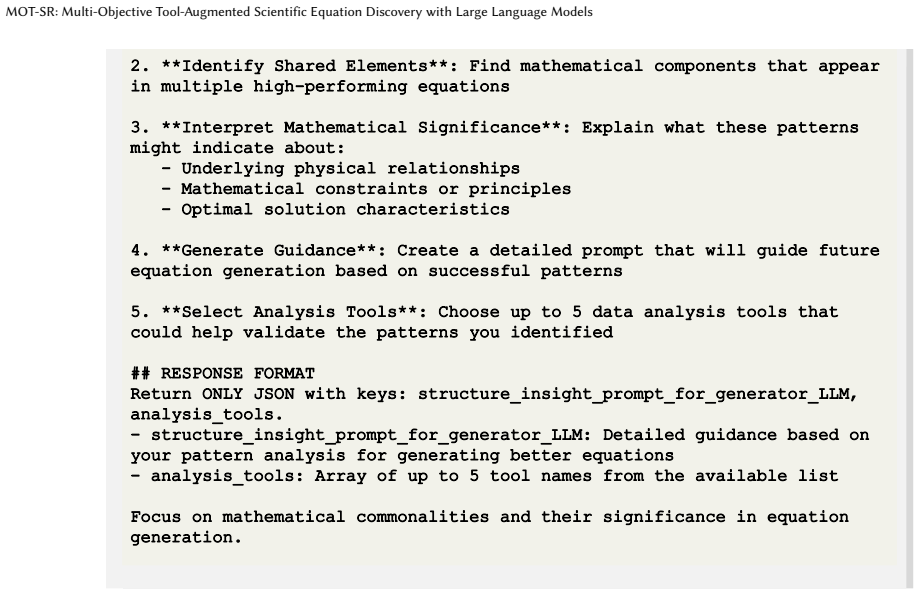
"analysis_tools" – a JSON array of 1–5 tool names from the allowed list. Escape newlines inside strings as `\n`. After the closing brace `}`, output nothing else. Meta Prompt Figure 16: Meta Prompt. ## Context {context} ## Mathematical Pattern Analysis Task Analyze the following equations to identify **common mathematical patterns and shared structural el...
-
[79]
**Select Analysis Tools**: Choose up to 5 data analysis tools that could help validate the patterns you identified ## RESPONSE FORMAT Return ONLY JSON with keys: structure_insight_prompt_for_generator_LLM, analysis_tools. - structure_insight_prompt_for_generator_LLM: Detailed guidance based on your pattern analysis for generating better equations - analys...
-
[84]
**Select Analysis Tools**: Choose up to 5 data analysis tools that could help validate the patterns you identified ## RESPONSE FORMAT Return ONLY JSON with keys: structure_insight_prompt_for_generator_LLM, analysis_tools. - structure_insight_prompt_for_generator_LLM: Detailed guidance based on your pattern analysis for generating better equations - analys...
-
[85]
arXiv:https://www.science.org/doi/pdf/10.1126/science.1165893doi:10.1126/ science.1165893
-
[86]
Incorporating the identified recurring mathematical functions
-
[87]
Using the successful variable interaction patterns
-
[88]
Maintaining coefficient relationships that work well
-
[89]
Respecting the physical constraints and relationships
-
[90]
Wang et al
Building upon the shared mathematical elements Oscillator1 Figure 18: Example Prompt in Oscillator1 - For Equation Generator. Wang et al. ## Data Analysis Results Applied 3 analysis tools to all variable pairs: **Tools used**: spearman_corr, residual_var, corr **Dataset overview**: - 2 independent variables analyzed - 10000 total data points ## Correlatio...
-
[96]
"" Find the mathematical function skeleton that represents acceleration in a damped nonlinear oscillator system with driving force, given data on position, and velocity
**Consider trade-offs**: Balance accuracy, generalization, and computational efficiency """ Find the mathematical function skeleton that represents acceleration in a damped nonlinear oscillator system with driving force, given data on position, and velocity. """ MOT-SR: Multi-Objective Tool-Augmented Scientific Equation Discovery with Large Language Model...
-
[97]
**Build upon success**: Use the selected high-quality solution as foundation
-
[98]
**Targeted improvement**: Focus on reducing residuals in identified problem areas
-
[99]
**Data-driven insights**: Incorporate findings from variable relationship analysis
discussion (0)
Sign in with ORCID, Apple, or X to comment. Anyone can read and Pith papers without signing in.