REVIEW 3 major objections 4 minor 5 cited by
Meson spectroscopy in the $Sp(4)$ gauge theory with three antisymmetric fermions
T0 review · 3 major / 4 minor · reviewed 2026-08-12 · deepseek-v4-flash
Pith's one-line read This paper reports lattice evidence that the massless Sp(4) gauge theory with three antisymmetric Dirac fermions confines and spontaneously breaks its approximate global symmetries, so the theory is QCD-like rather than conformal.
desk verdict First dynamical continuum-extrapolated meson spectrum for Sp(4) with three antisymmetric fermions: plausible QCD-like conclusion, but the massless numbers rest on a long WχPT extrapolation and a post-hoc ensemble cut. read the letter →
The pith
A machine-rendered reading of the paper's core claim, the machinery that carries it, and where it could break.
The reading
What carries the argument
The argument is carried by a combination of lattice technologies and a specific extrapolation ansatz. The lattice action is the standard plaquette gauge action with Wilson-Dirac fermions in the antisymmetric representation, simulated with the (rational) hybrid Monte Carlo algorithm for dynamical fermions, with the scale set by the gradient (Wilson) flow via the reference scale $w_0$. Meson masses and decay constants are extracted from two-point correlation functions of flavored bilinear operators, using stochastic wall sources and APE/Wuppertal smearing (iterative smoothing of sources and sinks), with a generalised eigenvalue problem for the first excited vector state. The central instrument is the NLO Wilson chiral perturbation theory ansatz, Eqs. (32)--(33), which assumes $\hat m_M^2 = \hat m_{M,\chi}^2(1+L_M^m \hat m_{\rm ps}^2)+W_M^m \hat a$ and likewise for decay constants; this functional form, applied to ensembles with $a m_{\rm ps}\lesssim 0.45$, converts the lattice data into continuum massless estimates and reveals QCD-like ordering of the spectrum. The discrimination between confinement and conformality comes from testing the measured mass dependence of $m_{\rm ps}/m_{\rm v}$ and $m_{\rm ps}/f_{\rm ps}$ against the hyperscaling behavior expected at an infrared fixed point.
What would settle it
A decisive test would be a new set of ensembles at substantially smaller fermion mass and finer lattice spacing, with $m_{\rm ps} L \gtrsim 7.5$ maintained: if the ratios $m_{\rm ps}/m_{\rm v}$ and $m_{\rm ps}/f_{\rm ps}$ flatten as the mass decreases while all composite-particle masses scale toward zero with a common exponent (hyperscaling), the confinement and chiral-breaking conclusion would be overturned; alternatively, a direct measurement of the chiral condensate in the massless limit that vanishes, together with flat dimensionless ratios, would indicate an infrared-conformal theory.
Extended reading notes
Core claim
The central claim is that the long-distance behavior of the Sp(4) theory with three antisymmetric Dirac fermions is confining and chirally broken, not conformal. The evidence is the fermion-mass dependence of dimensionless spectral ratios: $m_{\rm ps}/m_{\rm v}$ decreases as the partially-conserved-axial-current (PCAC) mass decreases, while $m_{\rm ps}/f_{\rm ps}$ drops sharply at small masses and the decay constants extrapolate to non-zero values in the massless limit; this contradicts the hyperscaling prediction of an infrared-conformal theory, in which all meson masses vanish with the same exponent and ratios stay flat. The measured spectrum has a light pseudoscalar, a heavier vector (with the tensor degenerate), and heavier scalar, axial-vector, and axial-tensor states, with a vector first-excited state extracted from a generalised eigenvalue problem. Fitting the light ensembles with a Wilson chiral perturbation theory ansatz linear in $\hat m_{\rm ps}^2$ and lattice spacing $\hat a$, the paper obtains finite, positive massless and continuum masses and decay constants, which it compares with quenched and $N_f=2$ results.
Load-bearing premise
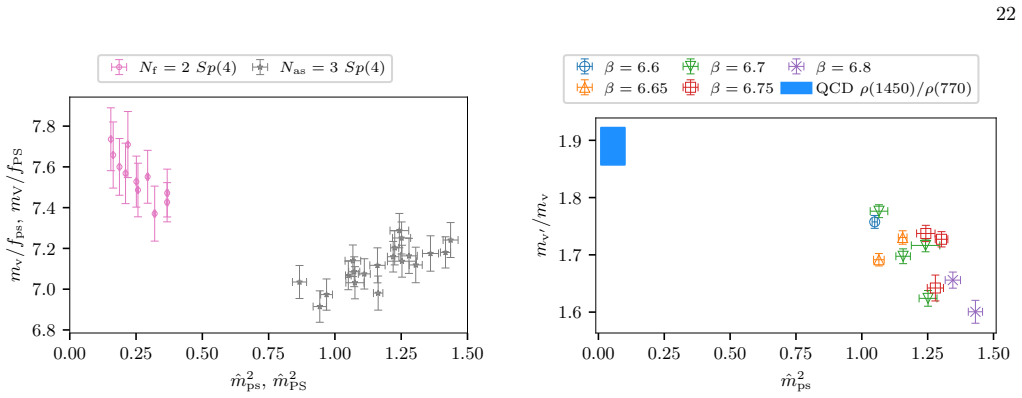
The extrapolated massless and continuum numbers rest on the assumption that the Wilson chiral perturbation theory ansatz, truncated to terms linear in $\hat m_{\rm ps}^2$ and in the lattice spacing $\hat a$, describes the data across a long lever arm where the lightest ensembles still have $m_{\rm ps}/m_{\rm v}\simeq 0.8$, and that excluding ensembles with $a m_{\rm ps}\gtrsim 0.45$ removes only lattice artefacts; if higher-order chiral logs, $O(a^2)$ effects, or the excluded heavy ensembles carry real dynamics, the numerical values in Table V are biased, while the qualitative confinement conclusion would survive.
Editorial extensions
If this is right
- If the massless limit is QCD-like, the $SU(6)\to SO(6)$ breaking pattern is available for composite Higgs models, and the constituent masses and decay constants in Table V provide the first dynamical inputs for such model building.
- The theory is not infrared conformal, so it does not sit inside the conformal window; searches for walking or near-conformal dynamics in $Sp(4)$ with antisymmetric matter must look elsewhere in parameter space.
- The continuum-extrapolated meson masses agree with quenched results for the vector, tensor, axial-vector, and axial-tensor channels, while the scalar mass is about 35% lower and the pseudoscalar and vector decay constants are larger, so dynamical fermion effects are visible and measurable.
- The measured ratio $m_v/f_{\rm ps}$ together with the Kawarabayashi-Suzuki-Riazuddin-Fayyazuddin (KSRF) relation gives a first estimate of the $v\to ps\,ps$ coupling, $g_{v\,ps\,ps}=4.656(80)$, which is smaller than in QCD and in the $N_f=2$ $Sp(4)$ theory.
Reading between the lines
- If the conclusion holds, the natural next target is the flavor-singlet scalar meson: a light scalar would signal dilaton-like near-conformal dynamics, and the paper's dilaton effective field theory (dEFT) exercise in Appendix E is a first, inconclusive step toward that test.
- The logarithmic dEFT scaling found in Appendix E, with fermion-condensate anomalous dimension $y\simeq 2.6$ roughly independent of lattice coupling, is a hint that the theory may sit close to, but outside, the conformal window; this is an interpretation the paper itself does not claim.
- A direct, testable extension would be a three-point function calculation of the $v\to ps\,ps$ coupling at smaller masses, which would replace the indirect KSRF estimate with a first-principles value and probe the approach to the hadronic regime.
- Because the fermion determinant is real and positive, the same algorithm can be applied at finite isospin chemical potential or finite temperature; if a first-order deconfinement transition exists there, the theory becomes a candidate source of gravitational waves from a dark sector, a direction the paper notes in its outlook.
Signed reviews
Editorial analysis
A structured set of objections, weighed in public.
Referee Report
Summary. This paper presents a lattice study of the Sp(4) gauge theory with three Dirac fermions in the two-index antisymmetric representation. The authors generate dynamical ensembles with unimproved Wilson fermions, map the bulk phase structure, set the scale via the Wilson flow, and measure masses and decay constants of flavored mesons in pseudoscalar, scalar, vector, tensor, axial-vector, and axial-tensor channels, including a GEVP extraction of the first excited vector state. They observe a mass dependence of mps/mv and mps/fps that they interpret as evidence for confinement with spontaneous chiral symmetry breaking, rather than IR conformality. They also perform continuum and massless extrapolations using a linear-in-mps^2 and linear-in-a ansatz inspired by NLO Wilson chiral perturbation theory, after post hoc selection of ensembles with amps < 0.45. The paper concludes that the theory is QCD-like, and provides the first dynamical estimates of the massless and continuum meson spectrum for this matter content, while explicitly cautioning about the length of the extrapolations and the inconclusiveness of a dilaton-EFT analysis in Appendix E.
Significance. If the qualitative conclusion holds, this is an important first dynamical lattice calculation for a theory of phenomenological interest in composite Higgs and dark matter model building. The paper is technically substantial: it combines a large ensemble campaign, finite-volume checks, topology monitoring, scale setting with Wilson flow, smeared-source spectroscopy, and a GEVP analysis, and it makes the data and analysis code publicly available (Refs. [302,303]). The comparison with quenched Sp(4) results and with the Nf=2 fundamental theory provides useful context and helps set the new results in a broader programme. The main limitation is that the quantitative spectrum in Table V rests on a long extrapolation from data that never enter the chiral regime, and the selection of ensembles used for that extrapolation is data-driven; these points are acknowledged in the text but need to be addressed more systematically before the quantitative numbers can be taken as definitive.
major comments (3)
- [Section VA, Table I] The threshold amps < 0.45 that defines the ensembles used in the continuum and massless extrapolation is determined a posteriori from the same data: after observing in Fig. 11 that the heavier ensembles cluster in a small region, the authors define the lighter set as those for which a linear relation between m_v^2 and m_ps^2 appears. This makes the selection criterion data-dependent, and if the 'heavy' ensembles (e.g., ASB0M1, ASB1M1, ASB2M1, ASB2M4, ASB3M1, ASB4M1, ASB4M2) carry physical dynamics rather than pure lattice artefacts, the fits are biased. Please demonstrate robustness by repeating the fits with the threshold varied over a reasonable range (for instance 0.40 to 0.50) and by presenting a fit that includes the heavy ensembles, or that adds a quadratic term in m_ps^2, and quantify the resulting shift in the Table V intercepts.
- [Section VB, Eqs. (32)-(33)] The continuum extrapolation assumes that the theory is in the chirally broken phase and imposes a linear form in m_ps^2 and a. The lightest retained ensemble still has mps/mv ≈ 0.8 and m_ps w0 ≈ 1, and the fit range in Fig. 12 is m_ps^2 w0^2 ≈ 0.8-1.5, so the extrapolation to zero is long. If the massless theory were IR conformal, this ansatz would be inapplicable, and the continuum fit cannot serve as an unbiased discriminator between the chiral and conformal scenarios. The qualitative 'not conformal' claim therefore rests mainly on the fixed-beta mass dependence of mps/mv and mps/fps (Figs. 6 and 7), which is subject to mass-dependent O(a) effects because the action is unimproved. Please either add an estimate of O(a^2) and higher-order chiral/log corrections, or state more explicitly in the Summary that the massless and continuum numbers in Table V are conditional on the chirally broken phase.
- [Section IIIC, Table III] Several ensembles used in the continuum extrapolation have very small numbers of effectively independent configurations for the Wilson flow scale: for example, ASB0M3 has N_GF_traj = 18, ASB1M5 has 17, ASB2M7 has 9, and ASB2M9 has 12, while the estimated autocorrelation times tau_w0 are comparable to or larger than the retained samples (Table XI). The bootstrap errors on w0/a, and hence on all hatted quantities entering Eqs. (32)-(33), are therefore likely underestimated. Please provide a more conservative estimate of the scale-setting uncertainty (for example, a cross-check using the t0 scale, or a binning analysis that accounts for the measured autocorrelation) and show its effect on the Table V intercepts.
minor comments (4)
- [Section IVB, Eqs. (28)-(29)] The one-loop perturbative renormalisation factors for the decay constants are used without an estimate of the two-loop or nonperturbative uncertainty; given the small statistical samples in the axial-vector channel, a sentence quantifying the expected size of the missing terms would help the reader assess the systematic error.
- [Appendix E] The statement that the scaling dimension y is 'independent of the lattice coupling, y ≃ 2.6' is not accompanied by uncertainties or fit qualities; since the exercise is explicitly described as inconclusive, please either add these numbers or remove the quantitative value to avoid giving it undue weight.
- [Section VC, Fig. 16] The QCD comparison uses the experimental ratio rho(1450)/rho(770); the label in the text should be checked against the PDG naming (the state is usually denoted rho(1450), not rho(1440)).
- [Section VI] The sentence 'the decay of the lightest vector meson into pairs of pseudoscalars is kinematically forbidden' is true for the simulated ensembles, but in the extrapolated massless limit m_v/m_ps is about 1.3 and this phase space would open; please clarify that the statement refers to the simulated mass range.
Circularity Check
No significant circularity: the confinement/chiral-breaking claim rests on direct fixed-β mass dependence of measured ratios, while the WχPT continuum extrapolation and Wilson-flow scale choice are transparent fitting/convention steps, not inputs masquerading as predictions.
full rationale
The paper's central claim, 'We have evidence that the theory displays confinement, accompanied by spontaneous breaking of its (approximately) global symmetries' (Sect. VI), is supported by direct measurements rather than by fitted extrapolations or self-citations. The fixed-coupling data show mass dependence in dimensionless ratios: for mps/mv, 'In a IR-conformal theory this ratio should be independent of the fermion mass; conversely we find clear evidence of a variation of this ratio, as the hyperquark mass changes' (Sect. VA), and for mps/fps, 'this ratio sharply drops for amPCAC ≲ 0.07 ... the results for the lighter ensembles contradict the hyperscaling hypothesis.' These are raw lattice observables compared with an external scaling prediction; no fitted parameter is renamed as a prediction. The continuum and massless extrapolations in Eqs. (32)-(33) are explicitly fits: 'The resulting best-fit values of these LECs are presented in Table V,' followed by the caveat that 'the massless extrapolations are rather long, and hence the results of this analysis might be affected by significant systematic extrapolation effects' (Sect. VB). The WχPT ansatz is standard external input (Refs. [297-299]) and is not derived from this paper's own results; moreover, the paper does not use the extrapolated Table V values as the evidence for confinement or chiral symmetry breaking. The Wilson-flow reference value W0 = 0.28125 is taken from the authors' earlier large-N scaling work [147], but scale setting is a convention that does not enter the dimensionless ratios carrying the phase determination, and the comparisons to quenched and Nf=2 data serve as external benchmarks. The acknowledged limitations—'slow evolution ... might be a consequence of near-conformal dynamics' (Sect. VA), 'grain of salt' (Sect. VB), and the 'inconclusive' dEFT exercise (Appendix E)—are validity and systematic-error caveats, not circular reductions. No equation or parameter in the paper reduces by construction to an input of the claimed result.
Assumptions & free parameters
free parameters (6)
- Wilson flow reference W0 =
0.28125 with clover energy density
- NLO WchiPT mass LECs m^2_M,chi for v, t, av, at, s, v' =
0.644(24), 0.637(24), 1.841(98), 2.37(12), 1.098(79), 3.41(44)
- NLO WchiPT decay-constant LECs f^2_M,chi for ps, v, av =
0.01769(97), 0.0464(37), 0.087(14)
- NLO WchiPT slope and discretisation coefficients L and W =
see Table V for six mass channels and three decay-constant channels
- Light-ensemble selection threshold amps < 0.45 =
0.45 in lattice units
- dEFT scaling dimension y =
y approximately 2.6
assumptions (6)
- domain assumption Wilson chiral perturbation theory truncated at NLO in the form of Eqs. (32)-(33) describes the mass and lattice-spacing dependence over the simulated range.
- domain assumption The Wilson flow scale w0 with W0 = 0.28125 is a valid common physical scale across different beta and fermion masses, despite its strong mass dependence.
- domain assumption Finite-volume effects are negligible when minf_ps L >= 7.5.
- domain assumption The unimproved Wilson and plaquette action has O(a) discretisation errors fully captured by the linear W a term in the continuum extrapolation.
- standard math The vector and tensor operators interpolate the same continuum states, so a 2x2 GEVP extracts the ground and first excited vector masses.
- domain assumption One-loop lattice perturbation theory with tadpole improvement gives the renormalisation factors for decay constants in Eqs. (28)-(29).
Cite this review
Pith. "Pith review of Meson spectroscopy in the $Sp(4)$ gauge theory with three antisymmetric fermions." pith.science (2026). https://pith.science/paper/V4CNDIFY
@misc{pith2026241201170,
  author       = {Pith},
  title        = {Pith review of: Meson spectroscopy in the $Sp(4)$ gauge theory with three antisymmetric fermions},
  year         = {2026},
  howpublished = {\url{https://pith.science/paper/V4CNDIFY}},
  note         = {Machine review of arXiv:2412.01170}
}
abstract
We report the results of an extensive numerical study of the $Sp(4)$ lattice gauge theory with three (Dirac) flavors of fermion in the two-index antisymmetric representation. In the presence of (degenerate) fermion masses, the theory has an enhanced global $SU(6)$ symmetry, broken explicitly and spontaneously to its $SO(6)$ subgroup. This symmetry breaking pattern makes the theory interesting for applications in the context of composite Higgs models, as well as for the implementation of top partial compositeness. It can also provide a dynamical realisation of the strongly interacting massive particle paradigm for the origin of dark matter. We adopt the standard plaquette gauge action with the Wilson-Dirac formulation for the fermions and apply the (rational) hybrid Monte Carlo algorithm in our ensemble generation process. We monitor the autocorrelation and topology of the ensembles. We explore the bare parameter space, and identify the weak and strong coupling regimes separated by a line of first-order bulk phase transitions. We measure two-point correlation functions between meson operators that transform as non-trivial representations of $SO(6)$, and extract the ground-state masses and the decay constants, in all accessible spin and parity channels. In addition, we measure the mass of the first excited state for the vector meson by solving a generalised eigenvalue problem. Spectral quantities show a mass dependence that is compatible with the expectation that, at long distances, the theory undergoes confinement, accompanied by the spontaneous breaking of the approximate global symmetries acting on the matter fields. Finally, we discuss the continuum and massless extrapolations, after setting the physical scale using the gradient flow method, and compare the results to those of existing studies in the quenched approximation, as well as to the literature on closely related theories.
Figures


Figures from the paper (14 more)




Forward citations
Cited by 5 Pith papers
-
Dark matter in composite Higgs models with a scotogenic EFT
In the SU(6)/Sp(6) composite Higgs model with a scotogenic Z2, three of four neutral pseudo-Goldstone dark matter candidates can reproduce the observed relic density, while the SU(2)L triplet candidate fails; spin-1 r...
-
Dilaton Effective Field Theory across the Conformal Edge
Fitting a dilaton EFT with a free exponent Δ to lattice spectra indicates SU(3) N_f=8 is confining (Δ<4) and SU(2) adjoint is infrared conformal (Δ>4).
-
Gluon Gravitational $ D$-Form Factor: The $\sigma$-Meson as a Dilaton Confronted with Lattice Data II
σ-pole residues in gluon D-form factors for π, N, ρ and Δ are consistent with dilaton effective theory predictions within large uncertainties.
-
Dilatonic states, phase transitions, and criticality in holography
A review of holographic examples indicating that a light dilaton appears near critical endpoints of first-order zero-temperature phase transitions, with explicit but lower-dimensional demonstrations.
-
Reproducibility and Open Science in Lattice Quantum Field Theory
A Lattice 2024 panel contribution advocating for open data, software, and workflows in lattice quantum field theory, summarizing community infrastructure and practical recommendations.
Reference graph
Works this paper leans on
-
[1]
We then estimate the corresponding auto- correlation lengths, τ w0 exp and τ Q exp, from exponential fits to CE (τ ) and CQ(τ )
and Q(t = L2/32), respectively. We then estimate the corresponding auto- correlation lengths, τ w0 exp and τ Q exp, from exponential fits to CE (τ ) and CQ(τ ). We present the results for τ w0 exp and τ Q exp in Table XI. The measurements of the flowed observables have been carried out on the configurations already separated byδtraj trajectories, leaving ...
-
[2]
Kaplan and H
D.B. Kaplan and H. Georgi,SU(2) x U(1) Breaking by Vacuum Misalignment, Phys. Lett. B136 (1984) 183
1984
-
[3]
Georgi and D.B
H. Georgi and D.B. Kaplan,Composite Higgs and Custodial SU(2), Phys. Lett. B145 (1984) 216
1984
-
[4]
Dugan, H
M.J. Dugan, H. Georgi and D.B. Kaplan,Anatomy of a Composite Higgs Model, Nucl. Phys. B254 (1985) 299
1985
- [5]
-
[6]
Witzel,Review on Composite Higgs Models, PoS LATTICE2018(2019) 006 [1901.08216]
O. Witzel,Review on Composite Higgs Models, PoS LATTICE2018(2019) 006 [1901.08216]
arXiv 2019
-
[7]
G. Cacciapaglia, C. Pica and F. Sannino,Fundamental Composite Dynamics: A Review, Phys. Rept.877 (2020) 1 [2002.04914]. 33
arXiv 2020
-
[8]
G. Ferretti and D. Karateev,Fermionic UV completions of Composite Higgs models, JHEP 03 (2014) 077 [1312.5330]
arXiv 2014
Show all 300 references
-
[9]
Ferretti,Gauge theories of Partial Compositeness: Scenarios for Run-II of the LHC, JHEP 06 (2016) 107 [1604.06467]
G. Ferretti,Gauge theories of Partial Compositeness: Scenarios for Run-II of the LHC, JHEP 06 (2016) 107 [1604.06467]
2016 arXiv
-
[10]
Cacciapaglia, G
G. Cacciapaglia, G. Ferretti, T. Flacke and H. Serôdio, Light scalars in composite Higgs models, Front. in Phys. 7 (2019) 22 [1902.06890]
2019 arXiv
-
[11]
Katz, A.E
E. Katz, A.E. Nelson and D.G.E. Walker,The Intermediate Higgs, JHEP 08 (2005) 074 [hep-ph/0504252]
2005 arXiv
-
[12]
Barbieri, B
R. Barbieri, B. Bellazzini, V.S. Rychkov and A. Varagnolo,The Higgs boson from an extended symmetry, Phys. Rev. D76 (2007) 115008 [0706.0432]
2007 arXiv
-
[13]
Lodone,Vector-like quarks in a ’composite’ Higgs model, JHEP 12 (2008) 029 [0806.1472]
P. Lodone,Vector-like quarks in a ’composite’ Higgs model, JHEP 12 (2008) 029 [0806.1472]
2008 arXiv
-
[14]
Gripaios, A
B. Gripaios, A. Pomarol, F. Riva and J. Serra,Beyond the Minimal Composite Higgs Model, JHEP 04 (2009) 070 [0902.1483]
2009 arXiv
-
[15]
Mrazek, A
J. Mrazek, A. Pomarol, R. Rattazzi, M. Redi, J. Serra and A. Wulzer,The Other Natural Two Higgs Doublet Model, Nucl. Phys. B853 (2011) 1 [1105.5403]
2011 arXiv
-
[16]
Marzocca, M
D. Marzocca, M. Serone and J. Shu,General Composite Higgs Models, JHEP 08 (2012) 013 [1205.0770]
2012 arXiv
-
[17]
Grojean, O
C. Grojean, O. Matsedonskyi and G. Panico,Light top partners and precision physics, JHEP 10 (2013) 160 [1306.4655]
2013 arXiv
-
[18]
Cacciapaglia and F
G. Cacciapaglia and F. Sannino,Fundamental Composite (Goldstone) Higgs Dynamics, JHEP 04 (2014) 111 [1402.0233]
2014 arXiv
-
[19]
Ferretti,UV Completions of Partial Compositeness: The Case for a SU(4) Gauge Group, JHEP 06 (2014) 142 [1404.7137]
G. Ferretti,UV Completions of Partial Compositeness: The Case for a SU(4) Gauge Group, JHEP 06 (2014) 142 [1404.7137]
2014 arXiv
-
[20]
Arbey, G
A. Arbey, G. Cacciapaglia, H. Cai, A. Deandrea, S. Le Corre and F. Sannino,Fundamental Composite Electroweak Dynamics: Status at the LHC, Phys. Rev. D 95 (2017) 015028 [1502.04718]
2017 arXiv
-
[21]
Cacciapaglia, H
G. Cacciapaglia, H. Cai, A. Deandrea, T. Flacke, S.J. Lee and A. Parolini,Composite scalars at the LHC: the Higgs, the Sextet and the Octet, JHEP 11 (2015) 201 [1507.02283]
2015 arXiv
-
[22]
Feruglio, B
F. Feruglio, B. Gavela, K. Kanshin, P.A.N. Machado, S. Rigolin and S. Saa,The minimal linear sigma model for the Goldstone Higgs, JHEP 06 (2016) 038 [1603.05668]
2016 arXiv
-
[23]
DeGrand, M
T. DeGrand, M. Golterman, E.T. Neil and Y. Shamir, One-loop Chiral Perturbation Theory with two fermion representations, Phys. Rev. D94 (2016) 025020 [1605.07738]
2016 arXiv
-
[24]
Fichet, G
S. Fichet, G. von Gersdorff, E. Pontón and R. Rosenfeld,The Excitation of the Global Symmetry-Breaking Vacuum in Composite Higgs Models, JHEP 09 (2016) 158 [1607.03125]
2016 arXiv
-
[25]
Galloway, A.L
J. Galloway, A.L. Kagan and A. Martin,A UV complete partially composite-pNGB Higgs, Phys. Rev. D 95 (2017) 035038 [1609.05883]
2017 arXiv
-
[26]
Agugliaro, O
A. Agugliaro, O. Antipin, D. Becciolini, S. De Curtis and M. Redi,UV complete composite Higgs models, Phys. Rev. D95 (2017) 035019 [1609.07122]
2017 arXiv
-
[27]
Belyaev, G
A. Belyaev, G. Cacciapaglia, H. Cai, G. Ferretti, T. Flacke, A. Parolini et al.,Di-boson signatures as Standard Candles for Partial Compositeness, JHEP 01 (2017) 094 [1610.06591]
2017 arXiv
-
[28]
Csaki, T
C. Csaki, T. Ma and J. Shu,Maximally Symmetric Composite Higgs Models, Phys. Rev. Lett.119 (2017) 131803 [1702.00405]
2017 arXiv
-
[29]
Chala, G
M. Chala, G. Durieux, C. Grojean, L. de Lima and O. Matsedonskyi,Minimally extended SILH, JHEP 06 (2017) 088 [1703.10624]
2017 arXiv
-
[30]
Golterman and Y
M. Golterman and Y. Shamir,Effective potential in ultraviolet completions for composite Higgs models, Phys. Rev. D97 (2018) 095005 [1707.06033]
2018 arXiv
-
[31]
Csáki, T
C. Csáki, T. Ma and J. Shu,Trigonometric Parity for Composite Higgs Models, Phys. Rev. Lett.121 (2018) 231801 [1709.08636]
2018 arXiv
-
[32]
Alanne, D
T. Alanne, D. Buarque Franzosi and M.T. Frandsen,A partially composite Goldstone Higgs, Phys. Rev. D96 (2017) 095012 [1709.10473]
2017 arXiv
-
[33]
Alanne, D
T. Alanne, D. Buarque Franzosi, M.T. Frandsen, M.L.A. Kristensen, A. Meroni and M. Rosenlyst, Partially composite Higgs models: Phenomenology and RG analysis, JHEP 01 (2018) 051 [1711.10410]
2018 arXiv
-
[34]
Sannino, P
F. Sannino, P. Stangl, D.M. Straub and A.E. Thomsen,Flavor Physics and Flavor Anomalies in Minimal Fundamental Partial Compositeness, Phys. Rev. D97 (2018) 115046 [1712.07646]
2018 arXiv
-
[35]
Alanne, N
T. Alanne, N. Bizot, G. Cacciapaglia and F. Sannino, Classification of NLO operators for composite Higgs models, Phys. Rev. D97 (2018) 075028 [1801.05444]
2018 arXiv
-
[36]
Bizot, G
N. Bizot, G. Cacciapaglia and T. Flacke,Common exotic decays of top partners, JHEP 06 (2018) 065 [1803.00021]
2018 arXiv
-
[37]
C. Cai, G. Cacciapaglia and H.-H. Zhang,Vacuum alignment in a composite 2HDM, JHEP 01 (2019) 130 [1805.07619]
2019 arXiv
-
[38]
Agugliaro, G
A. Agugliaro, G. Cacciapaglia, A. Deandrea and S. De Curtis,Vacuum misalignment and pattern of scalar masses in the SU(5)/SO(5) composite Higgs model, JHEP 02 (2019) 089 [1808.10175]
2019 arXiv
-
[39]
Cacciapaglia, T
G. Cacciapaglia, T. Ma, S. Vatani and Y. Wu,Towards a fundamental safe theory of composite Higgs and Dark Matter, Eur. Phys. J. C80 (2020) 1088 [1812.04005]
2020 arXiv
-
[40]
Gertov, A.E
H. Gertov, A.E. Nelson, A. Perko and D.G.E. Walker, Lattice-Friendly Gauge Completion of a Composite Higgs with Top Partners, JHEP 02 (2019) 181 [1901.10456]
2019 arXiv
-
[41]
Ayyar, M.F
V. Ayyar, M.F. Golterman, D.C. Hackett, W. Jay, E.T. Neil, Y. Shamir et al.,Radiative Contribution to the Composite-Higgs Potential in a Two-Representation Lattice Model, Phys. Rev. D99 (2019) 094504 [1903.02535]
2019 arXiv
-
[42]
Cacciapaglia, H
G. Cacciapaglia, H. Cai, A. Deandrea and A. Kushwaha,Composite Higgs and Dark Matter Model in SU(6)/SO(6), JHEP 10 (2019) 035 [1904.09301]
2019 arXiv
-
[43]
Buarque Franzosi and G
D. Buarque Franzosi and G. Ferretti,Anomalous dimensions of potential top-partners, SciPost Phys.7 (2019) 027 [1905.08273]
2019 arXiv
-
[44]
Cacciapaglia, S
G. Cacciapaglia, S. Vatani and C. Zhang,Composite Higgs Meets Planck Scale: Partial Compositeness from Partial Unification, Phys. Lett. B815 (2021) 136177 [1911.05454]
2021 arXiv
-
[45]
Cacciapaglia, A
G. Cacciapaglia, A. Deandrea, T. Flacke and A.M. Iyer,Gluon-Photon Signatures for color octet at the LHC (and beyond), JHEP 05 (2020) 027 34 [2002.01474]
2020 arXiv
-
[46]
Dong, C.-S
Z.-Y. Dong, C.-S. Guan, T. Ma, J. Shu and X. Xue, UV completed composite Higgs model with heavy composite partners, Phys. Rev. D104 (2021) 035013 [2011.09460]
2021 arXiv
-
[47]
Cacciapaglia, T
G. Cacciapaglia, T. Flacke, M. Kunkel and W. Porod, Phenomenology of unusual top partners in composite Higgs models, JHEP 02 (2022) 208 [2112.00019]
2022 arXiv
-
[48]
Banerjee, D.B
A. Banerjee, D.B. Franzosi and G. Ferretti,Modelling vector-like quarks in partial compositeness framework, JHEP 03 (2022) 200 [2202.00037]
2022 arXiv
-
[49]
Ferretti,Compositeness above the electroweak scale and a proposed test at LHCb, EPJ Web Conf.258 (2022) 08002
G. Ferretti,Compositeness above the electroweak scale and a proposed test at LHCb, EPJ Web Conf.258 (2022) 08002
2022
-
[50]
Cai and G
H. Cai and G. Cacciapaglia,Partial compositeness under precision scrutiny, JHEP 12 (2022) 104 [2208.04290]
2022 arXiv
-
[51]
Cacciapaglia, A
G. Cacciapaglia, A. Deandrea, M. Kunkel and W. Porod,Coloured spin-1 states in composite Higgs models, JHEP 06 (2024) 092 [2404.02198]
2024 arXiv
-
[52]
Banerjee, E
A. Banerjee, E. Bergeaas Kuutmann, V. Ellajosyula, R. Enberg, G. Ferretti and L. Panizzi,Vector-like quarks: status and new directions at the LHC, 2406.09193
-
[53]
Contino, Y
R. Contino, Y. Nomura and A. Pomarol,Higgs as a holographic pseudoGoldstone boson, Nucl. Phys. B671 (2003) 148 [hep-ph/0306259]
2003 arXiv
-
[54]
Agashe, R
K. Agashe, R. Contino and A. Pomarol,The Minimal composite Higgs model, Nucl. Phys. B719 (2005) 165 [hep-ph/0412089]
2005 arXiv
-
[55]
Agashe and R
K. Agashe and R. Contino,The Minimal composite Higgs model and electroweak precision tests, Nucl. Phys. B742 (2006) 59 [hep-ph/0510164]
2006 arXiv
-
[56]
Agashe, R
K. Agashe, R. Contino, L. Da Rold and A. Pomarol,A Custodial symmetry forZb¯b, Phys. Lett. B641 (2006) 62 [hep-ph/0605341]
2006 arXiv
-
[57]
Contino, L
R. Contino, L. Da Rold and A. Pomarol,Light custodians in natural composite Higgs models, Phys. Rev. D75 (2007) 055014 [hep-ph/0612048]
2007 arXiv
-
[58]
Falkowski and M
A. Falkowski and M. Perez-Victoria,Electroweak Breaking on a Soft Wall, JHEP 12 (2008) 107 [0806.1737]
2008 arXiv
-
[59]
Contino,The Higgs as a Composite Nambu-Goldstone Boson, 1005.4269
R. Contino,The Higgs as a Composite Nambu-Goldstone Boson, 1005.4269
-
[60]
Contino, D
R. Contino, D. Marzocca, D. Pappadopulo and R. Rattazzi,On the effect of resonances in composite Higgs phenomenology, JHEP 10 (2011) 081 [1109.1570]
2011 arXiv
-
[61]
Erdmenger, N
J. Erdmenger, N. Evans, W. Porod and K.S. Rigatos, Gauge/gravity dynamics for composite Higgs models and the top mass, Phys. Rev. Lett.126 (2021) 071602 [2009.10737]
2021 arXiv
-
[62]
Erdmenger, N
J. Erdmenger, N. Evans, W. Porod and K.S. Rigatos, Gauge/gravity dual dynamics for the strongly coupled sector of composite Higgs models, JHEP 02 (2021) 058 [2010.10279]
2021 arXiv
-
[63]
Elander and M
D. Elander and M. Piai,Towards top-down holographic composite Higgs: minimal coset from maximal supergravity, JHEP 03 (2022) 049 [2110.02945]
2022 arXiv
-
[64]
Elander, A
D. Elander, A. Fatemiabhari and M. Piai,Toward minimal composite Higgs models from regular geometries in bottom-up holography, Phys. Rev. D107 (2023) 115021 [2303.00541]
2023 arXiv
-
[65]
Erdmenger, N
J. Erdmenger, N. Evans, Y. Liu and W. Porod, Holographic Non-Abelian Flavour Symmetry Breaking, Universe 9 (2023) 289 [2304.09190]
2023 arXiv
-
[66]
Elander, A
D. Elander, A. Fatemiabhari and M. Piai,On Holographic Vacuum Misalignment, 2405.08714
-
[67]
Kaplan,Flavor at SSC energies: A New mechanism for dynamically generated fermion masses, Nucl
D.B. Kaplan,Flavor at SSC energies: A New mechanism for dynamically generated fermion masses, Nucl. Phys. B365 (1991) 259
1991
-
[68]
Grossman and M
Y. Grossman and M. Neubert,Neutrino masses and mixings in nonfactorizable geometry, Phys. Lett. B 474 (2000) 361 [hep-ph/9912408]
2000 arXiv
-
[69]
Gherghetta and A
T. Gherghetta and A. Pomarol,Bulk fields and supersymmetry in a slice of AdS, Nucl. Phys. B586 (2000) 141 [hep-ph/0003129]
2000 arXiv
-
[70]
Chacko and R.K
Z. Chacko and R.K. Mishra,Effective Theory of a Light Dilaton, Phys. Rev. D87 (2013) 115006 [1209.3022]
2013 arXiv
-
[71]
Strassler and K.M
M.J. Strassler and K.M. Zurek,Echoes of a hidden valley at hadron colliders, Phys. Lett. B651 (2007) 374 [hep-ph/0604261]
2007 arXiv
-
[72]
Cheung and T.-C
K. Cheung and T.-C. Yuan,Hidden fermion as milli-charged dark matter in Stueckelberg Z- prime model, JHEP 03 (2007) 120 [hep-ph/0701107]
2007 arXiv
-
[73]
Hambye,Hidden vector dark matter, JHEP 01 (2009) 028 [0811.0172]
T. Hambye,Hidden vector dark matter, JHEP 01 (2009) 028 [0811.0172]
2009 arXiv
-
[74]
J.L. Feng, M. Kaplinghat, H. Tu and H.-B. Yu,Hidden Charged Dark Matter, JCAP 07 (2009) 004 [0905.3039]
2009 arXiv
-
[75]
Cohen, D.J
T. Cohen, D.J. Phalen, A. Pierce and K.M. Zurek, Asymmetric Dark Matter from a GeV Hidden Sector, Phys. Rev. D82 (2010) 056001 [1005.1655]
2010 arXiv
-
[76]
Foot and S
R. Foot and S. Vagnozzi,Dissipative hidden sector dark matter, Phys. Rev. D91 (2015) 023512 [1409.7174]
2015 arXiv
-
[77]
Bertone and D
G. Bertone and D. Hooper,History of dark matter, Rev. Mod. Phys.90 (2018) 045002 [1605.04909]
2018 arXiv
-
[78]
Del Nobile, C
E. Del Nobile, C. Kouvaris and F. Sannino,Interfering Composite Asymmetric Dark Matter for DAMA and CoGeNT, Phys. Rev. D84 (2011) 027301 [1105.5431]
2011 arXiv
-
[79]
Hietanen, R
A. Hietanen, R. Lewis, C. Pica and F. Sannino, Composite Goldstone Dark Matter: Experimental Predictions from the Lattice, JHEP 12 (2014) 130 [1308.4130]
2014 arXiv
-
[80]
Cline, W
J.M. Cline, W. Huang and G.D. Moore,Challenges for models with composite states, Phys. Rev. D94 (2016) 055029 [1607.07865]
2016 arXiv
-
[81]
Dondi, F
N.A. Dondi, F. Sannino and J. Smirnov,Thermal history of composite dark matter, Phys. Rev. D101 (2020) 103010 [1905.08810]
2020 arXiv
-
[82]
S. Ge, K. Lawson and A. Zhitnitsky,Axion quark nugget dark matter model: Size distribution and survival pattern, Phys. Rev. D99 (2019) 116017 [1903.05090]
2019 arXiv
-
[83]
Beylin, M.Y
V. Beylin, M.Y. Khlopov, V. Kuksa and N. Volchanskiy,Hadronic and Hadron-Like Physics of Dark Matter, Symmetry 11 (2019) 587 [1904.12013]
2019 arXiv
-
[84]
Yamanaka, H
N. Yamanaka, H. Iida, A. Nakamura and M. Wakayama,Dark matter scattering cross section and dynamics in dark Yang-Mills theory, Phys. Lett. B 813 (2021) 136056 [1910.01440]
2021 arXiv
-
[85]
Yamanaka, H
N. Yamanaka, H. Iida, A. Nakamura and M. Wakayama,Glueball scattering cross section in lattice SU(2) Yang-Mills theory, Phys. Rev. D102 (2020) 054507 [1910.07756]
2020 arXiv
-
[86]
Cai and G
H. Cai and G. Cacciapaglia,Singlet dark matter in the SU(6)/SO(6) composite Higgs model, Phys. Rev. D 35 103 (2021) 055002 [2007.04338]
2021 arXiv
-
[87]
Pomper and S
J. Pomper and S. Kulkarni,Low energy effective theories of composite dark matter with real representations, 2402.04176
-
[88]
Appelquist, J
T. Appelquist, J. Ingoldby and M. Piai,Dilaton forbidden dark matter, Phys. Rev. D110 (2024) 035013 [2404.07601]
2024 arXiv
-
[89]
Hochberg, E
Y. Hochberg, E. Kuflik, T. Volansky and J.G. Wacker, Mechanism for Thermal Relic Dark Matter of Strongly Interacting Massive Particles, Phys. Rev. Lett.113 (2014) 171301 [1402.5143]
2014 arXiv
-
[90]
Hochberg, E
Y. Hochberg, E. Kuflik, H. Murayama, T. Volansky and J.G. Wacker,Model for Thermal Relic Dark Matter of Strongly Interacting Massive Particles, Phys. Rev. Lett.115 (2015) 021301 [1411.3727]
2015 arXiv
-
[91]
Hochberg, E
Y. Hochberg, E. Kuflik and H. Murayama,SIMP Spectroscopy, JHEP 05 (2016) 090 [1512.07917]
2016 arXiv
-
[92]
Bernal, X
N. Bernal, X. Chu and J. Pradler,Simply split strongly interacting massive particles, Phys. Rev. D95 (2017) 115023 [1702.04906]
2017 arXiv
-
[93]
Berlin, N
A. Berlin, N. Blinov, S. Gori, P. Schuster and N. Toro, Cosmology and Accelerator Tests of Strongly Interacting Dark Matter, Phys. Rev. D97 (2018) 055033 [1801.05805]
2018 arXiv
-
[94]
Bernal, X
N. Bernal, X. Chu, S. Kulkarni and J. Pradler, Self-interacting dark matter without prejudice, Phys. Rev. D101 (2020) 055044 [1912.06681]
2020 arXiv
-
[95]
Y.-D. Tsai, R. McGehee and H. Murayama,Resonant Self-Interacting Dark Matter from Dark QCD, Phys. Rev. Lett.128 (2022) 172001 [2008.08608]
2022 arXiv
-
[96]
Kondo, R
D. Kondo, R. McGehee, T. Melia and H. Murayama, Linear sigma dark matter, JHEP 09 (2022) 041 [2205.08088]
2022 arXiv
- [97]
-
[98]
X. Chu, M. Nikolic and J. Pradler,Even SIMP miracles are possible, Phys. Rev. Lett.133 (2024) 2 [2401.12283]
2024 arXiv
- [99]
-
[100]
Arkani-Hamed, H.-C
N. Arkani-Hamed, H.-C. Cheng, P. Creminelli and L. Randall,Pseudonatural inflation, JCAP 07 (2003) 003 [hep-th/0302034]
2003 arXiv
-
[101]
Cacciapaglia, D.Y
G. Cacciapaglia, D.Y. Cheong, A. Deandrea, W. Isnard and S.C. Park,Composite hybrid inflation: dilaton and waterfall pions, JCAP 10 (2023) 063 [2307.01852]
2023 arXiv
-
[102]
Liu, H.-X
J. Liu, H.-X. Zhang, S. Matsuzaki and H. Ishida, Walking-dilaton hybrid inflation with B− L Higgs embedded in dynamical scalegenesis, JHEP 10 (2024) 069 [2407.17748]
2024 arXiv
-
[103]
Witten,Cosmic Separation of Phases, Phys
E. Witten,Cosmic Separation of Phases, Phys. Rev. D 30 (1984) 272
1984
-
[104]
Kamionkowski, A
M. Kamionkowski, A. Kosowsky and M.S. Turner, Gravitational radiation from first order phase transitions, Phys. Rev. D49 (1994) 2837 [astro-ph/9310044]
1994 arXiv
-
[105]
Allen,The Stochastic gravity wave background: Sources and detection, inLes Houches School of Physics: Astrophysical Sources of Gravitational Radiation, pp
B. Allen,The Stochastic gravity wave background: Sources and detection, inLes Houches School of Physics: Astrophysical Sources of Gravitational Radiation, pp. 373–417, 4, 1996 [gr-qc/9604033]
1996 arXiv
-
[106]
Schwaller,Gravitational Waves from a Dark Phase Transition, Phys
P. Schwaller,Gravitational Waves from a Dark Phase Transition, Phys. Rev. Lett.115 (2015) 181101 [1504.07263]
2015 arXiv
-
[107]
Croon, V
D. Croon, V. Sanz and G. White,Model Discrimination in Gravitational Wave spectra from Dark Phase Transitions, JHEP 08 (2018) 203 [1806.02332]
2018 arXiv
-
[108]
Christensen,Stochastic Gravitational Wave Backgrounds, Rept
N. Christensen,Stochastic Gravitational Wave Backgrounds, Rept. Prog. Phys.82 (2019) 016903 [1811.08797]
2019 arXiv
-
[109]
N. Seto, S. Kawamura and T. Nakamura,Possibility of direct measurement of the acceleration of the universe using 0.1-Hz band laser interferometer gravitational wave antenna in space, Phys. Rev. Lett.87 (2001) 221103 [astro-ph/0108011]
2001 arXiv
-
[110]
Kawamura et al.,The Japanese space gravitational wave antenna DECIGO, Class
S. Kawamura et al.,The Japanese space gravitational wave antenna DECIGO, Class. Quant. Grav.23 (2006) S125
2006
-
[111]
Crowder and N.J
J. Crowder and N.J. Cornish,Beyond LISA: Exploring future gravitational wave missions, Phys. Rev. D72 (2005) 083005 [gr-qc/0506015]
2005 arXiv
-
[112]
Corbin and N.J
V. Corbin and N.J. Cornish,Detecting the cosmic gravitational wave background with the big bang observer, Class. Quant. Grav.23 (2006) 2435 [gr-qc/0512039]
2006 arXiv
-
[113]
Harry, P
G.M. Harry, P. Fritschel, D.A. Shaddock, W. Folkner and E.S. Phinney,Laser interferometry for the big bang observer, Class. Quant. Grav.23 (2006) 4887
2006
-
[114]
Hild et al.,Sensitivity Studies for Third-Generation Gravitational Wave Observatories, Class
S. Hild et al.,Sensitivity Studies for Third-Generation Gravitational Wave Observatories, Class. Quant. Grav. 28 (2011) 094013 [1012.0908]
2011 arXiv
-
[115]
Yagi and N
K. Yagi and N. Seto,Detector configuration of DECIGO/BBO and identification of cosmological neutron-star binaries, Phys. Rev. D83 (2011) 044011 [1101.3940]
2011 arXiv
-
[116]
Sathyaprakash et al.,Scientific Objectives of Einstein Telescope, Class
B. Sathyaprakash et al.,Scientific Objectives of Einstein Telescope, Class. Quant. Grav.29 (2012) 124013 [1206.0331]
2012 arXiv
-
[117]
Thrane and J.D
E. Thrane and J.D. Romano,Sensitivity curves for searches for gravitational-wave backgrounds, Phys. Rev. D 88 (2013) 124032 [1310.5300]
2013 arXiv
-
[118]
Caprini et al.,Science with the space-based interferometer eLISA
C. Caprini et al.,Science with the space-based interferometer eLISA. II: Gravitational waves from cosmological phase transitions, JCAP 04 (2016) 001 [1512.06239]
2016 arXiv
-
[119]
LISA collaboration, Laser Interferometer Space Antenna, 1702.00786
-
[120]
LIGO Scientific collaboration, Exploring the Sensitivity of Next Generation Gravitational Wave Detectors, Class. Quant. Grav.34 (2017) 044001 [1607.08697]
2017 arXiv
-
[121]
Isoyama, H
S. Isoyama, H. Nakano and T. Nakamura,Multiband Gravitational-Wave Astronomy: Observing binary inspirals with a decihertz detector, B-DECIGO, PTEP 2018 (2018) 073E01 [1802.06977]
2018 arXiv
-
[122]
Baker et al.,The Laser Interferometer Space Antenna: Unveiling the Millihertz Gravitational Wave Sky, 1907.06482
J. Baker et al.,The Laser Interferometer Space Antenna: Unveiling the Millihertz Gravitational Wave Sky, 1907.06482
1907 arXiv
-
[123]
Brdar, A.J
V. Brdar, A.J. Helmboldt and J. Kubo,Gravitational Waves from First-Order Phase Transitions: LIGO as a Window to Unexplored Seesaw Scales, JCAP 02 (2019) 021 [1810.12306]
2019 arXiv
-
[124]
Reitze et al.,Cosmic Explorer: The U.S
D. Reitze et al.,Cosmic Explorer: The U.S. Contribution to Gravitational-Wave Astronomy beyond LIGO, Bull. Am. Astron. Soc.51 (2019) 035 [1907.04833]
2019 arXiv
-
[125]
Caprini et al.,Detecting gravitational waves from cosmological phase transitions with LISA: an update, 36 JCAP 03 (2020) 024 [1910.13125]
C. Caprini et al.,Detecting gravitational waves from cosmological phase transitions with LISA: an update, 36 JCAP 03 (2020) 024 [1910.13125]
2020 arXiv
-
[126]
Maggiore et al.,Science Case for the Einstein Telescope, JCAP 03 (2020) 050 [1912.02622]
M. Maggiore et al.,Science Case for the Einstein Telescope, JCAP 03 (2020) 050 [1912.02622]
2020 arXiv
-
[127]
Huang, M
W.-C. Huang, M. Reichert, F. Sannino and Z.-W. Wang,Testing the dark SU(N) Yang-Mills theory confined landscape: From the lattice to gravitational waves, Phys. Rev. D104 (2021) 035005 [2012.11614]
2021 arXiv
-
[128]
Halverson, C
J. Halverson, C. Long, A. Maiti, B. Nelson and G. Salinas,Gravitational waves from dark Yang-Mills sectors, JHEP 05 (2021) 154 [2012.04071]
2021 arXiv
-
[129]
Z. Kang, J. Zhu and S. Matsuzaki,Dark confinement-deconfinement phase transition: a roadmap from Polyakov loop models to gravitational waves, JHEP 09 (2021) 060 [2101.03795]
2021 arXiv
-
[130]
Reichert, F
M. Reichert, F. Sannino, Z.-W. Wang and C. Zhang, Dark confinement and chiral phase transitions: gravitational waves vs matter representations, JHEP 01 (2022) 003 [2109.11552]
2022 arXiv
-
[131]
Reichert and Z.-W
M. Reichert and Z.-W. Wang,Gravitational Waves from dark composite dynamics, EPJ Web Conf.274 (2022) 08003 [2211.08877]
2022 arXiv
-
[132]
Pasechnik, M
R. Pasechnik, M. Reichert, F. Sannino and Z.-W. Wang,Gravitational waves from composite dark sectors, JHEP 02 (2024) 159 [2309.16755]
2024 arXiv
-
[133]
Banerjee, M
A. Banerjee, M. Merchand and I. Nałęcz,Phase transition and gravitational waves in maximally symmetric composite Higgs model, JHEP 10 (2024) 106 [2406.14633]
2024 arXiv
-
[134]
Bruno, N
M. Bruno, N. Forzano, M. Panero and A. Smecca, Thermal evolution of dark matter in the early universe from a symplectic glueball model, 2410.17122
-
[135]
Mason, B
D. Mason, B. Lucini, M. Piai, E. Rinaldi and D. Vadacchino,The density of states method in Yang-Mills theories and first order phase transitions, EPJ Web Conf.274 (2022) 08007 [2211.10373]
2022 arXiv
-
[136]
Mason, B
D. Mason, B. Lucini, M. Piai, E. Rinaldi and D. Vadacchino,The density of state method for first-order phase transitions in Yang-Mills theories, PoS LATTICE2022(2023) 216 [2212.01074]
2023 arXiv
-
[137]
Springer and D
F. Springer and D. Schaich,Density of states for gravitational waves, PoS LATTICE2021(2022) 043 [2112.11868]
2022 arXiv
-
[138]
Springer and D
F. Springer and D. Schaich,Progress applying density of states for gravitational waves, EPJ Web Conf.274 (2022) 08008 [2212.09199]
2022 arXiv
-
[139]
Lattice Strong Dynamics (LSD) collaboration, Advances in using density of states for large-N Yang–Mills, PoS LATTICE2022(2023) 223 [2303.01149]
2023 arXiv
-
[140]
Lucini, D
B. Lucini, D. Mason, M. Piai, E. Rinaldi and D. Vadacchino,First-order phase transitions in Yang-Mills theories and the density of state method, Phys. Rev. D108 (2023) 074517 [2305.07463]
2023 arXiv
-
[141]
Mason, B
D. Mason, B. Lucini, M. Piai, E. Rinaldi and D. Vadacchino,The deconfinement phase transition in Sp(2N ) gauge theories and the density of states method, in40th International Symposium on Lattice Field Theory, 10, 2023 [2310.02145]
2023 arXiv
-
[142]
Lattice Strong Dynamics (LSD) collaboration, First-order bulk transitions in large-N lattice Yang–Mills theories using the density of states, 2311.10243
-
[143]
Lucini, D
Bennett, B. Lucini, D. Mason, M. Piai, E. Rinaldi and D. Vadacchino,The density of states method for symplectic gauge theories at finite temperature, 2409.19426
-
[144]
Bennett, D.K
E. Bennett, D.K. Hong, J.-W. Lee, C.J.D. Lin, B. Lucini, M. Piai et al.,Sp(4) gauge theory on the lattice: towards SU(4)/Sp(4) composite Higgs (and beyond), JHEP 03 (2018) 185 [1712.04220]
2018 arXiv
-
[145]
Bennett, D.K
E. Bennett, D.K. Hong, J.-W. Lee, C.J.D. Lin, B. Lucini, M. Piai et al.,Sp(4) gauge theories on the lattice: Nf = 2 dynamical fundamental fermions, JHEP 12 (2019) 053 [1909.12662]
2019 arXiv
-
[146]
Bennett, D.K
E. Bennett, D.K. Hong, J.-W. Lee, C.-J.D. Lin, B. Lucini, M. Mesiti et al.,Sp(4) gauge theories on the lattice: quenched fundamental and antisymmetric fermions, Phys. Rev. D101 (2020) 074516 [1912.06505]
2020 arXiv
-
[147]
Bennett, J
E. Bennett, J. Holligan, D.K. Hong, J.-W. Lee, C.J.D. Lin, B. Lucini et al.,Color dependence of tensor and scalar glueball masses in Yang-Mills theories, Phys. Rev. D102 (2020) 011501 [2004.11063]
2020 arXiv
-
[148]
Bennett, J
E. Bennett, J. Holligan, D.K. Hong, J.-W. Lee, C.J.D. Lin, B. Lucini et al.,Glueballs and strings in Sp(2N ) Yang-Mills theories, Phys. Rev. D103 (2021) 054509 [2010.15781]
2021 arXiv
-
[149]
Bennett, D.K
E. Bennett, D.K. Hong, H. Hsiao, J.-W. Lee, C.J.D. Lin, B. Lucini et al.,Lattice studies of the Sp(4) gauge theory with two fundamental and three antisymmetric Dirac fermions, Phys. Rev. D106 (2022) 014501 [2202.05516]
2022 arXiv
-
[150]
Bennett, D.K
E. Bennett, D.K. Hong, J.-W. Lee, C.J.D. Lin, B. Lucini, M. Piai et al.,Color dependence of the topological susceptibility in Yang-Mills theories, Phys. Lett. B835 (2022) 137504 [2205.09254]
2022 arXiv
-
[151]
Bennett, D.K
E. Bennett, D.K. Hong, J.-W. Lee, C.J.D. Lin, B. Lucini, M. Piai et al.,Sp(2N) Yang-Mills theories on the lattice: Scale setting and topology, Phys. Rev. D 106 (2022) 094503 [2205.09364]
2022 arXiv
-
[152]
Bennett, J
E. Bennett, J. Holligan, D.K. Hong, H. Hsiao, J.-W. Lee, C.J.D. Lin et al.,Sp(2N) Lattice Gauge Theories and Extensions of the Standard Model of Particle Physics, Universe 9 (2023) 236 [2304.01070]
2023 arXiv
-
[153]
Bennett et al.,Symplectic lattice gauge theories in the grid framework: Approaching the conformal window, Phys
E. Bennett et al.,Symplectic lattice gauge theories in the grid framework: Approaching the conformal window, Phys. Rev. D108 (2023) 094508 [2306.11649]
2023 arXiv
-
[154]
Bennett, D.K
E. Bennett, D.K. Hong, H. Hsiao, J.-W. Lee, C.J.D. Lin, B. Lucini et al.,Lattice investigations of the chimera baryon spectrum in the Sp(4) gauge theory, Phys. Rev. D109 (2024) 094512 [2311.14663]
2024 arXiv
-
[155]
Bennett, J
E. Bennett, J. Holligan, D.K. Hong, J.-W. Lee, C.J.D. Lin, B. Lucini et al.,Spectrum of mesons in quenched Sp(2N) gauge theories, Phys. Rev. D109 (2024) 094517 [2312.08465]
2024 arXiv
-
[156]
Bennett et al.,Meson spectroscopy from spectral densities in lattice gauge theories, Phys
E. Bennett et al.,Meson spectroscopy from spectral densities in lattice gauge theories, Phys. Rev. D110 (2024) 074509 [2405.01388]
2024 arXiv
-
[157]
Bennett, N
E. Bennett, N. Forzano, D.K. Hong, H. Hsiao, J.-W. Lee, C.J.D. Lin et al.,Mixing between flavor singlets in lattice gauge theories coupled to matter fields in multiple representations, Phys. Rev. D110 (2024) 074504 [2405.05765]
2024 arXiv
-
[158]
J.-W. Lee, E. Bennett, D.K. Hong, C.J.D. Lin, B. Lucini, M. Piai et al.,Progress in the lattice simulations of Sp(2N) gauge theories, PoS 37 LATTICE2018(2018) 192 [1811.00276]
2018 arXiv
-
[159]
Lucini, E
B. Lucini, E. Bennett, J. Holligan, D.K. Hong, H. Hsiao, J.-W. Lee et al.,Sp(4) gauge theories and beyond the standard model physics, EPJ Web Conf. 258 (2022) 08003 [2111.12125]
2022 arXiv
-
[160]
Bennett, J
E. Bennett, J. Holligan, D.K. Hong, H. Hsiao, J.-W. Lee, C.J.D. Lin et al.,Progress inSp(2N ) lattice gauge theories, PoS LATTICE2021(2022) 308 [2111.14544]
2022 arXiv
-
[161]
J.-W. Lee, E. Bennett, D.K. Hong, H. Hsiao, C.J.D. Lin, B. Lucini et al.,Spectroscopy ofSp(4) lattice gauge theory withnf = 3 antisymmetric fermions, PoS LATTICE2022(2023) 214 [2210.08154]
2023 arXiv
-
[162]
Hsiao, E
H. Hsiao, E. Bennett, D.K. Hong, J.-W. Lee, C.J.D. Lin, B. Lucini et al.,Spectroscopy of chimera baryons in aSp(4) lattice gauge theory, PoS LATTICE2022(2022) 211 [2211.03955]
2022 arXiv
-
[163]
Bennett et al.,Progress on the spectroscopy of lattice gauge theories using spectral densities, in41st International Symposium on Lattice Field Theory, 10, 2024 [2410.11386]
E. Bennett et al.,Progress on the spectroscopy of lattice gauge theories using spectral densities, in41st International Symposium on Lattice Field Theory, 10, 2024 [2410.11386]
2024 arXiv
-
[164]
Zierler, E
F. Zierler, E. Bennett, N. Forzano, D.K. Hong, H. Hsiao, J.-W. Lee et al.,Progress on pseudoscalar flavour-singlets in Sp(4) with mixed fermion representations, in41st International Symposium on Lattice Field Theory, 10, 2024 [2410.11412]
2024 arXiv
-
[165]
Hsiao, E
H. Hsiao, E. Bennett, N. Forzano, D.K. Hong, J.-W. Lee, C.J.D. Lin et al.,Progress on the spectroscopy of an Sp(4) gauge theory coupled to matter in multiple representations, in41st International Symposium on Lattice Field Theory, 11, 2024 [2411.18379]
2024 arXiv
-
[166]
Maas and F
A. Maas and F. Zierler,Strong isospin breaking in S p(4) gauge theory, PoS LATTICE2021(2022) 130 [2109.14377]
2022 arXiv
-
[167]
Zierler and A
F. Zierler and A. Maas,Sp(4) SIMP Dark Matter on the Lattice, PoS LHCP2021 (2021) 162
2021
-
[168]
Kulkarni, A
S. Kulkarni, A. Maas, S. Mee, M. Nikolic, J. Pradler and F. Zierler,Low-energy effective description of dark Sp(4) theories, SciPost Phys.14 (2023) 044 [2202.05191]
2023 arXiv
-
[169]
Zierler, J.-W
F. Zierler, J.-W. Lee, A. Maas and F. Pressler,Singlet Mesons in DarkSp(4) Theories, PoS LATTICE2022 (2023) 225 [2210.11187]
2023 arXiv
-
[170]
Zierler, S
F. Zierler, S. Kulkarni, A. Maas, S. Mee, M. Nikolic and J. Pradler,Strongly Interacting Dark Matter from Sp(4) Gauge Theory, EPJ Web Conf.274 (2022) 08014 [2211.11272]
2022 arXiv
-
[171]
Bennett, H
E. Bennett, H. Hsiao, J.-W. Lee, B. Lucini, A. Maas, M. Piai et al.,Singlets in gauge theories with fundamental matter, Phys. Rev. D109 (2024) 034504 [2304.07191]
2024 arXiv
-
[172]
Dengler, A
Y. Dengler, A. Maas and F. Zierler,Scattering of dark pions in an Sp(4)-gauge theory, PoS LATTICE2023 (2024) 103 [2311.18549]
2024 arXiv
-
[173]
Dengler, A
Y. Dengler, A. Maas and F. Zierler,Scattering of dark pions in Sp(4) gauge theory, Phys. Rev. D110 (2024) 054513 [2405.06506]
2024 arXiv
-
[174]
Holland, M
K. Holland, M. Pepe and U.J. Wiese,The Deconfinement phase transition of Sp(2) and Sp(3) Yang-Mills theories in (2+1)-dimensions and (3+1)-dimensions, Nucl. Phys. B694 (2004) 35 [hep-lat/0312022]
2004 arXiv
-
[175]
Bochicchio,An asymptotic solution of Large-N QCD, for the glueball and meson spectrum and the collinear S-matrix, AIP Conf
M. Bochicchio,An asymptotic solution of Large-N QCD, for the glueball and meson spectrum and the collinear S-matrix, AIP Conf. Proc.1735 (2016) 030004
2016
-
[176]
Bochicchio,Glueball and meson spectrum in large-N massless QCD, 1308.2925
M. Bochicchio,Glueball and meson spectrum in large-N massless QCD, 1308.2925
-
[177]
Hong, J.-W
D.K. Hong, J.-W. Lee, B. Lucini, M. Piai and D. Vadacchino,Casimir scaling and Yang–Mills glueballs, Phys. Lett. B775 (2017) 89 [1705.00286]
2017 arXiv
-
[178]
Elander, M
D. Elander, M. Frigerio, M. Knecht and J.-L. Kneur, Holographic models of composite Higgs in the Veneziano limit. Part I. Bosonic sector, JHEP 03 (2021) 182 [2011.03003]
2021 arXiv
-
[179]
Elander, M
D. Elander, M. Frigerio, M. Knecht and J.-L. Kneur, Holographic models of composite Higgs in the Veneziano limit. Part II. Fermionic sector, JHEP 05 (2022) 066 [2112.14740]
2022 arXiv
-
[180]
Erdmenger, N
J. Erdmenger, N. Evans, Y. Liu and W. Porod, Holography for Sp(2Nc) gauge dynamics: from composite Higgs to technicolour, JHEP 07 (2024) 169 [2404.14480]
2024 arXiv
-
[181]
Imoto, T
T. Imoto, T. Sakai and S. Sugimoto,O(N(c)) and USp(N(c)) QCD from String Theory, Prog. Theor. Phys. 122 (2010) 1433 [0907.2968]
2010 arXiv
-
[182]
Peskin,The Alignment of the Vacuum in Theories of Technicolor, Nucl
M.E. Peskin,The Alignment of the Vacuum in Theories of Technicolor, Nucl. Phys. B175 (1980) 197
1980
-
[183]
Barnard, T
J. Barnard, T. Gherghetta and T.S. Ray,UV descriptions of composite Higgs models without elementary scalars, JHEP 02 (2014) 002 [1311.6562]
2014 arXiv
-
[184]
Hietanen, R
A. Hietanen, R. Lewis, C. Pica and F. Sannino, Fundamental Composite Higgs Dynamics on the Lattice: SU(2) with Two Flavors, JHEP 07 (2014) 116 [1404.2794]
2014 arXiv
-
[185]
Detmold, M
W. Detmold, M. McCullough and A. Pochinsky,Dark nuclei. II. Nuclear spectroscopy in two-color QCD, Phys. Rev. D90 (2014) 114506 [1406.4116]
2014 arXiv
-
[186]
Arthur, V
R. Arthur, V. Drach, M. Hansen, A. Hietanen, C. Pica and F. Sannino,SU(2) gauge theory with two fundamental flavors: A minimal template for model building, Phys. Rev. D94 (2016) 094507 [1602.06559]
2016 arXiv
-
[187]
Arthur, V
R. Arthur, V. Drach, A. Hietanen, C. Pica and F. Sannino, SU (2) Gauge Theory with Two Fundamental Flavours: Scalar and Pseudoscalar Spectrum, 1607.06654
-
[188]
C. Pica, V. Drach, M. Hansen and F. Sannino, Composite Higgs Dynamics on the Lattice, EPJ Web Conf. 137 (2017) 10005 [1612.09336]
2017 arXiv
-
[189]
J.-W. Lee, B. Lucini and M. Piai,Symmetry restoration at high-temperature in two-color and two-flavor lattice gauge theories, JHEP 04 (2017) 036 [1701.03228]
2017 arXiv
-
[190]
Drach, T
V. Drach, T. Janowski and C. Pica,Update on SU(2) gauge theory with NF = 2 fundamental flavours, EPJ Web Conf.175 (2018) 08020 [1710.07218]
2018 arXiv
-
[191]
Drach, T
V. Drach, T. Janowski, C. Pica and S. Prelovsek, Scattering of Goldstone Bosons and resonance production in a Composite Higgs model on the lattice, JHEP 04 (2021) 117 [2012.09761]
2021 arXiv
-
[192]
Drach, P
V. Drach, P. Fritzsch, A. Rago and F. Romero-López, Singlet channel scattering in a composite Higgs model on the lattice, Eur. Phys. J. C82 (2022) 47 [2107.09974]
2022 arXiv
-
[193]
Bowes, V
L.S. Bowes, V. Drach, P. Fritzsch, A. Rago and F. Romero-Lopez,2-flavour SU (2) gauge theory with 38 exponential clover Wilson fermions, PoS LATTICE2023(2024) 094 [2401.00589]
2024 arXiv
-
[194]
Ayyar, T
V. Ayyar, T. DeGrand, M. Golterman, D.C. Hackett, W.I. Jay, E.T. Neil et al.,Spectroscopy of SU(4) composite Higgs theory with two distinct fermion representations, Phys. Rev. D97 (2018) 074505 [1710.00806]
2018 arXiv
-
[195]
Ayyar, T
V. Ayyar, T. Degrand, D.C. Hackett, W.I. Jay, E.T. Neil, Y. Shamir et al.,Baryon spectrum of SU(4) composite Higgs theory with two distinct fermion representations, Phys. Rev. D97 (2018) 114505 [1801.05809]
2018 arXiv
-
[196]
Ayyar, T
V. Ayyar, T. DeGrand, D.C. Hackett, W.I. Jay, E.T. Neil, Y. Shamir et al.,Finite-temperature phase structure of SU(4) gauge theory with multiple fermion representations, Phys. Rev. D97 (2018) 114502 [1802.09644]
2018 arXiv
-
[197]
Ayyar, T
V. Ayyar, T. DeGrand, D.C. Hackett, W.I. Jay, E.T. Neil, Y. Shamir et al.,Partial compositeness and baryon matrix elements on the lattice, Phys. Rev. D99 (2019) 094502 [1812.02727]
2019 arXiv
-
[198]
Cossu, L
G. Cossu, L. Del Debbio, M. Panero and D. Preti, Strong dynamics with matter in multiple representations: SU(4) gauge theory with fundamental and sextet fermions, Eur. Phys. J. C79 (2019) 638 [1904.08885]
2019 arXiv
-
[199]
A. Lupo, M. Panero, N. Tantalo and L. Del Debbio, Spectral reconstruction in SU(4) gauge theory with fermions in multiple representations, PoS LATTICE2021(2022) 092 [2112.01158]
2022 arXiv
-
[200]
Hasenfratz, E.T
A. Hasenfratz, E.T. Neil, Y. Shamir, B. Svetitsky and O. Witzel,Infrared fixed point and anomalous dimensions in a composite Higgs model, Phys. Rev. D 107 (2023) 114504 [2304.11729]
2023 arXiv
-
[201]
Bergner and S
G. Bergner and S. Piemonte,Lattice simulations of a gauge theory with mixed adjoint-fundamental matter, Phys. Rev. D103 (2021) 014503 [2008.02855]
2021 arXiv
-
[202]
Bergner and S
G. Bergner and S. Piemonte,Mixed adjoint-fundamental matter and applications towards SQCD and beyond, PoS LATTICE2021(2022) 242 [2111.15335]
2022 arXiv
-
[203]
Appelquist, K.D
T. Appelquist, K.D. Lane and U. Mahanta,On the Ladder Approximation for Spontaneous Chiral Symmetry Breaking, Phys. Rev. Lett.61 (1988) 1553
1988
-
[204]
Cohen and H
A.G. Cohen and H. Georgi,Walking Beyond the Rainbow, Nucl. Phys. B314 (1989) 7
1989
-
[205]
Sannino and K
F. Sannino and K. Tuominen,Orientifold theory dynamics and symmetry breaking, Phys. Rev. D71 (2005) 051901 [hep-ph/0405209]
2005 arXiv
-
[206]
Dietrich and F
D.D. Dietrich and F. Sannino,Conformal window of SU(N) gauge theories with fermions in higher dimensional representations, Phys. Rev. D75 (2007) 085018 [hep-ph/0611341]
2007 arXiv
-
[207]
Ryttov and F
T.A. Ryttov and F. Sannino,Supersymmetry inspired QCD beta function, Phys. Rev. D78 (2008) 065001 [0711.3745]
2008 arXiv
-
[208]
Pica and F
C. Pica and F. Sannino,Beta Function and Anomalous Dimensions, Phys. Rev. D83 (2011) 116001 [1011.3832]
2011 arXiv
-
[209]
Pica and F
C. Pica and F. Sannino,UV and IR Zeros of Gauge Theories at The Four Loop Order and Beyond, Phys. Rev. D83 (2011) 035013 [1011.5917]
2011 arXiv
-
[210]
Kim, D.K
B.S. Kim, D.K. Hong and J.-W. Lee,Into the conformal window: Multirepresentation gauge theories, Phys. Rev. D101 (2020) 056008 [2001.02690]
2020 arXiv
-
[211]
Lee,Conformal window from conformal expansion, Phys
J.-W. Lee,Conformal window from conformal expansion, Phys. Rev. D103 (2021) 076006 [2008.12223]
2021 arXiv
-
[212]
Ryttov and R
T.A. Ryttov and R. Shrock,Infrared Zero ofβ and Value of γm for an SU(3) Gauge Theory at the Five-Loop Level, Phys. Rev. D94 (2016) 105015 [1607.06866]
2016 arXiv
-
[213]
Ryttov,Consistent Perturbative Fixed Point Calculations in QCD and Supersymmetric QCD, Phys
T.A. Ryttov,Consistent Perturbative Fixed Point Calculations in QCD and Supersymmetric QCD, Phys. Rev. Lett.117 (2016) 071601 [1604.00687]
2016 arXiv
-
[214]
Ryttov and R
T.A. Ryttov and R. Shrock,Scheme-independent calculation of γ ¯ψψ,IR for an SU(3) gauge theory, Phys. Rev. D94 (2016) 105014 [1608.00068]
2016 arXiv
-
[215]
Ryttov and R
T.A. Ryttov and R. Shrock,Scheme-Independent Series Expansions at an Infrared Zero of the Beta Function in Asymptotically Free Gauge Theories, Phys. Rev. D94 (2016) 125005 [1610.00387]
2016 arXiv
-
[216]
Ryttov and R
T.A. Ryttov and R. Shrock,Higher-Order Scheme-Independent Calculations of Physical Quantities in the Conformal Phase of a Gauge Theory, Phys. Rev. D95 (2017) 085012 [1701.06083]
2017 arXiv
-
[217]
Ryttov and R
T.A. Ryttov and R. Shrock,Higher-order scheme-independent series expansions ofγ ¯ψψ,IR and β′ IR in conformal field theories, Phys. Rev. D95 (2017) 105004 [1703.08558]
2017 arXiv
-
[218]
Ryttov and R
T.A. Ryttov and R. Shrock,Infrared fixed point physics in SO(Nc) and Sp(Nc) gauge theories, Phys. Rev. D96 (2017) 105015 [1709.05358]
2017 arXiv
-
[219]
Gracey, T.A
J.A. Gracey, T.A. Ryttov and R. Shrock, Scheme-Independent Calculations of Anomalous Dimensions of Baryon Operators in Conformal Field Theories, Phys. Rev. D97 (2018) 116018 [1805.02729]
2018 arXiv
-
[220]
Ryttov and R
T.A. Ryttov and R. Shrock,Scheme-Independent Calculations of Properties at a Conformal Infrared Fixed Point in Gauge Theories with Multiple Fermion Representations, Phys. Rev. D98 (2018) 096003 [1809.02242]
2018 arXiv
-
[221]
Ryttov and R
T.A. Ryttov and R. Shrock,Scheme-Independent Series for Anomalous Dimensions of Higher-Spin Operators at an Infrared Fixed Point in a Gauge Theory, Phys. Rev. D101 (2020) 076018 [2002.08979]
2020 arXiv
-
[222]
Ryttov and R
T.A. Ryttov and R. Shrock,Anomalous dimensions at an infrared fixed point in an SU(Nc) gauge theory with fermions in the fundamental and antisymmetric tensor representations, Phys. Rev. D108 (2023) 056007 [2307.12426]
2023 arXiv
-
[223]
Caswell,Asymptotic Behavior of Nonabelian Gauge Theories to Two Loop Order, Phys
W.E. Caswell,Asymptotic Behavior of Nonabelian Gauge Theories to Two Loop Order, Phys. Rev. Lett. 33 (1974) 244
1974
-
[224]
Banks and A
T. Banks and A. Zaks,On the Phase Structure of Vector-Like Gauge Theories with Massless Fermions, Nucl. Phys. B196 (1982) 189
1982
-
[225]
Chetyrkin,Quark mass anomalous dimension to O (alpha-s**4), Phys
K.G. Chetyrkin,Quark mass anomalous dimension to O (alpha-s**4), Phys. Lett. B404 (1997) 161 [hep-ph/9703278]
1997 arXiv
-
[226]
Vermaseren, S.A
J.A.M. Vermaseren, S.A. Larin and T. van Ritbergen, The four loop quark mass anomalous dimension and the invariant quark mass, Phys. Lett. B405 (1997) 327 [hep-ph/9703284]
1997 arXiv
-
[227]
Baikov, K.G
P.A. Baikov, K.G. Chetyrkin and J.H. Kühn, Five-Loop Running of the QCD coupling constant, Phys. Rev. Lett.118 (2017) 082002 [1606.08659]. 39
2017 arXiv
-
[228]
Herzog, B
F. Herzog, B. Ruijl, T. Ueda, J.A.M. Vermaseren and A. Vogt,The five-loop beta function of Yang-Mills theory with fermions, JHEP 02 (2017) 090 [1701.01404]
2017 arXiv
-
[229]
Holdom,Techniodor, Phys
B. Holdom,Techniodor, Phys. Lett. B150 (1985) 301
1985
-
[230]
Yamawaki, M
K. Yamawaki, M. Bando and K.-i. Matumoto,Scale Invariant Technicolor Model and a Technidilaton, Phys. Rev. Lett.56 (1986) 1335
1986
-
[231]
Appelquist, D
T.W. Appelquist, D. Karabali and L.C.R. Wijewardhana,Chiral Hierarchies and the Flavor Changing Neutral Current Problem in Technicolor, Phys. Rev. Lett.57 (1986) 957
1986
-
[232]
Kaplan, J.-W
D.B. Kaplan, J.-W. Lee, D.T. Son and M.A. Stephanov,Conformality Lost, Phys. Rev. D80 (2009) 125005 [0905.4752]
2009 arXiv
-
[233]
Catterall and F
S. Catterall and F. Sannino,Minimal walking on the lattice, Phys. Rev. D76 (2007) 034504 [0705.1664]
2007 arXiv
-
[234]
Del Debbio, A
L. Del Debbio, A. Patella and C. Pica,Higher representations on the lattice: Numerical simulations. SU(2) with adjoint fermions, Phys. Rev. D81 (2010) 094503 [0805.2058]
2010 arXiv
-
[235]
Hietanen, J
A.J. Hietanen, J. Rantaharju, K. Rummukainen and K. Tuominen,Spectrum of SU(2) lattice gauge theory with two adjoint Dirac flavours, JHEP 05 (2009) 025 [0812.1467]
2009 arXiv
-
[236]
Appelquist, G.T
T. Appelquist, G.T. Fleming and E.T. Neil,Lattice Study of Conformal Behavior in SU(3) Yang-Mills Theories, Phys. Rev. D79 (2009) 076010 [0901.3766]
2009 arXiv
-
[237]
Hietanen, K
A.J. Hietanen, K. Rummukainen and K. Tuominen, Evolution of the coupling constant in SU(2) lattice gauge theory with two adjoint fermions, Phys. Rev. D 80 (2009) 094504 [0904.0864]
2009 arXiv
-
[238]
Del Debbio, B
L. Del Debbio, B. Lucini, A. Patella, C. Pica and A. Rago,Conformal versus confining scenario in SU(2) with adjoint fermions, Phys. Rev. D80 (2009) 074507 [0907.3896]
2009 arXiv
-
[239]
LSD collaboration, Toward TeV Conformality, Phys. Rev. Lett.104 (2010) 071601 [0910.2224]
2010 arXiv
-
[240]
Bursa, L
F. Bursa, L. Del Debbio, L. Keegan, C. Pica and T. Pickup,Mass anomalous dimension in SU(2) with two adjoint fermions, Phys. Rev. D81 (2010) 014505 [0910.4535]
2010 arXiv
-
[241]
Fodor, K
Z. Fodor, K. Holland, J. Kuti, D. Nogradi and C. Schroeder,Chiral symmetry breaking in nearly conformal gauge theories, PoS LAT2009(2009) 055 [0911.2463]
2009 arXiv
-
[242]
Del Debbio, B
L. Del Debbio, B. Lucini, A. Patella, C. Pica and A. Rago,The infrared dynamics of Minimal Walking Technicolor, Phys. Rev. D82 (2010) 014510 [1004.3206]
2010 arXiv
-
[243]
DeGrand, Y
T. DeGrand, Y. Shamir and B. Svetitsky,Running coupling and mass anomalous dimension of SU(3) gauge theory with two flavors of symmetric-representation fermions, Phys. Rev. D82 (2010) 054503 [1006.0707]
2010 arXiv
-
[244]
Patella, L
A. Patella, L. Del Debbio, B. Lucini, C. Pica and A. Rago,Confining vs. conformal scenario for SU(2) with adjoint fermions. Gluonic observables, PoS LATTICE2010(2010) 068 [1011.0864]
2010 arXiv
-
[245]
Hayakawa, K.I
M. Hayakawa, K.I. Ishikawa, Y. Osaki, S. Takeda, S. Uno and N. Yamada,Running coupling constant of ten-flavor QCD with the Schrödinger functional method, Phys. Rev. D83 (2011) 074509 [1011.2577]
2011 arXiv
-
[246]
Fodor, K
Z. Fodor, K. Holland, J. Kuti, D. Nogradi, C. Schroeder, K. Holland et al.,Twelve massless flavors and three colors below the conformal window, Phys. Lett. B703 (2011) 348 [1104.3124]
2011 arXiv
-
[247]
Bursa, L
F. Bursa, L. Del Debbio, D. Henty, E. Kerrane, B. Lucini, A. Patella et al.,Improved Lattice Spectroscopy of Minimal Walking Technicolor, Phys. Rev. D84 (2011) 034506 [1104.4301]
2011 arXiv
-
[248]
Appelquist, G.T
T. Appelquist, G.T. Fleming, M.F. Lin, E.T. Neil and D.A. Schaich,Lattice Simulations and Infrared Conformality, Phys. Rev. D84 (2011) 054501 [1106.2148]
2011 arXiv
-
[249]
DeGrand,Finite-size scaling tests for spectra in SU(3) lattice gauge theory coupled to 12 fundamental flavor fermions, Phys
T. DeGrand,Finite-size scaling tests for spectra in SU(3) lattice gauge theory coupled to 12 fundamental flavor fermions, Phys. Rev. D84 (2011) 116901 [1109.1237]
2011 arXiv
-
[250]
Karavirta, J
T. Karavirta, J. Rantaharju, K. Rummukainen and K. Tuominen,Determining the conformal window: SU(2) gauge theory withNf = 4, 6 and 10 fermion flavours, JHEP 05 (2012) 003 [1111.4104]
2012 arXiv
-
[251]
DeGrand, Y
T. DeGrand, Y. Shamir and B. Svetitsky,SU(4) lattice gauge theory with decuplet fermions: Schrödinger functional analysis, Phys. Rev. D85 (2012) 074506 [1202.2675]
2012 arXiv
-
[252]
Appelquist et al.,Approaching Conformality with Ten Flavors, 1204.6000
T. Appelquist et al.,Approaching Conformality with Ten Flavors, 1204.6000
-
[253]
C.J.D. Lin, K. Ogawa, H. Ohki and E. Shintani, Lattice study of infrared behaviour in SU(3) gauge theory with twelve massless flavours, JHEP 08 (2012) 096 [1205.6076]
2012 arXiv
-
[254]
Y. Aoki, T. Aoyama, M. Kurachi, T. Maskawa, K.-i. Nagai, H. Ohki et al.,Lattice study of conformality in twelve-flavor QCD, Phys. Rev. D86 (2012) 054506 [1207.3060]
2012 arXiv
-
[255]
Cheng, A
A. Cheng, A. Hasenfratz, G. Petropoulos and D. Schaich,Scale-dependent mass anomalous dimension from Dirac eigenmodes, JHEP 07 (2013) 061 [1301.1355]
2013 arXiv
-
[256]
DeGrand, Y
T. DeGrand, Y. Shamir and B. Svetitsky,Near the Sill of the Conformal Window: Gauge Theories with Fermions in Two-Index Representations, Phys. Rev. D 88 (2013) 054505 [1307.2425]
2013 arXiv
-
[257]
Hasenfratz, A
A. Hasenfratz, A. Cheng, G. Petropoulos and D. Schaich,Finite size scaling and the effect of the gauge coupling in 12 flavor systems, PoS LATTICE2013(2014) 075 [1310.1124]
2014 arXiv
-
[258]
LSD collaboration, Lattice simulations with eight flavors of domain wall fermions in SU(3) gauge theory, Phys. Rev. D90 (2014) 114502 [1405.4752]
2014 arXiv
-
[259]
Lombardo, K
M.P. Lombardo, K. Miura, T.J. Nunes da Silva and E. Pallante,On the particle spectrum and the conformal window, JHEP 12 (2014) 183 [1410.0298]
2014 arXiv
-
[260]
Hasenfratz, D
A. Hasenfratz, D. Schaich and A. Veernala, Nonperturbative β function of eight-flavor SU(3) gauge theory, JHEP 06 (2015) 143 [1410.5886]
2015 arXiv
-
[261]
Athenodorou, E
A. Athenodorou, E. Bennett, G. Bergner and B. Lucini,Infrared regime of SU(2) with one adjoint Dirac flavor, Phys. Rev. D91 (2015) 114508 [1412.5994]
2015 arXiv
-
[262]
Fodor, K
Z. Fodor, K. Holland, J. Kuti, S. Mondal, D. Nogradi and C.H. Wong,The running coupling of 8 flavors and 3 colors, JHEP 06 (2015) 019 [1503.01132]
2015 arXiv
-
[263]
Fodor, K
Z. Fodor, K. Holland, J. Kuti, S. Mondal, D. Nogradi and C.H. Wong,The running coupling of the minimal sextet composite Higgs model, JHEP 09 (2015) 039 40 [1506.06599]
2015 arXiv
-
[264]
Rantaharju, T
J. Rantaharju, T. Rantalaiho, K. Rummukainen and K. Tuominen,Running coupling in SU(2) gauge theory with two adjoint fermions, Phys. Rev. D93 (2016) 094509 [1510.03335]
2016 arXiv
-
[265]
Rantaharju,Gradient Flow Coupling in the SU(2) gauge theory with two adjoint fermions, Phys
J. Rantaharju,Gradient Flow Coupling in the SU(2) gauge theory with two adjoint fermions, Phys. Rev. D 93 (2016) 094516 [1512.02793]
2016 arXiv
-
[266]
Fodor, K
Z. Fodor, K. Holland, J. Kuti, S. Mondal, D. Nogradi and C.H. Wong,Fate of the conformal fixed point with twelve massless fermions and SU(3) gauge group, Phys. Rev. D94 (2016) 091501 [1607.06121]
2016 arXiv
-
[267]
Athenodorou, E
A. Athenodorou, E. Bennett, G. Bergner, D. Elander, C.J.D. Lin, B. Lucini et al.,Large mass hierarchies from strongly-coupled dynamics, JHEP 06 (2016) 114 [1605.04258]
2016 arXiv
-
[268]
Hasenfratz and D
A. Hasenfratz and D. Schaich,Nonperturbative β function of twelve-flavor SU(3) gauge theory, JHEP 02 (2018) 132 [1610.10004]
2018 arXiv
-
[269]
Leino, J
V. Leino, J. Rantaharju, T. Rantalaiho, K. Rummukainen, J.M. Suorsa and K. Tuominen,The gradient flow running coupling in SU(2) gauge theory with Nf = 8 fundamental flavors, Phys. Rev. D95 (2017) 114516 [1701.04666]
2017 arXiv
-
[270]
Leino, K
V. Leino, K. Rummukainen, J.M. Suorsa, K. Tuominen and S. Tähtinen,Infrared fixed point of SU(2) gauge theory with six flavors, Phys. Rev. D97 (2018) 114501 [1707.04722]
2018 arXiv
-
[271]
Amato, V
A. Amato, V. Leino, K. Rummukainen, K. Tuominen and S. Tähtinen,From chiral symmetry breaking to conformality in SU(2) gauge theory, 1806.07154
-
[272]
Fodor, K
Z. Fodor, K. Holland, J. Kuti, D. Nogradi and C.H. Wong,Fate of a recent conformal fixed point and β-function in the SU(3) BSM gauge theory with ten massless flavors, PoS LATTICE2018(2018) 199 [1812.03972]
2018 arXiv
-
[273]
Hasenfratz, C
A. Hasenfratz, C. Rebbi and O. Witzel,Gradient flow step-scaling function for SU(3) with twelve flavors, Phys. Rev. D100 (2019) 114508 [1909.05842]
2019 arXiv
-
[274]
Hasenfratz, C
A. Hasenfratz, C. Rebbi and O. Witzel,Gradient flow step-scaling function for SU(3) with ten fundamental flavors, Phys. Rev. D101 (2020) 114508 [2004.00754]
2020 arXiv
-
[275]
Lattice Strong Dynamics collaboration, Near-conformal dynamics in a chirally broken system, Phys. Rev. D103 (2021) 014504 [2007.01810]
2021 arXiv
-
[276]
Lopez, G
C. Lopez, G. Bergner, I. Montvay and S. Piemonte, Measurement of the mass anomalous dimension of near-conformal adjoint QCD with the gradient flow, 2011.02815
2011 arXiv
-
[277]
Athenodorou, E
A. Athenodorou, E. Bennett, G. Bergner and B. Lucini,Investigating the conformal behavior of SU(2) with one adjoint Dirac flavor, Phys. Rev. D104 (2021) 074519 [2103.10485]
2021 arXiv
-
[278]
Bennett, A
E. Bennett, A. Athenodorou, G. Bergner and B. Lucini,New lattice results for SU(2) gauge theory with one adjoint Dirac flavor, PoS LATTICE2021 (2022) 204 [2110.12979]
2022 arXiv
-
[279]
Bergner, J.C
G. Bergner, J.C. Lopez, S. Piemonte and I.S. Calero, Lattice simulations of adjoint QCD with one Dirac overlap fermion, Phys. Rev. D106 (2022) 094507 [2205.00792]
2022 arXiv
-
[280]
Bennett, A
E. Bennett, A. Athenodorou, G. Bergner, P. Butti and B. Lucini,Update on SU(2) with one adjoint Dirac flavor, PoS LATTICE2022(2023) 204 [2212.09173]
2023 arXiv
-
[281]
Bergner, S
G. Bergner, S. Piemonte, I. Soler Calero and J.C. Lopez,One flavour adjoint QCD with overlap fermions, PoS LATTICE2022(2023) 206 [2212.10210]
2023 arXiv
-
[282]
Hasenfratz, E.T
A. Hasenfratz, E.T. Neil, Y. Shamir, B. Svetitsky and O. Witzel,Infrared fixed point of the SU(3) gauge theory with Nf=10 flavors, Phys. Rev. D108 (2023) L071503 [2306.07236]
2023 arXiv
-
[283]
Athenodorou, E
A. Athenodorou, E. Bennett, G. Bergner, P. Butti, J. Lenz and B. Lucini,SU(2) gauge theory with one and two adjoint fermions towards the continuum limit, 2408.00171
-
[284]
Rummukainen and K
K. Rummukainen and K. Tuominen,Lattice Computations for Beyond Standard Model Physics, Universe 8 (2022) 188
2022
-
[285]
Duane, A.D
S. Duane, A.D. Kennedy, B.J. Pendleton and D. Roweth,Hybrid Monte Carlo, Phys. Lett. B195 (1987) 216
1987
-
[286]
Clark and A.D
M.A. Clark and A.D. Kennedy,Accelerating dynamical fermion computations using the rational hybrid Monte Carlo (RHMC) algorithm with multiple pseudofermion fields, Phys. Rev. Lett.98 (2007) 051601 [hep-lat/0608015]
2007 arXiv
-
[287]
Lüscher,Properties and uses of the Wilson flow in lattice QCD, JHEP 08 (2010) 071 [1006.4518]
M. Lüscher,Properties and uses of the Wilson flow in lattice QCD, JHEP 08 (2010) 071 [1006.4518]
2010 arXiv
-
[288]
Luscher and P
M. Luscher and P. Weisz,Perturbative analysis of the gradient flow in non-abelian gauge theories, JHEP 02 (2011) 051 [1101.0963]
2011 arXiv
-
[289]
Lüscher,Future applications of the Yang-Mills gradient flow in lattice QCD, PoS LATTICE2013 (2014) 016 [1308.5598]
M. Lüscher,Future applications of the Yang-Mills gradient flow in lattice QCD, PoS LATTICE2013 (2014) 016 [1308.5598]
2014 arXiv
-
[290]
Boyle, A
P.A. Boyle, A. Juttner, C. Kelly and R.D. Kenway,Use of stochastic sources for the lattice determination of light quark physics, JHEP 08 (2008) 086 [0804.1501]
2008 arXiv
-
[291]
Gusken,A Study of smearing techniques for hadron correlation functions, Nucl
S. Gusken,A Study of smearing techniques for hadron correlation functions, Nucl. Phys. B Proc. Suppl.17 (1990) 361
1990
-
[292]
Roberts, W
D.S. Roberts, W. Kamleh, D.B. Leinweber, M.S. Mahbub and B.J. Menadue,Accessing High Momentum States In Lattice QCD, Phys. Rev. D86 (2012) 074504 [1206.5891]
2012 arXiv
-
[293]
Alexandrou, F
C. Alexandrou, F. Jegerlehner, S. Gusken, K. Schilling and R. Sommer,B meson properties from lattice QCD, Phys. Lett. B256 (1991) 60
1991
-
[294]
APE collaboration, Glueball Masses and String Tension in Lattice QCD, Phys. Lett. B192 (1987) 163
1987
-
[295]
Falcioni, M.L
M. Falcioni, M.L. Paciello, G. Parisi and B. Taglienti, AGAIN ON SU(3) GLUEBALL MASS, Nucl. Phys. B 251 (1985) 624
1985
-
[296]
Martinelli and Y.-C
G. Martinelli and Y.-C. Zhang,The Connection Between Local Operators on the Lattice and in the Continuum and Its Relation to Meson Decay Constants, Phys. Lett. B123 (1983) 433
1983
-
[297]
Lepage and P.B
G.P. Lepage and P.B. Mackenzie,On the viability of lattice perturbation theory, Phys. Rev. D48 (1993) 2250 [hep-lat/9209022]
1993 arXiv
-
[298]
Sheikholeslami and R
B. Sheikholeslami and R. Wohlert,Improved Continuum Limit Lattice Action for QCD with Wilson Fermions, Nucl. Phys. B259 (1985) 572
1985
-
[299]
Rupak and N
G. Rupak and N. Shoresh,Chiral perturbation theory for the Wilson lattice action, Phys. Rev. D66 (2002) 054503 [hep-lat/0201019]
2002 arXiv
-
[300]
Sharpe and R.L
S.R. Sharpe and R.L. Singleton, Jr,Spontaneous flavor and parity breaking with Wilson fermions, Phys. Rev. 41 D 58 (1998) 074501 [hep-lat/9804028]
1998 arXiv
Reviewed August 12, 2026 · model on record in the stance chip above.
Discussion (0). Continue with ORCID to comment.