REVIEW 2 major objections 6 minor 1 cited by
This paper argues that Balmer absorption in little red dots is common (≈44% after completeness correction), rare in little blue dots (<25%), and consistent with radiation-driven outflows like those in BAL quasars and variable stars.
Reviewed by Pith at T0; open to challenge. T0 means a machine referee read the full paper against a public rubric. the ladder, T0–T4 →
T0 review · deepseek-v4-flash
2026-08-01 13:33 UTC pith:V5E5QYBS
load-bearing objection The completeness-corrected incidence rates are a real contribution; the §5.2 radiative-driving 'exact correspondence' is an artifact of an equal-radius assumption that contradicts the paper's own cited radii. the 2 major comments →
An (in)complete NIRSpec census of Balmer absorption in Type 1 AGN -- radiation-driven outflows in little red dots, quasars and variable stars
The pith
A machine-rendered reading of the paper's core claim, the machinery that carries it, and where it could break.
Core claim
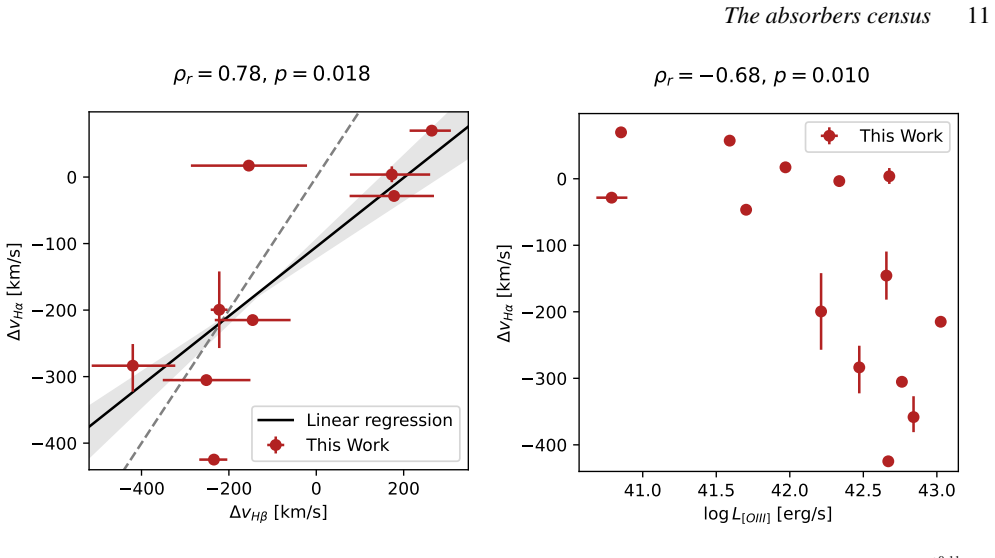
On the paper's own terms: Hα absorption is a common, completeness-corrected feature of little red dots (44%, 95% CI 38–65%) and rare in little blue dots (<25% at 2σ). The absorber velocities are mostly near rest or blueshifted up to about 400 km/s, skewed away from redshift, and the velocity offsets correlate with [OIII] luminosity, suggesting radiation from the nucleus drives the outflowing gas. Comparing absorber column densities, velocities, and luminosities across LRDs, FeLoBAL quasars, and luminous blue variable stars, the paper finds they follow a common L ∝ NH v² scaling expected for radiation-pressure-driven shells, concluding that LRDs are low-luminosity analogs of FeLoBAL outflows
What carries the argument
The analysis hinges on three tools: (1) a Gaussian optical-depth absorption model with parameters (τ₀, σ, Δv, C_f), compressed to the recoverable pair (equivalent width EW₀, velocity offset Δv) because R1000 cannot separate Doppler broadening from optical depth, while R2700 partially can; (2) 150,000 simulated R1000/R2700 spectra used to build a completeness function C(S/N, EW₀, Δv) and to test parameter recovery; (3) a spherical-shell force-balance toy model (Eq. 18) relating bolometric luminosity L to N_H v² R, from which a slope of ~1 in the L–N_H v² plane is interpreted as evidence for radiation-pressure driving.
Load-bearing premise
The radiative-driving conclusion rests on the assumption that LRD and FeLoBAL absorbing outflows sit at similar physical distances from their central engines, even though the cited radii differ by a factor of about 350 (≈2 pc vs ≈0.7 kpc).
What would settle it
Measure the physical size of an LRD Hα-absorbing region (e.g., via variability or interferometry). If LRD absorbers are indeed ~2 pc while FeLoBAL absorbers are ~0.7 kpc, then Eq. 18 predicts (N_H Δv²)_LRD/(N_H Δv²)_BAL ≈ (L_LRD/L_BAL) × (R_BAL/R_LRD) ≈ 0.039 × 350 ≈ 14, not the observed 0.04; a radius measurement that breaks this would invalidate the radiative-driving scaling.
If this is right
- If true, most LRDs (possibly all) contain dense hydrogen gas that absorbs Balmer lines, while LBDs rarely do, sharpening the distinction between these two classes of faint AGN.
- The blueshifted skew of absorber velocities argues against quasi-static pseudo-atmosphere (black-hole star) models and supports outflowing 'loitering' gas, as proposed for FeLoBAL quasars.
- LRD and FeLoBAL absorber energetics lie on the same L–N_H v² relation with slope consistent with 1, implying that radiation pressure drives both types of outflows.
- The Δv(Hα)–L[OIII] correlation suggests the absorbing outflows are energetically coupled to the narrow-line region, pointing to a common driving mechanism.
- Because R1000 data miss many rest-frame absorbers, previous incidence estimates are lower limits; higher-resolution R2700 and ground-based R~10,000 follow-up are needed to fully recover absorber properties.
Where Pith is reading between the lines
- If the cited radii for LRD (~2 pc) and FeLoBAL (~0.7 kpc) absorbers are both correct, the paper's assumption of similar physical scales is internally inconsistent; the numerical match of (N_H Δv²) ratios would then be coincidental unless radii scale with luminosity as R ∝ L^α with α≈0.26, which the paper's scatter analysis hints at.
- The conclusion that LBDs lack absorbers may be premature: the conservative <25% upper limit leaves room for a substantial hidden population, and if LBDs are edge-on LRDs, absorber detection could depend strongly on viewing angle.
- The LBV parallel suggests a universal radiation-pressure mechanism spanning scales from ~10 AU to kiloparsecs; if confirmed with resolved absorber sizes, N_H v² measurements could serve as a distance ruler for outflow radii.
- A testable extension: monitor LRD Hα absorbers for variability on timescales of months to years; the implied absorber radius from variability would directly test the scale assumption underlying the radiative-driving claim.
Editorial analysis
A structured set of objections, weighed in public.
Referee Report
Summary. The paper presents a census of Hα (and Hβ) Balmer absorption in 47 Type-1 AGN at 2<z<7 using archival JWST/NIRSpec MSA and IFU spectroscopy. After fitting broad Hα with several BLR models and identifying 13 robust absorbers (all LRDs), plus two literature absorbers, the authors perform extensive completeness simulations (150,000 spectra per grating) and derive completeness-corrected incidence rates: 44% (95% CI 38–65%) for LRDs and <25% at 2σ for LBDs. They show that R1000 data are strongly resolution limited and that only Δv and EW0 are reliably recovered, while σ, τ0, and Cf are degenerate. The paper further analyzes absorber demographics, finds a correlation between Δv_Hα and L_[OIII], compares LRDs with FeLoBAL quasars and LBV stars, and argues that the absorbers in LRDs and FeLoBALs are radiatively driven outflows. The title and abstract emphasize both the census and the outflow interpretation.
Significance. If the quantitative census survives scrutiny, this is a valuable contribution: it provides one of the first completeness-corrected Balmer-absorption incidence rates for LRDs, demonstrates a clear LRD/LBD dichotomy, and places LRDs on scaling planes with BAL quasars and stellar outflows. The paper's strengths include explicit Monte-Carlo completeness simulations, parameter-recovery tests, use of credible intervals rather than point estimates alone, and unusually candid discussion of resolution and degeneracy limitations. However, the central interpretive claim — that LRD and FeLoBAL absorption are both radiation-driven outflows on a common scaling relation — rests on an assumption about equal outflow radii that is internally contradicted by the cited radii in the same section. The completeness correction also carries a systematic prior dependence that is not folded into the reported credible intervals. The census results are likely robust in broad terms, but the abstract's 'establish' overstates the current evidence; the paper requires a major revision to fix the load-bearing scaling argument and to quantify prior sensitivity.
major comments (2)
- [§5.2, Eq. (18)] The 'almost exact correspondence' between (NH Δv²)_LRD/(NH Δv²)_BAL = 0.04 and ⟨L_LRD⟩/⟨L_BAL⟩ = 0.039 is obtained under the assumption that LRD and FeLoBAL outflows have similar physical scales. This assumption is directly contradicted by the numbers cited in the same paragraph: R~2 pc for LRDs and 0.7±0.5 kpc for FeLoBALs, i.e. a factor ~350 difference. Inserting those radii into Eq. (18) changes the predicted ratio of NHΔv² by a factor ~350, so the observed 0.04 is not a match to the luminosity ratio; it is an artifact of setting R_LRD=R_BAL. The radiative-driving conclusion in the abstract ('establish') therefore is not quantitatively supported by this comparison. The authors should either obtain or physically justify a common radius, treat R as a free parameter in the comparison, or explicitly reframe the LRD–FeLoBAL scaling as a tentative toy-model result consistent with, but not u
- [§3.3] The completeness correction uses simulated absorber parameters drawn from uniform distributions whose boundaries are set by the detected absorber sample ('albeit slightly extended'), and the 1D completeness functions are constructed by averaging over parameter regions populated by the detected sources. The Bayesian credible intervals from Eq. (9) therefore condition on this assumed intrinsic distribution and do not include the systematic uncertainty in that prior. Because the incidence rate — the central quantitative claim — depends on correcting for exactly the absorbers that are hardest to detect (weak EW0, |Δv| near zero, high narrow-line infill), the reported 44% and <25% rates should be accompanied by sensitivity tests. I request explicit alternative priors (e.g. power-law toward low EW0, a larger fraction of near-zero Δv, different narrow-to-broad Hα ratios) or a 2D completeness tr
minor comments (6)
- [§5.2] The sentence 'the results of Section 4.1 show that Δv² appears to likewise scale with L' seems to refer to the new scaling analysis in §5.2, not to the velocity-distribution discussion in §4.1. Please correct the cross-reference.
- [Eq. (12)] The first equality is dimensionally inconsistent: it has L outside and L_nu inside the integral, and the exponential should be e^{-tau_nu}. It should presumably be (L_nu/L)(1-e^{-tau_nu}) integrated over frequency, or an equivalent normalized form.
- [§3.3] The LBD sample is actually the non-LRD subset of the parent sample and includes one reddened quasar (JADES-GN-209777). The <25% upper limit is therefore strictly for non-LRDs, not for a pure LBD sample; please state this explicitly or exclude the quasar when quoting an LBD-specific rate.
- [Figure 6] The caption states that FeLoBAL velocities were scaled down by a factor of 10, but it does not describe how the completeness-corrected LRD velocity distribution was constructed or what error bars represent. Please add a sentence describing the correction and the error treatment.
- [Abstract/Conclusions] The abstract says the paper 'establish[es]' that LRD and BALQSO absorption is consistent with radiatively driven outflows, while the conclusions describe the comparisons as preliminary and limited by small samples and unconstrained R. Please align the abstract with the strength of the evidence.
- [Tables 1 and 2] The quoted asymmetric uncertainties are not defined. Please state in the table notes or text that they correspond to the 16th/84th percentiles of the posterior (or specify otherwise).
Circularity Check
No significant circularity: the completeness-corrected census is self-contained; the §5.2 equal-radius assumption is a non-circular modeling risk, not a reduction of a prediction to its inputs.
full rationale
The paper's central quantitative result—the completeness-corrected incidence rate of Hα absorbers—is not circularly derived. The completeness function C(S/N, EW0, Δv) is built by injecting simulated absorption profiles into R1000/R2700 spectra and rerunning the same ΔBIC detection criterion, rather than by fitting a parameter to the observed incidence. The simulation priors are informed by the detected absorbers' parameter ranges (Section 3.1), which could mildly anchor the correction to the detected population, but the paper explicitly extends the ranges to weaker features and cross-checks the result using two independent 1D completeness definitions (Section 3.3). No fitted quantity is renamed as a prediction. The absorber demographics and correlations are direct spectral measurements. The energetics argument in §5.2 is based on Eq. 18 derived from the Marconi et al. (2008) toy force-balance model, using external data (Leighly et al. 2025) and external calibrations (Stern & Laor 2012). The 'almost exact correspondence' between (NH Δv²)_LRD/(NH Δv²)_BAL = 0.04 and the luminosity ratio 0.039 does depend on the assumption R_LRD ≈ R_BAL, and the paper's own cited radii (2 pc vs 0.7±0.5 kpc) appear to conflict with that assumption. However, this is an unsupported and potentially inconsistent modeling assumption, not a case where the derived relation is equivalent to its inputs by construction; it is a correctness risk rather than a circularity. Self-citations (e.g., Juodžbalis et al. 2024a,b; 2026a) are used for fitting methodology and prior estimates, but they are not invoked as uniqueness theorems or as the sole basis for the main claim. Overall, the derivation chain is self-contained enough that no significant circularity is present; the mild self-referential choices in the completeness priors justify only a very low score.
Axiom & Free-Parameter Ledger
free parameters (4)
- Completeness simulation parameter ranges (Δv, σ, τ0, Cf) =
Δv ∈ [-800, 800] km/s; σ ∈ [50, 300] km/s; τ0 ∈ [0.8, 10]; Cf ∈ [0.1, 1.0]
- Narrow-to-broad Hα flux ratio in simulations =
0.5
- Selection thresholds =
S/N > 20; ΔBIC > 5 for absorbers; ΔBIC > 10 for BLR
- LRD classification cut =
β_UV < -0.2; β_opt > 0
axioms (5)
- domain assumption L_bol = 130 L_Halpha (Stern & Laor 2012) applies to LRDs
- ad hoc to paper Uniform distributions for intrinsic absorber parameters
- domain assumption Toy outflow model: shell of constant area, constant NH, constant τeff, no fragmentation, Γeff independent of R
- ad hoc to paper LRD and FeLoBAL outflows have similar physical scales
- standard math Flat ΛCDM cosmology (Ωm=0.315, H0=67.4)
read the original abstract
A notable achievement of the first generation of JWST surveys was the discovery of an abundance of faint high-redshift ($z > 4$) broad-line active galactic nuclei (AGN) in the $L_{\rm bol} < 10^{45}$~erg~s$^{-1}$ regime, previously only accessible at $z < 1$. The high prevalence of absorption features in their broad hydrogen lines is one of the peculiarities of a significant fraction of this new population. In this paper, we conduct a broad census of Balmer absorption in a sample of 47 Type-1 AGN spanning $2 < z < 7$. Accounting for incompleteness of JWST spectroscopic data, we estimate that $44_{-6}^{+21}$~\% of Little Red Dots (LRDs) have absorption in \Has while the incidence rate is $< 25$~\% (at 2$\sigma$) in Little Blue Dots (LBDs). Additionally, R1000 JWST/NIRSpec data is strongly resolution limited, implying an inability to disentangle Doppler broadening in the absorption from optical depth effects. This is alleviated with R2700 observations, although some degeneracies remain. We find a significant correlation between the velocity of the Balmer absorption and the [OIII]5007 narrow line luminosity, suggesting a common driving mechanism. We do not find any other significant correlations (and do not confirm previously claimed correlations) between Balmer absorption and other spectral properties of LRDs (except for the expected correlation between \Has and \Hbs absorption velocities). Comparing LRDs, quasars and stellar \Has absorbers, we establish that absorption in both LRDs and broad absorption line quasars is consistent with radiatively driven outflows, echoing the physics of variable stars yet occurring at vastly different scales.
Figures




Forward citations
Cited by 1 Pith paper
-
ATLAS. II. Extremely High Incidence of Balmer Line Absorption with Predominant Blueshifts in LRDs: Statistical Insights through Comparison with Type 1 AGNs
Balmer-line absorption occurs in ~35% (14/40) of JWST little-red-dot AGNs, roughly 850x the rate in SDSS type-1 AGNs, with mostly slow blueshifted absorber velocities.
Reference graph
Works this paper leans on
-
[1]
doi:10.1086/160817 , journal =
-
[2]
First light for the GRAVITY+ Adaptive Optics: Extreme adaptive optics for the Very Large Telescope Interferometer. , keywords =. doi:10.1051/0004-6361/202555666 , archivePrefix =. 2509.21431 , primaryClass =
-
[3]
Large separation fringe tracking for the Very Large Telescope Interferometer
First light for GRAVITY Wide. Large separation fringe tracking for the Very Large Telescope Interferometer. , keywords =. doi:10.1051/0004-6361/202243941 , archivePrefix =. 2206.00684 , primaryClass =
-
[4]
, year = 1943, month = jan, volume =
Nuclear Emission in Spiral Nebulae. , year = 1943, month = jan, volume =. doi:10.1086/144488 , adsurl =
doi:10.1086/144488 1943
-
[5]
Spectroscopic AGN survey at $z$ $\sim$ 2 with NTT/SOFI for GRAVITY+ observations
Spectroscopic AGN survey at z 2 with NTT/SOFI for GRAVITY+ observations. arXiv e-prints , keywords =. doi:10.48550/arXiv.2503.02942 , archivePrefix =. 2503.02942 , primaryClass =
work page internal anchor Pith review Pith/arXiv arXiv doi:10.48550/arxiv.2503.02942
-
[6]
GA-NIFS: an extremely nitrogen-loud and chemically stratified galaxy at z 5.55. , keywords =. doi:10.1093/mnras/stae2375 , archivePrefix =. 2404.04148 , primaryClass =
-
[7]
The Origin of Elements from Carbon to Uranium. , keywords =. doi:10.3847/1538-4357/abae65 , archivePrefix =. 2008.04660 , primaryClass =
Pith/arXiv arXiv 2008
-
[8]
Quasars as standard candles. III. Validation of a new sample for cosmological studies. , keywords =. doi:10.1051/0004-6361/202038899 , archivePrefix =. 2008.08586 , primaryClass =
Pith/arXiv arXiv 2008
-
[9]
A stellar dynamical mass measure of an inactive black hole in the distant universe. arXiv e-prints , keywords =. doi:10.48550/arXiv.2503.17478 , archivePrefix =. 2503.17478 , primaryClass =
-
[10]
Average Quasar Spectra in the Context of Eigenvector 1. , keywords =. doi:10.1086/339594 , archivePrefix =. astro-ph/0201362 , primaryClass =
-
[11]
Combining Direct Black Hole Mass Measurements and Spatially Resolved Stellar Kinematics to Calibrate the M _ BH _ Relation of Active Galaxies. , keywords =. doi:10.3847/1538-4357/ad9272 , archivePrefix =. 2411.02488 , primaryClass =
-
[12]
Recalibration of the Virial Factor and M _ BH - _ * Relation for Local Active Galaxies. , keywords =. doi:10.1088/0067-0049/203/1/6 , archivePrefix =. 1209.3773 , primaryClass =
-
[13]
The Black Hole Mass-Stellar Velocity Dispersion Relation of Narrow-line Seyfert 1 Galaxies. , keywords =. doi:10.1088/0004-637X/801/1/38 , archivePrefix =. 1412.7225 , primaryClass =
-
[14]
The Sloan Digital Sky Survey Reverberation Mapping Project: Estimating Masses of Black Holes in Quasars with Single-epoch Spectroscopy. , keywords =. doi:10.3847/1538-4357/abbc1c , archivePrefix =. 2007.02963 , primaryClass =
Pith/arXiv arXiv 2007
-
[15]
Systematic effects in measurement of black hole masses by emission-line reverberation of active galactic nuclei: Eddington ratio and inclination. , keywords =. doi:10.1051/0004-6361:20064878 , archivePrefix =. astro-ph/0603460 , primaryClass =
-
[16]
Stratified disc wind models for the AGN broad-line region: ultraviolet, optical, and X-ray properties. , keywords =. doi:10.1093/mnras/staa136 , archivePrefix =. 2001.03625 , primaryClass =
Pith/arXiv arXiv 2001
-
[17]
The evolution of the broad-line region among SDSS quasars. , keywords =. doi:10.1051/0004-6361:20054024 , archivePrefix =. astro-ph/0510385 , primaryClass =
-
[18]
Relativistic, Spherically Symmetric Star Clusters. I. Stability Theory for Radial Perturbations. , year = 1968, month = oct, volume =. doi:10.1086/149755 , adsurl =
-
[19]
, year = 1966, month = apr, volume =
The Evolution of a System of Gravitationally Interacting Point Masses. , year = 1966, month = apr, volume =
1966
-
[20]
Quasars and high-energy astronomy , year = 1969, month = jan, pages =
A Quasar Model Based on Relaxation Oscillations in Supermassive Stars. Quasars and high-energy astronomy , year = 1969, month = jan, pages =
1969
-
[21]
SF2A-2016: Proceedings of the Annual meeting of the French Society of Astronomy and Astrophysics , year = 2016, editor =
Multiwavelength Study of Fermi-LAT blazars Variability and Radiation Production Mechanisms. SF2A-2016: Proceedings of the Annual meeting of the French Society of Astronomy and Astrophysics , year = 2016, editor =
2016
-
[22]
Research in Astronomy and Astrophysics , keywords =
The current status of galaxy formation. Research in Astronomy and Astrophysics , keywords =. doi:10.1088/1674-4527/12/8/004 , archivePrefix =. 1207.3080 , primaryClass =
-
[23]
An 800-million-solar-mass black hole in a significantly neutral Universe at a redshift of 7.5. , keywords =. doi:10.1038/nature25180 , archivePrefix =. 1712.01860 , primaryClass =
-
[24]
A dynamical measure of the black hole mass in a quasar 11 billion years ago. , keywords =. doi:10.1038/s41586-024-07053-4 , archivePrefix =. 2401.14567 , primaryClass =
-
[25]
A small and vigorous black hole in the early Universe. , keywords =. doi:10.1038/s41586-024-07052-5 , archivePrefix =. 2305.12492 , primaryClass =
-
[26]
The diverse population of infant Black Holes at 4<z<11: merging, tiny, poor, but mighty
JADES. The diverse population of infant Black Holes at 4<z<11: merging, tiny, poor, but mighty. arXiv e-prints , keywords =. doi:10.48550/arXiv.2308.01230 , archivePrefix =. 2308.01230 , primaryClass =
-
[27]
Physics of Active Galactic Nuclei at all Scales , year = 2006, editor =
The Broad-Line Region in Active Galactic Nuclei. Physics of Active Galactic Nuclei at all Scales , year = 2006, editor =. doi:10.1007/3-540-34621-X_3 , adsurl =
-
[28]
American Astronomical Society Meeting Abstracts \#227 , year = 2016, series =
Relations Between Black Hole Mass and Total Galaxy Stellar Mass in the Local Universe. American Astronomical Society Meeting Abstracts \#227 , year = 2016, series =
2016
-
[29]
A dynamical measure of the black hole mass in a quasar 11 billion years ago. arXiv e-prints , keywords =. doi:10.48550/arXiv.2401.14567 , archivePrefix =. 2401.14567 , primaryClass =
-
[30]
The Near-Infrared Spectrograph (NIRSpec) on the James Webb Space Telescope. I. Overview of the instrument and its capabilities. , keywords =. doi:10.1051/0004-6361/202142663 , archivePrefix =. 2202.03305 , primaryClass =
-
[31]
Identification and properties of intense star-forming galaxies at redshifts z > 10. Nature Astronomy , keywords =. doi:10.1038/s41550-023-01921-1 , archivePrefix =. 2212.04480 , primaryClass =
-
[32]
JADES Imaging of GN-z11: Revealing the Morphology and Environment of a Luminous Galaxy 430 Myr after the Big Bang. , keywords =. doi:10.3847/1538-4357/acdbc6 , archivePrefix =. 2302.07234 , primaryClass =
-
[33]
A core in a star-forming disc as evidence of inside-out growth in the early Universe. Nature Astronomy , keywords =. doi:10.1038/s41550-024-02384-8 , archivePrefix =. 2306.02472 , primaryClass =
-
[34]
doi:10.5281/zenodo.7229890 , url =
Bushouse, Howard and Eisenhamer, Jonathan and Dencheva, Nadia and Davies, James and Greenfield, Perry and Morrison, Jane and Hodge, Phil and Simon, Bernie and Grumm, David and Droettboom, Michael and Slavich, Edward and Sosey, Megan and Pauly, Tyler and Miller, Todd and Jedrzejewski, Robert and Hack, Warren and Davis, David and Crawford, Steven and Law, D...
-
[35]
JADES NIRSpec Spectroscopy of GN-z11: Lyman- emission and possible enhanced nitrogen abundance in a z = 10.60 luminous galaxy. , keywords =. doi:10.1051/0004-6361/202346159 , archivePrefix =. 2302.07256 , primaryClass =
-
[36]
Stellar Population Inference with Prospector. , keywords =. doi:10.3847/1538-4365/abef67 , archivePrefix =. 2012.01426 , primaryClass =
Pith/arXiv arXiv 2012
-
[37]
On the variation of the initial mass function. , keywords =. doi:10.1046/j.1365-8711.2001.04022.x , archivePrefix =. astro-ph/0009005 , primaryClass =
arXiv 2001
-
[38]
The WISSH quasars project. XI. The mean spectral energy distribution and bolometric corrections of the most luminous quasars. , keywords =. doi:10.1051/0004-6361/202244296 , archivePrefix =. 2211.07677 , primaryClass =
-
[39]
Composite Quasar Spectra from the Sloan Digital Sky Survey. , keywords =. doi:10.1086/321167 , archivePrefix =. astro-ph/0105231 , primaryClass =
-
[40]
UNCOVERing the contribution of black holes to reionization in the JWST era. arXiv e-prints , keywords =. doi:10.48550/arXiv.2401.11242 , archivePrefix =. 2401.11242 , primaryClass =
-
[41]
Evidence for mature bulges and an inside-out quenching phase 3 billion years after the Big Bang. Science , keywords =. doi:10.1126/science.1261094 , archivePrefix =. 1504.04021 , primaryClass =
-
[42]
Overmassive Black Holes in Dwarf Galaxies Out to z 0.9 in the VIPERS Survey. , keywords =. doi:10.3847/2041-8213/acae25 , archivePrefix =. 2212.14057 , primaryClass =
Pith/arXiv arXiv 2041
-
[43]
arXiv e-prints , keywords =
Tip of the iceberg: overmassive black holes at 4<z<7 found by JWST are not inconsistent with the local M _ BH - M _ relation. arXiv e-prints , keywords =
-
[44]
Galactic Stellar and Substellar Initial Mass Function. , keywords =. doi:10.1086/376392 , archivePrefix =. astro-ph/0304382 , primaryClass =
-
[45]
The Propagation of Uncertainties in Stellar Population Synthesis Modeling. I. The Relevance of Uncertain Aspects of Stellar Evolution and the Initial Mass Function to the Derived Physical Properties of Galaxies. , keywords =. doi:10.1088/0004-637X/699/1/486 , archivePrefix =. 0809.4261 , primaryClass =
-
[46]
GA-NIFS: JWST discovers an offset AGN 740 million years after the big bang. , keywords =. doi:10.1093/mnras/stae943 , archivePrefix =. 2312.03589 , primaryClass =
-
[47]
Disc growth and quenching. , keywords =. doi:10.1093/mnrasl/slz163 , archivePrefix =. 1910.10446 , primaryClass =
Pith/arXiv arXiv 1910
-
[48]
Sustained super-Eddington accretion in high-redshift quasars
Sustained super-Eddington accretion in high-redshift quasars. arXiv e-prints , keywords =. doi:10.48550/arXiv.2312.08422 , archivePrefix =. 2312.08422 , primaryClass =
work page internal anchor Pith review Pith/arXiv arXiv doi:10.48550/arxiv.2312.08422
-
[49]
A unified accretion disc model for supermassive black holes in galaxy formation simulations: method and implementation. arXiv e-prints , keywords =. doi:10.48550/arXiv.2312.08428 , archivePrefix =. 2312.08428 , primaryClass =
work page internal anchor Pith review Pith/arXiv arXiv doi:10.48550/arxiv.2312.08428
-
[50]
First Detection of an Overmassive Black Hole Galaxy UHZ1: Evidence for Heavy Black Hole Seed Formation from Direct Collapse. , keywords =. doi:10.3847/2041-8213/ad0e76 , archivePrefix =. 2308.02654 , primaryClass =
arXiv 2041
-
[51]
TRINITY II: The luminosity-dependent bias of the supermassive black hole mass-galaxy mass relation for bright quasars at z = 6. , keywords =. doi:10.1093/mnrasl/slad060 , archivePrefix =. 2303.08150 , primaryClass =
-
[52]
Mesa Isochrones and Stellar Tracks (MIST). I. Solar-scaled Models. , keywords =. doi:10.3847/0004-637X/823/2/102 , archivePrefix =. 1604.08592 , primaryClass =
-
[53]
How to Measure Galaxy Star Formation Histories. II. Nonparametric Models. , keywords =. doi:10.3847/1538-4357/ab133c , archivePrefix =. 1811.03637 , primaryClass =
-
[54]
Nebular Continuum and Line Emission in Stellar Population Synthesis Models. , keywords =. doi:10.3847/1538-4357/aa6c66 , archivePrefix =. 1611.08305 , primaryClass =
-
[55]
Inferring the star formation histories of massive quiescent galaxies with BAGPIPES: evidence for multiple quenching mechanisms. , keywords =. doi:10.1093/mnras/sty2169 , archivePrefix =. 1712.04452 , primaryClass =
-
[56]
The Dust Content and Opacity of Actively Star-forming Galaxies. , keywords =. doi:10.1086/308692 , archivePrefix =. astro-ph/9911459 , primaryClass =
-
[57]
Massive and old quiescent galaxies at high redshift. , keywords =. doi:10.1051/0004-6361/201834547 , archivePrefix =. 1910.07544 , primaryClass =
Pith/arXiv arXiv 1910
-
[58]
Dwarf Galaxies with Optical Signatures of Active Massive Black Holes. , keywords =. doi:10.1088/0004-637X/775/2/116 , archivePrefix =. 1308.0328 , primaryClass =
-
[59]
A Quantitative Comparison of the Small Magellanic Cloud, Large Magellanic Cloud, and Milky Way Ultraviolet to Near-Infrared Extinction Curves. , keywords =. doi:10.1086/376774 , archivePrefix =. astro-ph/0305257 , primaryClass =
-
[60]
Little Red Dots: an abundant population of faint AGN at z 5 revealed by the EIGER and FRESCO JWST surveys. arXiv e-prints , keywords =. doi:10.48550/arXiv.2306.05448 , archivePrefix =. 2306.05448 , primaryClass =
-
[61]
GA-NIFS: A massive black hole in a low-metallicity AGN at z 5.55 revealed by JWST/NIRSpec IFS. , keywords =. doi:10.1051/0004-6361/202346137 , archivePrefix =. 2302.06647 , primaryClass =
-
[62]
JADES: The incidence rate and properties of galactic outflows in low-mass galaxies across 3 < z < 9. arXiv e-prints , keywords =. doi:10.48550/arXiv.2306.11801 , archivePrefix =. 2306.11801 , primaryClass =
-
[63]
The main sequence of star-forming galaxies across cosmic times. , keywords =. doi:10.1093/mnras/stac3214 , archivePrefix =. 2203.10487 , primaryClass =
-
[64]
Resolving ambiguities in the inferred star formation histories of intense [O III] emitters in the reionization Era. , keywords =. doi:10.1093/mnras/stad1597 , archivePrefix =. 2212.05072 , primaryClass =
-
[65]
Early Results from GLASS-JWST. X. Rest-frame UV-optical Properties of Galaxies at 7 < z < 9. , keywords =. doi:10.3847/2041-8213/ac959b , archivePrefix =. 2207.11135 , primaryClass =
Pith/arXiv arXiv 2041
-
[66]
A lensed protocluster candidate at z = 7.66 identified in JWST observations of the galaxy cluster SMACS0723 - 7327. , keywords =. doi:10.1051/0004-6361/202244719 , archivePrefix =. 2208.04930 , primaryClass =
-
[67]
The Physical Properties of Luminous z 8 Galaxies and Implications for the Cosmic Star Formation Rate Density from 0.35 deg ^ 2 of (Pure-)Parallel HST Observations. , keywords =. doi:10.3847/1538-4357/ac4803 , archivePrefix =. 2106.06544 , primaryClass =
-
[68]
The ALMA REBELS Survey: specific star formation rates in the reionization era. , keywords =. doi:10.1093/mnras/stac2291 , archivePrefix =. 2203.07392 , primaryClass =
-
[69]
Dust in active nuclei. I. Evidence for ``anomalous'' properties. , keywords =. doi:10.1051/0004-6361:20000177 , archivePrefix =. astro-ph/0010009 , primaryClass =
-
[70]
Are we surprised to find SMBHs with JWST at z 9?. , keywords =. doi:10.1093/mnras/stad2503 , archivePrefix =. 2305.12504 , primaryClass =
-
[71]
Undermassive Host Galaxies of Five z -0.5ex 6 Luminous Quasars Detected with JWST. arXiv e-prints , keywords =. doi:10.48550/arXiv.2310.18395 , archivePrefix =. 2310.18395 , primaryClass =
-
[72]
Detection of stellar light from quasar host galaxies at redshifts above 6. , keywords =. doi:10.1038/s41586-023-06345-5 , archivePrefix =. 2211.14329 , primaryClass =
-
[73]
TRINITY III: Quasar Luminosity Functions Decomposed by Halo, Galaxy, and Black Hole Masses and Eddington Ratios from z=0-10. arXiv e-prints , keywords =. doi:10.48550/arXiv.2305.19315 , archivePrefix =. 2305.19315 , primaryClass =
work page internal anchor Pith review Pith/arXiv arXiv doi:10.48550/arxiv.2305.19315
-
[74]
TRINITY IV: Predictions for Supermassive Black Holes at $z \gtrsim 7$
TRINITY IV: Predictions for Supermassive Black Holes at z rsim 7. arXiv e-prints , keywords =. doi:10.48550/arXiv.2309.07210 , archivePrefix =. 2309.07210 , primaryClass =
work page internal anchor Pith review Pith/arXiv arXiv doi:10.48550/arxiv.2309.07210
-
[75]
JWST Census for the Mass-Metallicity Star Formation Relations at z = 4-10 with Self-consistent Flux Calibration and Proper Metallicity Calibrators. , keywords =. doi:10.3847/1538-4365/acd556 , archivePrefix =. 2301.12825 , primaryClass =
-
[76]
A massive quiescent galaxy at redshift 4.658. , keywords =. doi:10.1038/s41586-023-06158-6 , archivePrefix =. 2301.11413 , primaryClass =
-
[77]
UNCOVER: A NIRSpec Identification of a Broad-line AGN at z = 8.50. , keywords =. doi:10.3847/2041-8213/ad037a , archivePrefix =. 2308.11610 , primaryClass =
Pith/arXiv arXiv 2041
-
[78]
Discovery of a quiescent galaxy at z=7.3. arXiv e-prints , keywords =. doi:10.48550/arXiv.2302.14155 , archivePrefix =. 2302.14155 , primaryClass =
-
[79]
A massive, quiescent galaxy at a redshift of 3.717. , keywords =. doi:10.1038/nature21680 , archivePrefix =. 1702.01751 , primaryClass =
-
[80]
Continuum and Emission-Line Properties of Broad Absorption Line Quasars. , keywords =. doi:10.1086/379293 , archivePrefix =. astro-ph/0308508 , primaryClass =
discussion (0)
Sign in with ORCID, Apple, or X to comment. Anyone can read and Pith papers without signing in.