REVIEW 2 major objections 5 minor 30 references
A physics-structured deep equilibrium model solves to its own start point and contributes zero accuracy on two reasoning tasks.
Reviewed by Pith at T0; open to challenge. T0 means a machine referee read the full paper against a public rubric. the ladder, T0–T4 →
T0 review · grok-4.5
2026-07-14 06:56 UTC pith:V5LEIGF2
load-bearing objection Clean, reproducible negative result: the DEQ is a no-op identity map on two tasks, the anchor story is falsified, and the substitution diagnostic is the real takeaway. the 2 major comments →
The Equilibrium Is the Initialization: Lazy Identity Collapse in Physics-Structured Deep Equilibrium Reasoning
The pith
A machine-rendered reading of the paper's core claim, the machinery that carries it, and where it could break.
Core claim
Across two reasoning tasks, multiple seeds, and controlled ablation arms, a port-Hamiltonian deep equilibrium model with learned initialization collapses to the identity: the solved equilibrium equals the solver’s start point, and bypassing the solver changes test accuracy by +0.00 percentage points in 18 of 19 runs. The single escape is divergence into decoder-adapted noise. The collapse is caused by gradient starvation along two distinct routes, not by the anchoring term, and the standard zeroing ablation confounds pathway with computation.
What carries the argument
The substitution test: feed the solver’s start point directly to the decoder, skipping the fixed-point solve. It isolates computation from pathway and returns a stable zero where the usual zeroing ablation produces seed-dependent swings as large as +44 pp.
Load-bearing premise
The two chosen tasks can already be solved by a shallow feed-forward read-out of the same frozen context, so the loss never has to reward genuine iteration.
What would settle it
Retrain the same architecture on a task whose direct context pathway is provably insufficient (for example, multi-hop reachability that cannot be read off the frozen embeddings) and check whether the substitution gap remains zero and whether iteration count begins to track ground-truth difficulty.
Editorial analysis
A structured set of objections, weighed in public.
Referee Report
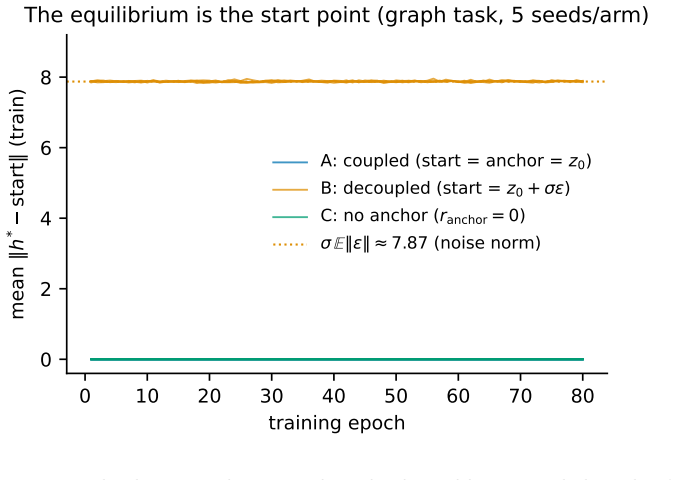
Summary. The paper reports a carefully controlled empirical study of a port-Hamiltonian deep equilibrium model (DEQ) with learned, goal-conditioned initialization on two binary reasoning tasks (ProofWriter entailment over frozen DeBERTa embeddings and BFS-labeled k-hop graph reachability). Across seeds, an anchor-strength sweep, and three intervention arms (coupled start=anchor, noise-decoupled retrain, and anchor removed), the solved equilibrium equals the solver start point to numerical precision (≈10⁻⁶–10⁻⁷), the substitution test that bypasses the solver entirely yields a +0.00 pp accuracy gap in 18 of 19 runs, iteration counts are uncorrelated with ground-truth BFS distance (r=0.009), and the full apparatus never outperforms a fresh two-layer MLP (or context-only) baseline. The authors falsify the natural “anchor causes collapse” story, identify two gradient-starvation routes, document a minority solver-blow-up regime that produces co-adapted noise, show that zeroing ablations are confounded while substitution is not, and distill a four-test diagnostic protocol (T1–T4). All results are regenerated from released raw logs on a free Colab GPU.
Significance. If the reported measurements hold—which the multi-seed tables, controlled retrain arms, substitution-versus-zeroing comparison, and positive MLP controls make highly plausible under the stated scope—this is a high-value negative result and methodological contribution for the DEQ / looped / recurrent-depth literature. The work explicitly tests and rejects the most tempting mechanistic explanation, distinguishes two degenerate regimes that pooled statistics would hide, and supplies a cheap, transferable audit (especially T1 substitution) that can be run in minutes. Full release of code, configs, seeds, raw logs, and analysis scripts that regenerate every table and figure is a genuine strength and raises the bar for similar cautionary studies. The result is scoped (tasks admit a direct pathway; one architecture family), yet the diagnostic protocol and the demonstration that “compute nothing” is a stable optimum under gradient starvation remain broadly useful.
major comments (2)
- Section 5.3 and Limitations: the two pipelines differ in backward-pass coverage of z0 (ProofWriter differentiates through the initializer; the graph pipeline’s custom VJP zeros those cotangents, leaving the initializer untrained). The paper correctly presents this as two routes to the same no-op, but the fully-differentiated “trained initializer + identity solve” configuration is therefore demonstrated on only one of the two tasks. A short additional experiment or clearer quantification of how much of the graph-task collapse is attributable to the untrained start would strengthen the claim that lazy identity collapse is the generic attractor rather than an artifact of gradient isolation.
- Section 9 and §§4.5/5.3: both tasks are solvable to high accuracy by a shallow feed-forward readout of the identical context (MLP baseline matches or beats the full apparatus). The paper acknowledges that tasks where the direct pathway cannot solve the problem “may exert the gradient pressure our setup lacks,” yet the cautionary force for the broader “implicit reasoning” literature rests on this point. Adding at least one controlled task on which the MLP baseline fails substantially (or an explicit negative-control experiment that removes the direct context channels) would make the gradient-starvation diagnosis more decisive rather than expected.
minor comments (5)
- Figure 1 caption and surrounding text: the y-axis label “mean h* start (train)” is slightly ambiguous; “mean ∥h*−start∥” would match the body text more cleanly.
- Table 2: the blow-up seed (seed 3) is correctly highlighted, but a one-sentence note in the caption that zeroing improves accuracy only in that regime would help readers who glance only at the table.
- Section 3.1, Eqs. (1)–(2): the spectral-norm clamp ≤0.95 is stated after the equations; moving the clamp description into the equation block or an immediately following sentence would reduce the chance a reader misses a load-bearing implementation detail.
- Abstract and §4.1: the phrase “+0 .00 percentage points” contains an extraneous space; cosmetic but repeated.
- Appendix A: the two-body energy-drift comparison is useful background; a single sentence in the main text pointing to it would help readers who skip the appendix understand why the port-Hamiltonian structure was chosen despite the eventual no-op result.
Circularity Check
No significant circularity: empirical measurements of no-op equilibria and substitution gaps against independent external baselines (BFS distance, fresh MLP, majority floors).
full rationale
The paper is a controlled empirical negative result, not a first-principles derivation. Its central claims (equilibrium equals start point to numerical precision; substitution gap of +0.00 pp in 18/19 runs; apparatus never beats a two-layer MLP; iteration-difficulty correlation r=0.009) are direct measurements on trained models, evaluated against independently defined quantities: BFS-verified distances, a freshly trained MLP baseline on identical frozen embeddings, majority-class floors, and the solver's own start point fed to the decoder. Controlled arms (anchor removal, noise-decoupled retrain, forced displacement) and the two gradient-starvation routes are likewise experimental interventions whose outcomes are reported, not assumed. Citations supply standard background methods (DEQs, Anderson acceleration, port-Hamiltonian structure) and do not load-bear uniqueness theorems or smuggle ansätze that force the no-op conclusion. No parameter is fitted to data and then re-presented as a prediction; no quantity is defined in terms of the result it purports to derive. The four-test diagnostic protocol is distilled post hoc from the observed failures and is falsifiable on other models. The Limitations section itself scopes the claim to the studied design family and tasks, confirming the result is self-contained rather than circular.
Axiom & Free-Parameter Ledger
free parameters (5)
- step size epsilon =
0.05
- anchor strength ra =
0.02 (default)
- spectral-norm clamp =
0.95
- Anderson memory m and iteration cap =
m=5, cap=300
- noise scale sigma in arm B =
2
axioms (4)
- domain assumption A deep equilibrium layer’s output is the fixed point of a learned map, differentiated via the implicit-function theorem / adjoint solve.
- domain assumption Anderson acceleration with the stated mixing and clipping finds a fixed point when one exists within the iteration budget.
- domain assumption The port-Hamiltonian structure–dissipation split with learned K, U and context-conditioned damping yields a well-defined continuous-time latent dynamics.
- ad hoc to paper BFS distance on the synthetic graphs is a valid ground-truth difficulty signal for iteration-count correlation.
invented entities (3)
-
lazy identity collapse regime
independent evidence
-
solver blow-up regime
independent evidence
-
four-test diagnostic protocol (T1–T4)
independent evidence
read the original abstract
Deep equilibrium models promise input-adaptive implicit computation: harder problems should demand more solver iterations, and the solved equilibrium should encode the result of genuine iterative inference. We report a cautionary study of a port-Hamiltonian DEQ with a learned initialization on two reasoning tasks -- ProofWriter entailment over frozen DeBERTa embeddings and a BFS-verified graph-reachability benchmark -- in which the implicit computation is a silent no-op. Across tasks, seeds, and controlled ablation arms, the solved equilibrium equals the solver's start point to numerical precision, and bypassing the solver entirely changes test accuracy by +0.00 percentage points in 18 of 19 training runs. Controlled interventions falsify the tempting explanation: removing the anchoring term reproduces every result, and retraining with noise-decoupled starts yields a solver that converges to the noisy start while the decoder learns to ignore it. The single escaping run diverges instead ($\|h^{*}-z_0\|=171$), producing a co-adapted noise channel whose removal improves accuracy. Iteration counts are uncorrelated with ground-truth difficulty ($r=0.009$), and the full apparatus never outperforms a two-layer MLP on either task. We trace the mechanism to gradient starvation along two distinct routes, show that the standard zeroing ablation is confounded and gives wildly seed-dependent answers where the correct substitution test gives a stable zero, and distill a four-test diagnostic protocol for auditing claimed implicit computation. All experiments run on a single free Colab GPU; code, raw logs, and analysis scripts are released.
Figures


Reference graph
Works this paper leans on
-
[1]
Zico Kolter, and Vladlen Koltun
Shaojie Bai, J. Zico Kolter, and Vladlen Koltun. Deep equilibrium models. InAdvances in Neural Information Processing Systems, 2019
2019
-
[2]
Uni- versal transformers
Mostafa Dehghani, Stephan Gouws, Oriol Vinyals, Jakob Uszkoreit, and Lukasz Kaiser. Uni- versal transformers. InInternational Conference on Learning Representations, 2019
2019
-
[3]
Jonas Geiping, Sean McLeish, Neel Jain, John Kirchenbauer, Siddharth Singh, Bhavya Kailkhura, Abhinav Bhatele, and Tom Goldstein. Scaling up test-time compute with latent reasoning: A recurrent depth approach.arXiv preprint arXiv:2502.05171, 2025
Pith/arXiv arXiv 2025
-
[4]
Adaptive computation time for recurrent neural networks.arXiv preprint arXiv:1603.08983, 2016
Alex Graves. Adaptive computation time for recurrent neural networks.arXiv preprint arXiv:1603.08983, 2016
Pith/arXiv arXiv 2016
-
[5]
Hamiltonian neural networks
Samuel Greydanus, Misko Dzamba, and Jason Yosinski. Hamiltonian neural networks. In Advances in Neural Information Processing Systems, 2019
2019
-
[6]
SympNets: Intrinsic structure-preserving symplectic networks for identifying Hamiltonian systems.Neural Networks, 132:166–179, 2020
Pengzhan Jin, Zhen Zhang, Aiqing Zhu, Yifa Tang, and George Em Karniadakis. SympNets: Intrinsic structure-preserving symplectic networks for identifying Hamiltonian systems.Neural Networks, 132:166–179, 2020
2020
-
[7]
Desai, Marios Mattheakis, David Sondak, Pavlos Protopapas, and Stephen J
Shaan A. Desai, Marios Mattheakis, David Sondak, Pavlos Protopapas, and Stephen J. Roberts. Port-Hamiltonian neural networks for learning explicit time-dependent dynamical systems. Physical Review E, 104(3):034312, 2021
2021
-
[8]
Zico Kolter
Shaojie Bai, Vladlen Koltun, and J. Zico Kolter. Multiscale deep equilibrium models. In Advances in Neural Information Processing Systems, 2020
2020
-
[9]
Implicit deep learning.SIAM Journal on Mathematics of Data Science, 3(3):930–958, 2021
Laurent El Ghaoui, Fangda Gu, Bertrand Travacca, Armin Askari, and Alicia Tsai. Implicit deep learning.SIAM Journal on Mathematics of Data Science, 3(3):930–958, 2021
2021
-
[10]
Zico Kolter
Ezra Winston and J. Zico Kolter. Monotone operator equilibrium networks. InAdvances in Neural Information Processing Systems, 2020. 11
2020
-
[11]
Anderson
Donald G. Anderson. Iterative procedures for nonlinear integral equations.Journal of the ACM, 12(4):547–560, 1965
1965
-
[12]
Zico Kolter
Shaojie Bai, Vladlen Koltun, and J. Zico Kolter. Stabilizing equilibrium models by Jacobian regularization. InInternational Conference on Machine Learning, 2021
2021
-
[13]
JFB: Jacobian-free backpropagation for implicit networks
Samy Wu Fung, Howard Heaton, Qiuwei Li, Daniel McKenzie, Stanley Osher, and Wotao Yin. JFB: Jacobian-free backpropagation for implicit networks. InProceedings of the AAAI Conference on Artificial Intelligence, 2022. arXiv:2103.12803
Pith/arXiv arXiv 2022
-
[14]
Zico Kolter, and Roger B
Cem Anil, Ashwini Pokle, Kaiqu Liang, Johannes Treutlein, Yuhuai Wu, Shaojie Bai, J. Zico Kolter, and Roger B. Grosse. Path independent equilibrium models can better exploit test-time computation. InAdvances in Neural Information Processing Systems, 2022
2022
-
[15]
Lagrangian neural networks.arXiv preprint arXiv:2003.04630, 2020
Miles Cranmer, Sam Greydanus, Stephan Hoyer, Peter Battaglia, David Spergel, and Shirley Ho. Lagrangian neural networks.arXiv preprint arXiv:2003.04630, 2020
Pith/arXiv arXiv 2003
-
[16]
Ricky T. Q. Chen, Yulia Rubanova, Jesse Bettencourt, and David Duvenaud. Neural or- dinary differential equations. InAdvances in Neural Information Processing Systems, 2018. arXiv:1806.07366
Pith/arXiv arXiv 2018
-
[17]
PonderNet: Learning to ponder.arXiv preprint arXiv:2107.05407, 2021
Andrea Banino, Jan Balaguer, and Charles Blundell. PonderNet: Learning to ponder.arXiv preprint arXiv:2107.05407, 2021
Pith/arXiv arXiv 2021
-
[18]
Can you learn an algorithm? Generalizing from easy to hard problems with recurrent networks
Avi Schwarzschild, Eitan Borgnia, Arjun Gupta, Furong Huang, Uzi Vishkin, Micah Goldblum, and Tom Goldstein. Can you learn an algorithm? Generalizing from easy to hard problems with recurrent networks. InAdvances in Neural Information Processing Systems, 2021
2021
-
[19]
End-to-end algorithm synthesis with recurrent networks: Extrapolation without overthinking
Arpit Bansal, Avi Schwarzschild, Eitan Borgnia, Zeyad Emam, Furong Huang, Micah Goldblum, and Tom Goldstein. End-to-end algorithm synthesis with recurrent networks: Extrapolation without overthinking. InAdvances in Neural Information Processing Systems, 2022
2022
-
[20]
Nowak, and Dimitris Papailiopoulos
Liu Yang, Kangwook Lee, Robert D. Nowak, and Dimitris Papailiopoulos. Looped trans- formers are better at learning learning algorithms. InInternational Conference on Learning Representations, 2024
2024
-
[21]
Hierarchical reasoning model.arXiv preprint arXiv:2506.21734, 2025
Guan Wang, Jin Li, Yuhao Sun, Xing Chen, Changling Liu, Yue Wu, Meng Lu, Sen Song, and Yasin Abbasi Yadkori. Hierarchical reasoning model.arXiv preprint arXiv:2506.21734, 2025
Pith/arXiv arXiv 2025
-
[22]
Less is more: Recursive reasoning with tiny networks.arXiv preprint arXiv:2510.04871, 2025
Alexia Jolicoeur-Martineau. Less is more: Recursive reasoning with tiny networks.arXiv preprint arXiv:2510.04871, 2025
Pith/arXiv arXiv 2025
-
[23]
The CLRS algorithmic reasoning benchmark
Petar Veliˇ ckovi´ c, Adri` a Puigdom` enech Badia, David Budden, Razvan Pascanu, Andrea Banino, Misha Dashevskiy, Raia Hadsell, and Charles Blundell. The CLRS algorithmic reasoning benchmark. InInternational Conference on Machine Learning, 2022
2022
-
[24]
Guillaume Alain and Yoshua Bengio. Understanding intermediate layers using linear classifier probes.arXiv preprint arXiv:1610.01644, 2016. v1 October 2016
Pith/arXiv arXiv 2016
-
[25]
Designing and interpreting probes with control tasks
John Hewitt and Percy Liang. Designing and interpreting probes with control tasks. In Proceedings of EMNLP-IJCNLP, 2019. 12
2019
-
[26]
Gradient starvation: A learning proclivity in neural networks
Mohammad Pezeshki, S´ ekou-Oumar Kaba, Yoshua Bengio, Aaron Courville, Doina Precup, and Guillaume Lajoie. Gradient starvation: A learning proclivity in neural networks. InAdvances in Neural Information Processing Systems, 2021
2021
-
[27]
Robert Geirhos, J¨ orn-Henrik Jacobsen, Claudio Michaelis, Richard Zemel, Wieland Brendel, Matthias Bethge, and Felix A. Wichmann. Shortcut learning in deep neural networks.Nature Machine Intelligence, 2(11):665–673, 2020. arXiv:2004.07780
Pith/arXiv arXiv 2020
-
[28]
ProofWriter: Generating implications, proofs, and abductive statements over natural language
Oyvind Tafjord, Bhavana Dalvi Mishra, and Peter Clark. ProofWriter: Generating implications, proofs, and abductive statements over natural language. InFindings of the Association for Computational Linguistics: ACL-IJCNLP, 2021
2021
-
[29]
DeBERTaV3: Improving DeBERTa using ELECTRA-style pre-training with gradient-disentangled embedding sharing
Pengcheng He, Jianfeng Gao, and Weizhu Chen. DeBERTaV3: Improving DeBERTa using ELECTRA-style pre-training with gradient-disentangled embedding sharing. InInternational Conference on Learning Representations, 2023. A Why Physics Structure Seemed Worth Trying The port-Hamiltonian parameterization was not chosen arbitrarily. In a standalone rollout experime...
2023
-
[30]
— roughly twenty orders of magnitude of improvement in energy control. This is the standard, genuine benefit of the inductive bias, and it is precisely why the main text’s finding is worth reporting: stability of the dynamics and usefulness of the equilibrium are different properties, and the first does not purchase the second. B Training Curves and Insta...
discussion (0)
Sign in with ORCID, Apple, or X to comment. Anyone can read and Pith papers without signing in.